

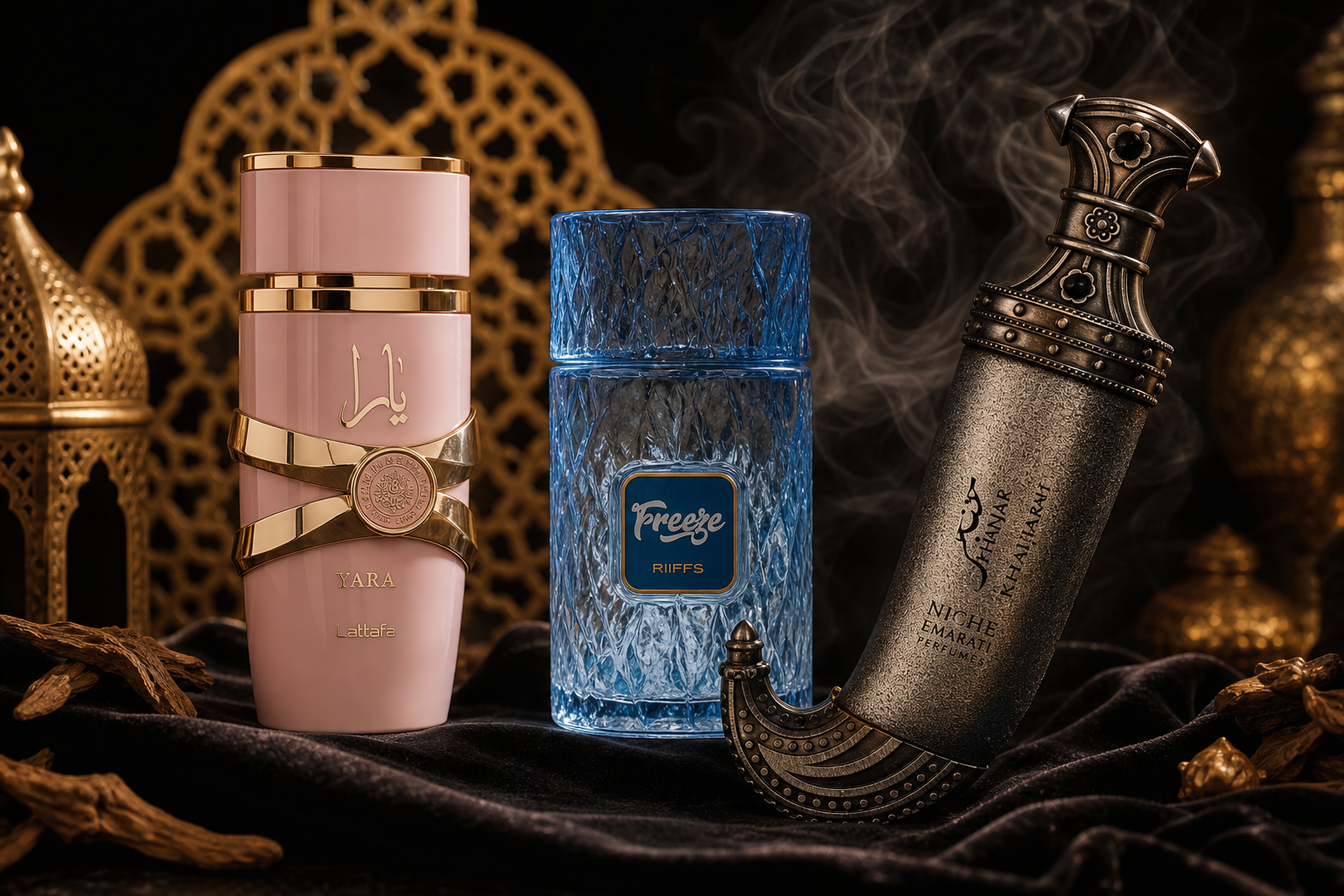
This year, Arabian perfumery has significantly strengthened its presence with us – from established names like Lattafa and Afnan to the rapidly growing Riiffs, Nusuk, and niche brand Niche Emarati. We highlight what sets each brand apart and how to choose your first Arabian perfume based on them.
Why Arabian Perfumery Has Captured the Attention of Czech Customers This Year
Until recently, Arabian perfumes were more of a curious detour for most Czech customers – something to bring back from a holiday or order on a whim. This year, the situation has significantly changed. Arabian perfumery has moved from the fringes to become a common choice, and in Brasty's perfume portfolio, it is now among the best-selling and fastest-growing brands. Whether you're looking for a sweet gourmand scent for the evening or a more subtle woody perfume to accompany you through the workday, Arabian brands cover both options.
What's Behind This Interest
The first reason is the raw material base itself. Arabian perfumery traditionally relies on materials that have long played a secondary role in the European mainstream: oud, amber, resins, spices, sandalwood, and a rich vanilla base. The result is compositions with a distinct character right from the first spray – these are not scents that get lost among others.
The second reason is concentration. A large portion of new Arabian releases come out directly as Eau de Parfum or Parfum, in higher concentrations than what we're used to with regular Eau de Toilette. This affects both the longevity and how long the scent lingers around you. If you've ever wondered why your perfume seems to disappear by lunchtime, this is a difference you'll notice immediately.
The third factor is the balance between craftsmanship and price range. Arabian brands remain in more affordable ranges without compromising on intensity – and this is precisely what has opened the door to customers who want to try more than one bottle a year. You can build a collection gradually and without much risk of making a wrong choice.
Two Styles to Choose From
Arabian perfumes are most often sought after in two distinctly different styles:
- Sweet Gourmand Line – vanilla, Tonka bean, caramelized spices, dried fruits, and a musky base. Perfect for evenings, cooler months, and occasions where you can let the scent take center stage. This is the style that kickstarted Arabian perfumery's popularity here.
- Woody and Spicy Line – oud, sandalwood, cedar, cardamom, vetiver, and dry amber. More restrained and noticeably cleaner in its dry-down, making it suitable for the office or a regular day in the city.
Between these two poles lie rose, fruity, and leather compositions that can be worn year-round. Most new Arabian releases are unisex, so you don't have to be guided by the category the bottle falls into – it's more about how the scent suits your skin and the occasion you're wearing it for.
Five Brands That Raised the Bar This Year
The brands that have made the most visible impact in the Arabian segment this year can be divided into three groups. Lattafa and Afnan are established names that have brought Arabian perfumery to the average Czech customer and still hold the strongest sales positions. Riiffs and Nusuk, on the other hand, are newcomers whose sales have grown the fastest among all Arabian brands over the past year – these are young portfolios where fresh new releases drive a significant portion of sales. And Niche Emarati shows where Arabian perfumery is heading when it turns to a more discerning audience seeking a niche character.
In the following text, we'll take a closer look at each of these five brands – how they differ olfactorily, who they suit, and where it makes sense to start if you're trying an Arabian perfume for the first time.
Lattafa and Afnan: Brands That Popularized Arabian Perfumes
When Arabian perfumery is discussed today, two names usually come up first. Lattafa and Afnan may not be the oldest or most exclusive houses in the Middle East, but they are the ones that brought oriental perfumes to a wider audience. Both brands have a distinct olfactory signature, both focus on a strong scent trail and long-lasting performance, and both have consistently been among the bestsellers in our entire category. If you're just discovering Arabian perfumery, starting with one of them makes sense.
Lattafa: Sweetly Oriental Signature
Lattafa's signature is recognizable by its soft, sweet base. Vanilla, amber, and musk form the core of most of its compositions; spices, dried fruits, or white flowers are then added to differentiate the individual perfumes. The transition between top and base notes is usually smooth, so the scent doesn't feel abrupt – from the first spray to the dry-down, it remains recognizable. If you're new to oriental perfumery, this is an advantage: you know what to expect from the scent right from the start.
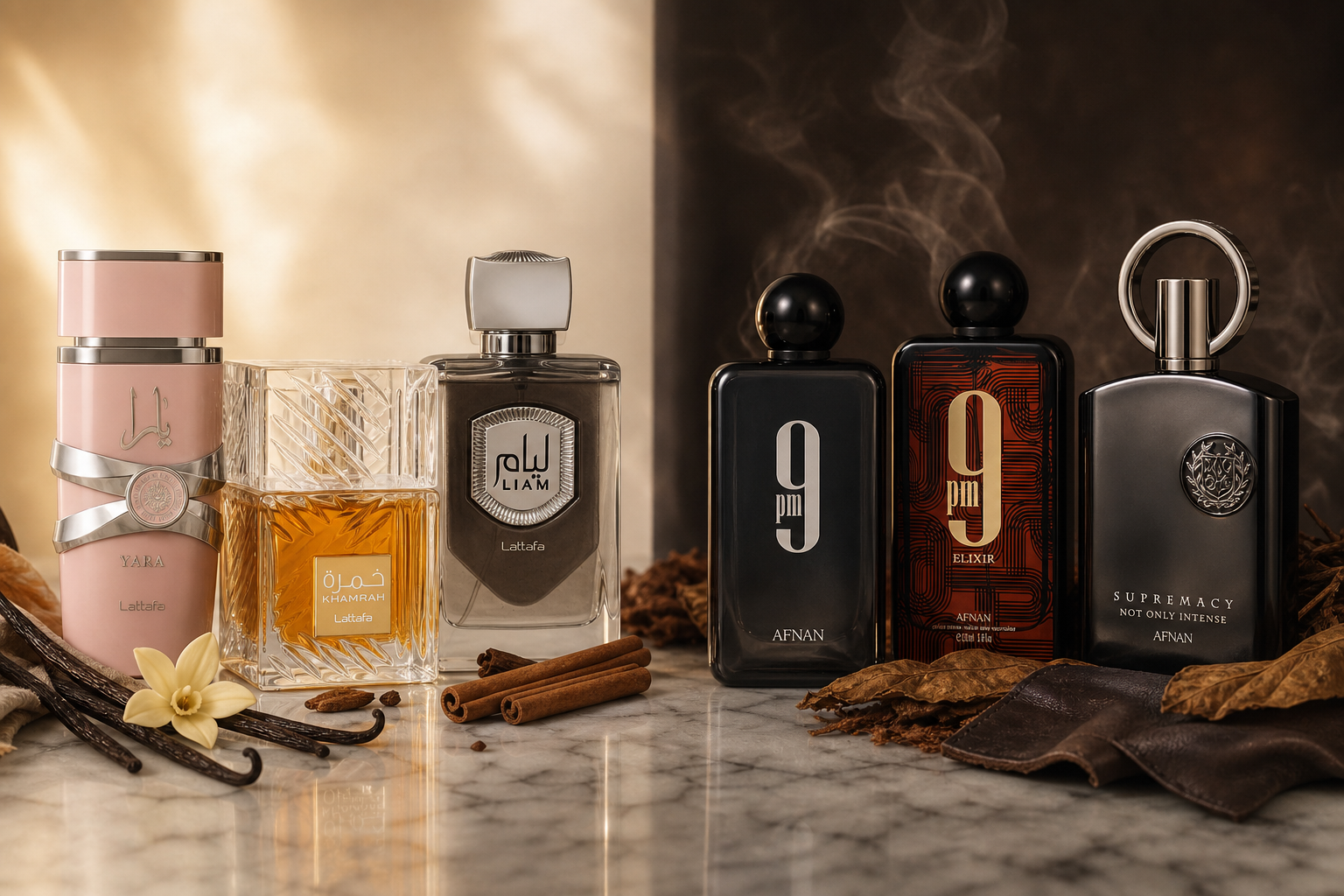
The flagship fragrance of the brand is Lattafa Yara, an Eau de Parfum for women. It opens with a juicy citrus note, has a creamy floral accord at its heart, and a base of vanilla with sandalwood and musk. It's sweet but not overly heavy – which is why it has become one of the most frequently ordered perfumes in our range. It also comes in other versions, such as Yara Candy, which takes the entire composition even further into a gourmand direction.
If you're looking for something more pronounced, there's Lattafa Khamrah – a unisex Eau de Parfum where cinnamon, dates, and tonka bean meet vanilla and amber. It's a wintery, spicy scent with a gourmand undertone that lasts long on the skin and can be dominant in larger doses; usually, one or two sprays are enough. On the other hand, Lattafa Liam is a more casual unisex choice for everyday wear and has been one of the brand's fastest-growing items in recent months.
Afnan: Darker, Smokier Tone
Afnan takes a different approach. Where Lattafa is sweet and rounded, Afnan works with darker materials – spices, smoky woods, tobacco, and leather accords. The result feels more formal and evening-appropriate; many of its perfumes are better suited for cooler months and occasions where the scent needs to be noticed. The brand is also a step higher in price range than Lattafa, which is reflected in the richness of the compositions.
The most famous fragrance of the brand is Afnan 9 pm, an Eau de Parfum for men. It combines an apple-lavender top with a base of tonka bean, vanilla, and amber – it's a sweet yet distinctly masculine composition with good longevity, and it's one of our long-term best-selling men's fragrances in this category. If 9 pm seems too common, opt for the 9 pm Elixir variant: it's a more concentrated unisex perfume, denser and slightly spicier. From the men's line, Afnan Supremacy Not Only Intense is also worth noting, which goes in the same direction, just more emphatically.
The difference between the two brands can be summarized simply:
- Lattafa – sweet vanilla-amber line, more for daytime and universal wear.
- Afnan – spices, wood, and smoke in a darker rendition, more for evening and cooler months.
Whichever you start with, both offer a safe entry into the category. Both have a wide range, the compositions are understandable, and the longevity is above average compared to regular Eau de Toilettes – exactly what most people expect from Arabian perfumery. When you're ready to explore further, Arabian perfumery also offers younger and less widespread names.
Riiffs and Nusuk: Fastest Growing Newcomers
Some brands take years to establish their position, while others appear in the rankings within a single season. Riiffs and Nusuk belong to the latter group – both offer a relatively small portfolio, yet both have seen a significant increase in sales over the past year. If you're curious about what customers who are just discovering Arabian perfumery are buying today, it often starts with these two names.
Riiffs: Icy Freshness Rising to the Top
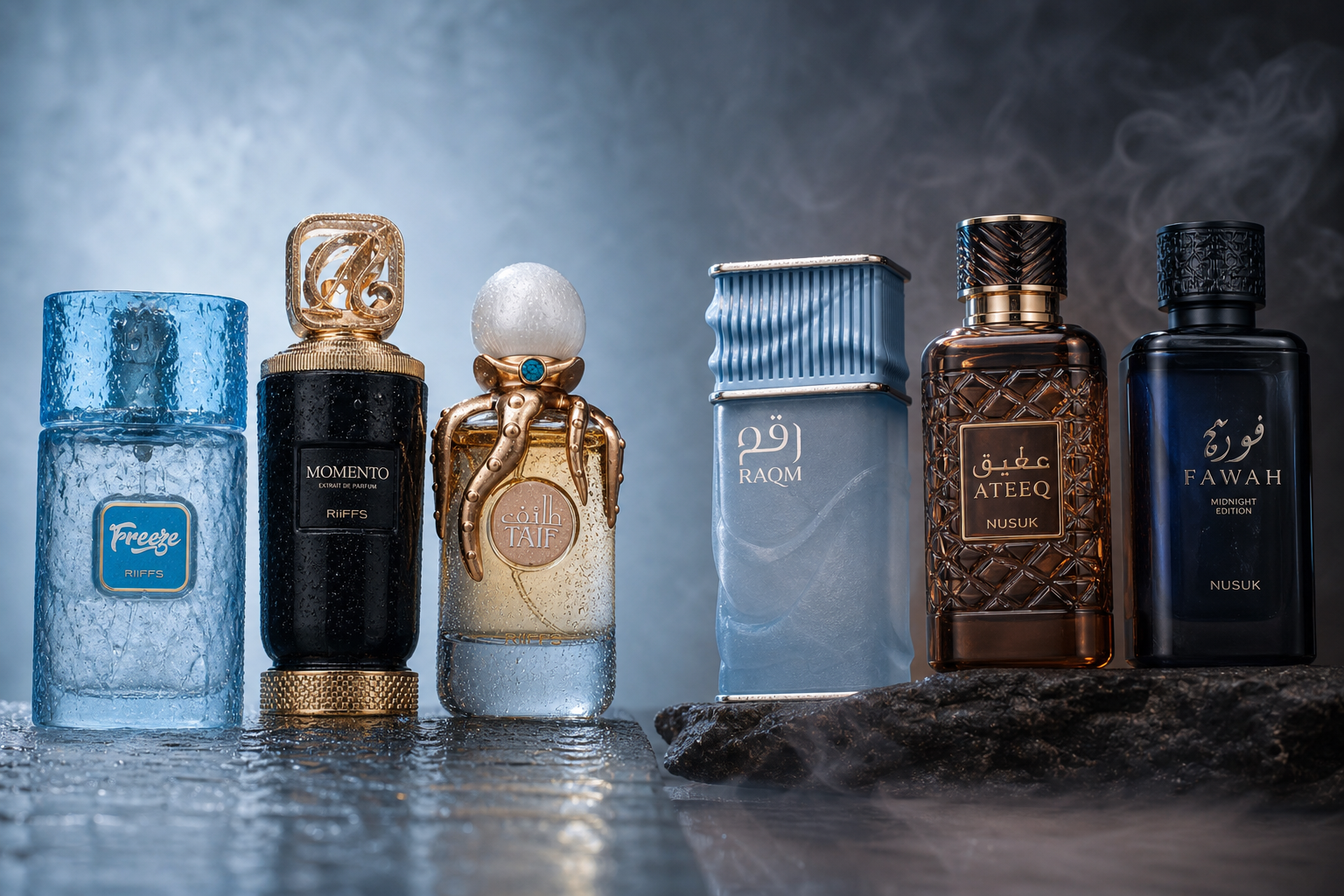
Riiffs Freeze has become the best-selling perfume in the entire fragrance portfolio, measured by revenue over the past month – which is remarkable for a brand that has only recently appeared on the market. The explanation is quite straightforward. Freeze targets an icy fresh, menthol-cool profile that Arabian fragrances have long offered only marginally; most of the portfolio stuck to sweet, amber, and woody compositions. At the same time, it is a unisex fragrance in perfume concentration, so it lasts longer than a regular eau de toilette, while still being in the mid-price range.
Freeze is not the only reason the brand is growing. Riiffs relies on a fast pace of new releases – about two-thirds of its sales today are generated by products that weren't in the catalog last year. If the icy line suits you, these titles are also worth your attention:
- Riiffs Momento – currently one of the brand's fastest-growing items, a slightly softer and more wearable option than Freeze, suitable for everyday use.
- Riiffs Taif – a nod to the Saudi Arabian city famous for rose cultivation, one of the classic ingredients of oriental perfumery.
- Riiffs Zenith – a more intense, closed composition for those who want more from a fragrance than just freshness.
- Riiffs Freeze in Flames and Riiffs Virtessa – two newer variants that are driving the brand's growth today.
Nusuk: Smaller Portfolio, Distinctive Evening Signature
Nusuk takes a different approach. While Riiffs bets on breadth and rapid additions, Nusuk intentionally keeps its offering narrow – you'll find only a few dozen in the catalog. This makes its direction clearer: denser, darker, and more festive fragrances that do not aim to be universal.
The flagship of the brand is Nusuk Ateeq, a unisex fragrance in perfume concentration that has brought the brand into the spotlight. It's a good entry point if you want to try a more pronounced Arabian style but don't want to dive straight into the heaviest compositions – it handles both afternoon and evening wear and stays on the skin for a long time.
If you're looking for a purely evening option, there are two alternatives. Nusuk Raqm is one of the new releases that have contributed most to the brand's growth this year, aiming for a richer, more enveloping mood. Nusuk Fawah Midnight Edition, as the name suggests, targets night wear and has been one of the fastest-growing men's eau de parfums in the offering this past season. It is complemented by Nusuk Gladius, another fresh addition.
What both brands share is a modern approach to Arabian perfumery. They do not try to mimic European bestsellers or copy traditional attar compositions. They work with bold, clearly defined ideas – whether it's the icy contrast of Riiffs or the concentrated evening density of Nusuk – and offer them in perfume concentration at more accessible conditions than you're used to with similarly intense fragrances. Their rapid rise is no accident.
Niche Emarati and the Olfactory Signature of Arabian Scents
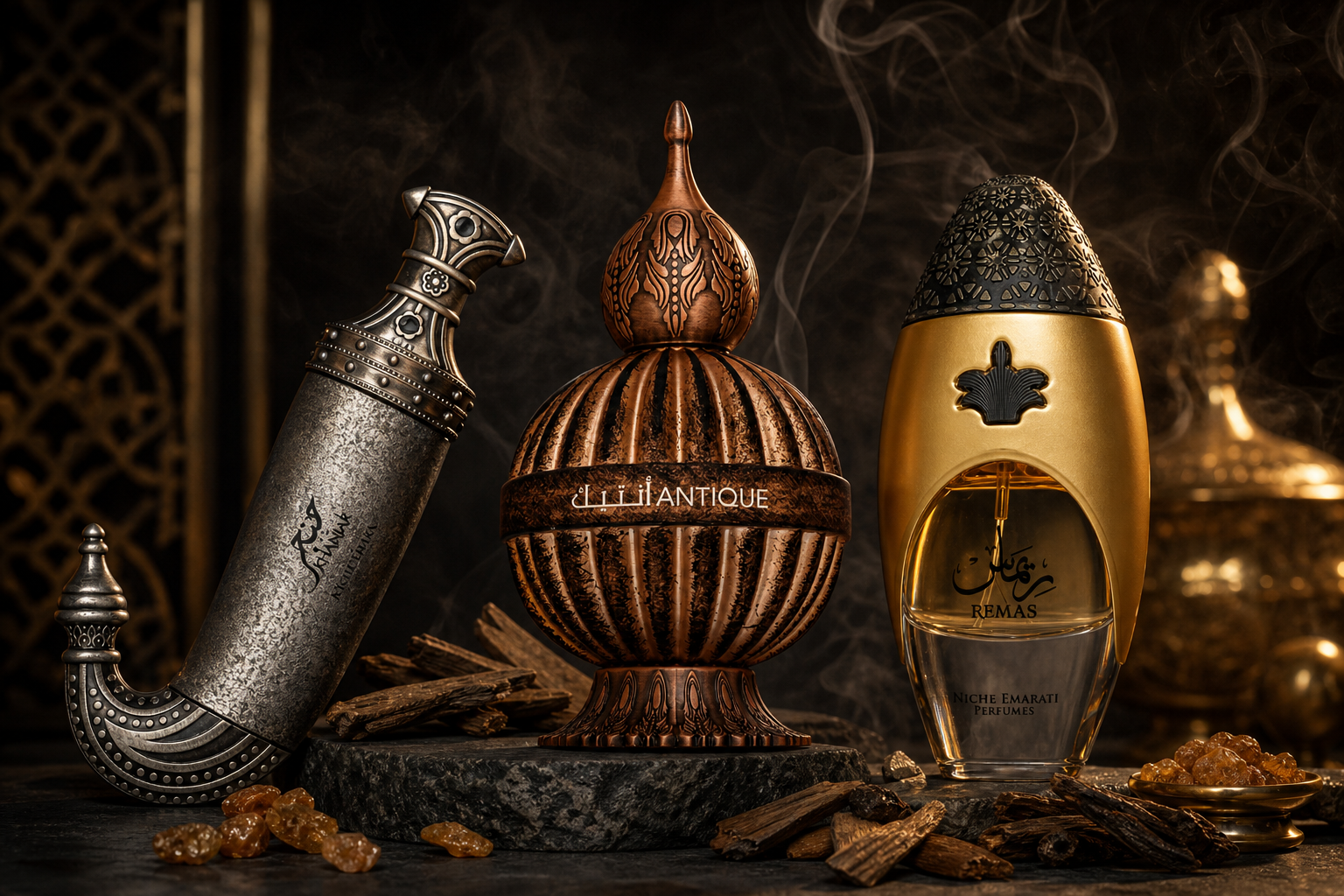
The latest brand to make a significant impact this year is taking a slightly different direction than the others. Niche Emarati doesn't rely on a vast catalog or rapid turnover of new releases – it works with a smaller number of compositions, bringing the Arabian style closer to niche perfumery. The result is a more distinct authorial signature: a denser structure, slower development on the skin, and a trail that evolves throughout the day.
For you, this means one practical thing. It's not a choice for subtle everyday wear in the office, but rather for moments when you want the perfume to be noticeable. If you've only tried mainstream Arabian fragrances so far, transitioning to a denser composition might be surprising – it's worth testing it first on a paper strip and then on your skin.
Khanjar as the Gateway
The most prominent representative of the brand is the Niche Emarati Khanjar Eau de Parfum in a unisex 85 ml version. It belongs to the spicy woody compositions: the opening is warmer and more pronounced than light citrus scents, the heart is held by spices, and the base rests on woods and sweeter resinous tones. That's why Khanjar doesn't fare well in the hot midday sun but works well in the evening, autumn, and winter.
A longer trail is more the rule than the exception for this type of composition. Arabian perfumery traditionally works with a higher concentration of fragrance oils, so even one or two sprays usually last longer than a comparable European eau de toilette. When trying the scent for the first time, start with a smaller amount – you can always add more, but you can't take it away.
Notes That Span Across Arabian Brands
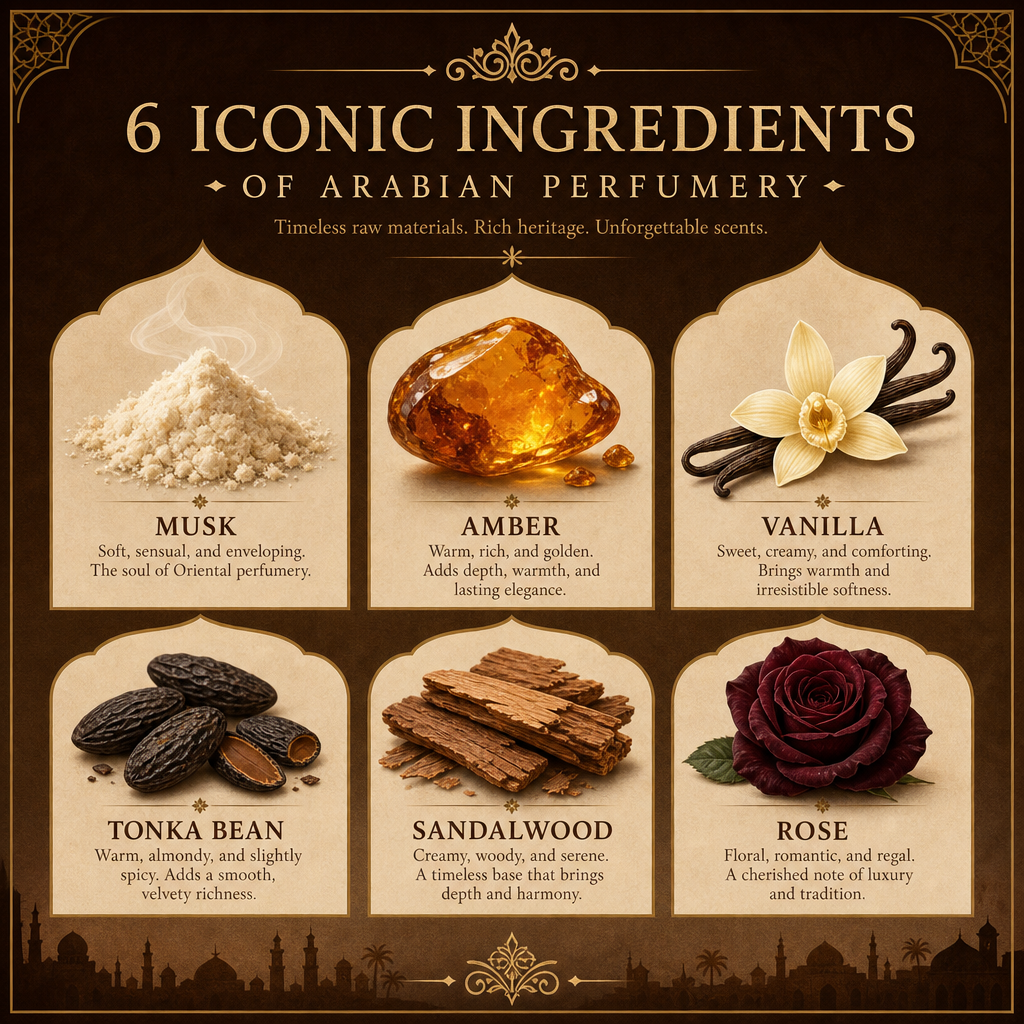
Once you line up the compositions of Arabian brands side by side, a surprisingly narrow group of ingredients begins to repeat. This forms the shared olfactory signature of the entire segment:
- Musk – a soft, warm base that holds the scent on the skin and gives it a clean impression even after several hours.
- Amber – sweet, resinous depth; the typical reason why Arabian compositions feel denser than European mainstream.
- Vanilla – a gourmand element that softens the spices and makes the scent more accessible to a broader audience.
- Tonka Bean – an almond-tobacco undertone on the border of sweetness and bitterness; often responsible for what is called a dessert impression.
- Sandalwood – a creamy woody base that grounds and extends the composition.
- Rose – in the Arabian sense, darker and juicier rather than spring-like; often paired with oud, spices, or amber.
The combination of these notes explains why Arabian perfumes resonate so much in the cooler part of the year and why many people find them more quickly than light floral scents. It also shows the boundary of the entire segment: if sweet, amber, and woody compositions don't suit you, changing the brand won't help – the signature remains similar.
Mainstream or Niche Approach?
The difference between an accessible Arabian scent and a niche approach is not that one is of higher quality. They differ in intent. Accessible Arabian perfumes aim for immediate effect, understandable composition, and low entry barrier – you try them without much deliberation. The niche approach, on the other hand, assumes you'll get to know the scent gradually: it's less straightforward, harder to describe in one sentence, and works best when worn repeatedly.
In practice, both positions do not compete but complement each other. More accessible Arabian scents serve well as a reliable choice for every day, while compositions like Khanjar are often for specific occasions. When you place both side by side, you'll feel the difference in density and development within the first ten minutes.
How to Choose Your First Arabic Perfume
The selection of Arabic perfumes can seem overwhelming at first glance – dozens of names, similarly decorated bottles, and descriptions filled with superlatives. However, you only need to ask yourself one question: what scents do you already enjoy wearing? Based on your answer, you can narrow down your choices to one or two compositions, making your first purchase less of a gamble.
Consider the following guide as a helpful roadmap. It is based on which Arabic perfumes customers most frequently discover and how strong a scent you will feel comfortable wearing.
- You like sweet, gourmand scents. Start with Lattafa Yara Eau de Parfum. It belongs to the softer, creamy-sweet compositions that are more suited for everyday wear rather than formal evenings. If you want the same sweetness in a darker, spicier version with a woody base, Lattafa Khamrah is the logical next step.
- You are drawn to smoky intensity. Afnan 9 pm Eau de Parfum is one of the most frequently mentioned men's Arabic perfumes and is suitable when you expect a rich sweet-spicy trail from your perfume for cooler months and evenings. Keep in mind that one or two sprays are more than enough.
- You prefer freshness and a modern twist. Riiffs Freeze Perfume shows that Arabic perfumery doesn't have to be heavy and sweet. It works with a cooler, cleaner profile that is suitable for the office and warmer days, making it ideal for those who have previously worn more European fresh scents.
- You want classic oriental. Nusuk Ateeq Perfume is an entry point into a more traditional oriental style with resins, amber, and wood. It is unisex, so you can share it with your partner and see who it suits better.
- You already have a niche taste. Niche Emarati Khanjar Eau de Parfum is aimed at those who have moved past the best-selling mainstream scents and are looking for a less common, more characterful olfactory signature.
Before You Order Your First Bottle
Three practical tips to save you from unnecessary disappointment:
- Pay attention to concentration. Eau de Parfum and perfume are not the same. Perfume is usually thicker and lasts longer on the skin, so it is applied more sparingly than Eau de Parfum, which you might be used to.
- Test on skin, not on paper. Arabic compositions develop more slowly, and you often recognize their true character only after wearing them for several hours.
- Don't buy three bottles at once. The price level of this category is more accessible compared to established European brands, which might tempt you to accumulate. Testing two or three brands gradually will give you more than a shelf full of unopened boxes.
Availability is the main reason why it's worth approaching Arabic perfumes as an opportunity for experimentation. You can afford to try a scent that you would only cautiously sniff on a tester at more expensive houses, gradually clarifying whether you enjoy the sweet gourmand line, smoky oriental, or fresh modern twist more. You can find the complete range in the Arabic perfumes category, where you can filter by women's, men's, and unisex options and calmly compare which of the five described brands matches your taste the closest.
Category
Recommended articles

"Give a girl the right shoes and she can conquer the world!" Marilyn Monroe