
Why It's Worth Knowing the Composition of a Perfume
Whether you're choosing your first perfume or have been building a collection for years, the fragrance description on the label might seem like a foreign language. Top notes, heart, base, along with a list of ingredients from bergamot to musk – without a guide, it's just a list of words. But once you understand how the composition is structured and why, choosing a perfume stops being a gamble and becomes a decision you can justify.
A fragrance doesn't behave like paint on a wall, which you see all at once. It evolves over time: what you smell in the store during the first few seconds after spraying is a different part of the composition than what others perceive from you in the evening. This shift is the reason behind most disappointments with a perfume that smelled perfect in the tester but not at home.
How the Fragrance Pyramid Works
Perfumers describe the structure of a fragrance using the so-called fragrance pyramid. It has three levels, each responsible for a different phase:
- Top Notes – the most volatile ingredients, which you smell right after spraying. They usually last a few minutes to just under half an hour and are meant to open the fragrance. Typically, these include citrus and fresh aromatic notes.
- Middle Notes (Heart) – the core of the composition, which unfolds after the top notes fade and lasts several hours. Here you'll find floral essences and spices; the heart gives the perfume its character, by which you recognize it.
- Base Notes – the heaviest and least volatile ingredients. They emerge gradually, linger on the skin and clothing the longest, and determine how the fragrance fades. These include woods, resins, and warm balsamic notes.
The pyramid is not a minute-by-minute schedule, but rather a guideline. The levels overlap in practice, and much depends on the concentration: an Eau de Toilette relies more on a fresh start, while an Eau de Parfum has a richer and longer-lasting base. So when you read that a fragrance is based on top notes of bergamot and a floral heart, you know that the sparkling opening will fade quickly, and the floral core will accompany you for the rest of the day at work.
Six Ingredients That Repeat
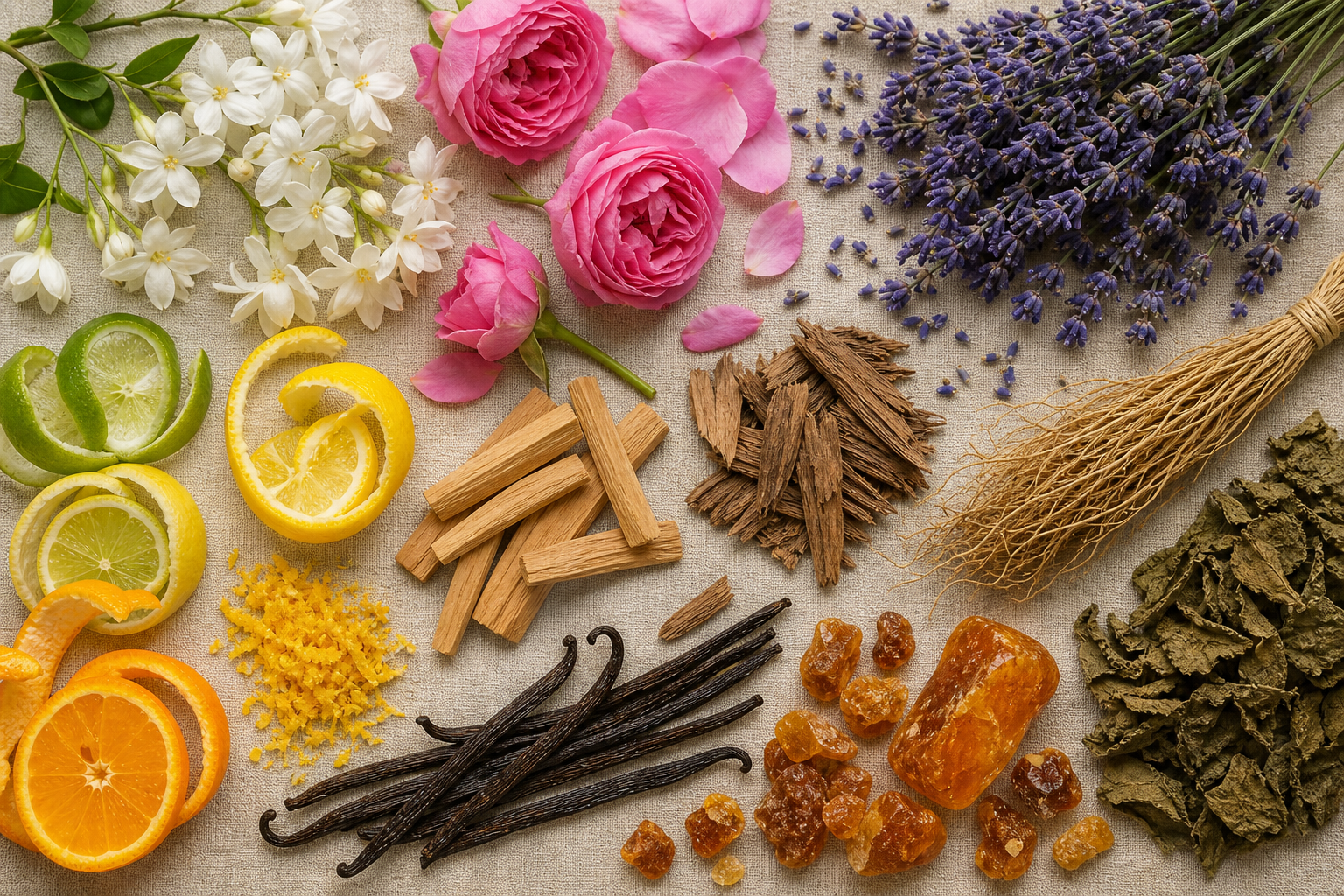
When reading descriptions, you'll come across a surprisingly small range of ingredients that recur repeatedly. Citrus, floral essences, woody tones, musk, vanilla, and amber form the backbone of a large part of contemporary perfumery – you'll find them in affordable new releases as well as in luxurious compositions, in fragrances for women, men, and unisex compositions. The difference lies in the ratio, quality of processing, and the boldness with which the perfumer combines the ingredients.
For you, this means a practical shortcut. Just remember how these six groups behave, and you can estimate from the description whether the fragrance will be light for summer days or rich for cool evenings – and whether it will last until evening or need to be refreshed during the day. In the following sections, we'll go through each group separately: where the ingredient comes from, how it smells on its own, and what role it plays in the final composition.
Citrus – the Sparkling Start of Most Compositions
The first seconds after spraying almost always belong to citrus. Bergamot, mandarin, or grapefruit are the first to release from the skin and determine the impression a perfume makes when you try it in the store. That's why you'll find them in the vast majority of compositions – from light summer eau de toilettes to perfume waters that you might expect to be purely woody or oriental based on their description.
How Citrus Essence is Obtained
Citrus raw material doesn't come from the pulp or juice, but from the peel of the fruit. It is most often cold-pressed: the peel is mechanically disrupted, the oil sacs within release aromatic liquid, which is then separated from the aqueous component. The essence obtained in this way retains a juicy, almost "freshly peeled" character typical of citrus. Some raw materials are also produced by distillation – the result is usually gentler, smoother, and less sharp, making it suitable for compositions where citrus is meant to support other ingredients.
A relatively small amount of essence is produced from one fruit, so in common perfumery, natural raw materials are often combined with synthetic molecules. These provide stability to the citrus opening and help keep the fragrance balanced even after long storage, when the bottle is exposed to light and heat.
Why You Smell Citrus First
Citrus essences are among the most volatile raw materials perfumers work with. Their molecules are light and evaporate quickly from the skin, usually within the first few minutes. That's why they occupy the top notes, the part of the composition you perceive immediately after spraying. However, this also means that the citrus sparkle never lasts all day. If you've ever felt that a perfume "transformed into something else" after an hour, it was likely the departure of the citrus and the arrival of the heart of the fragrance.
Bergamot, Mandarin, and Grapefruit – Three Different Characters
Although all three materials are called citrus, each behaves differently in a composition:
- Bergamot – sweet, but with a slight bitterness and a tea undertone. It appears elegant, unobtrusive, and easily blends with anything else, making it suitable even where citrus is not meant to be the main theme.
- Mandarin – softer and sweeter than the other two materials, with hints of both juice and peel. It appears friendly and playful, often found in perfumes for women and in gentler unisex compositions.
- Grapefruit – sharper, bitter, and distinctly fresh. It adds energy to the opening and a slightly metallic sparkle, which works well in sporty and aromatic fragrances.
When Citrus Fragrances Shine
Citrus scents develop best in warmth. Higher temperatures accelerate evaporation and the light fresh note opens almost immediately, which is the main reason why citrus compositions are traditionally worn in summer and appear rather shy and brief in the cold. So if a summer perfume seems weak in winter, it may not be the fragrance itself, but the environment in which you are testing it.
Bergamot, meanwhile, has a much broader application than its fresh profile might suggest. You can find it at the beginning of leather, woody, and oriental perfumes, where it is not meant to create a citrus impression, but to brighten a dense base and make it accessible right from the first minutes. Next time you read the composition of a perfume that caught your interest, try looking for bergamot specifically – you'll likely find it there, even if you perceive the scent as purely warm.
Floral Essences – The Heart That Gives Fragrance Its Face
When the top notes fade, the middle layer of the composition comes into play – and this is where flowers sit in most perfumes. Floral ingredients give the fragrance its character, which is how you remember it: they determine whether it feels sensual, classically elegant, or freshly aromatic. This impression is most often created by three ingredients – jasmine, rose, and lavender.
Before we delve into individual flowers, it's worth distinguishing the three methods by which a flower ends up in a bottle. This isn't cosmetic poetry, but a description of different technologies:
- Essential oil is produced by steam distillation. It is suitable for materials that can withstand heat – typically lavender.
- Absolute essence is obtained by solvent extraction and is used where hot steam would damage delicate petals. This is how jasmine and part of the rose production are processed.
- Synthetic reproduction constructs the flower's scent from individual fragrant molecules. For many flowers, there is no other way – lily of the valley, lilac, and peony do not provide a usable natural extract, so their scent in perfume is always a reconstruction.
The presence of synthetics does not mean a worse perfume. The reproduced note tends to be more stable over time, varies less between batches, and conserves resources that are scarce in nature – hundreds of kilograms of hand-picked flowers are needed for a kilogram of jasmine absolute essence. Most modern perfumes therefore deliberately combine natural extracts with synthetic molecules.
Jasmine is among the most intense floral ingredients. It smells creamy, honeyed, with a special depth provided by naturally occurring indoles – these give jasmine a sensual, almost leathery undertone. Perfumery uses two main types: jasmine sambac, which feels fresher and tea-like, and grandiflorum jasmine, which is richer and sweeter. Only a small amount is needed in a composition, as jasmine tends to overpower surrounding notes.
Rose appears more civil and velvety compared to jasmine. The most commonly processed are damask rose and centifolia rose. Distillation produces rose oil with a sweet, slightly citrusy, and waxy facet, while extraction yields absolute essence, which is darker, denser, and more honeyed. Rose is also a note that can fundamentally change the character of the entire fragrance: with fruity notes, it sounds romantic, with patchouli and wood, it becomes serious and modern.
Lavender stands somewhat apart. It is aromatic, clean, with a herbal to slightly camphoraceous hint, and because it does not come across as sweet, it works well in men's and unisex compositions – forming the backbone of aromatic and fougère fragrances, where it meets oakmoss and coumarin. In women's perfumes, it is more of an accessory that calms the floral heart and reduces its sweetness.
Why do flowers settle in the heart? It's all about volatility. Floral molecules evaporate more slowly than citrus but faster than woods and resins, so they fully emerge on the skin about fifteen to thirty minutes in and usually last two to four hours before the base takes over. The exact duration varies depending on concentration and skin type – fragrance fades faster on dry skin than on oily, and Eau de Parfum lasts longer than Eau de Toilette. That's why it's worth not judging a perfume by the first seconds on a test strip: what you smell in the first minutes is just the prelude. The character that stays on your skin throughout the morning is determined by the floral heart – and that's the phase worth waiting for when testing.
Dřevité tóny – kostra, na které vůně stojí
Dřevité suroviny se v parfému chovají podobně jako nosná konstrukce domu. Nejsou to ony, co ucítíte jako první, ale právě ony drží celou kompozici pohromadě a dávají jí hloubku i výdrž. Jejich molekuly jsou těžké a odpařují se pomalu, takže na pokožce zůstávají ještě ve chvíli, kdy z lehčích surovin dávno nic nezbylo. Pokud jste svůj parfém po několika hodinách skoro nepoznali, stála za tou proměnou nejčastěji dřevitá báze.
Santalové dřevo
Santal patří k nejcennějším surovinám v parfumerii. Historicky se nejvíc cenil indický santal z oblasti Mysore, jenže strom roste velmi pomalu – použitelné jádrové dřevo má až po patnácti a více letech – a divoký výskyt se po desetiletích intenzivní těžby výrazně ztenčil. Proto se dnes u santalu tolik mluví o udržitelných zdrojích: většina parfumerie pracuje s plantážním santalem z Indie a Austrálie, kde se stromy pěstují cíleně a těžba podléhá kontrole. Vedle toho se běžně používají i syntetické suroviny, které santalový charakter napodobují – nejsou to náhražky z nouze, ale standardní nástroj moderní parfumerie. Ve vůni je santal měkký, krémový, mírně mléčný a lehce oříškový; v kompozici působí spíš jako polštář než jako ostrá hrana.
Cedr
Cedr je proti santalu suchý a přímočarý. V parfumerii se nejčastěji setkáte se dvěma typy: cedr atlaský z marockého pohoří Atlas je pryskyřičnatý a lehce kouřový, zatímco takzvaný cedr virginský ze Severní Ameriky – botanicky jde ve skutečnosti o jalovec – voní suše a připomene vám ořezanou tužku. Parfuméři sahají po cedru rádi právě proto, že dodá struktuře pevnost, aniž by přebil ostatní suroviny. Dobře podepře květinové srdce i kořeněné akordy a v pánských parfémech tvoří jednu z nejčastějších bází vůbec.
Vetiver
Vetiver je zajímavý tím, že vlastně vůbec není dřevo. Jde o tropickou trávu, jejíž vonná surovina se získává destilací kořenů – ty se musí vykopat, očistit a usušit, což z vetiveru dělá surovinu náročnou na ruční práci. Nejznámější je haitský vetiver, ceněný pro čistý a lehce kouřový projev; dalšími významnými zdroji jsou Jáva a ostrov Réunion. Ve vůni najdete zemitost, kouř, náznak vlhké půdy i překvapivě svěží, nahořkle citrusovou hranu. Právě ta dělá z vetiveru oblíbenou surovinu letních kompozic, které mají působit svěže, ale ne sladce.
Pačuli
Pačuli pochází z jihovýchodní Asie a největší podíl produkce dnes připadá na Indonésii. Vonný olej se získává z listů, které se nechají zavadnout a projdou fermentací, teprve potom se destilují. Pačuli přitom patří mezi suroviny, kterým čas prospívá – vyzrálý olej bývá jemnější a kulatější než čerstvý. Ve vůni je pačuli tmavá, zemitá a mírně sladká, s nádechem vlhké hlíny a hořké čokolády. Tvoří páteř chypre kompozic a orientálních směsí a v malém množství dokáže i lehké květinové vůni dodat hloubku.
Čím se jednotlivá dřeva liší
- Santalové dřevo – krémové, mléčné, měkké; zjemňuje a zaobluje ostatní suroviny.
- Cedr – suchý, pryskyřičnatý, tužkový; dodává strukturu a čistotu.
- Vetiver – zemitý a kouřový s hořkou svěžestí; působí uhlazeně a spíš chladně.
- Pačuli – tmavá, zemitá, lehce sladká; přidává hutnost a temperament.
Při výběru se vyplatí dát dřevitým tónům čas. Na testovacím papírku poznáte hlavně to, co je nahoře; dřevitá báze se naplno ukáže až na pokožce po dvou až třech hodinách. Pokud vám vůně připadá plochá nebo mizí příliš rychle, zkuste příště sáhnout po kompozici s výraznějším dřevitým podkladem – rozdíl ve stopě bývá dobře znát.
Pižmo, vanilka a ambra – teplá základna a jak podle ní vybírat
Když z pokožky odezní jiskřivý začátek i květinové srdce, zůstane to, s čím strávíte nejvíc času. Základní tóny určují, jak parfém voní odpoledne i večer. Vedle dřevin tuto vrstvu tvoří trojice surovin, která dodává kompozici hřejivost a smyslnost: pižmo, vanilka a ambra.
Pižmo – měkkost, kterou spíš tušíte, než pojmenujete
Pižmo se historicky získávalo ze žláz kabara pižmového, běžná parfumerie ale dnes pracuje výhradně se syntetickými pižmy. Důvod je etický i praktický: syntetické molekuly jsou stabilní a jejich profil lze přesně řídit. Nejde přitom o jednu vůni, ale o celou rodinu – bílá pižma působí čistě až mýdlově, jiná mají krémový nebo pudrový nádech.
Do popředí se pižmo dostane málokdy. Spíš zaobluje ostré hrany ostatních surovin a drží kompozici pohromadě. Pokud vám parfém připomíná čerstvě vyprané prádlo nebo teplou pokožku, bývá za tím právě pižmová báze.
Vanilka – sladkost, která nemusí být těžká
Vanilka se získává z lusků vanilky pravé. Sklizené zelené lusky projdou několikaměsíční fermentací a sušením, teprve během nich vznikne charakteristická vůně. Zpracování je zdlouhavé, a proto vanilka patří k nákladnějším přírodním surovinám v parfumerii.
V parfémech potkáte extrakt z lusků i syntetický vanilin, tedy hlavní vonnou složku vanilky. Přírodní extrakt přináší hloubku a lehce kouřový podtón, syntetická cesta čistotu a předvídatelnost. Vanilka bývá jádrem gurmánských vůní, ale zdaleka nemusí být jen dezertní – s kořením nebo dřevem působí spíš teple a temně než sladce.
Ambra – teplo s minerálním podtónem
Ambra šedá je původně produkt trávicího ústrojí vorvaně, který dozrával v mořské vodě. Dnešní parfumerie s ní prakticky nepracuje a místo toho používá rekonstruovaný ambrový akord: směs přírodních pryskyřic, jako je labdanum, a syntetických molekul, které ambrový dojem věrně napodobí. Výsledek voní teple, balzamicky a mírně minerálně, někdy s náznakem soli a sluncem prohřáté pokožky. Ambra dodává vůni objem, aniž by ji zatěžovala.
Proč tahle trojice prodlužuje výdrž
Odpověď je fyzikální: molekuly pižma, vanilinu i ambrových materiálů jsou těžší a odpařují se pomaleji než citrusy nebo lehké květiny. Zároveň fungují jako fixátory a zpomalují odpar lehčích surovin nad sebou, takže se kompozice nerozpadne během první hodiny. Roli hraje i koncentrace – parfémová voda má vyšší podíl vonné směsi než toaletní voda, takže v ní teplá základna vystoupí zřetelněji.
Šestice v kostce a co si z ní odnést
Celá šestice surovin dává jednoduchou mapu, podle které lze číst téměř každý parfém:
- citrusy – jiskřivý, ale krátký start;
- květinové esence – srdce, které dává vůni charakter;
- dřevité tóny – struktura a suchý základ;
- pižmo – měkkost a soudržnost celku;
- vanilka – teplá sladkost od dezertní po kouřovou;
- ambra – objem, teplo a delší dozvuk.
Při výběru se vyplatí postupovat od báze. Pokud vám vyhovují vůně, které se drží celý den a působí hřejivě, hledejte v popisu právě pižmo, vanilku nebo ambru – v sortimentu Brasty patří tato trojice k nejčastěji zastoupeným notám. Nejvíc jich najdete v orientálních a gurmánských kompozicích a v unisex kategorii, kde teplá základna funguje napříč pohlavími. Máte-li radši lehkost, volte vůně, kde tyto suroviny stojí v pozadí za citrusy nebo květinami. A parfém vždy zkoušejte na pokožce – teplá základna se rozvíjí postupně a na papírku ji neposoudíte celou.
Category
Recommended articles
"Give a girl the right shoes and she can conquer the world!" Marilyn Monroe