
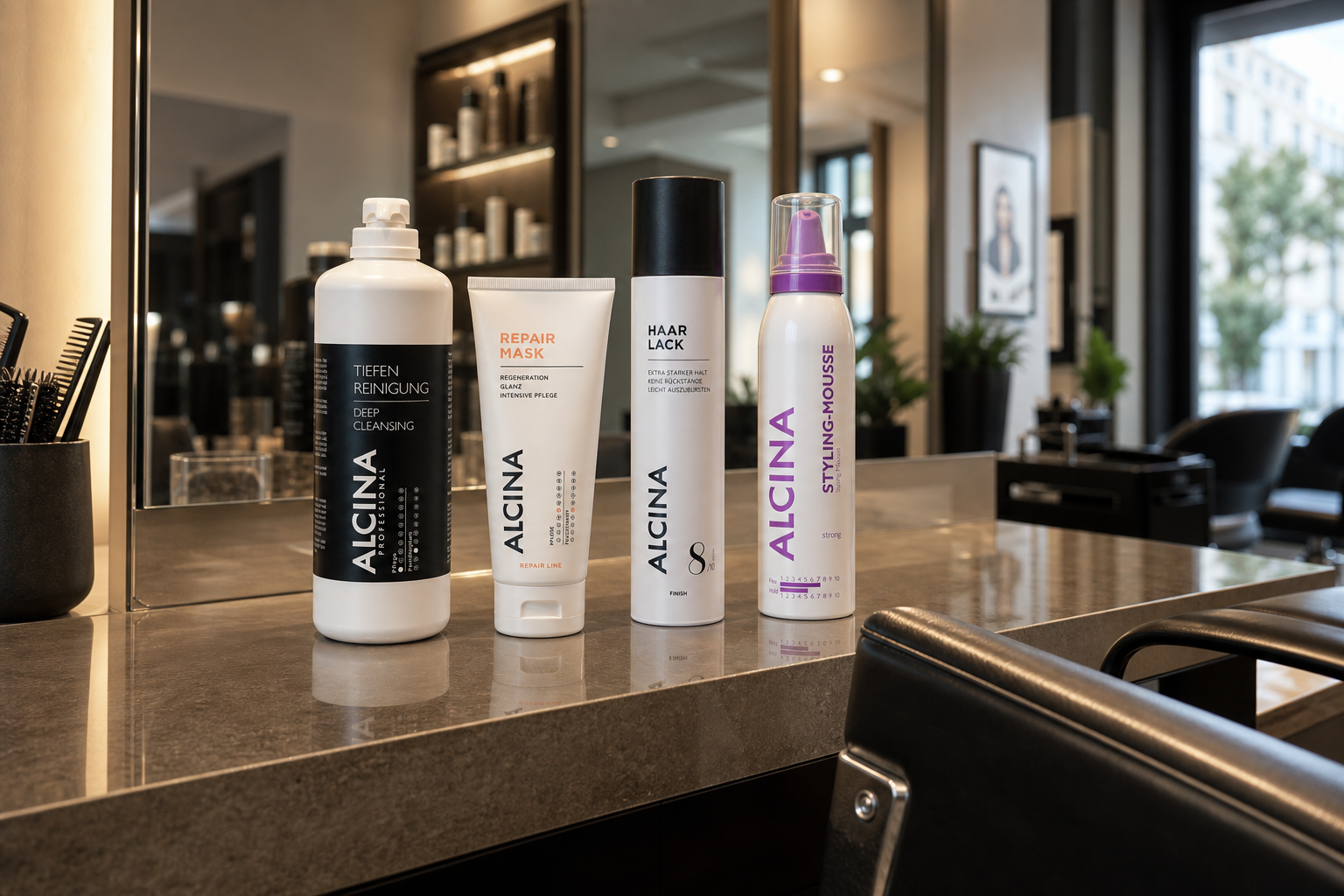
Alcina – a brand you might recognize from the salon
You know the experience at the hairdresser's: you're sitting by the sink, the stylist massages shampoo into your hair, then something that sits for a while, and you leave with hair that styles noticeably better the next day than usual. But at home, you can't replicate that care – you didn't catch the name, and you won't find it in a typical drugstore. When you finally hear "Alcina," many people don't recognize the name.
Alcina is a German professional hair care brand primarily aimed at salons. Hairdressers use it daily and know it from professional training. However, it's not exclusive to them. The individual lines are readily available for home care and are used just like any other shampoo, conditioner, or mask. The main difference is that the composition and range are designed with the assumption that your hair has been professionally assessed.
This is also reflected in the way the brand presents itself. Alcina doesn't rely on celebrity campaigns, its packaging is understated, and the lines are distinguished more by hair needs than catchy names. In the salon, this doesn't matter – there, someone who sees your hair up close and knows its history will hand you the right variant. But when you want to order care for yourself at home, it takes a moment to navigate the selection.
This article is here to help with that. We've selected nine products from various Alcina lines – from washing to scalp care to masks, leave-in treatments, and styling. For each, we explain who it's suitable for and when it might make sense to choose something else. No shampoo works the same on fine bleached hair as it does on a thick mane that gets oily quickly.
This isn't a ranking or a selection of bestsellers. It's more like a map: whether you're dealing with dry ends, a sensitive scalp, or just want to switch from a drugstore shampoo to professional hair care, there should be at least one product in the selection that makes sense for you. And if Alcina doesn't appeal to you, you'll find other professional brands in our hair care range that you commonly encounter in salons.
German Heritage and Alcina's Portfolio Structure
Alcina is a German brand of professional hair cosmetics developed for hairdressing distribution. In practice, this means that the formulas and packaging were primarily created for salon use and only then made available for home use. If you've first noticed the name Alcina on a shelf by the wash basin, it's no coincidence – in the hairdressing world, it's a well-established name that you won't find in regular drugstores.
In hair cosmetics at Brasty, professional brands form the backbone of our offering. The strongest names are Wella Professionals, Schwarzkopf Professional, and L'Oréal Professionnel – brands with extensive lines covering the entire spectrum from washing to treatment to coloring. Alcina fits into this company with the same logic: it doesn't offer one universal line for everyone, but a system where you choose based on what your hair and scalp truly need.
What "Professional" Line Means in Practice
The word professional appears often in descriptions and is rarely explained. For salon brands, it stands behind several specific features:
- Segmentation by hair type and need – instead of one shampoo for everything, you'll find separate variants for dry, fine, colored, or quickly greasing hair.
- More concentrated treatments – masks and treatments from professional lines are usually applied in smaller amounts and for shorter periods than users are used to from regular care. Therefore, it's worth starting cautiously with dosing.
- Salon-sized packaging – alongside the classic 250 ml, there are also liter-sized packages. These make sense when the product is used by the whole household or when you've already verified it.
- Consistency of individual steps – shampoo, conditioner, and subsequent care from one line are designed to complement each other, not to clash.
How the Portfolio is Divided
You can divide Alcina's offerings into four branches. Following the same key, you can easily navigate the selection:
- Hair Care – shampoos, conditioners, masks, and leave-in treatments, everything that works with lengths and ends.
- Scalp Care – products targeting oiliness, dryness, or sensitivity of the scalp. They address roots and scalp, not lengths, and therefore are not interchangeable with regular shampoo.
- Coloring – salon colors and accompanying products, which are more suited to a hairdresser's hands than a home bathroom.
- Styling – hairsprays, pastes, sprays, and heat protection products, the final step in hairstyling.
The division has a practical impact on selection. If your scalp is burning or itching, a rich mask for the ends won't change the situation – you need a product from the second branch. Conversely, dried-out lengths after summer won't be fixed by a shampoo for sensitive scalp because it addresses a different issue. Most disappointments with professional cosmetics arise precisely because the right quality product from the wrong category is chosen.
The selection of nine products we've chosen is arranged to cover both care dimensions – scalp and lengths. Thanks to this, you can create a routine tailored to your hair, whether you're addressing a specific problem or want complete care from washing to final styling.
Washing and Scalp Care: The First Four Products
Our selection of nine products begins with the least glamorous yet most crucial step – washing. In professional hair care, shampoo is not just a foam carrier; it's the first decision that influences how everything else you apply to your hair will behave. Alcina approaches this from a salon perspective: first, they ask about the condition of your scalp, then about the lengths and ends.
This is why the first four selected products target the two strongest areas of the range – shampoos and targeted scalp care. It's also the part of the product line that most people naturally start with when trying a new brand: shampoo is used up the fastest, offers the most accessible entry into the entire range, and quickly shows if the care suits you.
Whether you're dealing with color that fades quickly or a scalp that reacts to everything, navigating this part of the range is fairly straightforward. Simply put, there are four situations these selected products address:
- Colored Hair. Shampoos with a gentler cleansing base that don't unnecessarily wash out the color and help keep the shade fresh longer. Ideal if you regularly color your hair and want to maintain the tone between salon visits.
- Sensitive Scalp. Options designed for scalps that easily get irritated, itch, or don't tolerate frequent washing well. You'll recognize them by their gentler formulation and milder fragrance. Perfect if you've had issues with regular drugstore shampoos in the past.
- Oily Roots and Limp Lengths. Shampoos that clean more thoroughly and provide support at the roots. Choose these if you have fine hair and your style falls flat the day after washing.
- Targeted Scalp Care. Serums, tonics, and treatments applied directly to the scalp and left to work. These complement shampoo, not replace it – they make sense when a change in washing alone isn't enough, and you want to give your scalp an extra step of care.
Specific names, packaging volumes, and price levels can be found directly with the individual products below. Generally, professional shampoos are available in both small trial sizes and liter bottles, which are significantly cheaper per wash – for a range you already know suits you, larger sizes are worth it.
Whichever you choose, the result depends on how you use the shampoo. Rub it in your palms, apply it to wet hair, and massage the scalp with your fingertips, not the lengths – they will clean themselves when you rinse the foam. For hair weighed down by styling, double washing makes sense: the first application removes product residues and oils, while the second works on the scalp. And rinse longer than you think necessary; insufficiently rinsed shampoo is a common reason why hair looks dull and gets weighed down faster.
Washing and scalp care form the foundation upon which other steps make sense. Once you know what suits your scalp, choosing the rest of your care becomes noticeably easier – and you'll save yourself from buying products that end up untouched in the bathroom.
Masks, Leave-In Care, and Styling: The Remaining Five
Washing is just the first half of the job. Shampoo prepares the hair and scalp, but how your hair looks the next day and how easy it is to manage depends on the follow-up care. The second set of five from the nine goes further – to post-wash treatment, daily protection, and the final hairstyle shape.
Masks and conditioners are among the most sought-after categories in professional hair cosmetics, right after shampoos. The difference between them is mainly in intensity and duration of action. Conditioner works more on the surface, sealing the hair cuticle and making it easier to comb; it's applied briefly and can be used after every wash. A mask is thicker, contains a higher proportion of nourishing ingredients, and needs several minutes to absorb. For dry, colored, or heat-stressed hair, it's usually suitable once or twice a week; for hair that gets greasy quickly, more like once every two weeks and only on the lengths and ends.
If you want to get the most out of Alcina without unnecessary experimentation, start with a shampoo and mask duo from the same line. Products from the same line are designed to complement each other: the shampoo cleans and prepares the hair, and the mask replenishes what washing has stripped away. Only when this basic duo works does it make sense to add more layers of care.
Leave-in care is a category that many people discover only after years – and then never give up. This includes milks, creams, serums, oils, and sprays that are applied to damp or dry hair and left in. Their benefits are purely practical: they make combing easier, unify the ends, calm frizz in humid weather, and some also serve as heat protection from blow dryers or straighteners. They can be used daily because they are designed for light application.
Here, dosing is more crucial than anything else. For fine hair, one dose spread in the palms and applied from mid-lengths down is enough, while thick and coarse hair can handle double that. If your hair goes limp after a few hours, the problem is usually not with the product but with the amount used or that it got too close to the roots.
Styling is the final layer – and also the one where mistakes are most often made. Alcina and other professional brands categorize styling products based on the hold and texture they create:
- Hair sprays – fix the finished hairstyle; lighter versions can be brushed out, stronger ones hold the shape all day.
- Shaping pastes, creams, and clays – work with texture and a matte finish, suitable for shorter hair and layered cuts.
- Styling sprays and mousses – applied to damp hair before blow-drying, they lift volume at the roots or define waves.
The practical rule is: the stronger the hold, the more cautiously you should use the amount. Excess styling weighs down the hair and makes it harder to comb the next day. It's worth including a deep cleansing wash from time to time to remove styling residues – this also restores the effectiveness of the mask, as the nourishing ingredients can better reach where they need to go.
When you put it all together, you get a weekly rhythm that you can manage even on a busy morning: shampoo according to the condition of your scalp, conditioner after every wash, mask once or twice a week, leave-in care every time you dry your hair, and styling depending on how long you want the hairstyle to last. You can explore specific Alcina products from this second set of five below.
How to Choose the Right Alcina Products for Your Hair
Nine products might seem like a lot at first glance, but they actually cover just a few clearly defined situations. It's worth selecting hair care products based on what your hair and scalp truly need, not just what looks interesting on the shelf. Go through the following overview, find your situation, and you'll know which type of product to focus on.
- Dry and damaged hair. The foundation is a gentle cleansing product paired with an intensive mask, used once or twice a week. If you have split ends, add a leave-in treatment – it will do more for dry lengths than additional washing.
- Colored hair. Opt for a shampoo designed for colored hair and complement it with a treatment that softens the hair and maintains a smooth surface. The goal here isn't a quick transformation, but to keep the shade fresh for as long as possible between salon visits.
- Fine hair lacking volume. Avoid heavy, highly nourishing textures and choose a lightweight shampoo along with a leave-in product that won't weigh the hair down. Volume in fine hair is more often lost due to excess care rather than a lack of it.
- Sensitive scalp. Start with a product specifically designed for the scalp and use it regularly, not just when your scalp signals discomfort. If issues persist, it's advisable to consult a dermatologist – cosmetic care doesn't replace medical treatment.
- Styling. Choose based on the result you want: more flexible hold for everyday wear, firmer hold for a hairstyle that needs to last all day. If you're using heat, add a product with heat protection to your routine.
The second question you'll encounter right when ordering is the packaging size. For products you use with every wash, larger packaging is more cost-effective in the long run – but only consider it once you know the product suits you. Masks, serums, and styling products, on the other hand, are used more slowly, so a smaller size is usually sufficient, leaving room to try something else. A practical compromise is to purchase shampoo in a larger size and the rest of the routine in smaller sizes.
If you're trying the brand for the first time, it doesn't make sense to buy the entire range at once. Choose one cleansing product and one follow-up treatment that match your situation from the overview above, and give them three to four weeks. During this time, you'll see how your hair behaves after washing, how long it stays clean, and whether you like the texture and scent – things you can't tell from the packaging description. Only then does it make sense to expand your routine with a mask, serum, or styling product.
You can find specific products from the nine in the product blocks of each section and compare them in the hair cosmetics category, where you'll see them side by side by volume, hair type, and price. And if you're still unsure after reading, start with what you most frequently address – in hair care, consistency leads to results more than the number of bottles on the shelf.
Category
Recommended articles
"Give a girl the right shoes and she can conquer the world!" Marilyn Monroe