
 Riiffs Freeze in Flames: Ice and Flames Illuminate Warsaw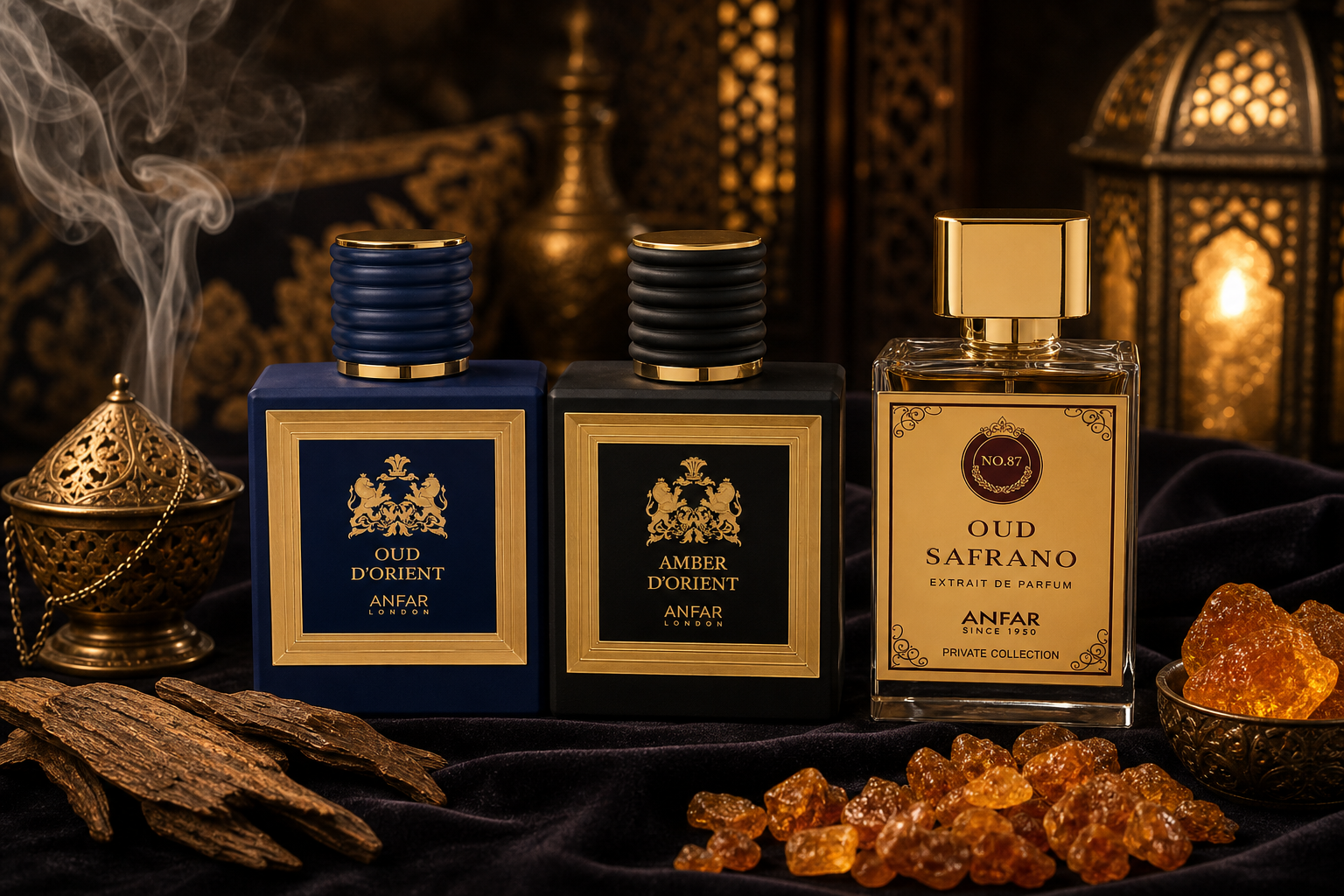
The Anfar brand is one of the names bringing the style of Arabic perfumery to Europe. Let's explore its roots, typical ingredients, and how it differs from the European perfumery tradition.
Anfar and the World of Arabian Perfumery
Whether you've only heard about Arabian perfumes or are considering your first purchase, the name Anfar is likely to come up sooner or later in your search. It is one of the brands gaining recognition in Europe alongside the growing interest in oriental compositions—perfumes that are based more on woody, resinous, and sweet ingredients rather than light citrus freshness. Anfar is far from the only name in this category, but it serves as a good entry point: it exemplifies the logic shared by the entire category.
The term Arabian perfumery is used quite loosely. Sometimes it refers to perfumes made on the Arabian Peninsula, other times it describes an olfactory style—the way a composition is put together, how pronounced its base is, and how long it lasts on the skin. In practice, these often overlap, but it's worth distinguishing between origin and style before you start comparing specific bottles. A brand from Europe can work with oud just as a producer from the Gulf can, and vice versa.
In the following sections, we will gradually explore several closely related topics:
- the background of the Anfar brand and the type of offerings it represents,
- the ingredients that give oriental compositions their distinctive character,
- how Arabian perfumery differs from European perfumery traditions,
- how to wisely choose your very first perfume of this type.
Right from the start, it's worth separating two levels that are often merged in texts about Arabian perfumery. The first level is verifiable facts about a specific brand: where it comes from, what formats it offers, and what its range looks like. The second level is the general characteristics of the entire category—denser concentrations, emphasis on base notes, or unisex wear. Anfar shares these traits with many other manufacturers, but this doesn't mean it invented them or that every one of its perfumes follows the same template. We distinguish in the text where we are talking about the brand and where about the category.
The practical benefit of such a distinction becomes apparent when choosing. Knowing that a sweet resinous base is a feature of the style, not a specialty of one manufacturer, stops you from searching for the one "right" bottle and starts you asking what intensity and notes suit you best. This is a much more useful question, and the answer can be applied to other brands beyond the one we discuss here.
If you've mainly worn European perfumes until now, your first encounter with an oriental composition can be quite surprising. It's not that it's better or worse—it simply works with different proportions and assumes a slightly different way of wearing. The goal of the following lines is to provide you with enough context to choose such a perfume consciously, not by chance.
Where Anfar Comes From: The Brand's Roots in the Gulf
When you think of an Arabian perfume, most people imagine a rich, sweetly woody scent that lingers on a sweater until the next day. However, behind this impression lies a perfumery scene with a history quite different from the European one. Anfar is among the brands that emerge from this scene—shaped by the environment of the Arabian Peninsula and the Persian Gulf countries, where fragrant oils and perfumes have been produced and used continuously for centuries.
Right from the start, it's fair to say where verifiable information ends. Detailed data about the Anfar brand itself is not publicly available—there's no documented founding date or names of the people behind it, as is customary with major European houses. Therefore, we won't invent a story just to sound appealing. Instead, we can describe the environment from which the brand originates and the features that specifically characterize its offerings.
The Gulf's perfumery tradition is based on a different foundation than the French one. While in Europe, modern perfumery developed around alcohol compositions, fashion houses, and seasonal novelties, on the Arabian Peninsula, work has been done mainly with fragrant oils, resins, and wood for centuries. Frankincense, myrrh, amber, rose water, and especially oud—a resinous wood that remains the olfactory signature of the entire region. Here, fragrance was never just a fashion accessory: it was part of hospitality, household care, and religious life. This is reflected in the way perfume is worn in the region—applied generously and layering several formats over one another is common practice, not an enthusiast's experiment.
Geography also played its role. The Gulf ports lay on trade routes that brought sandalwood and spices from India, resins from Arabia, and oud from Southeast Asia. The palette of raw materials you smell in Arabian compositions today did not emerge by chance.
The modern layer came in recent decades. Around the commercial centers of the United Arab Emirates and other Gulf countries, a model of brands emerged that translated traditional oriental compositions into a format familiar to European customers: spray bottles, standardized concentrations, and distribution abroad. These brands retained the typical richness and sweet woody character but made them accessible to a broad audience—without the need to seek out a specialized oil attar dealer. Anfar fits right in here.
Features Observable in Anfar's Offerings
- Focus on more concentrated formats. The core of the offering lies in Eau de Parfums and concentrated perfumes, formats with a higher proportion of fragrant substances. Light Eau de Toilettes, which make up a large part of the European market, play more of a secondary role here.
- Unisex orientation. A large part of the compositions is not strictly divided into women's and men's. This aligns with the region's customs, where woody, amber, and rose scents are traditionally worn across genders.
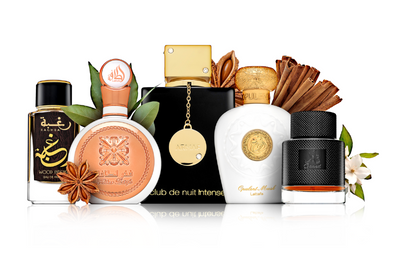
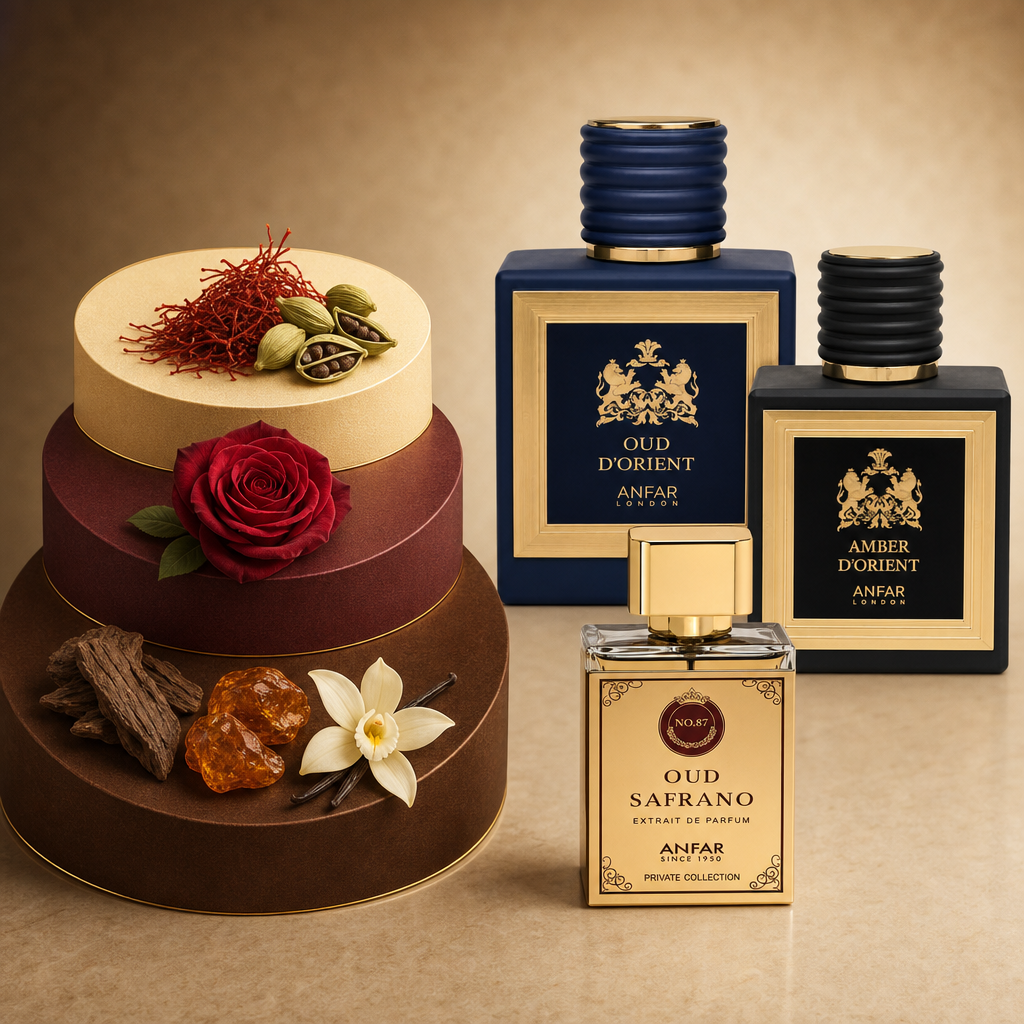
- Distinctive bottle visuals. Ornate shapes, metallic elements, and vividly colored glass are typical for Gulf perfumery. The bottle is not just seen as packaging but as part of the experience—hence, these perfumes are often bought as gifts.
- Friendly price range. Compared to niche houses that work with a similar palette of raw materials, brands of this type are priced lower. This makes them a common entry point into Arabian perfumery.
In summary: You won't understand Anfar as a standalone brand with a grand narrative, but as part of a perfumery culture that has its own raw materials, its own wearing customs, and its own idea of how a perfume should work on the skin. With this framework, its offerings make significantly more sense than when compared to European novelties.
Ingredients that Define Anfar Compositions
You can recognize Arabian perfumery by its ingredients before even seeing the bottle. The compositions offered by Anfar and other manufacturers from the Arabian Peninsula are built on resins, woods, balsams, and spices—materials that exude a rich, warm, and long-lasting scent. Once you familiarize yourself with their olfactory vocabulary, you can imagine the fragrance just from the label description, even before you smell it. This is a significant advantage when shopping online.
Woody Base: Oud as the Starting Point
Oud, sometimes referred to as agarwood, is a resinous wood formed when Aquilaria trees react to fungal infection. It smells dark, smoky, leathery, with a slightly medicinal undertone. In small amounts, it adds depth and gravity to a composition; in larger quantities, it transforms it into a dense, almost animalistic impression that lingers on the skin for a long time. Because natural oud is rare, most available Arabian perfumes use oud accords—blends of ingredients that mimic its character. These are usually more readable and softer.
Surrounding the oud in these compositions are other woody ingredients, each steering the result in a different direction:
- Sandalwood – creamy, milky soft, slightly nutty. It rounds off sharp edges and adds smoothness to the fragrance.
- Cedar – dry, pencil-like, slightly dusty. It brings structure and a certain austerity.
- Vetiver – earthy, smoky, with a grassy hint. It reduces sweetness and adds gravity.
- Patchouli – damp earth, bitter chocolate, dark green. It connects the woods with the sweet base.
Sweet Base: Amber, Musk, Vanilla, Tonka Bean
An amber accord is almost a mandatory component in oriental compositions. Today, it is primarily composed of labdanum, benzoin, and vanilla tones, and it smells warm, resinous, somewhat like heated skin. Musk in contemporary perfumery is represented by synthetic musky ingredients: they are soft, clean, slightly powdery, and mainly hold the fragrance together so it doesn't break into individual notes. Vanilla adds a dense sweetness, and tonka bean adds an almond, hay, and slightly tobacco-like tone. This duo is why Arabian perfumes often remind you of dessert, coffee, or dried fruit.
Flowers Meet Spices: Rose, Saffron, Cardamom
In this tradition, the rose holds a different status than in European floral fragrances. It doesn't act as a delicate bouquet but as a rich, jammy, and slightly spicy material that pairs well with oud and amber. Saffron smells leathery, hay-like, and sweet at the same time, often giving the fragrance its typical oriental touch right from the start. Cardamom brings a fresh, sweetly resinous spiciness, ensuring the opening of the composition doesn't feel too heavy. Accompanying it are cinnamon, clove, or pepper.
How Ingredients Combine into a Fragrance
A fragrance is traditionally described in three layers. The top notes are what you smell in the first few minutes—often spices, saffron, cardamom, or a citrus burst, and their role is to open the fragrance. The middle notes, or heart, emerge after about half an hour: here, you typically find rose, jasmine, or other flowers with spices. The base notes develop the slowest but last the longest. This includes oud, woods, amber, musk, vanilla, and tonka bean.
In oriental compositions, the base carries the main character. Its ingredients have larger molecules and evaporate slowly, so they remain on the skin for many hours after the top spices have long vanished. This is why a fragrance may seem sharp or unreadable immediately after spraying, yet smell warm and rounded after an hour. When reading the description of such a perfume, pay attention to the last line—it will reveal how it will smell for most of the day.
How Arabian Perfumery Differs from European Tradition
Arabian and European perfumery are not two levels of quality, but two different schools of taste. Each has grown from a different climate and a different idea of what a perfume should do in a space. Knowing how they differ helps you better anticipate what to expect from a particular bottle.
Concentration and richness. The European tradition largely works with Eau de Toilettes and lighter variants, which are meant to be subtle and can be reapplied throughout the day. Arabian compositions are more often found in Eau de Parfum, perfume extract, or even oil concentrate. A higher proportion of fragrance ingredients means a slower development, longer-lasting presence on the skin, and a more pronounced trail. The difference is not in the value of one school over the other, but in the dosage and how much space the composition takes around you.
Composition structure. A European perfume typically opens with a fresh citrus or aromatic accord: bergamot, mandarin, lavender, green notes. The Arabian approach places emphasis elsewhere – the main character lies in the base. Sweet, balsamic, resinous, and woody notes are noticeable practically from the start, and the top notes serve more as a brief prelude. Therefore, an Arabian composition usually doesn't have a long build-up after spraying and is as it will remain.
Approach to gender division. On the Arabian Peninsula, gender division is traditionally taken more loosely than in European perfumery, which has long relied on separate lines for women and men. A large part of Arabian compositions are thus unisex and are worn by both men and women depending on how the scent suits their skin. In European practice, this boundary is also blurring, but the starting point was different.
Formats less known to Europeans. Alongside the common spray, Arabian perfumery maintains forms that you encounter less frequently with European brands:
- Oil perfumes – a thick alcohol-free concentrate applied in small amounts to the wrists, behind the ears, or in the crook of the elbows. It develops more slowly, stays closer to the body, and leaves a less loud, yet persistent trail.
- Layering multiple scents – the perfume is not only combined with body care but also with another perfume or scented oil from the same family. The aim is to deepen and extend the base, not to create a completely new scent.
- Scenting textiles – fabric holds fragrance molecules longer than skin, so scarves and garments are intentionally scented.
Influence of a warm climate. High temperatures accelerate evaporation. A fragrance that seems appropriate in a hot afternoon on the peninsula develops more slowly in a cooler European interior, but lasts significantly longer and seems richer. This is the most common reason why people describe their first Arabian perfume as too intense. The solution is usually fewer sprays and applying it to clothing or hair instead of directly on warm skin.
Who this style typically suits. Arabian perfumery is most often favored by those who fit most of these points:
- You like sweet, vanilla, amber, or woody scents and fresh citrus openings leave you rather indifferent.
- You're looking for a perfume that lasts all day without reapplication.
- You don't mind your scent being noticeable from several steps away, or you mainly wear it in the evening and during cooler months.
- You want to try unisex compositions regardless of who they are primarily intended for.
Be more cautious in the opposite situation: in an open office, in healthcare or education, in hot summer, and when sweet gourmand accords don't suit you. Even then, you don't have to completely avoid Arabian perfumery – just opt for a lighter composition, reduce the dosage, and let the scent work closer to the body.
How to Choose Your First Arabic Perfume
Whether you've been drawn to Arabic perfumery by the brand Anfar, or you're simply curious about the scents based on woody and resinous notes, your first purchase can feel like a leap into the unknown. The following guide will help you select a perfume that you'll truly love and won't leave untouched in your bathroom.
A good starting point is a note you're already familiar with from other perfumes. If you enjoy vanilla, tonka beans, or amber, opt for sweet woody compositions – they are warm, approachable, and their intensity won't surprise you. Conversely, if you prefer cleaner and spicier profiles, begin with cardamom, saffron, and sandalwood. Leave oud, the hallmark of the entire category, for later – it's smoky, leathery, and can be quite overwhelming at first encounter.
If you want to simplify the process into a straightforward hierarchy, start at the top and only move down when the previous level no longer feels prominent:
- sweet woody compositions with vanilla, tonka beans, and amber – a friendly entry into the category,
- floral musky combinations, typically rose with musk and soft wood,
- spicy woody profiles with saffron, cardamom, and sandalwood,
- oud and resinous compositions, where wood and smoke carry the entire perfume.
The second thing to consider before choosing a specific name is concentration. Arabic perfumes are commonly sold as Eau de Parfum or as perfume, meaning they are in more concentrated formats than what you're used to with European classics. For daytime, two sprays of Eau de Parfum are usually sufficient – the composition will unfold naturally in the warmth, and your skin will do the rest. For the evening, you can opt for a more concentrated format and apply it to warmer areas of the skin, such as the neck or the crook of the elbow. The tried-and-true rule is: it's better to apply less and add more later if needed, than to wear a scent all day that's noticeable across the room.
Testing on the skin is more crucial with these compositions than anywhere else. A paper strip will only reveal the top notes, which in Arabic perfumes fade relatively quickly – the character is carried by the base, which reveals itself after several hours. Therefore, give each candidate a full day, don't test more than two perfumes at once, and don't judge them by the first ten minutes. It's worth trying the perfume in two different situations: it behaves differently on a cold morning than in a heated office.
Once you're clear on the profile you're looking for, you can head to the Arabic perfumes category in the Brasty catalog. Customers here most often choose brands like Lattafa, Afnan, Rasasi, Riiffs, and Zimaya. They all offer unisex compositions based on a sweet woody base, differing more in sweetness, smokiness, and richness than in the basic approach. Price-wise, they are mostly in the more affordable segment of perfumery, so your first Arabic perfume doesn't have to be a major investment – more expensive ones are typically concentrated formats and limited editions.
Your first Arabic perfume doesn't have to be the one you stick with. Consider it an entry point: it will teach you to recognize how much sweetness and woodiness you prefer, and next time you'll choose much faster. And if the category intrigues you, there's plenty of room to gradually build a small collection – one perfume for everyday wear, another for the evening, and a third for the colder months.
Category
Recommended articles
Riiffs Freeze in Flames: Ice and Flames Illuminate Warsaw "Give a girl the right shoes and she can conquer the world!" Marilyn Monroe