


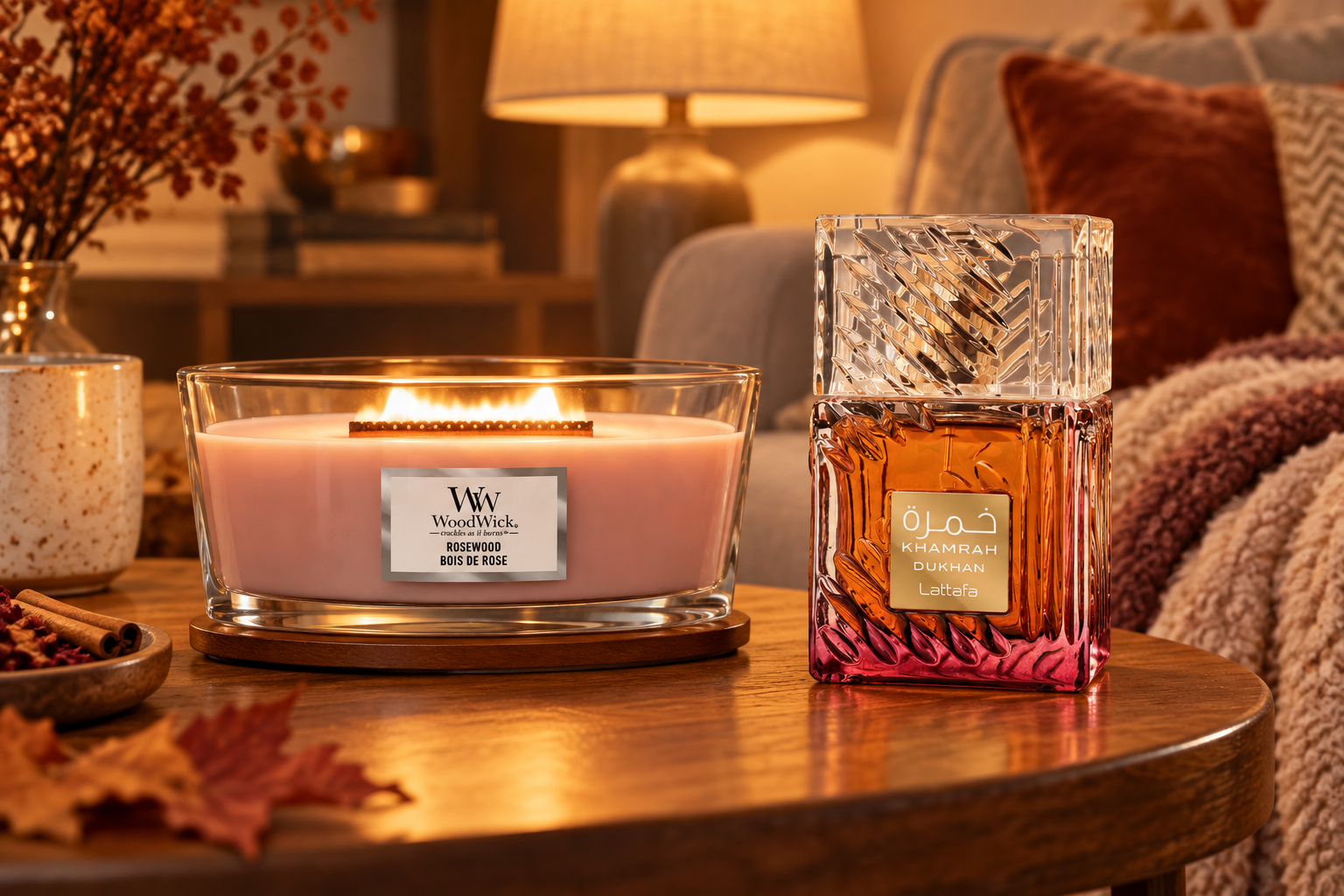
A seasonal selection for those who want their autumn evenings to be perfectly harmonized from the ambiance to their personal fragrance. We'll show you how to pair dessert-inspired candles with perfumes based on vanilla, amber, and tonka bean so that the layers complement rather than overpower each other.
Why Autumn Evenings Call for Fragrance Layering
Autumn announces itself before you even notice. The daylight fades by afternoon, evenings stretch longer, and you find yourself spending noticeably more time at home than in summer. With this comes a specific desire: to have your home set up so you can unwind. Some people draw the curtains and turn on a lamp, others reach for a scented candle – and many of us spritz on some perfume after a shower, even if we're not going anywhere. It's not vanity; it's a way to separate the evening from the rest of the day.
This is where the two elements meet, although we usually handle them separately. A scented candle and perfume are not two separate disciplines, but two layers of the same impression. One plays in the space, the other on the skin. A candle warms up slowly, maintains one mood throughout the evening, and you perceive it more in the background, similar to light or room temperature. Perfume, on the other hand, evolves over time, reacts to the warmth of your skin, and is closest to you. When both layers come together in one room, they either complement each other or start to clash – and the difference between the two is not price or brand, but the harmony of compositions.
A typical autumn scenario looks like this: a candle with a strong sweet note burns on the dresser, you have an oriental perfume with the same base on your wrist, and after half an hour, you can't tell which is which. The scents don't cancel each other out; they just become richer. The opposite extreme is equally unfortunate – a sharply citrusy space and a creamy soft perfume on the skin don't communicate at all, and the whole feels disjointed. Between these extremes lies a wide range where both layers work together, and that's what this entire article is about.
To reliably hit that range, it's worth not choosing each layer separately. Before bringing home a new candle or reaching for a home perfume, ask yourself three questions:
- What do you feel most strongly in both compositions? Sweet base, wood, spices, or fruit – if you find at least one common ingredient, you have a bridge between space and skin.
- Which layer should lead the evening? One should be dominant, the other should serve as a backdrop. Two equally loud scents will silence each other.
- How long should the impression last? A candle works over hours, while perfume on the skin changes several times in the same period. Keep in mind that the end of the evening smells different from its beginning.
In the following sections, we'll explore both layers separately and together. We'll start with notes that suit an autumn evening most naturally – vanilla, amber, and tonka bean. They are warm enough to work in cooler seasons and clear enough to recognize even without experience with olfactory vocabulary. On the space side, we'll work with dessert-themed candles from brands like Woodwick and Yankee Candle, which cover this sweeter spectrum from subtle to bold. On the skin side, we'll use perfumes built on the same trio of ingredients.
Don't expect a universal guide, because none exists – scent perception is individual and depends greatly on room size, ventilation, and how long the candle burns. What we offer is a clear principle and several pairs that, according to our experience, make sense together. With them, you can then create your own combination based on what you already have at home.
The Olfactory Alphabet of Autumn: Vanilla, Amber, and Tonka Bean
Autumn scents in the home and autumn perfumes on the skin surprisingly often rely on the same three ingredients. Vanilla, amber, and tonka bean appear in the description of a scented candle as well as in the pyramid of an Eau de Parfum, yet they behave differently in each world. Wax heats the scent evenly and disperses it into the space, while skin warms it gradually and adds its own nuance. Once you recognize this difference, you'll start reading a candle's label and a perfume's description with the same vocabulary – and that is precisely the skill that turns a random purchase into a conscious choice.
Vanilla: Sweet Warmth That Speaks Immediately
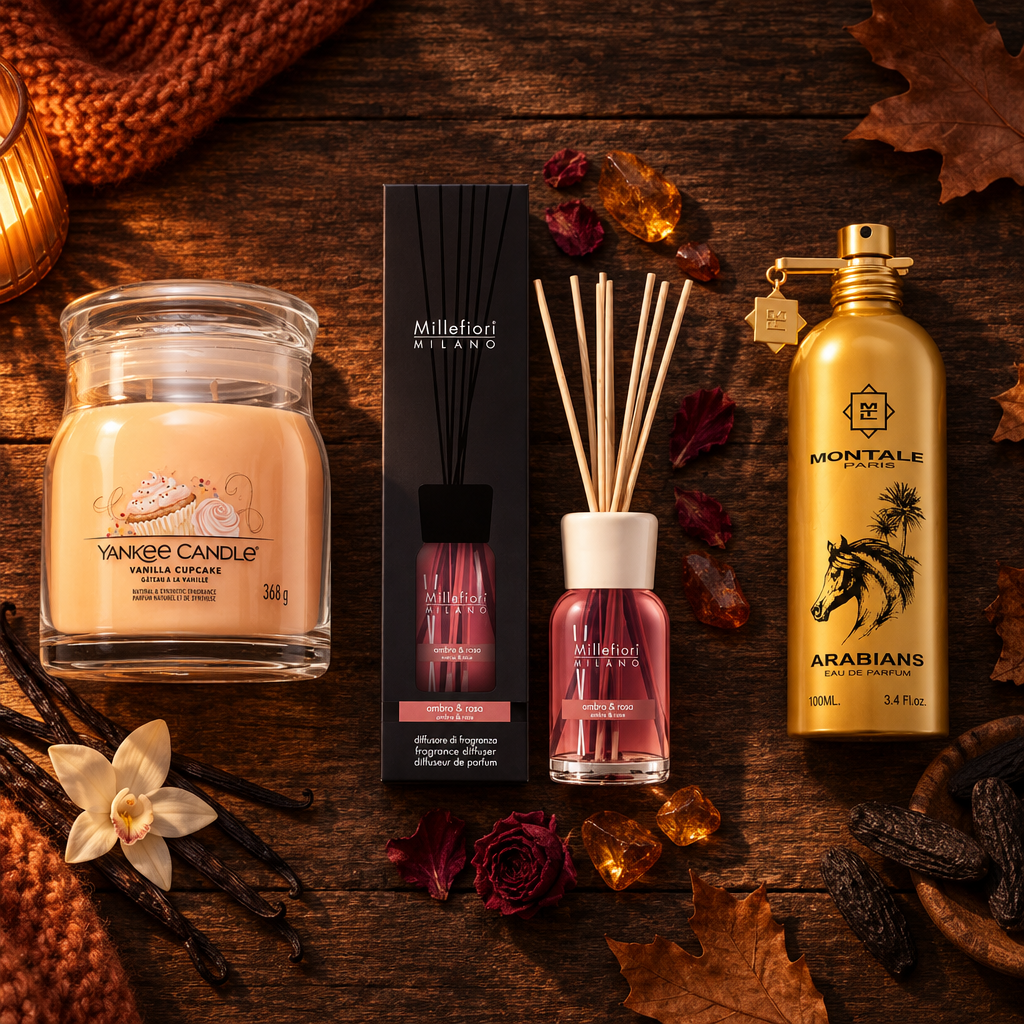
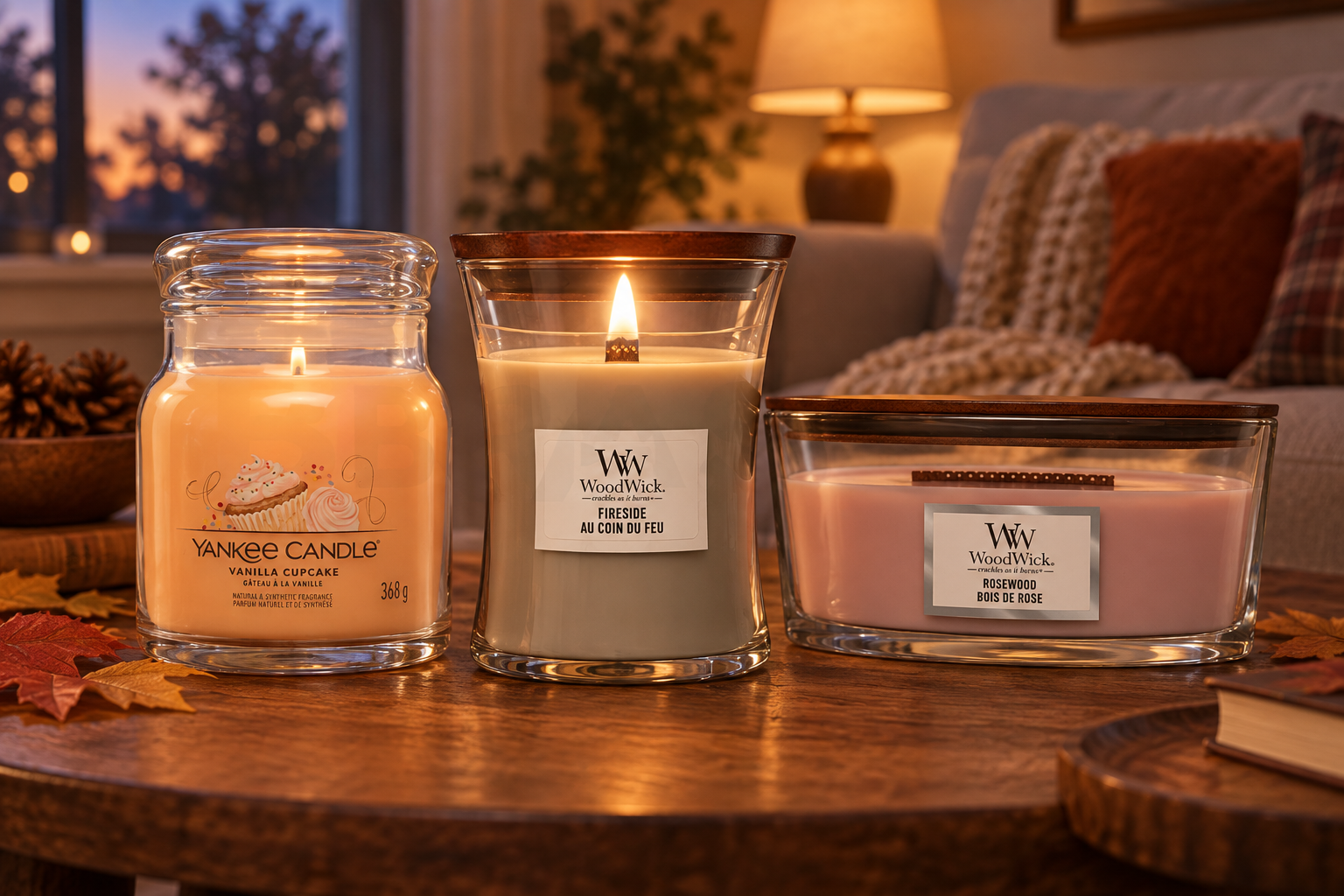
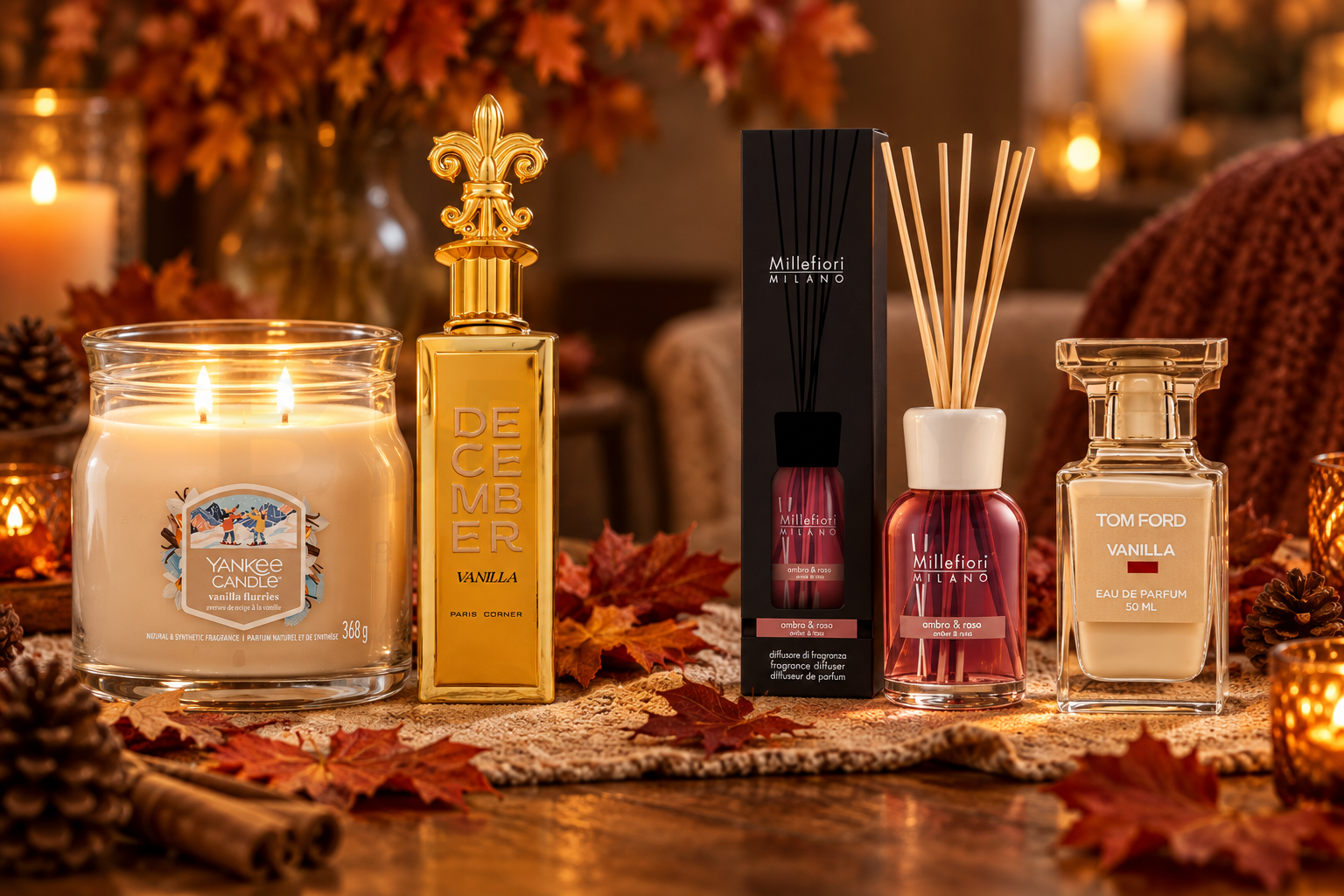
Vanilla is the most recognizable of the trio. In wax, it heats up within minutes and fills the room with a dessert-like, almost confectionery impression; a typical example is Yankee Candle Vanilla Creme Brulee, where the sweetness breaks into caramelized, slightly burnt sugar. It's this burnt edge that prevents a gourmand candle from feeling syrupy – without it, it would be flat.
On the skin, vanilla plays a different role. It sits in the base notes, so in the first few minutes after spraying, you hardly notice it, and it fully reveals itself only after half an hour. It is almost always complemented by spices or dried fruits in perfumes, which shifts it from a dessert to a richer oriental scent. This is well illustrated in Lattafa Khamrah Eau de Parfum, where the vanilla base is surrounded by dates and warm spices. Practically, this means: what you smell immediately in a candle, you will hear with a delay from a perfume – and much more subdued.
Amber: Powdery Depth Instead of Sweetness
Amber is not a sweet note in the true sense. It is resinous, warm, and slightly powdery, so it functions more as a foundation in a composition rather than the main voice. In a candle, it is recognized by the scent feeling soft and "lived-in" – like freshly laundered wool blankets. Yankee Candle Soft Wool & Amber is an example of how amber can ground an entire scent without sweetening it.
In a perfume, amber has another function: it extends the longevity of other ingredients and rounds off their edges. That's why it is so often found in autumn and winter compositions – it holds the scent together when the cold air carries away lighter citruses and flowers. If you find amber at the end of a perfume's pyramid description, expect the scent to grow in depth rather than breadth.
Tonka Bean: Almonds, Tobacco, and a Soft Epilogue
Tonka bean is the least known of the trio and simultaneously a note that is slightly growing in catalogs. It smells of bitter almonds, hay, and dried tobacco, with a sweet trace somewhere between vanilla and chocolate. On the skin, it gives the scent a characteristic soft epilogue: it doesn't overpower but prolongs. This is beautifully evident in Montale Arabians Tonka Eau de Parfum, where tonka holds the entire oriental composition together; it's a high-end perfume that requires very little.
In scented candles, tonka rarely appears in the name, so you have to find it indirectly. A similar impression – creamy warmth with a darker, slightly spicy undertone – can be found in Woodwick Patchouli Créme, for example. If this type of scent suits your home, it's very likely that the tonka note in a perfume will suit you as well.
Three notes, three different behaviors. Vanilla is quick and distinct, amber is slow and supportive, tonka is quiet but persistent. With this vocabulary, you can compare a candle's description with that of an Eau de Parfum, even if they are written in completely different styles – and you'll know when two scents speak the same language and when they just happen to use the same word.
Gourmet-Inspired Woodwick and Yankee Candle for Long Evenings
As the evenings draw in, a few details can set the mood in your living room – and a scented candle is one of them. In our selection of home fragrances, two brands stand out in autumn, similar in format but differing in how they release scent into the room. Whether you're looking for a candle for evening reading or something more subtle for the bedroom, it's worth knowing the difference before you pick up the first jar.
Woodwick uses a wooden wick that gently crackles as it burns. This sound is quiet, almost at the edge of perception, yet it adds a fireplace-like ambiance to the evening. The flame is wider and flat, melting the wax across the entire surface and spreading the fragrance more evenly. In contrast, Yankee Candle sticks with the classic cotton wick and wax candles in a jar. They burn quietly, releasing the scent more gradually, and smaller formats are suitable for a bedside table where crackling might be disturbing.
From Woodwick's autumn, dessert-inspired range, four scents are noteworthy:
- Woodwick Black Cherry – dark cherry with a slightly liqueur undertone, suitable for the living room where a stronger presence is welcome.
- Woodwick Santal Myrrh – sandalwood with resinous myrrh, a calmer and more woody choice for late evenings.
- Woodwick Evening Onyx – a darker composition with a spicy base, acting as a counterbalance to an overly sweet interior.
- Woodwick Gilded Sands – a warmer, amber-toned fragrance, perfect if you enjoy a soft, rounded impression without sharp edges.
Yankee Candle's autumn selection leans more towards gourmet and cozy:
- Yankee Candle Soft Wool & Amber – soft amber with the feel of a freshly laundered sweater, a versatile choice for both living room and bedroom.
- Yankee Candle Vanilla Creme Brulee – caramelized vanilla, the sweetest of the four; use sparingly in small rooms.
- Yankee Candle Black Coconut – coconut set in a darker, woody frame, so it doesn't feel summery.
- Yankee Candle Mystical Tarot Card – a spicy, slightly mysterious composition for evenings when you want something less usual.
Choose the weight based on the size of the room, not on how long you want the candle to last. The smallest formats around 37g and 85g are essentially samples: they last a few evenings and are perfect for testing the scent or for use in a bathroom or small study. Medium jars ranging from approximately 368 to 453g cover an average bedroom or small living room. Large jars around 567 to 610g make sense in spacious or connected rooms where a smaller candle won't suffice – plus, they tend to be more economical per gram of wax than smaller formats.
If you're unsure which direction suits you, start with a gift set. The Woodwick Mini Jar Gift Set combines three smaller jars with wooden wicks, allowing you to experience the characteristic crackling and three different scents at once. Yankee Candle Discover Your Fragrance goes even further, offering twelve miniatures – enough to determine over a few weeks whether you prefer gourmet sweetness or woody calm. Both sets also make an understandable gift for someone you're still getting to know.

Perfumes That Complement Rather Than Overpower the Candle
A candle and a perfume compete for the same air in the living room. The difference between a pleasantly infused room and a heavy, overly sweet atmosphere is not so much the quality of either scent, but whether they share a common note and whether it's clear which one takes the lead. The entire layering process is based on these two principles, and you can master them in just one evening.
A Shared Note as a Bridge
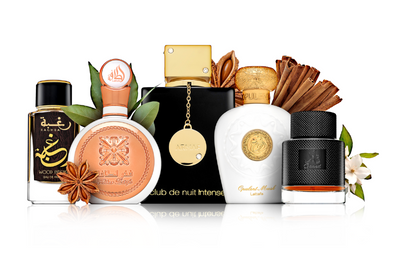
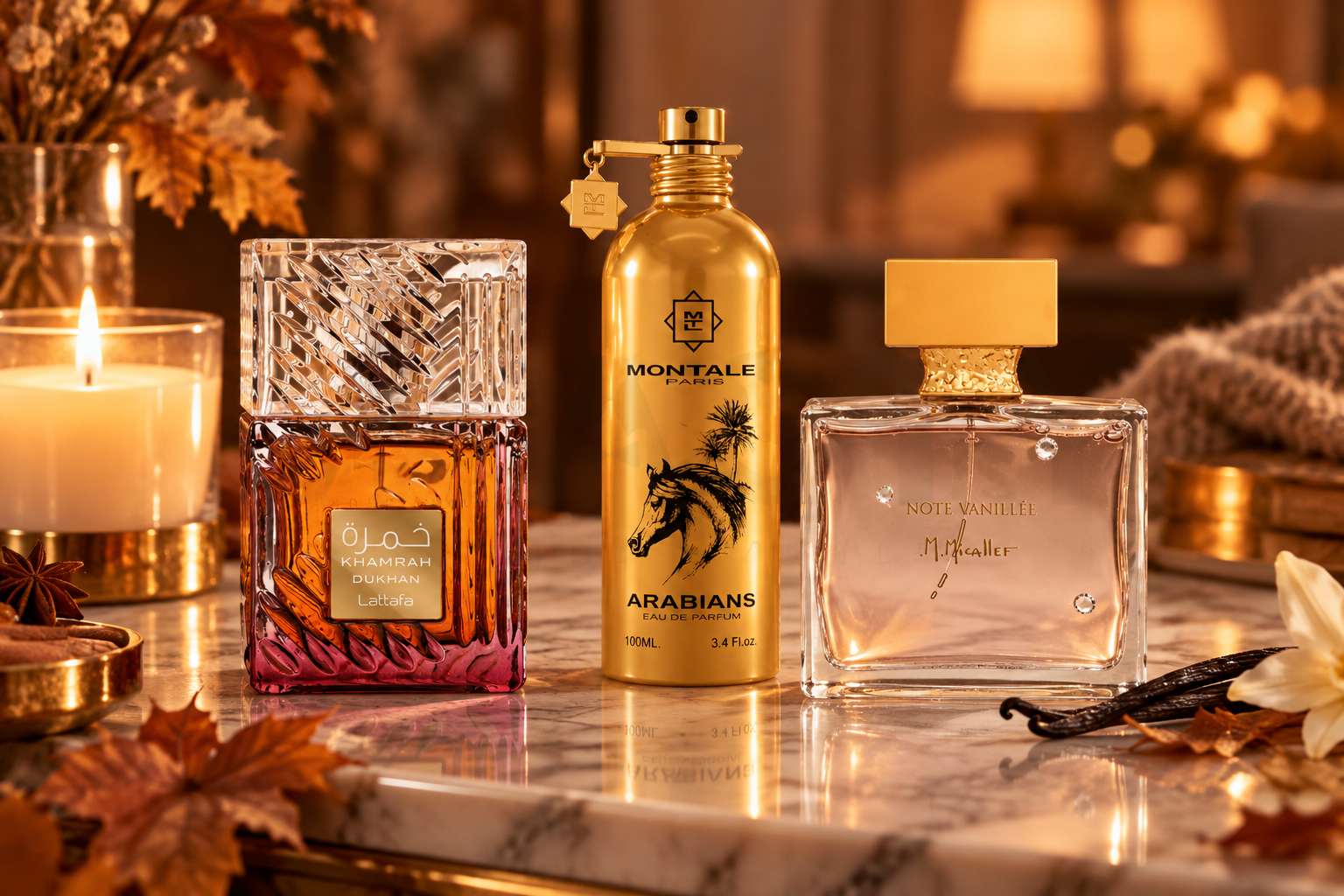
An effective way to connect two scents is through a common ingredient they both contain. The nose perceives it as a continuation of the same theme, not as a competing signal. For baked and coffee candles, choose a perfume that builds on a similar gourmand base – consider Lattafa Khamrah Qahwa Eau de Parfum with coffee and date undertones or the smokier Lattafa Khamrah Dukhan. For candles with a woody amber character, Montale Arabians Tonka Eau de Parfum, with its tonka bean and vanilla notes, complements the warm base, or opt for French Avenue Amber Empire pure perfume if you're looking for a more accessible price range.
The bridge doesn't have to be literal. It's enough if both compositions meet within the same fragrance family – warm spices, wood, vanilla accord. Conversely, a sharp citrus perfume against a dessert candle creates the impression of two unrelated scents in one room.
One Layer Leads, the Other Accompanies
The second principle is even simpler: at any given time, only one scent should play at full volume. When you light a large candle with a strong gourmand note, let the perfume take a backseat. Practically, this means choosing a lighter concentration – preferably an eau de toilette or eau de parfum rather than a pure perfume – and reducing the number of sprays to one or two, ideally on areas not directly in the warm air current from the candle.
The ratio can be reversed at any time. On evenings when the main focus is the scent on the skin, let the candle serve as a quiet backdrop, using a smaller format or a less intense fragrance profile, and opt for a more pronounced composition. Afnan 9 pm Elixir pure perfume with its rich sweet base or Nusuk Ateeq, which maintains its own trail even in a space where another scent is present, can fulfill this role well.
Practical Guidelines to Avoid Disappointment
- Apply perfume before lighting the candle, and never over a burning wick – perfumes contain alcohol, so they should be kept away from open flames.
- In a smaller apartment, opt for unisex compositions. They tend to be more balanced and compete less for attention in open spaces than sharply profiled men's or women's fragrances.
- Test combinations gradually. First, light the candle, let it diffuse for a few minutes, and then assess how much space is left for the perfume.
- Keep in mind that the ambiance changes throughout the evening. The candle intensifies, while the perfume on the skin fades to its base notes, and it's in this phase that you'll know if the pair truly works together.
When you combine these two principles, choosing the second layer stops being a gamble. A shared note ensures the scents make sense together, and a clearly defined dominant layer prevents your living room from turning into an overcrowded perfumery.

Three Perfect Pairings for a Cozy Autumn Evening at Home
Everything mentioned before can be summed up in one sentence: one note should connect both layers, and one layer should lead. To save you the trouble of creating from scratch, we've prepared three ready-made combinations of scented candles and perfumes. For each, you'll find who it's suitable for, which room it fits best, and how to soften or enhance it.
First Pairing: Coffee and Vanilla Evening
The scented candle Yankee Candle Vanilla Creme Brulee and the perfume Lattafa Khamrah Qahwa speak the same language. The candle holds a sweet, slightly caramelized vanilla, while the perfume adds a coffee bitterness, spices, and dried fruits. The shared note is vanilla, with the perfume remaining the dominant layer – the candle provides the base on which the coffee note truly shines.
This combination is perfect for the living room or kitchen, where you might be brewing evening tea or coffee. It's ideal for those who love gourmand fragrances and aren't afraid of a sweet touch. If the pairing feels too dessert-like, light the candle about half an hour in advance and extinguish it before guests arrive – leaving only a warm vanilla trace in the room, with the perfume leading on the skin. To go the opposite direction, simply let the candle burn all evening and apply the perfume to clothing instead of the wrists, so the sweetness lingers longer.
Second Pairing: Woody Amber Serenity
When you want to quiet the evening, reach for the candle Woodwick Santal Myrrh and the perfume Montale Arabians Tonka. Sandalwood with myrrh creates a calm, resinous base in the room, complemented by the perfume's tonka bean, vanilla, and amber. The common denominator here is a woody balsamic depth, making both layers sound like a single entity, not two competing fragrances.
This pairing is the most intense of the three and works best in a larger room with a high ceiling, where the smoky component has space to disperse. We recommend it for those who appreciate oriental and woody compositions and view an evening at home as a ritual. You can soften it with a smaller candle size or a single spray – Arabians Tonka is a perfume where less is more. To intensify it, place the candle further away: the wood will then carry through the space, and the perfume will remain your personal layer.
Third Pairing: Soft Powdery Amber
If the previous two combinations are too rich for you, we offer a softer option. The candle Yankee Candle Soft Wool & Amber smells of clean textiles and warm amber, while the pure perfume French Avenue Amber Empire sharpens the same amber and adds a spicy, slightly leathery outline. The result is powdery and cozy – closer to the feeling of freshly laundered sheets than a dessert.
This pairing is perfect for the bedroom and smaller rooms, where a strong scent quickly saturates. It's also suitable for those who don't usually wear perfume at home and want to start with something subtle. To soften it further, apply the perfume only to clothing and light the candle in an adjacent room; the scent will arrive muted. For a more pronounced evening, simply refresh the perfume after two hours, as soft amber compositions tend to fade on the skin.
How to Apply the Principle to Your Favorite Note
Consider these three pairings as exemplary solutions, not a closed list. The process is always the same: find a note that the candle and perfume share, and decide which layer will lead. In the rest of the Perfumes category, you'll find dozens of compositions with vanilla, amber, and tonka bean, and in the Home Fragrances category, you can complement them with a candle or diffuser from the same family. Whether you stick to the gourmand line or head towards wood, the shared note principle works reliably throughout the autumn.


Category
Recommended articles

"Give a girl the right shoes and she can conquer the world!" Marilyn Monroe