



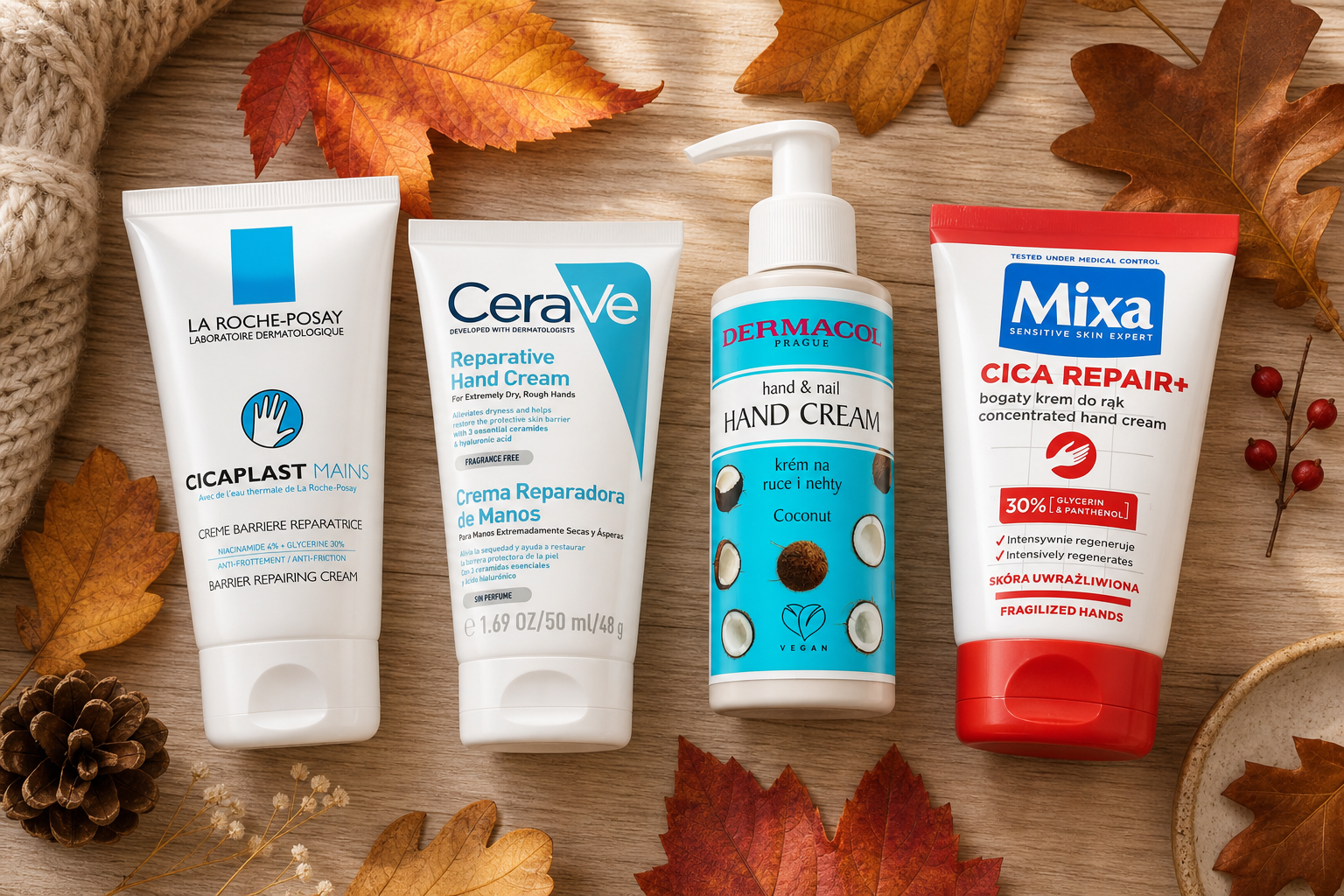
Why Hands Dry Out with the Arrival of Cold Weather
You usually notice it during the first truly cold week. Hands that managed with just one cream in your bag over the summer suddenly feel tight, rough to the touch on the back, and fine cracks appear around the joints, which tug uncomfortably every time you bend your fingers. The skin looks paler, loses its elasticity, and the cream absorbs in seconds without leaving a feeling of comfort. It's nothing unusual or a sign that you've made a mistake in your care – our hands are practically exposed all day and are the most frequently exposed part of the body to water.
The autumn dryness isn't caused by a single culprit, but by a combination of three factors that appear around the same time:
- Lower temperatures outside. As the temperature drops, the air holds less moisture, and the skin loses water faster than it can replenish it. The cold wind speeds this up even more, and your hands burn or itch when you return home.
- Dry air from the heating. In homes and offices, the relative humidity drops significantly when the heating is turned on. The skin dries out even when you're sitting in warmth and feel like nothing is threatening it.
- More frequent hand washing. The cold season means more washing, more disinfecting, and often warmer water than is good for your hands. Each wash removes part of the protective layer that the skin has to rebuild.
Each of these factors alone would likely be manageable for your hands. The problem is that they come all at once and within a few weeks, so the skin doesn't have time to adapt. That's why autumn dryness appears so suddenly: in September, occasional moisturizing was enough, and by mid-October, you feel like the cream disappears faster than you can apply it.
The usual reaction is to reach for the same cream as in the summer and simply apply it more often. But this is usually not enough. A light summer emulsion is designed for different conditions, and more of the same won't replace what the skin lacks in the cold. Autumn hand care isn't about quantity, but about adjusting the entire routine – hands need a different texture during the day than at night, and what and how you wash them with also plays a role.
In this article, we'll go through what actually happens to the skin of your hands in autumn, how to set up washing and daily moisturizing so it doesn't hold you back at work, what extra benefits evening treatment can provide, and how to recognize which care suits your hands best. By adjusting your routine at the start of the heating season, you won't be trying to catch up with cracked skin come January.
Skin Barrier Under Pressure from Cold and Heating
Your hands don't behave differently in autumn just on a whim. The change is due to the skin barrier – the outermost layer of the skin responsible for two things: keeping water in and keeping unwanted elements out. As long as it functions well, you hardly notice it. Once it weakens, you'll feel tightness, roughness, and sensitivity to everyday stimuli that didn't bother you before.
It's easiest to imagine it as a wall. The bricks are the keratinized cells of the outer layer, and the mortar between them is a mix of skin lipids – primarily ceramides, fatty acids, and cholesterol. This fatty mortar holds the cells together and slows down the evaporation of water from the deeper layers. When it diminishes, gaps form between the bricks, and water evaporates from the skin faster than the body can replenish it.
The second important component is natural moisturizing factors. These are small molecules inside the cells of the outer layer – amino acids, urea, lactic acid, and other substances that can bind water and keep it where it's needed. However, they have one disadvantage: they are water-soluble. With every wash using warm water and regular soap, some of them wash away along with the lipids, leaving the skin temporarily without both. Once a day, you won't notice it. Ten times a day over several weeks, you will.
Adding to this is the heating season. Heated rooms tend to have significantly drier air than the autumn weather outside, and dry air draws water from the skin. Cold weather outside is also associated with lower production of skin sebum. The skin thus finds itself in a situation where it loses water faster and has a harder time replenishing its protective layer.
Hands react to this sooner than the face, for two reasons. The skin on the back of the hands is thin and contains significantly fewer sebaceous glands, so it doesn't create as continuous a sebum film as the face. And unlike the face, you immerse, wash, and dry your hands several times a day. Therefore, hands dry out faster, and you notice the change on them first.
From this comes a practical conclusion worth remembering when reading ingredients: hydration and nourishment are not the same, and each addresses a different problem.
- Hydrating component provides water and helps retain it in the skin – this includes glycerin, urea, hyaluronic acid, or panthenol.
- Nourishing, lipid component replenishes the fats missing in the mortar between cells – plant oils, shea butter, squalane, or ceramides.
Water alone without lipids will soon evaporate from the skin, and the feeling of tightness will return. Fat alone without hydration will create a pleasant film on the surface, but won't supply the missing water to dry skin. That's why in autumn, it's worth asking of every product which of the two roles it fulfills – and whether your hand care covers both. This distinction is key to why the autumn routine differs from the summer one: it's not about applying more, but about replenishing what the skin truly lacks.
Daily Routine: Washing, Disinfecting, and Light Textures
Throughout the day, you care for your hands more often than you might realize. You wash them before lunch, after shopping, after a tram ride – and in between, you expose them to the cold air outside and overheated offices inside. That's why it's worth going through your daily routine step by step: each step can be adjusted to prevent unnecessary drying of your hands.
Lukewarm Water Instead of Hot
Hot water feels relieving when you come in from the cold, but it's not good for your hand skin. The hotter the water, the more it strips away the oils that keep your skin supple. So, set the water to lukewarm, roughly body temperature – your hands will get just as clean.
Drying is equally important. Damp skin dries out faster in cold air, so make sure to thoroughly dry your hands after washing, including between your fingers and around your nails. Just press the towel gently against your skin instead of rubbing it.
Cleansing Gel or Oil Instead of Drying Soap
A classic bar of soap cleans effectively, but during the heating season, it can be harsh on your skin. Gentler options include soap-free cleansing gels, cleansing foams, or cleansing oils labeled as suitable for dry and sensitive skin. Cleansing oils turn into a gentle emulsion on wet hands and leave the skin significantly less tight after rinsing. Frequency is key: a few washes a day are manageable for most skin types, but ten or more will make a difference.
Disinfection with Care
Alcohol-based disinfectants make sense in the cold season and aren't necessarily a worse choice than washing. When your hands aren't visibly dirty, a quick disinfection can be gentler on the skin than another cycle of water and cleanser. Choose products that contain glycerin or panthenol, and always let them dry before applying cream.
Cream on Slightly Damp Skin
A simple change with a big effect: apply cream within a minute or two after washing, while your skin is still slightly damp. This way, the cream seals in the moisture left in the skin, rather than trying to add moisture to already dry hands. Don't forget the back of your hand, the skin over the joints, and around the nails – these are the areas where tension and small cracks appear first.
Light Textures That Last Through the Workday
The main reason people give up on moisturizing during the day is the greasy film. The solution is lighter forms of care: emulsions, fluids, and creams with a more watery consistency that absorb quickly. They work with humectants like glycerin, hyaluronic acid, or urea in lower concentrations, complemented by a smaller proportion of oil components.
- Emulsions and Fluids – quick absorption, allowing you to type on a keyboard or flip through papers right after application.
- Hand Serum – the lightest option for more sensitive skin that doesn't tolerate heavier textures well.
- Medium-Weight Cream – a compromise if your hands are very dry and light care isn't enough.
Rich balms have their place, but save them for times when you don't need your hands immediately. During the day, it's more practical to choose something that won't slow you down.
Place Bottles Where You'll Really Use Them
Daily hand care depends on accessibility. One bottle in the bathroom usually results in two applications a day. Several smaller bottles placed around the house and in bags will change your routine more than the most expensive formula.
- by the kitchen sink, where you wash your hands most often,
- in the bathroom by the sink,
- on your desk or in a drawer at the office,
- in your handbag, backpack, or winter coat pocket.
For travel, small bottles up to thirty milliliters are practical, while at home, larger bottles with a pump make sense. And a simple rule helps: wherever you wash your hands, make sure there's a cream nearby.
Night Treatment: Rich Balms and Hand Masks
During the day, hands are constantly interrupted – washing, disinfecting, typing, carrying shopping bags. A cream applied at ten in the morning often lasts only until the first rinse. Night is the only time of day when hand care can be completely undisturbed: the skin isn’t washed for several hours, doesn’t rub against clothing, and the richer texture has time to fully absorb. If you want to change just one thing in your autumn routine, let it be your evening step.
Rich Balm Instead of Day Cream
A day hand cream is always a bit of a compromise. It needs to absorb quickly, not slip on the keyboard or leave prints on paper, so it tends to be lighter and more watery. In the evening, you don’t have to compromise – instead, opt for the richest texture you can tolerate.
Rich balms and hand ointments have a higher content of fats and oils, or lipids, compared to daily emulsions, replenishing what is washed away with warm water during the day. The composition of autumn balms regularly includes:
- urea – softens hardened skin and helps retain water; suitable for rough backs and hardened areas around joints,
- panthenol – used in soothing products for irritated and mechanically stressed skin,
- glycerin – a classic moisturizing ingredient that binds moisture,
- plant butters and oils, such as shea butter – create a layer on the surface that slows water evaporation.
You can recognize a balm by how it behaves: it’s thicker, spreads more slowly, and remains noticeable on the skin for a while after application. What would bother you at work is exactly what you want in bed at night.
Evening Routine Step by Step
The entire treatment takes two minutes and is worth doing the same way every time:
- Wash your hands with lukewarm water and a gentle cleansing gel or oil, and pat them dry, don’t rub.
- Apply the balm in a significantly thicker layer than you’re used to during the day – enough so that it remains visible for a while.
- Massage it in circular motions into the backs, between fingers, joints, and around the nails. Palms can handle more, the back of the hands has few sebaceous glands and needs the most attention.
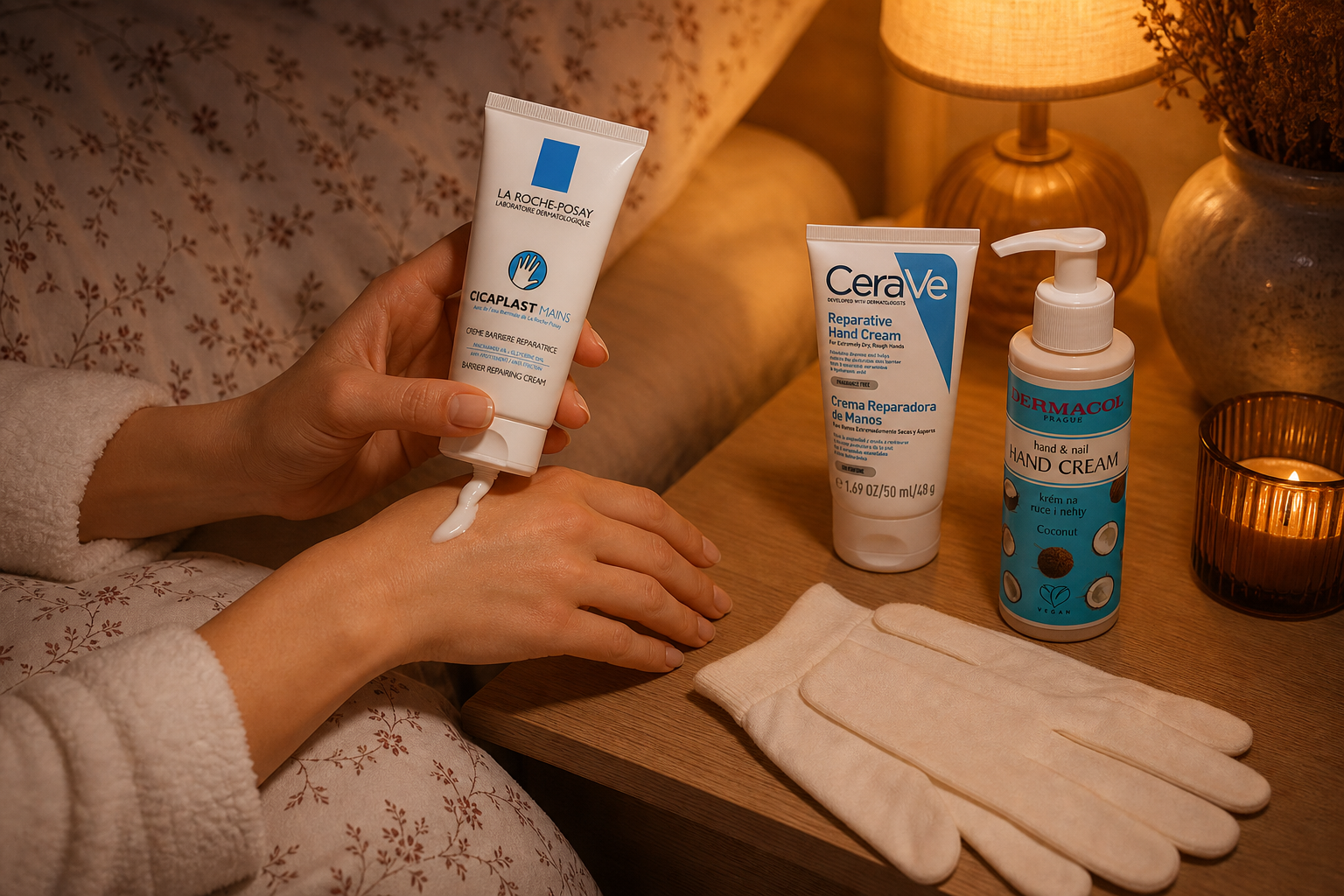
- Put on thin cotton gloves and leave them on overnight.
Cotton gloves aren’t just a fancy accessory. They keep the balm on the skin instead of the bedding, prevent you from wiping it off in your sleep, and by slightly enclosing the environment, they support its absorption. They don’t need to be special – just thin cotton ones that can be washed. If gloves bother you in bed, try them at least twice a week.
Hand Masks and Nail Cuticles
When the skin is really dry, a more intensive step can be taken once a week. Ready-made hand masks usually come in the form of disposable gloves soaked in a thick serum: you put them on for ten to twenty minutes according to the instructions, then remove them and massage the remaining product into your hands. The advantage is that you don’t have to measure or mix anything. However, you can achieve a similar effect with a regular balm: apply it in a really thick layer, put on gloves, and leave it on longer than usual.
What is most often forgotten in evening care is the nail cuticle. In the cold, it cracks among the first because it is thin and has practically no protection of its own. Just rub a drop of nail oil or any plant oil into it after applying the balm and massage it gently with your fingertip. It’s better not to cut the cuticle – gently pushing it back after a bath when it’s softened is more gentle on the hands.
The difference is usually noticeable after several weeks of regular evening care rather than after a single night. That’s why it’s worth introducing the evening step right at the start of the heating season, while hands are only slightly dry.
How to Choose the Right Hand Care for You
When we sum up the entire autumn routine, it fits into three moments of the day. In the morning, a light layer that absorbs quickly and doesn't interfere with work. During the day, reapply cream after every wash, preferably on still damp skin. In the evening, the richest step that has all night to restore missing lipids to the skin. This rhythm applies to all types of hands; only the consistency and composition of the products differ.
- Morning: light emulsion or fluid, non-greasy finish, small packaging for your handbag or desk.
- During the day: gentle cleansing gel or oil instead of regular soap, lukewarm water, cream after every wash.
- Evening: rich balm with a higher lipid content, a hand mask once a week, cuticle care.
The last question remains: what composition and texture to choose for your hands. The following three situations cover most of what you'll encounter this autumn.
Generally Dry Hands That Feel Tight in Winter
If your hands only occasionally surprise you with a feeling of tightness and roughness after the autumn chill, a simple duo will suffice: a lighter day cream and a richer night balm. From our range of facial and body cosmetics, Bioderma Atoderm PP Baume or La Roche-Posay Lipikar Baume AP+ M fit well here – both are designed for dry skin all over the body, so you can confidently use them on the backs of your hands. Large packages have a practical advantage: you don't have to skimp on them and can easily leave one in the bathroom and another by your bed.
Very Dry and Flaky Skin
When the skin on the backs of your hands peels, cracks around the joints, and itches, ordinary hydration is not enough. Look for products with a higher oil content, urea, or panthenol, which provide fats in addition to water. This group includes the oil balm Uriage Xémose, specifically designed for very dry skin prone to itching. Apply a more generous layer in the evening and let it sit for a while before reaching for your phone or book. Once a week, you can complement your routine with a hand mask – for example, the moisturizing and smoothing Dermacol mask, which acts as a more intensive version of evening treatment.
Sensitive Hands and Frequent Washing
Do you work in healthcare, gastronomy, or with preschool children? Then the most important change for you is not the cream, but what you wash your hands with. Replace regular soap with a gentle cleansing oil or shower gel without harsh surfactants – like those offered by the Bioderma Atoderm or Uriage Cleansing Oil lines. Oil-based cleansers leave a gentle film on the skin, reducing the feeling of dryness after repeated washing. Choose follow-up care without fragrance and with a short ingredient list; sensitive skin usually reacts more calmly to fewer ingredients.
The final tip is not about selection, but timing. It's worth setting up your routine right at the start of the heating season, while your hands are still in good condition. Cracked and inflamed skin takes a long time to heal, and care at that point is more about putting out fires than preventing them. One change a week is enough: first, replace the soap, then add an evening balm, and finally, supplement with a small package for your handbag. In a month, you'll have a routine that lasts until spring.
Category
Recommended articles
"Give a girl the right shoes and she can conquer the world!" Marilyn Monroe