

A seasonal selection for readers returning from vacation with dry and dull blonde hair: six products including masks, oils, and leave-in treatments to restore shine and volume. We'll also advise on the order to incorporate them into your weekly routine.
Why Blonde Hair Becomes Dry and Dull After Summer
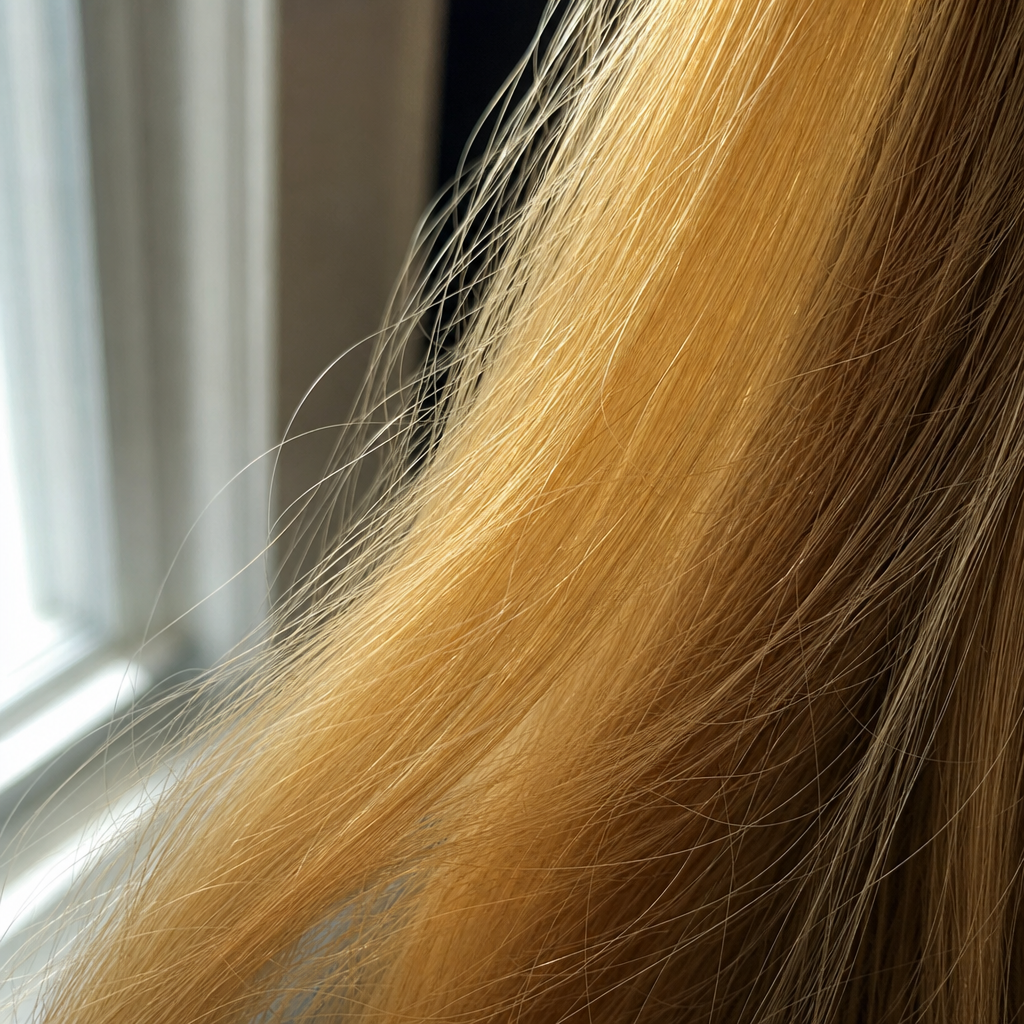
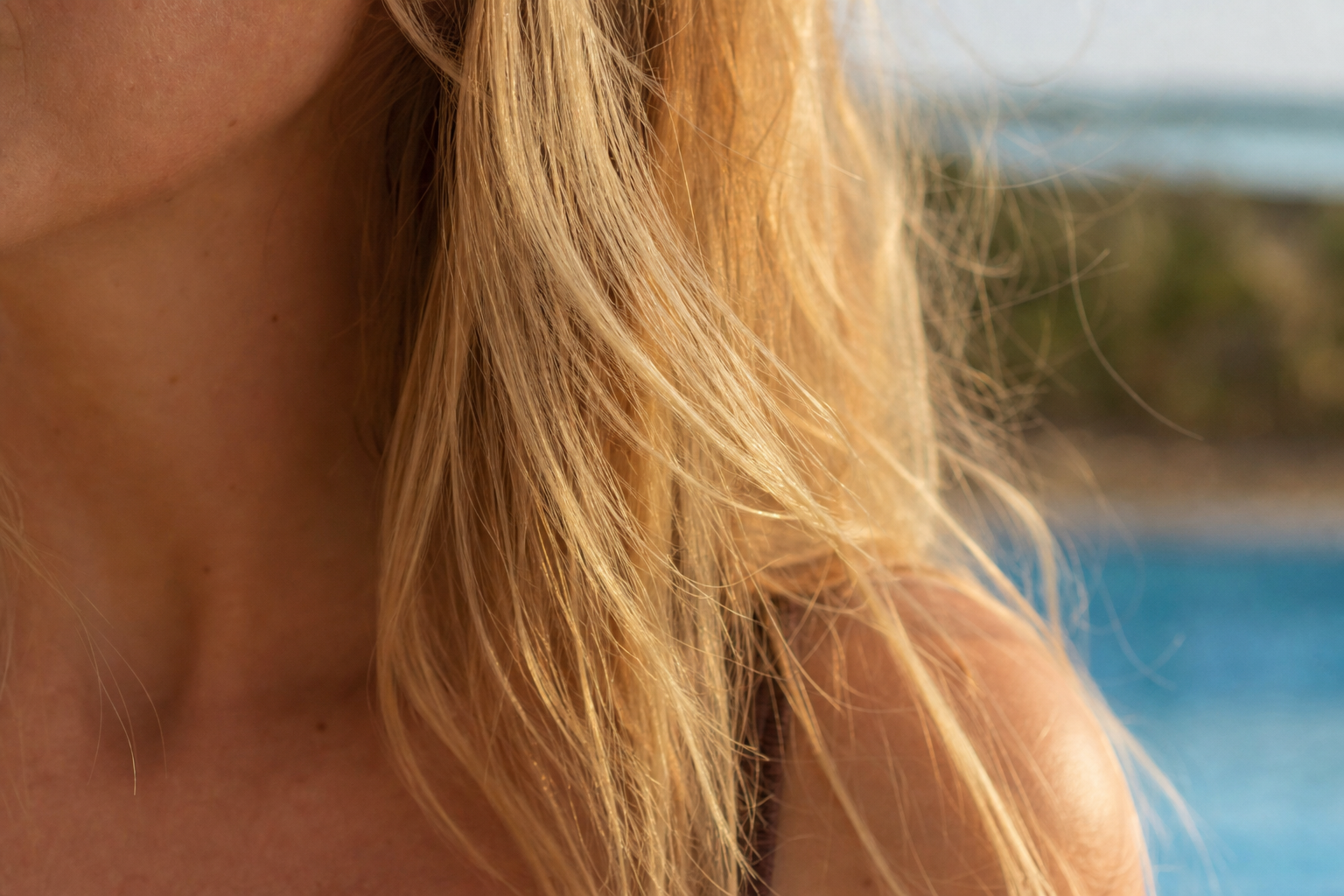
Whether you spend your summer by the sea, at the pool, or just on the balcony with a book, blonde hair usually takes more from the season than the rest of your hairstyle. By the end of August, it tends to feel drier to the touch, is harder to comb, and doesn't reflect light as willingly as it did in spring. This isn't due to one dramatic event, but rather a combination of small influences that have affected the hair over several weeks.
Three factors typically come together to dry out light hair in the summer:
- Sunlight – The ultraviolet component of sunlight gradually disrupts the protein structure of the hair and breaks down residual pigment. The hair may appear even lighter, but it is also weaker and drier than at the beginning of summer.
- Saltwater – Salt from swimming dries on the hair and draws out moisture. The surface remains rough, making the hair harder to comb and more prone to tangling in the wind.
- Chlorinated Water – Disinfectants and minerals from the pool settle on the hair's surface. In lightened lengths, this typically results in a loss of shine and a shift in tone to brassy or even greenish hues.
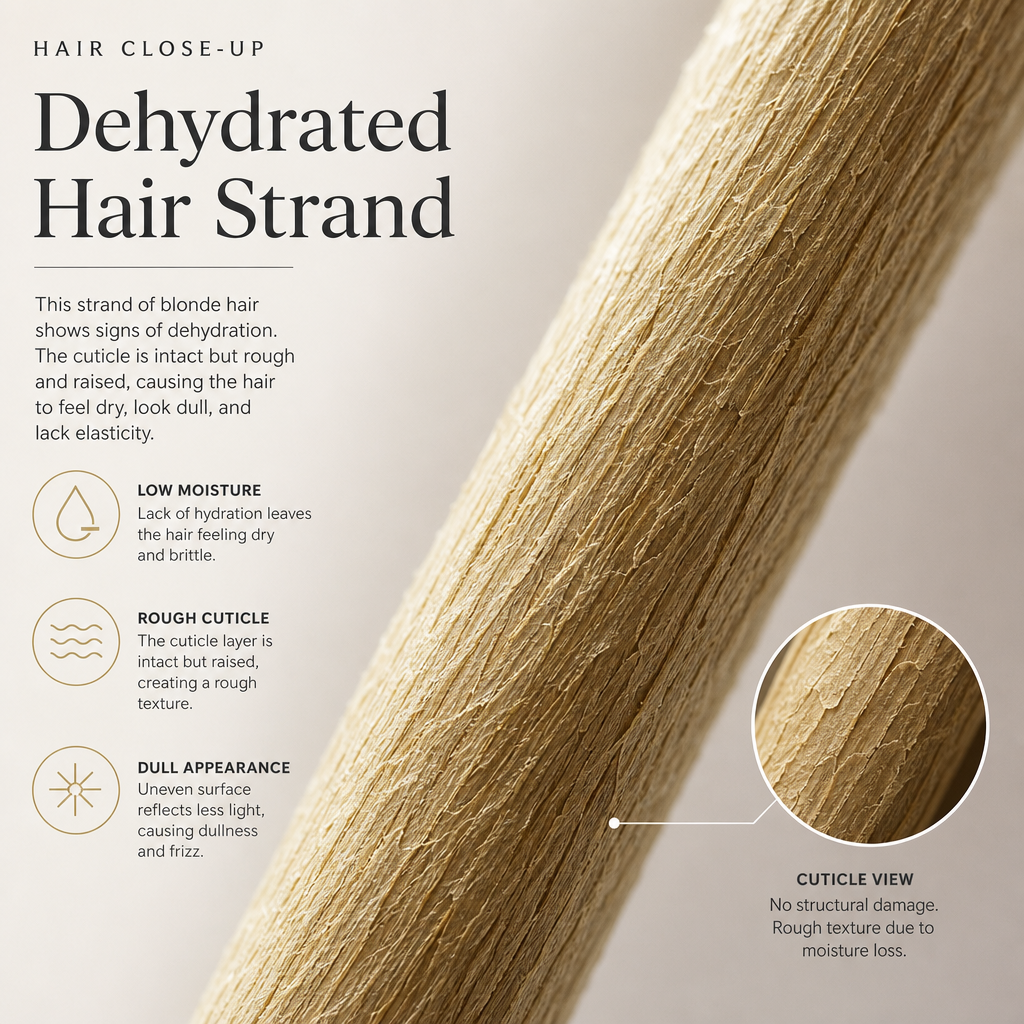
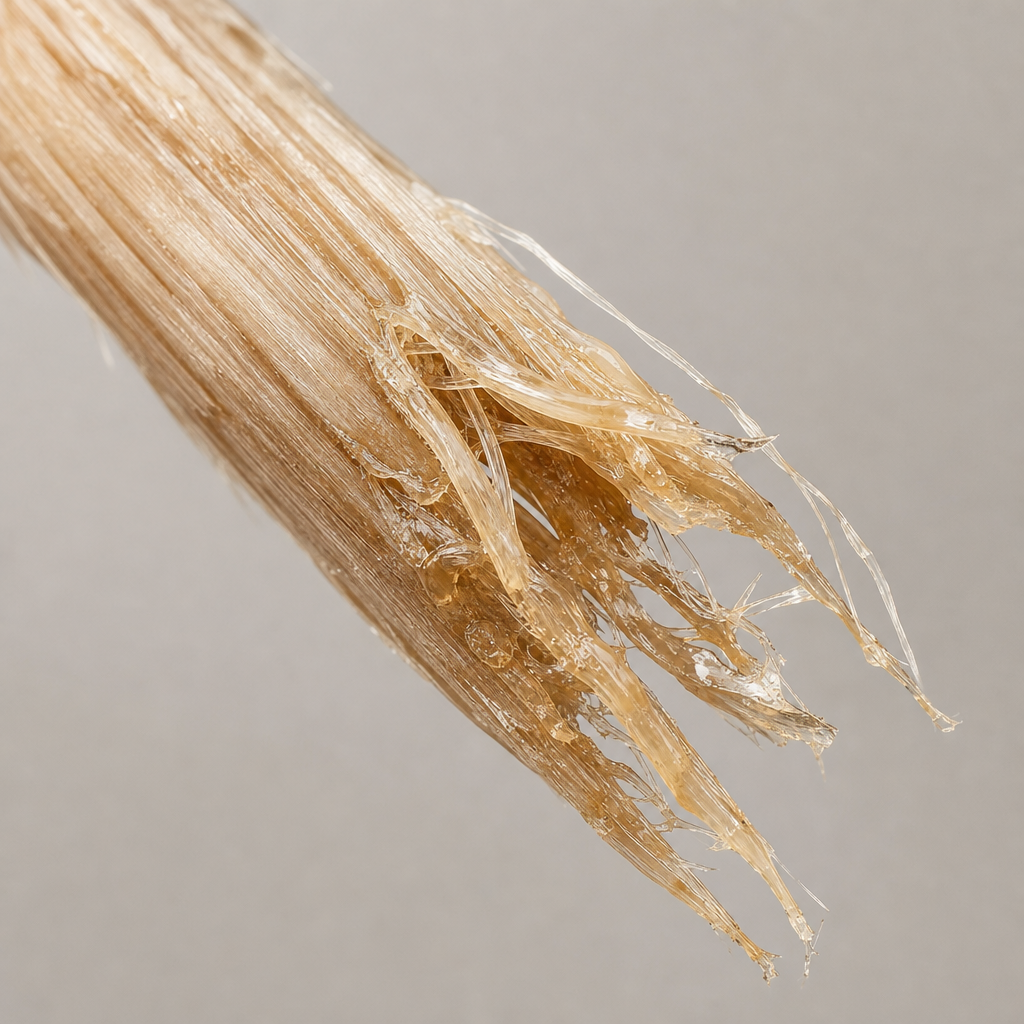
The condition that summer sun and water leave your hair in is technically called increased porosity. The surface of the hair is made up of the cuticle – a layer of fine scales that lie closely together in healthy strands. In dry hair, the scales are lifted, allowing water to quickly enter and just as quickly escape. In practice, this means hair dries noticeably fast after washing, stretches more when wet, and forms small knots at the ends.
Lightened or highlighted hair starts from a worse position than natural blonde. To achieve a light shade, its structure has undergone a chemical process that opened the cuticle and permanently altered part of the internal mass. Hair is not living tissue, so such an intervention doesn't heal on its own – the strand simply continues to grow with it. Therefore, summer doesn't affect untouched hair, but hair that has already been stressed. This is why seasonal dryness is more pronounced in blonde hair, and why subsequent care requires more effort than with untreated darker hair.
Porosity is closely linked to the loss of shine, which is the first thing you'll notice after the holidays. Hair shine is nothing more than light reflecting off a smooth surface: the more evenly the scales lie, the clearer the reflection. A disrupted cuticle scatters light in all directions, making hair appear dull even shortly after washing. The warm yellowish tint that often appears on lightened hair during summer also contributes to this impression, reducing the freshness of the shade.
The good news is that the hair's surface can be smoothed, and missing moisture and nourishing components can be restored through care. In the following sections, we select six specific products that can handle this task: masks for deep regeneration, oils for smoothing the surface, and leave-in treatments for everyday shine. We will also turn to the restorative ranges from brands like Wella Professionals and L'Oréal Professionnel, which are designed for this type of damage. All the mentioned types of products can be found in the hair care category on Brasty, so you can create a routine without mixing several shops.
Pre-Purchase Diagnosis: Dryness, Damaged Structure, or Yellow Tint
Before selecting a specific product, it's worth spending a few minutes in front of the mirror. Blonde hair returns from the sun and salty or chlorinated water in three quite different states, each requiring a different type of care. If you choose a rich reconstructive mask when your hair mainly lacks moisture, you'll end up with a weighed-down and limp hairstyle. Conversely, light hydration won't fix hair whose outer layer is already mechanically damaged.
A simple test can help distinguish the states. Take a single strand of hair between your fingers, gently stretch it, and observe its behavior:
- rough to the touch, but flexible and intact – dehydration prevails,
- rubbery and stretchy, or conversely brittle with split ends – indicates a damaged structure,
- straw-like to brassy in appearance – the condition is accompanied by a question of shade.
Dryness: Hair is Rough but Still Flexible
The mildest of the three states. Hair looks dull, is difficult to comb, quickly absorbs water after washing, and loses it just as quickly. It becomes static, the ends appear straw-like, but they don't break under your fingers. Here, it's worth looking at hydrating hair masks and complementing them with hair oil, which seals the hair surface and slows down water evaporation. You won't lose volume if you apply the oil only to the lengths and ends.
Damaged Structure: Brittle Ends, Rubbery Length
You can recognize it by the fact that wet hair stretches like rubber when combed and instead of returning to its original length, it breaks. White dots on the ends, significant splitting, and irregular structure along the length are common. Here, hydration alone is not enough – look for hair masks labeled as reconstructive, protein, or reparative and complement them with leave-in treatments that protect the lengths between washes and during blow-drying. In lightened hair, both states often combine, so don't hesitate to alternate between hydrating and reconstructive treatments based on what your hair currently needs.
Yellow Tint: Shade Has Shifted to Warm Tones
The third state is not about condition but about color. Sun exposure, chlorine, and minerals in water gradually wash away cool pigments, revealing a warm yellow to brassy undertone. You can most reliably assess it in daylight by a window, not under a bathroom bulb – which naturally supports warm tones. The solution is a toning treatment with purple or blue-violet pigment, found among both hair masks and shampoos. The pigment won't bleach the shade, just optically balance it, and its effect is therefore counted in several washes, not months.
Professional Lines vs. Regular Drugstore
Lightened hair is a specific material, and salon lines address it more directly. They are often designed as comprehensive systems where shampoo, mask, and leave-in care complement each other, offering a wider range of toning shades tailored specifically for blondes, and due to higher concentration, they are usually dosed more sparingly. Practically, this means that a higher price per package doesn't necessarily mean a higher price per use. The professional branch of hair cosmetics is covered by brands like Wella Professionals, Schwarzkopf Professional, L'Oréal Professionnel, or Kemon – each of these brands offers a line focused directly on colored and lightened hair.
Once you know which of the three states predominates for you, the selection narrows down to one or two categories. Most blondes after summer deal with a combination of dryness and tint, so a duo of a hydrating mask plus toning treatment works well; for truly damaged structure, prioritize reconstruction and incorporate toning once the hair is strengthened.
Three Masks to Restore Hair Density and Tone
Masks work differently than conditioners. They stay on the hair significantly longer, contain a higher concentration of nourishing ingredients, and work inside the hair fiber, not just on its surface. For hair lightened to blonde, this makes a significant difference after summer – sun and chlorinated water disrupt the keratin structure, making the hair porous and losing elasticity. The following three masks address three different situations: damaged structure, severe dryness of lengths, and the warm tint that blonde hair often acquires after summer.
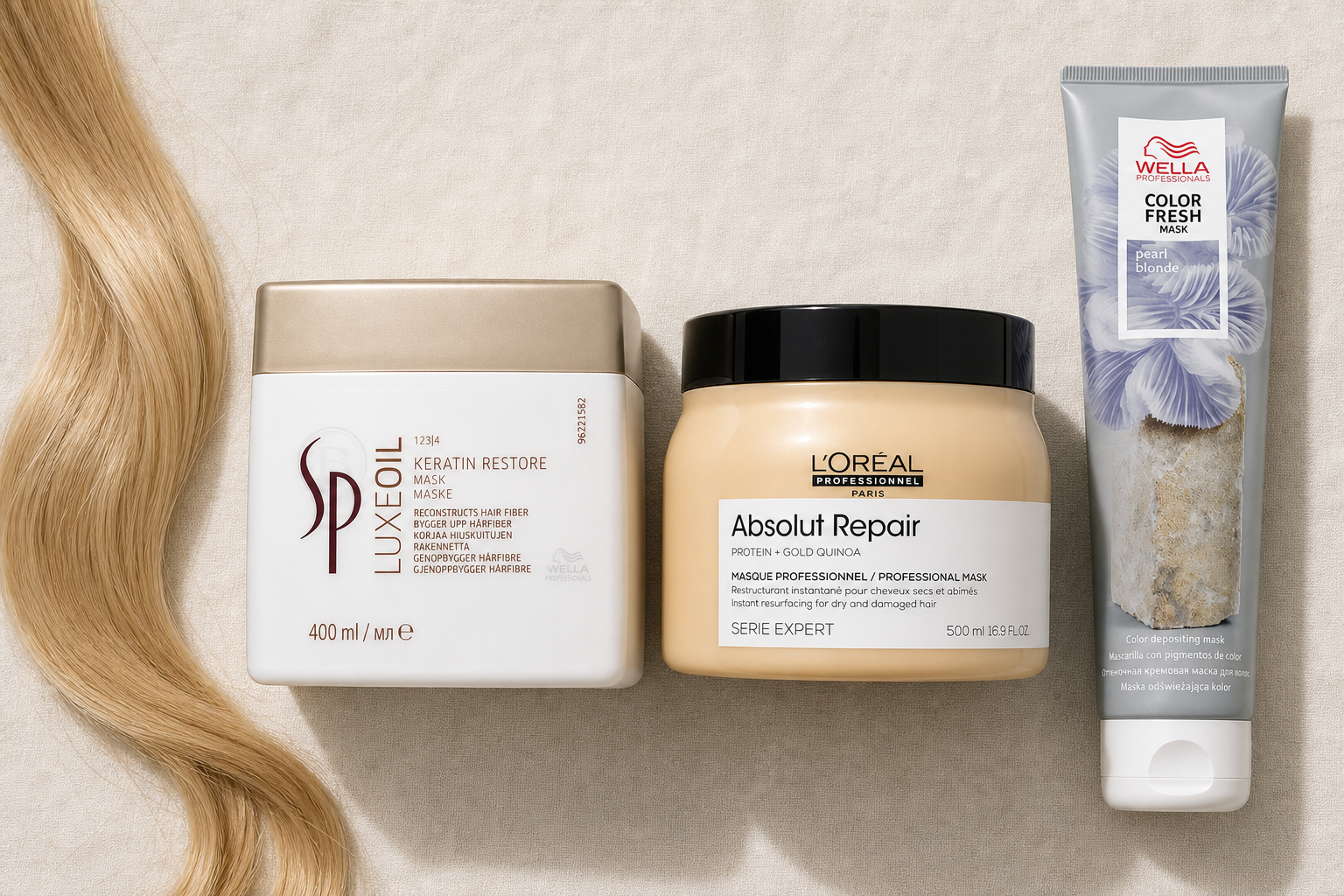
Wella Professionals SP Luxe Oil Keratin Restore Mask 400 ml
The SP Luxe Oil range is based on replenishing keratin, the protein that largely makes up hair. The mask has a thick consistency, yet it doesn't weigh down the lengths – after rinsing, the hair remains elastic and holds its shape better, making the hairstyle appear fuller. Opt for this if your hair breaks halfway down the length, splits at the ends, and stretches like rubber when wet and combed. A 400 ml package is enough for longer hair for several months.
- For whom: Blonde hair with a damaged structure due to bleaching, highlights, or frequent heat styling.
- How often: Once a week, for severely damaged lengths, twice a week during the first month.
- Application time: Five to ten minutes on towel-dried hair, then rinse thoroughly.
L'Oréal Professionnel Série Expert Absolut Repair Mask 500 ml
Absolut Repair targets very dry and mechanically damaged hair. The texture is creamy and rich, making it more suitable for thicker or coarser hair – fine blonde hair might be weighed down and lose volume with every wash. It is especially appreciated by long lengths that have undergone several seasons of coloring and summer by the water. The 500 ml package corresponds to a salon format, which is worthwhile if you use the mask regularly throughout the autumn.
- For whom: Very dry lengths and split ends, preferably thicker hair types.
- How often: Once a week; for fine hair, preferably once every two weeks and only on the lengths.
- Keep in mind: Apply from mid-lengths down, not on the scalp – at the roots, hair would become limp.
Wella Professionals Color Fresh Mask Pearl Blonde 150 ml
This mask belongs to a different category. Besides care, it contains direct pigments that refresh the blonde shade and simultaneously tone down the warm, yellowish tint. It's not a dye; the pigment gradually washes out, allowing you to subtly adjust the shade between salon visits. The pearly tone suits cool blonde shades; for warm honey blondes, use it cautiously and for a shorter duration to avoid a grayish result.
- For whom: Cool and pearly blondes that have warmed to yellow over the summer.
- How often: Depending on the intensity of the tint, approximately once every one to two weeks, excluding days with a restorative mask.
- Keep in mind: Work with gloves, apply to towel-dried hair, and shorten the application time based on how readily the hair absorbs the pigment.
You don't have to buy all three masks at once. If your hair primarily needs structural strengthening, start with the keratin variant; if it's mainly dry, intensive repair makes more sense. Add a toning mask when the length is already in decent condition and you're mainly addressing the shade – on highly porous hair, pigment deposits unevenly, and the result can be patchy.

Oils and Leave-In Care for Shine Without Weighing Down
A mask can do a lot, but it only works during the few minutes it's in your hair. Lightened lengths after summer need support between washes, and that's where oils and leave-in care come in. For blonde hair, it's all about a delicate balance: you want smoothness and shine, not a greasy film that darkens the light shade and makes the lengths stick together. The following trio covers three different situations you'll most commonly encounter after the holidays.
Oil or Milk? Each Solves a Different Problem
Oil primarily works on the hair's surface. It smooths the cuticle, so light reflects more evenly and less frayed lengths appear shinier. It's a typical finishing layer – applied to the ends and the lower half of the lengths, whether before blow-drying or on a finished hairstyle.
Leave-in milk has a different task: it provides moisture, significantly eases detangling, and creates a light layer that helps hair withstand the heat of a blow dryer or straightener. After summer, it's a more practical choice wherever lengths tangle and break during combing. Both types of care are not mutually exclusive – milk addresses structure and manageability, while oil focuses on the final look.
Three Products for Everyday Use
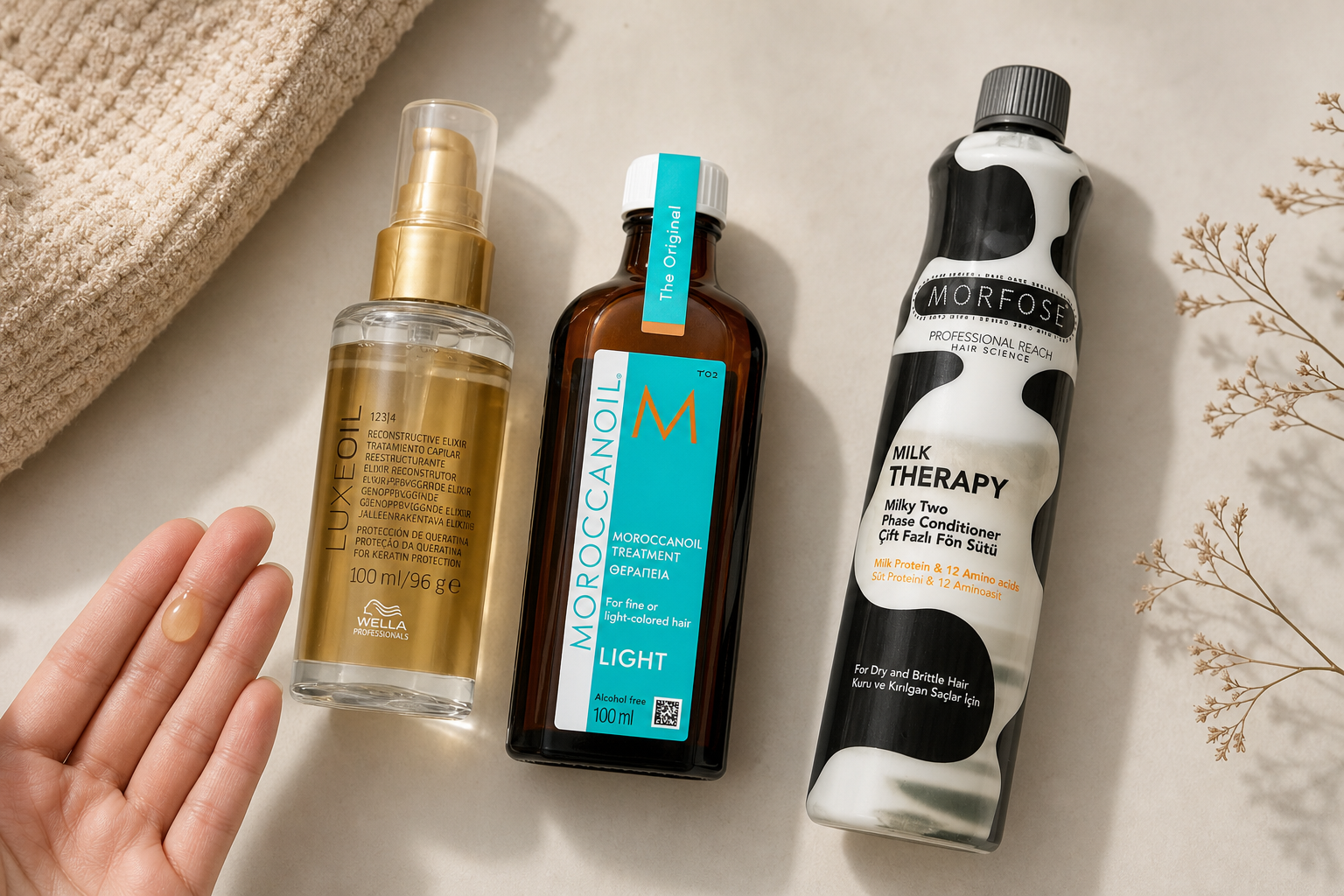
Wella Professionals SP Luxe Oil Reconstructive Elixir 100 ml is a lightweight oil, especially suitable for the ends. It can be worked into damp hair before blow-drying or added in minimal amounts to dry lengths when they need smoothing after a long day. For lightened hair, you'll appreciate that it can be dispensed drop by drop and doesn't need to be applied along the entire length. If you used a mask from the same range in the previous step, both treatments complement each other as they work on the same logic of treating stressed lengths.
Milk_Shake Incredible Milk 150 ml is a multi-purpose leave-in spray. It comes into play right after towel-drying, sprayed onto damp hair, and its main benefit is evident during detangling: the comb glides through the lengths without pulling, so weakened blonde hair breaks less. It also serves as an intermediate step before heat styling. For everyday routines, it's the most versatile piece of the entire set – handling detangling, light hydration, and blow-dry preparation in one application.
Moroccanoil Treatment Light 200 ml is a lighter version of the classic oil treatment, designed for finer and lighter hair. If you have thin blonde hair where regular oil immediately feels heavy, this is a safer path to shine. The texture is thinner, spreads more easily, and is harder to overapply. It's the most expensive item in the selection, but a 200 ml bottle lasts a long time with moderate use.
Dosage: The Detail That Matters Most
For lightened hair, the amount matters more than the product's strength. An excessive dose of light oil can do more harm than a small dose of rich treatment – hair becomes limp, the shade darkens, and it looks unwashed the next day. Therefore, stick to a few principles:
- Start with one pump of oil and two to three sprays of milk. You can always add more, but you can't take it away.
- Apply from the ends upwards and leave the roots alone. On blonde hair, oiliness in the upper part is immediately noticeable.
- Rub the product between your palms before touching your hair. Applying "in one spot" creates a darkened strand.
- Both oil and milk work better on damp hair than dry. Leave only the final touch of shine for dry lengths.
- If you have a short bob, reduce the dose to about half compared to long hair.
A week of moderate dosing will tell you more about your hair than any recommended amount on the label. Observe how the lengths look the day after washing – if they maintain volume at the roots and the ends aren't frayed, you've got the dosing just right.


How to Incorporate Six Products into Your Weekly Routine
Six products only make sense when each has a clear place in your weekly routine. Otherwise, you might find yourself alternating between a heavy mask and oil almost every other day, leaving your hair limp and making you think the care isn't working. The following plan is designed for the first month after returning from vacation when blonde hair is most affected by sun, salt, and chlorine.
Foundation: What to Use After Every Wash
The entire routine is held together by shampoo. If you've chosen a restorative mask, it's worth sticking with the same line – for example, Wella Professionals SP Luxe Oil Keratin Protect Shampoo complements the keratin line SP Luxe Oil, while L'Oréal Professionnel Série Expert Absolut Repair Professional Shampoo pairs with the mask from the same series. Products within the same line are designed to work together, so you don't have to guess if two products are competing with each other.
Wash your hair two to three times a week rather than daily, and apply shampoo mainly to the scalp; the lengths will rinse themselves when you wash out the foam. After towel drying, apply leave-in care – it should be applied to damp hair from mid-lengths down and is the only step you repeat every time in this plan. Save the oil for the end of styling and use it sparingly; for fine blonde hair, usually one to two drops rubbed in the palms is enough.
Once a Week: Restorative Mask
Use a thick restorative mask once a week, instead of conditioner. Apply it to well-towel-dried hair, as it will run off wet lengths and won't adhere. Five to ten minutes according to the instructions is plenty – longer exposure won't improve the result, it will just increase the risk of your hair feeling heavy the next day.
Every Two Weeks: Toning Mask
Toning is only effective once the structure is at least partially treated. Porous hair after summer absorbs pigment unevenly, and the shade lasts a shorter time. For the first two weeks, focus on restoration, and introduce the toning mask once the lengths no longer feel rough to the touch. Then, use it every two weeks instead of a regular mask, and for a shorter time – it's harder to reduce the tone than to add it.
Sample Week
- Monday – Wash with shampoo from the chosen line, restorative mask, leave-in care, a drop of oil on the ends.
- Wednesday – Wash, conditioner or directly leave-in care and heat protection before blow-drying.
- Friday or Saturday – Wash and every other week use a toning mask; otherwise, just light care and oil on the lengths.
What to Avoid During the First Month
- Hot washing. High water temperature opens the hair cuticle, making the color appear duller. Wash with lukewarm water and finish with as cool a rinse as is comfortable for you.
- Styling without heat protection. Flat irons or curling irons should not be used on unprotected hair, especially after summer. A heat protection product is cheaper than another set of masks.
- Everything at once. Mask, serum, and oil in one wash will weigh down blonde hair. Stick to one intensive step per wash.
- Impatience with toning. Purple pigment won't repair damaged structure, it only covers the tone.
Consider the six products as a framework that you can adjust to your needs. At Brasty, you'll find hair masks, hair oils, and leave-in care as separate categories of hair cosmetics, so you can tailor the plan to what your hair needs most after summer.
Category
Recommended articles

"Give a girl the right shoes and she can conquer the world!" Marilyn Monroe