

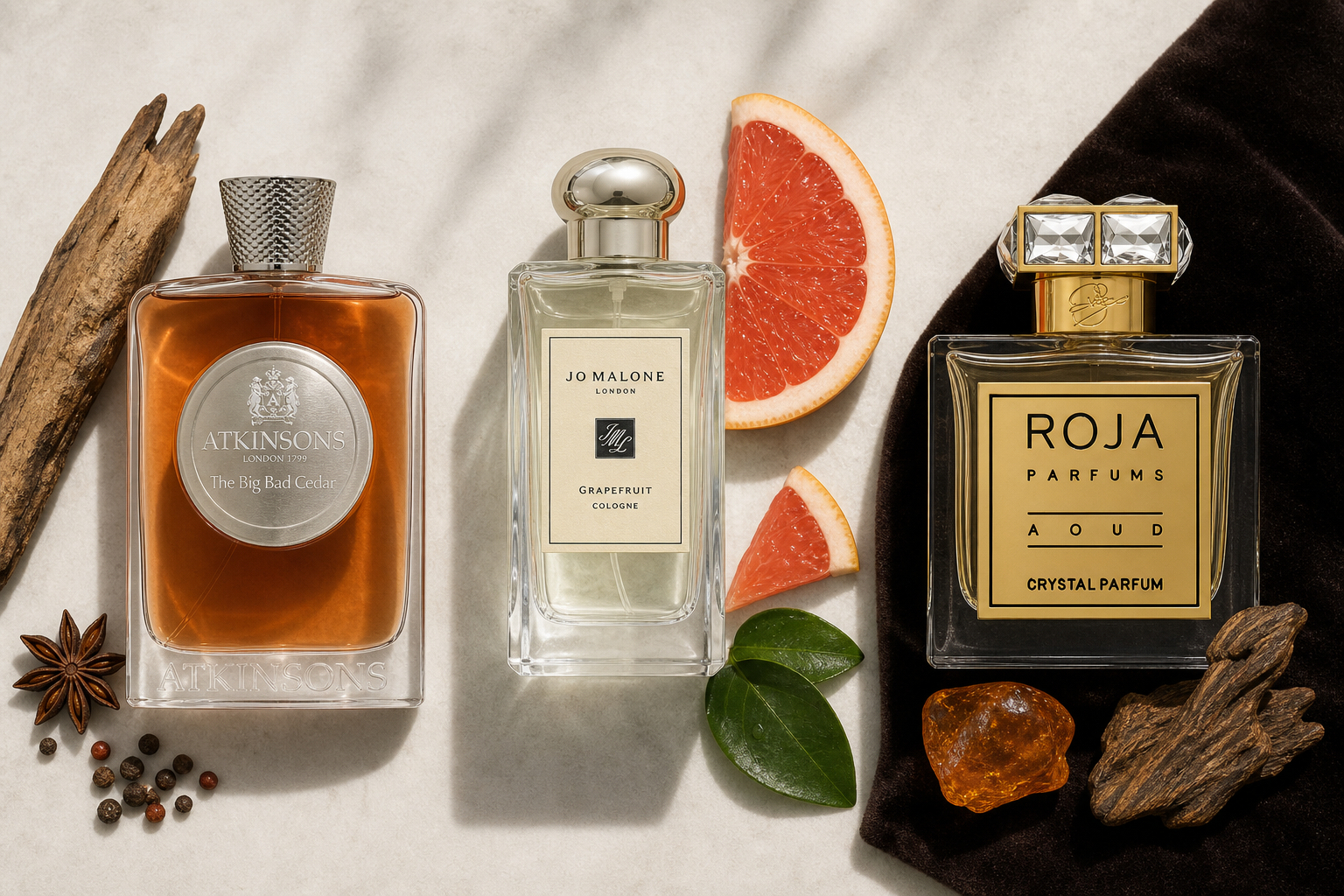
Are you familiar with Arabian and French niche houses and want to explore the British school of perfumery? We present three British brands from Brasty's selection – the historic Atkinsons, the minimalist Jo Malone London, and the ultra-luxurious Roja Parfums – and we pick three perfumes from each to try.
The British School of Perfumery: How It Differs from France and Arabia
Whether you're drawn to French elegance or the richness of Arabian compositions, British niche houses offer a third path. It's worth exploring before you reach for a specific bottle – the British signature isn't recognized by a single ingredient or fragrance family, but by the way the perfumer handles the material.
The French school, known from brands like Dior, Chanel, or Yves Saint Laurent, is based on abstraction. A composition should be a picture, not a list of ingredients: individual notes are layered until they merge into an impression that can't be broken down into parts. Arabian perfumery, now very popular among Czech customers thanks to brands like Lattafa or Afnan, takes the opposite approach – it works with high concentration, rich amber, oud, and sweet balsams and isn't afraid to be heard across the room.
The British approach lies somewhere in between and follows a different logic. It doesn't aim to impress with loudness or opacity. A typical British composition has a discernible core: you can recognize grapefruit, rose, cedar, or blackberry because the main ingredient remains recognizable at first sniff, and the rest of the composition frames it. The result feels restrained, almost matter-of-fact – and this restraint is intentional, not a lack of imagination.
The second hallmark is the motif of the English garden. British houses repeatedly return to ingredients that grow behind the house or in the greenhouse: roses, honeysuckle, rhubarb leaf, grass after rain, damp earth, hedge wood. It's not about rural nostalgia, but an olfactory vocabulary that the British customer has known since childhood and which appears much less frequently in continental perfumery.
The third line leads to the tradition of colognes. London houses grew out of pharmacy and barber operations, where light citrus waters were mixed for everyday refreshment, not festive evening perfumes. This results in the more moderate strength of some compositions and the habit of combining and layering scents – in Britain, it's common practice, not an experiment for enthusiasts.
The fourth element is the spices brought from colonial trade routes. Pepper, cardamom, saffron, ginger, oud, and rare woods reached London by sea before most European cities and became ingrained in British perfumery. Therefore, you may encounter a composition that looks like an English classic but opens into oriental warmth in its base notes.
Summed up in four points, you can usually recognize the British signature by:
- restraint – the composition doesn't aim to be the loudest scent in the room;
- discernible main ingredient – you know what you're smelling without deciphering a pyramid;
- motif of the English garden – flowers, grass, wood, and the moisture of the temperate zone;
- spices and rare woods – the legacy of colonial trade in the base notes.
This framework will serve as a benchmark for the rest of the article. Atkinsons, Jo Malone London, and Roja Parfums each develop the British school in their own way: one relies on historical London tradition and spiced woods, another on minimalism and layering, and the third on ultra-luxurious concentrations. All three belong to the niche segment in Brasty's offering, which we maintain as a separate category, and each has its own chapter in this article with specific perfumes to try.
Atkinsons: A London House with a History Since 1799
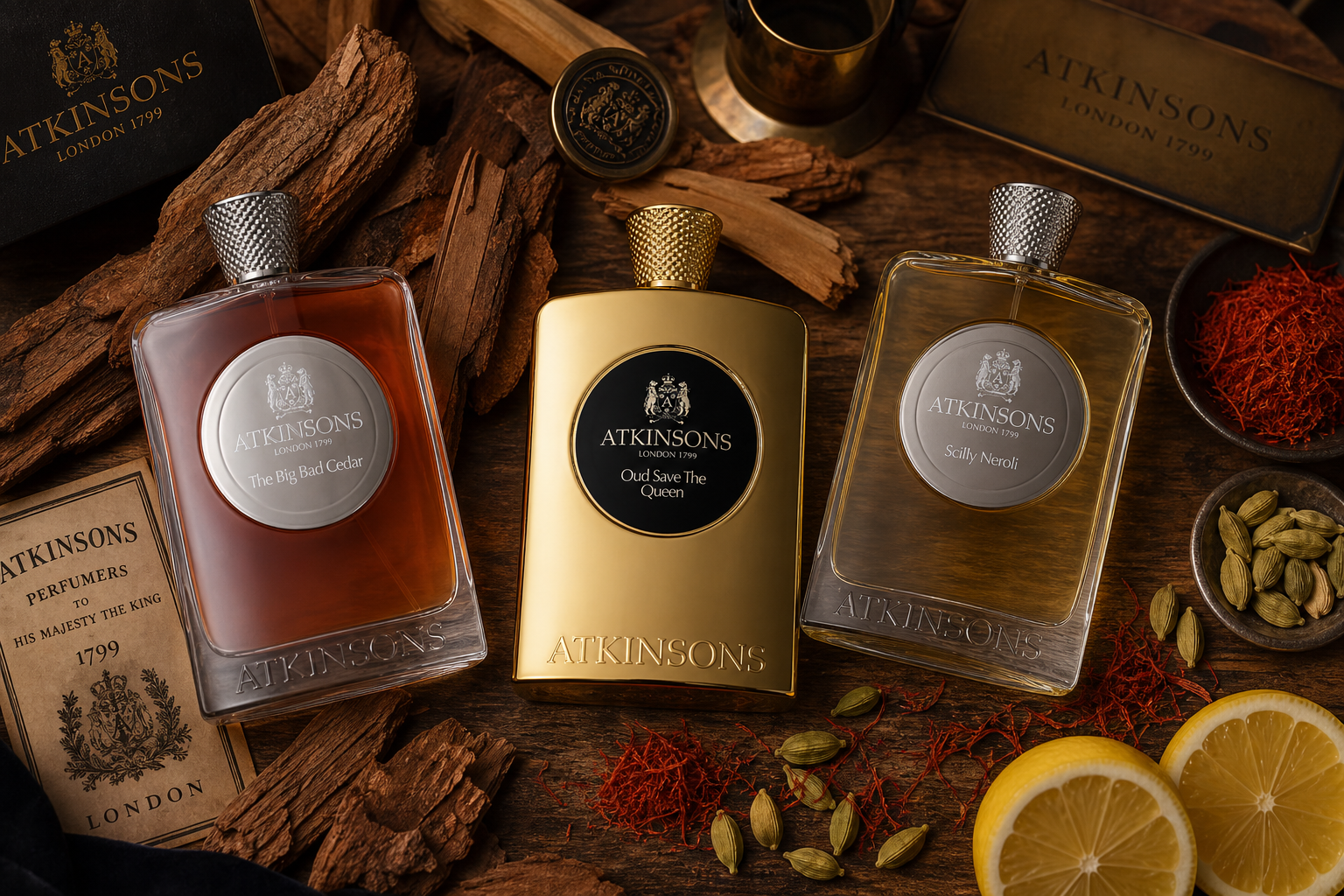
Of the three British houses discussed in the article, Atkinsons reaches the furthest back in time. The brand dates back to 1799 when James Atkinson opened a shop in London selling perfumes, soaps, and pomades. From the beginning, the name included a bear in its emblem—according to company legend, the founder brought a bear from Cumberland in northern England, which kept him company in the shop on Old Bond Street. Today, this story seems more like a curiosity, but it aptly reflects how the house sees itself: as an English institution that doesn't take its history too seriously.
British humor is part of Atkinsons' identity, not just an embellishment on the label. The perfume names play with royal titles, anthems, and English realities—Oud Save The Queen or Her Majesty The Oud are wordplays that a French house would probably not dare. This playfulness is not limited to the names. The compositions are often clear and have a distinct character, so even a less experienced nose can recognize what they are encountering.
The House's Signature: Wood, Spice, and a Citrus Contrast
Olfactorily, Atkinsons stands on woody and spicy compositions. You will most often encounter cedar, sandalwood, oud, and amber, complemented by pepper, cardamom, or saffron. This base gives the perfumes density, warmth, and a longer trail on the skin, making them more suitable for cooler months and evenings. However, the house almost always contrasts this weight with a lighter counterpart—bergamot, lemon, orange blossom, or neroli. The result is a fragrance that starts fresh and gradually settles into wood and spice, rather than being sweet or heavy from the first spray.
Three Moods to Match Your Mood
The house's signature is best showcased in specific perfumes, which differ in mood, not quality:
- The Big Bad Cedar – a woody base in its purest form. Cedar is not a decoration here but the main ingredient; smoky and resinous tones surround it. A choice for someone who likes dry, masculine scents and doesn't need sweetness.
- Oud Save The Queen – a spicy oud line with a more pronounced oriental trail. Oud is combined with spices and a balsamic base, making the perfume denser and more festive. It suits evenings, cold weather, and occasions where the fragrance is meant to be noticed.
- Scilly Neroli – a lighter, summer mood inspired by the archipelago off the southwest coast of England. Neroli and citrus keep the fragrance airy, with wood remaining in the background as a base. If you want to get acquainted with the house in warm months or are looking for an office perfume, start here.
This trio covers the entire range in which Atkinsons operates: from dry wood through spicy oud to fresh citrus lightness. Depending on which of these three moods is closer to you, you can guess where to explore further in the house's offerings.
Where to Go Next Within the Brand
If the oud line captivates you, Her Majesty The Oud is available as its more floral, feminine variant—oud complemented by rose and fruity tones, offering a softer take on the same theme. Lovers of amber and warm balsams can turn to the perfume Amber Empire, which works with amber, vanilla, and spices and is suitable for winter and evenings. The James line, on the other hand, continues the English tradition of men's toilet and cologne: a cleaner, more sober profile that is easy to wear every day and doesn't try to dominate the space.
When choosing, it's worth considering that Atkinsons' woody and oud perfumes have decent longevity, so two sprays are usually enough. And if you're unsure which direction to go, try the lighter mood first—from there, you can easily transition to spice and wood rather than the other way around.

Jo Malone London: Minimalism and Layering of Colognes
After historical grandeur comes the complete opposite. Jo Malone London is a London house that has built its signature on restraint: instead of dense compositions with dozens of ingredients, it offers perfumes that you recognize within the first seconds. A creamy label, a simple bottle, a name that immediately reveals what to expect. If complex oriental blends overwhelm you and you're looking for a scent you can wear without thinking, this approach might suit you.
One ingredient leads, the others merely accompany it. The typical composition of this house has a clear center – grapefruit, blackberry, rose – and around it, just a brief accompaniment of a few notes that support the main ingredient but do not overshadow it. The result is a fragrance you can describe in a single sentence. It sounds simple, but in practice, such a structure has nowhere to hide: every ingredient is audible and each must stand on its own.
The second characteristic is the format. A large part of the offering is colognes – a lighter concentration that stays closer to the skin and does not fill the entire room. For some, this is a weakness because the scent does not last all day. For others, it's an advantage: such a fragrance can be worn to the office or on a summer afternoon without bothering anyone, and you can refresh it during the day without shame. That's why these perfumes work well in pairs.
Layering Fragrances Step by Step
Layering means applying two colognes on the skin one after the other and letting them blend into one scent. It's not about random mixing – a simple procedure proves effective:
- Choose a base: a denser, quieter scent with a woody, musky, or amber base that lasts longer on the skin.
- Add an accent: a fresh citrus or fruity layer that gives the result an initial impression and brightens it.
- Apply both shortly after each other on the same spot, not on opposite sides of the body – otherwise, you'll smell two scents instead of one.
- Initially, stick to a pair. Three or more layers tend to be more chaos than composition.
Layering also has a practical side: two bottles give you more combinations than two separate perfumes, and the result is unique to you.
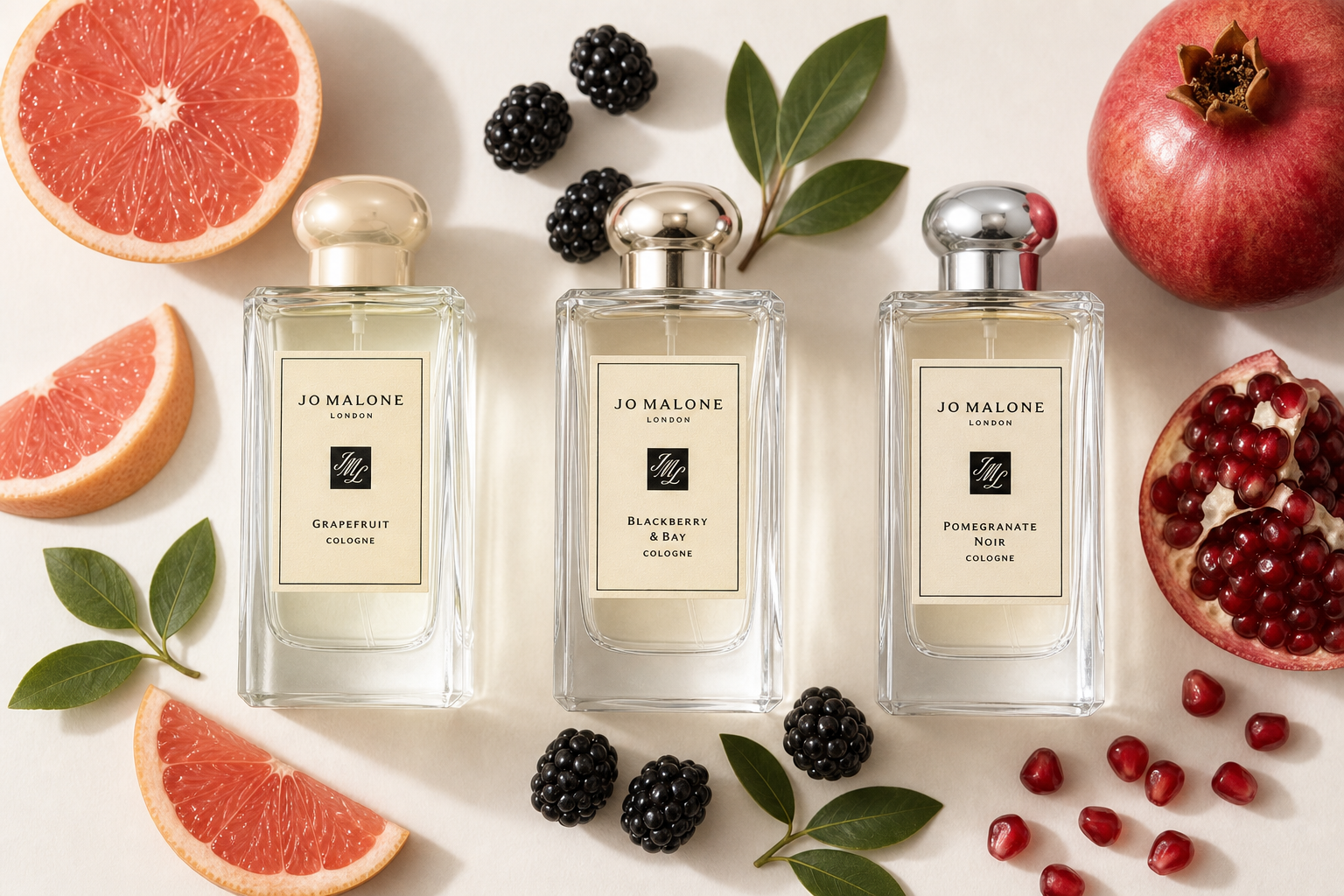
From the selection, we choose three colognes that showcase three different moods of the same signature:
- Grapefruit – a straightforward entry into the world of this house. Sharp, juicy citrus with a slight bitterness of the peel, complemented by a green and musky background. A morning scent for summer and the office, working equally well for women and men.
- Blackberry & Bay – a fruity green composition where dark, slightly sour blackberry meets herbal bay leaf. It's the scent of an autumn garden after rain: sweet just enough not to feel childish.
- Pomegranate Noir – the darkest of the mentioned trio. Pomegranate and raspberries lie on a spicy woody base with patchouli. It lasts longer than pure citrus and is suitable for evening, theater, or cooler days.
Once you get a feel for the signature, expansion is possible. Red Roses is a pure, unsweetened rose that can be layered under almost anything. Orange Blossom brings the white flower of orange with a gentle soapy cleanliness. White Musk acts as a quiet base, adding depth to other layers without overpowering them. Honeysuckle & Davana is the sweetest of this quartet – honeysuckle with an apricot, slightly alcoholic undertone of davana.
Who will this approach suit? If you're looking for a perfume that announces your arrival before you do, you'll be disappointed – more concentrated perfume waters are better suited for that. But if you prefer a scent that is more a part of you than a statement, and you enjoy composing it according to your mood, this house offers a space where you can settle in for a long time.

Roja Parfums: Ultra-luxurious perfumes with high concentration
Roja Parfums represents a position in British perfumery that you would expect more from a jeweler than a typical perfume brand. The London house of perfumer Roja Dove relies on expensive ingredients – such as rose, oud, amber, jasmine, or sandalwood – and uses noticeably more of them in its compositions than is usual in the mainstream. It is priced at the highest tier of the entire British trio, and this is reflected in the way such a perfume is worn.
The difference from regular perfumery starts with concentration. Eau de toilette contains only a small proportion of fragrance composition, with the rest being a carrier, eau de parfum is denser, and pure perfume, the form in which Roja Parfums most often works, goes even higher. In practice, you will notice this in three ways:
- Longevity. While a light eau de toilette gradually fades during the day, a concentrated perfume remains noticeable much longer and usually lasts into the evening.
- Sillage. A higher proportion of ingredients means a fuller sillage. The scent stays closer to the body, yet it is more distinctly noticeable and evolves more slowly.
- Application. One spray here usually replaces several sprays of eau de toilette. Therefore, a smaller bottle lasts longer than it might seem at first glance.
Application is often the main challenge with high concentration. We recommend starting with a single spray on the wrist or chest, waiting about half an hour, and then possibly adding more. The composition develops more slowly on the skin, and what seems subtle at application can sound significantly stronger after a while. On fabric, especially on a collar or scarf, concentrated perfume binds even more firmly than on the skin – so use it sparingly on clothing.
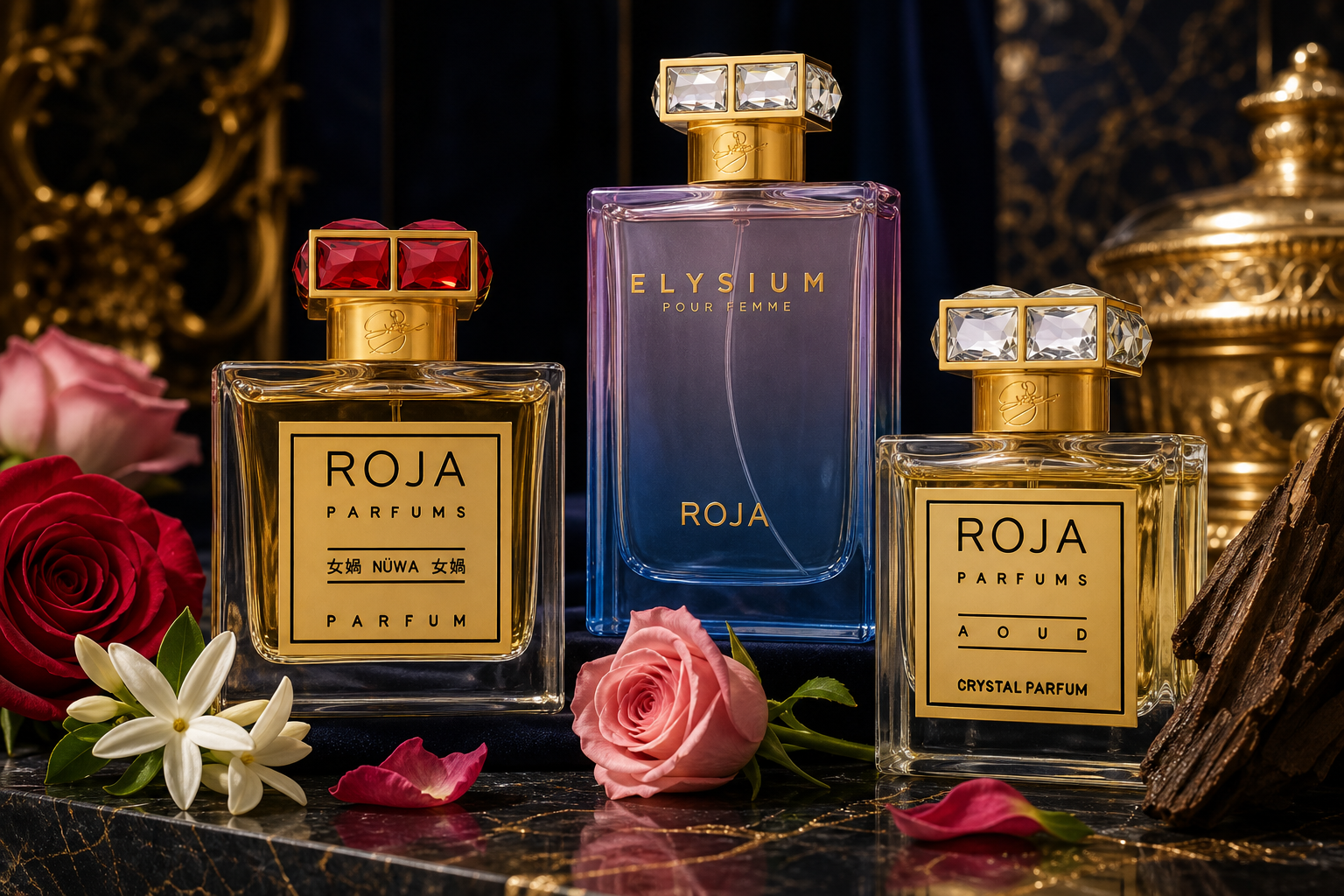
If you are trying the house for the first time, you can explore three different aspects of its signature with these compositions:
- Nüwa – a floral and radiant choice, where rose and jasmine rest on a rich amber and woody base. It feels festive, making it suitable for evening occasions and the cooler part of the year.
- Elysium Pour Femme – a fresh and energetic counterpart. A citrusy opening and white flowers keep the composition lighter and more discernible during the day, without losing the house's character. A suitable choice if you want high concentration but not a heavy scent.
- Amber Aoud Crystal – the deepest of the trio. Amber and oud create a dark, sensual base that remains noticeable long after application. It's a perfume for those who appreciate an oriental signature.
If you want to delve further into the oriental realm, try Taif Aoud, where rose meets oud in a classic Middle Eastern framework. A more sensual, honeyed floral tone is offered by Scandal. Both compositions are quite pronounced and are hardly suitable for the office – they shine better in the evening or on special occasions.
Therefore, do not choose Roja Parfums as an everyday fragrance to stock up on, but as a piece you reserve for specific occasions. It's worth assessing them directly on the skin, not from a paper strip: with such high concentration, the scent changes more on the skin than you might expect, and only after several hours will you see if its base suits you.
How to Choose Among Three Houses: Signature, Price, Occasion
All three houses are built on the same foundation – restraint and a clear main ingredient. In practice, you decide based on three things: the signature, the price range, and the occasion for which you want the perfume. When you compare them side by side, the choice narrows down to a single question: what do you expect from a fragrance right now?
In short, the differences can be summarized as follows:
- Atkinsons – historical woody and spicy compositions with cedar, oud, and amber. The most affordable price range of the trio, yet with a distinctive signature that holds its own even at a social evening. Suitable when you're looking for one scent that can handle both a regular day and an evening out.
- Jo Malone London – light colognes based on a single dominant ingredient. Mid-range pricing, lower concentration, and shorter sillage. Ideal for work, daily wear, and layering, where you combine two colognes according to your mood and the season.
- Roja Parfums – concentrated perfumes with a high proportion of perfume composition, rose, oud, and amber. The highest price range among these three houses and the longest-lasting on the skin. They make sense for special occasions when the fragrance needs to last all evening.
The price difference between the houses is not accidental: it reflects the concentration, the proportion of natural ingredients, and the bottle volume. With colognes, you pay for lightness and the ability to switch them up, with concentrated perfumes for richness and the fact that two to three doses will suffice on your skin. That's why it's worth starting with a smaller volume at the highest price point, if available for the fragrance – you can get a feel for it before deciding on the full size.
The British style can be sampled gradually and in an order that won't overwhelm. Start with a fresh citrus that's recognizable at first sniff – perhaps a grapefruit or neroli note. From there, move to the woody middle with cedar, where the fragrance gains structure and a longer sillage. Only then try oud and amber compositions, which are the richest and require you to know how to dose them. This journey will teach you to recognize where your personal intensity limits lie.
If you want to experience the British signature as quickly as possible, there are three specific entry points: Jo Malone London Grapefruit as a fresh daily cologne, Atkinsons The Big Bad Cedar as a woody middle with a more pronounced character, and Roja Parfums Amber Aoud Crystal as a concentrated evening perfume. In this order, you'll see how the same British restraint behaves in light, medium, and full concentration – and from there, you'll easily recognize which of the three houses is truly yours. You can find all three in the niche section of Brasty side by side, so you can compare them all at once.
Category
Recommended articles

"Give a girl the right shoes and she can conquer the world!" Marilyn Monroe