

Roasted coffee, smoke, and leather are among the most distinctive trends in niche perfumery. We'll show you how they differ, who they suit, and which perfumes from our selection represent them best.
Rich Fragrances That Find You Themselves
Whether you're choosing a perfume for the colder months or just curiously exploring niche perfumeries, sooner or later you'll encounter compositions that are impossible to ignore. Roasted coffee, smoke, and leather are among the most distinctive ingredients in contemporary perfumery, and they share one trait: they don't try to blend in. You don't need to look for them in the list of new arrivals – they'll find you once you catch a whiff of them on someone in the tram or elevator.
Although these are three distinct olfactory directions, they surprisingly have a lot in common. On a paper strip or on the skin, they behave similarly and place similar demands on the wearer.
- Density. Coffee, smoky, and leather notes are heavy and oily, making the composition feel full from the first moments. They don't have a light, airy introduction to gradually prepare you for the main event.
- Long-lasting trail. These ingredients evaporate slowly and linger in the base notes. A fragrance from this family will last on clothing until the next day and leaves a noticeable trail behind you longer than fresh compositions.
- Character. Coffee, smoke, and leather have a firm place in memory – everyone associates them with something. That's why such a perfume is memorable and will be directly associated with you.
It's no coincidence that these directions have settled mainly in niche perfumery. Mainstream new arrivals rely on fresh citrus, aquatic accords, and light musks because they need to appeal to the widest possible audience and work both in the office and on vacation. Niche brands have more freedom: they can afford higher concentrations of ingredients, a less compromising introduction, and a composition that simply doesn't suit part of the audience. Rich fragrances are created where the aim is not universal acceptability but recognizability. Where a fresh new scent offers refreshment, a smoky or leather composition offers a mood you can step into like a coat.
In the following sections, we'll go through all three directions one by one. For each, we'll discuss how the ingredient behaves in the composition, what mood it creates, and what type of wearer it usually suits best – gourmet sweet bitterness, dry incense smoke, and smooth leather each aim somewhere different. Finally, we'll add a practical key to selection, so that exploring doesn't turn into a blind purchase.
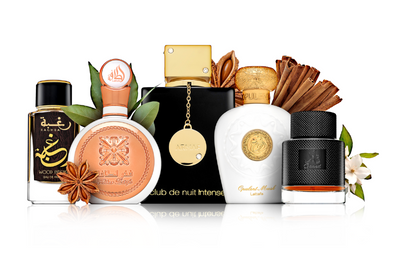
In the Brasty catalog, these profiles are represented by brands across the entire range. More accessible Arabic brands like Lattafa, Zimaya, or Riiffs put density and trail at the forefront and allow for experimentation without great risk. In the middle are French Avenue, Nusuk, or Armaf with more carefully constructed compositions and a slightly more refined expression. At the luxury end are Montale and Yves Saint Laurent, where the higher level is reflected in a more delicate handling of the ingredient and smoother transitions between notes. Wherever you start, the principle remains the same – these are perfumes that require a few thoughtful spritzes instead of a generous dose.
Roasted Coffee: Sweet Bitterness for Chilly Days
The coffee note is among the gourmand accords, but it shares less with dessert sweetness than one might think. Perfumers work with the image of freshly roasted beans – that is, the bitter, smoky-sweet aspect that emerges during roasting. Coffee alone would feel raw in a composition, so it's accompanied by ingredients that round it out: Tonka beans with almond and tobacco undertones, vanilla that wraps the bitter edge in a creamy layer, and cardamom or cinnamon, which return a spicy spark to the whole.
It's interesting how the coffee accord evolves over time. In the top notes, it feels sharp and almost literal – the first few minutes might remind you of a cup of espresso or freshly ground beans. During the first hour, the edge softens, sweet and resinous ingredients come to the forefront, and the base settles into a velvety, slightly dusty trail, where you sense the coffee more than you can distinctly name it. This shift makes the gourmand coffee line rewarding: the perfume smells different after application and in the evening, without losing its character.
The density of these compositions also explains why they suit the cooler part of the year. In the heat, gourmand sweetness expands quickly and can easily start to feel heavy or syrupy. In the frosty air, it opens slowly, stays closer to the body, and feels cozy rather than overwhelming. From autumn to spring, coffee perfumes stand out the most – they provide warmth and a distinct trail without filling the entire room.
If you're just discovering the coffee line, there are three differently tuned entries to consider:
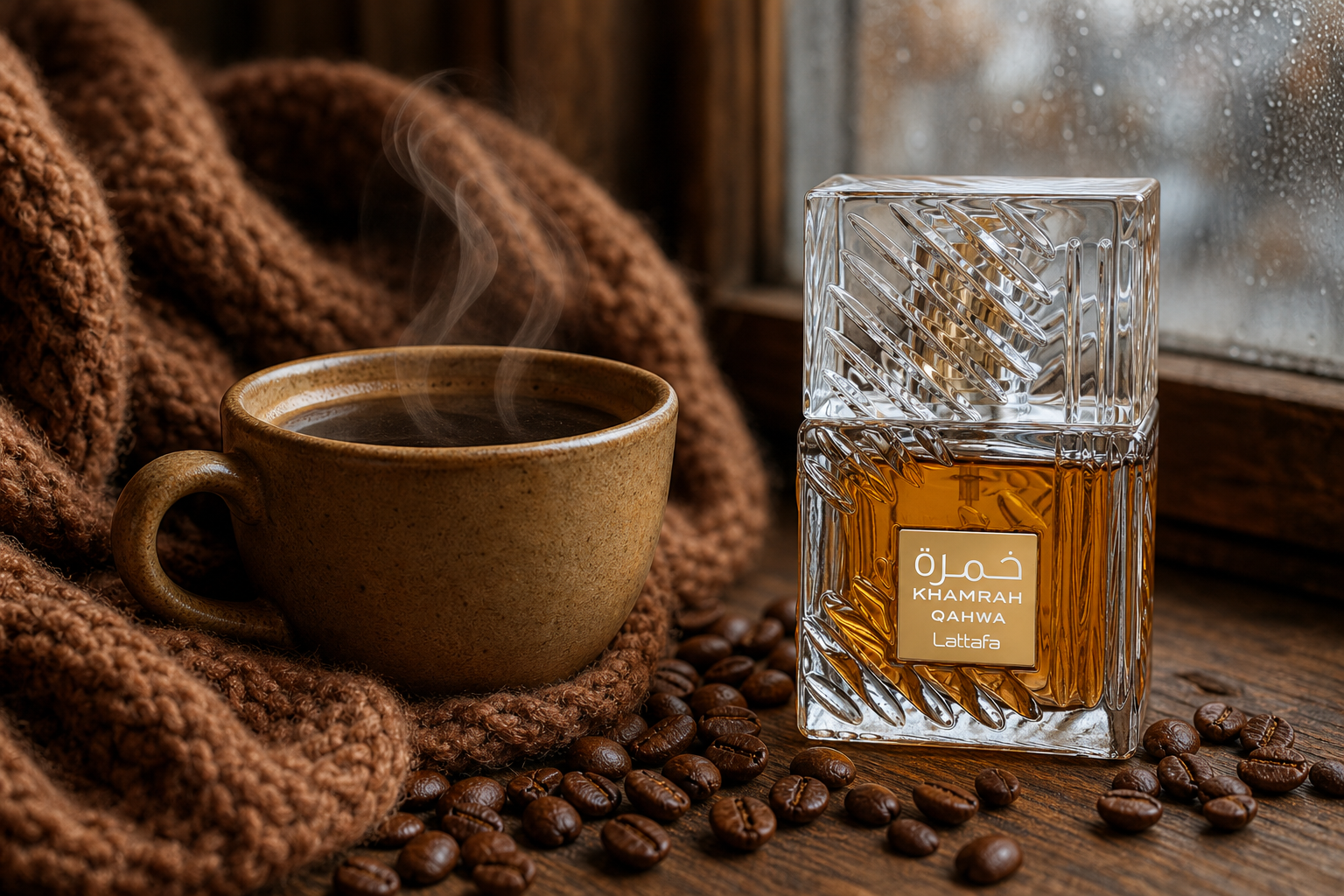
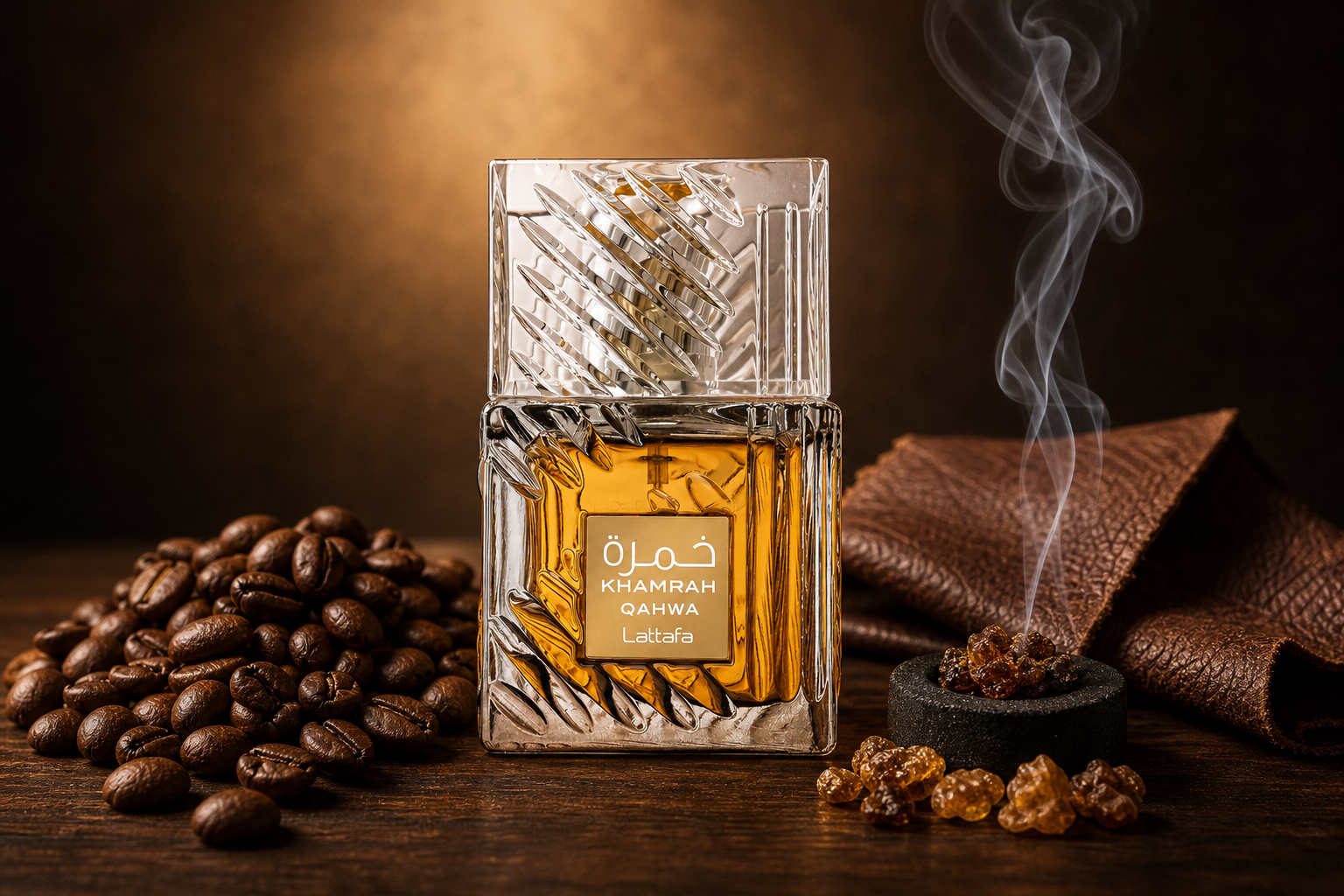
- Lattafa Khamrah Qahwa – a textbook example of the genre. The coffee accord is right at the center, supported by Tonka bean and spicy sweetness, and the whole remains readable from the first application to the fading. A good choice if you want to hear the coffee without hesitation.
- Lattafa Asad Bourbon – a woodier and less dessert-like take on the same theme. The sweet component steps back, giving more space to warm woods and tobacco shades, so the eau de parfum feels more mature and evening-like. It suits wearers for whom pure gourmand sweetness is too pronounced.
- French Avenue Liquid Brun – a more accessible unisex entry for those who want to explore the theme first. The coffee bitterness here is gentler and smoother, complemented by a vanilla-woody base, making the perfume suitable even for an ordinary workday. The unisex tuning means it can be worn unchanged by both men and women.
Who is this group for? Primarily for wearers who want to be noticed up close. Coffee compositions are not perfumes for a sweltering summer tram, but in the cold, they work exactly as a gourmand scent should – the surroundings notice them only when they come closer, and even after several hours at the desk, a sweet-bitter imprint remains readable on the skin. If fresh mainstream perfumes seem anonymous to you, coffee is the logical next step.
Smoky Accords: Smoke, Incense, Burnt Wood
You can recognize smoke immediately, but describing it in words can be surprisingly difficult. In perfumery, it's not about a single material, but the impression from the interplay of resins, woods, and smoky distillates. Under one word, there are three quite distinct moods: cool incense smoke, dense resinous balm, and raw burnt wood accord. Once you can distinguish them, you can choose much more precisely.
Incense Smoke is the airiest of the three. Olibanum, or true incense, smells resinous and slightly citrusy, more cool than warm, and acts like a translucent veil in a composition, not a heavy curtain. It most often pairs with rose, saffron, or pepper, giving them a ceremonial touch.
Resinous Balm goes in the opposite direction. Benzoin, labdanum, myrrh, and amber bring sweetness, warmth, and a sticky density that slowly melts on the skin. The smoky trace here is not sharp but wrapped in vanilla softness. This position is wearable even for those who find pure smoke too stark.
Burnt Wood is the rawest of the mentioned positions. It stands on tarry and charred woods, like birch tar, guaiac, or vetiver, and evokes an extinguished campfire or a recently snuffed-out candle. It's dry, ashy, and can be surprising in the first few minutes, so it's handled carefully.
Most smoky perfumes do not place smoke as the main ingredient. It works more like a layer laid over another motif – over vanilla, coffee, dates, tobacco, or a woody base. You'll notice this because the first breath is distinctly smoky, but after half an hour, the smoke recedes, leaving a sweeter, smoother core. Therefore, you can easily get the wrong impression from the first sniff on a test strip. It's worth evaluating smoky compositions on the skin with a few hours' delay.
Four perfumes from the niche range illustrate the individual positions well:
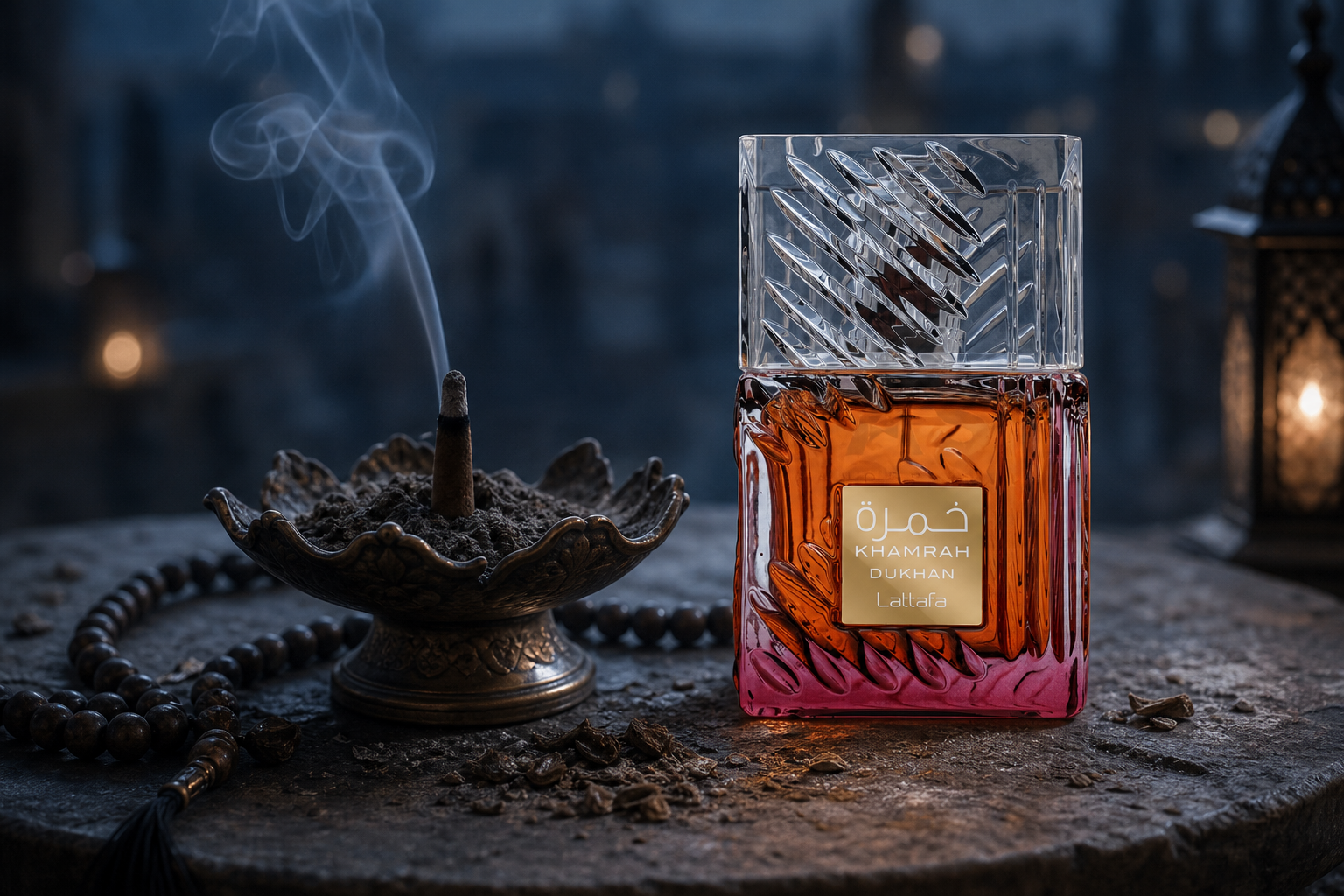
- Lattafa Khamrah Dukhan – an Eau de Parfum that takes a familiar spicy date motif and adds a distinct smoky veil. The sweetness remains but is subdued and less gourmand. A sensible first step if you're just starting with smoke.
- Nusuk Ateeq – a perfume with balsamic, resinous depth and a soft woody finish. The smoke here feels settled and warm, without sharp edges.
- Riiffs Freeze in Flames – a perfume built on the contrast of a cooler, aromatic opening and a hot smoky base. The name hints exactly at what the scent does: it maintains tension between icy and burnt.
- Niche Emarati Khanjar – an Eau de Parfum for a more pronounced oriental presentation, where smoke meets oud, spices, and a rich amber base. A choice for those who want the smoke to really be heard.
Be more moderate with the application of smoky perfumes than with fresh scents. Two sprays are usually enough – one on the chest under clothing, the other on the neck or wrist. Resinous and smoky materials have high density and carry further in a closed room than you might expect. If the composition feels heavy, apply it to a scarf or the lapel of a jacket instead of directly on the skin; fabric will soften the smoke. In warmth, smoky notes develop faster, so reduce in summer.
Smoky perfumes sound most natural where there is air and a bit of chill around you. Evening events, theater, dinner, or formal meetings suit them because the dense trail has space to slowly unfold. They also fit well for an autumn walk when the smoky base meets damp earth and fallen leaves. Conversely, smoke is not suitable for a heated, closed office or gym – it intensifies, thickens, and becomes too noticeable to those around you.
Leather Base: Elegant Ruggedness for the Evening
Leather is one of those ingredients in perfume that you don't recognize by a single note, but by the overall impression. In perfumery, it's an accord composed of several materials – birch tar, resinous styrax, or modern synthetic molecules – that together evoke the idea of tanned leather, gloves, or car upholstery. This is why leather compositions vary so much: two bottles with the same description can smell soft and powdery at one time, and almost like a smoldering campfire at another.
To navigate, it helps to perceive leather in three positions depending on how strongly the accord is based:
- Powdery Leather – the softest variant, usually softened with iris, violet leaf, vanilla, or musk. It smells smooth, a bit like the inside of a new handbag, and feels more elegant than raw on the skin.
- Suede Leather – more matte, warmer, with a hint of fabric. It's often complemented by amber, tonka bean, or sandalwood and stays closer to the body, making it suitable for situations where you don't want to be smelled across the room.
- Tar Leather – the most pronounced pole, where the leather accord approaches smoke, asphalt, and burnt wood. It's a position for wearers who want to be recognizable and don't mind being associated with a specific character.
Leather rarely stands alone. Perfumers most often combine it with patchouli, which gives it an earthy, slightly bitter depth and extends the trail – this pair forms a classic evening framework. The combination with oud shifts the composition into an oriental register: oud adds a resinous, slightly medicinal sharpness, and leather rounds it off, making the result festive, not aggressive. Vetiver, on the other hand, dries out the whole structure – it brings smoky grass and root bitterness, making the leather base sound cleaner and better suited to warmer weather.
In our catalog, leather compositions mainly hold a position in the premium range, where higher quality ingredients and longer-lasting effects are used. If you want to start, there are three differently tuned options:
- Montale Leather Patchouli – an Eau de Parfum that builds precisely on the pair from the previous paragraph. The leather here is darker and the patchouli pronounced, resulting in a dense and linear scent. Suitable for cooler evenings and for wearers who like a clearly readable signature.
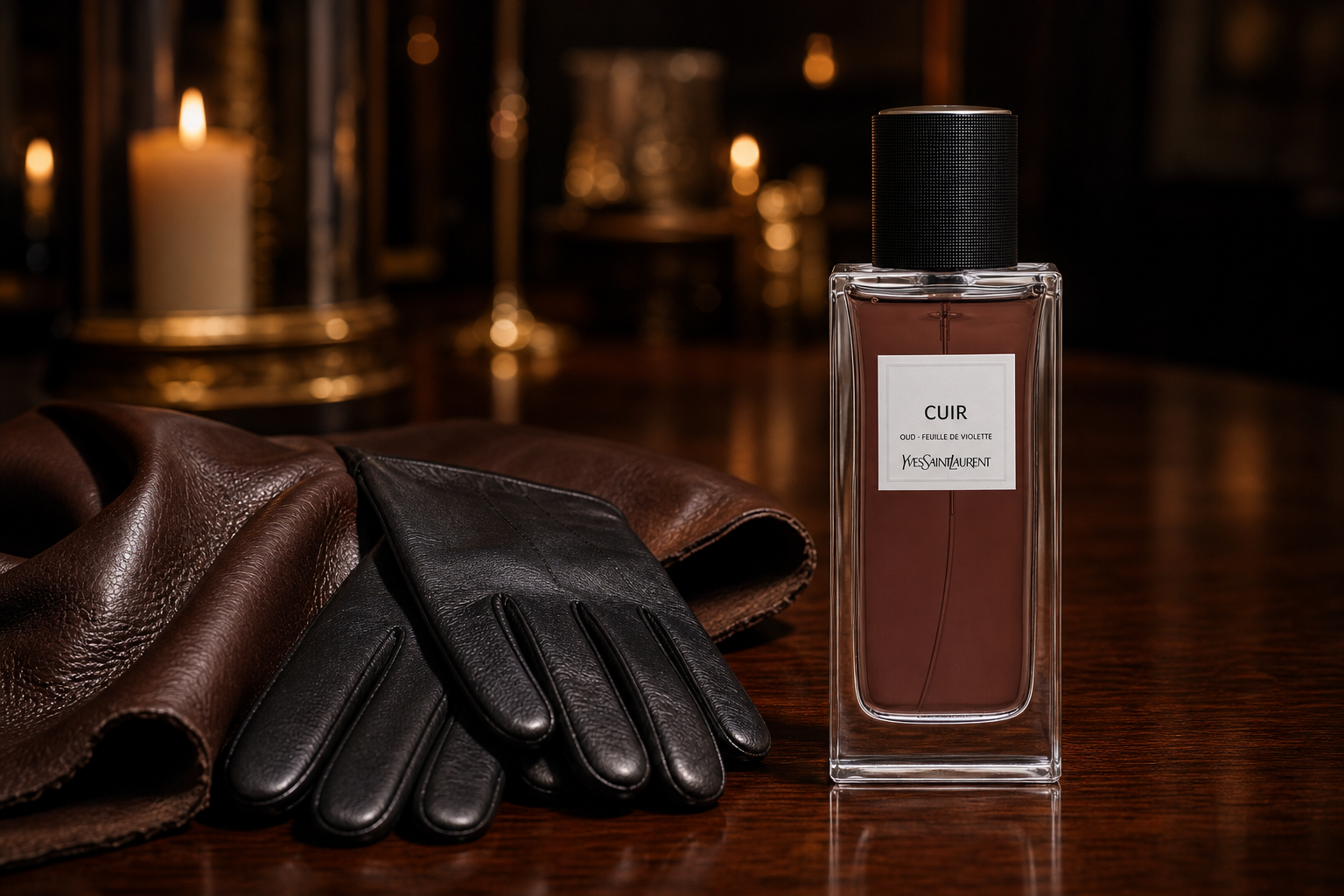
- Yves Saint Laurent Cuir Oud – Feuille de Violette – an Eau de Parfum from a more luxurious range, where leather meets oud and violet leaf. The violet softens the leather accord, giving it a powdery, almost aristocratic touch. A unisex choice for formal occasions.
- Armaf Club de Nuit Intense Man – a more affordable Eau de Toilette that uses leather as a complement to a fruity-woody composition. The leather impression here is gentler and more sociable, making it a sensible first step before reaching for more pronounced bases.
Who are leather perfumes for? Primarily for readers looking for a formal, but not overly polished signature – something that suits a suit, a dinner at a restaurant, or a business meeting where you want to appear confident. Leather pairs well with quality clothing and cooler weather; in summer and enclosed spaces, apply it more sparingly, as it grows faster than you expect. If you're unsure, start with suede or powdery tones and work your way up to tar – the leather base is one that the nose needs to get used to for a while, and the reward is a scent that others will associate with you.
How to Choose Based on Occasion, Time of Day, and Intensity
Three dense directions side by side might seem like a tough decision, but in reality, it can be distilled into a single question: where are you going and how long do you want to be noticed? Coffee, smoke, and leather each have their natural setting, and once you identify it, the choice narrows itself.
Decision Key by Situation
The simplest way is to start with an occasion you regularly experience – not one that happens once a year.
- Coffee notes are suited for chilly days and intimate gatherings. The sweet bitterness works at a close range, making it ideal for a café, an afternoon meeting, or a dinner for two.
- Smoky accords are best saved for the evening and more formal occasions. Smoke and incense have a serious tone, add a touch of sophistication, and tend to intensify in warmth – less is often more here.
- Leather base is the choice for a representative outing: a presentation, dinner with clients, a wedding, or the theater. It stays close to the skin but reads as intentional, not accidental.
Dosage by Time of Day
Intensity is not a property of the bottle, but of how you use the perfume. For the office or public transport, opt for one to two sprays on the wrist and neck; dense compositions develop further from body heat, and your colleague at the next desk doesn't need to know. In the evening, you can afford a trail that precedes you a little – add a spray to the chest or clothing, where the scent lingers longer and develops more slowly.
The time of day is also related to temperature. In the morning and in the cold, the fragrance opens more slowly, so coffee and leather compositions can handle a bit more. In an overheated room or a summer evening, even one spray of smoke can last for hours. If you're unsure, start with less: you can always add more, but you can't take it away.
To Layer or Not to Layer
Layering makes sense where the directions complement each other, not where they compete. Coffee sweetness and smoke share a woody and balsamic base, so they can coexist – a smoky perfume on clothing and a coffee one on the skin adds depth without confusion. Leather compositions, on the other hand, usually stand alone: they already have contrast within, and another layer might reduce their clarity. Stick to a simple rule: layer no more than two perfumes and let one play a supporting role.
Three Levels of Equipment
Dense fragrances are not a discipline that requires starting from the top shelf. The differences between levels can be described without numbers – it's mainly about the density of ingredients, the length of the trail, and how long the composition develops on the skin.
- More accessible entry into the category – Zimaya Sharaf Blend. A straightforward, warmly spicy composition that lets you feel out if the dense style suits you, without immediately committing to a full setup.
- Balanced middle choice – Riiffs Momento. A sweet woody profile with a longer trail; it serves well when you already know you want to go in this direction regularly and are looking for a noticeable improvement in longevity.
- Luxurious culmination – Montale Arabians Tonka. A dense gourmand-woody composition that develops slowly and rewards patience. It makes sense when you know exactly what you're looking for.
Before You Reach for the Full Bottle
With dense fragrances, it's worth taking your time. Try your chosen direction first in a smaller package or sample and wear it for several days in a row – at work, outside, and at home. Only then will you know if it suits you in the morning as well as in the evening and if its trail doesn't tire you after a few hours. In the niche section of Brasty, you'll find smaller volumes of many of these perfumes, so you can start cautiously and save the full bottle for a composition that truly finds you.
Category
Recommended articles

"Give a girl the right shoes and she can conquer the world!" Marilyn Monroe