

Dark circles, redness, or pigmentation spots each require a different type of coverage. We'll guide you through five types of concealers, from lightweight serum to creamy, long-lasting, high-coverage formulas, and color correction, advising on which problem and skin type they suit best.
Five Levels of Coverage: How to Know What Your Skin Really Needs
Concealer is often the first thing you reach for in the morning when something in the mirror doesn't quite please you. However, a universal concealer for everything doesn't exist, which is why choosing one often feels like a lottery. Whether you're dealing with dark circles under the eyes, redness around the nose, or pigmentation spots from summer, each situation requires a different texture, amount of pigment, and application method.
These three situations cover most reasons why someone would buy a concealer:
- Dark circles under the eyes – it's not about unevenness, but rather a bluish-purple or brownish undertone showing through the thin skin around the eyes. The concealer's job here is to brighten, not weigh down.
- Red and irritated areas – redness around the nose, individual imperfections, or permanently sensitive cheeks. You're dealing with both color and slight unevenness at the same time.
- Pigmentation spots and more pronounced imperfections – darker spots from tanning, acne marks, or scars that can't be covered with a thin layer. You need coverage that lasts all day.
The instinct is to grab the formula with the maximum coverage available. In practice, though, this is often why concealer settles into wrinkles, flakes, or creates a noticeable lighter patch on the face. The key isn't the strength of the formula, but whether the type of coverage matches the problem and the condition of the skin.
Light coverage has a thin, liquid to serum-like texture with a low pigment content. It blends with the skin, doesn't highlight fine lines, and is suitable wherever you want to brighten rather than conceal. However, it won't cover a deep pigmentation spot even with three layers.
Medium coverage is a compromise that suffices for most people on a regular day. The texture is creamy, with noticeably more pigment, yet the product remains blendable. It can handle under-eye circles and individual imperfections without looking like a mask when used in moderation.
High coverage means a thick, often compact formula with a high concentration of pigment. It's applied in small amounts, layered, and set with powder. The reward is coverage that hides even what otherwise can't be concealed, but the trade-off is more demanding application and precise shade selection.
Before you start considering shades, categorize your issue. It only takes four steps:
- Examine your skin in natural light without makeup and identify what bothers you. Is it color, unevenness, or both?
- Place a finger on the problem area and press lightly. If the spot visibly disappears under a thin layer, you can manage with light to medium coverage.
- Assess the surroundings. Dry or mature skin with fine lines tolerates less product, while oilier skin appreciates a long-lasting formula that doesn't smudge.
- Only then choose a shade, always testing on the jawline or directly on the area you will cover.
According to this guide, the entire range can be divided into five types of coverage, which the article will go through step by step: light serum concealers for brightening the eye area, creamy concealers with medium coverage for everyday wear, long-lasting matte formulas for oilier skin and long days, high-coverage compact concealers for pigmentation spots and scars, and color correctors that neutralize the problem before skin tone comes into play.
The Concealers category on Brasty has over three hundred items, from simple sticks to dermatologically focused compact formulas. Once you know which of the five groups your issue belongs to, the selection narrows down to dozens of products that have a real chance of working for you.
Lightweight Serum Concealers for Brightening Under-Eye Circles
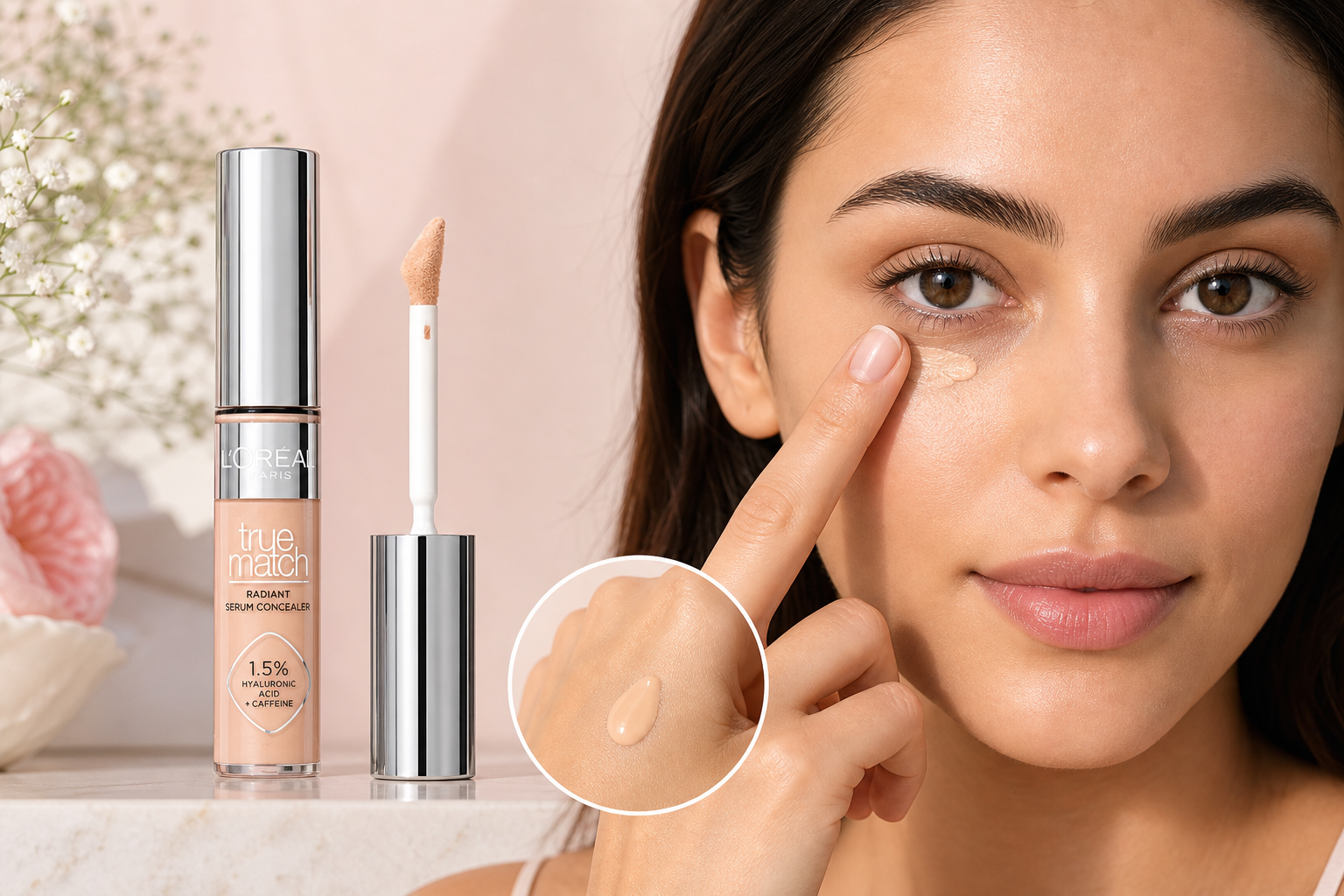
The first stop on the coverage scale is liquid concealers with a serum texture. They are thin, almost watery, and spread over the skin in a thin layer that doesn't completely cover – and that's exactly the point. Instead of full coverage, they work with light: gently brightening the shadow under the eyes, evening out the tone, and optically illuminating the eye area, making the face look more rested, even if you didn't get much sleep last night.
The reason this group is perfect for the eye area is simple. The skin there is the thinnest on the entire face and is practically always in motion – you blink thousands of times a day. A thick, heavy formula will eventually settle into fine lines under these conditions, making the result look older than the original circles. A serum concealer is so lightweight that it doesn't settle into creases, allowing it to stay fresh-looking much longer.
You'll appreciate this type of coverage especially in these situations:
- Dry and dehydrated skin – the serum texture doesn't pull or highlight flakes, which matte formulas tend to emphasize.
- Mature skin with fine lines – the less product there is under the eyes, the less there is to settle.
- Light, slightly bluish circles – those that are visible but not a significantly dark shadow.
- Days when you just want to even out the tone – without makeup, just a thin layer under the eyes and mascara.
Serum concealers are often enriched with moisturizing and caring ingredients, most commonly hyaluronic acid or glycerin, which help hydrate the skin while worn. Sometimes vitamin C or caffeine is added for optical brightening. However, consider this a pleasant bonus, not a replacement for eye cream – concealer remains decorative cosmetics, and eye care is the responsibility of your morning and evening routine, not a single thin layer under makeup.
Application determines the result more than the product itself. Apply very little – two to three small dots in the inner corner and under the eye, never a continuous wide triangle. Then dab the product with the pad of your ring finger or a damp sponge, never spread it by dragging. The warmth of your finger helps the texture blend with the skin, and the dabbing motion sets it instead of pulling it to the sides. If you need slightly higher coverage, wait until the first layer dries and add only to the area where the shadow is strongest.
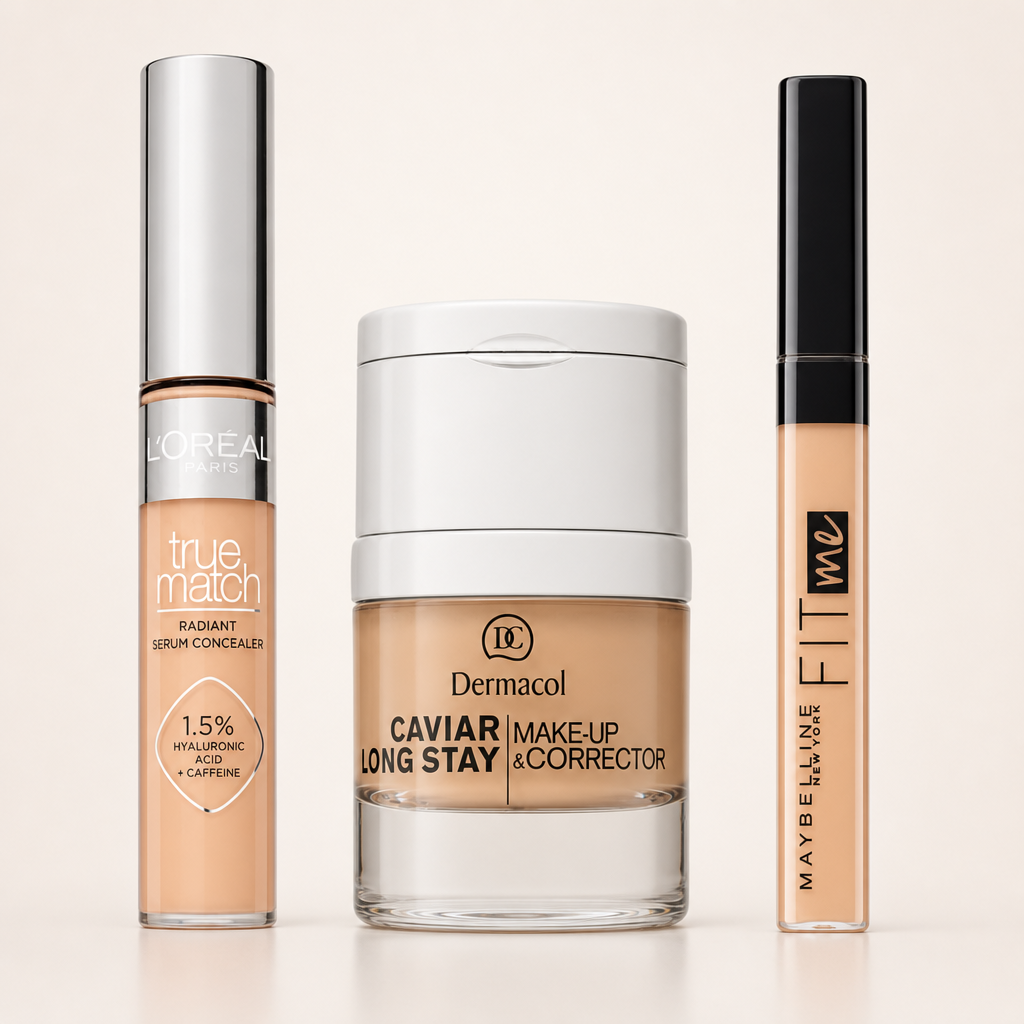
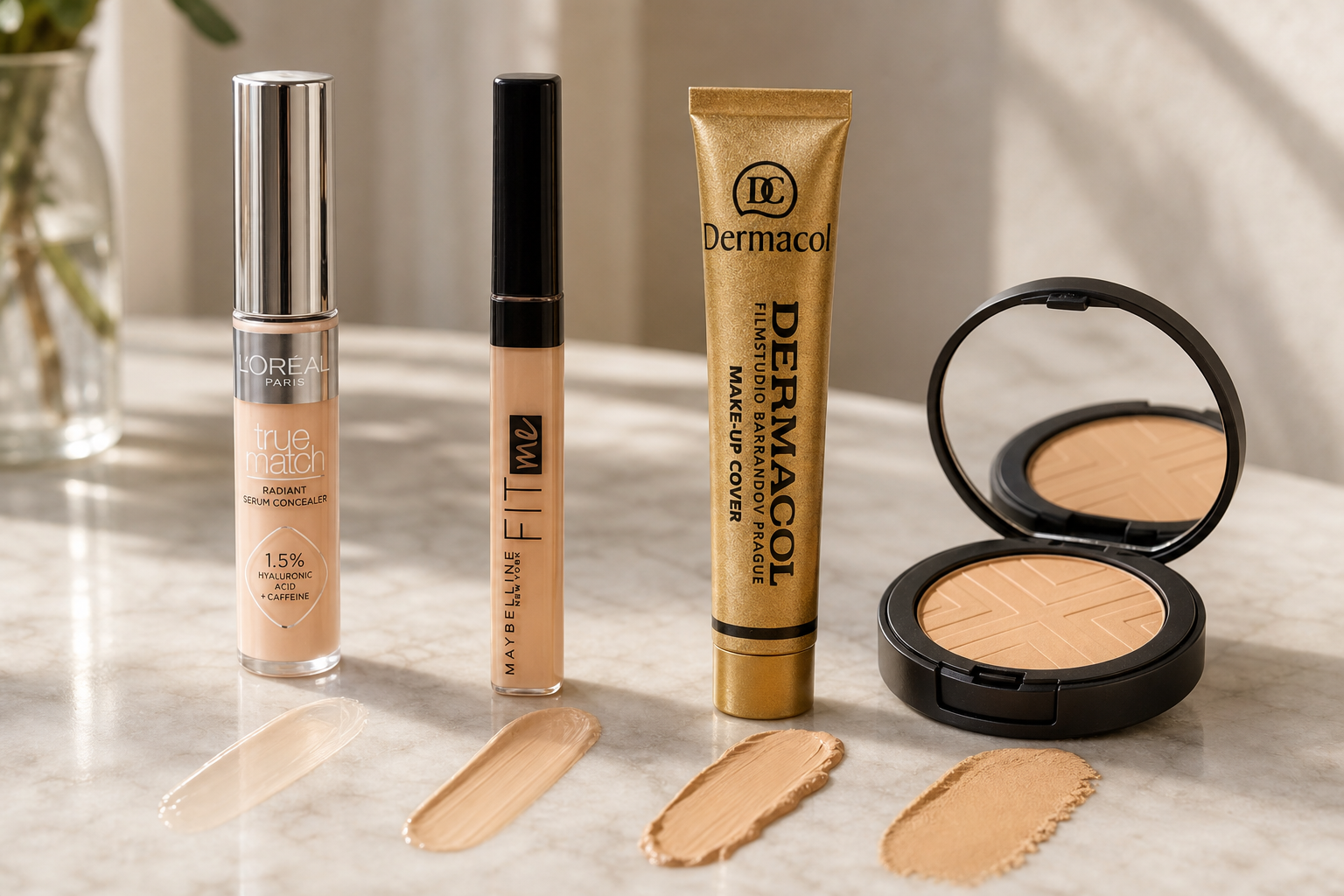
A typical representative of this group is the L'Oréal Paris True Match Radiant Serum Concealer in an 11 ml applicator package. The texture is noticeably more liquid than classic cream concealers, remaining fresh and slightly luminous on the skin, making it more suitable for brightening than masking. Choose a shade half a tone lighter than your makeup, but don't overdo it – overly white under-eyes look unnatural.
And when won't a serum concealer be enough? For deep dark, purple, or brown circles, prominent pigmentation spots, acne scars, or red areas. There, a light layer will only lighten the tone, and the problem will still show through. In such cases, you need to reach for a higher coverage formula, or first color-correct the undertone and then unify.
Creamy and Long-Lasting Concealers for All-Day Wear
If you were to have just one concealer in your makeup bag, it would most likely be a creamy one. Creamy formulas with medium coverage form the most versatile group of all five: they have enough pigment to tone down redness around the nose and minor imperfections, yet remain flexible enough to blend seamlessly. And if you opt for their long-lasting matte variant, they will stay on your skin throughout the workday without the need for touch-ups.
What Medium Coverage Can Do
Medium coverage doesn't mean that the concealer will completely cover the problem. It means it will reduce its visibility enough to blend with the surrounding skin in normal daylight. For most situations, this is just the right amount.
- Redness around the nostrils that appears after a cold or with weather changes.
- Individual imperfections and traces of them – the creamy consistency allows precise application to one spot without affecting the surrounding area.
- Lighter under-eye circles, where a brightening serum isn't enough, but full coverage would feel heavy on the delicate skin.
When choosing a shade in the medium category, you still have some leeway: a slightly inaccurate tone can be evened out with blending. For circles, choose a shade half a tone lighter than your makeup, for redness, a matching shade.
Long-Lasting Matte Formulas and Their Logic
Long-lasting variants are technically the same group, just with a differently constructed formula. They contain a higher proportion of fast-evaporating ingredients and fixing polymers, so they quickly set into a matte film on the skin. This gives them their main advantage and main drawback: the advantage is resistance to smudging, the drawback is the short time window in which you can work with the product.
From the available selection, this includes products like Dermacol Caviar Long Stay Make-Up & Corrector, which combines the function of makeup and concealer in one package. It's also suitable when you want to unify your entire face with one product and simultaneously refine problematic areas. Similarly structured long-lasting concealers can also be found in the ranges of brands like Maybelline and Max Factor – both are more affordable ways to try such a formula.
Oily, Combination, and Dry Skin React Differently
On oily and combination skin, long-lasting matte concealers are in their element. They don't contain a significant amount of oily ingredients, so they don't create a slippery layer underneath, which would cause the pigment to migrate into lines throughout the day.
On dry and flaky skin, however, the same property works against you: the matte film highlights peeling areas and fine lines. If you have dry skin and still want durability, start with preparation. Apply a moisturizing cream, wait until it is fully absorbed, and only then reach for the concealer. Keep the layer as thin as possible and limit powdering to areas where oil actually forms.
Why It's Worth Rushing with Long-Lasting Formulas
With these concealers, a simple rule applies: what you don't blend within a few seconds, you won't blend at all. Once the film sets, any further movement with fingers or a sponge will disrupt rather than smooth it. Work in small sections – apply a few dots, immediately blend them into the edges, and only then move on. Apply less than you think you need; a second thin layer looks more natural than one thick one.
It's precisely the combination of versatility and durability that makes creamy concealers a sensible first choice for most people. The exception remains prominent pigment spots and scars, which medium coverage won't cover.
Highly Coverage Compact Formula for Pigmentation Spots
The fourth group of concealers is entirely different in consistency from everything else. Instead of a lightweight emulsion that spreads over the skin on its own, you get a dense compact mass with a high pigment content and minimal water. This is precisely why you reach for it when you need to cover something that always reappears under a thin layer – pigmentation spots, acne scars, more pronounced redness from rosacea, or tattoos.
It's not difficult to recognize. If you've already applied a regular concealer twice and the spot still shows through, a third layer won't solve the problem; it will only increase the risk of the makeup starting to crumble. It's cleaner to switch to a denser formula, apply less, and let the pigment work instead of layering.
How to Work with Dense Texture
Compact concealer is not applied directly from the jar to the skin. It needs to be warmed up first to soften and spread without pulling the skin. The process is slower than with liquid concealers, but the result lasts longer.
- Take a very small amount, ideally with your fingertip or a flat brush. The dense formula covers even in a thin layer, and excess is harder to blend than it seems.
- Warm it up on the back of your hand for a moment. The heat softens the texture, and the concealer won't roll.
- Apply by tapping, not spreading. Spreading moves the mass away from the covered spot and reveals what you wanted to hide.
- Layer gradually. Two thin layers look more natural than one thick one and better follow the skin's contours.
- Immediately set with a translucent powder, such as Max Factor Facefinity Pro Blur Longwear Setting Powder or Artdeco No Color Setting Powder.
Consider setting with powder as a mandatory part of the process, not an extra step. An unset layer of high-coverage concealer transfers to collars and fingers. Only a minimal amount of powder is needed, applied by tapping over the covered area.
Shade Matters More Than with Other Types
This is also the group where choosing the right shade is least forgiving. The coverage is so high that the skin color under the concealer has no chance to soften the result – what you apply is what you see. A half-tone lighter shade will create a light spot on the face, while a darker one will create a gray patch. Always test along the jawline in daylight and follow your skin's undertone: warm, neutral, or cool. If you're hesitating between two shades, the darker one usually blends better.
Two Representatives Worth Comparing
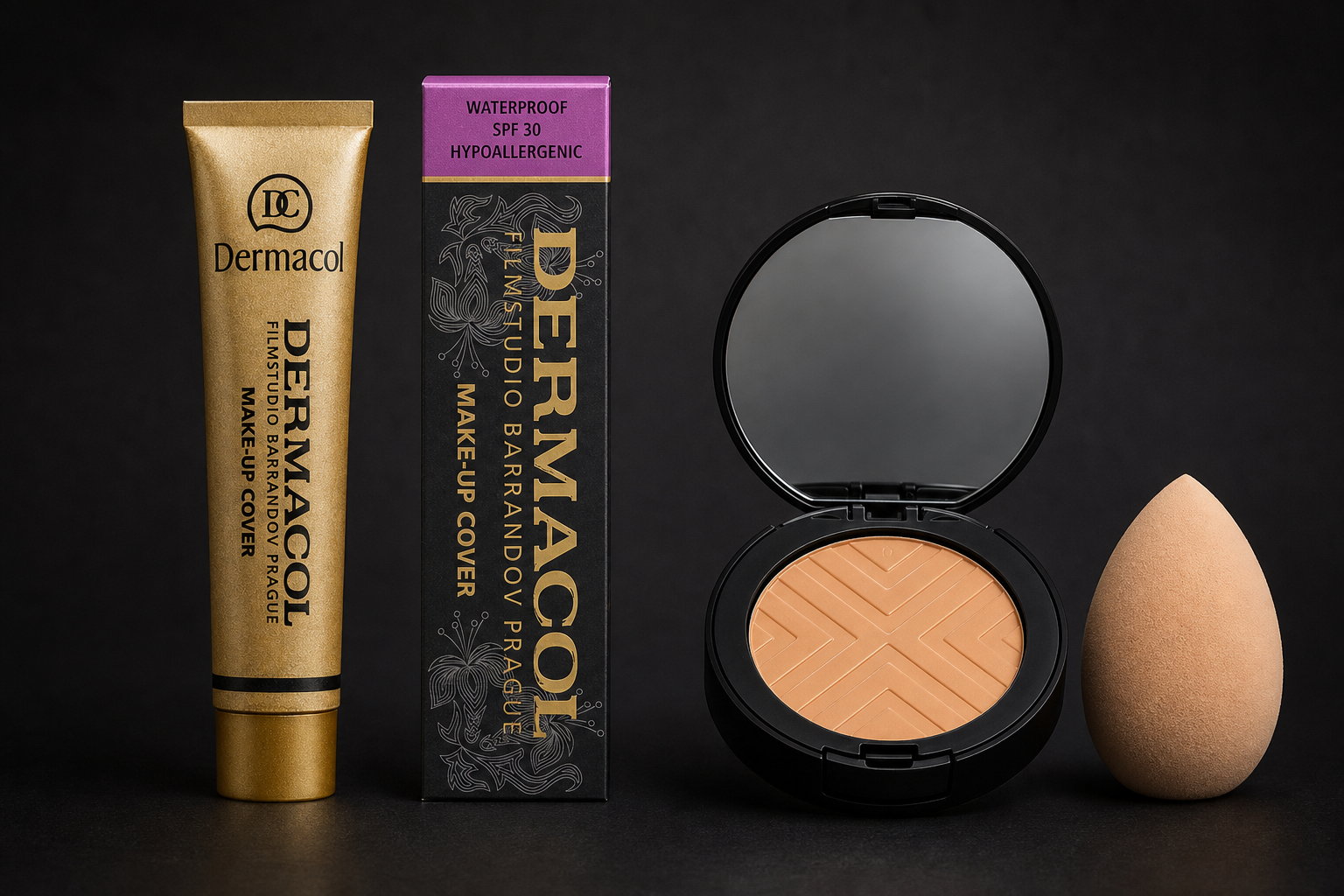
Dermacol Make-Up Cover is an established classic in this category and is one of the best-selling concealers in our range. It offers very high coverage, can be used on spots or larger areas, and is available in two sizes: 30 g for approximately 214 CZK and a smaller 13 g package around 153 CZK. The shades are numbered, so it's worth comparing them carefully.
Vichy Dermablend Covermatte represents the more expensive, pharmacy branch. A compact 9.5 g package costs about 573 CZK and targets skin prone to shine and imperfections; the finish is matte, and the formula is designed to last all day. Per gram, it's a significantly more expensive choice, but the smaller jar is more than enough if you use the concealer only on specific spots.
The difference between them is not so much in coverage strength as in purpose and budget: Dermacol makes sense for layering over larger areas at a reasonable price, Vichy when you're looking for a matte result on a smaller, precisely defined spot.
One limitation applies to the entire group: the dense formula is not suitable for the eye area because it settles into fine lines – stick to lighter variants there. On dry skin, apply only after absorbed hydration; otherwise, the coverage will cling to flaking areas and highlight them.
Color Correction and Our Final Recommendations
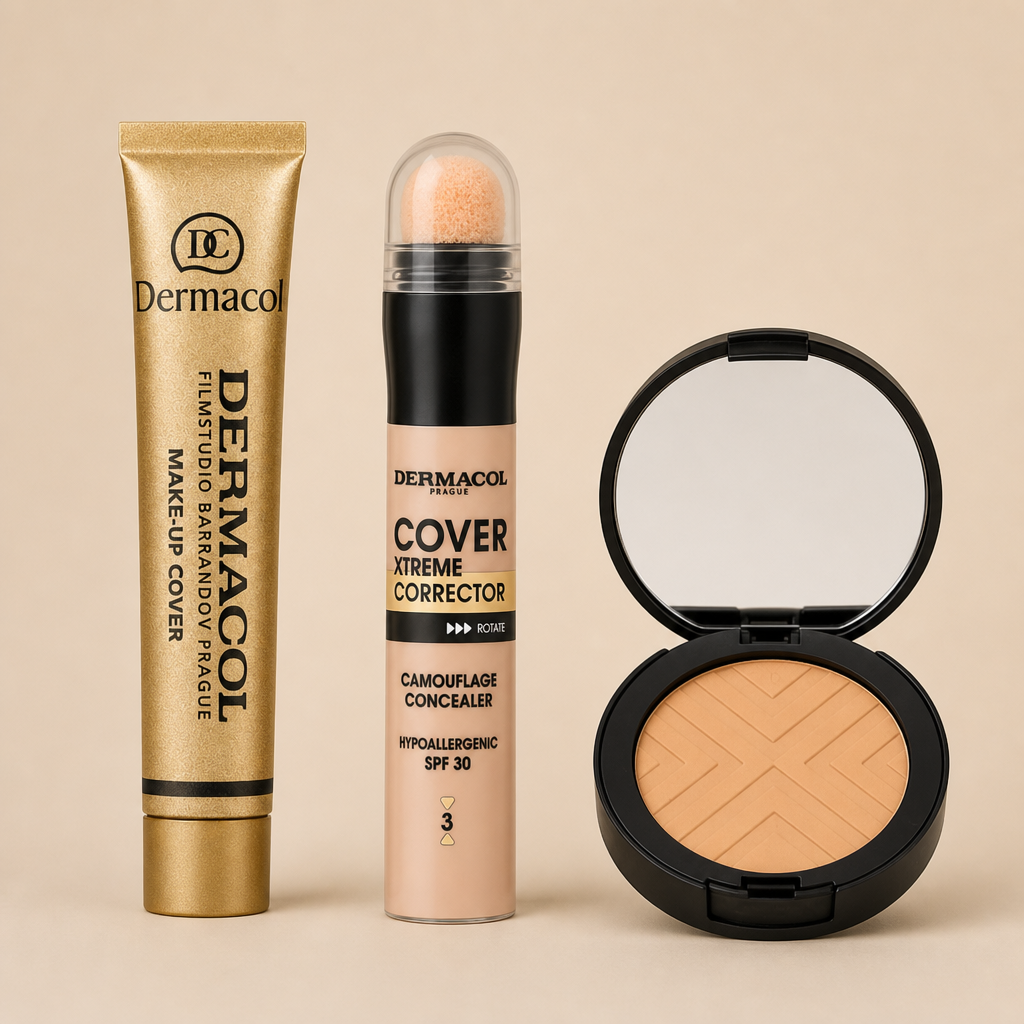
The fifth type of concealer doesn't work with coverage but with color. While a traditional concealer matches the skin tone to cover imperfections, a corrective shade first neutralizes them visually. This principle is based on complementary colors: pairs that lie opposite each other on the color wheel cancel each other out. That's why green is applied to red, peach or orange to blue-purple, and lilac to grayish tones.
Green for redness. The green shade is applied to irritated areas around the nose, red marks from imperfections, and spots that still appear red even after applying makeup. Apply it only to specific spots and blend the edges until they disappear. If spread over the entire face, it will make the complexion appear gray.
Peach and orange for under-eye circles. Blue-purple circles need a warm contrast. Peach is gentler and suits light to medium skin tones with mild circles, while orange works more aggressively and is suitable for darker skin tones or very dark circles. Start with less than you think you need: the correction should lighten the circle, not completely cover it.
Lilac for sallow and tired skin. Lavender to lilac shades counteract the yellowish and grayish tint after a sleepless night or during winter months. It is applied in a thin layer to the center of the cheeks, chin, and between the eyebrows and temples.
One rule applies without exception: the corrective shade is a middle step, never the final layer. It is always covered with a regular concealer in a skin tone or foundation, otherwise, a colored spot will remain visible on the face. The process is simple – a thin layer of correction, wait a moment, then gently dab a covering layer with a sponge or finger. Do not brush back and forth, as this would wipe away the correction.
Quick Overview: Problem, Coverage Type, Skin Type
- Under-eye circles on dry or mature skin – light serum coverage that doesn't settle into fine lines.
- Circles with a pronounced blue-purple undertone – peach or orange correction with a light concealer over it.
- Uneven tone on oily or combination skin – creamy concealer in a long-lasting matte variant.
- All-day wear on normal skin – universal creamy medium coverage that can be layered.
- Pigmentation spots, scars, tattoos – highly covering compact formula set with powder.
- Persistent redness and rosacea – green correction with high coverage in thin layers over it.
Specific Selection from Brasty's Offer
Translated into actual products, the selection across price levels looks like this:
- Dermacol Make-Up Cover 211 13 g – high coverage in a smaller package, an accessible entry into the category of compact formulas.
- Dermacol Make-Up Cover 222 30 g – the same formula in a larger package and long one of our best-selling concealers.
- Dermacol Caviar Long Stay Make-Up & Corrector 3 Nude 30 ml – long-lasting dual-function product for those who want one shade for both makeup and correction.
- L'Oréal Paris True Match Radiant Serum Concealer 2R 11 ml – a light serum concealer for brightening the eye area.
- Vichy Dermablend Covermatte 45 Gold 9.5 g – a dermocosmetic choice at a higher price level for sensitive and problematic skin.
If you're unsure, start with medium coverage in a shade slightly lighter than your makeup. Add color correction only when you find that the concealer alone doesn't handle your specific problem. In the concealer category, you'll also find other options from brands like Maybelline, Max Factor, or Bourjois, so there's plenty to choose from depending on the texture you prefer.


Category
Recommended articles

"Give a girl the right shoes and she can conquer the world!" Marilyn Monroe