






For parents dealing with their baby's flaky and itchy skin, we present a simple daily routine from bath time to applying emollients.
How to Recognize Dry and Atopic Skin in Babies
Whether you're dealing with the first flakes on your baby's cheeks or wondering why your baby wakes up at night rubbing their legs against the sheets, the beginning is always the same: you need to identify what you're seeing. Dry and atopic skin in young children can appear subtly and change from day to day – one day everything seems fine, and a week later the skin feels noticeably rough to the touch. We'll guide you on what to look for in a typical day and, most importantly, reassure you: much of the daily discomfort can be managed with gentle home care.
What to Notice During a Typical Day
Dryness in babies often appears in areas where the skin is thin or frequently bends. You're more likely to notice it by touch rather than sight – you might stroke your child's back and feel a slight roughness that wasn't there last week. It helps to go through the following checklist and compare it with what you observe with your child:
- Flaky or dull spots on the cheeks. The skin loses its softness and may gently peel after bathing.
- Rough elbow and knee creases. These bends are areas where dryness lingers the longest and often returns.
- Redness that comes and goes. Spots appear after bathing, in overheated rooms, or after a long walk in the cold, and fade over time.
- Itching and restless sleep. The child tosses and turns, rubs one leg against the other, wakes up, and finds it harder to settle back to sleep.
- Scratches made by the child. Small scratches on the cheeks or the backs of the hands indicate that the skin itches even when it doesn't look irritated.
When It's Temporary Dryness and When It's More
The difference between temporarily dry skin and atopic eczema is mainly in how the condition behaves over time. Temporary dryness is usually widespread, mild, and responds well to regular moisturizing – within a few days, the skin becomes smooth again. In contrast, atopic skin returns in cycles: calm periods alternate with times when the skin is noticeably red, itchy, and the child becomes irritable because of it. The patches often have distinct edges, repeatedly appear in the same places, and simple moisturizing isn't enough.
It can also be misleading because both conditions often coexist. A baby may have generally dry skin and one small area that behaves differently from the rest of the body. Therefore, it's worth monitoring the progression rather than focusing on a single day: when the condition worsens, how long the calm periods last, and whether the problem keeps returning to the same spots. A few notes on your phone or a photo taken during a flare-up can tell the doctor more than trying to remember.
A Diagnosis is Always Confirmed by a Doctor
Here's an important note: while you can guess a lot from appearance and progression, a diagnosis is made by a pediatrician or dermatologist. Home care and professional assessment are not mutually exclusive; rather, they complement each other – the doctor will confirm what you're dealing with, and you can set your daily routine accordingly. If the patches are oozing, crusting, the skin appears inflamed, or the child can't sleep for several nights due to itching, make an appointment with a doctor and follow their recommendations for further steps.
The good news is that much of the daily discomfort can be managed with simple habits at home. For both dry and atopic skin, regularity is key: a gentle bath that doesn't dry out the skin, followed by a layer of moisturizer immediately after. In the following sections of the article, we'll go through what such a routine looks like step by step – from water temperature to choosing a cleansing product, to what to apply and how often.
Why Children's Skin Dries Out Faster Than Adults'
Children's skin is not just a smaller version of adult skin. It differs in structure and how it manages water, making it more sensitive to everyday stimuli. Understanding what happens beneath the surface makes daily care much more meaningful – it stops being an extra chore and becomes a logical step with a clear purpose.
Thinner Layer and Faster Water Loss
The outer horny layer of a newborn's and infant's skin is significantly thinner than that of an adult, and its cells hold together less firmly. Water evaporates from it more quickly, so the skin dries out before you even notice. The ratio of body surface area to volume also plays a role: a baby has a considerably larger skin area relative to its size, through which moisture escapes.
The sebaceous gland also plays a role. After the first few weeks of life, the production of skin sebum decreases, and the protective film on the surface is weaker than it was shortly after birth. The acidity of the skin's surface, the so-called acid mantle, which helps maintain balance, is also lower. The result is skin that is less able to defend against drying out and more easily allows irritants from outside to penetrate.
The Skin Barrier and What Disrupts It in Everyday Life
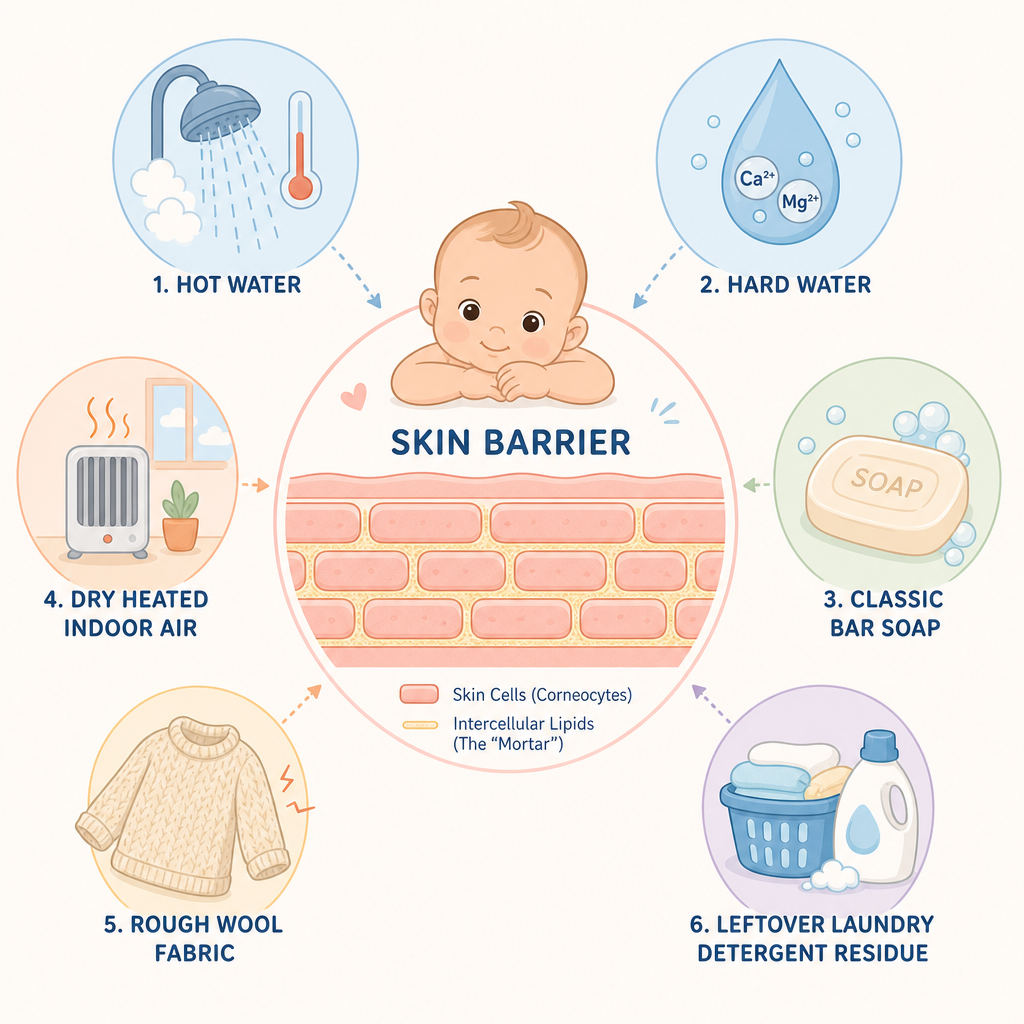
You can imagine the skin barrier as a wall. The cells of the horny layer are bricks, and intercellular lipids – ceramides, fatty acids, and cholesterol – function as mortar that holds them together. As long as there is enough mortar, water stays inside, and irritants, allergens, and microorganisms stay outside. Once it diminishes, gaps form in the wall: moisture escapes, the skin tightens, becomes flaky, and starts to itch. In atopic skin, this mortar is weakened long-term, often due to genetic predispositions, so the barrier is disrupted even by stimuli that another child might not notice at all.
In a typical day, it is disrupted by a number of quite inconspicuous things:
- Too hot and long baths. Warm water dissolves the fats on the skin's surface faster than the body can replenish them.
- Hard water. A higher content of calcium and magnesium leaves a fine residue on the skin, which dries and irritates it.
- Frequent washing with regular soap. Common foaming soaps have an alkaline pH and degrease more than is desirable for children's skin.
- Dry air. Heated radiators and air conditioning reduce humidity in the room and also draw water from the skin.
- Rough textiles. Wool and coarsely woven materials irritate mechanically, while soft cotton is gentler on the skin.
- Residues of laundry detergents. Strongly perfumed fabric softeners and insufficiently rinsed laundry are common yet easily removable triggers.
Why the Condition Changes Throughout the Year
Dry skin behaves differently in winter than in summer. During the heating season, indoor air humidity drops to levels that dry out the skin almost continuously, and this is compounded by quick transitions between a heated home and the cold outside. Short regular ventilation, a lower bedroom temperature, and a humidifier can help.
Summer dries out the skin differently, but it dries it out nonetheless. Saltwater leaves tiny crystals on the skin after drying, which irritate, chlorinated pool water disrupts the protective film, and sweat combined with sand and sun acts mechanically on already irritated areas. After swimming, a quick rinse with fresh water and moisturizing on still damp skin usually helps.
Because of this fluctuation, it makes sense to maintain a routine even when the skin appears fine. The barrier doesn't recover overnight; it takes weeks – and regular care during calm times is exactly what gives the skin a reserve for tougher days. Care that you skip when things are calm will be missed when the first frosty morning or the start of the heating season arrives.
A Bath That Doesn't Dry Out the Skin
An evening bath is often a pleasant ritual for a baby, marking the end of the day. However, for dry and atopic skin, it's also a critical moment that determines how the skin will look the next morning. Water itself doesn't hydrate—in fact, it washes away some of the fats that hold the skin barrier together. The good news is that with a few small adjustments, a bath can become part of the skincare routine, not a hindrance.
Water temperature should be monitored first. A baby's bath is usually between 35 and 37 °C, which is cooler than most adults would find comfortable. Hot water strips the skin of its protective film more quickly, leading to tension and itching after the bath. A bath thermometer is an inexpensive tool: you can tell with your wrist that the water isn't hot, but a two-degree difference might not be noticeable.
Bath duration for dry and atopic skin should be kept short, around five to ten minutes. Longer soaking softens the skin so much that water evaporates from it along with the few remaining fats once out of the tub. A practical guide: as soon as the skin on the fingers starts to wrinkle, it's time to finish.
Frequency is often a question among parents. A short lukewarm bath every other day or even daily is fine, as long as it's immediately followed by moisturizing—this pair gives the whole routine its purpose. Without a subsequent layer of emollient, even a daily bath tends to dry out the skin. When the skin is calm, many parents manage with a bath every other day, with just washing the face, neck, and sweaty areas in between.
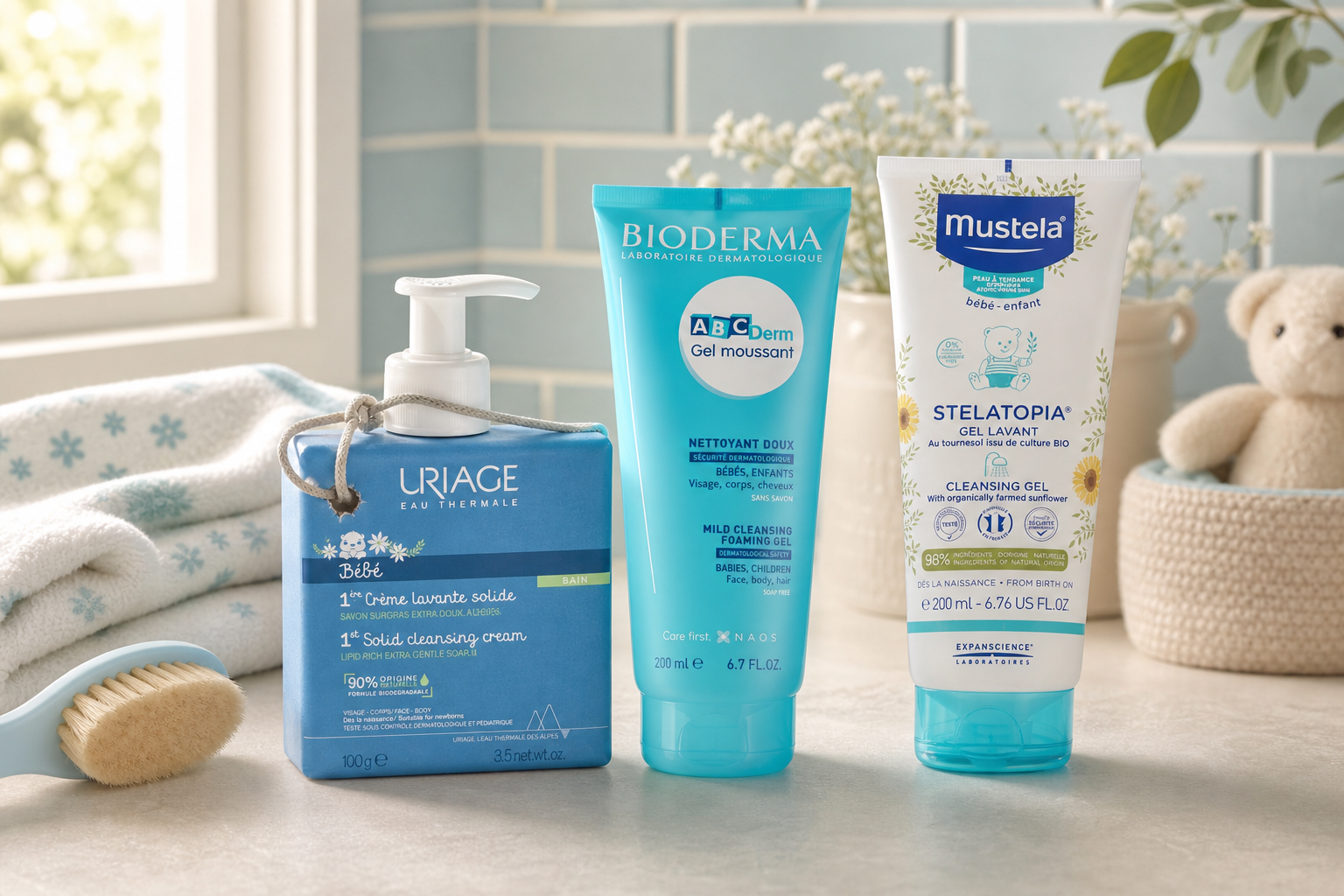
The crucial difference is what you wash the child with. Traditional foaming soap and bubble bath contain surfactants designed to thoroughly degrease—which is exactly what dry and atopic skin needs the least. Moreover, they usually have an alkaline pH, while a healthy skin barrier is slightly acidic. More suitable are products labeled as syndet, i.e., cleansing gels without traditional soap, with a pH close to that of the skin. Another option is a shower or bath oil, which leaves a gentle protective film on the skin during washing.
- Syndet cleansing gel – foams minimally, suitable for daily short baths and washing sweaty areas.
- Shower or bath oil – ideal on days when the skin is significantly drier; after the bath, the tub may be slippery, so keep that in mind.
- Fragrance and dye-free – for dry and atopic skin, a simpler formulation is generally a better choice.
Drying matters more than it seems. Do not rub with a towel, but gently pat and let it absorb the water—rubbing irritates already sensitive areas and can trigger itching in atopic skin. Pay special attention to the folds of the neck, elbow and knee pits, and behind the ears, where moisture tends to linger. The skin should not be completely dry to the touch: slightly damp skin is the ideal base for moisturizing, which should follow within a few minutes.
That's why it's worth having everything prepared in advance. A towel laid out on the changing table, a clean onesie, a diaper, and an open tube of emollient within reach mean you don't have to leave the room after taking the baby out of the tub, and there's no chance for the skin to dry out.
And what shouldn't be in the bath? Strongly scented foams and colorful fizzing tablets, which may entertain the child but unnecessarily burden the skin. It's also better to skip herbal infusions and homemade additives without consulting a doctor—it's impossible to predict how atopic skin will react. If the water in your area is very hard, rinsing the child with a shower at the end and moving straight to moisturizing can help.
Moisturizing with Emollient as a Daily Routine Essential
Whether your baby occasionally has flaky patches or skin that repeatedly becomes dry, moisturizing is the core of the entire care process. A gentle bath won't burden the skin, but it won't replenish the missing oils either. That's the job of an emollient.
What is an Emollient
Simply put, an emollient is a softening product that replenishes the skin's lipid layer and helps it retain moisture. It usually contains a combination of oils, butters, and lipids similar to those the skin naturally produces, complemented by moisturizing agents like glycerin. Products for children's skin are typically fragrance and dye-free with a simple composition – the fewer unnecessary additives, the less chance of irritating sensitive skin.
An emollient is not a medication and does not replace treatment that a doctor might recommend. Its role is different: to keep the skin in the best possible condition during periods between flare-ups.
Lotion, Cream, or Balm?
You'll encounter three basic textures, and the difference between them is mainly in the ratio of water to oils:
- Body Lotion – the lightest option, absorbs quickly, and spreads easily. Suitable for slightly dry skin, warmer months, and morning moisturizing before dressing.
- Cream – thicker and more nourishing, a compromise between spreadability and nourishment. It's often a universal choice for year-round daily use.
- Balm or Ointment – the thickest texture with a high oil content. It lasts longer on the skin, making it ideal for the driest areas and during times when the skin is most stressed – in winter, during heating season, or in windy conditions.
In practice, a combination often works well: a lighter texture for the whole body and a thicker balm targeted where dryness returns most often – the elbows, knees, backs of hands, or cheeks. If you're unsure, start with a cream and adjust the texture based on the skin's reaction.
Timing: A Few Minutes After Bathing
The proven rule is to moisturize within a few minutes after bathing, ideally within three to five. At that moment, the skin is still supple and saturated with water, and a layer of emollient helps retain the moisture inside instead of letting it evaporate. Therefore, it makes sense to have the product ready within reach before you take the child out of the bath.
Moisturizing isn't just for bath time. For dry and atopic skin, it's usually recommended to apply even outside of bath time, ideally twice a day: in the morning during diaper changes and in the evening after bathing. When the skin is significantly drier, a third layer during the day is perfectly fine.
How to Apply the Product
The amount is often where people tend to skimp. For moisturizing the whole body, think of a generous amount in the palm rather than a drop, and for daily care, it's worth opting for a larger package. The guideline is the result: after application, the skin should remain supple to the touch, not matte and dry.
- Scoop the product into your palm and warm it briefly between your fingers.
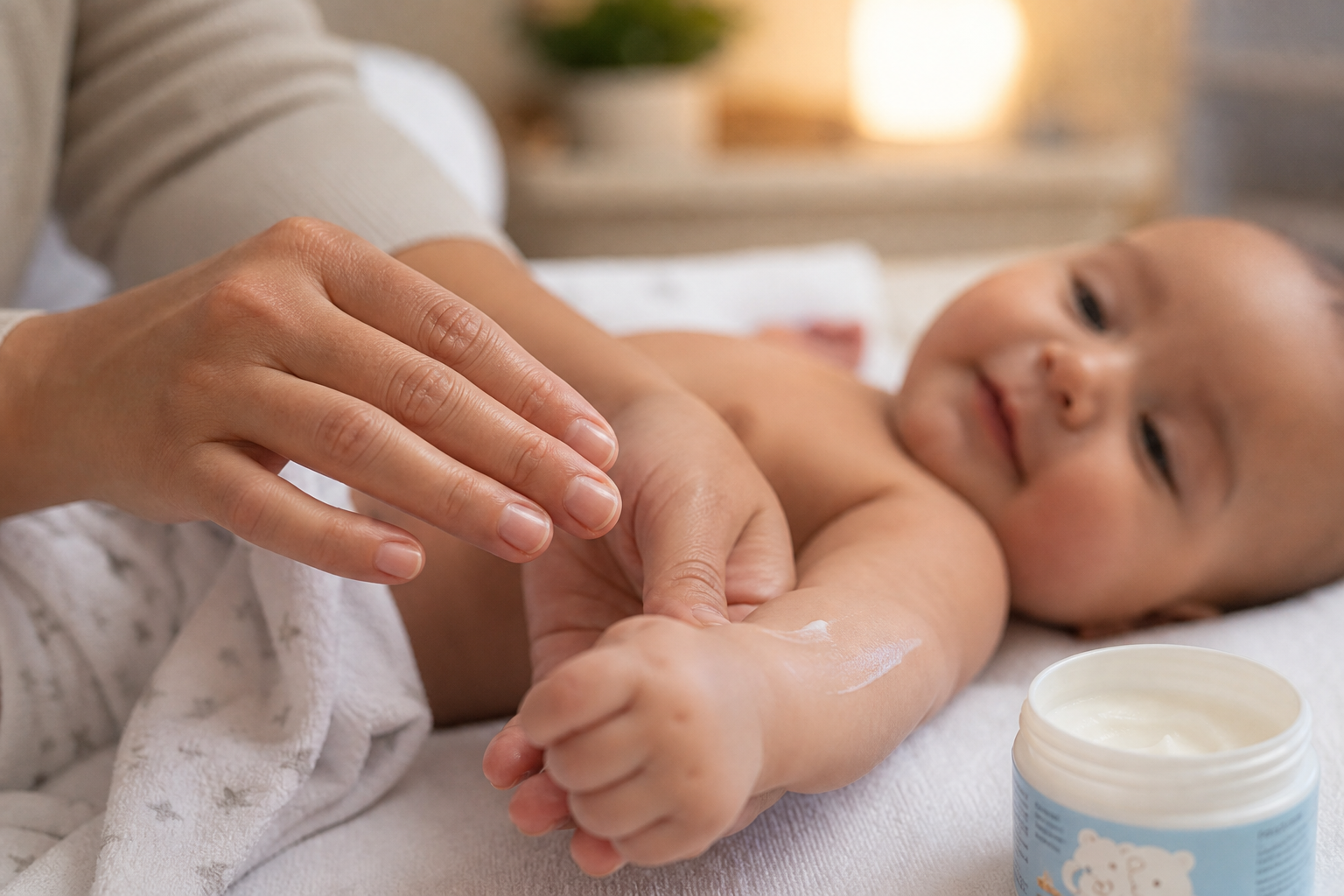
- Apply with gentle strokes in the direction of hair growth, without rubbing or vigorous massaging. The goal is a continuous layer, not massaging it in deeply.
- Start from the feet upwards: feet and legs, tummy and back, arms, and finally neck and face.
- Don't forget the folds – wrists, elbows, knees, ankles, and behind the ears.
- Allow the product to dry for a moment before dressing the child.
For atopic skin, persistence is more important than intensity. A week of thorough care followed by two weeks of break will help significantly less than a modest yet daily layer of emollient. Therefore, apply even when the skin looks fine – maintaining a calm period is exactly what you want to prolong as much as possible. The routine is most reliably maintained when linked to the evening bath or diaper changes.
Step-by-Step Routine and Tips for Enhancing It
When you put all the previous steps together, you'll find that daily care for your baby's dry and atopic skin takes less time than it might initially seem. It's not a demanding ritual, but a series of small habits repeated in the same order. Consistency is what helps the skin the most – and you can manage it even on busy days at home.
Morning: Light Moisturizing
In the morning, during diaper changes and dressing, take a quick look at your child. Focus on areas that dry out the fastest: cheeks, backs of hands, elbows, knees, and the skin around the diaper. Where the skin is rough or grayish, apply a thin layer of a lighter emollient – body lotion or cream absorbs faster than a thick balm and won't bother the child under clothing. Feel free to repeat the moisturizing during the day as soon as you notice the skin tightening again.
Evening: Short Bath, Then Emollient
Evening is bath time. Fill the tub with lukewarm water, let the child soak briefly, and use a syndet cleansing gel or shower oil designed for dry and atopic skin. After the bath, dry the baby by patting with a towel, not rubbing, and within a few minutes, while the skin is still warm, apply a thicker emollient. Spread the balm in gentle strokes in the direction of hair growth and let it absorb for a while before dressing the child. If itching is most bothersome in the evening, this layer is often the most crucial step.
When to Consult a Doctor
The home routine can handle much of the daily discomfort, but it doesn't replace professional assessment. Consult a pediatrician or dermatologist if:
- Lesions are oozing, forming crusts, or have a yellowish coating,
- Redness significantly worsens over a few days or spreads quickly,
- The child repeatedly wakes up at night due to itching and scratches until bleeding,
- The skin doesn't respond even after several weeks of consistent care,
- Fever or a significant change in behavior accompanies skin symptoms.
A specialist will assess the underlying causes and recommend further steps. Moisturizing with an emollient is usually not omitted – it remains the foundation on which further care is built.
How to Enhance the Routine
In facial and body cosmetics, there are several lines that parents often turn to in this situation. Consider them as guidance for selection, not a complete shopping list – choose specific products based on how your child's skin reacts to them.
- Bioderma Atoderm – a line focused on dry and atopic skin. It includes shower oil and cleansing gel for baths, along with nourishing creams and balms for moisturizing.
- La Roche-Posay Lipikar – body balms for very dry skin, also available in larger sizes, which you'll appreciate when moisturizing daily.
- Uriage Xémose – soothing care in the form of an oil balm, intended for skin prone to itching.
- CeraVe – moisturizing creams and lotions for daily moisturizing and gentle cleansing products to accompany them.
For children's skin, less is sometimes more: one cleansing product, one emollient, and consistency. Before reaching for another new product, give the chosen combination a few weeks – with atopic skin, the results are more noticeable in calmer nights than at first glance after a single use. And if you're unsure about the composition or suitability of a product for your child's age, consult a pediatrician or pharmacist.


Category
Recommended articles
"Give a girl the right shoes and she can conquer the world!" Marilyn Monroe