

 Riiffs Freeze in Flames: Ice and Flames Illuminate Warsaw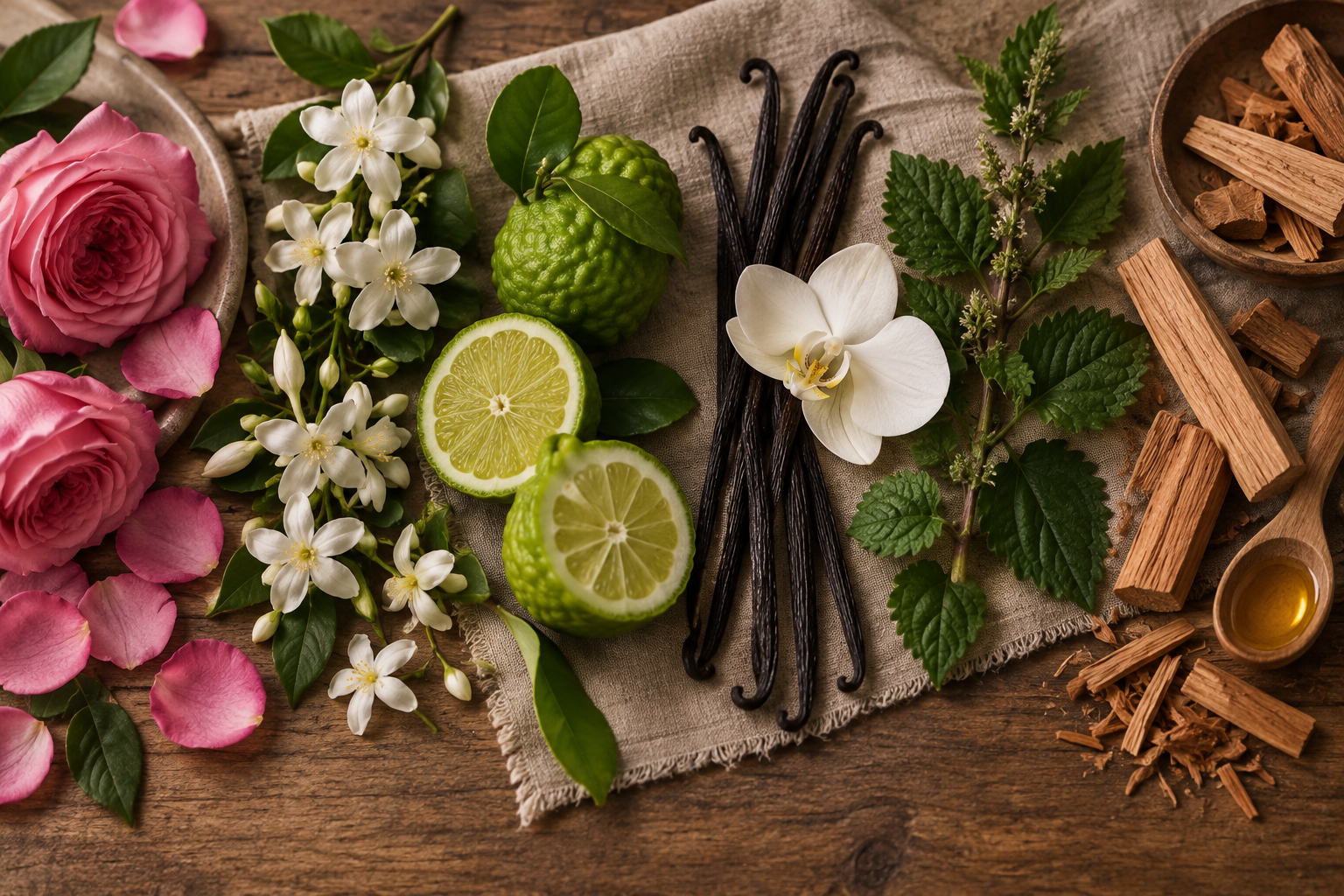
What lies behind the notes in a perfume description? In the first part of our encyclopedia of perfume ingredients, we introduce rose, jasmine, bergamot, vanilla, patchouli, and sandalwood – where they come from, how they are obtained, and how they smell.
Rose – The Queen of Floral Notes
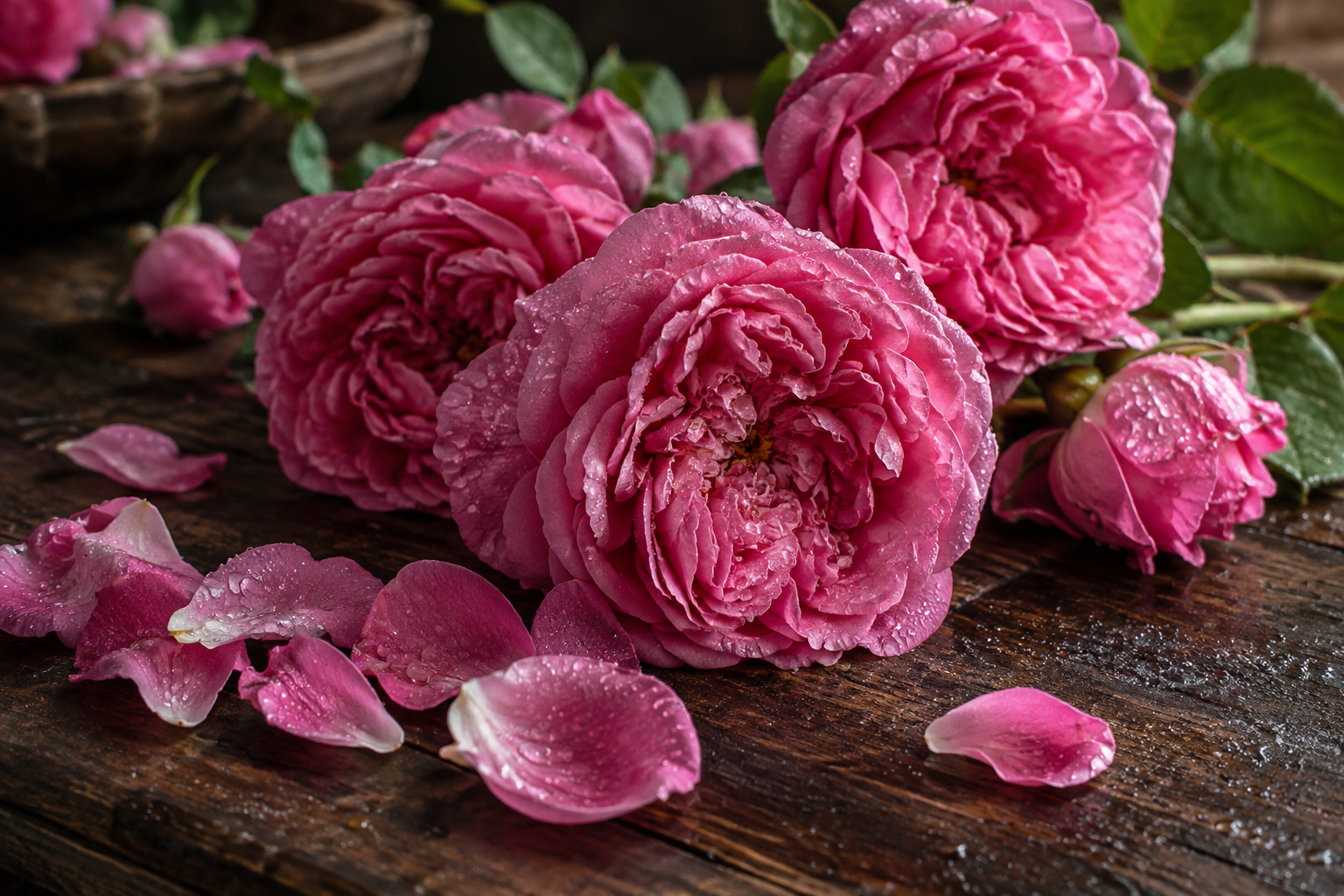
Among perfumery ingredients, the rose holds a special place. It has been used for centuries, is one of the most expensive natural materials, and remains familiar even to those who have never thought about perfume composition. Its scent is instantly recognizable, yet beneath the initial impression lies a blend of hundreds of fragrant substances, each adding a different nuance.
Perfumery primarily works with two varieties. The Damask rose (Rosa damascena) has a rich, spicy, and slightly honeyed scent with a strong body; it is harvested as a small, densely packed flower. The Centifolia rose (Rosa centifolia), also known as the May rose, has a softer, greener, and more honeyed fragrance, with a hint of freshly crushed petals. You can distinguish the difference between them even without perfumery training – just smell both materials side by side.
Geography plays a similar role for roses as it does for wine. The most famous area is Bulgaria's Rose Valley near Kazanlak, where Damask roses have been cultivated for generations and harvested during a short window in May and June. Turkey's Isparta supplies similar material in large volumes, Moroccan plantations in the Atlas foothills are more associated with the Centifolia rose, and France's Grasse, the cradle of modern perfumery, maintains a small but prestigious production of May roses. The same variety smells different in each of these regions – the outcome is influenced by soil, altitude, and night temperatures before harvest.
Harvesting remains manual and begins before dawn. Petals carry the most fragrance in the cool and quickly lose it as the sun rises, so they are picked only during a few morning hours. The raw material is then processed in two ways:
- Steam Distillation – petals are steamed, and the resulting condensate is separated into rose oil and rose water. The oil is one of the rarest perfumery materials; thousands of hand-picked flowers are needed for a single gram.
- Solvent Extraction – a gentler process that first yields a waxy concrete and then an alcohol-washed absolute extract. This is more vibrant in color and closer in scent to the living flower than the distillate.
So how does rose smell in a perfume? The basic impression is honeyed and velvety, with a subtle lemon sparkle in the first minutes and a spicy undertone reminiscent of clove or pepper. On warm skin, it develops into a fruity depth with hints of dried apricots and raspberries, while in cooler conditions, it appears cleaner and greener. Distilled oil tends to be sharper and more metallic, while the absolute extract is denser, darker, and sweeter – hence both forms are often combined in compositions.
In addition to natural material, perfumery commonly uses synthetic molecules that mimic or enhance individual facets of the rose – such as damascenones for fruity richness or rose oxide for a fresh, slightly green sheen. These are not substitutes in the pejorative sense: natural extract and synthetic molecules usually complement each other in a composition, as the natural oil alone can be too heavy for certain effects.
In the fragrance pyramid, the rose most often occupies the heart notes, the part of the composition that unfolds after the top notes fade and holds the perfume's character for several hours. It acts as a connecting element: linking to a citrus or fruity opening and smoothly transitioning to the base. It is most commonly paired with patchouli, which adds an earthy shadow, sandalwood for creamy softness, and oud, which shifts it into a darker, oriental register. Newer compositions like to add raspberry or lychee accords to highlight its fruity aspect.
Jasmine – the intoxicating night bloom
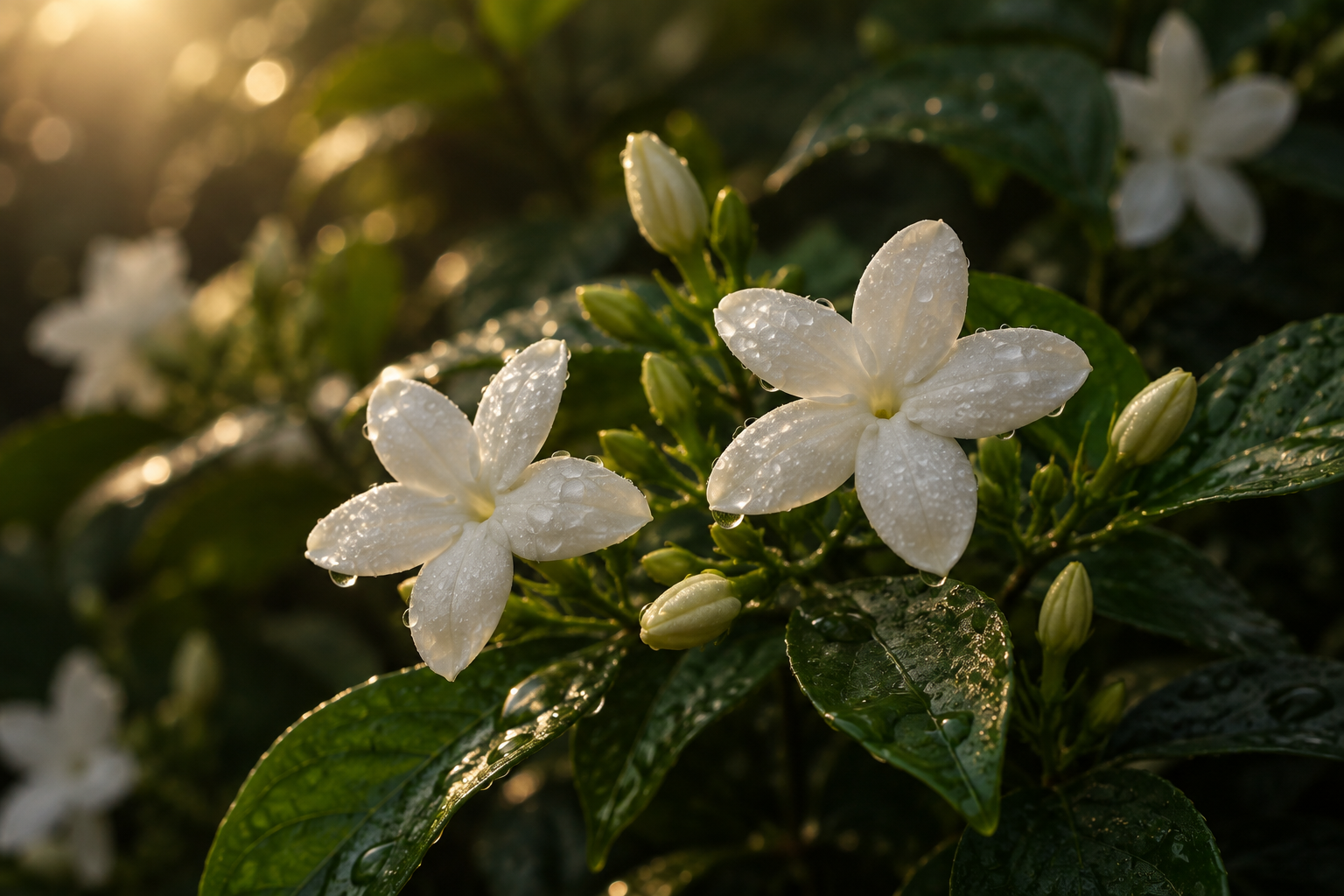
While most flowers open their petals to the sun, jasmine awakens at dusk. Its small white stars emit their strongest fragrance between midnight and dawn, guiding the entire cultivation craft around it. If the jasmine note seems denser and more sensual than other flowers, it's no coincidence.
You will mainly encounter two botanical species:
- Large-flowered Jasmine (Jasminum grandiflorum) – a species with larger, richly developed flowers. Its scent is full, honeyed, and softly fruity, with a pronounced body.
- Jasmine Sambac (Jasminum sambac) – a smaller and rounder flower, also known from flavored teas. It smells greener, sharper, and its animalic undertone is more noticeable.
The plant originates from India and surrounding southern countries, and Indian cultivation still holds a strong position today – Jasmine Sambac is associated with ceremonies and daily flower garlands there. Other key cultivation areas include Egypt with plantations in the Nile Delta, Morocco, and southern France, where jasmine has thrived around Grasse for centuries. Each location gives the raw material a slightly different character: Egyptian material tends to be richer and more honeyed, while French is gentler and greener.
Harvesting is therefore a night-time job. The flowers are picked by hand, usually in the hours before dawn, because as the day progresses and temperatures rise, the fragrance content in the flower decreases. Only the open flowers are collected, they must be processed within hours, and thousands are needed for a single kilogram of fragrant material – hence the labor intensity and high value of jasmine raw material.
Jasmine is not distilled with steam. Its fragrance molecules are so sensitive that hot steam would damage them, resulting in a scent more reminiscent of cooked vegetables than flowers. Historically, enfleurage was used: fresh flowers were placed on a layer of pure fat, which gradually absorbed their scent, and the exhausted flowers were replaced with new ones until the fat was saturated. The resulting pomade was then washed with alcohol.
Enfleurage is extremely labor-intensive, so today it has been largely replaced by solvent extraction. First, a concrete is obtained from the flowers – a waxy semi-solid mass with a concentrated scent – and further processing in alcohol produces an absolute extract, a thick liquid with which the perfumer truly composes.
The scent of jasmine absolute extract is intensely floral, honey-sweet, and slightly animalic in depth. It opens with a green, almost juicy phase, beneath which a sensual core with a hint of indole develops – a natural compound that gives jasmine its narcotic, slightly intoxicating character. In dilution, it feels warm and seductive, in concentration almost disturbingly bodily. This very contrast makes jasmine a material that perfumers use drop by drop.
In composition, jasmine belongs to the heart notes. It emerges when the fresh top note fades, adding body and fullness to the fragrance – filling the space between the sparkling beginning and the dense base. It pairs well with strong companions:
- rose – a classic floral combination where jasmine adds richness and depth,
- neroli and orange blossom – soften its animalic side and bring light into the heart,
- sandalwood – a creamy woody base that grounds jasmine and extends its trail,
- musky accords – enhance sensuality and help the floral heart last longer on the skin.
Therefore, you can recognize jasmine in a perfume even when it's not listed as the main note: it contributes to the fullness and softness of the entire floral heart.
Bergamot – the sparkling start of a fragrance
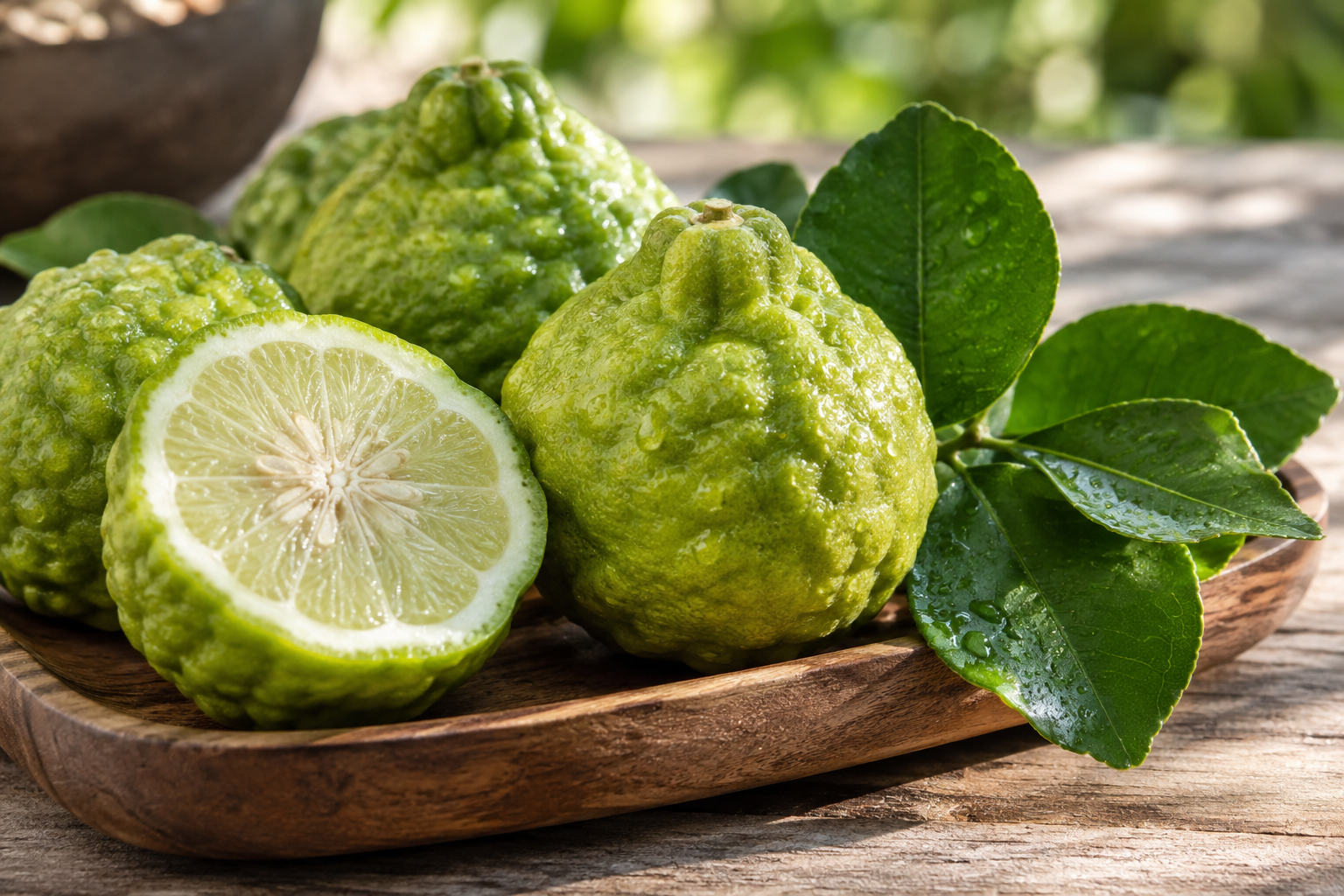
When a perfume sparkles with the first spray, it's often thanks to bergamot. This small citrus fruit, with a thin peel, is somewhere between a lemon and a small orange in color and shape. Its pulp is so bitter and sour that it's not typically eaten. Its true value lies in the peel – specifically in the microscopic glands full of essential oils that release when pressed.
Bergamot is also remarkable for how a small region can supply the entire perfume world. The vast majority of the world's production comes from Calabria, a narrow strip of the Ionian coast nestled between the sea and the mountains. The mild winters, humid sea air, and permeable soil give the fruit a profile that is only partially replicated elsewhere. The harvest takes place in the winter months, roughly from November to February, and much of it is still done by hand.
The method of extraction is as defining for bergamot as its place of origin. The essential oil is not obtained by distilling the pulp or pressing the juice, but mechanically from the peel, cold. A machine gently disrupts the peel, the released oil is captured with water as an emulsion, and centrifugation separates the two components. The result is a liquid known in perfumery as essence – unlike distillates, it has never come into contact with hot steam, thus retaining even the most volatile molecules. From the remnants after pressing, a secondary, finer material is obtained through gentle distillation; it smells purer but lacks the richness of pressed essence.
The extraction method is also linked to the most well-known technical topic around bergamot – furocoumarins. These naturally occurring substances, most commonly bergapten, remain in the peel and transfer into the pressed essence. In combination with sunlight, they can increase skin sensitivity to light, which is why perfumery often uses modified versions from which furocoumarins have been removed. Such a version is described as somewhat smoother and less bitter, yet it can be used without restriction in daytime compositions.
The scent of bergamot is freshly citrusy, but unlike most citrus fruits, it is not sweet. It has a sparkling start, with a distinct floral edge close to orange blossom and a dry, elegant bitterness in the background that gives the raw material its character. Compared to orange, it feels more restrained and mature, and compared to lemon, less sharp and sour. You might have the most famous example at home in your cupboard: it is bergamot essence that gives Earl Grey tea its distinctive aroma.
The molecules of bergamot essence are light and evaporate quickly, which predisposes the raw material to a role in the top notes. On the skin or a paper strip, it is typically noticeable for several tens of minutes. Its role is not to last, but to open the composition: to give it light, a clear beginning, and a smooth transition to what follows.
What bergamot is most often paired with:
- Lavender – a classic duo of aromatic scents; bergamot lightens lavender and reduces its herbal harshness.
- Neroli and orange blossom – related citrus-floral notes that extend the bergamot edge deeper into the heart of the fragrance.
- Tea accords – a natural connection that brings out the dry, slightly astringent dimension of bergamot.
- Oakmoss – a contrast of freshness and earthy bitterness, on which the entire chypre family is built.
In classic structures, the presence of bergamot is directly structural. Chypre is formed as an arch between a citrus start and a mossy-woody finish, with bergamot making up its first half; fougère stands on a trio of fresh citrus, lavender, and coumarin sweetness. Without bergamot, both families would have to base their opening on another raw material.
Vanilla – the Sweet Warmth of a Gourmand Base
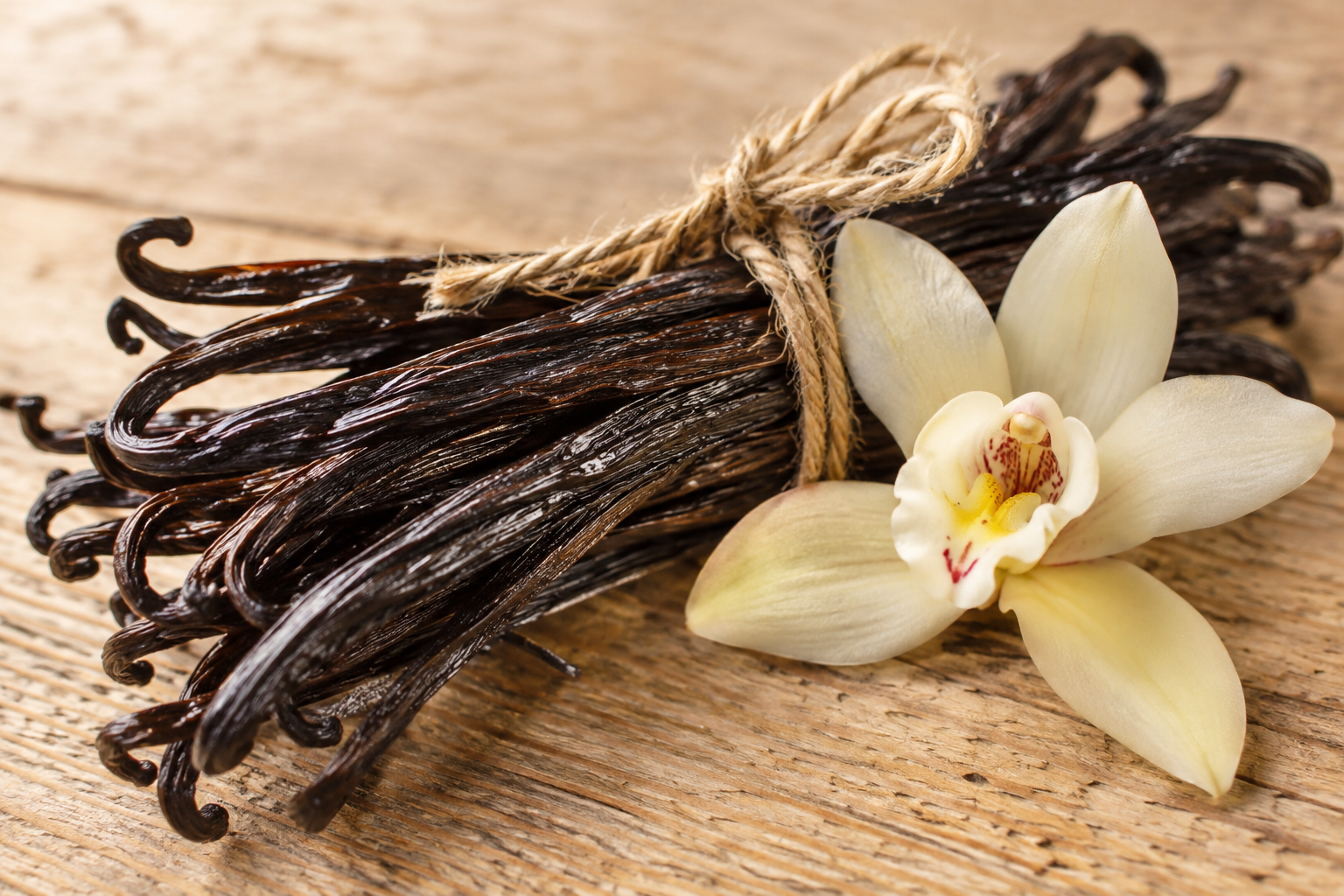
You probably know vanilla from the kitchen before the perfumery. In a bottle, however, it's not about the aroma for baking, but a raw material with an unusually labor-intensive journey from flower to extract. Vanilla is the fruit of a tropical orchid, a climbing vine from the Vanilla genus, which climbs tree trunks and requires humid, constant warmth. Its home is Central America, where it is pollinated by local bees and hummingbirds. However, once humans moved it elsewhere, the pollinator stayed home – so growers in Madagascar, Réunion, the Comoros, or Tahiti must pollinate each flower by hand. The flower opens for only one day, so the plantation is visited every morning, and each flower is pollinated one by one with a thin stick.
Even more interesting is what happens after the harvest. The green pod itself is practically scentless: aromatic substances are bound within and need to be released. Processing takes months and involves several steps:
- Steaming – a short bath in hot water stops the pod's growth and starts enzymatic processes.
- Sweating and Fermentation – pods are placed in boxes and blankets, where daily heating alternates with nightly rest; they darken and begin to smell.
- Drying – gradual, often in the sun, so the pod loses water but remains supple.
- Aging – several months of rest in closed containers, during which the scent balances and deepens.
Several forms of raw material are then prepared from the dried pods. Tincture is made by long maceration in alcohol and is used where vanilla should sound light and transparent. Extract is more concentrated and thicker. Absolute extract is the densest – dark, syrupy, almost dessert-like in scent. A modern alternative is carbon dioxide extraction, which captures a fresher, less "cooked" profile.
Alongside the natural raw material is vanillin – the main aromatic component of vanilla, which can also be produced synthetically. On its own, it smells clear and sweet, but flatter: it lacks the accompanying substances that natural extract has in hundreds, which add depth, a smoky undertone, and a slight acidity. It's not a choice between "real" and "fake," but rather between one color and an entire palette. Perfumers commonly combine both levels.
So how does vanilla smell? Warm, balsamic, and creamy sweet, with a soft, almost milky texture. Depending on the variety and processing method, additional shades are added – smoke, tanned leather, dried fruit, or rum. Madagascar-type pods tend to be darker and more dessert-like, while Tahitian ones are more floral, with an anise and slightly powdery hint.
In the fragrance pyramid, vanilla resides in the base notes. It doesn't open the composition but holds it together: it extends longevity, smooths out sharp edges, and gives the fragrance a soft, rounded finish that you can feel on your skin long after the first spray. It is also one of the fundamental building blocks of the gourmand family. It pairs particularly well with these partners:
- Tonka bean – adds an almond and hay note and softens the vanilla further;
- Benzoin and resins – deepen the balsamic quality and add density to the composition;
- Spices like cinnamon, cardamom, or clove – enhance the warm side and take away the excessive sweetness of vanilla;
- Cocoa and roasted notes – shift the whole into a bittersweet, dessert-like position;
- Woody accords – give the sweetness a backbone and prevent it from dissolving.
Vanilla deserves patient sniffing: on a paper tester, it mainly shows its sweet shell, while only on the skin do its smoky, leathery, and resinous layers emerge, which are initially hidden under the sugar.
Patchouli – Earthy Dark Green
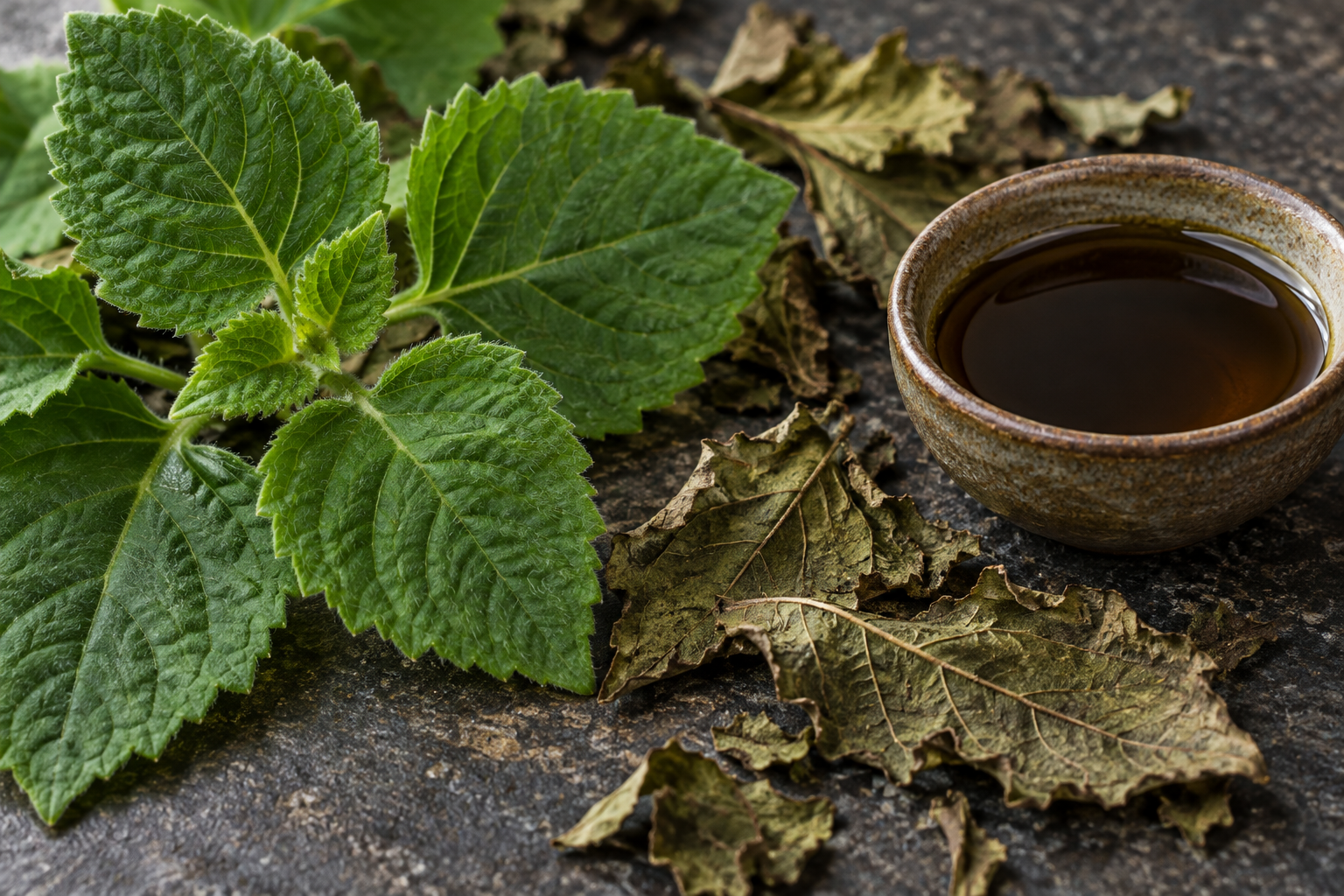
Patchouli is an unassuming shrub from the mint family, which also includes sage and lavender. It grows to about a meter, with soft, hairy leaves and small light flowers that are practically useless for perfumery – the plant's fragrant value is entirely in its leaves. It thrives in humid tropical climates with warm nights, so the main growing areas are in Indonesia, particularly Sumatra and Java, as well as India, the Philippines, and Malaysia. The leaves can be harvested several times a year, making patchouli one of the more accessible natural materials.
Few ingredients carry such a distinct cultural imprint. Patchouli arrived in Europe in the nineteenth century as an accompaniment to imported Indian shawls – dried leaves were interspersed between the fabric to protect it from moths, and customers learned to recognize genuine oriental goods by that characteristic scent. A hundred years later, patchouli became the olfactory signature of the late sixties and early seventies, worn more as a statement than as a perfume. However, in oriental perfumery, it has never been a fashion episode; it has been a staple for centuries.
The processing of patchouli is unlike what you're used to with fragrant materials. While flowers usually need to be processed as soon as possible after harvest, freshly picked patchouli leaves are first allowed to wilt, then slowly dry in the shade, and finally undergo partial fermentation. Only then does steam distillation take place. This intermediate step is not negligence – during wilting and fermentation, cell walls break down, fragrant compounds are more easily released, and the oil profile deepens. The result is a thick dark liquid ranging in color from amber to nearly black.
Another characteristic puts patchouli in a special position. Most natural oils lose their freshness over time and spoil through oxidation, but patchouli oil gains quality as it ages. Young oil tends to be sharper and rawer, but after a few years in peace, it darkens, rounds out, and develops a velvety depth. In perfumery, it is not uncommon to work with batches that are several years old.
So, how does patchouli smell? The foundation is earthiness – damp forest soil after rain, fallen leaves, roots, and moist wood. In the first few minutes, a cool camphor top note hovers over it, which can come across as sharply mentholated and is often why some people don't take to patchouli at first sniff. Once it fades, a dark sweetness reminiscent of bitter chocolate and dry cocoa powder emerges, finishing with a wine-like, almost cognac tone.
In composition, patchouli plays a dual role. It is a classic base note, meaning it's what you smell from the perfume hours later on the skin or the next day on a scarf. It also serves as a fixative: its heavy, low-volatility molecules slow the evaporation of lighter materials above it, so the entire scent structure holds together longer. Its most natural partners include:
- rose – the earthiness underpins floral sweetness and reduces its sugariness,
- oakmoss – together they create a damp forest base on which the chypre family stands,
- bergamot – a sparkling citrus opening adds contrast and light to the dark base,
- vanilla – sweet warmth smooths the camphor edges and shifts the whole towards an oriental expression.
This is why patchouli is a fundamental building block of two major fragrance families. In chypre compositions, it forms a dark base with oakmoss, against which the citrus beginning and floral heart are reflected. In oriental compositions, it combines with resins, spices, and vanilla into a dense balsamic base. And because its earthy character has no distinctly masculine or feminine undertone, you often find it in unisex compositions.
Sandalwood – The Creamy Depth of a Woody Base
Sandalwood is one of those ingredients that doesn't shout in a composition, yet it gets noticed. Where the citrus sparkle has long evaporated and the floral heart has quieted, sandalwood holds a warm, milky-soft trail that lingers on the skin until the end of the day. That's why it's used as one of the pillars of the woody base.
A Tree That Grows Slower Than It's Harvested
The classic ingredient is white sandalwood (Santalum album), traditionally associated with the Indian region of Mysore. It's an inconspicuous evergreen tree with one peculiarity: it's semi-parasitic. It connects its roots to the roots of surrounding host plants, drawing water and minerals from them. Without suitable neighbors, it doesn't thrive, and planting alone is not enough.
The second peculiarity is time. Fragrant substances accumulate in the heartwood over decades; the tree is considered a fully-fledged raw material at about thirty years old, and with further age, the content and quality of the oil continue to rise. This imbalance between slow growth and rapid demand led to decades of uncontrolled logging. Indian sandalwood is therefore now subject to strict regulation – the trees have protected status, and logging and export are under state supervision.
As a result, Australian sandalwood (Santalum spicatum) and white sandalwood grown on Australian plantations are coming to the fore, where they are planted with a view to harvest decades later. Plantation raw material has a traceable origin and a more consistent profile. Australian sandalwood, meanwhile, smells drier and less milky than Indian – it's not a copy, but a distinct material.
The Scent Hidden in the Core and Roots
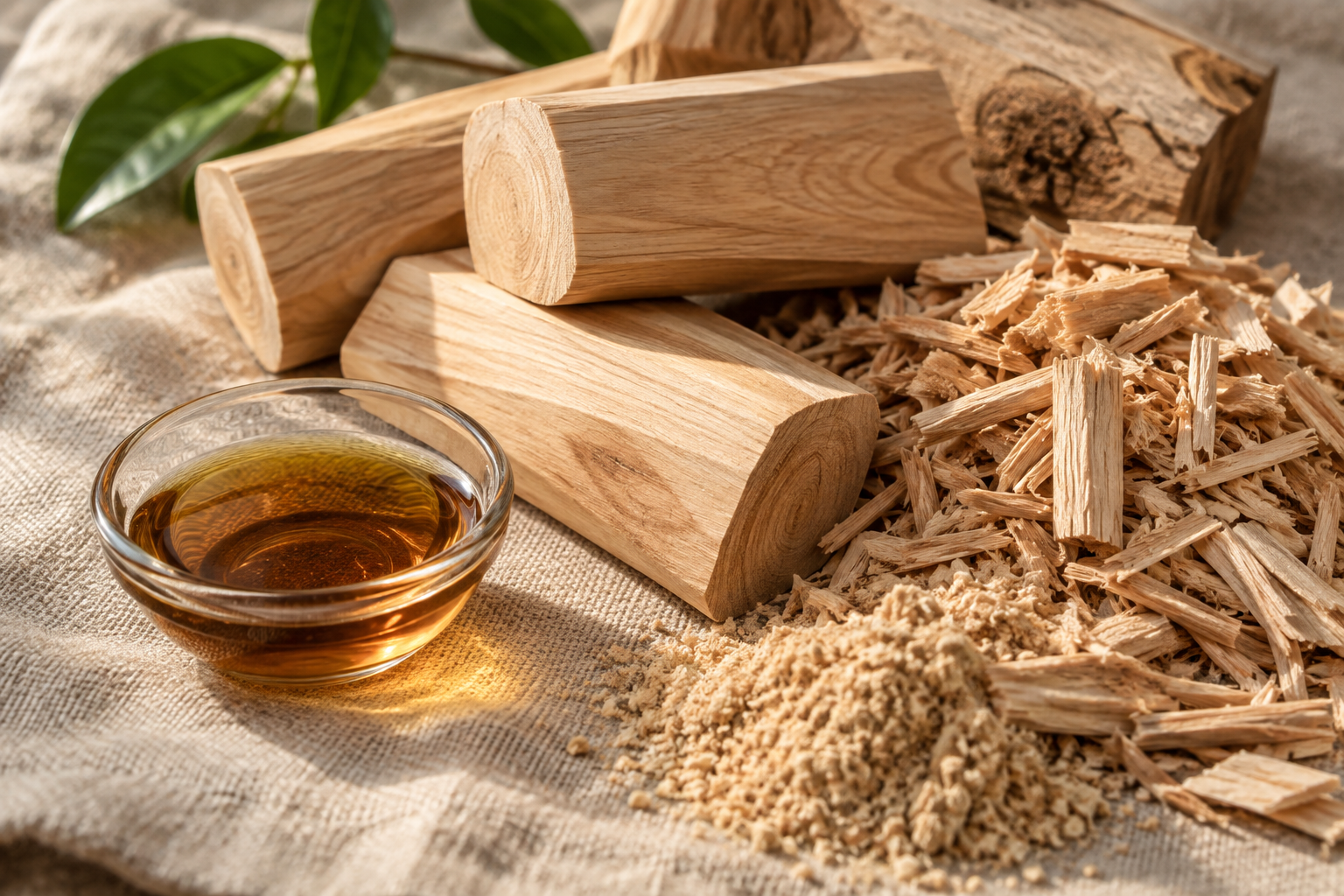
For many ingredients, fragrant substances are sought in the flower, peel, or leaf; with sandalwood, neither the bark nor the leaves offer practically anything. The aromatic part is the inner, darker heartwood, and the roots are even richer. Therefore, the whole tree is harvested, including the root system, not just the trunk.
The wood is stripped of its light outer layer, chipped, and ground into coarse chips or even dust – the finer the material, the easier the steam penetrates inside. This is followed by steam distillation, which for sandalwood is one of the most time-consuming: it's not measured in hours like with citrus, but in tens of hours, and with traditional methods, even several days. The main carriers of the scent are santalols; their proportion in the oil is also a measure of quality.
How Sandalwood Smells
Describing sandalwood in a single word is difficult, "creamy" is probably the closest. The scent is milky and smooth, like warm wood without sharp edges – no sawdust, no resin. Underneath, there's a slightly nutty, gently sweet, and balsamic tone. On the skin, it has an almost skin-like, bodily character – as if it's not the wood that's fragrant, but the skin itself. The dry-down is long but unobtrusive – sandalwood doesn't overpower its surroundings, rather it holds them together.
Place in the Pyramid: Base Notes and a Silent Foundation
Sandalwood belongs unequivocally to the base notes. Besides its own scent, it acts as a fixative: it slows the evaporation of lighter components, so the composition lasts longer and disintegrates more smoothly. It also serves as a silent foundation, on which other ingredients are well placed – roses sound rounder, jasmine less sharp, spices like cardamom or saffron gain a warmer frame, and incense accords lose their cold, church-like undertone.
You can find it across families: in oriental and woody fragrances, in floral perfumes for women, in aromatic compositions for men, and very often in unisex perfumes, where its soft neutrality suits both sides. So if you find that the finish of a perfume, when it warms up and clings to the skin, is just right for you, it's quite likely that sandalwood is to blame.
Category
Recommended articles
Riiffs Freeze in Flames: Ice and Flames Illuminate Warsaw "Give a girl the right shoes and she can conquer the world!" Marilyn Monroe