

 Riiffs Freeze in Flames: Ice and Flames Illuminate Warsaw
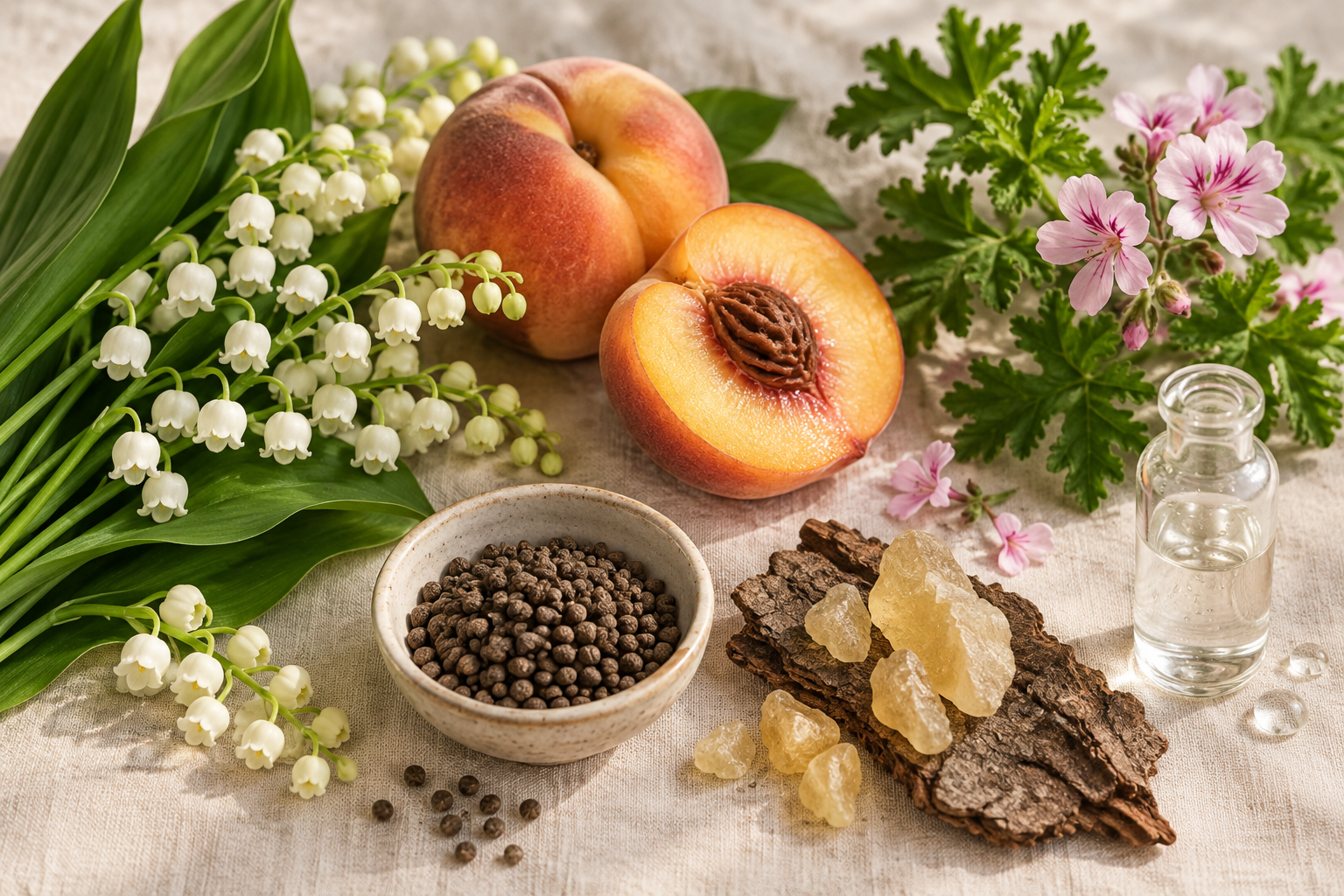
What lies behind the notes in a perfume description? In the tenth installment of our encyclopedia, we introduce lily of the valley, peach, geranium, ambrette seed, elemi, and aldehydes – from the silent flower that cannot be distilled to the sparkling molecules that transformed modern perfumery.
Lily of the Valley – Spring Bells That Cannot Be Distilled
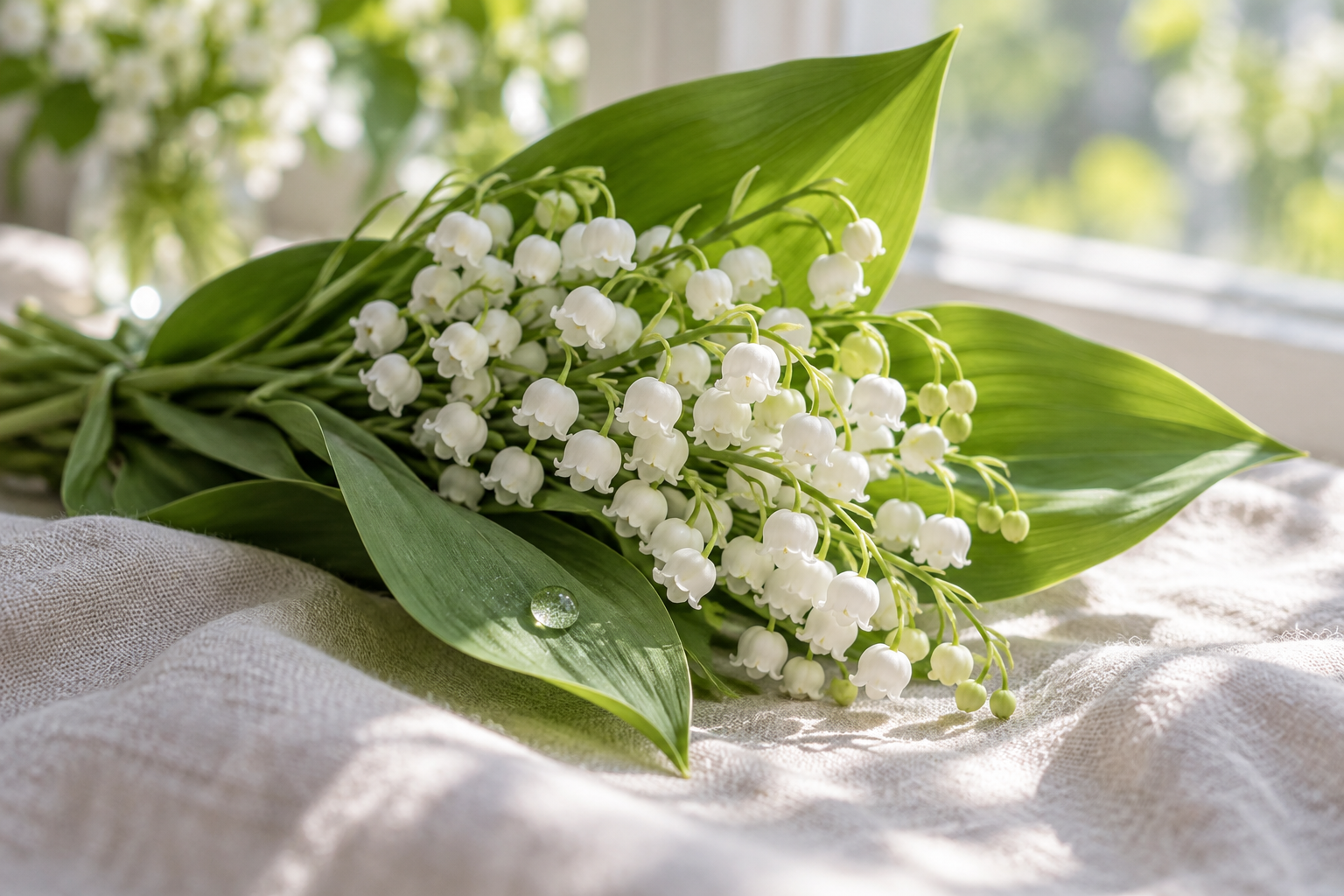
Just bend over the shady forest floor in May, and you'll smell it: a pure, cool, slightly green scent that seems to carry the morning dew. Lily of the Valley (Convallaria majalis) is a small plant found in European deciduous forests, yet it is a classic motif in floral perfumery. It has one peculiarity – its scent cannot be truly extracted from the flowers.
The Silent Flower That Must Be Composed
Perfumers classify Lily of the Valley among the so-called silent flowers. Its delicate bells do not yield a usable oil through steam distillation, nor does solvent extraction capture the scent you experience in the forest. Therefore, the scent of Lily of the Valley in perfumery has always been composed – initially from combinations of other natural substances, and from the turn of the 19th and 20th centuries, primarily from synthetic molecules.
A major breakthrough came with hydroxycitronellal, a molecule with a soft, fresh floral scent that began to be used in the early 20th century. Following this, a series of other substances emerged, highlighting different facets of Lily of the Valley – sometimes lemony fresh, other times watery, green, or powdery soft. Some previously popular molecules are now restricted or completely banned by European regulations, so perfumers continually "reconstruct" Lily of the Valley from newer building blocks. Each Lily of the Valley in a bottle is thus a portrait, not an imprint.
The resulting impression is fresh, green, and dewy, with a subtly soapy, almost transparent floral nuance. In compositions, Lily of the Valley is mainly used in the heart of the fragrance, where it adds lightness and airiness even to heavier florals. It pairs well with rose, jasmine, and ylang-ylang, which round it out, with bergamot, which brightens it at the start, with green leaves that emphasize its forest origin, and with musk, which helps its purity linger longer on the skin. A famous Lily of the Valley perfume from the mid-50s is still cited today as a model of a transparent spring flower.
A Flower for Good Luck
In France, Lily of the Valley has its own day. Every year on May 1st, it is given to loved ones for good luck, and vendors offer it on almost every corner. It is said that the custom was established in the 16th century by a French king who received a sprig of Lily of the Valley as a talisman and decided to distribute it to the ladies of the court every spring. Lily of the Valley became a symbol of spring, new beginnings, and elegant floral perfumery. It also appears in bridal bouquets and, according to Christian legend, is said to have grown from the tears of the Virgin Mary.
One thing to keep in mind: the charming Lily of the Valley is a poisonous plant. Its charm belongs in the garden, vase, and perfumes – not in the kitchen.
Peach – the velvety fruit of immortality
Few fruits have as rich a story as the peach. Its homeland is China, where it has been cultivated for millennia and has long symbolized longevity and immortality. It is said that in the gardens of the goddess Xi Wangmu, peaches of immortality ripened only once every three thousand years, and whoever tasted them gained eternal life. Therefore, the peach still appears on Chinese paintings, porcelain, and birthday wishes for the elderly.
It reached Europe via Persia. The ancient Romans considered it a Persian fruit, hence its Latin name Prunus persica – literally "Persian plum."
A scent that cannot be extracted
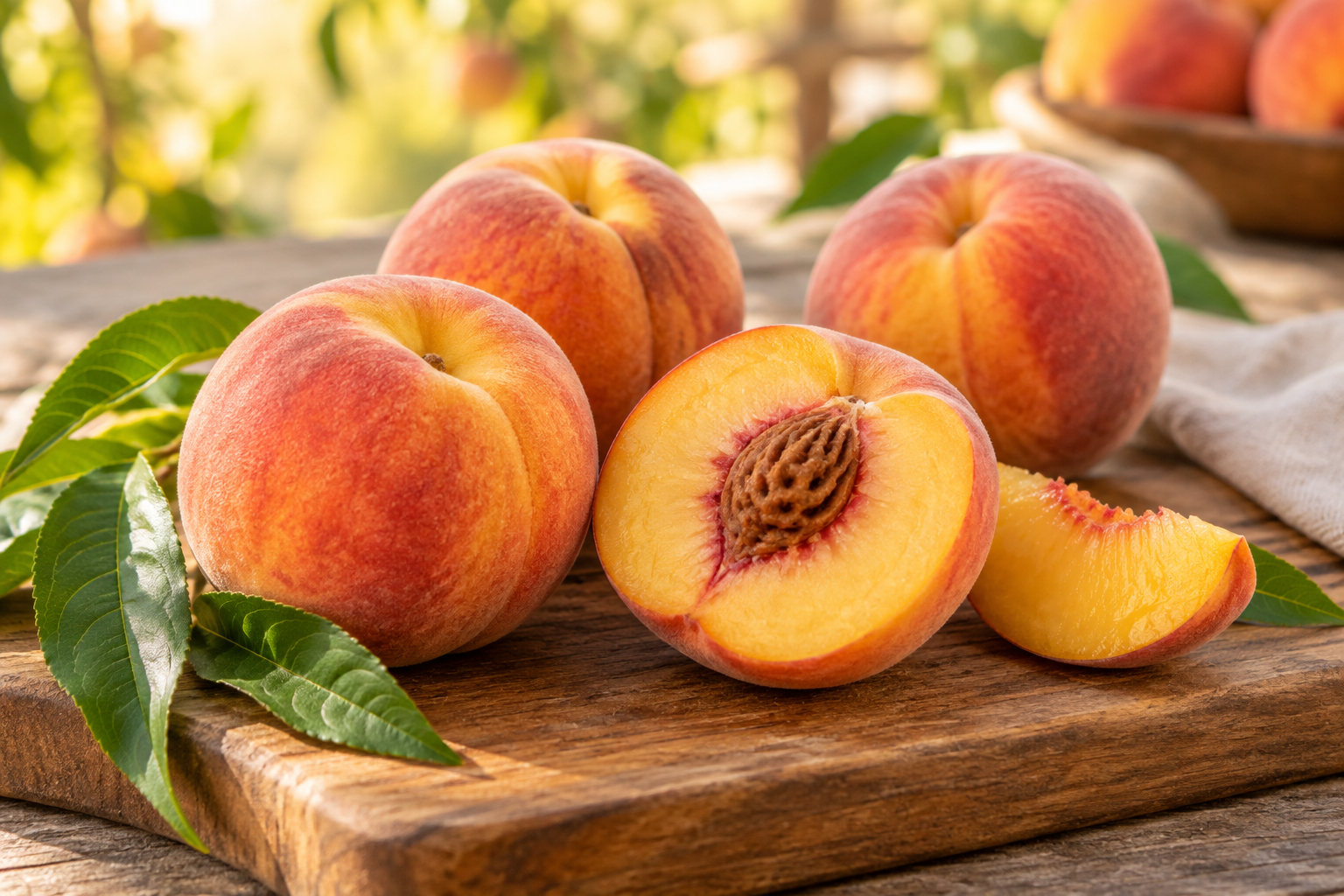
Although the peach smells fragrant on the tree, perfumers cannot extract anything directly from it. The fragrant oil cannot be produced in usable quantities from the pulp, and while the oil pressed from the pits is popular in cosmetics, it does not carry a fruity scent. Therefore, the peach note in perfume is always a reconstruction. The key to this is lactones – molecules that naturally occur in the fruit itself. The most famous of these is gamma-undecalactone, known in perfumery as "aldehyde C-14." Despite its name, it is not an aldehyde – the designation originated in the early 20th century and has persisted in the industry to this day.
The resulting scent is velvety, juicy, and creamy, with a subtle hint of coconut and ripe apricot. It does not have the sour or fresh quality of citrus – it is more reminiscent of the warm skin of sun-ripened fruit.
In top notes and the heart
Peach is used in top notes, where it adds a juicy opening to the composition, and in the heart, where it rounds out the flowers and adds softness. It gained fame in chypre perfumes from the early 20th century. The lactone peach softened the earthy, slightly bitter oakmoss and created a contrast that made history in perfumery. It is said that the famous chypre perfume from 1919 owes its unmistakable signature to this combination. Fruity chypre has since become a separate branch of the entire family.
In fragrance compositions, you will most often encounter it in these combinations:
- jasmine – shares a creamy, sensual fullness with peach, and together they appear radiant,
- rose – peach reduces its powderiness and adds juiciness,
- oakmoss – a classic chypre contrast of velvet and forest earth,
- vanilla – shifts peach towards a dessert-like, gourmand impression,
- musk – extends its softness and gives the impression of clean skin.
Geranium – the Pink Soul of the Window Sill Plant
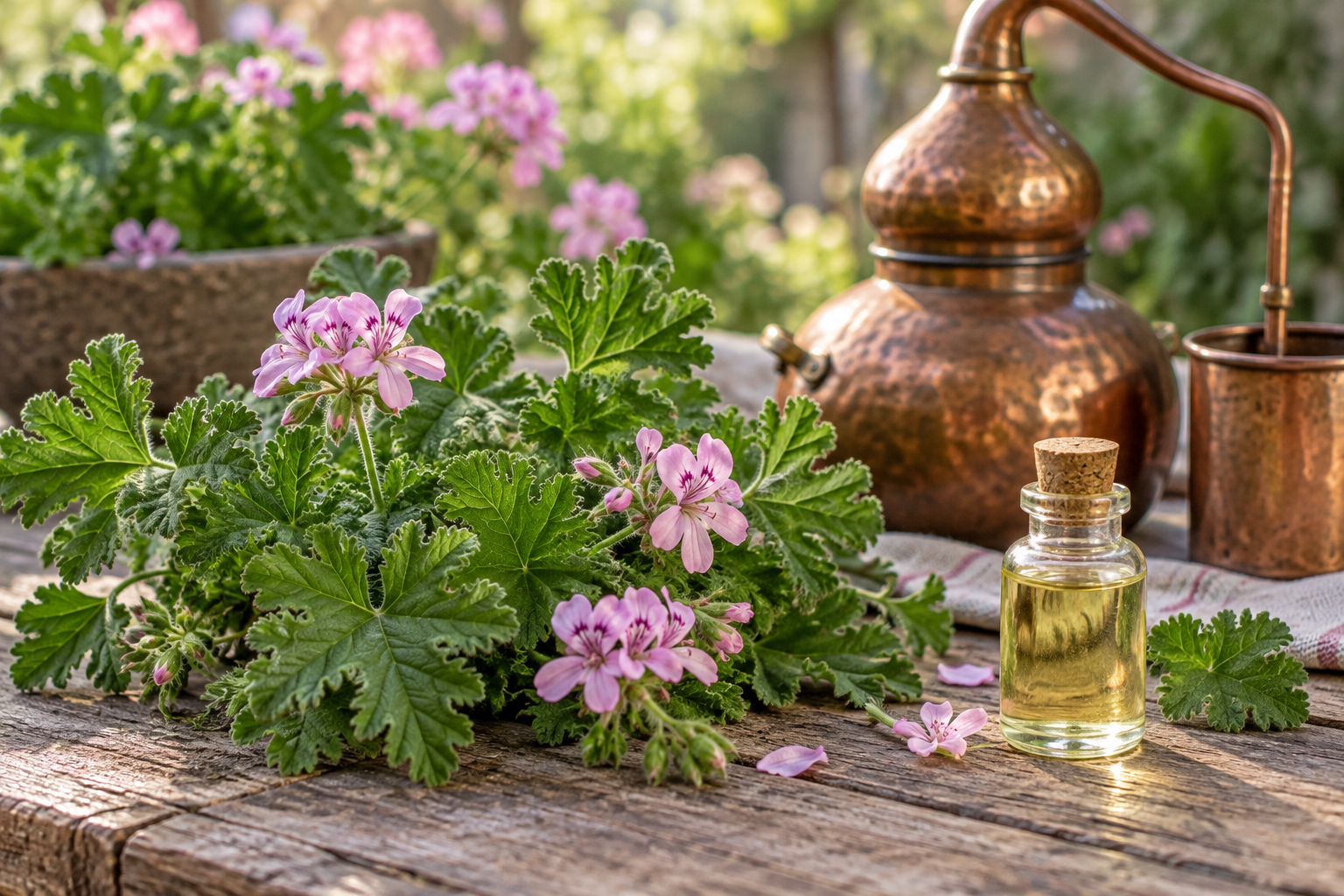
When you crush a geranium leaf between your fingers, you'll notice a green, slightly spicy scent. However, its fragrant relatives offer much more: their leaves evoke rose, lemon, and mint all at once. These fragrant geraniums, traditionally called geranium in perfumery, are popular floral ingredients—even though not a single petal is distilled from them.
From South Africa to European Gardens
The home of geraniums is South Africa, particularly the Cape region. They arrived in Europe in the 17th century and quickly became a staple in gardens, greenhouses, and windows. Botanically, they belong to the genus Pelargonium, not the genus Geranium, which is known as cranesbill in English. However, the name geranium has stuck in perfumery and remains to this day.
Fragrant geraniums began to be cultivated extensively in the 19th century, first in France and soon in North Africa and on the island of Réunion. The reason was simple: their oil has a distinctly rosy scent and is much easier to obtain than rose oil, which requires tons of petals per kilogram. Geranium thus became a reliable companion to rose—it doesn't completely replace it but complements, brightens, and supports it.
Essential oil is obtained by steam distillation of the leaves and stems. Today, most production comes from Egypt and China. Réunion gave its name to the "Bourbon" variety after the island's old name; its oil is considered particularly gentle and sweetly rosy, but only a small amount is produced now.
Rose with a Green Leaf
The scent of geranium is rosy, but not powdery sweet. It carries a fresh note of crushed leaf, a citrus sparkle, and a cool, almost minty finish. The similarity to rose is due to shared molecules geraniol and citronellol, found in both ingredients. Oils from different regions vary—Egyptian is often described as balanced and rounded, while Chinese is somewhat sharper and lemony.
In perfume, geranium usually forms the heart of the fragrance. It holds a special place in aromatic fougère scents, where it forms the backbone of the composition along with lavender, oakmoss, and coumarin—hence, it's often found in classic men's perfumes. It pairs well with these ingredients:
- rose – geranium brightens it and adds green freshness,
- lavender – together they create a clean, aromatic impression,
- bergamot – emphasizes the citrus aspect of the leaves,
- patchouli – adds earthy depth,
- vetiver – anchors the scent in a dry, woody base.
Ambrette Seed – Hibiscus with a Musk Scent
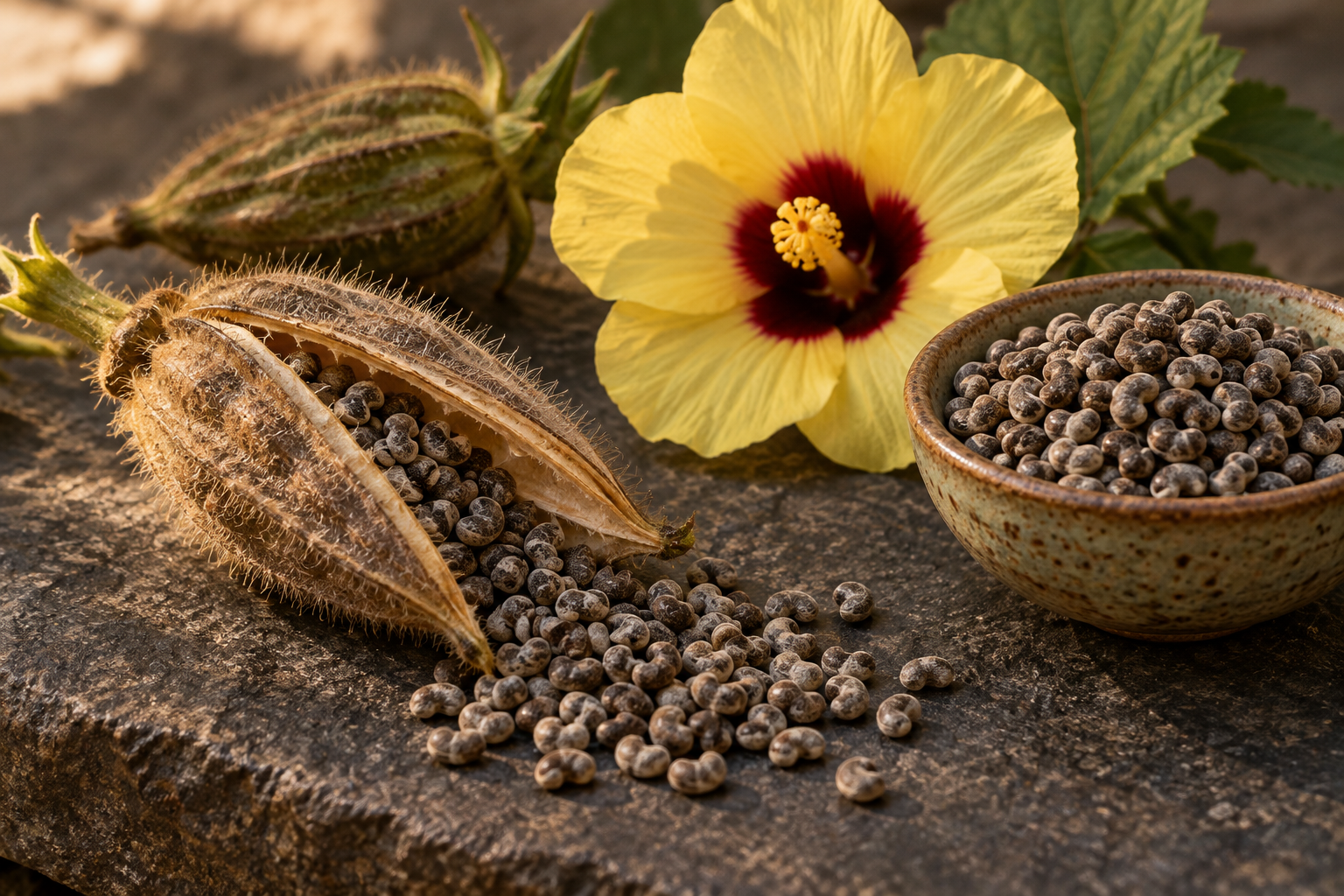
Musk mallow (Abelmoschus moschatus), once classified directly among hibiscus, is a robust tropical plant with large yellow flowers and a dark center. It originates from South Asia and is now cultivated in places like India, Ecuador, and Madagascar. However, in perfumery, its small gray-brown kidney-shaped seeds, hidden in hairy capsules, are what matter. The French name ambrette, which the Czech name is also derived from, refers to ambergris – as their scent has long been associated with a warm, soft, and slightly animalistic tone.
The Journey from Seed to Precious Oil
The seeds are dried and crushed after harvest. The oil is extracted through steam distillation, or sometimes solvent or carbon dioxide extraction. Distillation initially produces a thick waxy substance, nicknamed ambrette butter due to its fatty acid content; only through further purification does it become the finer absolute. The yield is low and processing laborious, so perfumers use ambrette sparingly. The main contributor to its characteristic scent is ambrettolide – a macrocyclic lactone, a molecule with a large ring of atoms, similar to other musky substances. Chemists can now also produce it synthetically, and it is among the valued musk molecules in modern perfumery.
How does ambrette smell? Imagine a soft, powdery warm musk that doesn't feel heavy or animalistic, but rather like clean, slightly sweet skin. It has a fruity note reminiscent of ripe pear and a drop of wine. In compositions, it is used in the heart and especially in the base, where it rounds out the fragrance, extends it, and adds a velvety depth.
Plant-Based Substitute for Animal Musk
True musk was once obtained from the gland of the male musk deer, a small mountain ruminant from Asia. It was extremely rare, so ambrette seed was offered as a plant-based alternative – in perfumes, powders, and even incense. Animal musk is no longer used in perfumery out of consideration for the protection of musk deer, and ambrette remains one of the few natural sources of musk scent. The seeds have also been used outside of perfumery: in the Arab world, they were even said to flavor coffee.
Ambrette pairs well with iris, creating powdery velvety accords, adds warm sensuality to rose, and softens neroli into a skin-like soft haze. It intertwines with sandalwood in a creamy, woody warm base and, along with other musky tones, helps create the impression of "clean skin," which stays close to the body. If you like perfumes that don't shout but stay with you all day, it's quite possible you've encountered ambrette seed without even knowing it.
Elemi – the Citrusy Resin of the Philippine Forests
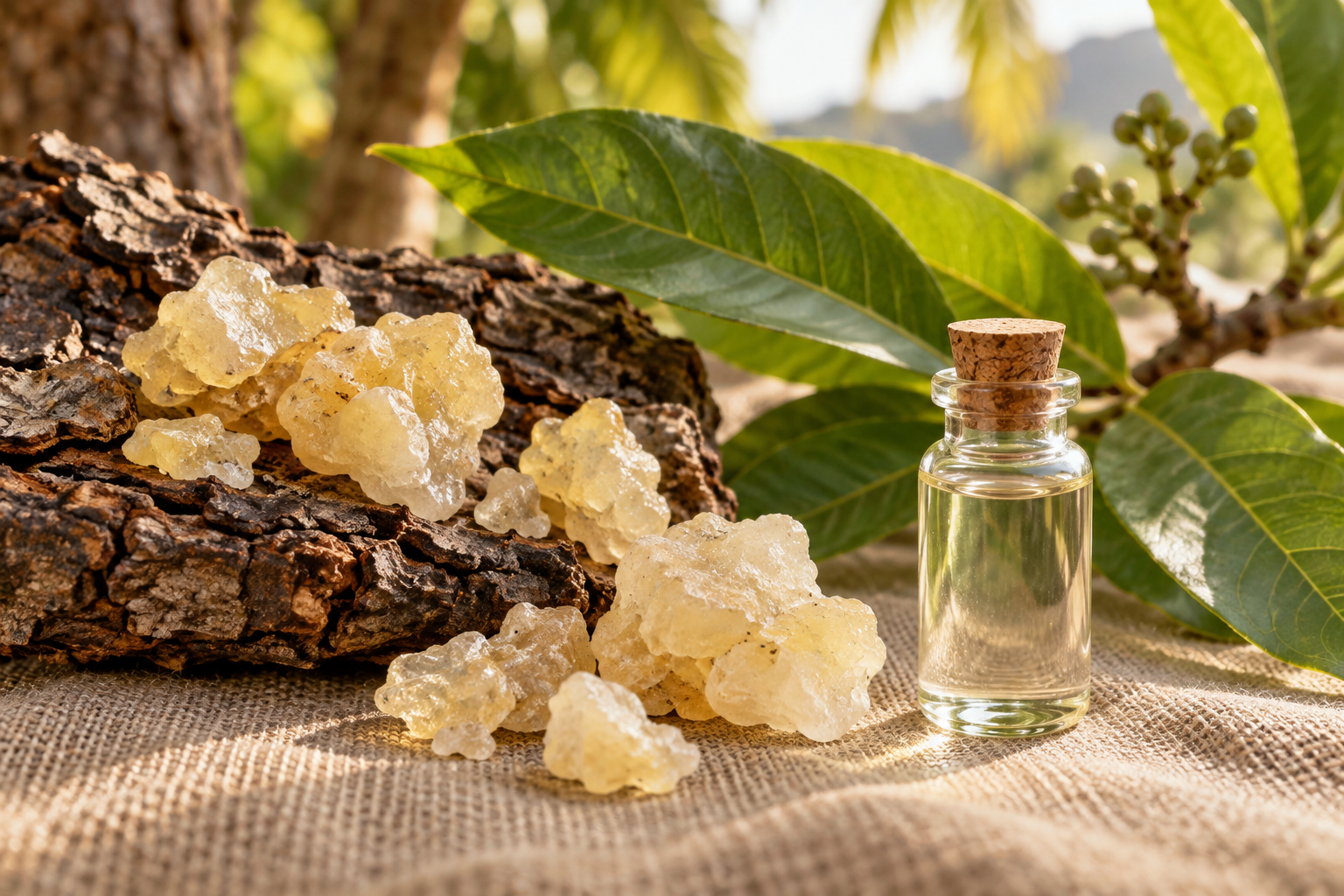
In the tropical forests of the Philippines grows the mighty Canarium luzonicum tree. It belongs to the Burseraceae family, the same botanical family as frankincense and myrrh – and like its more famous relatives, it hides a fragrant resin beneath its bark. Harvesters carefully cut the bark, and from the incisions slowly oozes a sticky, initially whitish to yellowish substance that gradually hardens in the air. This is how elemi is formed, a resin whose scent is neither heavy nor smoky, but surprisingly fresh.
From Resin to Essential Oil
Perfumers most often work with the essential oil obtained from the resin through steam distillation. It is rich in limonene – the same molecule you know from the scent of lemon peel – and elemol, a sesquiterpene alcohol that adds depth to the fragrance. Besides the oil, a resinoid is also prepared, obtained through solvent extraction; it tends to be thicker, more balsamic, and lingers longer on the skin.
The scent of elemi is reminiscent of a walk through a coniferous forest with a freshly cut lemon in hand: it is freshly citrusy, slightly spicy, with hints of pepper and fennel, coniferous, and beneath it all softly balsamic. This dual nature makes it a welcome ally. In the top notes, it brightens the composition and adds airiness, while the resinous undertone creates a bridge to the heavier resins in the heart. Where frankincense or labdanum alone might seem somber, elemi brings light.
Ointments, Balms, and Artist's Varnishes
Elemi reached Europe centuries ago and for a long time had its place more in pharmacies than in perfumery. It was part of traditional healing ointments and balms – much like frankincense and myrrh, with which it shares its origin and long history. It also found use in crafts: it was added to varnishes and drying oils, which it supposedly made more flexible to prevent cracking, and it traditionally appeared in painting. It found its way into perfumery later, but with greater acclaim among those seeking a fresh counterpoint to heavy balsams.
In fragrant compositions, elemi prefers to meet its resinous relatives – frankincense and myrrh – and amber labdanum. It also pairs well with citrus, enhancing their freshness, with black pepper, which highlights its spicy side, and with lavender, creating a clean aromatic impression. If you are captivated by a lemony spark in a perfume, slowly unveiling a warm, temple-like balsamic veil, it is quite possible that elemi is the one in the background.
Aldehydes – The Sparkling Bubbles of Modern Perfumery
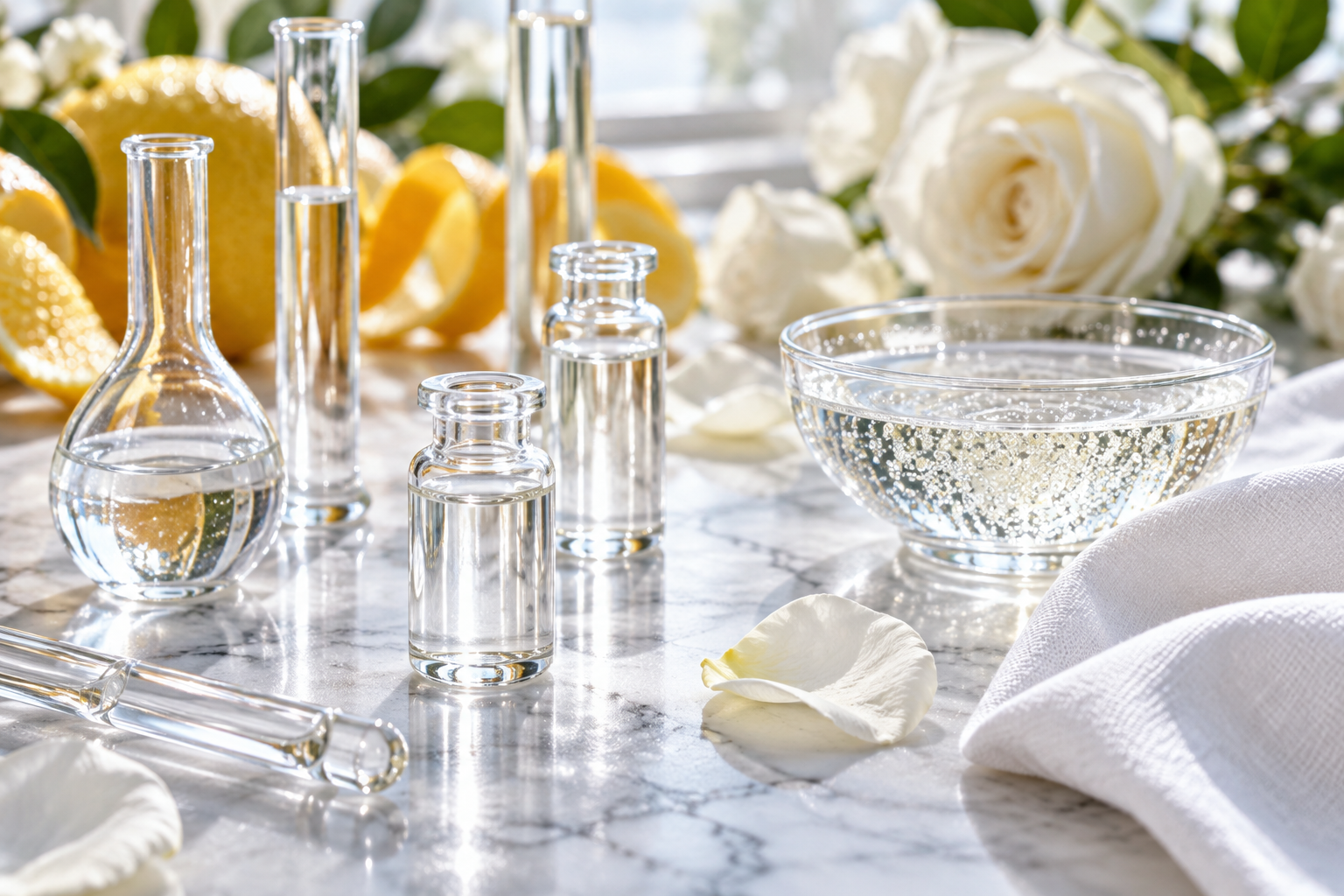
When a fragrance is described as fizzing like champagne or smelling like fresh, starched linen, it's often due to aldehydes. Unlike flowers, resins, or seeds, aldehydes are not a single raw material but a whole group of organic molecules. They occur in trace amounts in nature, such as in citrus peels or rose oil. However, for perfumery, they are produced synthetically, in a pure and precisely defined form.
What Do the Numbers C-10, C-11, C-12 Reveal?
Perfumers most commonly work with so-called fatty aliphatic aldehydes. They are denoted by the letter C and a number, which indicates the number of carbon atoms in the molecule – the most well-known are C-10, C-11, and C-12. Each has a slightly different character: shorter chains tend to be fresher and reminiscent of orange peel, while longer ones appear waxier and more soapy, evoking ironed linen or candle wax.
On their own, in concentrated form, aldehydes smell sharp, greasy, and can be unpleasant to an untrained nose. Only in trace amounts do they transform – in a fragrance, they act like sparkling bubbles that float above the entire composition. They bring a sense of clean linen, wax, freshly fallen snow, and a slightly metallic sheen. They are most noticeable in the top notes, which lift and "open" the fragrance, making it feel more spacious, airy, and seemingly illuminated. It's sometimes said that aldehydes function like light shining on other ingredients.
The Revolution of the Twenties
Aldehydes appeared in perfumery as early as the beginning of the 20th century, but their true fame came with the floral-aldehydic perfumes of the 1920s. The symbol of this wave became the famous perfume from 1921, which opened the era of abstract fragrances – compositions that did not mimic any specific flower but created a completely new, artistic impression. There is a story that the distinctive sparkling character was due to a laboratory mistake: an assistant supposedly added aldehydes in a much higher dose than intended, and the result ultimately thrilled everyone. Whether this actually happened, no one knows for sure today, but the story is inextricably linked to aldehydes.
Favorite Partners of Aldehydes
They shine best in floral compositions. With rose, jasmine, and ylang-ylang, they create a bright, powdery elegant heart, adding a cool, almost metallic subtlety to iris. In the base, they are nicely supported by creamy sandalwood and vanilla, which gradually soften and warm the sparkling start of the fragrance. If you want to recognize aldehydes in a scent, focus on the first few minutes after application – that's when the typical impression of bubbles and cleanliness is most pronounced.
Category
Recommended articles
Riiffs Freeze in Flames: Ice and Flames Illuminate Warsaw "Give a girl the right shoes and she can conquer the world!" Marilyn Monroe
