

 Riiffs Freeze in Flames: Ice and Flames Illuminate Warsaw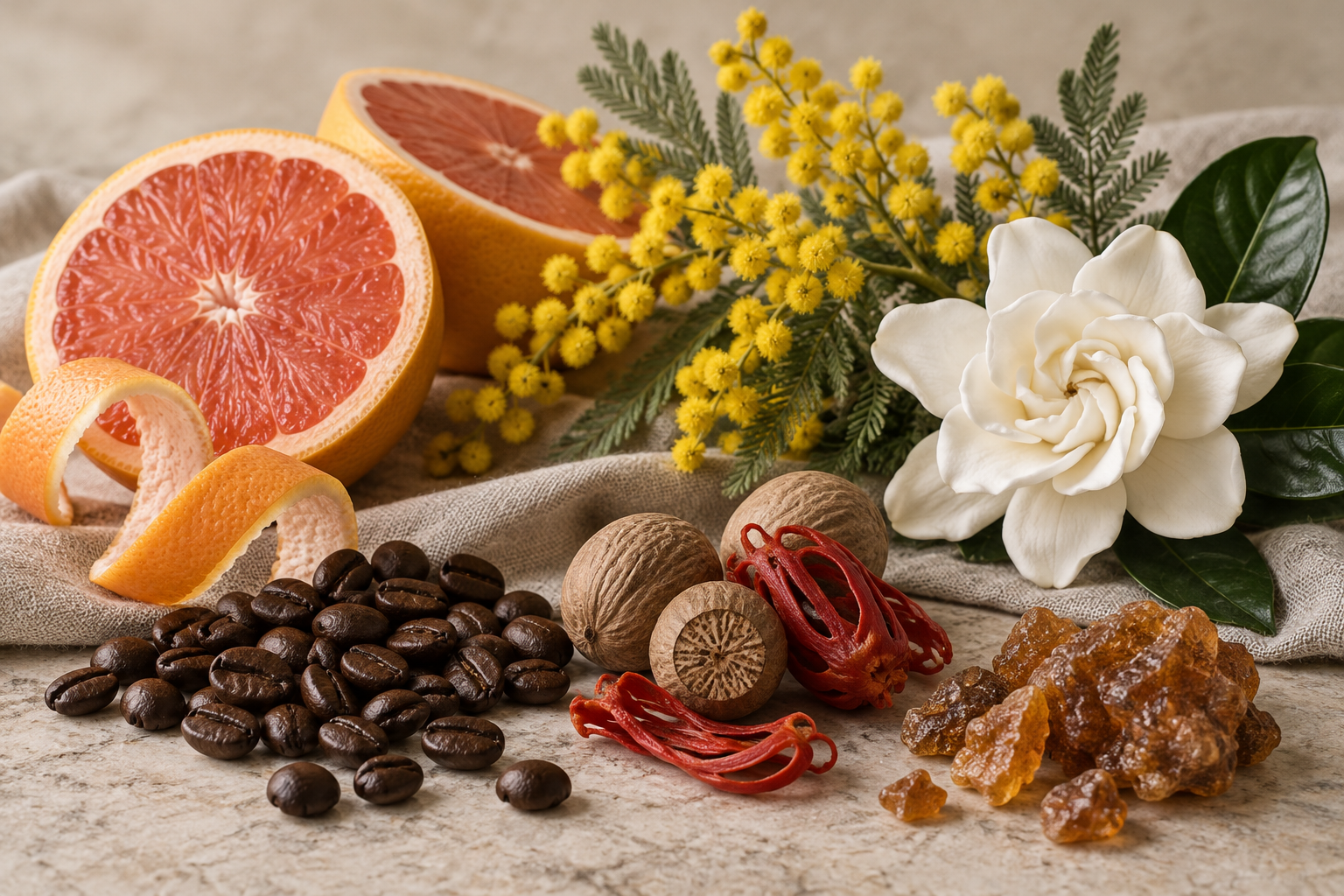
What lies behind the notes in a perfume description? In the 6th part of our encyclopedia, we introduce grapefruit, mimosa, gardenia, coffee, nutmeg, and opoponax – their origins, scents, and stories.
Grapefruit – the Sparkling Bitterness of Citrus
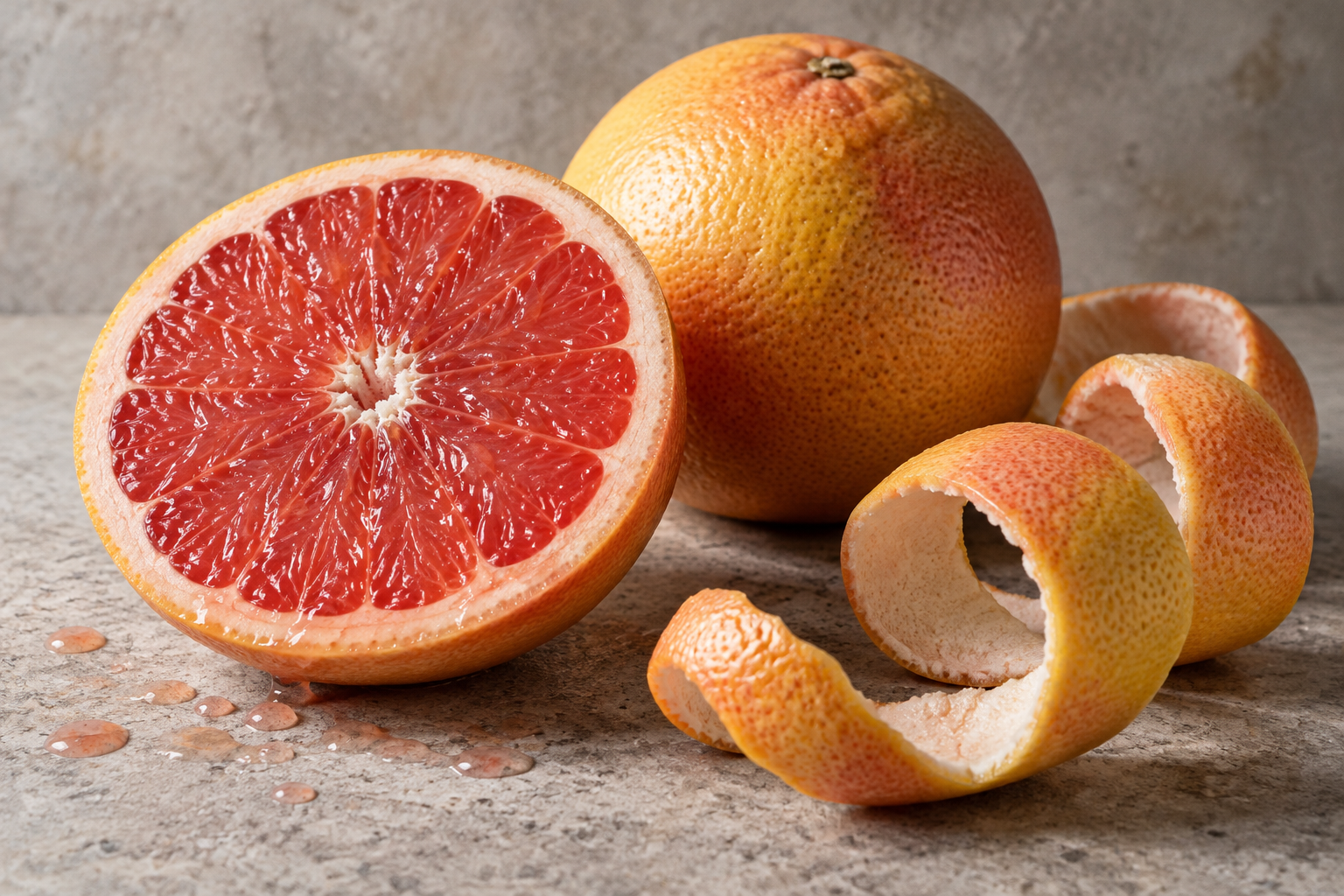
Among citrus fruits, grapefruit is relatively young. It originated from the natural crossbreeding of pomelo and sweet orange on the Caribbean island of Barbados, where it was described in the mid-18th century by Welsh clergyman and naturalist Griffith Hughes, who called it the "forbidden fruit." Botanists today classify it under the name Citrus × paradisi, and the English name, which also influenced the Czech name, refers to the way the fruits hang on the tree in clusters, similar to grapes.
In perfumery, the essential oil is extracted from the peel. It is obtained by cold pressing – just like with bergamot or lemon, the small oil sacs in the peel are mechanically ruptured, and the released oil is separated from the juice and water. Without heating, it retains the fresh, juicy character of a freshly cut fruit. The composition is dominated by limonene, which is shared by almost all citrus fruits; however, the distinctive signature of grapefruit is created by substances present only in trace amounts.
The first of these is nootkatone, a sesquiterpene ketone with a bitter, slightly woody scent that you associate with grapefruit peel. The second group consists of sulfurous thiols, primarily 1-p-menthen-8-thiol. These are substances with an exceptionally low perception threshold, so the human nose can detect them even in minute concentrations. In higher doses, it would be unpleasant, but in balance with other components, it gives grapefruit its characteristic sparkle – a slightly sulfurous, almost tropical undertone that distinguishes it from orange and lemon.
In compositions, grapefruit almost always opens the top notes. It is used in citrus and fresh fragrances, in aromatic compositions, and in fougère, where it brightens herbs and lavender. Proven combinations include:
- vetiver – earthy, smoky woodiness enhances the bitterness of the peel and adds depth,
- mint – intensifies the cool, refreshing impression,
- rose – citrus acidity lightens the flower and gives it a modern, juicy touch,
- musk – a clean, soft base on which grapefruit lingers longer.
The weakness of grapefruit essential oil is its volatility. Limonene and other light molecules evaporate from the skin within a few minutes, so grapefruit alone would disappear shortly after application. Perfumers therefore extend its impression – they add isolated or synthetic nootkatone, which evaporates more slowly, work with more stable synthetic molecules with a grapefruit character, and anchor the citrus accord in the woody and musky tones of the base. So when you smell grapefruit in a fresh perfume even after several hours, it is usually not the essential oil itself, but a carefully crafted composition.
Mimosa – the Powdery Flower of the Provençal Early Spring
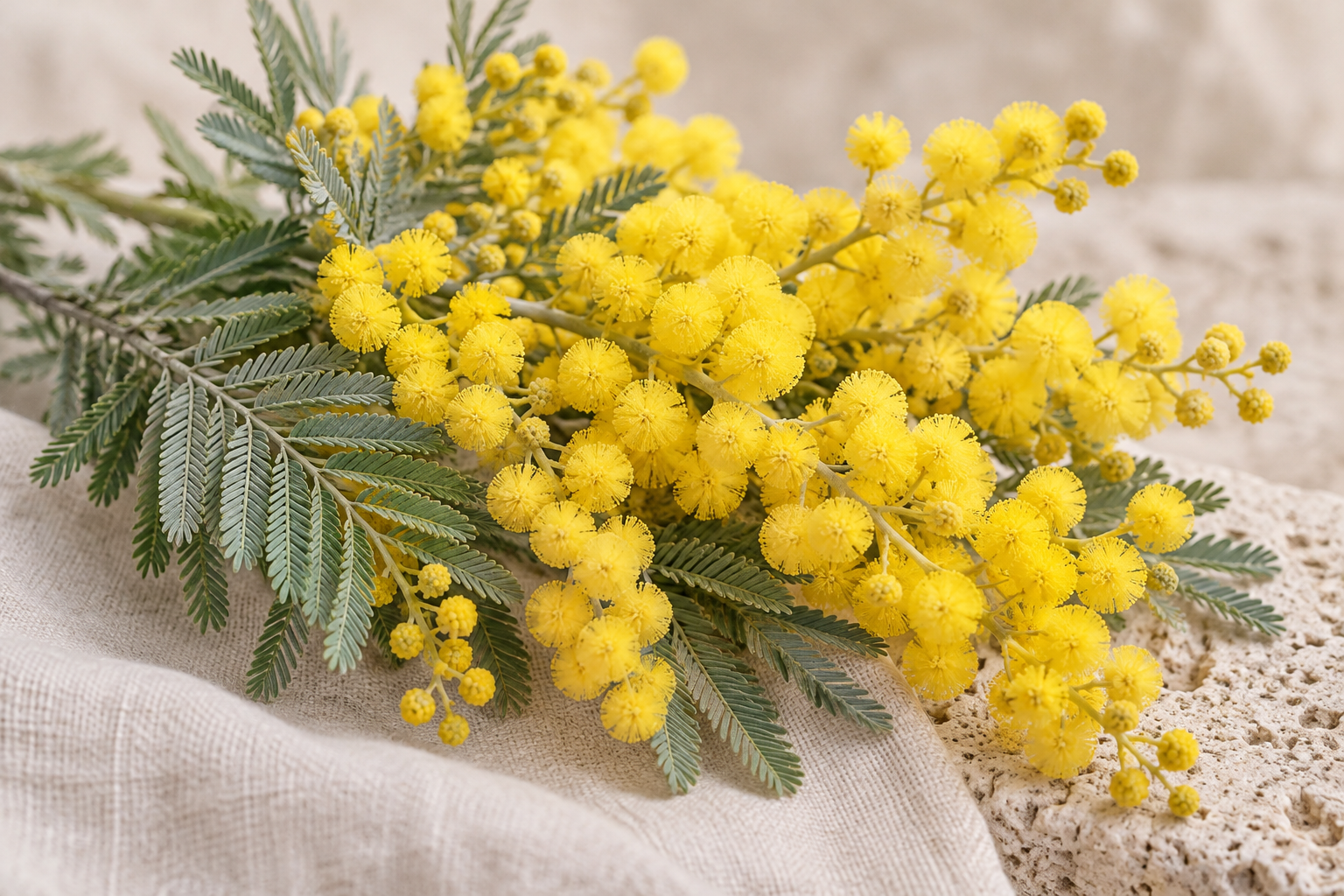
When the chill of winter still lingers on the French Riviera, the hills above Cannes are illuminated by thousands of tiny yellow spheres. What perfumers call mimosa is actually the silver wattle (Acacia dealbata) – a tree with silvery-green feathery leaves, which botanically does not belong to the true mimosas of the Mimosa genus. It originates from southeastern Australia and Tasmania, and was introduced to Europe in the 19th century as an ornamental plant. In the Mediterranean climate, it became so naturalized that it started to grow wild. Today, it forms extensive groves in the Tanneron mountains near Grasse, which are among the largest mimosa forests in Europe.
The flowers are harvested from January to March and processed by extraction with volatile solvents. This produces a concrete – a thick, waxy substance from which the absolute oil is obtained by washing with alcohol and removing the waxes. Steam distillation is practically not used for mimosa, as the delicate flowers cannot withstand high temperatures. The yield is low and the harvest depends on the success of the early spring – a late frost can significantly reduce the yield.
Mimosa absolute oil smells honeyed and powdery, with a hint of green stems, waxy petals, and a subtly sweet almond. On the skin, it feels soft and warm, without the intoxicating heaviness typical of white flowers – more like sun-warmed pollen than a dense bouquet.
In perfumery, mimosa usually occupies a place in the heart of the composition. It stands out most in floral and powdery fragrances, where it naturally blends with several ingredients:
- violet, with which it shares green freshness and powdery softness,
- orris, whose root adds an elegant, slightly earthy powder,
- heliotrope, which enhances its almond and vanilla undertone,
- almond, which emphasizes the sweet, almost confectionery aspect of the flower.
But mimosa is also a symbol of festivities. Every February in Mandelieu-la-Napoule, a mimosa festival is held with floats adorned with thousands of branches, and the approximately 130-kilometer-long Route du Mimosa winds through the landscape from Bormes-les-Mimosas to Grasse. In Italy, since 1946, yellow flowering branches are given to women on March 8th, International Women's Day – as a humble yet joyful reminder that spring is on its way.
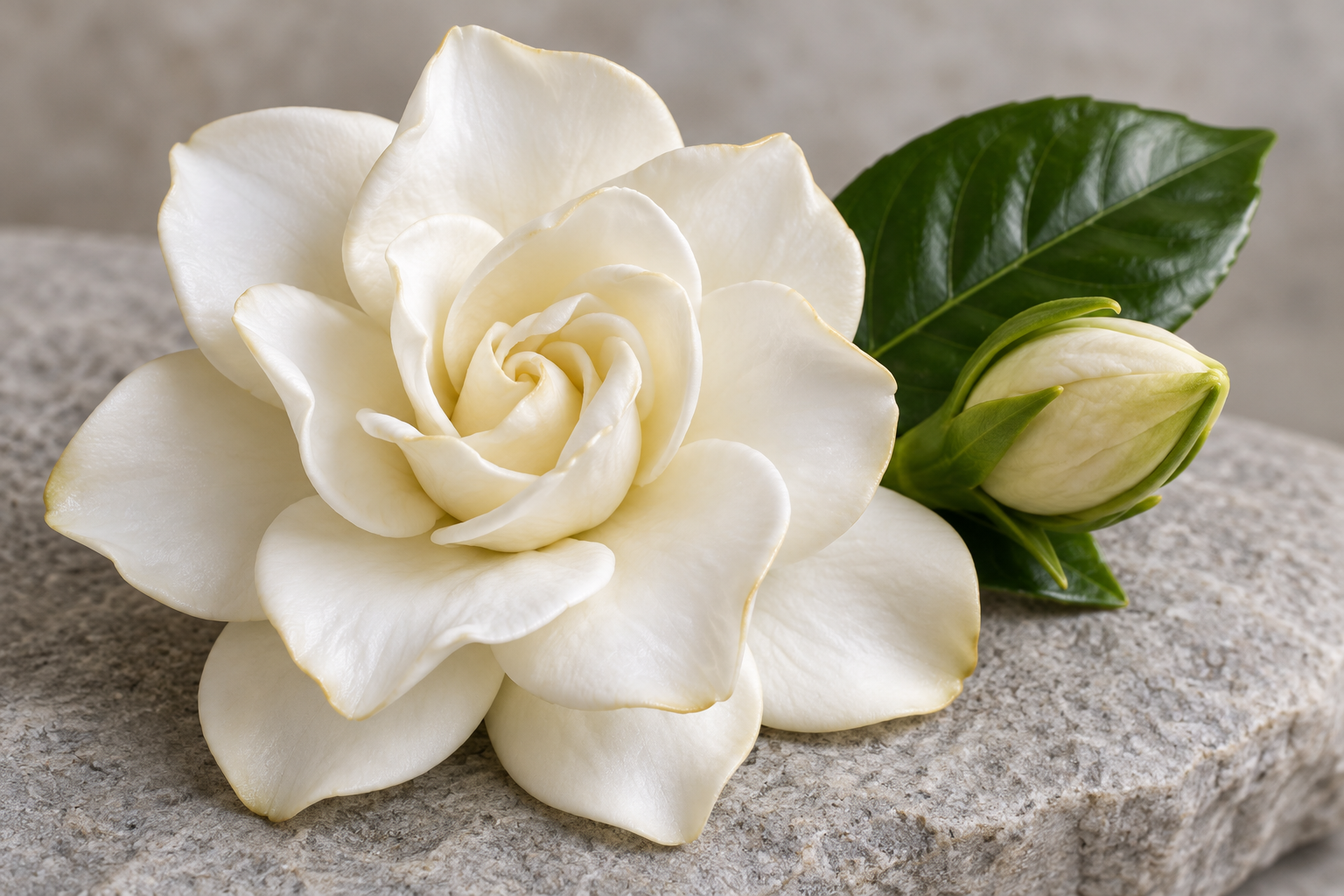
Gardenia – the creamy white flower crafted by perfumers
The gardenia jasminoides is an evergreen shrub from the Rubiaceae family, native to southern China and Japan. It has tough, glossy dark green leaves and waxy white flowers that turn yellow and brown within a few days. Anyone who has caught their scent in the warm evening air knows that their fragrance can fill an entire room.
However, you would be hard-pressed to find true gardenia in a perfume composition. The flowers are delicate, darkening with every touch, and they release their fragrant substances reluctantly. As a result, absolute oil is extracted from them only in tiny amounts and at a cost that precludes its regular use. Almost every "gardenia" you smell in a fragrance is thus the work of a perfumer – a carefully crafted accord, not an extract from the flower.
In reconstructing the scent, the perfumer first analyzes what makes up the fragrance of the living flower. Gardenia smells creamy and dense, with a slightly coconut, almost milky undertone, through which a fresh green line and a peculiar earthy, mushroom-like accent reminiscent of a damp forest shine through. These layers are then composed from other ingredients:
- Jasmine provides a bright, slightly sensual white heart,
- Tuberose brings creamy density and intoxicating fullness,
- Orange blossom softens the whole with a honeyed freshness,
- Synthetic molecules – such as styrallyl acetate with a sharp green, fruity floral note or lactones with coconut and peach sweetness – complete what natural ingredients alone cannot capture.
This crafted gardenia most often appears in the middle notes of white floral compositions, where it lends a velvety fullness and sheen to the scent. It loves to pair with coconut, which enhances its creaminess, with juicy peach, and with soft musk in the base, allowing the flower to linger gently on the skin.
The flower's European name comes from Alexander Garden, a Scottish physician and naturalist who worked in Charleston, South Carolina, in the 18th century and corresponded with Carl Linnaeus. The genus was named after him by British naturalist John Ellis. In the 19th and early 20th centuries, a fresh gardenia was a staple in the buttonhole of elegant gentlemen, and later became the signature of jazz singer Billie Holiday, who tucked white flowers into her hair during performances.
Coffee – The Roasted Bitterness of Gourmet Scents
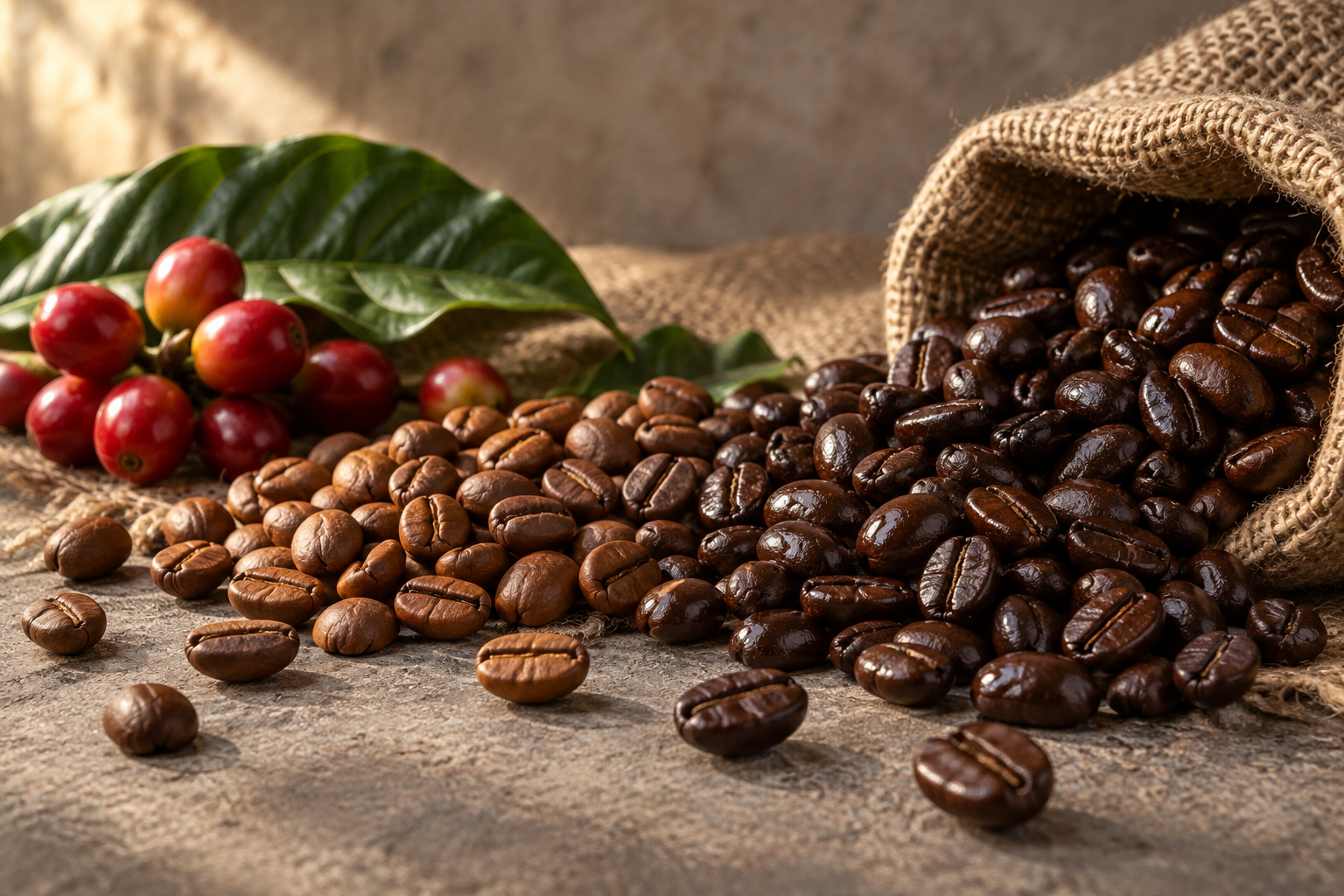
The Arabica coffee plant (Coffea arabica) originates from the mountainous forests of southwestern Ethiopia, where it still grows wild under the canopy of taller trees. Its discovery is linked to the legend of the shepherd Kaldi, whose goats became restless and couldn't sleep after eating the red berries. Kaldi shared his observations with monks from a nearby monastery, who then made a drink from the berries that helped them stay awake during night prayers. This story was first recorded in the 17th century, making it more of a charming tale than a historical account. It is documented, however, that coffee was cultivated and consumed in Yemen in the 15th century, from where it spread through the port of Mocha to the Ottoman Empire, Persia, and eventually Europe.
Perfumery almost exclusively uses roasted beans – green coffee smells more grassy and leguminous, with the typical coffee aroma developing only during roasting. This process involves the Maillard reaction and sugar caramelization, creating hundreds of aromatic compounds, including pyrazines and sulfur compounds. Absolute oil is obtained from roasted beans through solvent extraction, but increasingly, supercritical carbon dioxide (CO₂) extraction is used. This method operates at low temperatures, leaves no solvent residues, and faithfully captures the scent of freshly ground coffee. The degree of roasting matters: lighter roasting yields a fruitier, slightly acidic, and nutty tone, while dark roasting brings bitterness, smoke, and a hint of dark chocolate.
The coffee scent is dark, roasted, slightly smoky, and bittersweet, with hints of caramel and roasted nuts. It is very intense, so perfumers use it sparingly – in excess, it can easily overpower other ingredients. It is used in the heart and base of compositions, especially gourmet ones, where it adds a bitter counterbalance to sweet accords, and in oriental fragrances, where it lends depth and warmth. Proven combinations include:
- vanilla and tonka beans – soften the bitterness and evoke coffee with cream,
- cocoa – deepens the dark, chocolate character,
- rose – creates an unexpected contrast between floral and roasted bitterness,
- patchouli – adds earthiness and a woody note.
You will also encounter coffee in perfumery outside the bottle. A bowl of coffee beans often sits by testers, allowing you to sniff them between different scents to "reset" your sense of smell. Research does not confirm this effect: in small studies, coffee beans did not help distinguish scents better than a simple breath of fresh air. Nonetheless, it makes sense – a short break and a strong, familiar smell divert attention and give the nose a moment of rest. Similarly, a few breaths outside or sniffing your own unscented skin on the forearm will serve just as well.
Nutmeg – the Warm Spice of the Moluccas
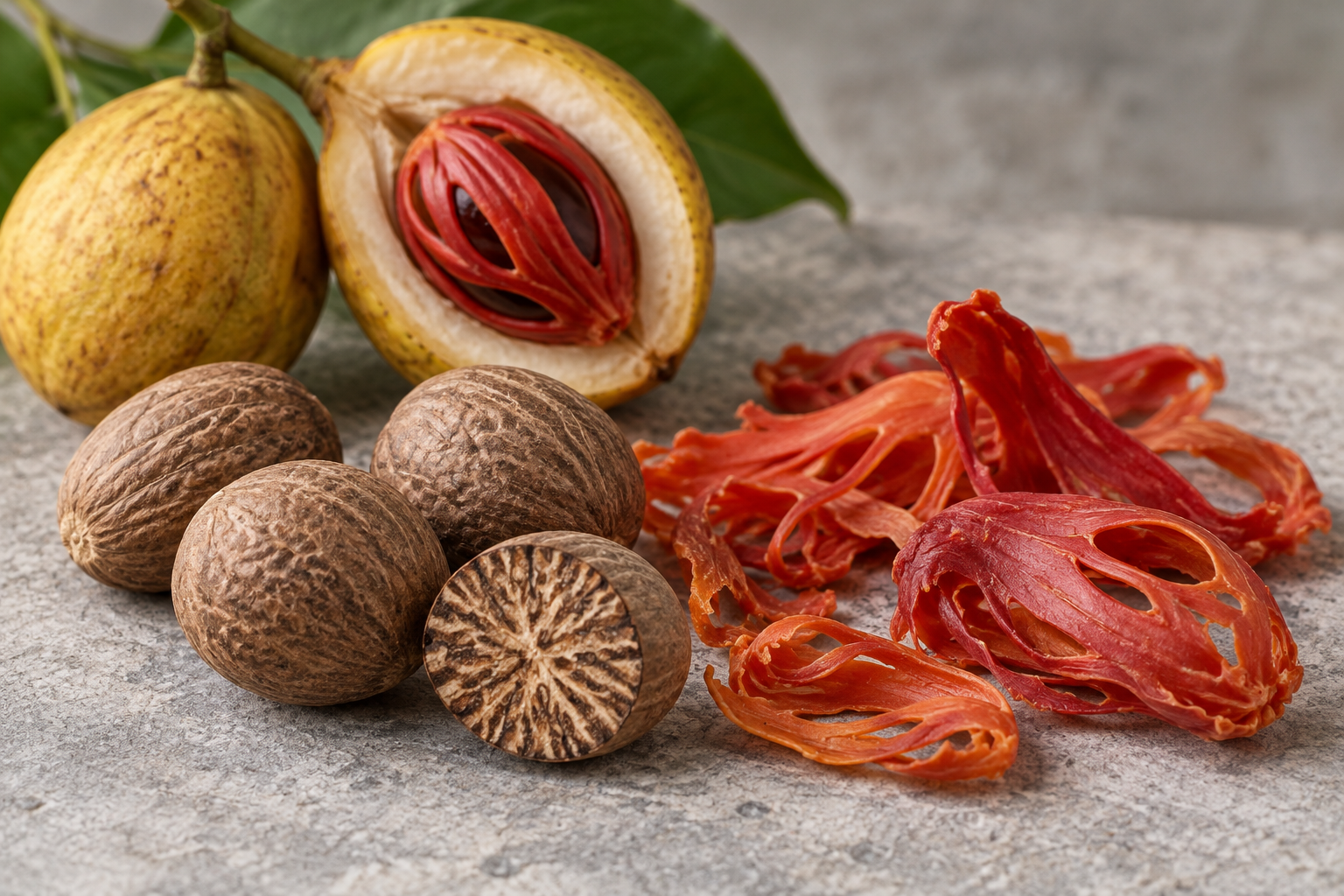
The nutmeg tree (Myristica fragrans) is an evergreen tree native to the Banda Islands, a small archipelago in the Moluccas in eastern Indonesia. Its yellowish fruits resemble apricots. When ripe, the flesh splits open to reveal a dark, shiny seed encased in a bright red lace-like aril. From a single fruit, two different spices are derived. The seed itself, once the hard shell is removed, is known as nutmeg. The red aril, technically called mace, is dried separately, turning golden orange, and is referred to in both cooking and perfumery as mace. Its fragrance is somewhat milder and sweeter than that of nutmeg.
Perfumery primarily uses the essential oil obtained by steam distillation of crushed nutmegs; mace can be processed similarly. The essential oil is colorless to pale yellow and has a warm, spicy scent with a slightly sweet, woody tone and a resinous hint. Initially, it releases a fresh, almost pine-like sparkle, then unfolds into a warm depth reminiscent of Christmas pastries or mulled wine. This character is due in part to sabinene, pinene, and myristicin.
In compositions, nutmeg is used in the top and middle notes. It is a classic ingredient in spicy and oriental perfumes, adds warmth to woody fragrances, and in fougère compositions, it softens fresh lavender and aromatic herbs. It most commonly pairs with these partners:
- citrus – enhances and extends their sparkle,
- lavender – together they create a warmly aromatic accord,
- rose – adds a velvety spiciness to the flower,
- tobacco and vanilla – together they create a soft, almost gourmand base.
Perfumers use it sparingly: in small amounts, it enlivens a composition, but in higher concentrations, it could easily overpower other ingredients. If you want to recognize it in a perfume, focus on the first few minutes after application – the warm spicy note is most noticeable then.
The story of nutmeg is also the story of colonial spice trade. For centuries, the nutmeg tree grew almost exclusively on the Banda Islands, and in Europe, its fruits were worth their weight in gold. In the 17th century, the Dutch East India Company enforced a monopoly on the archipelago, but the small island of Run was claimed by the English. The conflict was resolved by the Treaty of Breda in 1667: the Dutch relinquished New Amsterdam on Manhattan, which the English had occupied three years earlier, and in return, the English ceased their claims on Run. From today's perspective, the exchange seems incredible – but at the time, an island covered with nutmeg trees was more valuable than a settlement on the North American coast.
Opoponax – Sweet Balsamic Resin from the Horn of Africa
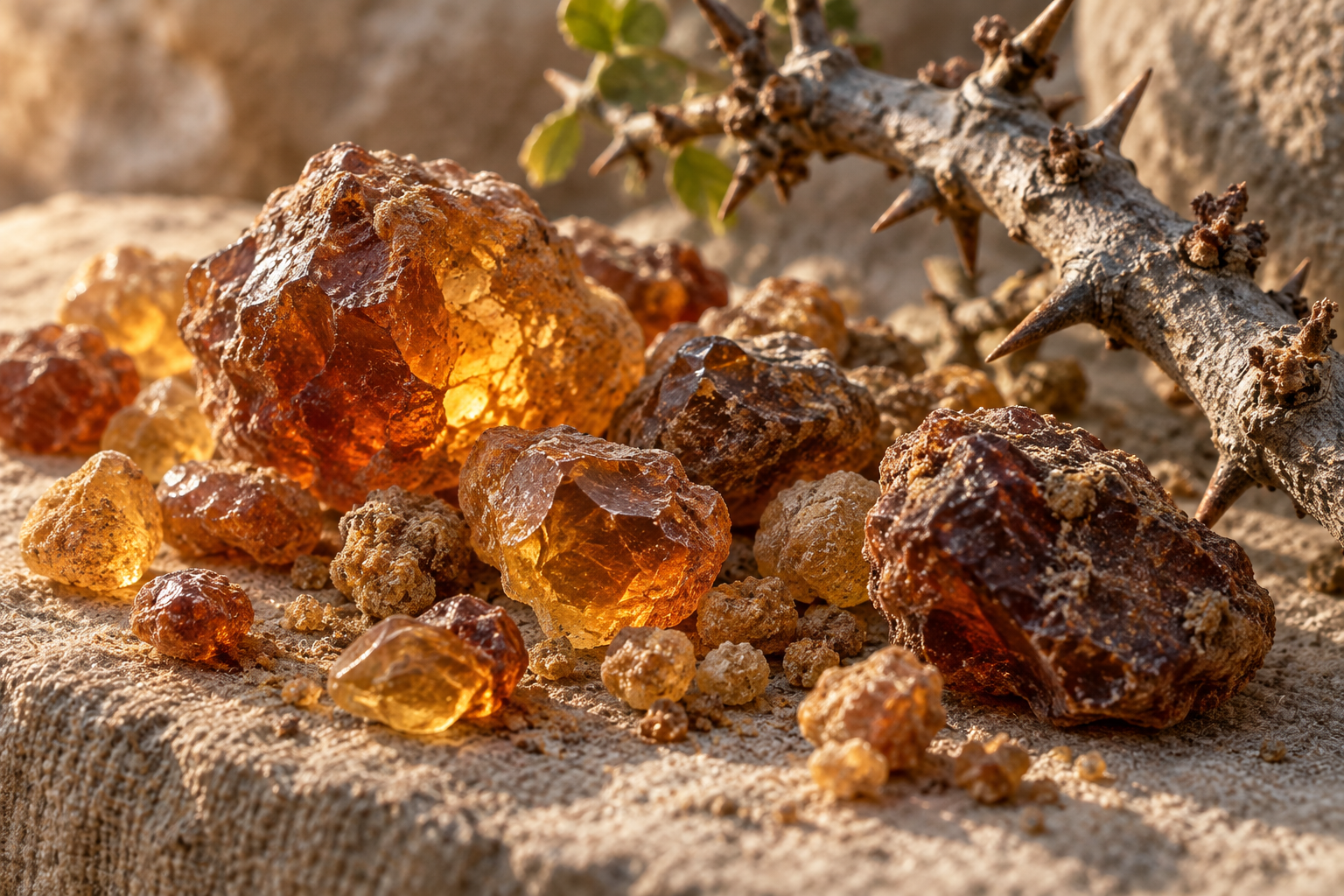
In the dry, rocky landscapes of Somalia and southeastern Ethiopia grows the low, thorny shrub Commiphora guidottii. It belongs to the same genus as myrrh, which we have already covered in this series, and its resin is quite similar – only softer, sweeter, and more gentle. This is why it is called sweet myrrh, and in perfumery, it is known as opoponax.
The collection process is similar to that of other incense resins. Collectors cut the bark of the shrub, and from the incisions, a milky sap slowly oozes out, hardening in the air into yellowish to reddish lumps. These are gathered, sorted, and prepared for export after several weeks. For perfumers, the resin is processed in two ways. Solvent extraction produces a thick, dark resinoid that captures the full range of the fragrance, including its heavy, sticky components. Steam distillation yields an essential oil – lighter, clearer, and with a more pronounced spicy note.
The scent of opoponax is warm and balsamic, with a honeyed sweetness reminiscent of beeswax or dried fruit. Beneath it, there is a slightly earthy, sometimes leathery undertone and a subtle hint of spice. Unlike myrrh, it lacks a strong bitterness and a cool, camphoraceous aspect, giving it a more rounded feel. On the skin, it develops slowly and lasts for many hours.
This longevity makes it a valued fixative. In base notes, it slows the evaporation of more volatile components and adds depth to the composition. You will find it primarily in amber and oriental fragrances, where it naturally blends with vanilla, labdanum, and benzoin, and in chypre compositions, where it softens the mossy dryness. It also pairs well with rose – its floral freshness is underlined by warmth and a velvety sweetness.
The story of opoponax is intertwined with caravan routes that for centuries transported incense and myrrh from Arabia and the Horn of Africa to Egypt, Mesopotamia, and Mediterranean ports. Fragrant resins were among the most valuable commodities of their time, burned in temples and during ceremonial rites. The origin of the name itself is also interesting. The Greek word opopanax, composed of terms for "juice" and "panacea," originally referred to the gum resin of the Mediterranean umbelliferous plant Opopanax chironium, known to ancient medicine. Only later did the name in trade come to refer to the sweet myrrh from the Horn of Africa – and although the two plants are botanically unrelated, the name opoponax in perfumery today still refers to the African resin.
Category
Recommended articles
Riiffs Freeze in Flames: Ice and Flames Illuminate Warsaw "Give a girl the right shoes and she can conquer the world!" Marilyn Monroe