





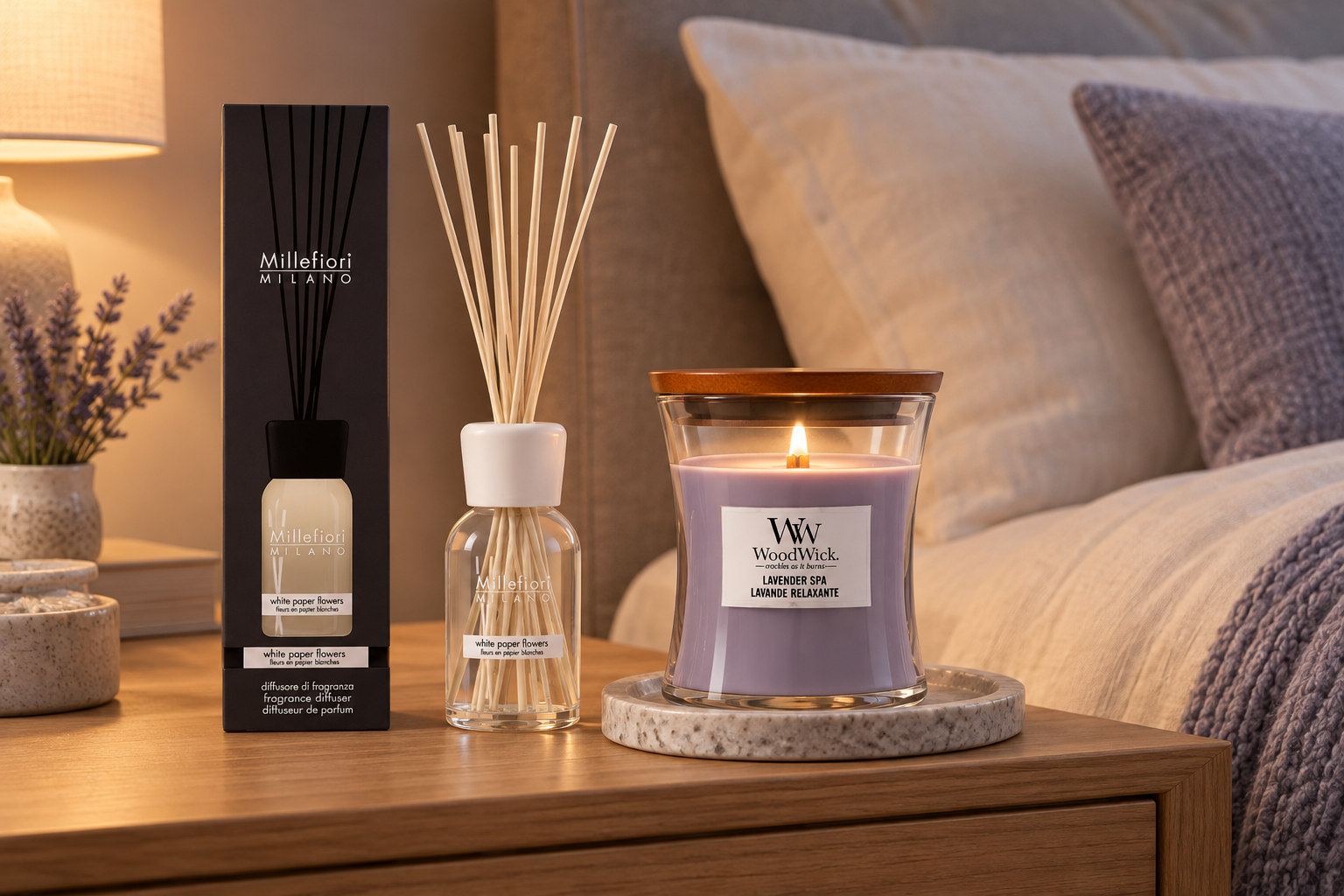
An evening ritual doesn't have to be complicated. Simply air out the room, choose soft notes of lavender, white tea, or cedar, and then safely place a diffuser with a candle.
Why Your Bedroom Deserves Its Own Evening Scent
The bedroom is where the day finally comes to a close. Behind its doors, work emails, shopping lists, and unfinished tasks are left behind, giving you a moment just for yourself. Yet, this room is often overlooked – during the day, laundry dries here, things are stored, and the air carries traces of everything that has happened at home. It takes just a little effort to transform it into a space you'll look forward to retreating to in the evening.
One of the simplest ways is through scent. It doesn't have to be complicated: a gentle aroma that greets you every time you enter the bedroom in the evening gradually becomes a signal that it's time to unwind. Much like a cup of tea or a book on your bedside table, a scent helps separate the busy day from a peaceful evening – not because it has any special power, but because you start associating it with this moment.
Whether you're coming home after a demanding day at work or an evening spent with family, a short evening ritual can offer you a few minutes of calm. It's not another task for your planner, but rather a small gesture of care for yourself and the space where you spend a significant part of your life.
The entire ritual is based on a few simple steps, which we will explore throughout the article:
- Airing Out – fresh air provides a clean foundation for a subtle fragrance to shine.
- Diffuser on the Nightstand – a discreet source of scent that fills the bedroom without a flame and without daily maintenance.
- Scented Candle for a Moment – its light and fragrance complete the atmosphere before you settle in; always extinguish it before sleeping.
- Linen Spray – an optional addition for those who enjoy delicately scented bedding.
But it's good to say right from the start: home fragrances are not a cure or a recipe for sleep. No one can guarantee that you'll fall asleep faster or sleep better with them. However, they can contribute to a pleasant atmosphere where you can relax – and that's what this ritual is all about. Choose tones that you find appealing, and adjust the process to suit your preferences.
Ventilate, Tidy Up, Prepare: The Foundation of the Ritual
Before reaching for the diffuser or matches, give your bedroom a moment to breathe. Throughout the day, various odors accumulate in your home—from cooking, cosmetics, clothes draped over chairs, and dust settling on shelves. Each scent is subtle on its own, but together they create a background that blends with the delicate evening fragrance. The result may smell different than expected, tempting you to add more and more fragrance. Clean air is the first step of the ritual—only then will the scent you choose for your bedroom truly stand out.
The best approach is a short and thorough airing. Open the window wide for about five to ten minutes; in colder months, even less time will suffice. Ideally, ventilate about an hour before you plan to use the bedroom. If your apartment layout allows, open a window in the opposite room as well—a draft will refresh the air faster than a window left slightly open all day. After airing, close the window and let the room "settle" for a moment. The fragrance you choose will then spread through a calm space, without being immediately carried away by air currents.
At first glance, it may not seem related to fragrance, but a tidy bedroom smells different than one cluttered with items. Here are a few tips to enhance the ritual:
- Made bed. A fluffed pillow and neatly arranged blanket create a calm atmosphere, and clean bedding brings a fresh, neutral tone.
- Clothes outside the bedroom. Worn items on a chair or the floor carry the day's odors—they belong in the laundry basket instead.
- Clear nightstand. Keep only what you actually use at night on it. A clear surface feels calmer and will later be useful for a diffuser or candle.
- Food and dishes elsewhere. A coffee mug or snack leftovers can subtly overpower even stronger scents.
If you like the fragrance to linger directly on fabrics, you can try a gentle linen spray as an optional addition. A light mist sprayed from a distance onto a throw or pillow edge, ideally a little before bedtime so the fabric has time to dry. Use a moderate amount—strong scents on bedding, which is close to you at night, can be more distracting than soothing. One piece of advice to take seriously: always test a new spray on a hidden part of the fabric, like the underside of a hem, and let it dry. This way, you'll see if it leaves a stain or alters the color of the material.
With a ventilated room, made bed, and clear nightstand, you have a clean canvas ready. Now it's time for the fragrance itself—and since it doesn't have to compete with anything, even a subtle version will suffice.
Lavender, White Tea, Cedar: Notes for a Peaceful Evening
As the day draws to a close, most of us reach for scents that are not overpowering. They don't dominate but rather complement the atmosphere, allowing silence to take center stage. Whether you prefer herbal, clean, or woody notes, a trio that frequently appears in home fragrances for the evening bedroom is lavender, white tea, and cedar.
- Lavender belongs to the aromatic family of scents. We perceive it as herbal, slightly sweet, and clean, with a gentle camphor undertone reminiscent of dried bouquets or freshly laundered linens. Many associate it with evening and relaxation, making it a common note in evening compositions.
- White Tea is more airy than pronounced. It feels clean, fresh, and slightly green, without the bitterness we know from black tea. It brings a sense of lightness to the composition and remains subtle when combined with flowers.
- Cedar represents the woody family. It is dry, warm, and earthy, somewhat reminiscent of a sharpened pencil or wooden furniture. In compositions, it usually forms the base note, supporting other components and providing stability to the fragrance.
Why Choose Lighter and Softer Scents in the Evening
In the bedroom, scents that draw attention are usually not suitable for the evening. Strong gourmand notes like caramel, sweet vanilla, or baked fruit can feel heavy and rich in a smaller enclosed space. Sharp citruses, on the other hand, are perceived as sparkling and "morning" – fresh lemon or grapefruit work better during the day in the kitchen or bathroom. Lighter, softer compositions based on herbs, tea, and wood create a calmer backdrop and are less intrusive in a small space.
Combinations That Harmonize
All three notes complement each other well. Lavender with cedar combines herbal freshness with dry wood – the result is clean but not cold. White tea with jasmine or other delicate flowers feels airy and will delight those who prefer light fragrances. Cedar with white tea offers a restrained, almost minimalist combination. You can find both of these combinations, for example, among Woodwick scented candles.
Fragrance Perception is Individual
What one person finds pleasant and calming, another might associate with something entirely different. The perception of scents is influenced by personal memories, habits, and sensitivity of smell. For some, lavender evokes a grandmother's wardrobe, while others associate it with a summer holiday in southern France. Therefore, consider the mentioned notes as a guide, not a rule. When searching for a favorite combination, a few principles might help:
- Don't judge a scent immediately after opening – let it unfold for a while and return to it after a few minutes.
- Try only one note or one combination per evening to avoid mixing impressions.
- Notice how the scent affects the room over a longer period, not just at the first moment.
- If unsure, start with a smaller size candle or diffuser and opt for a larger one once the scent convinces you.

Diffuser for the Nightstand, Candle for a Moment
Once you've chosen your scents, the next step is deciding where to place the fragrance in your bedroom and how much you actually need. This is where mistakes often happen – a scent that's pleasant in the living room can be overpowering in a smaller bedroom. It's wise to start cautiously and gradually increase the intensity.
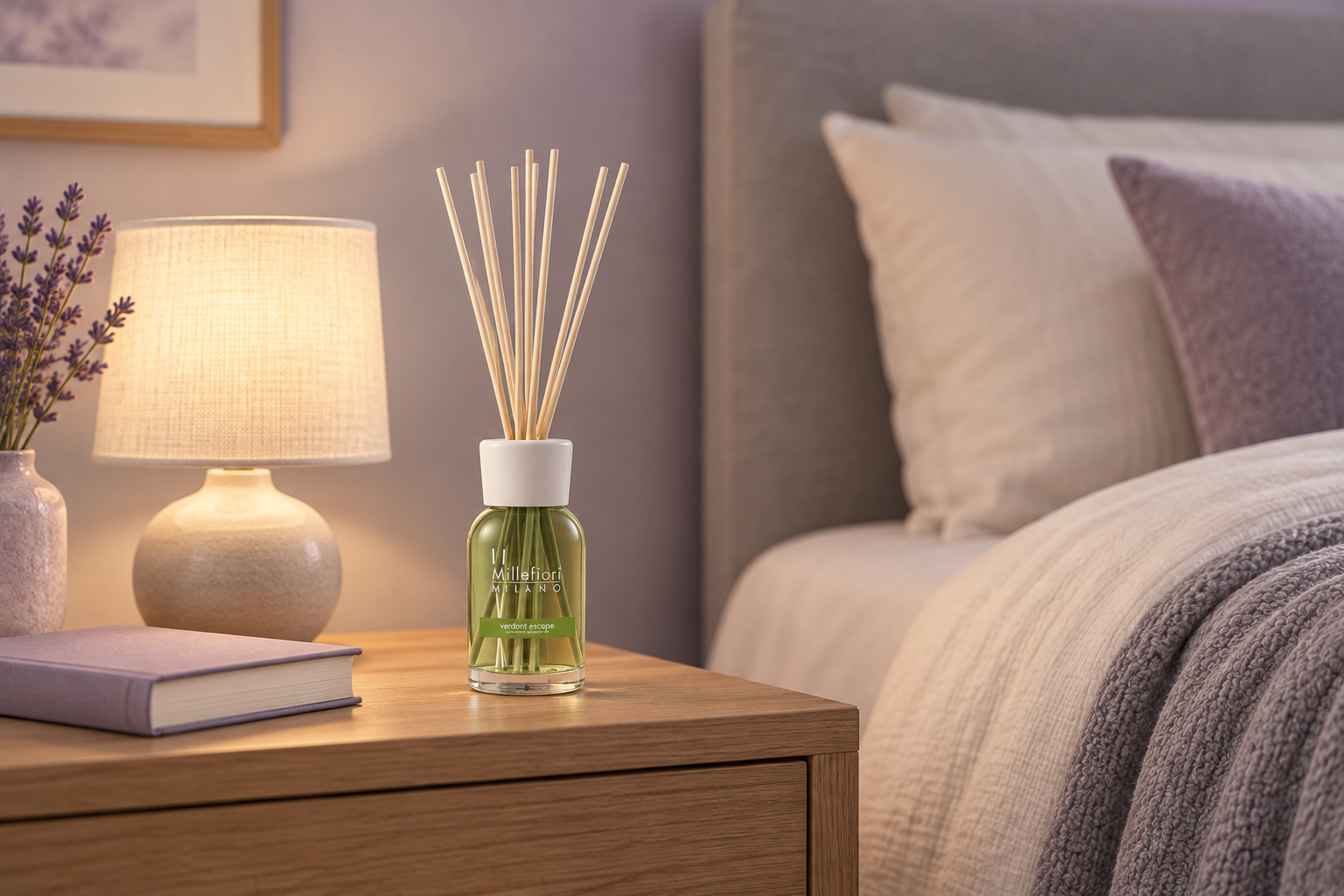
A reed diffuser is practical for the bedroom because it provides a continuous fragrance and requires no maintenance. It works best on a nightstand or dresser, where it stands securely and won't be accidentally knocked over at night. However, don't place it too close to your pillow – the scent should gently fill the space, not be directly under your nose. It's also best to keep it away from direct sunlight and air currents from heating or an open window, where the liquid would evaporate faster and the scent would be uneven.
You can adjust the intensity by the number of reeds. Here's a general guide:
- Smaller bedroom: start with two to three reeds. The scent will be subtle, and you'll get used to it calmly.
- Medium or larger bedroom: you can use more reeds, but add them gradually, ideally one every few days.
- If you stop noticing the scent: flip the reeds – the saturated end will be on top, and the fragrance will be refreshed.
You can always increase the scent, but reducing it in a fragranced room takes much longer. So, it's better to add another reed a day later rather than a day earlier.
A scented candle has a different role in the bedroom than a diffuser. It's not a continuous source of fragrance but part of your evening routine – light it when you're preparing your bed, changing clothes, or reading quietly, and let it create an atmosphere. Place it on a stable, non-flammable surface and away from fabrics like curtains, throws, or bedding. Extinguish it before you go to bed and never leave it burning unattended. A snuffer or lid is useful for extinguishing it, as they reduce smoke from the wick.
If you want to combine a diffuser and a candle in the bedroom, ensure the scents don't clash. A few simple rules can help:
- Choose scents from the same or related family, such as two herbal scents, or a woody one with a subtle floral note.
- Let one scent be the main one and the other just a complement. Pair a stronger candle with a subtle diffuser, or vice versa.
- Don't mix sweet gourmand notes with fresh citrus – in a small space, they can easily create a confusing and heavy impression.
- If you're unsure, let the candle rest for the evening and stick with the diffuser.
In the bedroom, less is often more. The scent should be more of a quiet background that you notice when you enter the room, rather than something that strongly accompanies you until you fall asleep. If you barely notice it in the morning after waking up, you've probably set the right dosage.
Your Evening Ritual Step by Step
When you put all the steps together, you create a short and easily memorable sequence that you can manage even after a long day. You don't need a stopwatch or special equipment—just a few minutes dedicated to yourself and the space where you'll sleep.
- Ventilate. Briefly but thoroughly open the window, ideally before your evening hygiene routine. Fresh air provides a clean base on which every scent will appear more subtly and clearly.
- Prepare the bed. Arrange the bedding, remove items from the bedroom that don't belong, and dim the main light. If you like using a linen spray, a light mist from a sufficient distance will do.
- Light a candle. Place it on a stable, non-flammable surface away from curtains and let it burn only while you're in the room. It's a moment for a book, a quiet conversation, or just a few minutes of peace.
- Set the diffuser. Check how many sticks are in the bottle, and depending on the size of the room, remove or turn them as needed. The diffuser provides a subtle and continuous scent, so it remains in the bedroom even when the candle is extinguished.
- Extinguish the flame and turn off the lights. Before you go to bed, always extinguish the candle—preferably with a snuffer or by covering it with a lid, if it has one, to prevent smoke from the wick. Only a gentle trace of fragrance will remain in the room.
The ritual doesn't have to be long or complicated. Much more important than the number of steps is regularity—when the same sequence is repeated night after night, it begins to function as a signal that the day is ending. Equally important is that the scent is genuinely pleasant to you. If a particular note becomes tiresome after a few evenings, feel free to change it; the ritual is meant to serve you, not the other way around.
If you're looking for a starting point, our selection of home fragrances offers compositions that naturally fit into a peaceful evening. From Woodwick scented candles with their signature crackling wooden wick, you might consider Lavender & Cedar, where lavender meets a woody base, Lavender Spa, White Tea & Jasmine combining white tea and jasmine, or Trilogy Calming Retreat, which combines three harmonizing scents in one container. Among Millefiori Milano diffusers, light floral and clean tones like White Paper Flowers are worth noting, as they don't feel heavy or intrusive in the bedroom.
Whether you choose a candle, a diffuser, or both, select based on what is pleasant to you, and take your time to find your combination. The evening ritual can thus become a natural part of the day that you look forward to.
Category
Recommended articles

"Give a girl the right shoes and she can conquer the world!" Marilyn Monroe