
 Riiffs Freeze in Flames: Ice and Flames Illuminate Warsaw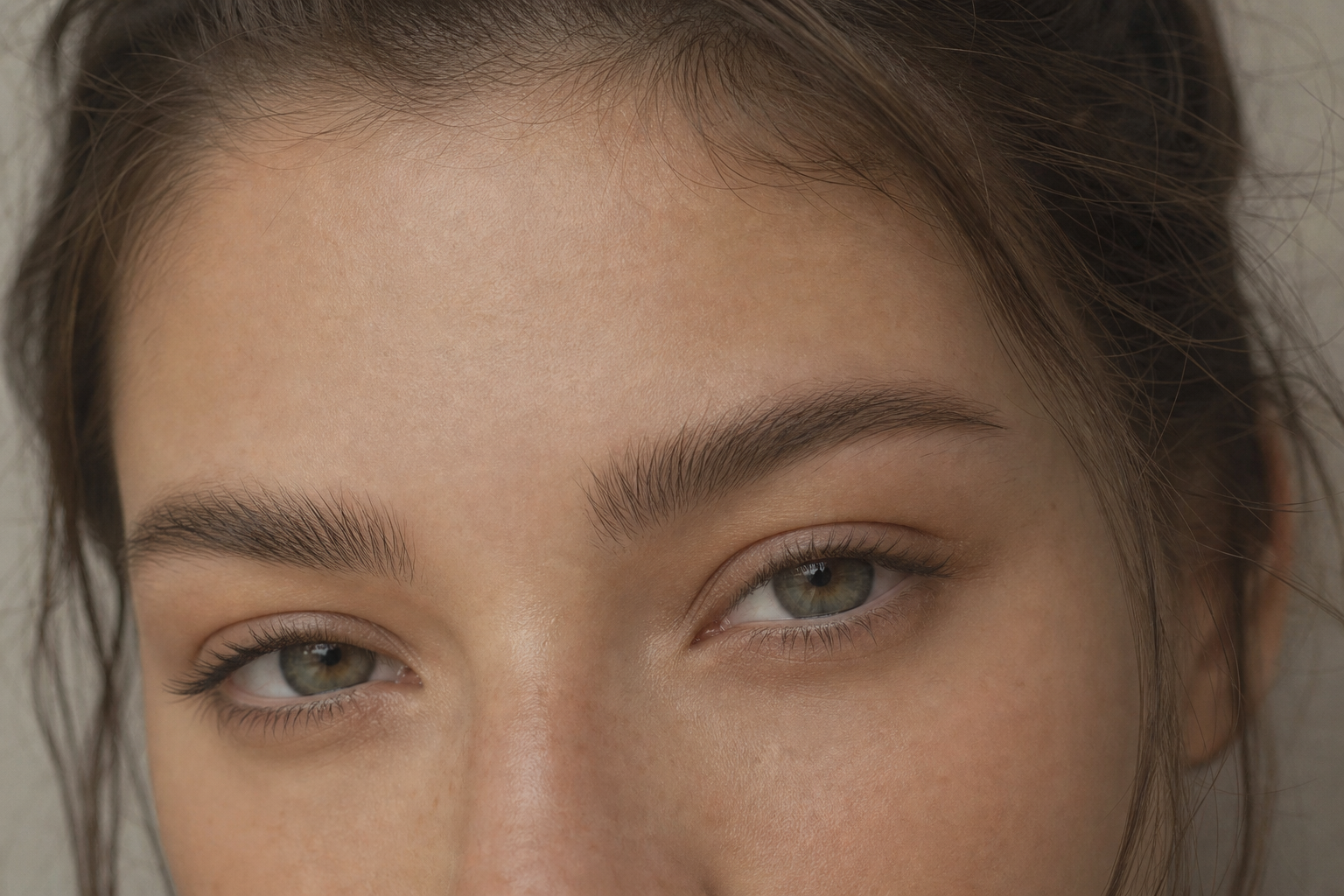
Eyebrows in 2026 embrace a softer, fluffier shape – without sharp lines and without shine. Let's explore why this shift is happening and what it means for your daily routine.
Trend of 2026: Soft Brows Instead of Sharp Lines
Whether you fill in your brows daily or just brush them occasionally, 2026 is set to simplify your makeup routine. After several seasons of sculpting brows into sharply defined shapes with precise beginnings and ends, the focus has shifted in the opposite direction. Soft, slightly blurred outlines are in vogue, giving the impression that the hairs naturally grew that way.
The difference is most noticeable at the edges. Sharp brows had a clearly defined boundary: the beginning was as intense as the middle, and the transition to the skin was evident at first glance. In contrast, the soft shape works with gradual lightening and allows the edge to fade naturally. It's not about a different line, but a different way to finish it.
At first glance, you can recognize soft brows by a few details:
- The start at the bridge of the nose is the lightest part of the entire shape, not its most intense point.
- The outline is not a continuous line but consists of small strokes that follow the direction of each hair's growth.
- The bottom edge remains clean, while the top is intentionally not drawn to a point.
- The shade is usually a tone lighter than the natural hair color, so the brows don't become the darkest element on the face.
- The density remains uneven – sparser areas are only lightly filled in, not to full intensity.
Interestingly, soft brows are not actually a new shape. It's more of a return to what most people naturally have – their own density and slight irregularities that previous seasons deliberately concealed. While sharp lines required brows to conform to a single template, the current approach is based on how hairs actually grow. This is why they look slightly different on every face: for some, it means a denser and straighter line, for others, a gentle arch with more visible gaps that simply aren't covered.
The practical impact is mainly noticeable in time and product usage. The soft shape usually requires less product and less time in front of the mirror, as the goal is not to redraw the brows but to enhance what's already there. Any mistakes are also less noticeable – an overdrawn stroke can be blended or brushed out, whereas a sharp outline often needed to be removed and started over. For everyday makeup, it's a relief appreciated even by those who have previously avoided brow grooming.
At the same time, soft doesn't mean unkempt. A blurred outline still needs a clear bottom edge and hairs aligned in one direction, otherwise, it risks looking like no effort was made at all. The difference between thoughtfully soft and just neglected shapes lies in those few details, which we will explore in the next parts of the article – from finding the line according to your hair growth to the daily routine that maintains the shape without hardening it.
From Thin Lines to Glossy Lamination: A Brief History of Eyebrows
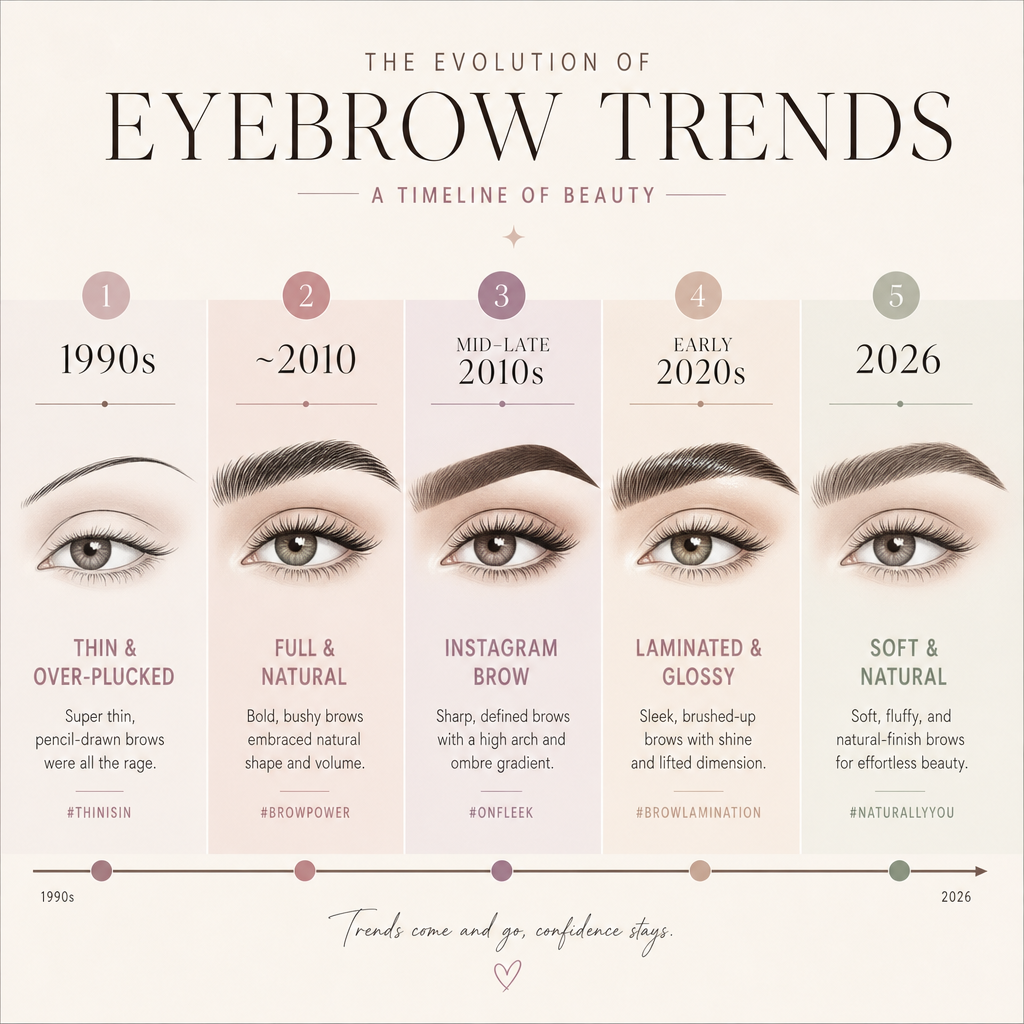
Few details in makeup have transformed as dramatically over the last three decades as eyebrows. Since the 1990s, they have gone through several very different phases—each bringing something new, but also overdoing something. When you look at them in sequence, the soft shape of 2026 stops seeming like a random fashion twist and starts making sense as a reaction to what came before.
The 1990s and the turn of the millennium were all about thin, highly arched lines. Eyebrows were heavily plucked with tweezers, sometimes down to just a few sparse hairs, and missing parts were filled in with a hard pencil. The result was graphically clear but had a downside: the drawn line didn't follow the natural growth of the hairs, so the shape had to be recreated every morning. Many women still describe how their eyebrows never returned to their original thickness after years of intense plucking. This experience is why the following decade swung to the opposite extreme.
Around 2010, the pendulum swung back. The ideal became full, thicker eyebrows with a strong line, meant to look like a natural gift, not the result of tweezers. Plucking was limited to the edges, and hairs began to be seen as material to work with, not excess. This shift was healthy and essentially still holds today—the problem only arose when thickness started being demanded by cosmetics.
The second half of the 2010s brought what is still known today as Instagram brows. Fullness turned into a precisely drawn shape: sharply cut tails, a beginning softened into an ombré, and contours "tidied" with concealer to create a clean edge. New textures helped—creamy pomades and waterproof gels that lasted all day. It worked great under artificial light and in photos, where the sharp edge held the face together. But in regular daylight, it was often clear that it was a drawing, not an eyebrow, and creating it took a lot of time.
At the turn of the 2020s, a response emerged that promised thickness without drawing: lamination. Hairs are brushed upwards and fixed in the chosen direction, so the eyebrows gain volume on their own. It was complemented by a glossy finish, either from a fixing gel or a thin layer of oil. However, it soon became clear where this approach had its limits. Strong fixation combined with gloss can look "wet," and for sparser hairs, brushing upwards reveals gaps that were previously unseen. And since lamination is a chemical treatment, it can't be repeated indefinitely.
How the Products Themselves Have Changed
The transformation of trends went hand in hand with the development of textures. What you take for granted today simply didn't exist in the 1990s:
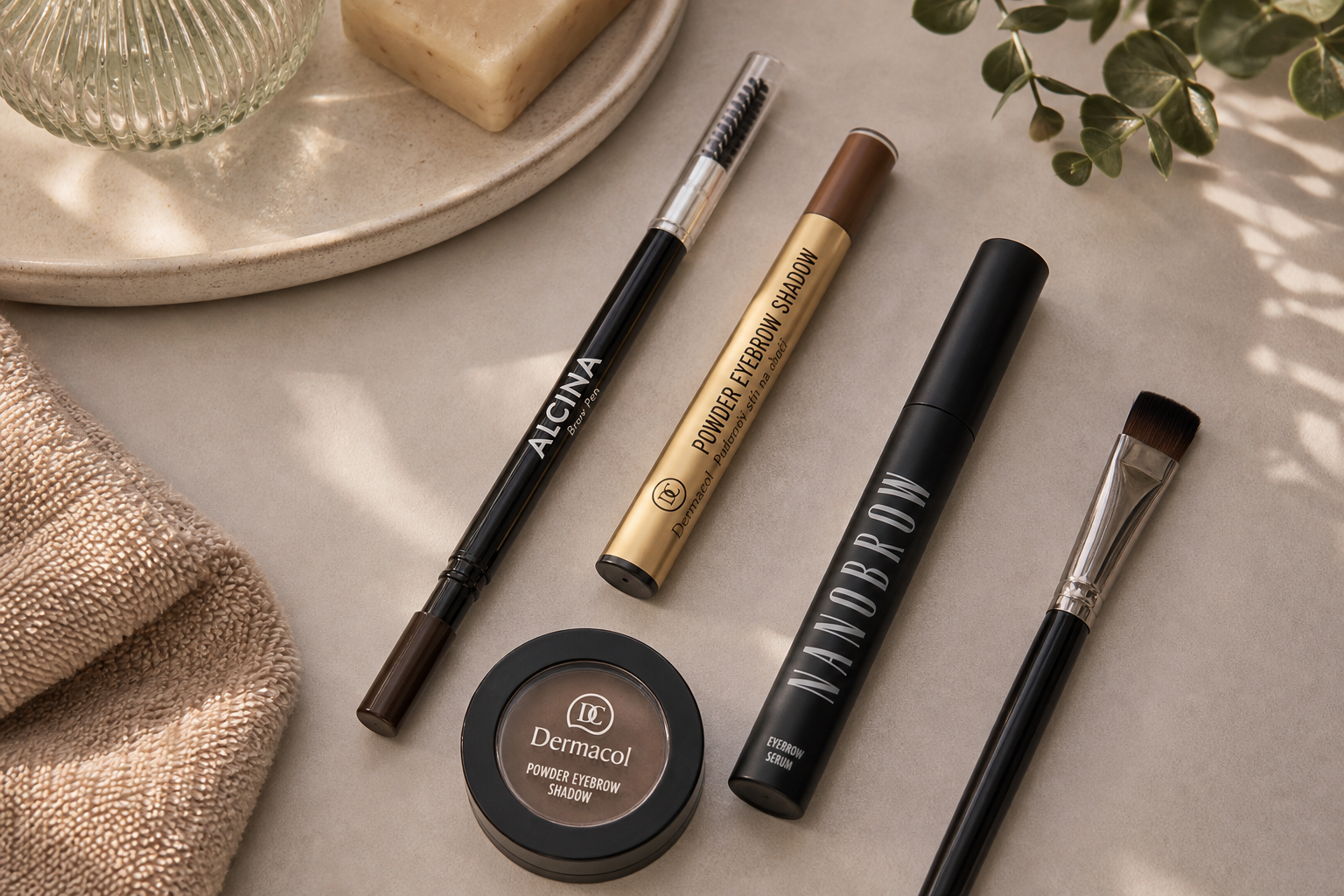
- Eyebrow pencils – from hard leads with a broad stroke to ultra-thin tips that draw lines as thin as a single hair.
- Powder textures – shadows and powders designed for eyebrows allowed for soft filling of empty spaces without visible edges.
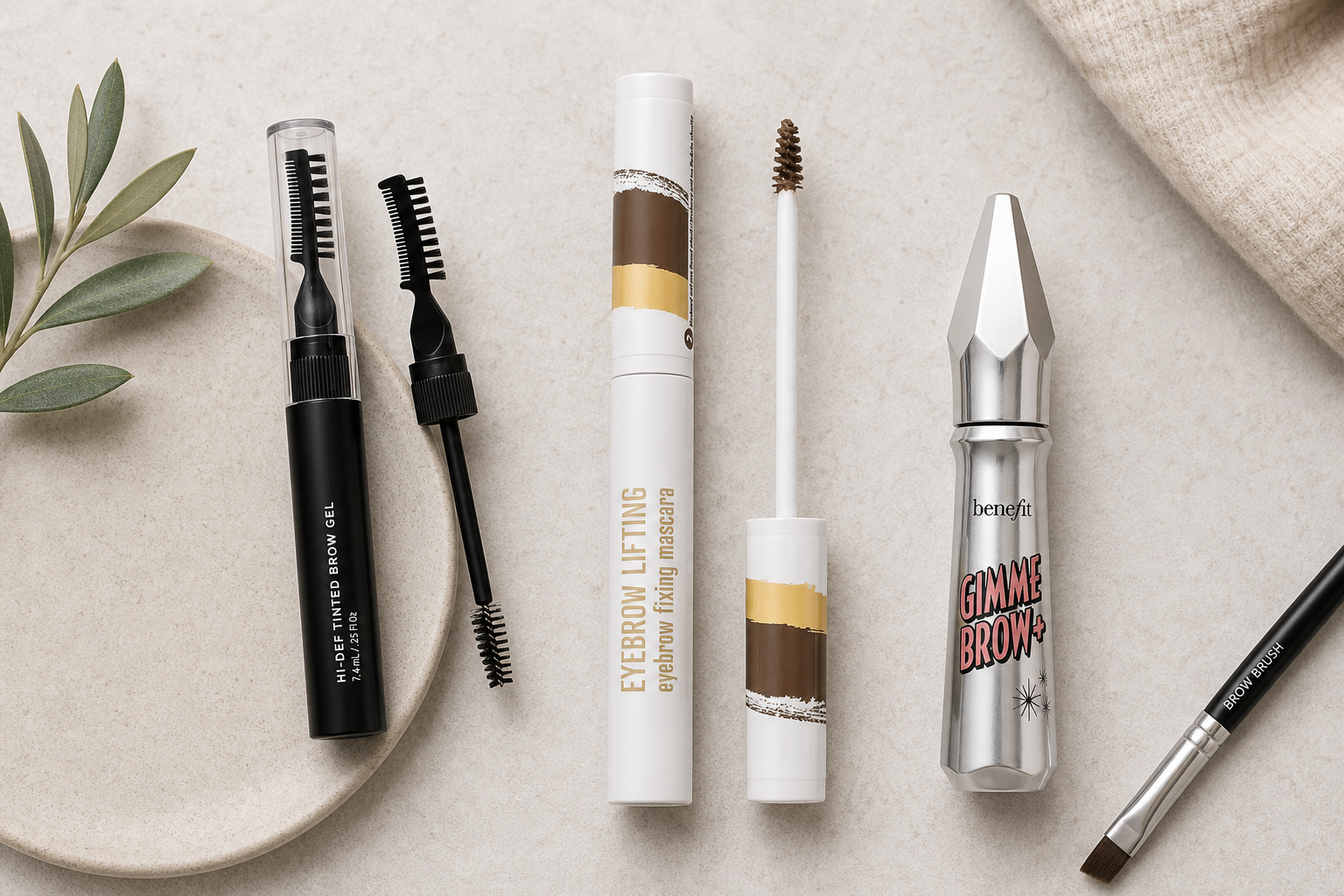
- Tinted gels – brush hairs into place while lightly tinting them, eliminating the need to draw the shape.
- Cream pomades and brow fillers – dense textures for bold definition, now more of a choice for evening makeup than everyday use.
- Eyebrow serums – from a niche novelty to a standalone care category, mainly used by women with thinning eyebrows.
Each stage has passed something on. The 1990s showed where working against natural growth leads, the 2010s restored the good reputation of thickness, and lamination brought the idea that hairs can be combed, not just drawn. 2026 takes the usable parts and discards what proved uncomfortable—the sharp edge and excessive gloss.
How to Find a Soft Shape Based on Your Natural Brow Growth
Soft eyebrows aren't created by tracing a template, but by following the natural growth of your hairs. Universal proportions may look good in photos, but on a real face, they often go against the grain, resulting in a harsh, pasted-on outline. Before reaching for a pencil, stand in front of a mirror in natural daylight and leave your brows as they are for a moment. Only then will you see where the density is greater and where the hairs merely suggest a line.
Three Key Points to Identify
The classic advice involves three points and still makes sense—though today it's used more freely, as a guide rather than a ruler. Take a straight brush or pencil and place it against your face:
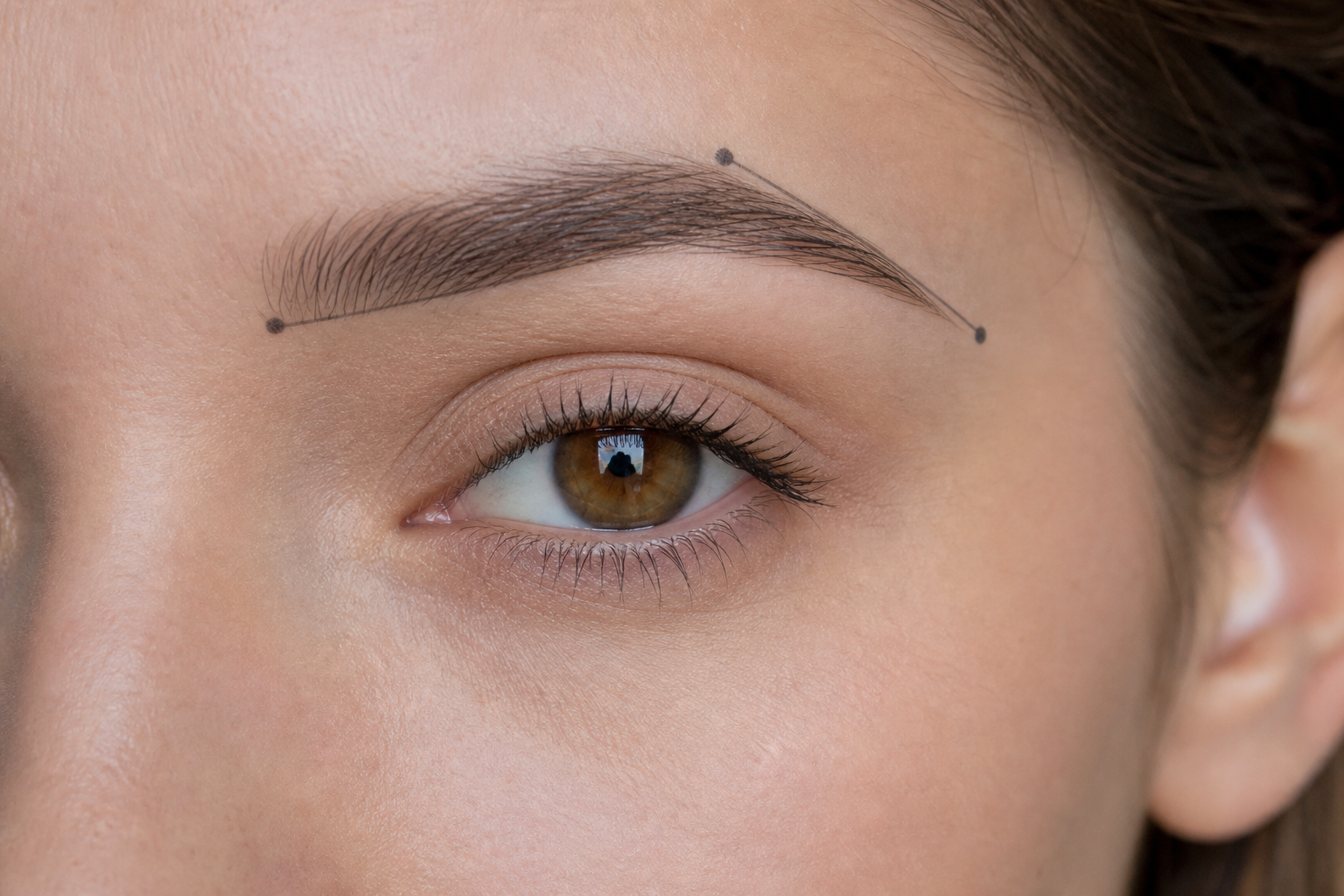
- Start – vertically above the inner corner of the eye, roughly in line with the nose's wing. Hairs here are usually the finest and most dispersed, so a sharp edge looks the least natural.
- Highest Point – find it by tilting the brush from the nose's wing across the outer edge of the iris. This is where you decide if the brow will look calm or dramatic.
- End – in line from the nose's wing to the outer corner of the eye. It shouldn't drop lower than the start, or the whole arch will visually pull the eye down.
The difference from the past is how distinctly these points are defined. While in the era of strong definition, the highest point was sharply raised and moved closer to the brow's center, today we keep it lower, slightly towards the outer end, with a gradual transition. The arch is more suggested than drawn. If you're unsure how much lift you can handle, try reducing the difference between the highest point and the start by a few millimeters—often that's enough to achieve a softer result.
Short Strokes in the Direction of Growth
Once you know the shape's path, stop thinking about the line and start thinking about the hairs. Achieve a soft look with short strokes that mimic the natural growth direction—almost vertically upwards at the start, diagonally outwards and upwards in the middle, and smoothly downwards towards the end. Place strokes next to each other, not over each other; layering in one spot creates a blotch that's hard to blend.
The order helps too. Start where the brow is sparsest and work towards the start—by then, the pencil's tip will have minimal product, and the mark will naturally be lighter. Brushing with a clean spoolie is the simplest way to turn a drawing into a structure.
Where to Leave Brows More Sparse
Not every area is worth filling in. Sparse sections add depth to the brows, and without them, you get a flat, continuous shape that looks more like a stamp. It's especially worth leaving out:
- the first millimeters at the nose bridge, where a few gentle upward strokes suffice,
- the upper edge along the entire length—this is where the outline is most visible,
- small gaps within the brow unless they reveal significantly lighter skin,
- the lower edge in the inner third, where sharp filling visually brings the brow closer to the eye.
Common Mistake: Too Sharp a Start
A drawn-on brow is most noticeable by its sharply defined start. This happens easily: we first place the pencil where our hand is steadiest, applying the most product. The result is an edge you won't find anywhere on the face, as no brow starts with a cut.
The solution doesn't require more product. Return to the start at the very end, use only the leftover pigment on the tip, and immediately blend the mark upwards and outwards with a spoolie. If the area is too dark, go over it with a clean spoolie—removing pigment is easier than covering it with more layers. And if your brows grow slowly in this area, the solution isn't heavier drawing, but patience.
Less Shine, More Texture: Matte Finish Instead of Hard Fixation
A soft shape is only half of what sets today's eyebrows apart from previous seasons. The other half isn't about the outline, but the surface: for years, eyebrows were brushed straight up and locked into a shiny, tightly fixed structure. The year 2026 shifts the focus to a result that absorbs light rather than reflects it – towards a more matte and airy brow, where individual hairs remain visible. The reason is simple: shine highlights. It accentuates a well-defined shape, but just as reliably every clumped strand and every gap between hairs.
Strong Fixation or Light Brushing?
The difference isn't in the amount of product, but in what the product is supposed to do to the eyebrows. Strong fixation binds the hairs into one unit: the shape holds all day, but then the eyebrows behave like a continuous surface. Light brushing, on the other hand, just directs the growth direction – the hairs remain movable and individually distinguishable up close. You'll know the fixation is stronger than today's style prefers by a few signs:
- the eyebrows shine more prominently than the surrounding skin after drying,
- the hairs are clumped into patches and the skin shows through more than before styling,
- by the end of the day, the product crumbles or forms small light residues.
A simple habit helps: apply with an almost dry brush and wipe off the excess on the edge of the container. Most brow gels are mixed so that you need significantly less than what the brush picks up directly from the tube.
When Lamination Still Makes Sense
Lamination – a salon treatment where the hairs are chemically softened and brushed in the chosen direction – isn't disappearing, but its goal is changing. Instead of the most pronounced vertical effect, a gentler variant is chosen today, which aligns the hairs more in one direction rather than standing them straight up. It works especially well where hairs grow unevenly, cross each other, or point against the rest of the brow. It looks artificial on very sparse eyebrows, where vertical brushing further enlarges the gaps between hairs, and on eyebrows that naturally grow straight. And since it's a chemical treatment, it makes sense to leave a pause between repetitions.
Why Gels Are Replacing Thick Pomades
The shift in finish corresponds to a shift in textures. Thick waxy pomades that literally sculpted the eyebrows are giving way to lighter gels with brushes. Today, you'll mainly encounter three types:
- Clear Gel – doesn't tint, just directs. It's suitable if you have thick enough eyebrows and are only concerned with holding the shape.
- Tinted Gel – lightly colors the hairs while brushing them. Choose a shade slightly lighter than your eyebrows; a darker tone brings back the harsh outline.
- Fiber Gel – fine fibers cling to the hairs and visually fill in sparser areas; it works with volume, not shine.
On the packaging, look for the finish description: matte, natural, or light fixation aligns with today's style, while extra strong fixation and glossy shine belong more to the previous wave.
The more natural style has one catch – the less product covering the eyebrows, the more clearly you can see how the hairs really are. Subtle habits help: remove makeup from eyebrows as thoroughly as from lashes, don't brush out dried fixation film dry, and extend the intervals between shaping, as a soft shape can handle much more regrowth than a sharp line. A matte finish doesn't mean less work, just differently distributed – less on the surface and more on the individual hairs.
Everyday Eyebrow Routine: Pencil, Gel, or Serum?
A softer approach to eyebrows has one practical advantage: it doesn't require a complicated process or a full makeup bag. Most of the work is done in a few minutes, and the rest depends on what suits your brows. Whether you're racing against the clock in the morning or enjoy taking your time with makeup, it's worth having two routine options at hand – a quick weekday one and a more meticulous one for days when you want to look more polished.
Three-Minute Version for a Regular Day
The basics can be managed in three steps. The fewer interventions you make, the more natural your eyebrows will look.
- Brush the hairs upwards and outwards with a dry brush. You'll see the true shape and the areas where the growth is sparse, and often you'll find that less is missing than you expected.
- Fill in only the empty spots. Short strokes in the direction of hair growth work better than a continuous line around the perimeter, which can make the eyebrows look closed off and rigid.
- Apply a gel to the eyebrows and smooth the hairs into a position where they naturally hold. The end of the eyebrow just needs a slight adjustment; you don't need to pull it into a point.
If you have a little extra time, add one step: blending. Gently soften the edges of the fill with a clean brush or a square of a cosmetic pad so the transition to the skin isn't visible. Blurred edges are what differentiate drawn eyebrows from natural ones.
According to Hair Type: Pencil, Powder, or Just Gel
The choice of product isn't dictated by trends but by what you have. The same pencil can disappear on one eyebrow and look like a tattooed line on another.
- Sparse eyebrows and light hairs. An eyebrow pencil with a very fine tip, used to draw individual hairs, or a powder filler applied with an angled brush, works well. The powder creates a soft shadow in which the drawn hairs blend.
- Thick and unruly eyebrows. You usually don't need any filler. A clear gel is enough to align the hairs and keep them in place without clumping them into a hard block.
- Uneven growth. A combination is often more feasible than a single product: a tinted gel unifies the color along the entire length, and a pencil is used to fill in just one or two specific spots.
- Dark eyebrows and lighter hair. Choose a shade slightly lighter than the color of the hairs. A darker tone can visually weigh down the eyebrows, losing the soft impression.
Opt for a cooler and less saturated shade than you might expect – warm reddish tones on dark eyebrows quickly come to the forefront.
Eyebrow Serums: A Journey for Weeks, Not Just One Evening
When eyebrows are permanently sparse after years of plucking, decorative cosmetics only solve this morning's issue. A longer-term solution is lash and brow serums, which are applied with a brush along the growth line, usually once a day in the evening on cleansed skin. It's not an immediate effect: each hair has its own growth cycle, so any change is worth assessing only after several weeks of regular use, and more so in photographs than in the mirror.
At the same time, the results of serums vary from person to person, and no one can guarantee them. If you have sensitive eyes or wear contact lenses, review the ingredients and manufacturer's recommendations before first use. And remember, a serum doesn't replace shaping – that still comes from brushing and gentle filling, with the serum just providing the material.
Most of what we've described can be covered by three items in your bag: an eyebrow pencil, gel, and possibly a serum if you're addressing density long-term. You'll find all three categories in Brasty's range, from fine pencils and powder fillers to clear and tinted gels, and even lash and brow serums. Choose based on how your eyebrows grow today – not based on the shape that was in style ten years ago.
Category
Recommended articles
Riiffs Freeze in Flames: Ice and Flames Illuminate Warsaw "Give a girl the right shoes and she can conquer the world!" Marilyn Monroe