
Why Choose a Palette Over Individual Eyeshadows
Eyeshadows are one of those items that you can easily end up with a handful of at home, yet you always reach for the same two shades. Whether you apply makeup every morning on your way to work or only occasionally for evening outings, buying individual shadows forces you to piece together shades and hope they match. A palette solves this task for you: the shades are curated to complement each other and can be combined without lengthy trials.
The practical difference is immediately noticeable in your makeup bag. One flat case takes up less space than five separate pots, and when traveling, you don't have to decide which shadows to bring. In one palette, you usually find the entire gradient from the lightest tone under the brow, through the medium color on the lid, to the dark shade in the outer corner. From one package, you can create both a subtle daytime and a more dramatic evening look without needing to buy anything extra.
In this article, we compare six palettes based on four criteria that determine how often you'll actually reach for the palette:
- Ratio of Matte to Shimmer Shades – matte tones form the base and crease shadow, while shimmery ones add light. Palettes with a predominance of mattes are suitable for the office, while those with more shimmer are better for evening.
- Pigmentation and Blendability – how intense the color is with the first brush stroke and how easily the edges can be blended out. Highly pigmented shadows should be applied sparingly, while less pigmented ones can handle more layering.
- Versatility with Eye Color – warm browns and copper tones enhance blue eyes, cooler greys and plums highlight green and hazel eyes. A versatile palette contains at least one shade of both.
- Price Range – more interesting than the overall price is the cost per shade and how many shades from the palette you actually use.
Price is precisely why we've included three different levels in our selection. Affordable ranges from brands like Maybelline and Max Factor are great if you want a neutral base for everyday use or are just experimenting with which shades suit you. More sophisticated palettes from Artdeco are aimed at those who expect deeper shades and a more thoughtful composition for evening occasions. All three levels are based on the same principle: one case should cover more situations than a single shadow.
For each of the six palettes, you'll find specific recommendations on who the shades suit and for what occasion they're appropriate. It's not a ranking from worst to best – the palettes differ in focus, standing side by side as different answers to the question of what you expect from your makeup.
Maybelline: Neutral Shades for Every Day
In the world of decorative cosmetics, Maybelline has long been one of the strongest mid-range brands at Brasty, and in the past year, it has become one of the fastest-growing. This has practical implications for their eyeshadow palettes: you get well-pigmented shades and a thoughtfully composed palette without having to dig deep into your wallet. If you're just discovering which tones suit your eyes, this is a sensible place to start.
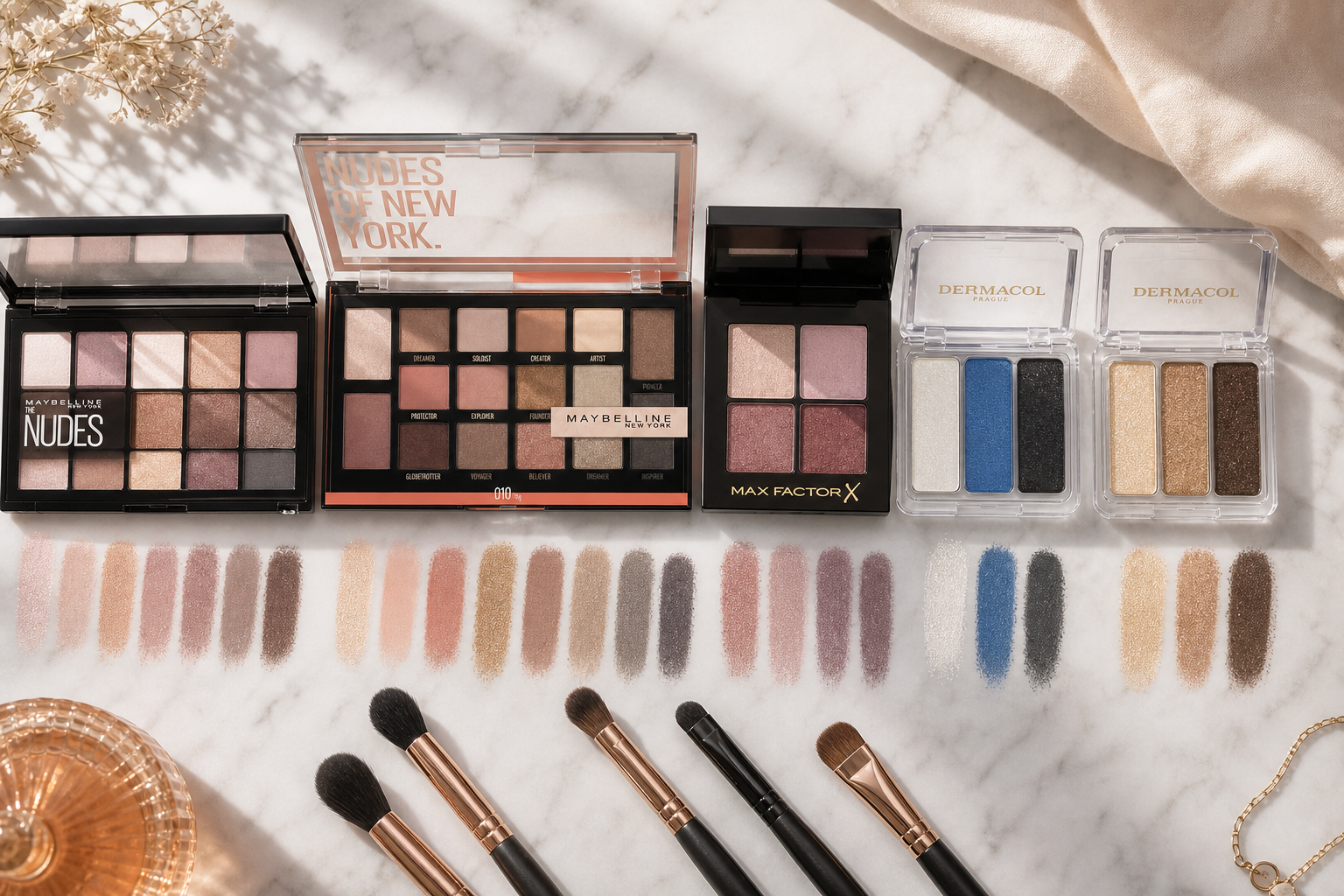
Maybelline The Nudes Eyeshadow Palette 9.6 g for 227 CZK is a classic in this regard. The twelve shades range from the lightest cream base through warm beige and peach tones to deep brown and almost graphite. In one box, you have the entire transition from base to lash line definition. It combines matte and slightly pearlescent finishes, which is useful for everyday makeup – matte shades shape, while pearlescent ones add a touch of brightness.
For a regular day at the office or school, you can get by with three shades:
- the lightest matte tone on the entire movable lid to unify the color,
- a medium beige-brown in the crease for subtle eye depth,
- a light pearlescent shade in the inner corner and under the brow for highlighting.
The result looks polished but doesn't overpower the rest of your makeup – perfect for situations where you want to emphasize your lips or blush. You can achieve this in a few minutes without needing to layer the shades extensively.
In the evening, you can elevate your look with the same palette without reaching for another product. Apply the darkest brown to the outer corner in a V shape, blend it upwards into the crease, and soften the edge with a fluffy brush. You can also use the same dark shade dry to accentuate the lower lash line – the transition is softer than with a pencil and easier to correct. This versatility is the main argument for a nude palette: one box serves both morning and evening looks.
If a purely neutral palette seems too calm for you, another option within the brand is palettes that feature bolder colors and more pronounced shimmer. Maybelline offers these alongside their nude range, differing in several ways:
- they include warmer or cooler color accents – burgundy, copper, plum, or green,
- they have a higher proportion of shimmery and metallic shades, perfect for weddings, celebrations, or evening photoshoots,
- they require a bit more careful brushwork, as richer pigments are less forgiving of mistakes.
Who is each type suitable for? The neutral palette is ideal for those of you who wear makeup daily and want the assurance of a foolproof look. A more colorful palette makes sense as an addition if you already have a nude base at home and want to expand your repertoire for occasions where you can afford to be bolder.
Whichever option you choose, remember that the result depends on the application. The included sponge applicators are fine for quickly applying color to the lid, but for blending transitions, we recommend using a separate brush with soft bristles – for example, from the Real Techniques line, which we also carry in decorative cosmetics. The difference between a harsh blotch and a soft transition is made by the brush, not the price of the palette.
Max Factor: Quick Morning Makeup Without Big Experiments
Max Factor is a classic choice on Brasty in the mid-price range – a brand that customers choose more for reliability than for discovering new trends. Its eyeshadow palettes are based on earthy and nude tones, so you can imagine the result even before you open the palette for the first time. This is their main advantage. When you're doing your makeup in a hurry in the morning, you don't want to worry about whether two shades match while standing in front of the mirror.
The first of the two palettes we've selected from Max Factor's catalog is deliberately understated and versatile. The shades follow each other in gentle steps: a light matte base under the brow and in the inner corner, a warmer medium tone on the movable lid, and a darker brown in the outer corner. The differences between adjacent shades are small, so even if you apply them a bit off, the transition won't create a harsh spot. Such a palette is suitable for the office, meetings, or a day spent out of the house when makeup needs to last and not appear as a heavy layer.
The second palette is built on a more pronounced contrast. Alongside neutral bases, it contains one or two dark shades and usually a tone with a subtle shimmer that can hold attention in the evening even under artificial lighting. The principle of use remains the same, only the ratio changes: you apply the dark shade in a narrow strip along the lash line and leave the shimmer on a small area in the middle of the lid. This palette is ideal for situations when you're going straight from work to dinner and don't want to redo your makeup from scratch at home.
When you compare both options side by side, the difference looks roughly like this:
- Universal Palette – gentle transitions, matte shades, forgiving of inaccurate application. Suitable if you do your makeup every day and want one reliable scheme.
- Contrast Palette – darker shades and added shimmer, the result is more noticeable. Suitable if you prefer evening makeup or want both options in one box.
- Common to Both – earthy colors, mid-price range, and shades that can be combined without the risk of clashing.
The practical aspect is similar for both palettes. Basic eye makeup can be done in about three to five minutes: one light shade over the entire lid, one medium in the crease, and possibly a darker tone along the lash line. Shadows of this class are usually soft enough to blend with the included sponge applicator or your finger, so you don't need to reach for a brush with a sharp edge. This is a difference you'll appreciate especially in the morning – the fewer tools makeup requires, the fewer steps can be rushed.
For travel, compact packaging is more suitable. If you travel often and want to have only one item for your eyes in your cosmetic bag, it makes sense to choose a palette with more contrast – it covers both day and evening situations, and you don't need to pack a second box. Conversely, if you mainly use makeup on weekdays and rarely do evening makeup, the universal palette will suffice, and you won't be left with half the shades untouched.
Dermacol: More Sophisticated Palettes for Evening Occasions
For daytime makeup, speed and subtlety are key. But in the evening, the rules change a bit: shades can be richer, transitions softer, and your eyes can handle more layers. This is exactly where Dermacol's eyeshadow palettes come in. They combine matte and pearlescent finishes, allowing you to create a look from a single palette that stands out even in the dim light of a restaurant.
Dermacol Eyeshadow Palette 2 Starry Night
Starry Night is built on darker smoky tones complemented by metallic accents. It's a palette for classic smoky eyes, without the need for three different products – apply the lighter shade all over the lid, place the darker one in the outer corner, and brighten the center with a metallic tone. It's that bright spot in the middle of the lid that makes the look evening-ready.
Cooler smoky shades work best with blue and gray eyes, creating contrast without overpowering the iris color. For brown eyes, Starry Night acts more as a deepening effect – it frames the eye and enhances the iris color. If you have green eyes and find cool tones too harsh, opt for the other palette in the pair.
Dermacol Eyeshadow Palette 3 Golden Sands
Golden Sands features a warm palette of golden, sandy, and bronze shades. The result is festive yet softer than smoky eyes – perfect for occasions where you want to look polished and celebratory, not dramatic. The bronze shade can do both: applied lightly, it works as an evening neutral, applied more densely, it replaces the dark shadow in the outer corner.
Warm golden tones flatter brown and hazel eyes by highlighting their natural golden flecks. For green eyes, bronze is a proven choice: warm brown sits opposite green on the color wheel, making the iris pop. If you have blue eyes, stick to sandy shades and use bronze as a thin line along the lashes.
How They Differ from More Affordable Lines
The main difference from basic lines is noticeable right from the first application: the pigment is richer, so the shadow on the lid matches what you see in the palette, without needing multiple applications. This is especially evident when layering – with three shades layered on top of each other, less pigmented shadows tend to blend into an indistinct gray, whereas richer shades maintain their boundaries even after blending.
The second difference is in the palette's composition. The shades aren't randomly arranged but designed as functional trios or quartets: a light base tone, a medium transition shade, a dark corner shade, and a bright accent. You don't have to worry about what matches with what.
When a More Sophisticated Palette is Worth It
It's not worth buying an evening palette for just one occasion a year. However, it makes sense when your makeup needs to last several hours and look good in photos:
- Wedding – whether you're the bride, a bridesmaid, or a guest, makeup starts in the morning and ends late at night. Layered shadows hold their shape longer than a single shade applied alone.
- Corporate party or ball – subdued lighting requires more contrast, otherwise the makeup fades into the background from a distance.
- Photography – camera flashes flatten colors, so richer pigments show up better in photos than subtle daytime shades.
- Evening event transitioning from work – during the day, a light base tone suffices, and in the evening, you simply deepen the look with a darker shade from the same palette.
For all these occasions, we recommend starting with an eyelid primer: richer pigments tend to slide into creases on oilier lids, and a primer is a simple safeguard against this.
How to Choose the Right Palette from Six Options
Six palettes side by side might seem like an overwhelming choice at first glance. In reality, each one answers a slightly different question – how often do you wear makeup, how much time do you have in the morning, and whether you want the shadows just to even out your eyelid or to play with color. Once you clarify these three things, the decision usually narrows down to one, at most two options.
Consider these four common scenarios:
- Everyday work makeup. You're looking for matte neutral shades ranging from light beige to brown, which you can apply quickly and don't require perfectly precise blending. A palette with six to nine shades is more than enough – with larger palettes, half of the slots usually remain untouched.
- Universal travel palette. Compactness is key, with light base tones, a medium transition shade, and a dark one for highlighting the outer corner all in one box. A mirror in the lid is a practical detail you'll appreciate in a hotel or on a train.
- Evening occasions. Here, a palette with shimmery and metallic shades and long-lasting pigmentation is worth it. Keep in mind that darker finishes take longer to apply and require more careful blending – it's not for quick morning makeup.
- Desire to experiment with color. If beige and brown bore you, a palette that offers richer tones alongside a neutral base makes sense – think terracotta, plum, or green. You don't have to wear the color all over the lid; to start, just highlight the lower lash line with it.
Price-wise, the six palettes fall into roughly two categories. Maybelline and Max Factor palettes are in the more affordable range and are a sensible choice if you're just trying out shadows or want a second palette for your handbag without worrying about the budget. Artdeco belongs to the more premium category – you're paying for finely milled pigment, better blendability, and for some of the range, a system of interchangeable pans that lets you customize the palette's contents. The difference between the categories is most noticeable with dark and metallic shades, where cheaper shadows are harder to blend and crumble more easily.
Whichever palette appeals to you, two things will influence the result more than the palette itself. The first is an eyeshadow primer. A thin layer on the lid evens out skin tone, prevents shadows from creasing, and significantly extends wear time – you'll appreciate it especially in summer and on oilier lids. The second thing is brushes. To start, you'll need two: a flat one for applying color to the movable lid and a fluffy round one for blending transitions. Foam applicators that often come with the packaging are good for quick application, but achieving a soft transition with them is much harder. You can find eyeshadow primers and brushes in separate categories on Brasty, so you can order them along with your palette.
And if you're looking for just one palette for everything and don't want to spend too much time choosing, the Maybelline The Nudes Eyeshadow Palette is a great option. Twelve neutral shades cover both subtle daytime makeup and darker evening looks, with a balanced mix of matte and shimmery finishes, and the price remains affordable – so you won't mind if you only use some shades occasionally. You can browse the complete range of palettes and individual shadows in the Eyeshadow category on Brasty.co.uk.
Category
Recommended articles
"Give a girl the right shoes and she can conquer the world!" Marilyn Monroe