
Layering Fragrances: What It Means and Why It Works
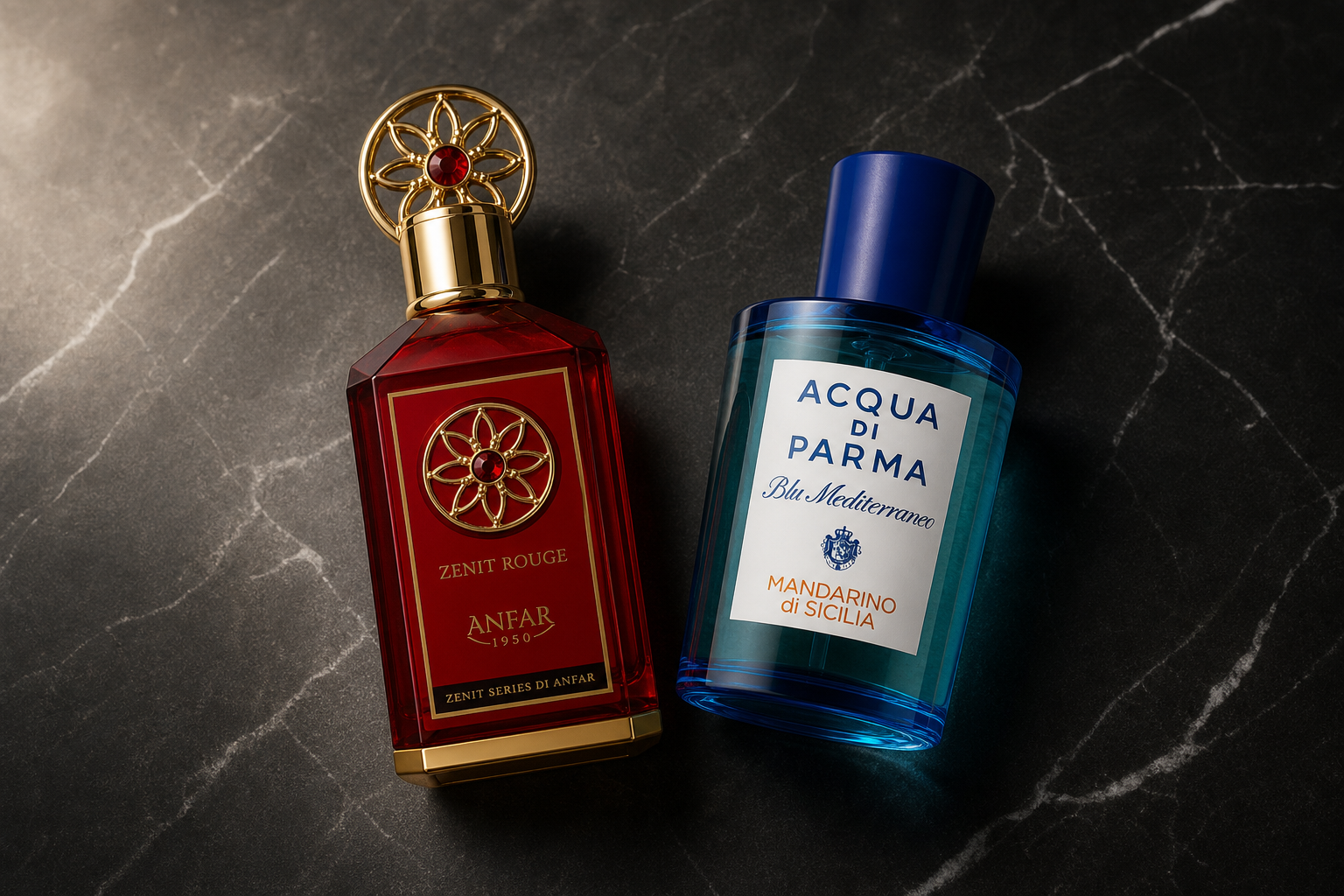
Whether you have two bottles at home or a whole shelf, sooner or later you'll wonder: what happens if I use two perfumes at once? That's exactly what fragrance layering is about. It's the intentional combination of two perfumes on the skin to create a single cohesive impression – not two competing scents, but one composition perceived as a whole by those around you.
The key word in this definition is intentional. Layering isn't just about spraying on whatever is at hand. You work with two perfumes that are meant to achieve a common result, and you know in advance which one forms the base and which one complements it. The difference between a thoughtful combination and a random one becomes apparent within the first half-hour of wearing.
The idea itself isn't new. In oriental perfumery, fragrant oils and perfumes have been combined for a long time, and many brands take this tradition into account. The topic has reached a wider audience mainly because the range of available perfumes has significantly expanded in recent years – when you have three or four bottles at home instead of just one for special occasions, you naturally start to experiment. The desire for a more personal scent also plays a role. Layering is a way to create an impression from commonly available perfumes that isn't worn by everyone else.
At the same time, it's understandable why many people are hesitant to try it. There's a fear that combining perfumes will ruin both at once – that you'll lose a scent you love and also use up part of a bottle that wasn't cheap. This fear is only partially justified. A failed combination is unpleasant but temporary: you can wash off the perfume, get through the day, and choose differently next time. The risk decreases if you first test the combination on a small area of skin, rather than applying it all over before an important meeting.
The fact that layering works at all is no accident. A perfume isn't a single flat scent, but a structure of three layers: top notes, which you smell immediately after application, middle notes or the heart, which develop within the first hour, and base notes, which last the longest on the skin. When you apply two perfumes, their layers don't overlap like two coats of paint – they intertwine. The result can therefore be richer than each perfume individually, but also confusing if the layers clash with each other.
In practice, you can expect three things from layering:
- A more personal scent – a pair of common perfumes sounds different than either one alone.
- Adjustment according to mood and season – you can underpin a lighter perfume with something warmer in cooler months without buying a new bottle.
- Utilizing a perfume that otherwise sits unused – a scent that didn't quite suit you on its own can often work well as a complement to another.
A good result doesn't rely on talent or an extensive collection, but on a few clear rules: the order in which to apply perfumes, how to handle them on the skin, and how to identify pairs that have a chance of working. We'll go through these step by step and show you a method you can try with what you already have at home – without making a single extra purchase.
Why Some Perfumes Harmonize and Others Clash
When two fragrances blend seamlessly on the skin, it's neither coincidence nor luck. The secret lies in the composition itself: a perfume is not a single scent, but a gradually unfolding structure that transforms on the skin over several hours. Once you understand what happens within it, you can predict whether a pair will complement each other or clash.
The Three Layers of a Composition
Perfumers describe a fragrance in three layers that overlap and evolve over time:
- Top Notes – what you smell immediately after application. These are usually fresh and volatile: citrus, bergamot, mandarin, grapefruit, green and aromatic notes. They typically last only a few minutes on the skin.
- Middle Notes, or the Heart – the core of the composition that unfolds after the top layer fades. This includes floral notes like jasmine or rose, spices, cardamom, or fruity accords. The heart carries the character of the perfume and determines how it is perceived by others.
- Base Notes – the heaviest and most enduring layer. Musk, amber, vanilla, patchouli, sandalwood, cedar, or vetiver linger on the skin for hours and create the trail you leave behind.
When layering, two perfumes don't meet as closed entities, but rather their individual layers interact. The top notes of both scents compete in the first few minutes when the nose is most sensitive, while the bases coexist for several hours. Therefore, the outcome is mainly determined by how both bases look – not by what you smell immediately after application.
Connecting Note or Clash of Two Bases
The most reliable bridge between two perfumes is a note that both compositions share. If both contain musk, amber, or vanilla, you have a common point where the scents meet and begin to act as one. These notes work particularly well as binders: they are soft, warm, without sharp edges, and can even cover quite different hearts.
The second approach is a related fragrance family. A citrus composition easily blends with an aromatic or woody one, while a floral scent pairs well with powdery or subtly gourmand notes. The closer the two scents are in character, the less likely you are to end up with something you don't want to wear all day.
Conflict arises when both compositions want to be heard at the same time and in the same position. Two strong oriental scents often clash because each relies on its own spicy and resinous base – instead of harmony, you get a dense mix where neither of the original scents is recognizable. Similarly, an unfortunate combination occurs when a sharp citrus start meets a very sweet gourmand perfume: the first layer feels sour, the second heavy, and there's nothing to bridge them.
Concentration Determines the Leader
Another factor influencing the outcome is the concentration of the fragrance component. Eau de toilette has a lower concentration, opens more freshly, and fades from the skin after a few hours. Eau de parfum contains more fragrance components, lasts longer, and its base remains noticeable even in the evening. In combination, the two concentrations behave differently: eau de parfum naturally forms the foundation that carries the pair, while eau de toilette adds freshness in the first hours.
You can tell which of the two perfumes will be dominant by several clues. Higher concentration often leads over lower. A sweet, spicy, or resinous base will overpower a woody or musky base. And a perfume known for its longevity and strong sillage will dominate even a scent you would expect to be an equal partner. The more pronounced of the pair then dictates the overall impression of the resulting combination.
Basic Rule: Apply the Heavier Layer First, Then the Lighter Fragrance
Layering hinges on the order. Whether you're combining two perfumes from your own collection or selecting a second one to complement a long-time favorite, there's a simple rule: apply the heavier, more intense composition to the skin first, followed by the lighter fragrance. This isn't just a cosmetic detail. The order determines whether the pair will create a harmonious scent or two conflicting fragrances.
The reason is purely practical. Heavier woody, oriental, and gourmand compositions are based on base notes like musk, amber, vanilla, sandalwood, or patchouli. These evaporate slowly from the skin and linger for hours, making them a reliable foundation. In contrast, lighter citrus and floral perfumes carry most of their character in the top notes, which are volatile and fade much faster. If you apply them first, the heavier layer would simply overshadow them, leaving barely a hint of the delicate bergamot or jasmine trail.
The process itself can be summarized in four steps:
- Base first. Two sprays of the heavier perfume on warm areas – the inside of the wrists, under the jawline, or the collarbones.
- Let the base settle. A minute or two is usually enough for the alcohol to evaporate and the composition to adjust to the skin's temperature.
- Lighter fragrance on top. One spray, even just on one of the areas where you applied the base layer.
- Wait before judging. Evaluate the combination only after several minutes, not in the first few seconds.
The ratio of sprays is the simplest safeguard against a heavy outcome. Initially, a ratio of roughly double the base to the lighter layer works well – that is, two sprays of the intense perfume and one of the fresh one. If the base composition is really rich, feel free to go for a one-to-one ratio. It's always wiser to start lower: adding another spray after ten minutes is easy, washing off the entire layering and starting over is much less so.
The application site plays a bigger role than expected. Warm areas – wrists, neck under the jawline, collarbone area, and inner elbows – develop the scent faster because they warm it up. You can apply both layers to the same spot for the most seamless result. If you want to keep both compositions more distinct, separate them: base on the chest, lighter fragrance on the neck. Leave layering on clothing aside until you've confirmed the combination – fabric holds perfume significantly longer than skin, and a failed attempt is not easily removed.
And finally, patience. The first seconds after spraying tell you almost nothing about the final combination. What you smell is largely the evaporating alcohol and the most volatile top notes of both perfumes. The true picture emerges only when the layers warm up and blend, about twenty to thirty minutes later. Assess the combination then, ideally once more after a few hours when the base layer is most prominent. This later impression is what those around you will perceive for most of the day.
Proven Pairings and Common Beginner Mistakes
Once you have the rule of layering order in mind, the fun part begins – finding specific pairings. Beginners usually end up with a combination where one perfume acts as the carrier and the other as the complement. The following three pairings are reliable and can be mixed across most fragrance families.
Vanilla or Tonka Base with a Citrus Perfume
Vanilla and tonka bean give a fragrance a sweet, rich trail that lasts for hours on the skin. On their own, they can feel heavy, especially in warmer months. A citrus perfume – with bergamot, mandarin, or grapefruit – adds a fresh top note, making the whole combination feel lighter without losing depth. This pairing is suitable for work or any day when you want to smell pleasant yet subtle.
Musk Scent with Floral
Musk is easy to combine because it doesn't tell a strong story on its own – it creates a soft, clean background. A floral perfume with jasmine or rose stands out more and feels more rounded than on its own, as musk smooths out the sharper edges of floral notes. It's a grateful choice for evenings or occasions when the scent should be present but discreet.
Woody Base with Spicy Perfume
Cedar, sandalwood, or vetiver create a dry, structured base that can sound austere on its own. Cardamom, or other mild spices, bring warmth and a slight spiciness, making the result feel more inhabited. You'll appreciate this pairing year-round, but it truly comes alive in cooler months and for evening occasions.
What to Avoid
Most unsuccessful attempts have surprisingly similar causes. Avoiding them will save you from disappointment with a bottle that isn't bad on its own.
- Two equally strong perfumes. When you combine two intensely oriental or two heavy spicy compositions, neither gets the space it needs. The result isn't richer, just noisier. One perfume should always take a back seat.
- Three or more layers at once. The more layers you add, the harder it is to discern what you're actually smelling and what's contributing to the result. Two layers are the maximum for beginners – only when pairings consistently work should you experiment further.
- Judging by the first impression on a paper strip. A test strip mainly shows the top notes and never captures how the combination reacts to your skin's temperature and chemistry. Apply to your wrist or the inside of your forearm and give the pair at least half an hour before forming an opinion.
One principle stands behind everything: layering should refine the scent, not overpower it. If you can't recognize either perfume after applying the second one, the combination isn't working – and you just need to reduce, not add. Often, reducing the number of sprays of the lighter perfume to just one, or applying it somewhere other than the same spot, helps. Layering is about fine-tuning, not building a new fragrance from scratch.
How to Try Layering at Home – Tips for Choosing Perfumes
Layering can be studied, but ultimately, your own skin will decide. Start with what you already have at home. Choose two perfumes you know well and dedicate a calm morning to them—a day when you're not in a rush and can periodically observe how the scent evolves on your skin. Familiar perfumes have one advantage: you know exactly how they smell on their own, so you'll immediately notice what changes with layering.
Always test on your skin, not on a paper strip. The strip will show you a rough outline of the composition, but nothing more. The temperature of your skin, its moisture, and your personal chemistry alter the result so much that the same pair of perfumes can smell different on two people. Choose one spot—your forearm or wrist—and work only with that.
For your first attempt, just keep a few things in mind:
- Apply sparingly: one to two sprays of a heavier perfume as a base, one spray of a lighter one on top. Layering is about proportion, not quantity.
- Let the first layer settle for about a minute before adding the second.
- Don't rub the perfume with your palms or wrists—friction unnecessarily breaks up the composition.
- Give the combination the whole day. What might surprise you after five minutes can become the most interesting aspect of the pair after two hours.
- Record the result. A simple note on your phone: what you used, in what ratio, and how the scent developed in the morning, afternoon, and evening.
Layering is a discipline where it's worth starting small. Buying two 100ml bottles blindly is an unnecessary risk—if the pair doesn't work, you'll be left with two large bottles you might never return to. It's more feasible to start with smaller volumes: 15, 20, or 30ml bottles, travel versions, and decants, which are small bottles filled from the original flacon. For the price of one large bottle, you can try several combinations and purchase a larger volume only of the pair that proves successful.
What types of perfumes work well as a base layer? Generally, the heavier and slower ones. These include unisex compositions based on vanilla, amber, or a woody base—cedar, sandalwood, patchouli, or Tonka bean. Oriental and gourmand perfumes and perfume extracts, which have a higher concentration of fragrance ingredients and last longer, also work well. Such a scent creates a stable foundation on which the second layer can develop, rather than getting lost in it.
For the top layer, lighter and fresher perfumes are suitable: citrus and aromatic compositions with bergamot, mandarin, or grapefruit, pure musk scents, and delicate floral perfumes. Eau de toilettes often work better here than perfumes—their lower concentration of fragrance ingredients means they complement the base layer rather than overpower it.
When choosing, one guideline helps: in the perfume category, look at the notes, not the name. Each perfume has a description of the composition with top, heart, and base notes—and it's based on these that you can estimate if both bottles have a common point they can rely on. Unisex compositions tend to be more balanced in notes, making it easier to pair them. Brasty's range covers both roles: heavier vanilla, amber, and woody perfumes for the base layer, and fresh citrus and musk scents for the second.
And one last piece of advice often forgotten in layering: treat it as a game, not a test. If the pair doesn't work, it's no big deal—both perfumes still work excellently on their own. And if they do work, you'll have a scent that you won't find mixed like this on any shelf.
Category
Recommended articles
"Give a girl the right shoes and she can conquer the world!" Marilyn Monroe