



For readers encountering their first greys, we'll explain what grey blending is and how it differs from full coverage. We'll show why the transition between your natural color and greys can be softened instead of fully covered.
What is Grey Blending and Who is it For?
Whether you've just noticed your first silver strands or have been seeing them multiply over several seasons, sooner or later the question arises: what to do with them? The classic answer has long been the same: dye everything to a uniform shade and deal with regrowth every three to four weeks. Grey blending offers a different approach – it doesn't completely cover the greys but blends them with your natural color so they no longer stand out as a foreign element.
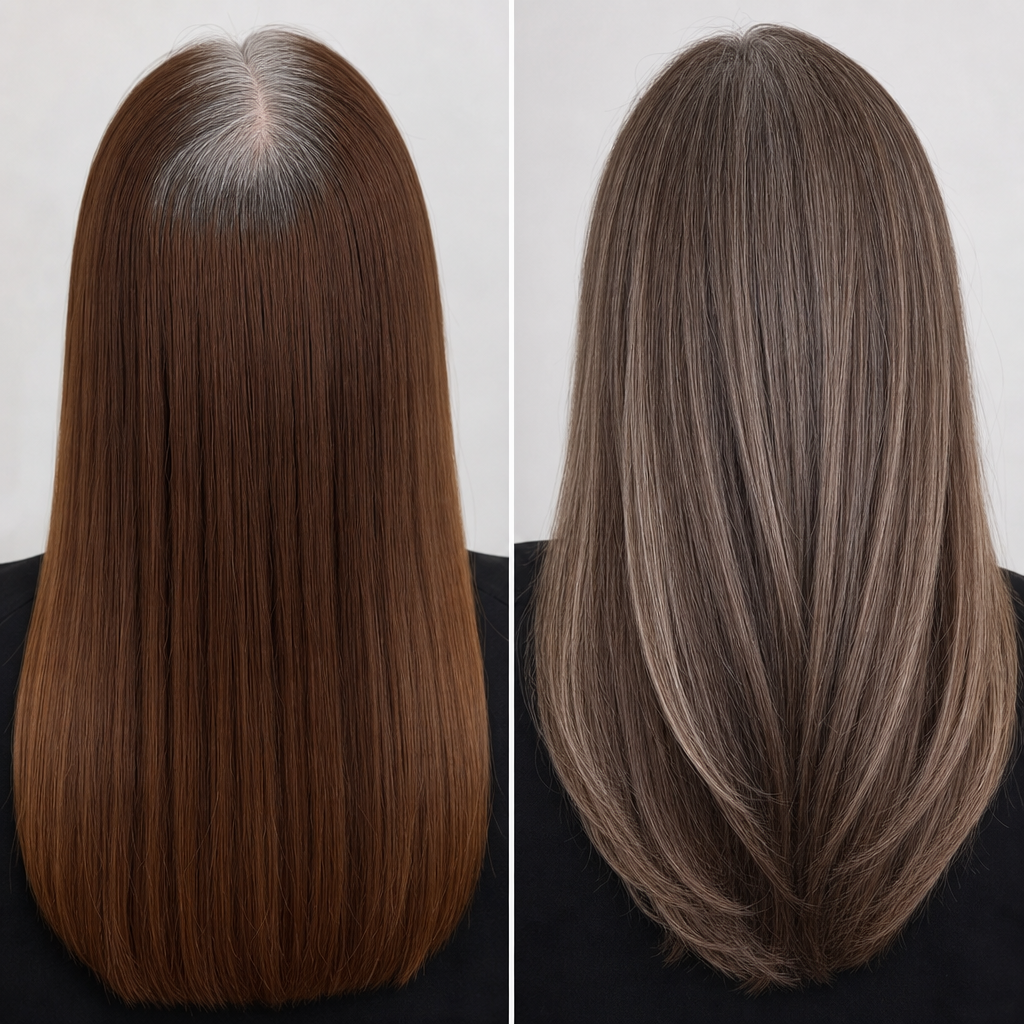
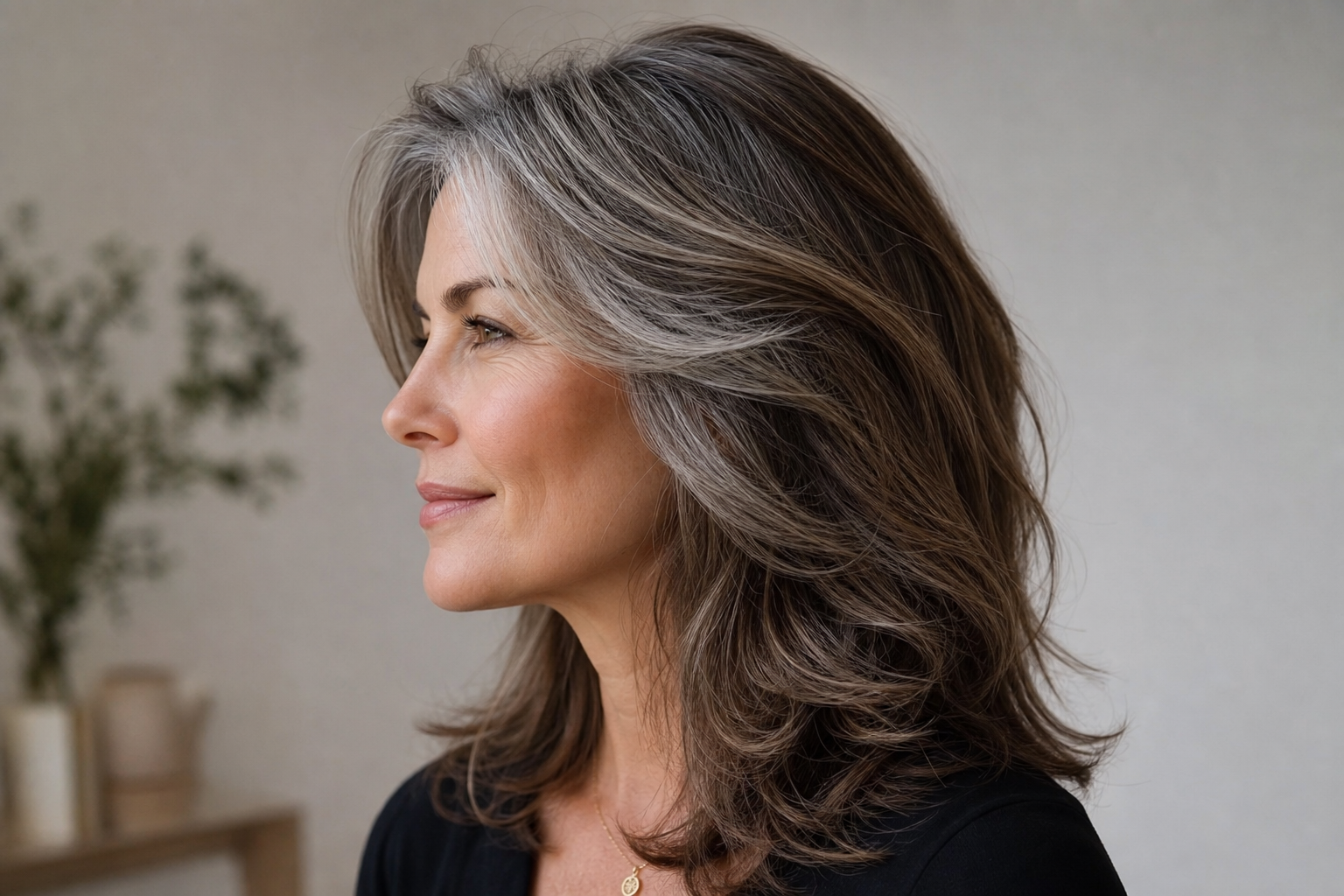
The name of the technique says it all. The English term blending means merging, and that's exactly what this is about: the goal isn't 100% coverage, but rather to soften the contrast between the white hair and the rest of your head. The stylist works with shades that are close to your natural color, helping the greys lose their harsh edge. The result doesn't look like a new hair color, but rather like a lighter version of your own color.
Grey blending is particularly suitable when:
- your greys are scattered throughout your head, usually in the tens of percent, not concentrated in a single continuous white streak;
- you are more bothered by the sharp contrast between the greys and the rest of your hair than the greys themselves;
- you don't want to be tied to a salon visit every three to four weeks;
- your natural color still suits you and you don't want to change it to a significantly darker or completely different shade;
- you're considering eventually embracing your greys and are looking for a transitional solution that will gradually lead you there.
Conversely, the higher the proportion of greys you have and the more compact the area they form – typically a continuous streak around the face or in the front of the head – the more challenging it is to blend without compromise. The boundaries of the method deserve their own attention, and we will address them further in the text.
Why is this approach gaining popularity? There are two reasons, both practical. The first is time: growing hair doesn't create a sharp line that needs immediate attention, so you can go significantly longer between salon visits. The second is a shift in the perception of greys – many people today don't see silver hair as a flaw that needs to be hidden but as a part of their look that can be embraced. Grey blending sits right between these two poles and doesn't force you to choose immediately between full coverage and full acceptance.
If you recognized yourself in this description, you have the answer to the first question: this article is talking about your situation. In the following sections, we'll explore how grey blending differs from full dyeing, how such a transformation takes place, and what you can do at home to maintain the results.
Grey Blending vs. Full Coverage: What's the Difference?
The difference between the two techniques doesn't start with the shade of the color, but with the request you bring to the salon. Full coverage of grey hair is a request for a uniform result: the stylist works with the entire length and regrowth, aiming for hair that appears monochromatic with no visible greys. Grey blending, on the other hand, anticipates that some greys will remain in the hairstyle. The color is used to soften the contrast between white and pigmented hair—not to eliminate it.
You can mainly tell the difference in the result by how the hair looks in daylight. Full coverage provides a continuous color surface where individual strands do not differ from each other. Grey blending uses shades that are close to each other, so the greys appear as lighter highlights in the overall color distribution. Both approaches start from the same initial state—they just handle it in opposite ways.
The most noticeable difference appears after a few weeks when the hair grows out. With full coverage, a distinct line forms at the roots because the new length is a different color than the rest of the hair. This boundary can only be addressed by further coloring of the roots, which is why salon visits follow a fairly strict schedule. With grey blending, no sharp boundary forms: the grown-out greys blend into the lighter strands already present in the hairstyle, so the transition isn't noticeable even after a longer period.
This also has a practical impact on planning. Full coverage usually requires a regular and shorter interval between visits because the regrowth becomes visible quite soon. With grey blending, the interval is more flexible, and you often schedule your appointment based on how the hair actually looks, not according to the calendar. The specific interval varies depending on growth speed, the proportion of greys, and the chosen shade, so there is no universal number.
In summary, the two techniques differ in five key points:
- Color Work Objective – full coverage aims for a uniform shade along the entire length, while grey blending softens contrast and creates a gentle transition.
- Visibility of Greys – full coverage hides them, grey blending consciously leaves them as part of the color distribution.
- Regrowth Appearance – distinct line at the roots versus a gradual transition without a sharp boundary.
- Salon Rhythm – regular and shorter intervals versus more flexible scheduling based on hair condition.
- Length Work – repeated application of color along the entire length versus working only on selected strands.
Home maintenance also differs, although in both cases it involves colored hair. Full coverage emphasizes maintaining the uniform shade as long as possible without fading, focusing on care for colored hair. With grey blending, it's more about the tone purity in the lighter strands, as they are most sensitive to unwanted hues. The complexity doesn't differ in the number of steps, but in what the care focuses on.
It's also worth mentioning that there isn't an impermeable boundary between the two techniques. Stylists commonly combine them—for example, by treating the front sections around the face with full coverage and leaving the rest of the head highlighted. The decision doesn't have to be permanent and can be adjusted as the proportion of greys changes over time.
Neither technique is inherently better or worse. They are two different solutions to the same starting point, and the choice between them is mainly about what result you want to see in the mirror and how much time and salon visits you're willing to invest. If you prefer the certainty of a uniform shade, full coverage makes sense. If you're more drawn to a gradual transition and a more relaxed schedule, it's worth discussing grey blending.
How Grey Blending Works: Techniques, Shades, and Maintenance
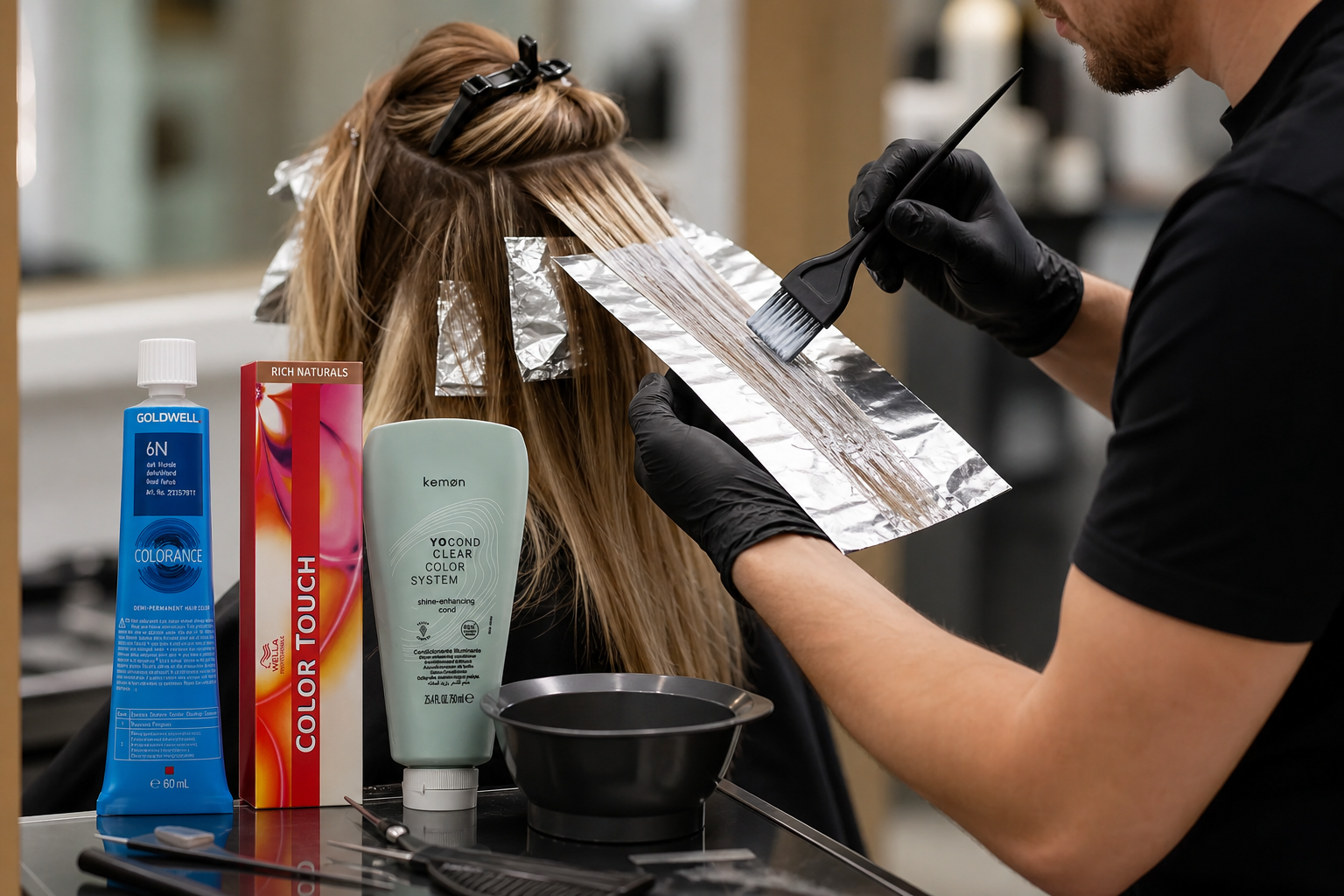
Grey blending starts with a consultation, not a mixing bowl. The hairdresser first examines how much grey you have, how it's distributed across your head, and its texture. Grey hair tends to be coarser and absorbs pigment differently than surrounding hair, which is why softer techniques are used. From the consultation, a plan is developed to work primarily with lighter strands, darker ones, or a combination of both. The goal is not to hide the greys but to blend them into the surrounding color, creating a natural highlight effect.
In practice, several techniques are usually combined to complement each other:
- Subtle Highlights – very fine lightened strands break up the uniformity of grey. The finer the strand and the closer its shade to your natural color, the softer the transition.
- Darker Strands – add depth and contrast to the hair. Without them, the result can be flat, especially as more greys appear at the top of the head.
- Toning with Demi-Permanent Color without Ammonia – unifies the tone throughout the length and adds a warmer or cooler tint to the greys. This type of color doesn't lighten but deposits pigment on the hair's surface, gradually washing out.
- Gloss Treatment – evens out differences in porosity between grey and pigmented hair. This makes the greys less "shiny" and the hair as a whole appear more uniform.
The shade for grey blending is intentionally chosen close to your natural color, usually within about two tones up or down. The greater the difference between your hair color and the color applied to the greys, the sharper the line will be as the hair grows – losing the main advantage of the method. For the same reason, more than one shade is used, typically two to three. Hair never has one color all over; naturally, lighter and darker strands alternate, and grey blending mimics this irregularity. The undertone also plays a role: cool ash tones blend with greys more easily, while warm golden or copper tones on grey hair can appear more pronounced than expected.
How long the result lasts depends mainly on how much of it is toning and how much is highlighting. The toning component usually washes out over several washes, and its fading is gradual – the color fades rather than disappearing suddenly. Lightened strands remain in the hair until you trim them, but as they grow out, they move away from the scalp. This is why grey blending doesn't create a sharp regrowth line like full coloring does: the transition blurs instead of becoming more pronounced. Most people return to the salon every few months rather than weeks, usually to refresh the tone, not to cover regrowth.
To ensure your vision aligns with your hairdresser's, it's worth asking a few specific questions during the consultation:
- What percentage of greys do you expect to soften, and how many will remain visible?
- How many shades will you mix, and how far will they be from my natural color?
- Will there be toning that washes out, or just lightened strands?
- When should I book my next appointment?
- How will the result look when the toning washes out – before the next visit?
The last question is often overlooked in consultations, yet it reveals the most. Grey blending doesn't have a fixed result but evolves over time – and satisfaction depends on whether you like its later, more highlighted phase. By having the hairdresser describe how the color looks after one month and three months, you'll leave with realistic expectations.


Method Limitations: When Grey Blending Isn't Enough
Grey blending has a clearly defined scope. It works as long as the colorist has something to interlace – as long as there is enough natural pigment alongside the greys to create a deliberate play of shades. Once this balance shifts or the hair stops accepting color willingly, the result diverges from expectations. We'll describe situations where the method encounters challenges, so you come to the salon with a realistic idea.
High Proportion of Greys: Lacking Material for Interlacing
The method relies on the contrast between grey and pigmented hair. Colorists estimate the proportion of greys before mixing the color; temples and hairlines around the face typically grey earlier than the crown. As long as greys are in the minority, highlighted strands absorb them, and the eye perceives them as lighter accents. But when greys become the predominant part of the hair, there's nothing left to interlace: light strands blend into a single plane, and the promised brightening effect is lost.
Dark Hair: Too Big a Leap
With dark brown and black hair, the difference between the base and the grey is the greatest, so even subtle interlacing can appear more pronounced than expected. The transition can be managed, but it requires more patience: fewer strands, softer application at the roots, and gentle toning to reduce the contrast to an acceptable level. If you wish for a change in shade without altering the overall impression, a dark base might lead you back to full coverage. Conversely, the lighter and warmer your base, the better the greys blend into the whole.
Resistant Greys with a Glassy Surface
Some greys have a smooth, tightly closed cuticle, which hairdressers call glassy. Such hair accepts color more slowly and unevenly, so after a few washes, it may return to its original light appearance sooner than surrounding strands. The hairdresser responds with pre-treatment, longer exposure, or choosing a covering shade – yet the result remains less predictable than with hair that readily takes color. If you remember color fading noticeably quickly from your temples, tell the colorist right from the start.
Men's Version: Gradual Darkening
For men, the issue is usually not addressed as highlights but as slight darkening. The goal is often to appear a shade or two darker, not perfectly uniform color – hence, toning shampoos and gradual effect products are often used to soften greys over several washes. However, with a short haircut, regrowth happens quickly, and the boundary is visible sooner than with long hair. Beards also grey differently, have a coarser texture, and accept color differently, so matching both to one shade may not succeed on the first try. Products specifically designed for beards should be used, not hair dye.
When It Makes Sense to Change Strategy
The decision isn't irreversible and doesn't have to be made immediately. You can orient yourself by several signals:
- Greys make up the majority of the hair, and interlacing no longer creates visible contrast – full coverage will provide a more balanced result.
- You desire a uniform color without visible strand structure, perhaps due to a professional environment or personal taste.
- The interval between salon visits is shortening due to rapid regrowth, making maintenance tiresome.
- If, on the other hand, regrowth doesn't bother you and you see greys as part of your look, it's entirely legitimate to leave them be and focus only on care, shine, and toning yellow tones.
Grey blending isn't a long-term commitment. It's a way to give yourself time – and if it stops working for you, the transition to full coverage or a return to natural color remains open.
Home Care to Prolong Your Transition
Grey blending doesn't end when you leave the salon. It's your home routine that determines whether your highlighted strands maintain their clean tone for several weeks or shift to a yellowish hue within a month. The good news is you don't need ten bottles – just four essential roles that divide the work: gentle cleansing, cool pigment, toning refresh, and nourishment.
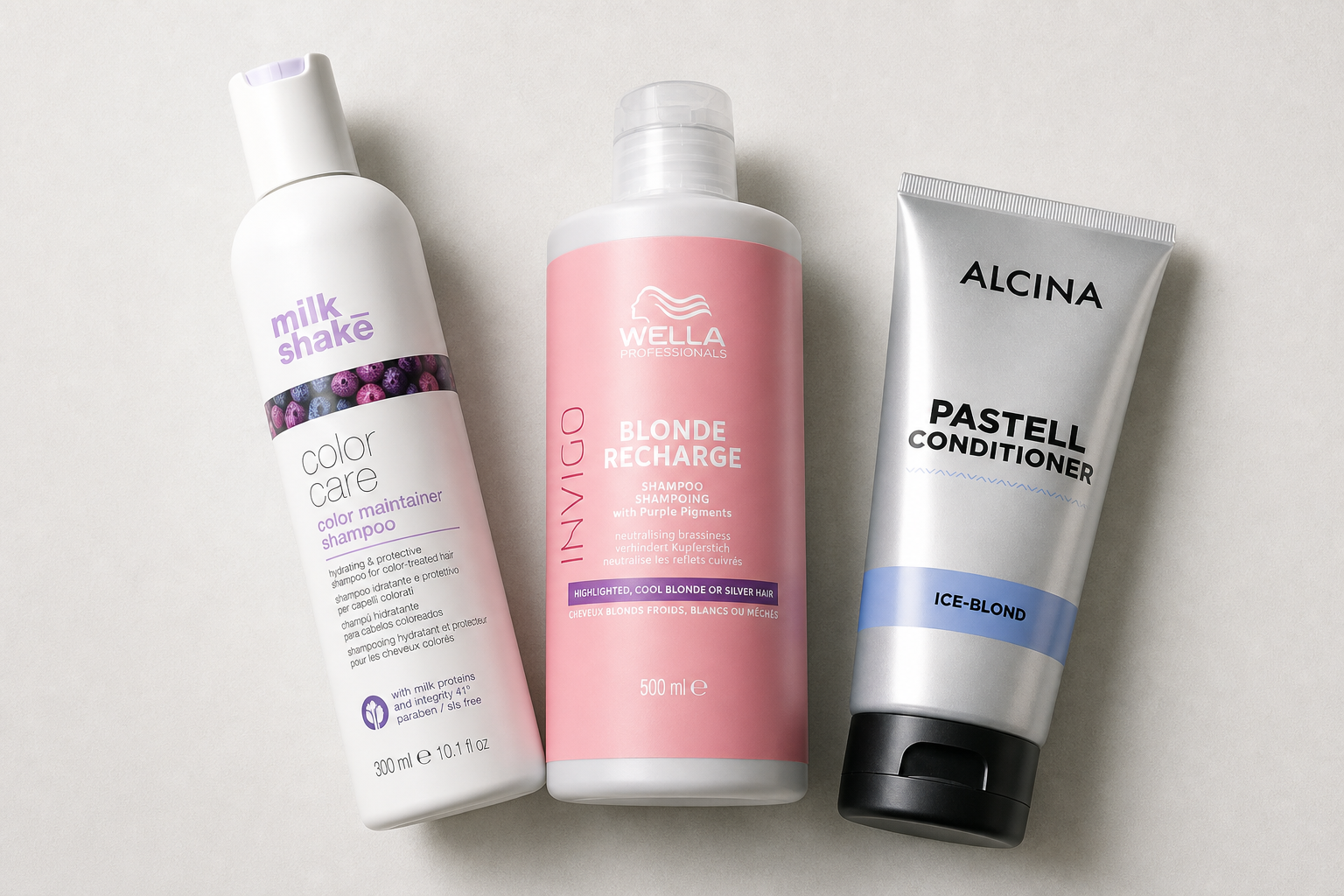
Shampoo for Colored Hair is the first and least noticeable step. Highlighted and toned sections have a more open hair cuticle, so the pigment fades faster than in uncolored lengths. Shampoos for colored hair use a gentler cleansing system and are designed to prevent unnecessary color washout. In our hair care range, this includes Milk_Shake Color Care Color Maintainer Shampoo or the L'Oréal Professionnel Série Expert Vitamino Color line. A small habit change can also help: wash with lukewarm, not hot, water.
Cool Pigment addresses the most common complaint with grey hair – a warm, yellowish tint. Grey hair lacks its own pigment, so external influences show more visibly. Purple and silver shampoos deposit a small amount of cool pigment into the hair, which visually balances the warm tone. From our selection, consider Kemon Actyva Colore Brillante Anti-Yellow Shampoo or products from the Fanola No Yellow line. With cool pigments, less is often more:
- Use them every second or third wash, otherwise continue with a regular shampoo for colored hair.
- Stick to the application time on the package – leaving it on longer can result in a grey-blue tint on porous areas.
- Apply to damp, not wet hair, to prevent diluting the pigment.
- If only certain sections are highlighted, give them more attention than the rest of your head.
Toning Masks are a way to refresh your transition between salon visits without resorting to dye. Apply them to washed hair, leave on briefly, and the shade is refreshed; the pigment gradually washes out, so the result doesn't create a regrowth line. A well-known option is the Wella Professionals Color Fresh Mask, where pearly and cool shades suit grey hair, or the Lakmé Teknia Color Refresh line if you want to enhance a warmer undertone. Before first use, test the mask on a hidden strand – porous hair absorbs pigment differently than healthy lengths.
Hydration and Shine are a chapter of their own for grey hair. Grey hair tends to be coarser, less manageable, and reflects light poorly, so even well-done grey blending can look dull if you don't support the structure. Plan for an extra mask – typically once a week – and an oil or leave-in treatment for the ends. Proven choices from our range include Wella Professionals SP Luxe Oil Keratin Restore Mask, L'Oréal Professionnel Série Expert Absolut Repair Mask, or the lighter Moroccanoil Treatment Light.
The rest are small details that determine how long your stylist's work lasts. Use heat protection before straightening or curling – highlighted strands dry out faster than the rest of the hair. Detangle wet hair with a wet brush, such as those from the Tangle Teezer range, to avoid unnecessarily disrupting the open cuticle. And in the sun, a hat or scarf helps: ultraviolet radiation shifts the tone to warmth as reliably as harsh washing.
With this routine, you can usually extend the interval between salon visits by several weeks – and that's exactly what grey blending is all about.

Category
Recommended articles

"Give a girl the right shoes and she can conquer the world!" Marilyn Monroe