
What Are Fragrance Mists
Whether you're new to the world of perfumes or have a shelf full of your favorite bottles at home, you've likely encountered two terms: Eau de Toilette and Eau de Parfum. These are a good starting point when explaining what fragrance mists are. Imagine a scent composition you know from a classic perfume, but in a much lighter, airier form that is applied in a gentle cloud and blends with you almost imperceptibly.
A fragrance mist (often also referred to as "body mist" or "hair mist" in English) is a distinct format of scented cosmetics. It tends to be more watery and lighter than perfume, usually coming in a larger bottle with a spray that releases a fine mist rather than a targeted splash. It's not just a diluted version of Eau de Parfum that someone watered down in the bathroom. It's a separately developed product with its own formula, its own logic of use, and its own reason for existing.
The simplified comparison "a mist is just a weaker perfume" misses the mark a bit. While it follows the same olfactory alphabet, meaning the composition of top, middle, and base notes, manufacturers design it as an easy-going addition to the daily routine, not as a festive fragrance for special occasions. The composition is therefore usually simpler and more straightforward, and the formulation is designed so that you can reapply the mist several times a day without feeling "over-perfumed".
You will find fragrance mists in roughly two forms: hair mists, which ensure your hair carries the scent, and body mists intended for the skin. Both have their own application rules and situations where they are most suitable, which we will discuss in more detail in the article. For now, it's enough to know that these are two related paths to one goal, which is to envelop yourself in a scent gently and without much thought.
And why should you know about mists when your favorite perfume serves you reliably? Because they open up opportunities for moments where a classic Eau de Parfum would be unnecessarily intense or impractical. A subtle scent trail for the office, a refresh after morning exercise, a fragrance woven directly into your hair, or the ability to layer several scents over each other. These are all situations where a mist offers something that a perfume alone cannot achieve. So whether you're looking for your first scented product or just want to expand your fragrance repertoire, it's worth discovering what this lighter sibling of perfumes can do.
Concentration and Longevity: How Mists Differ from Perfumes
The main difference between a fragrance mist and a classic perfume lies in a single number — the percentage of fragrance oils dissolved in the base. This concentration determines how strong the scent is, how long it lasts, and how noticeable its trail is. Once you understand where mist falls on this scale, you'll know exactly what to expect and won't be disappointed if it doesn't behave like a bottle of Eau de Parfum.
Intensity Ranking from Strongest to Lightest
Perfumery traditionally works with several concentrations, differing in the amount of fragrance essence. For orientation, you can rank them from the most intense to the most delicate:
- Perfume — the highest concentration of fragrance oils, the most pronounced and long-lasting effect. A small amount is enough, and the scent accompanies you for hours.
- Eau de Parfum — slightly lower essence content, yet rich and noticeable. It is one of the most popular formats because it combines longevity with a pleasant intensity.
- Eau de Toilette — lighter concentration, fresher and airier impression. Suitable for daytime and work, where a stronger perfume might be too much.
- Eau de Cologne — even lower oil content, very fresh and short-lived burst, often applied more generously and even repeatedly throughout the day.
- Fragrance Mist — the lightest of the family. The proportion of fragrance oils is significantly lower than in Eau de Toilette, so it smells gently, subtly, and unobtrusively.
Fragrance mist thus sits at the very bottom of this ranking. This is not a shortcoming — it's intentional. Mist is not meant to fill a room or last from morning till night; it is meant to envelop you in a light, barely noticeable aura.
Why Mists Have Lower Longevity and Sillage
Longevity describes how far from you the scent can be detected, and sillage (often referred to as "trail") is what you leave behind when you walk by. In fragrance mist, both of these features are deliberately subdued. The lower concentration of fragrance oils means that the scent molecules are released into the surroundings less abundantly, so the resulting impression stays close to the skin. While Eau de Parfum can fill your immediate surroundings, mist creates a more intimate scent aura that is mainly perceived by you and those in close proximity.
This subtlety has its advantages. You can apply mist more freely without risking it being overpowering — for example, in an open office, at the gym, or anywhere a strong perfume trail might be disruptive. It also means that layering the fragrance essence occurs more smoothly: the mist spreads into a wider cloud and settles evenly, rather than creating a single strong focal point.
How Long Does Mist Last
Due to its lower concentration, fragrance mist usually lasts a shorter time on the skin than Eau de Parfum or Eau de Toilette. Generally, expect a few hours before the scent gradually fades. The exact longevity depends on various factors — your skin type, whether it's hydrated, the ambient temperature, and the specific composition, as fresh citrus notes dissipate faster than warmer base notes with musk or vanilla.
In hair, however, the scent often lasts noticeably longer. Hair captures fragrance molecules well and releases them gradually with every movement, so a gentle hint of mist can accompany you even when it's long gone from your skin. Don't see the short duration on the body as a weakness, but as a characteristic of the format — mist is designed to be refreshed at any time throughout the day as you wish.
Hair Mist vs. Body Mist: Where and How to Apply Them
While both fall under the same category of light fragrant products, hair mist and body mist differ in terms of where they are applied and how they are used. It's not just a cosmetic detail. Hair and skin react differently to fragrance, so the application technique varies slightly for each. Understanding where each mist belongs will allow you to get much more out of it than just a random spritz in the air.
Hair Mist: A Fragrance That Moves with You
Hair strands have a porous surface that captures fragrance and gradually releases it every time you move your hair. That's why hair mist smells so natural and effortless. The scent wafts whenever you turn your head or the wind brushes through your hair. It is applied to the lengths and ends, not the roots. Hold the spray about twenty centimeters away from your hair and press once or twice briefly, ideally over brushed hair, to ensure the fragrance spreads evenly.
Most hair mists are formulated more gently than traditional perfumes because direct contact with a high alcohol content could dry out the hair strands. However, a simple rule applies: apply to dry or slightly damp hair and avoid the scalp. If you also use styling products, apply the mist as the final step so the fragrance remains on the surface and doesn't mix with other textures.
Body Mist: A Gentle Veil Over the Skin
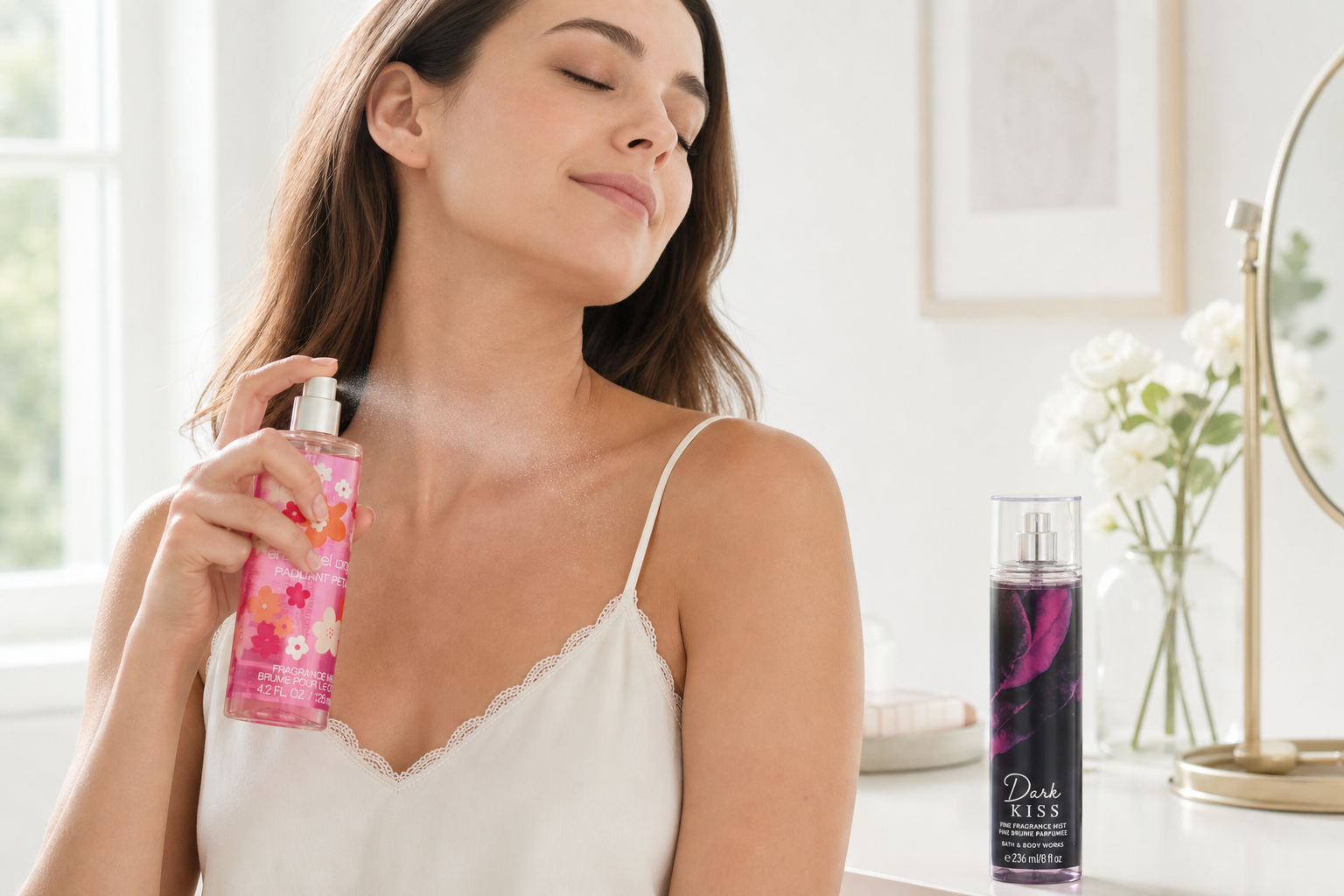
Body mist works on a different principle. Instead of concentrating the fragrance in a few spots, it spreads it in a gentle veil over a larger area of the skin. Typically, you apply it to the chest, shoulders, inner arms, or décolletage. A proven method is to spray the mist into the air in front of you and walk through the resulting cloud, allowing the droplets to settle evenly without creating any saturated spots.
This is the main difference compared to traditional perfume or eau de toilette. Concentrated perfume is applied directly to pulse points, such as the wrists, behind the ears, or behind the knees, where body heat gradually warms and intensifies the fragrance. Mist, on the other hand, deliberately disperses and softens the scent, resulting in a more airy and subtle effect. If you're used to rubbing your wrists together, there's no need to do so with body mist. Just let it dry.
Layering and Reapplying Throughout the Day
Both mists can be well combined. You can apply body mist to the skin and gently add the same or a related fragrance to your hair, creating a more cohesive and fuller impression. This layering works best when the scents complement each other, ideally from the same product line.
Since mists are lighter, it's perfectly fine to reach for them again during the day. A quick refresh after lunch or before an afternoon meeting revives the scent without being overpowering. We recommend keeping a smaller bottle handy in your bag. A few seconds are enough to feel fresh, as if you've just spruced up. Try for yourself what frequency suits you, as your perception of your own scent dulls throughout the day, and it's easy to apply more than necessary.
When to Choose a Mist Over a Regular Perfume
A fragrance mist is not just a diluted version of a perfume, but a standalone tool in your beauty arsenal. Its lightness and subtle trail make it ideal for moments when a stronger perfume might feel too intense or simply unnecessary. Let's explore specific situations where a mist serves you better than the classic bottle on your vanity.
Hot Summer Days and High Temperatures
A mist is perfect when the mercury is rising. In the heat, scents develop faster and more intensely, so even a regular dose of perfume can feel heavy or overwhelming. A lighter mist concentration is more pleasant under these conditions — it provides a fresh impression without overwhelming you or those around you. Plus, you can refresh it throughout the day, which is a big advantage in summer when you sweat and shower more often.
Sports and Physical Activities
Fragrance mists are also suitable after light exercise or a walk, when you want to quickly refresh. A strong perfume isn't suitable for the gym or yoga — respect for other exercisers and the trainer dictates choosing something subtle. A gentle mist over your body or clothes will delicately scent you without filling the locker room with a heavy cloud of fragrance. Think of it as a fresh finishing touch, not a bold olfactory statement.
Office and Shared Spaces
An open office space is a classic example where less is more. If you're sitting close to colleagues all day, some of whom may be sensitive or even allergic to strong scents, a considerate choice of mist is the right way to go. It creates just a gentle fragrant aura around you that doesn't invade others' space. It's also suitable for other places where you're close to people — public transport, elevators, waiting rooms, or meetings in small conference rooms.
Quick Refresh Anytime During the Day
A mist is your ally for a quick refresh in the middle of a busy day. A few spritzes after lunch, before an afternoon meeting, or on the way from work to an evening event will restore your sense of freshness in seconds. Since it's not a concentrated perfume, you don't have to worry about the resulting scent being overwhelming after reapplication — layering mist is more forgiving and easier to gauge. It's also practical because it absorbs quickly and doesn't leave a greasy feeling.
Refreshing Hair Between Washes
A typical scenario for hair mist is a day when your hair doesn't need washing yet but deserves a fresh scent. Hair readily absorbs odors from its surroundings — kitchens, restaurants, cigarette smoke. A light mist designed specifically for hair will gently refresh and give it a pleasant scent without resorting to another wash, which can weigh down the hair structure. It's a gentle way to bridge the time between washes and feel fresh.
Whether you're dealing with a tropical afternoon, a trip from the gym, consideration in the office, or just the desire to refresh during the day, a fragrance mist offers a solution where a classic perfume would be too strong. It's not about completely replacing your favorite perfume — rather, you gain a lighter option for situations where it fits better.
How to Choose Your First Fragrance Mist
Whether you're drawn to a fresh morning refresh or a gentle veil of scent around your hair, choosing your first fragrance mist is easier than it might seem. It helps to clarify three things in advance: which fragrance family appeals to you, who the mist is intended for, and in what format you want to use it. We'll go through them step by step so you can find exactly what you're looking for in the product descriptions.
Start with the Fragrance Family
The fragrance family is the quickest way to navigate the selection. It describes the composition's character and hints at what impression to expect from the mist:
- Citrus — fresh and sparkling, based on orange, lemon, or bergamot. It feels light and clean, suitable for warm days and work.
- Floral — gentle and romantic, featuring rose, jasmine, or peony. It's a grateful choice if you want to maintain a subtle, friendly trail.
- Woody — warmer and earthier, with sandalwood, cedar, or patchouli at the base. It adds depth to the scent and is suitable for cooler evenings.
Besides these three, you'll also encounter oriental, gourmand, or aromatic families in perfumery. If you're just starting, go for what feels naturally pleasant to you — mist is ideal for first experiments due to its lightness, as it can be easily refreshed throughout the day.
Intended Use: for Women, Men, or Unisex
Like perfumes, fragrance mists are categorized by intended use into variants for women, men, and unisex. It's not a strict rule, more of a guideline indicating which tone composition the mist leans towards. Unisex mists often feature citrus, tea, or woody notes and are a good choice if you want a scent for a couple or simply don't want to bother with labels. Feel free to trust your own nose — what matters is how the scent suits you.
Understanding Fragrance Description: Top, Heart, and Base Notes
To make sense of product descriptions, it's worth knowing the three layers perfumers use to compose a scent. These layers help you understand how the fragrance will develop on your hair or skin:
- Top Notes are what you smell immediately after application. They are usually fresh and light, like citrus or green notes, and fade quickly.
- Heart Notes form the core of the fragrance and emerge as the top notes dissipate. They often include flowers and spices.
- Base Notes last the longest and give the fragrance its character — typically musk, vanilla, or woods.
In fragrance mists, this development is gentler and shorter due to the lower concentration, but knowing the structure helps you gauge whether the description matches what you expect from the scent.
Format Based on Where You Want the Scent
The final question is whether you'll choose a mist for hair, body, or both. Decide based on where you most often need the scent and what composition you seek for that use — hair variants are usually gentler on lengths, while body mists target the skin. Nothing stops you from having both formats at home and alternating them according to mood and occasion.
Where to Look Next
Once you're clear on the fragrance family, intended use, and format, all that's left is to choose a specific piece. In Brasty's range of perfumes, you'll find fragrance mists alongside classic perfume and eau de toilette, allowing you to compare at your leisure — and possibly complement a favorite perfume you already wear with a light mist. We believe that with these guidelines, you'll confidently choose your first fragrance mist.
Category
Recommended articles
"Give a girl the right shoes and she can conquer the world!" Marilyn Monroe