
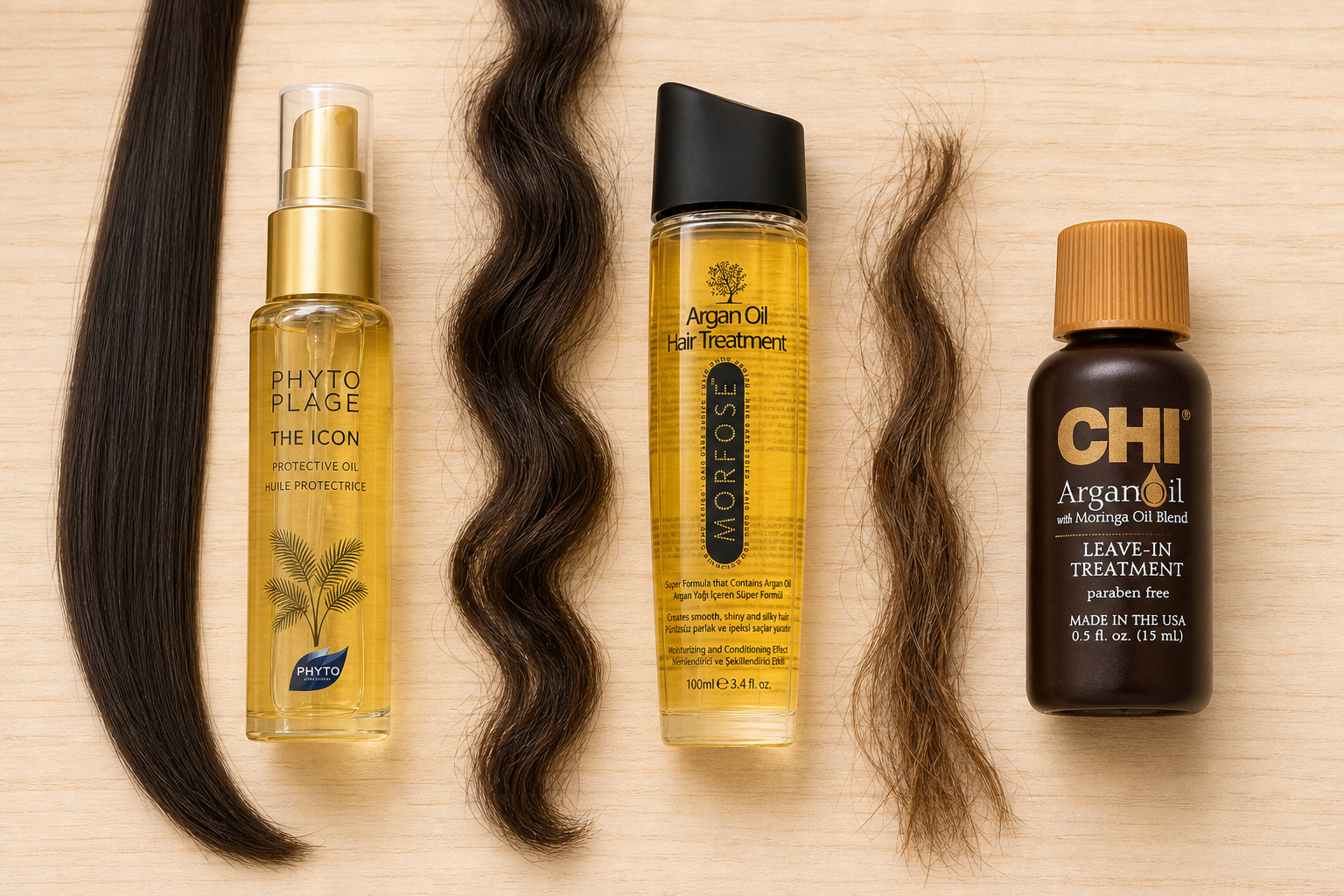

Feeling lost when choosing a hair oil? We'll guide you on how to select the right texture and composition based on your hair type, and how to dose and apply it correctly so it doesn't weigh down your lengths.
Why You Should Consider Hair Oil and What to Expect
Whether your hair gets frizzy after every wash or you just want it to look fresh even on the third day, hair oil is often one of the first products recommended. However, it's also a category surrounded by misunderstandings: some expect oil to "repair" damaged hair, while others fear it due to memories of a greasy film from a failed attempt. The truth lies somewhere in between and starts with understanding what hair oil actually does.
The surface of each hair is made up of the cuticle—a layer of tiny scales that lie flat and reflect light when the hair is healthy. Washing, blow-drying, straightening, coloring, and even regular friction from clothing can lift these scales, making the surface less smooth. The hair then shines less, is harder to comb, and tangles more easily. Oil creates a thin film on this structure, which optically and mechanically smooths out the irregularities. This is where all its main benefits stem from:
- Shine and Smoother Appearance — A unified surface reflects light better, making hair look healthier without changing its actual condition.
- Less Frizz — The film on the surface slows down how quickly hair reacts to humidity, which is the main trigger for unruly strands around the face.
- Easier Combing — Oil adds slip to the lengths, reducing resistance from a comb or brush, so you don't have to tug at tangled ends.
- Protection Against Mechanical Damage — Less friction during combing, drying, and sleeping means fewer broken hairs over time.
- Calming Static Electricity — This is often the most noticeable difference during the heating season or under a hat.
Oil, Serum, or Leave-In Treatment?
These three categories share the same spot on the bathroom shelf, and their boundaries often overlap in practice, as manufacturers choose names based on marketing. However, they can be distinguished by what they predominantly contain and what to expect from them:
- Oil is the most concentrated of the three. It primarily consists of oil-based ingredients, contains minimal water, and works mainly on the hair's surface. It's applied in small amounts, mostly to the lengths and ends.
- Serum tends to be lighter and more targeted. It often addresses a specific need—smoothing, color protection, volume at the roots, or scalp care—and may not have an oil base.
- Leave-In Treatment is closest to a conditioner. It contains a water phase, moisturizing and nourishing ingredients, and serves as the basic everyday layer, with oil possibly being the final step.
These three products don't compete with each other; they complement each other. If you're unsure where to start, leave-in treatment addresses manageability and hydration, while oil fine-tunes appearance and protects the lengths.
What You Can't Expect from Oil
To avoid disappointment, it's good to know the limits. Oil doesn't replace a hair mask or intensive treatment: these work with moisturizing and protein components and have a different role than the surface layer created by oil. Split ends can be temporarily unified and masked by oil, but not mended—the only real solution is trimming. Similarly, it won't solve scalp issues, whether it's oiliness at the roots or itching and dandruff; hair care has separate categories for that. And unless the product specifically states it offers heat protection, don't rely on it before using a straightener or curling iron.
When you approach oil with realistic expectations—as a final layer that improves appearance, manageability, and resilience of the lengths—it rarely disappoints. All that's left is to choose the type that suits your hair and use it in a way that doesn't unnecessarily weigh it down.
Oil Compositions: Plant-Based, Silicone, and Combined Formulas
Hair oil bottles may look similar on the shelf, but the important details are hidden on the back label. Ingredients are listed in descending order by quantity, so the first five to seven items will tell you more about the product than the front label description. Whether you're looking for a light daily treatment or a more nourishing oil for stressed ends, understanding the ingredients will save you from disappointment.
Oils Predominantly Made of Plant Ingredients
Plant oils are listed under their Latin names — argan as Argania Spinosa Kernel Oil, jojoba as Simmondsia Chinensis Seed Oil, coconut as Cocos Nucifera Oil, marula as Sclerocarya Birrea Seed Oil. These are true oils from seeds, fruits, or nuts, rich in fatty acids and vitamin E.
Their effect on hair is more gradual. You won't get an instant glossy shine, but with regular use, hair appears more manageable and less split at the ends. Jojoba oil is similar in composition to skin sebum, making it one of the lighter oils, while coconut oil is among the richer ones. Generally, the higher a plant oil is in the ingredients list, the thicker the product — and the more cautiously it should be applied.
Silicone-Based Formulas
You can recognize silicones by the endings -cone, -conol, or -siloxane — typically dimethicone, dimethiconol, amodimethicone, or cyclopentasiloxane. They are not oils in the botanical sense but synthetic substances that coat the hair with a thin film.
They work primarily on the surface and their effect is immediate: hair becomes easier to comb, reflects light, and frizzes less. This is a practical feature, not a flaw — for coarse or frequently blow-dried hair, such a film makes sense. It's also good to know what silicone oil can't do: it doesn't nourish the hair from the inside, it just smooths it from the outside. Lighter, volatile silicones evaporate from the hair on their own, while heavier ones can build up with frequent use, in which case a deep-cleansing shampoo can help.
Combined Elixirs
Most oils on the market fall into this category. A plant-based foundation provides the nourishing component, complemented by light silicones that ensure an immediate appearance. You can easily identify them — plant oil is usually at the top of the ingredients list, followed a few lines down by one or two items with a silicone suffix. It's a sensible compromise for those who want to see a difference immediately after application but don't want to give up long-term suppleness.
Keratin and Protein Variants
A separate group consists of oils enriched with hydrolyzed keratin, hydrolyzed wheat or silk proteins, or amino acids. They target hair weakened by coloring, highlighting, or heat styling — where the fiber is damaged and needs filling as well as smoothing. With proteins, more doesn't mean better: with daily use of concentrated protein products, hair can start to feel hard and brittle, so it's advisable to alternate them with regular moisturizing care.
A Practical Guide to Reading Labels
When choosing, check the first items in the ingredients list and match them to one of four options:
- Plant oil right at the beginning — nourishing formula with a more gradual effect, may weigh down fine hair.
- Silicone at the top — quick surface effect, shine, and easy combing without internal nourishment.
- Plant oil at the top, silicones further down — combined elixir, a universal choice.
- Keratin or hydrolyzed protein near the top — reconstructive care for damaged hair, not for everyday routine.
This way, you can easily estimate whether the oil will weigh your hair down or disappear without a trace.
How to Choose Hair Oil Based on Hair Type
Hair oil doesn't work universally. The same bottle that makes coarse hair manageable can weigh down fine hair in half a day, making it look greasy. The key to a good choice is not the price or the volume of the packaging, but the compatibility between the product's texture and what your hair can actually handle.
Before reaching for a specific bottle, try answering three questions:
- How thick is each strand? Fine hair needs a light texture, while coarse hair can handle a richer one.
- How quickly does your scalp get oily? The quicker it does, the more cautiously you should use the amount and apply it further from the roots.
- Have your hair undergone coloring, highlights, or chemical straightening? Then look for formulas focused on restoration and protection.
Fine and Oily Hair
For fine hair, so-called dry oils are suitable — light, quickly absorbable formulas in a spray or a bottle with a pump that don't leave a film on the hair. You can manage with a minimal amount of product, usually one pump spread in your palms and applied exclusively to the ends and the lower third of the lengths. If your scalp gets oily by the next day, avoid the roots completely.
Coarse and Thick Hair
Coarse strands have a stronger cuticle and can handle a richer texture without any issues. It's worth looking for more nourishing elixirs with a higher content of plant oils, which soften the hair, make detangling easier, and tame flyaways. For thick hair, it's also important to distribute the product — apply it strand by strand, not all at once on the whole head, otherwise, it will only reach the top layer and the lower part of the lengths will remain untreated.
Curly and Wavy Hair
Curls and waves naturally have a lower ability to carry oil from the roots to the ends, making them drier and more prone to frizz. Medium to rich textures are suitable, which envelop the curl and keep it together without weighing it down. They work well in combination with leave-in care — in this case, the oil not only nourishes but mainly seals in moisture and defines the shape. If your waves lose elasticity as they dry, try switching to a lighter option; if they remain frizzy and dry, move to a more nourishing one.
Colored Hair
Coloring disrupts the outer layer of the hair, and the pigment gradually escapes. For colored hair, it's sensible to choose oils labeled as care for colored hair, ideally with a UV filter to limit fading due to sun exposure. The texture should be lighter to medium to avoid weighing down hair weakened by the chemical process. For blonde and highlighted lengths, also check if the formula has a distinctly warm tone — some plant oils can visually warm up a cool shade over time.
Damaged and Chemically Treated Hair
Hair that has undergone repeated bleaching, perms, or regular straightening needs more than just surface smoothing. Here, protein and keratin elixirs are appropriate, working to reinforce damaged areas in the strand and restore smoothness and strength to the lengths. It's suitable to alternate protein care with purely hydrating or nourishing treatments, as proteins alone can make hair harder and more brittle over time. If you're unsure about the level of damage, gauge it by how the hair behaves when wet — if it stretches significantly and breaks easily, a reconstructive formula is a better choice than a simple softening oil.
Combination types are quite common and nothing to fear. An oily scalp and simultaneously dry, colored ends are not a contradiction — it just means that when choosing, you should focus on the ends, the part of the hair where you actually apply the oil.
Proper Application: Dosage, Technique, and Timing
Even a well-chosen oil can weigh your hair down if applied incorrectly or if you use more than your hair can handle. The difference between lightly highlighted ends and clumped strands often comes down to just one extra drop. The following guide will help you incorporate your choice into your daily routine.
Dosage Based on Hair Length and Thickness
The amount of oil depends on two things: how long your hair is and how thick it is. As a general guideline, follow these doses:
- Short haircut or bob — usually one drop is enough, and for fine hair, even half a drop will do.
- Shoulder-length hair — one to two drops, depending on how porous it is and how quickly it gets oily.
- Long hair of medium thickness — two to three drops divided into two applications.
- Long and thick hair — three to four drops, and for very voluminous or curly hair, even a bit more.
The simple rule is: better less and add more if needed. You can add a missing drop in seconds, but excess oil can only be removed by washing your hair again. Until you find the right amount for a specific product, expect two to three trial runs — oil consistencies vary, and a light dry oil is dosed differently than a thick elixir.
Application Technique Step by Step
The application itself takes just a few seconds, but the order of steps matters:
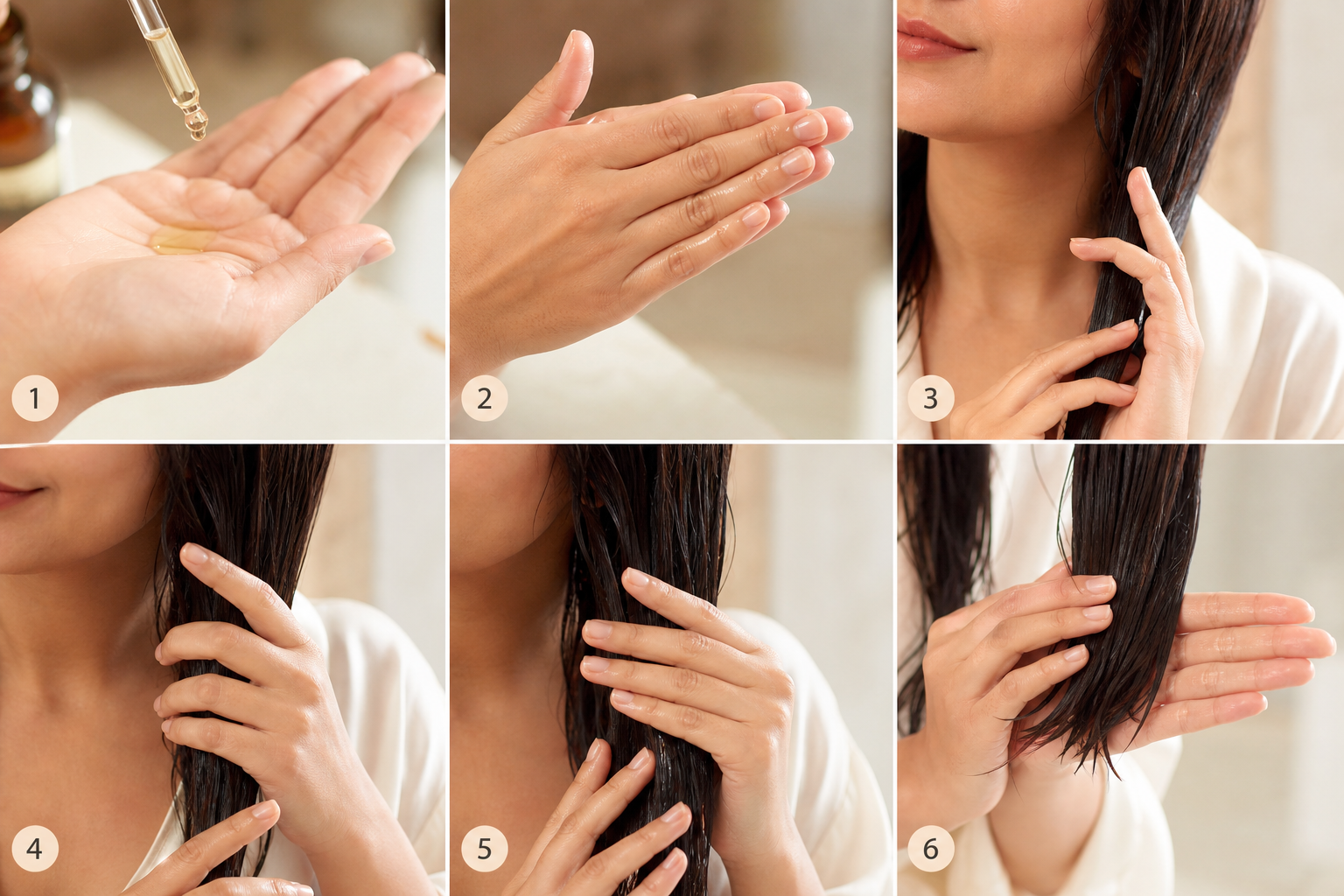
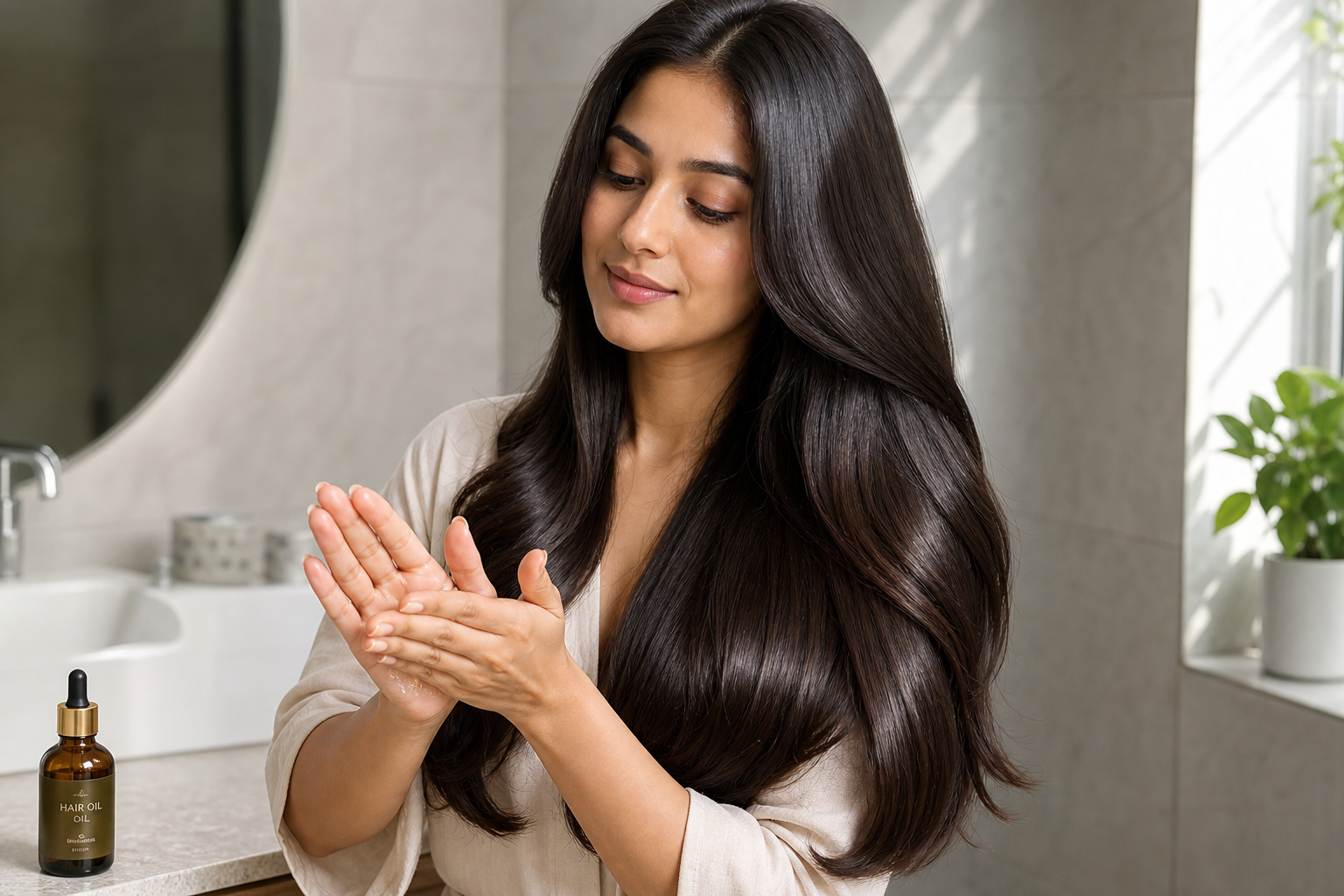
- Drip the oil into your palm and spread it between your palms and fingers. This warms it up and distributes it evenly, preventing concentrated greasy spots.
- Start from the lengths around chin level or lower and work towards the ends. The ends are the oldest and most stressed part of the hair, so the oil will do the most work there.
- Lightly run the remaining oil on your palms over the surface of your hair to smooth down any flyaways.
- Finally, comb through your hair with your fingers or a wide-tooth comb to distribute the oil evenly.
Avoid the roots and scalp during regular styling. Hair near the scalp has natural oils, and additional oil will only weigh it down and shorten the freshness of your style. The exception is oil treatments specifically designed for scalp massage, which are applied before washing and then rinsed out.
Damp Hair Before Blow-Drying
Oil spreads more easily and penetrates more evenly on towel-dried, still damp hair. At this stage, it primarily acts as a treatment to soften the hair, make detangling easier, and reduce breakage during brushing. Many oils also contain ingredients that partially protect the hair from heat during blow-drying — if you regularly use a straightener or curling iron, check this feature on the packaging and supplement the oil with a separate heat protection product if necessary. Oil alone is not a substitute for a specialized product unless the manufacturer explicitly states so.
Dry Hair as a Final Step
Oil is used on dry hair for styling — at the very end, after blow-drying or straightening. Here, it's mainly about appearance: reducing frizz, smoothing the surface, and adding a subtle shine. Reduce the dose slightly, as dry hair does not absorb oil as readily as damp hair, and excess will remain on the surface.
Adjust the timing based on what you expect from the oil. If you primarily want to nourish your hair and make detangling easier, apply it to damp hair. If you're addressing frizz and shine throughout the day, save it for the end. You can combine both, but then split the dose in half to avoid unnecessarily weighing down your hair.
Frequency of Use, Common Mistakes, and How to Choose from the Range
Oil is one of those products that can easily be overused — and at the same time, it's often used too infrequently to make a noticeable difference. Frequency is not just a detail, but a crucial part of the entire care routine. The general rule is: the drier and coarser the hair, the more often it can handle oil, and conversely, the finer the hair, the more carefully you need to time it.
How Often to Use Oil Based on Hair Type
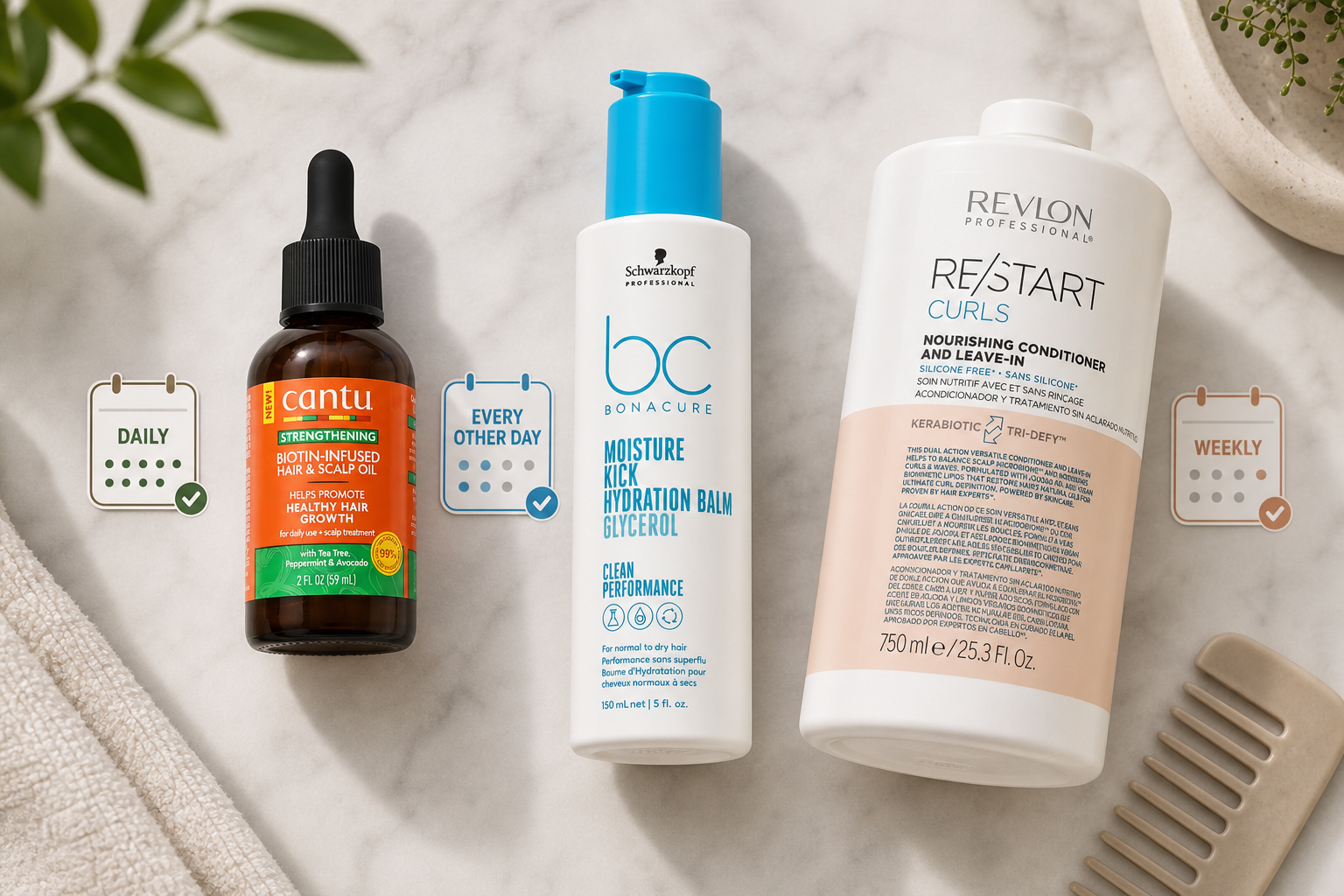
- Dry, coarse, and curly hair — can handle oil daily. For curls, it's often part of the daily routine because the hair struggles to distribute natural oils from roots to ends, causing the tips to dry out the fastest.
- Colored and chemically treated hair — usually every other day or after each wash. Hair after coloring tends to be porous, so it absorbs oil quickly, but it's good to alternate with a lighter leave-in treatment.
- Normal hair — two to three times a week, ideally after washing and before blow-drying.
- Fine hair and oily scalp — about twice a week and only on the ends. Here, it's worth opting for a light elixir and better to use less than more.
Consider these intervals as a starting point, not a prescription. In winter or after a summer by the sea, even fine hair may need oil more frequently.
Common Mistakes to Avoid
Most disappointments with oils don't stem from a poorly chosen product, but from minor usage errors. The most common ones are:
- Using too much. Hair will only absorb as much as it can handle — what it doesn't absorb stays on the surface and looks like a greasy film. It's always easier to add a second dose than to rescue overloaded hair.
- Applying to the roots. The scalp produces its own oils, and additional oil usually doesn't help — on the contrary, it can shorten the freshness of the hairstyle by a day or more. Exceptions are products specifically designed for the scalp.
- Oil on improperly dried hair. On dripping wet hair, it spreads unevenly and some will wash away with the water; on completely dry hair, it's harder to distribute and can easily clump in one spot. The golden middle ground is towel-dried damp hair.
- Layering several heavy products at once. A rich mask, a dense leave-in cream, and a nourishing oil can be too much for one routine. It's better to combine a lighter texture with a richer one, not two rich products side by side.
Oil Treatment Before Washing as an Add-On
Besides leave-in applications, there's another regime — oil treatment before washing. Apply oil to dry hair about half an hour to an hour before showering, let it work, and then wash your hair as usual. It's especially suitable for very dry, damaged, or coarse hair, which would look weighed down if oil were left in permanently.
Include the treatment more like once a week rather than daily. For fine hair, it's often a more pleasant option than daily leave-in application — they get nourishment, but volume remains intact.
How to Navigate the Selection
When choosing, consider three things: the thickness of the consistency, whether it's a plant-based, silicone, or combined formula, and what volume makes sense for your length. Light elixirs in small packaging can last months for shorter hair, while for long, thick hair, a larger package is worthwhile.
In Brasty's hair care range, you'll find oils and leave-in treatments across professional brands known from salons — from Wella Professionals and L’Oréal Professionnel to Schwarzkopf Professional, Milk_Shake, Davines, and Kevin Murphy. There are light elixirs for fine hair and richer formulas for coarse, curly, and chemically treated lengths. If you're unsure where to start, opt for a smaller package of a lighter texture — it will easily show you whether your hair needs more or less.
Category
Recommended articles

"Give a girl the right shoes and she can conquer the world!" Marilyn Monroe