

We'll explain what happens to your hair during blow-drying and straightening, and why thermal protection helps keep it healthy. We offer a comparison of three professional brands – Wella Professionals, Schwarzkopf Professional, and Milk_Shake – based on hair type, product texture, and price.
What Happens to Hair During Blow-Drying and Straightening
Our morning routine is similar for most of us: washed hair, a towel, a hairdryer on full blast because time is short, and finally a straightener or curling iron for a few strands around the face. The whole process takes ten minutes, and the hairstyle lasts until evening. However, this seemingly harmless sequence is one of the most common reasons why hair loses its shine over time, splits at the ends, and struggles to hold its shape. Heat itself isn't the enemy – it's the intensity, frequency, and whether you place something between the hot surface and the hair to diffuse the heat that matters.
The hair fiber has a cuticle on its surface, a layer of flat scales that overlap like roof tiles. As long as the hair is sufficiently hydrated, the scales lie close together: the surface is smooth, evenly reflecting light, which is why hair looks shiny. The cuticle also holds water inside the fiber. When exposed to high temperatures, the water inside turns to steam and escapes faster than it should. The scales lift, the surface becomes rough, and the hair starts to scatter light instead of reflecting it. You know the result: a matte surface, static flyaways, and split ends appearing sooner than expected.
Not every device affects hair the same way. A hairdryer blows warm air over a larger area and works for a shorter time, making it generally gentler on hair – unless you hold it just a few centimeters from your head. Straighteners and curling irons work differently: they transfer heat through direct contact, concentrated in a narrow strip, and also mechanically stretch the hair. That's why regular straightening affects the condition of the lengths sooner than daily blow-drying. The state of the hair before styling also plays a role. Colored, bleached, or naturally porous hair already has a compromised cuticle before you even apply the straightener, and heat penetrates them much faster.
The trickiest part of heat damage is its timing. Hair is not living tissue and cannot repair itself like skin, so minor changes just accumulate. After one straightening session, you might not notice anything, and maybe not even after a week. The fatigue becomes apparent only after several weeks of regular styling, and it does so subtly:
- ends start to split faster than you can trim them,
- hair struggles to hold color, and the shade appears faded,
- lengths tangle, and a comb passes through with resistance,
- morning styling takes longer because the hairstyle just won't hold.
At that point, you're no longer dealing with prevention but with regeneration – and that's always more time-consuming. That's why it's worth incorporating protection before the first signs appear. Heat protection for hair is a separate category on Brasty with 105 products, which in itself indicates that it's not a one-size-fits-all product. You'll find light sprays as well as richer creams and serums, and each format is designed for a different hair type: fine hair will flatten under a heavy cream, while thick and coarse lengths will barely notice a light spray.
That's why it makes sense to choose carefully, not just based on the first product with the word protect on the label. In the next sections of the article, we'll first explain how thermoactive protection actually works on hair, and then we'll compare three professional brands that are among the bestsellers in hair cosmetics on Brasty – Wella Professionals, Schwarzkopf Professional, and Milk_Shake. We'll show how their textures differ, who they suit, and how they compare in terms of price and packaging volume.
How Thermal Protection for Hair Works
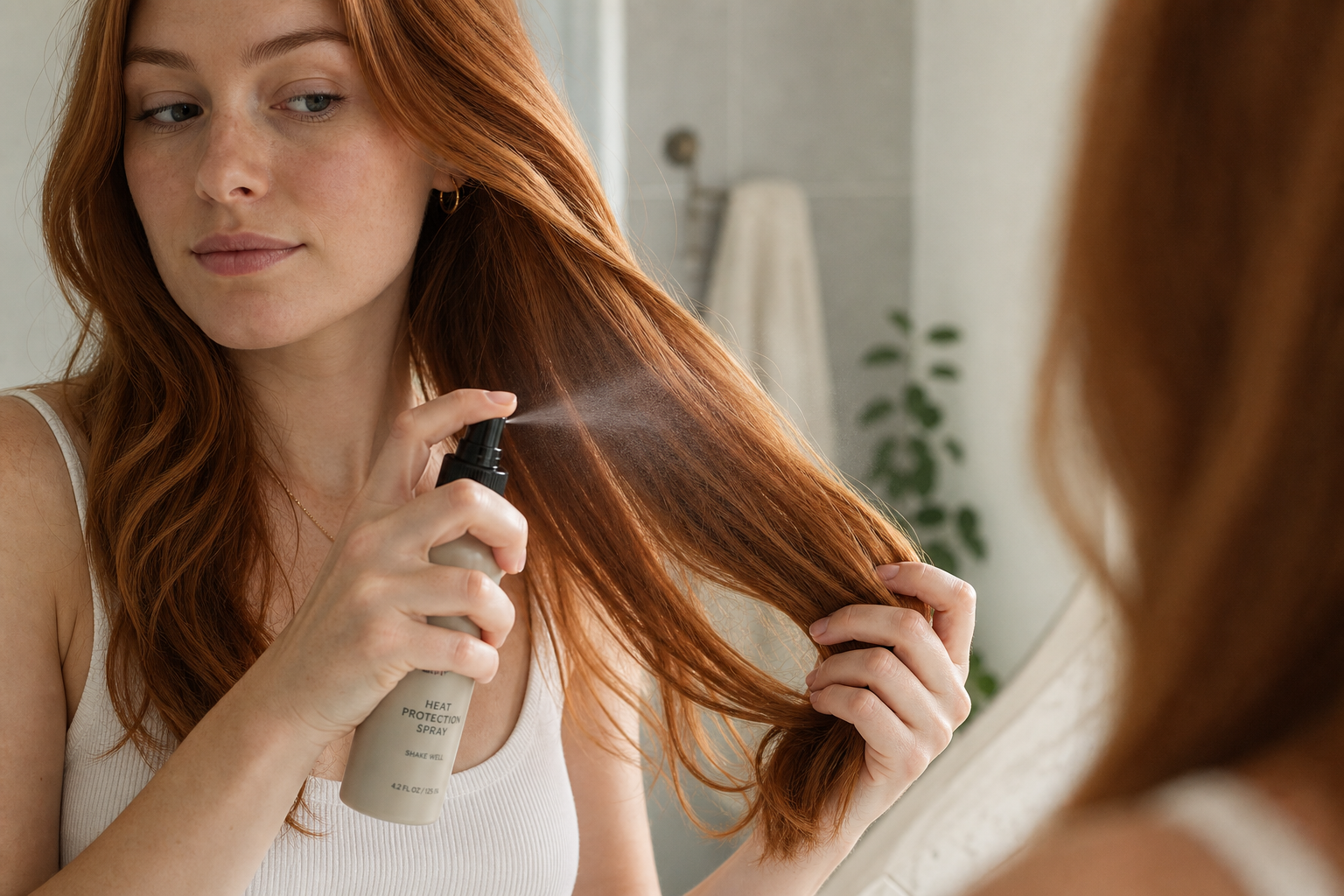
Thermal protection doesn't act as a barrier that completely blocks heat—such a product doesn't exist. It works differently: film-forming ingredients, most often lightweight polymers, silicones, or hydrolyzed proteins, dry on the hair's surface to form a thin, continuous layer. This layer acts as an interface between the hot surface of the straightener and the cuticle. Instead of a concentrated impact on one spot, the heat is distributed more evenly along the length of the strand, reducing the temperature spikes that are most damaging to the cuticle.
The second effect is equally important and often overlooked: the film slows down the evaporation of water from the hair fiber. Hair contains water inside, and when it heats up rapidly, this water turns into steam that needs to escape. That's why hair sometimes sizzles under a straightener. The more gradually the water leaves, the less tension there is inside the fiber. The term "thermoactive" refers to the fact that some ingredients fully activate only under heat—doing their job when a hairdryer or straightener comes into play.
In the catalog, you'll find four textures in which thermal protection is commonly sold. They mainly differ in how much residue they leave on the hair, which determines who they are best suited for.
- Styling Sprays – the lightest option, sprayed onto damp hair before blow-drying. They don't weigh down the roots, making them a common choice for fine hair and styles that quickly lose volume. Suitable for daily blow-drying.
- Leave-in Milks – thicker, creamy texture with a higher proportion of nourishing ingredients. Ideal for thick, long, or porous hair, which absorbs spray without visible effect. Milk also smooths frizz, combining two steps into one.
- Serums – concentrated texture, applied drop by drop mainly to lengths and ends. Perfect for colored and chemically treated hair, where the cuticle is most damaged.
- Oils – the richest format, used sparingly for thermal protection. Suitable for coarse, strong, and dry hair; fine hair quickly becomes weighed down by it.
A practical rule for application is based on texture. Watery sprays and milks should be applied to towel-dried, still damp hair—they spread evenly and dry with the hair during blow-drying. Oil and serum textures, on the other hand, make more sense on dry hair just before using a straightener or curling iron, as they distribute unevenly on a wet surface. If you blow-dry in the morning and use a curling iron in the evening, you can combine both: spray in the morning on damp hair, a drop of serum in the evening just on the lengths.
Where to find these formats on Brasty? The most direct route is the Thermal Hair Protection category, where you'll find products with declared thermoactive functions—currently, there are about a hundred. Milks and light creams with protective effects are also listed under Leave-in Care, concentrates for lengths in the Hair Serums category, and the richest textures in Hair Oils. For a specific product, it's worth checking the description to see what temperature the manufacturer indicates protection for—the range between gentle blow-drying and professional straightening is significant.
Wella Professionals, Schwarzkopf Professional, and Milk_Shake Compared
These three brands form the strongest trio in hair cosmetics on Brasty based on revenue share – Wella Professionals with 13.6%, Schwarzkopf Professional with 7.2%, and Milk_Shake with 6.5%. Each approaches hair preparation before blow-drying and straightening differently: they vary in texture, packaging size, and price range.
Wella Professionals – Oil and Serum Textures
Wella Professionals is our best-selling professional hair brand, relying on the SP Luxe Oil and Fusion lines for styling preparation. Leading the catalog from the former is SP Luxe Oil Reconstructive Elixir 100 ml for 211 Kč – an oil serum for lengths and ends, suitable for coarser, thicker, or colored hair that can handle oil. For those seeking a lighter texture, there's SP Liquid Hair Molecular Hair Refiller 100 ml for 403 Kč, a watery serum without an oily film – ideal for fine hair, where oil quickly becomes a burden. The Fusion line is represented by Intense Repair Mask 500 ml for 516 Kč; it's not a styling product but a treatment meant to complement styling days.
Schwarzkopf Professional – Light Serums and Styling Line
Schwarzkopf Professional is the fastest-growing among the trio year-on-year and has over six hundred products in its catalog. From the BC Bonacure line, the strongest candidate is Sealed Ends+ Clean Performance 100 ml for 198 Kč – a serum specifically targeting the ends, the area most affected by straightening. The texture is lighter than oil elixirs, making it suitable for medium-density hair. The Osis+ styling line addresses the other half of the equation: Osis+ Volume Up 300 ml for 183 Kč is a volumizing product used after protection, not instead of it.
Milk_Shake – One Milk Instead of Three Products
Milk_Shake is the smallest brand in terms of product count but has the fastest growth and a premium price range. Its best-selling product is Incredible Milk 150 ml for 296 Kč, a multi-purpose leave-in milk. It is sprayed onto damp hair before blow-drying, smoothing the hair and making it easier to comb – effectively doing the job that would otherwise require a spray conditioner and a separate serum. If you're not keen on assembling a routine from three bottles, it's a practical solution; however, for very fine hair, be mindful of the dosage.
Texture, Yield, and Price Side by Side
Price comparison looks different depending on whether you look at the price per package or per milliliter. Wella and Schwarzkopf are in the mid-range, Milk_Shake in the premium – but Incredible Milk, thanks to its larger packaging, costs about 1.97 Kč per milliliter, Sealed Ends+ at 1.98 Kč, and Reconstructive Elixir at 2.11 Kč. A premium price tag doesn't necessarily mean more expensive use.
One specific tip from each brand:
- Wella Professionals SP Luxe Oil Reconstructive Elixir 100 ml (211 Kč) – for thick, coarse, or colored hair that can handle an oil texture.
- Schwarzkopf Professional BC Bonacure Sealed Ends+ Clean Performance 100 ml (198 Kč) – for damaged ends and medium-density hair.
- Milk_Shake Incredible Milk 150 ml (296 Kč) – for everyday blow-drying and for anyone who wants one product instead of two.

The Most Common Mistakes in Heat Protection and How to Avoid Them
A thermo-active product can only do as much as you allow it to. Most disappointments with sprays and lotions are not due to their composition, but rather the way they are applied – the protection doesn't reach the areas where heat affects the most. The following mistakes are among the most common, and we'll advise you on how to eliminate them in just one styling session.
Applying to dripping wet hair. In residual water, the spray gets diluted and some of it runs off before it can dry on the hair's surface. Therefore, first towel-dry your hair so it is damp, not wet. Leave-in lotions are more forgiving than sprays in this regard – a thicker texture, like that of Milk_Shake Incredible Milk 150 ml, spreads evenly in damp lengths and doesn't run.
Over-spraying one section, leaving the rest dry. Holding the bottle over one spot creates a saturated strand and sticky roots, while the lower layers remain unprotected. Divide your hair into at least three to four sections, hold the spray about twenty centimeters from your head, and after applying, comb through with a wide-toothed comb. It's the combing that ensures the film is evenly distributed.
Neglecting the ends. The ends are the oldest and most porous part of the hair, but during a quick morning styling, they receive the least product. Treat them separately – rub a drop of serum or oil between your palms and run through the last ten centimeters of length. Serums like Schwarzkopf Professional BC Bonacure Sealed Ends+ Clean Performance 100 ml or oil elixirs from the Wella Professionals SP Luxe Oil range fulfill this role without weighing down the roots.
Confusing protection with hairspray or mousse. Hairspray and mousse address hairstyle hold, not heat resistance. Moreover, hairspray can easily bake onto hot plates, leaving hair sticky. Save the hold for the end, once the hairstyle has cooled. Look for thermo-active products in the separate Heat Protection category and in Leave-in Care; hairsprays and mousses are a different discipline.
A sensible order of steps looks like this:
- leave-in care on damp hair for detangling and hydration,
- thermo-active spray or lotion evenly along the lengths, with emphasis on the ends,
- blow-dry at medium temperature, nozzle aimed in the direction of the hair,
- straightener or curling iron only on completely dry hair, ideally with one slow pass.
More product instead of lower temperature. Doubling the spray layer won't outsmart hot metal. Most hair requires a lower temperature on the straightener and one slow pass instead of three quick ones – you'll feel this difference to the touch before noticing the result of swapping product for strength. For fine or colored hair, it makes sense to start at the lower end of the temperature range and only increase if the style doesn't hold.
Protection instead of regeneration. A thermo-active film helps during styling, but it doesn't replenish what the hair has already lost. Between styling days, incorporate a mask and for dry ends, also a serum – the Hair Masks and Hair Serums categories are precisely for this. A proven representative is the Wella Professionals SP Luxe Oil Keratin Restore Mask 400 ml, which only needs to be left on for a few minutes after washing.
When you go through the mistakes one by one, you'll find that heat protection isn't about how much product you use, but where and when you apply it. Damp hair, even combing, treated ends, and lower temperature do more for the appearance of lengths than any brand change.
How to Choose Heat Protection Based on Hair Type, Texture, and Price
Whether you blow-dry your hair every morning or use a straightener once a week, selecting the right product can be narrowed down to three questions: what type of hair you have, its condition, and how often you expose it to heat. The following guide leads from hair type to texture and finally to price – deciding in this order is the easiest.
Based on Hair Density and Strength
- Fine hair that quickly loses volume – stick to the lightest textures. A spray disperses in a thin layer and won't weigh down the lengths; save oil for the ends only, and use an amount the size of a grain of rice.
- Thick, coarse, or curly hair – can handle leave-in milk or cream. A thicker texture spreads better over stronger strands and also tames frizz, which is most common with these hair types when blow-drying.
- Long hair with stressed ends – combine two textures. Use spray or milk for the lengths, and serum for the last few centimeters, as the ends are the oldest part of the hair and are most affected by heat.
Based on Condition: Colored vs. Natural Hair
Colored hair has a disrupted cuticle and absorbs and loses moisture faster than uncolored hair. The practical implication is simple – choose a texture that stays on the hair until the end of styling, like milk or serum, rather than a watery spray. Natural, never-colored hair tends to be more resilient, so a lighter spray will suffice, and you only need to intensify care in winter or after summer at the beach.
No matter what type of hair you have, remember that heat protection is not a substitute for hydration. It's considered the last layer before heat, not the only care you give your hair.
Based on Styling Frequency
If you blow-dry daily, opt for a multi-purpose leave-in product that handles detangling and protection in one step – it will save you morning minutes and be used reasonably. For occasional straightening or curling, a more targeted product for a smaller area of hair is worthwhile; it lasts longer and you don't have to worry about styling residue building up.
Price and Efficiency Orientation
In hair cosmetics, heat protection generally falls into two price ranges. An affordable mid-range around 180 to 220 CZK covers most common needs – this includes products like Schwarzkopf Professional BC Bonacure Sealed Ends+ Clean Performance 100 ml for 198 CZK or the oil-based Wella Professionals SP Luxe Oil Reconstructive Elixir 100 ml for 211 CZK. The premium range starts above 220 CZK and usually offers larger packaging or multi-purpose formulas.
When comparing, look at the price per milliliter, not the label price. A 100ml serum for two hundred crowns costs two crowns per milliliter, while a 150ml milk for just under three hundred crowns costs just under two crowns – and with a product you use daily, the difference adds up over the year.
Where to Start
If you're choosing your first heat protection and don't want to experiment for long, start with Milk_Shake Incredible Milk 150 ml for 296 CZK. It's a leave-in milk that combines heat protection with smoothing and detangling, so it covers both fine and thicker hair and forgives minor application mistakes. Once you know what suits your hair, refine your choice with a spray or serum.
You can find the entire selection in the Heat Protection category, where there are currently 105 products. It's also worth checking out Leave-In Care – that's where most multi-purpose milks and creams that handle heat protection along with regular daily care are found.
Category
Recommended articles
"Give a girl the right shoes and she can conquer the world!" Marilyn Monroe