

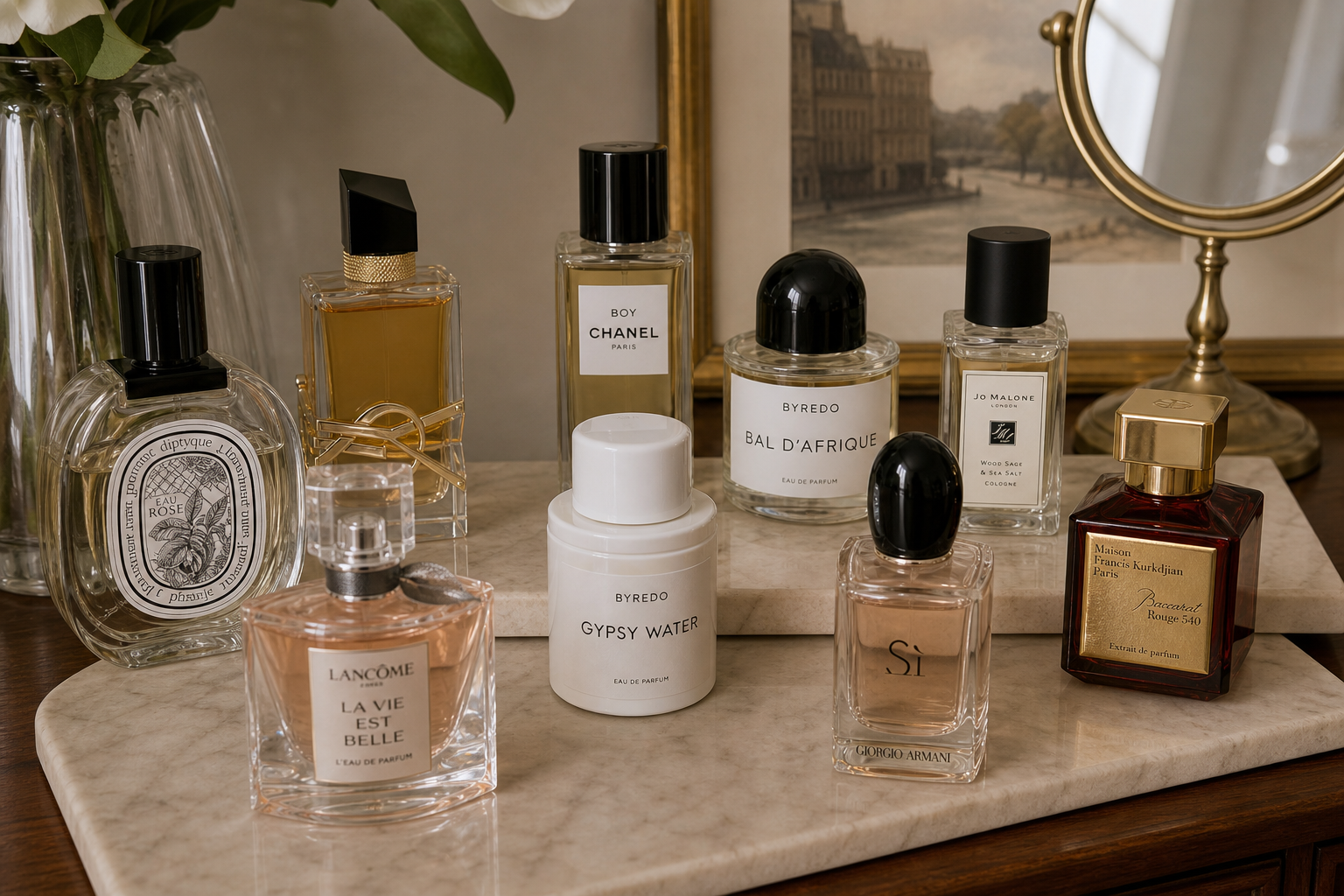
A fragrant wardrobe allows you to have a perfume for every occasion – but how many bottles are just right? We'll show you how to calculate a reasonable collection size based on your lifestyle and usage, and how to expand it without unnecessary duplicates.
How Many Perfumes Are Just Right? A Question Without a Single Answer
It starts subtly. To the one bottle you've been wearing for years, you add a gift from loved ones, then a perfume that caught your eye on vacation, and something fresh for summer. One morning, you realize there are six bottles on your shelf, and you can't remember the last time you reached for the third one from the left. You enjoy the rotation because it allows you to choose based on your mood and the weather. Yet, the question that is hard to answer directly returns: where does a thoughtfully curated fragrance wardrobe end and a clutter of bottles, half of which just take up space, begin?
Right from the start, it's fair to say that there is no universal number. Advice like "five perfumes are enough for everyone" seems practical but misses the essential point – how many different situations you actually dress for throughout the year. Some spend five days a week in the office and have a weekend consisting of just one role. Others transition from morning meetings to evening social events and also travel to the seaside in summer. The same number would mean something completely different for both: an unnecessary surplus for the first, an eternal compromise for the second.
The answer shifts according to three things that are more related than they might seem at first glance:
- The number of roles you play throughout the year. Everyday work, leisure time, sports, social evenings, or a vacation by the water place different demands on a perfume.
- Actual consumption. The more bottles you have open at once, the slower each one empties.
- Longevity of an open perfume. The composition changes over time, and a collection you can't finish using works against you.
This leads to the most common misconception we encounter with this question: that a larger number of bottles automatically means a better fragrance wardrobe. It doesn't have to. Ten perfumes that overlap and share the same mood serve worse than three carefully chosen ones, each with a clear place in your week. The quality of a wardrobe isn't determined by the number, but by how well it covers the situations you actually encounter. After all, even people with extensive collections usually admit that most of the year revolves around a few staples, while the rest remain more of a collector's joy than a daily choice.
Further in the text, we'll explore specific scenarios based on lifestyle, look at how much perfume you actually use in a year and how long an open bottle stays in good condition, and finally offer a simple rule for gradually expanding your wardrobe without unnecessary duplicates. The goal isn't to arrive at a number that applies to everyone. The goal is to find yours – and most importantly, to understand why it looks the way it does.
What Determines the Size of Your Fragrance Wardrobe – Lifestyle, Not the Number of Bottles
The size of your fragrance wardrobe isn't determined by how many perfumes you like, but by how many different situations you actually encounter in a week. Perfume functions much like an outer layer of clothing: you need as many as the roles you regularly step into. If you spend most of the week in one environment and have quiet weekends, you can get by with a few. If you move from an open office to a business lunch and then to an evening event all in one day, you have a real reason to reach for more than one bottle.
Three things determine the size of your wardrobe, which you can consider before you start choosing a specific scent:
- Number of environments per week. Go through a typical week and count how many different contexts you have – work, sports, school, dinner with friends, family visits. Environments that behave similarly and place the same demands on you should be counted as one.
- Level of formality. A conservative office or client meetings require a different type of composition than a casual weekend. The wider the range between the most formal and most relaxed situation of your week, the more you need two distinct options instead of one universal one.
- Switching between day and evening. If your day ends when you close your laptop, one perfume a day is enough. If you regularly have evening plans, it makes sense to have a lighter daytime choice alongside a more intense evening composition.
Based on these three factors, three model profiles can be described. These aren't boxes, but rather guiding points – most people find themselves somewhere in between.
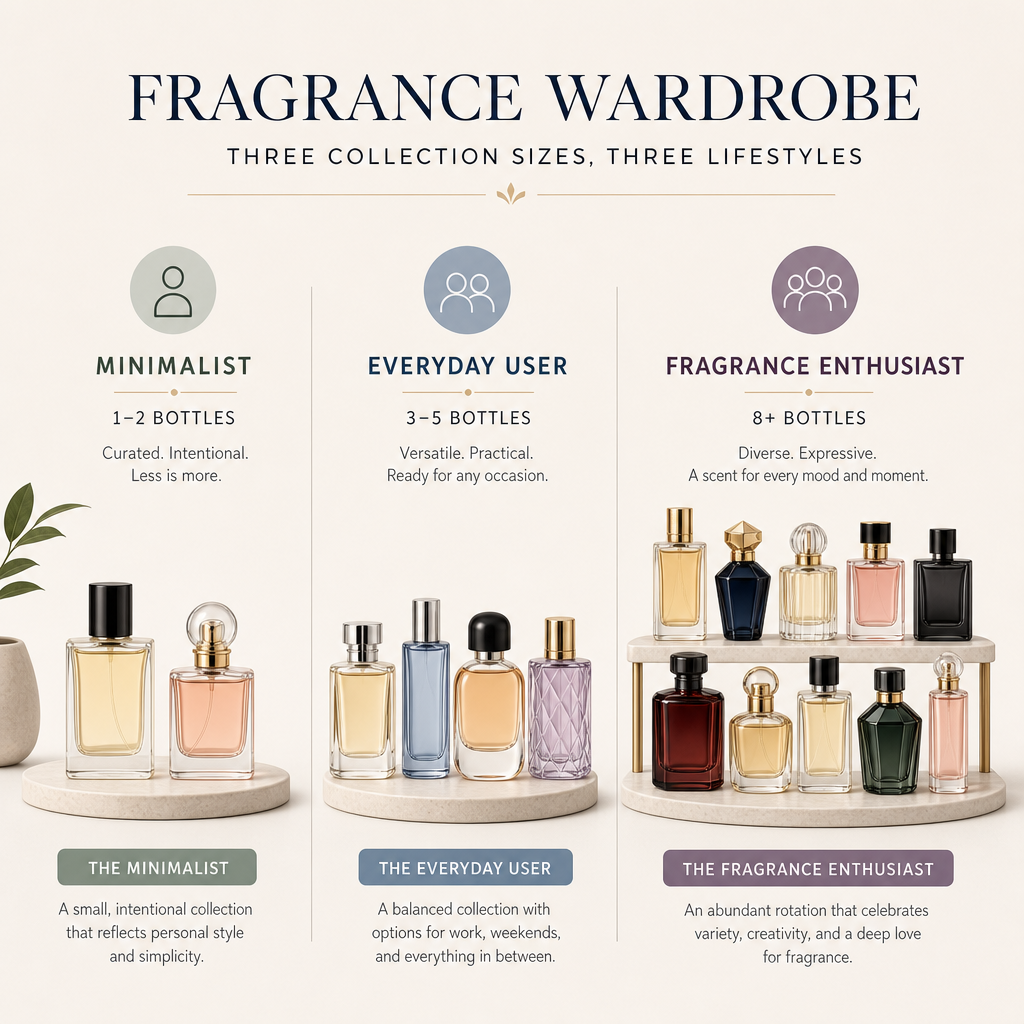
Minimalist with one to two perfumes. The week has a stable rhythm, environments don't differ much from each other, and the social calendar is calm. One well-chosen universal perfume does most of the work, with a second serving as a backup for special occasions. The advantage is that people will associate the scent directly with you. The limits of this profile become apparent when a situation arises where the chosen perfume doesn't fit – like a hot summer with a composition more suited to cooler months.
Average user with three to five perfumes. The most common case. The week includes work, leisure, and some social events, with the occasional formal occasion. Three to five perfumes cover the daily routine, warmer and cooler parts of the year, and one more pronounced evening option. This range is usually sustainable and practical: you remember what's in your wardrobe and actually wear each bottle.
Enthusiast with a wider rotation. Here, it's not just about covering the calendar, but also about the interest itself – perfumery is a hobby, and the collection has value beyond practical use. This is a legitimate reason, but it's good to know where the limits lie. The wardrobe becomes excessive when you lose track of what you own, when some bottles don't get worn all year, or when choosing another fragrance has nothing to do with how your week looks.
The practical guideline is: the number of perfumes should match the number of roles, not the desire to shop. If you can say when and why you wear each bottle, your wardrobe is healthy, whether it has two pieces or twelve. If you get stuck on some scents and can only answer "I liked it," you know you don't need to consider another addition just yet.
How Much Perfume Do You Actually Use and How Long Does It Last Once Opened
The discussion about the size of your fragrance wardrobe usually revolves around feelings: one extra bottle surely won't break the bank. But once you pick up a calculator, the picture becomes clearer. Perfume consumption is a quantity that can be fairly well estimated – and from this, you can determine how many bottles you actually have a chance to finish.
A standard spray releases about a tenth of a milliliter with one press, depending on the design, a little less or a little more. A 100-milliliter bottle thus contains approximately a thousand sprays. If you spray yourself four times in the morning – two sprays on the neck, two on the wrists or clothing – you will use just under 150 milliliters in a year. In other words: a perfume that you wear every day without alternating with anything else will last you about eight to ten months.
And now the same with rotation. If you alternate five perfumes and each comes into play once every five days, the annual consumption of one bottle drops to about thirty milliliters. A 100-milliliter bottle will then last you more than three years. With a wardrobe of ten pieces, the same bottle stretches to six to seven years – and at that point, the question is more whether you'll ever finish it than whether it will last.
Guideline for a 100-milliliter bottle with four sprays a day:
- everyday wear without rotation – about eight months,
- three days a week – approximately a year and a half,
- one day a week, i.e., rotation of five to seven perfumes – four to five years,
- only special occasions, a few times a month – practically a supply for decades.
Concentration also plays a role in the calculation. Eau de Toilette contains a smaller proportion of perfume oils than Eau de Parfum, stays on the skin for a shorter time, and is carried closer to the body. Many people therefore add it during the day or go straight for five or six sprays, so consumption increases and the bottle disappears faster. Eau de Parfum and even more concentrated perfume extract usually suffice with two sprays, but they are noticeable for longer. So when comparing two equally sized bottles, keep in mind that you'll finish the Eau de Toilette sooner.
An opened perfume doesn't spoil overnight; it changes gradually. Contact with air, light, and temperature fluctuations first diminish the top notes: citrus, bergamot, or fresh green notes lose their sparkle, and the composition feels heavier from the start. Base notes like amber, patchouli, vanilla, or sandalwood are more resilient and can become more pronounced over the years. A look at the bottle can also tell you: a darker shade of liquid doesn't necessarily mean the perfume is unusable, but it signals that the scent may no longer match its original form.
How long an opened bottle stays in good condition largely depends on where it is kept. The bathroom is unsuitable due to steam and fluctuating temperatures, even though it's convenient. A few habits are enough:
- keep perfumes in their original box or at least out of direct light,
- choose a drawer, closet, or cooler room instead of the bathroom and windowsill,
- always close the bottle with the cap and avoid unnecessary shaking,
- when decanting into a travel spray, prepare smaller amounts, as more air is in contact with the liquid in a small volume.
For the size of your wardrobe, the conclusion is quite straightforward: the more perfumes you wear simultaneously, the smaller portion of each you will manage to use, and the more storage conditions matter. If you rotate five or more perfumes, smaller bottles of thirty or fifty milliliters often serve you better than large ones – you'll finish them while the scent is still in form.
Duplication in Your Collection – When You Have the Same Fragrance Twice
A fragrant wardrobe rarely grows according to plan. You receive one bottle for your birthday, bring another back from a trip, and buy a third because it caught your attention on someone else. Over time, you may find that two different boxes offer almost the same experience. Duplication itself isn't a mistake – it only becomes inconvenient when one bottle sits unused for years because of it.
Duplication Isn't About Scent Match, But Role Match
Two perfumes don't have to smell identical to clash in your wardrobe. The deciding factor is the role they play: the time of day, season, and situation in which you reach for the bottle. If you have two sweet oriental compositions and wear both exclusively on winter evenings, they serve the same role regardless of one being smokier and the other fruitier. Conversely, two perfumes from the same fragrance family can coexist perfectly if one is suitable for the office and the other for a festive evening. A simple question helps: if you had to choose just one of the two bottles in the morning, would you hesitate for long? If the answer is "it doesn't matter, they both do the same thing," you have duplication.
Where Overlaps Most Often Occur
The current offerings revolve around a few ingredients that repeatedly appear in popular compositions. Vanilla, amber, tonka bean, and patchouli form the backbone of many sweet and woody perfumes of recent seasons – and this is where most overlaps occur.
- The same ingredient in the leading role. Vanilla with amber, often complemented by tonka bean, repeats across brands and price levels. The difference between two such perfumes is often smaller than the different packaging promises.
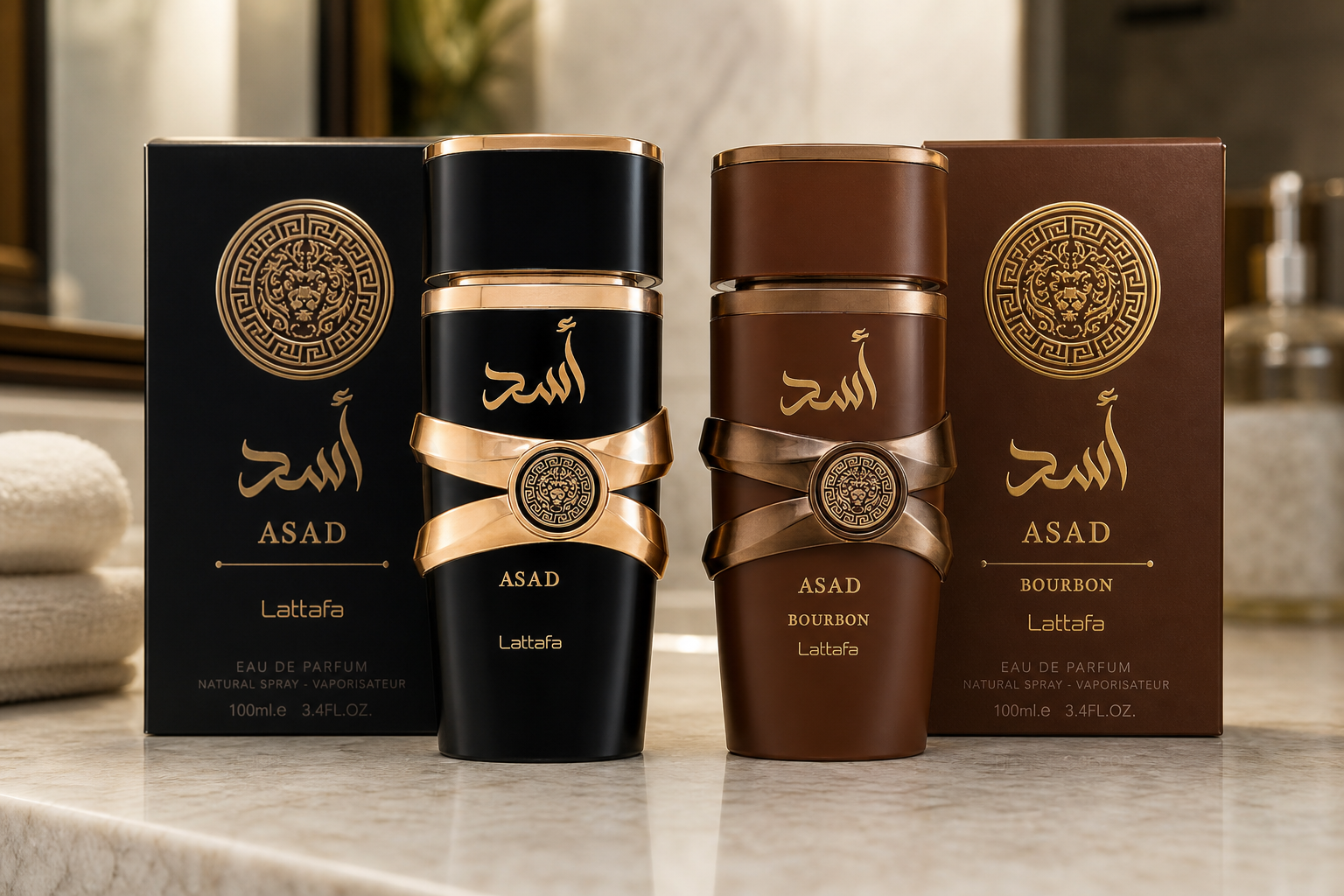
- Variants of a successful fragrance. Popular perfumes expand into entire lines – in families like Lattafa Khamrah or Lattafa Yara, several variations with the same base and different accents stand alongside the original version. Two of them make sense when you can perceive the difference even after hours on the skin.
- Different concentrations of the same name. Eau de toilette and eau de parfum of the same fragrance aren't two scents, but two intensities of one motif. They work as a pair only when you wear the lighter one during the day and the heavier one in the evening.
Collection Audit in Three Steps
- Sort perfumes by fragrance family. Floral, citrus, oriental, woody, gourmand, aromatic – a rough sorting is enough. Where a pile of three or more bottles forms, look for pairs that compete with each other.
- Assign an occasion to each bottle. Work, everyday wear, sports, evening out, formal event. Write the role, not the brand – this column will show how many perfumes are vying for the same spot in your collection.
- Compare only pairs from the same pile. Apply both perfumes to two different wrists and observe them for several hours; the interesting part is the lingering base, not the first minute. If after an hour you can't tell which wrist is which, you have your answer.
Uncovered duplication doesn't mean saying goodbye. You can use the weaker of the pair as an everyday work perfume or give it to someone in the family. The purpose of the audit isn't to reduce the collection at all costs, but to understand why each bottle is there.
When Duplication Is Useful
Not every overlap is unnecessary. It often makes sense for a pair that divides one motif into two seasons: a lighter, more citrusy version for hot days and a richer, spicier variant for cold months. The result is a signature that changes with the air temperature. A second bottle of the same perfume in a smaller size, kept in a suitcase or travel bag, can also be justified. The difference between useful and unnecessary duplication is simple: the former was intentional, the latter accidental.
How to Gradually Expand Your Fragrance Wardrobe – The Missing Role Rule
A fragrant wardrobe often grows randomly in most households. A new release catches your eye, a friend recommends something, or you receive a perfume as a gift – and a bottle is added to your bathroom that never really makes it into rotation. Gradual expansion makes sense when each new addition has a clear place. This can be called the missing role rule: you don't buy a perfume because it's new, but because there's a specific situation missing in your wardrobe that you currently have nothing to cover.
Find the Empty Spot First, Then the Perfume
Before you start choosing a specific composition, review what your current selection can do. Just three questions are enough:
- Season – do you have something fresh for hot days and something richer for frosty mornings, or does a single woody composition serve you all year round?
- Occasion – can you cover the office, sports, family celebrations, and dinners where you want to stand out a bit more?
- Time of Day – is your favorite perfume suitable for a morning in an open office as well as for an autumn evening?
If you find that you don't have an answer to any of these questions, you have a task for your next purchase – and a guide on which direction to look. If, on the other hand, you find that the role is already filled and you're only tempted by something similar, it's worth waiting to buy; you'll likely end up cluttering your wardrobe rather than expanding it.
Test the Perfume on Your Skin, Not Just on a Paper Strip
A paper tester mainly shows the top notes, the first few minutes. You'll only know how the composition develops into the heart and base notes on your own skin, during a regular day – at work, outside, after meals. That's why it's worth opting for a smaller bottle or a sample before committing to a full-sized bottle, which you can wear for several days in a row.
We recommend a simple approach: wear the new perfume for at least three different days and notice if it lasts as long as you need and if it fits the situation you chose it for. Only then does it make sense to consider a larger volume. This step usually reliably reveals perfumes that smell great in the store but don't fit any specific role in your everyday life.
Where to Look in the Offer
For orientation, it's useful to start with the categories For Women, For Men, and Unisex. Unisex is a practical choice for missing roles – compositions that aren't tied to a single designation often fit more easily alongside what you already have and tend to be more versatile across seasons.
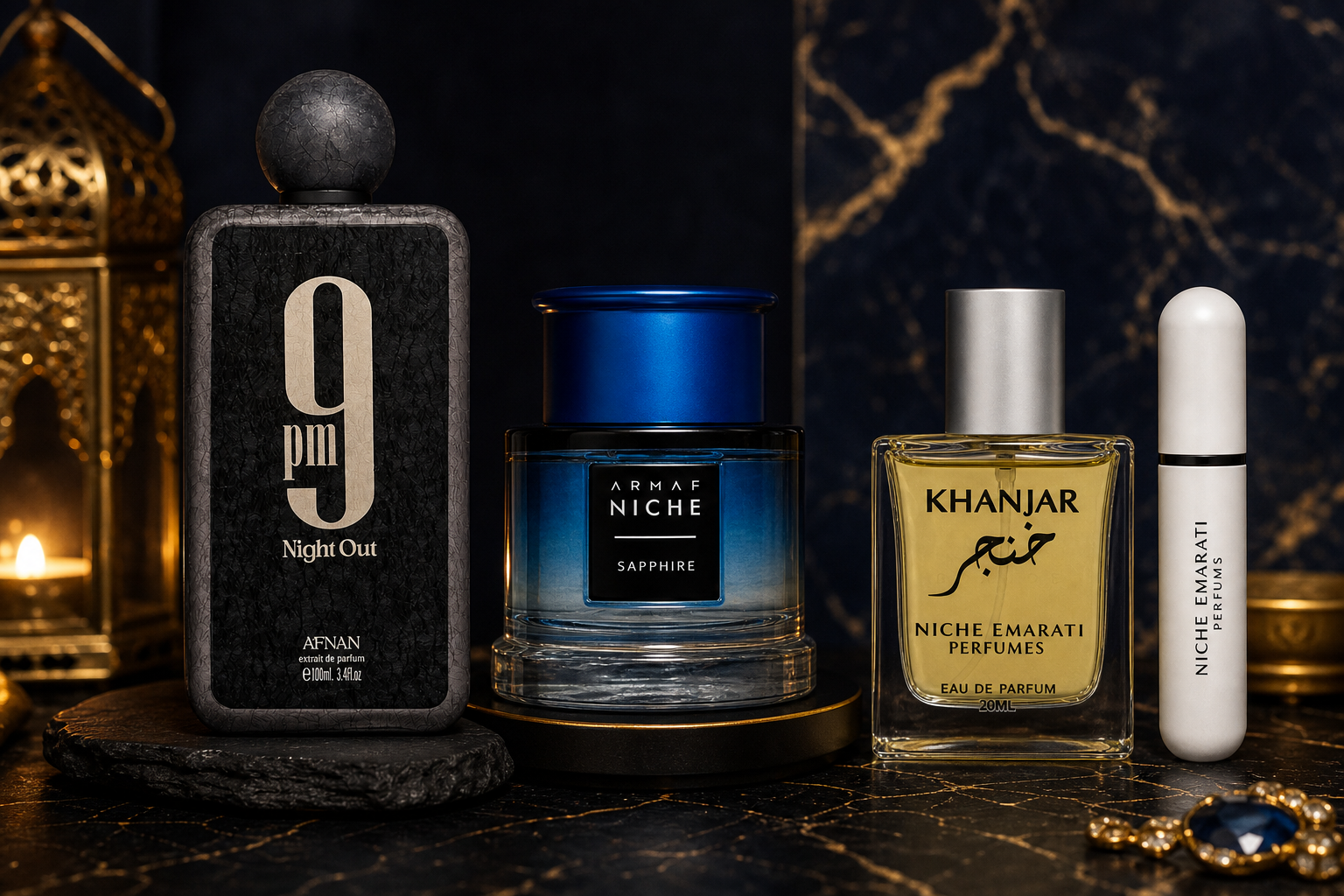
If you want to fill the role of a richer evening perfume, look at brands like Lattafa, Riiffs, or Afnan – they offer oriental and gourmand compositions with vanilla, amber, or Tonka bean, which are suitable for cooler months and occasions where the perfume should be noticeable. If you're interested in less mainstream perfumery and want to take your rotation further, Brasty has a dedicated niche segment with compositions outside the mainstream.
The price level doesn't have to be a deciding factor: more affordable brands today can easily fill the role of an everyday perfume, while you can save for a more distinctive, collectible piece over a longer period. Feel free to alternate between both – a wardrobe composed of several price ranges tends to be more practical than a collection where everything is from the same shelf.
And a final note on pace: a new perfume a few times a year is enough for most people. When you expand slowly and according to missing roles, your wardrobe remains organized, each bottle gets used up, and your morning selection takes a few seconds instead of several minutes of indecisive pacing.
Category
Recommended articles

"Give a girl the right shoes and she can conquer the world!" Marilyn Monroe