
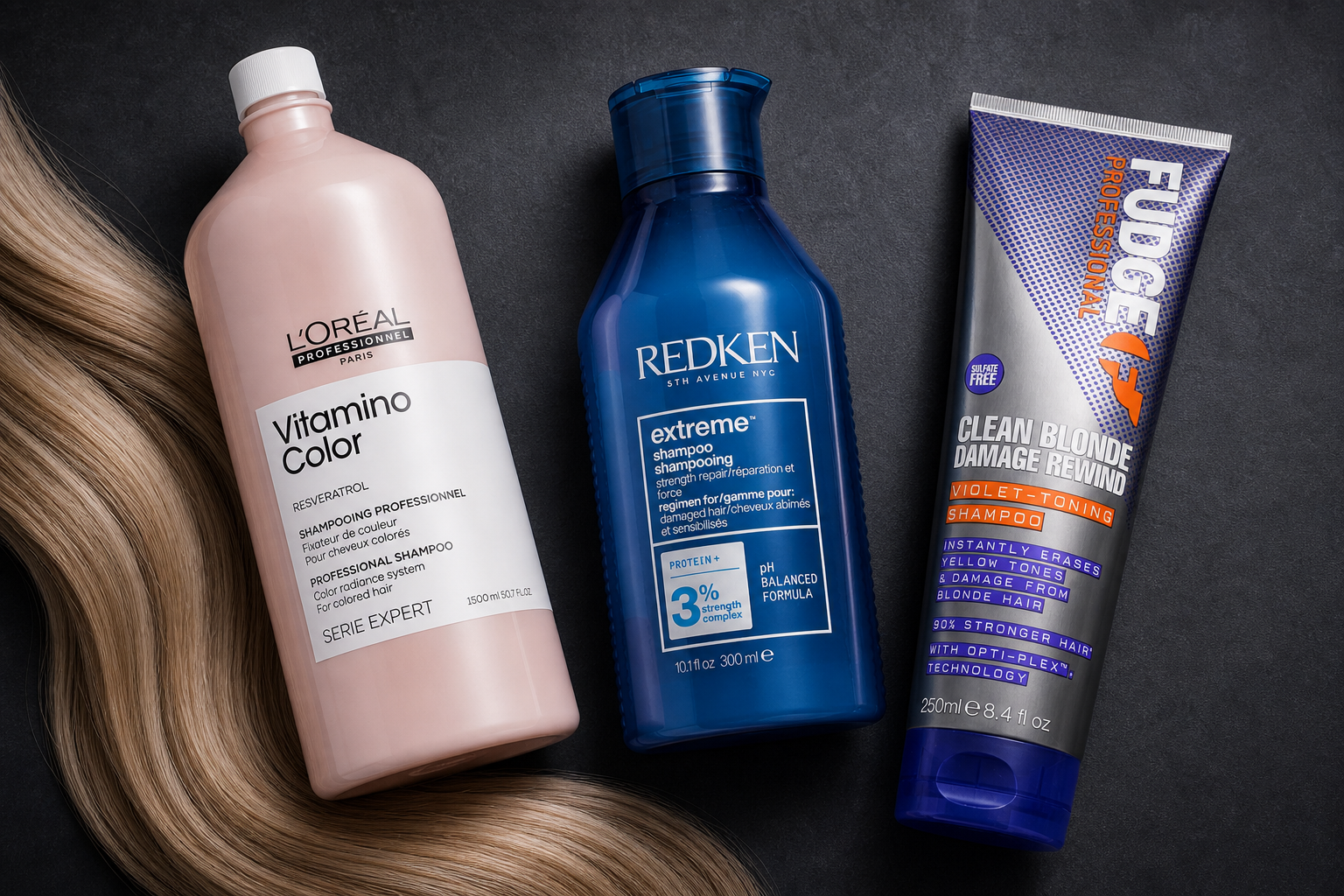

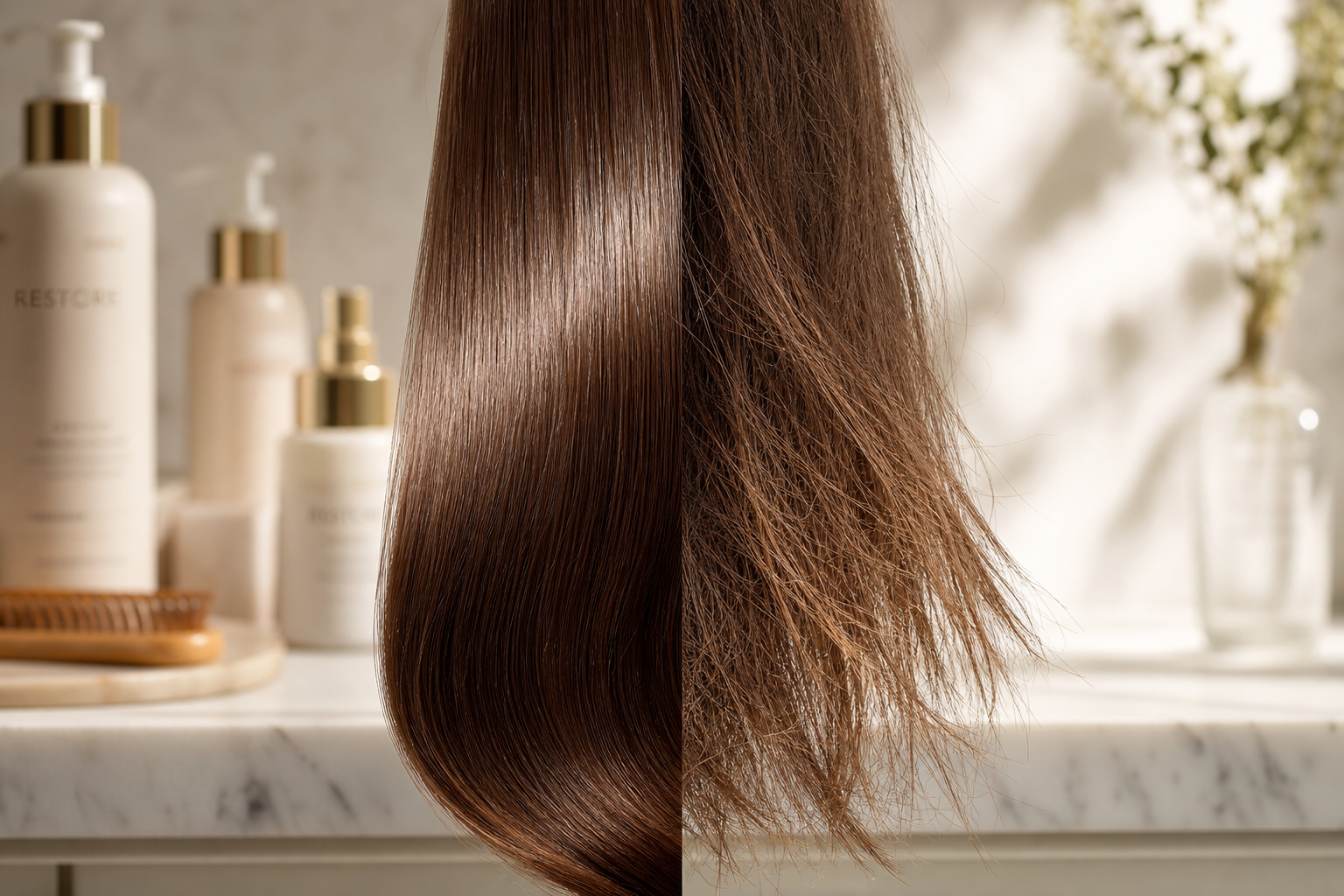
Dozens of restorative shampoos promise the same results, but your hair needs just one of them. We'll guide you on how to select the right formula based on the type of damage – from coloring and bleaching to heat and mechanical stress – that will truly help.
Why One Repair Shampoo Can't Fix Every Hair Damage
You've seen it on the shelves and in online listings: dozens of bottles side by side, each promising essentially the same thing. Repair, restoration, nourishment, fixing damaged hair. But when you read the back of two such shampoos, you'll find they have different compositions, different cleansing bases, and are designed for different hair types. The word "repair" on the front label isn't a diagnosis, but a broad commercial category – it includes care for freshly bleached blonde hair as well as shampoo for someone who just blow-dries their hair daily.
The reason is simple: hair doesn't get damaged in just one way. Simply put, it has two parts that can be damaged separately. The outer cuticle acts like a roof covering made of scales that should lie smoothly against each other – thanks to it, the hair shines, can be combed, and retains moisture. Inside is the hair's own substance with bonds that hold its structure and strength. Chemical processes target the inside, while thermal and mechanical stress primarily attack the surface. And because these are two different injuries, they need two different compositions.
That's why a shampoo that restored your friend's hair after bleaching might not do anything visible for you. You didn't buy a bad product; you just applied it to a different problem. Rich restorative care designed for chemically damaged hair can actually weigh down hair that's only heat-damaged, robbing it of volume without addressing what's truly needed.
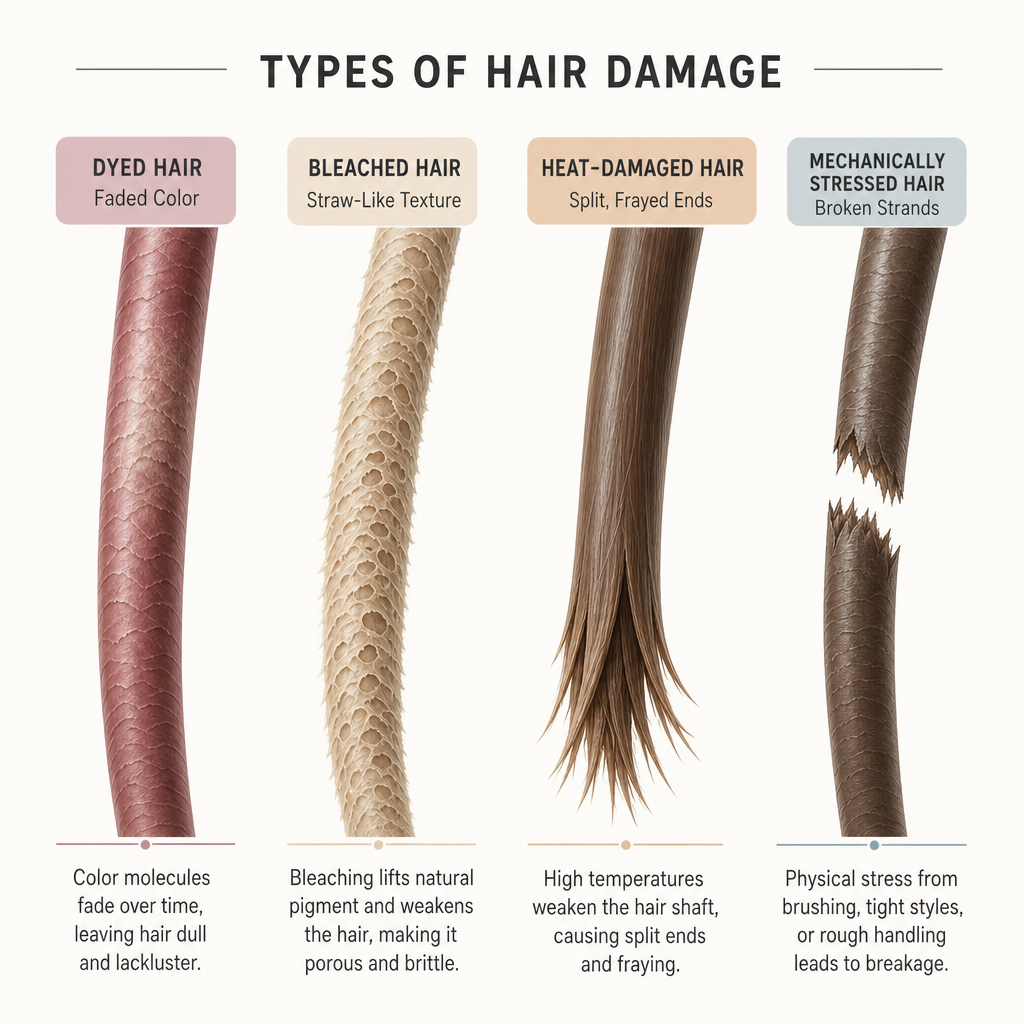
In this article, we'll categorize hair care products by cause, not by the marketing name of the line. We'll work with four types of damage you most commonly encounter in practice:
- Coloring – oxidative color opens the cuticle to get inside the hair. The main task of care is to maintain the shade and close the surface back up.
- Bleaching and Highlighting – the most significant impact on hair structure. The hair is porous, easily loses water, and is vulnerable when wet.
- Heat – blow dryers, straighteners, and curling irons dry the hair from the inside and damage its protective layer. This results in a rougher surface and loss of shine.
- Mechanical Stress – combing, rubbing against a towel, ponytails, and hair ties. Damage is most visible on lengths and ends.
In real life, of course, few people fit into just one category. Colored hair is usually also blow-dried, and bleached ends additionally break when combed. But that doesn't mean distinguishing is pointless – on the contrary, it helps you identify which damage is your main issue and choose a shampoo accordingly. You can then fine-tune the rest with subsequent care.
Once you've finished reading, you'll be able to look at your hair like a hairdresser: recognize what the main problem is and know what type of composition corresponds to it. You'll then choose based on your own diagnosis, not what's written in the largest print on the package.
How to Identify What Damages Your Hair
Before you start comparing the ingredients of different shampoos, it’s worth spending a few minutes in front of the mirror. Damaged hair looks and behaves differently depending on whether it's been affected by chemicals or years of exposure to hot air or rough brushing. The following steps can be done at home without any equipment – all you need is good lighting, a comb, and a bit of honesty about your habits.
Start by comparing the ends with the roots. Separate a thin strand, stretch it over your palm, and observe where the hair changes. If the roots are smooth and shiny, while the last third appears dull, dry, and slightly lighter, it's likely damage that has accumulated over time – the hair has collected it over years of washing, drying, and styling. Conversely, if even the middle part is unpleasantly dry and there's little difference between the roots and ends, it usually indicates damage that occurred all at once along the entire length. Typically from coloring or bleaching.
Notice how the hair behaves when wet. Wet hair reveals more than dry hair. Hair in good condition is flexible when wet, smooth to the touch, and quickly returns to its shape after being pulled out of the water. Hair weakened by chemicals tends to be unusually soft, almost gummy, as if it sticks, and stretches easily when combed. Hair stressed by heat and friction, on the other hand, remains rough even when wet, feels coarse to the touch, and the comb catches on small irregularities.
Don't overlook the scalp. Shampoo is primarily applied to the scalp, with the lengths just passing through it. Pay attention to whether your scalp itches, feels tight after washing, if flakes appear, or if the roots become greasy faster than before while the ends remain dry. This combination is common and changes the requirements: you're not just looking for care for damaged lengths, but also a cleansing base that doesn't irritate the scalp.
The final piece of the puzzle is your hair history. Try to honestly answer four questions:
- Chemicals – how often do you dye your hair, how big is the difference between your natural and target color, and have you ever bleached or highlighted?
- Heat – how many times a week do you use a hairdryer, straightener, or curling iron, and do you use heat protection?
- Mechanics – do you comb your hair wet or only when it's partially dry? Do you wear tight ponytails and buns? Do you dry your hair by rubbing it with a towel?
- Washing – how often do you wash your hair and how hot is the water you use?
When you combine observations and history, your hair usually falls into one of four categories:
- Colored Hair – the color doesn't hold as well as expected, appears washed out after a few washes, and the length is drier all over, not just at the ends.
- Bleached and Highlighted Hair – wet hair is soft and pliable, but after drying, it becomes rough and straw-like, harder to comb, and easily breaks where it has been lightened repeatedly.
- Heat-Damaged Hair – the surface has lost its shine, the ends split, the hair becomes static, and the hairstyle quickly "falls flat."
- Mechanically Stressed Hair – damage is uneven, concentrated in areas where the hair is most pulled: around the hair tie, in the part you comb most often, or in the length that rubs against collars and backpacks.
In practice, these categories often overlap – a common combination is bleached lengths that also encounter a straightener daily. Choose the cause that is strongest for you and select a shampoo accordingly; you can adjust the remaining factors with what you add to your washing routine and what habits you reduce. We will delve into each category in more detail, including what compositions make sense to look for.
Coloring and Bleaching: Damage That Starts Inside the Hair
Coloring and bleaching are interventions that change the hair from the inside. While heat or friction mainly affect the surface, oxidative color and bleach must first penetrate the hair – and this cannot be done without disrupting its structure.
The principle is similar for both. An alkaline component lifts the cuticle, the scaly outer layer of the hair, allowing active ingredients to penetrate the cortex. There, hydrogen peroxide breaks down the natural pigment, and during coloring, a new color shade is created simultaneously. Bleaching goes a step further: it repeatedly breaks down pigment in a stronger concentration, making the intervention into the internal bonds of the hair more pronounced. After rinsing, the cuticle never closes completely to its original state, leaving the hair porous.
Porous hair behaves differently than untouched hair. It quickly absorbs water and loses it just as quickly, making it appear dry even with regular hydration. Color pigments wash out with each shampooing, causing the shade to fade and change tone. The surface is rougher, reflects light poorly, and breaks more easily when combed. That's why it's worth considering the composition of shampoo differently for this type of damage than for hair that has never been colored.
What to look for in chemically treated hair:
- Gentle cleansing base. Strong surfactants clean thoroughly but also wash away what you want to keep in porous hair – lipids, caring ingredients, and some pigment. Sulfate-free shampoos or those with milder cleansing agents clean less aggressively, and the color usually lasts longer on them.
- Keratin and amino acids. Hair is made of keratin, so hydrolyzed keratin, amino acids, or protein complexes can temporarily fill porous spots and restore tensile strength to lengths. The effect is not permanent, lasting roughly until the next wash.
- Bond repair technology. Lines labeled as care for internal hair bonds target bonds disrupted by oxidation. In salons, they are used directly during coloring, while home shampoos and treatments from the same line continue the care between salon visits.
- Emollient and lipid components. Panthenol, ceramides, or plant oils smooth the cuticle, making the hair reflect light better and reducing static. Care for colored hair also includes UV filters, which slow down color fading in the sun.
Colored and bleached hair do not need exactly the same care. Shampoo for colored hair primarily aims to protect the shade: it has the gentlest possible cleansing base, lower pH to keep the cuticle flat, and often antioxidants and sun filters. Its task is to interfere as little as possible with what is stored in the hair. Shampoo for bleached and heavily lightened hair, on the other hand, mainly addresses structure – it tends to be thicker, more protein-rich, and accounts for the hair being weakened along its entire length. If you have highlights or balayage, you're essentially on both sides at once: roots are less burdened than lengths and ends, so it's worth following the condition of the lengths and alternating shampoos as needed.
A separate chapter is purple shampoos for blonde and highlighted hair. It's not about regeneration, but toning: the purple pigment optically neutralizes yellow and brassy tones that will eventually appear on lightened hair. Therefore, it makes sense to use them only when you actually see the tint, not right from the first wash after bleaching. Most people find using purple shampoo once every two to three washes sufficient, using a caring variant the rest of the week. Follow the recommended application time and shorten it for very porous hair – porous hair absorbs pigment the fastest and can easily appear gray or purple.
Heat and Mechanical Stress – What Damages Hair from the Outside
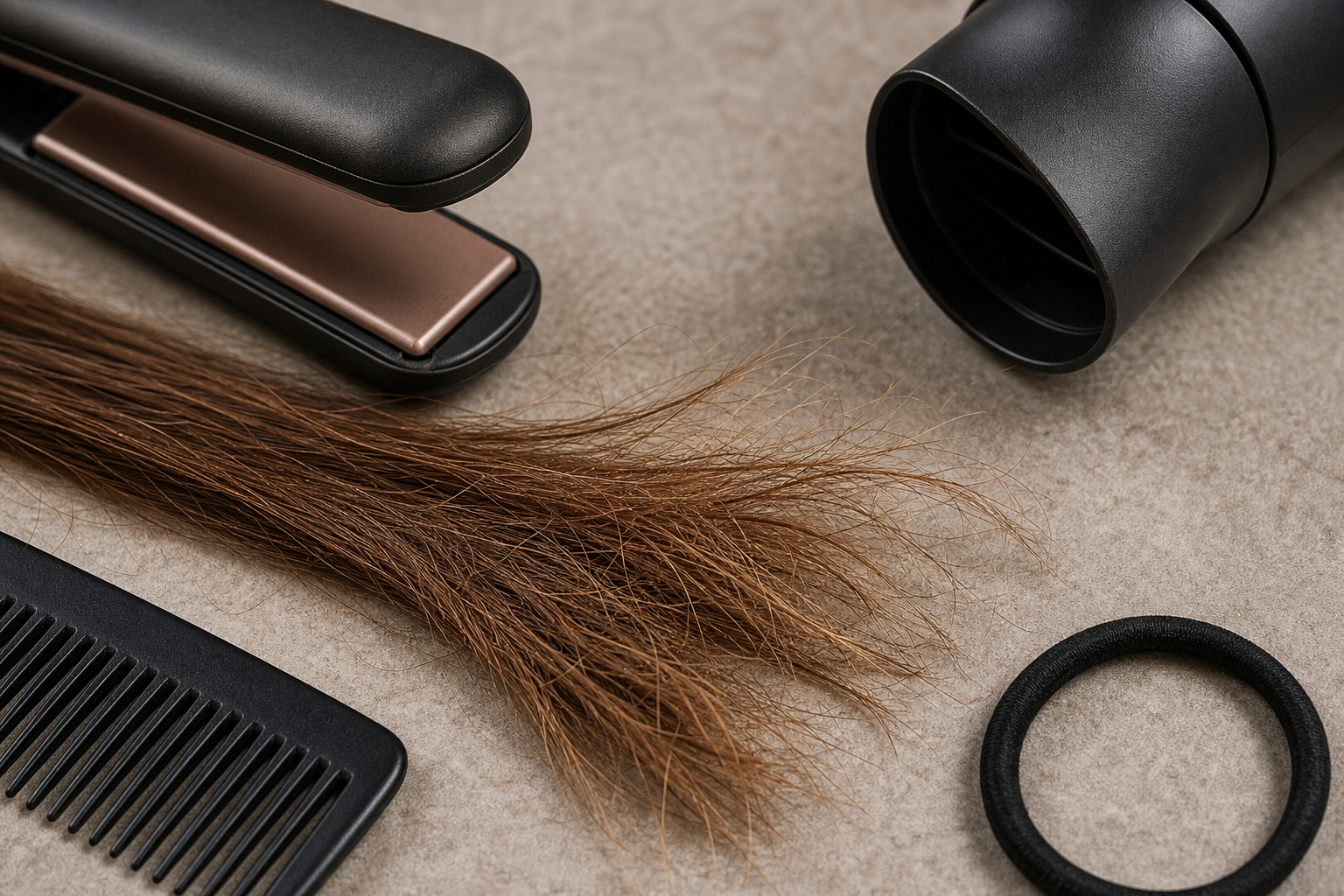
This type of damage doesn't occur from a single blow-dry or one use of a straightener. It accumulates gradually – from daily drying with hot air, morning straightening, brushing wet hair, wearing a tight hairband in the same spot all day, and vigorously towel-drying your hair. That's why most people only notice it when the lengths and ends look noticeably different from the hair at the roots.
High temperatures evaporate water from the hair faster than is natural, lifting the cuticle scales, the outer layer that normally lies smooth like roof tiles. A lifted surface retains moisture less effectively and is more prone to abrasion. Mechanical stress compounds this from the other side: friction from a towel, pillow, or comb teeth breaks off small particles from the surface, and where a hairband permanently bends the hair at one point, a weakened spot forms. Wet hair is more flexible and vulnerable than dry hair, so brushing right after washing stresses the hair the most.
You can identify such damaged hair even without a magnifying glass:
- the ends are thinner, lighter, and visibly split, while the hair at the roots looks healthy;
- the hair becomes static and stands out, especially in winter and after blow-drying;
- the surface feels rougher, the hair doesn't glide smoothly between fingers and tends to squeak;
- the shine is duller because light doesn't reflect evenly off an uneven surface;
- the hair tangles more easily and takes more effort to brush than before.
In the shampoo composition, look for hydration and fats rather than the strongest reconstruction you can find. The hair lacks water and a lipid layer on the surface, not primarily the internal structure. Hydrating ingredients like glycerin, panthenol, or hyaluronic acid, complemented by plant oils and butter components, will smooth the hair surface and reduce friction. Equally important is the cleansing base: gentle surfactants will wash away dirt and styling products but won't strip the hair of its residual protective layer. Shampoos labeled as hydrating, nourishing, or for dry and stressed hair target this exact need.
The washing technique also helps. Lather the shampoo in your palms, massage it into the scalp, and let the foam wash the lengths as it runs down – no need to scrub them separately. Lukewarm water instead of hot is gentler on the lifted cuticle and less drying.
But shampoo is just one part of the solution, and honestly, the smaller part. If you continue to straighten or curl without a heat protection product, the damage will return faster than care can smooth it out. Several things help at once: lowering the temperature of the hairdryer and straightener to a reasonable level, letting hair air dry a bit before blow-drying, squeezing out water with a towel rather than rubbing the hair, brushing with a brush designed for wet hair and working from the ends to the roots, and alternating between fabric or spiral hairbands instead of wearing them in the same spot all the time.
And one more practical note: heat and friction often coincide with another type of damage. Those who dye their hair usually also dry and straighten it. In such a situation, it's worth choosing a shampoo based on what troubles the hair most right now and supplementing the rest with additional care.
How to Create a Hair Care Routine that Supports Your Shampoo
Shampoo is the first step in your bathroom routine, but also the shortest – it spends barely a minute on your hair, and its main role is to cleanse the scalp and set the stage for what comes next. If your care routine ends there, even a carefully chosen formula will only do part of the job.
The Order of Steps Worth Following
Caring for damaged hair involves four layers, each with a different role:
- Shampoo – cleanses the scalp and removes styling residue from the hair. Focus on the roots, letting the shampoo run through the lengths during rinsing.
- Conditioner – should be used after every wash. It smooths the cuticle and reduces friction during detangling. Apply it from mid-lengths to ends, avoiding the roots.
- Mask or Hair Treatment – once or twice a week instead of conditioner. It works longer and contains a higher concentration of nourishing ingredients, making it most noticeable on damaged lengths.
- Leave-in Care, Serum, or Oil – applied to damp hair before blow-drying. It locks in moisture and makes styling easier; this step also includes heat protection products.
Layering everything at once is not advisable. Excessive oils and creams can weigh hair down, reduce volume, and make it look greasy the next day. Start with a small amount focused on the ends and add more only if the hair remains dry.
How Often to Wash Your Hair
There is no universal interval – follow your scalp, not the lengths. If the roots get oily, there's no need to delay washing; a gentle cleansing base can handle frequent use, and tangled hair is harder to detangle, which can worsen damage. Lukewarm water instead of hot helps.
The Limits of What Hair Care Can Achieve
Hair is a dead structure outside the scalp, so it cannot regenerate itself. Care can smooth the damaged surface, replenish missing substances, and protect the hair from further stress – but this effect is renewable, not permanent, and gradually diminishes with each wash. Therefore, it makes sense to maintain care long-term, not as a one-time treatment before an event. For split ends, a split hair cannot be permanently glued back together, it can only be temporarily smoothed. The only definitive solution is to trim it, approximately every eight to twelve weeks.
When the Problem Lies with the Scalp
Sometimes hair looks tired even if you don't overdo it with coloring or heat. Itching, tightness, flaking, dandruff, or oily roots with dry ends signal that the problem starts elsewhere than in the lengths. A regenerating shampoo for lengths won't solve it. For these situations, there is a separate group of dermatological shampoos, represented in our range by lines like Vichy Dercos. If problems persist or worsen, cosmetics are no longer enough, and it's advisable to consult a doctor.
How to Choose a Specific Product
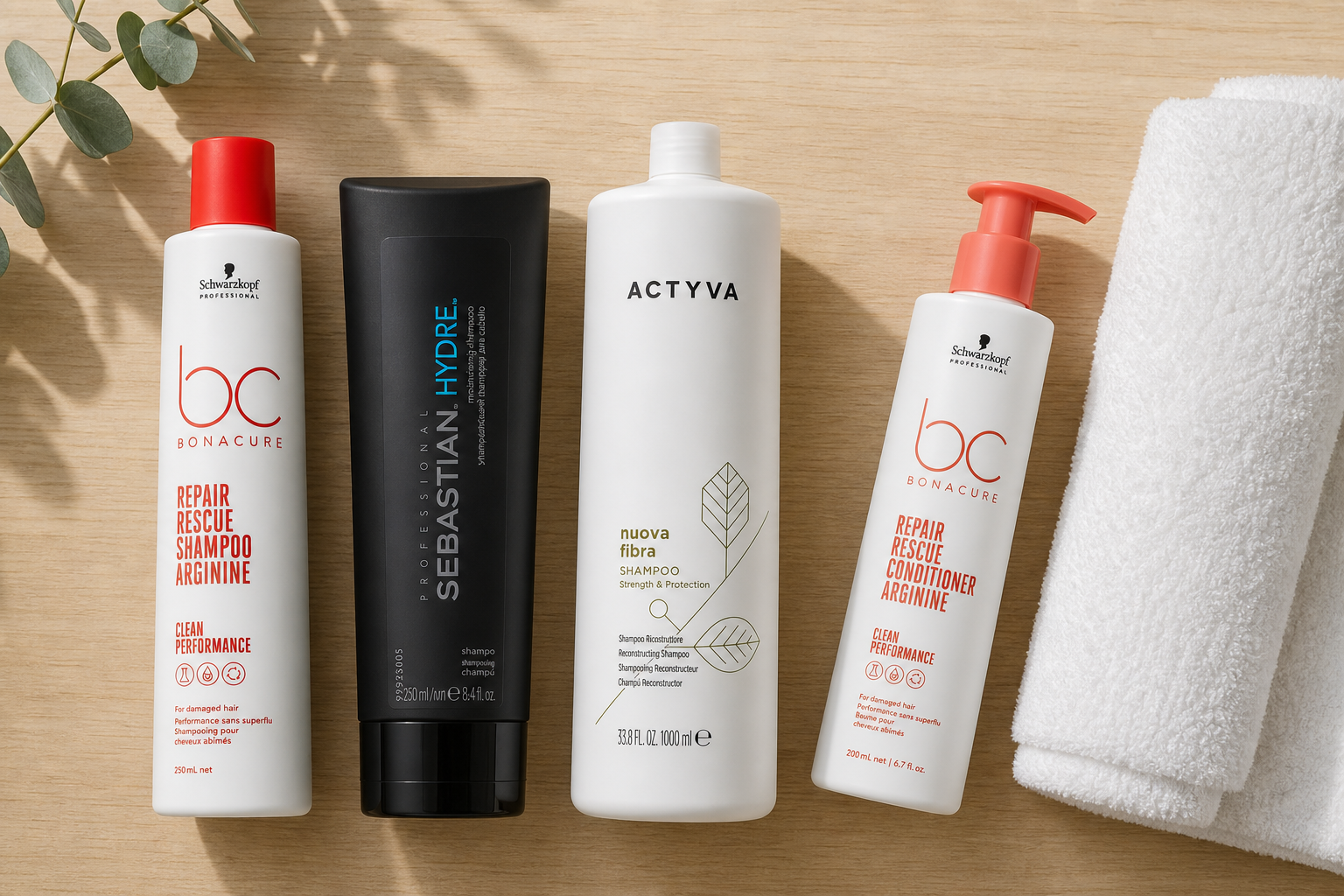
It helps to divide the offer into several groups based on what you need from your care:
- Professional Regenerative Lines – salon cosmetics from brands like Wella Professionals, L'Oréal Professionnel, or Schwarzkopf Professional. Suitable for hair weakened by coloring and heat, they usually offer a complete line of shampoo – conditioner – mask.
- Shampoos for Colored Hair – gentler cleansing bases designed to maintain the color as long as possible.
- Care for Blonde and Highlighted Hair – purple and toning shampoos and masks that work with the shade of bleached hair.
- Oils and Leave-in Care – a supplement for dry and coarse lengths that need mainly smoothing and protection.
- Dermatological Shampoos – the choice when you need to address the scalp first and then the lengths.
Sticking with one line for at least a few weeks will give you a much better idea of whether it suits you than switching between five bottles after one wash.

Category
Recommended articles

"Give a girl the right shoes and she can conquer the world!" Marilyn Monroe