

Why Hair Breaks: Understanding the Cause Determines the Care
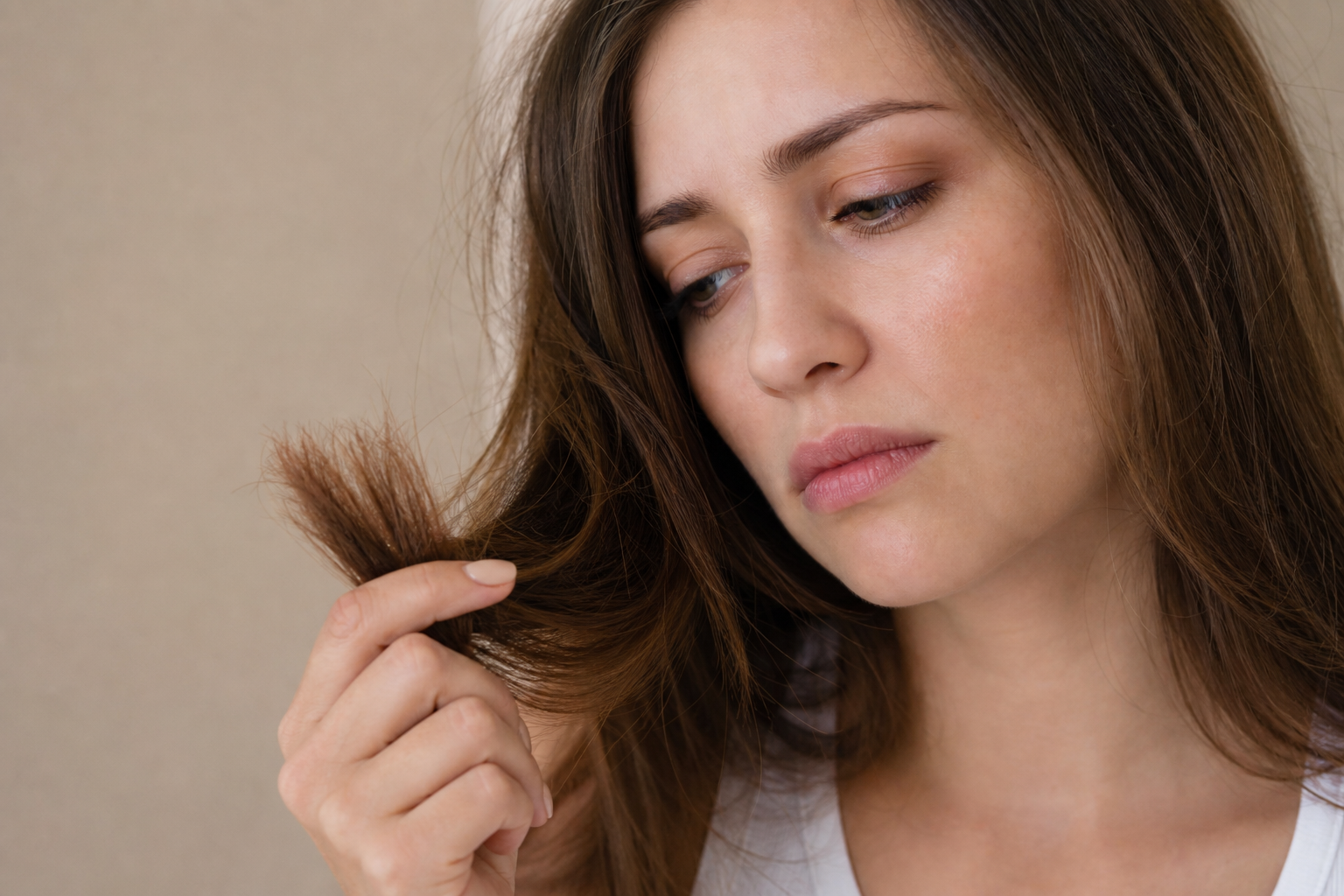
Hair breakage isn't a single diagnosis but a common symptom of several different causes. One strand may snap in the middle, another may split only at the ends, and yet another may break just above the scalp. Each has a different underlying reason – which is why the care your friend swears by might do nothing for you. Before selecting a specific product, it's worth spending a few minutes identifying your type of breakage.
In practice, you'll encounter three main scenarios that only partially overlap:
- Chemically weakened hair from coloring and bleaching. The fiber has lost part of its internal structure, the cuticle scales don't lie flat, and the hair loses elasticity. It typically breaks in the middle of the length and at the ends, where it has undergone the most chemical treatments.
- Dry hair from heat styling. Straighteners, curling irons, hot blow dryers, rough detangling of wet hair, or tight hair ties. The hair feels dry to the touch, becomes static, is harder to detangle, and the ends split faster than you can visit the hairdresser.
- Hair weakened at the scalp. It grows thin, breaks close to the roots, and the lengths appear sparse. The scalp may be sensitive, become oily quickly, or conversely, become flaky.
You can distinguish these scenarios at home. Just watch for three signals. The first is the breakage point: brush your dry hair and examine the brush. Short fragments without a light root indicate breakage along the length, while entire long hairs with a root suggest shedding, which belongs to a different care chapter.
The second signal is the behavior of hair after washing. If wet hair is unusually pliable to the point of being gummy and breaks when detangling, it's most often chemical damage. Conversely, if it's rough, tangled, and immediately stiff after drying, dryness prevails. And if your hair falls out weak from the roots and volume lasts only a few hours, look for the cause at the scalp.
The third signal is the speed at which split ends return. If you trim them and within a month they're back to the same state, the damage isn't just historical but ongoing – somewhere in your current routine. This is actually good news: such damage can be immediately influenced without waiting for regrowth.
Hair cosmetics offer five formats for breakage, which this article compares. Each addresses a different part of the problem:
- Shampoo – cleanses hair and sets the condition of the scalp, but remains on the fiber only briefly.
- Mask or treatment – the most concentrated care for lengths, left to work and then rinsed out.
- Leave-in care – stays in the hair, eases detangling, and protects between washes.
- Serum – targeted care for a specific issue, most often for the scalp or damaged ends.
- Oil – seals the hair surface, adds shine, and reduces frizz.
None of these formats can replace the work of the others. A mask won't fix a shampoo that dries out your scalp, and oil won't replace replenishing the fiber's internal structure. Professional lines, which are among the bestsellers in our hair cosmetics range (Wella Professionals, L'Oréal Professionnel, or Schwarzkopf Professional), design their products so that each step follows the previous one without substituting.
So before you start comparing specific products, answer two questions: where exactly does your hair break, and what causes it? With these two answers, you'll know whether to invest primarily in intensive care for lengths, gentler washing, or protection that stays on the hair all day.
Shampoo: The Foundation of Your Routine, But Not a Cure for Breakage
Shampoo is the step you repeat most often in the bathroom, which is why it’s often credited with more power in addressing breakage than it actually has. Its role is quite clear: to remove oil, styling residue, and impurities, smooth the hair surface, and prepare it for what comes next. This last point is why it makes sense to start with choosing the right shampoo – it determines how effective the subsequent care will be.
At the same time, it’s important to understand its limitations. Shampoo typically stays in your hair for one to two minutes before being rinsed out. It doesn’t have the time to do more than a surface treatment on damaged structures. If your hair is breaking along the lengths, a good shampoo will prepare the ground and, most importantly, won’t worsen the situation; the actual repair is handled by products that stay on the hair significantly longer.
In practice, shampoos for brittle hair are divided into two groups based on the cause:
- Reconstructive lines for damaged lengths. This includes products like Wella Professionals SP Luxe Oil Keratin Protect Shampoo or L'Oréal Professionnel Série Expert Absolut Repair. They cater to hair that’s been colored, highlighted, and frequently heat-styled: they cleanse more gently, leaving hair smoother and easier to detangle, so you don’t stress it as much when combing.
- Dermatological shampoos focused on the scalp. A typical example is the Vichy Dercos range. If your hair weakens more at the roots and your scalp is flaking, itching, or irritated, a reconstructive shampoo for lengths won’t help – you need a product that works with the scalp, not the ends of your hair.
The two groups are not mutually exclusive. If you’re dealing with both an irritated scalp and damaged lengths, it’s common to have two shampoos at home and alternate them based on what’s more pressing at the time.
A practical note on volumes and pricing. Professional lines are usually sold in two formats: smaller bottles around 250 to 400 ml, which allow you to try the range, and large professional formats of one liter or more. A liter bottle has a higher initial cost, but it’s more economical per milliliter – it makes sense once you know the range suits you. Generally, the main part of the offer falls into the mid-range and premium levels, roughly between 160 and 480 crowns per bottle; above this, you’ll mostly find liter-sized professional formats and luxury lines.
Summed up into one rule: choose your shampoo as the first step, as it sets the initial condition of your hair for everything else. Don’t expect it to repair already broken hair – that’s the job for treatments with longer application times and products that remain on the hair after washing.
Mask or Treatment: The Ultimate Solution for Damaged Lengths
When hair breaks along its entire length, simply washing and quickly rinsing with conditioner usually just maintains the status quo. A mask is the format that has the greatest impact on damaged lengths – it doesn't work for mere seconds, but for several minutes, allowing it to penetrate deeper than care that you rinse out quickly. The duration of its application is the main reason why a mask is more beneficial for brittle hair than any other single product.
Consistency and composition also play a role. Masks tend to be thicker, with a higher content of nourishing and film-forming substances, often containing proteins, keratin, or oils, which manufacturers specifically target at weakened hair structure. Cosmetics won't permanently repair hair – once a bond is broken, it won't return to its original state – but they can replenish what the lengths lack, smooth the surface, and reduce friction that causes split ends.
Mask vs. Conditioner: Each Has Its Own Role
This is the most common confusion we encounter in consultations. Conditioner is quick maintenance: it seals the hair surface, makes detangling easier, and is used practically after every wash. A mask is more concentrated and requires time – usually five to twenty minutes according to instructions. It's not about which is better, but that one doesn't replace the other. If you can only afford one, start with the mask.
In practice, this means applying from mid-lengths down, not on the scalp. Lightly squeeze or towel-dry your hair before applying – on soaked hair, the mask will slip off and most of it will go down the drain.
Treatment and Salon Care: A Step More Intense
The difference between a regular home mask and salon treatment is mainly in concentration and how the steps follow each other. For home use, classics like Wella Professionals SP Luxe Oil Keratin Restore Mask or L'Oréal Professionnel Série Expert Absolut Repair Mask are proven – both are designed for dry and mechanically stressed lengths and work as regular weekly maintenance.
Treatments and care originally intended for salons go a step further:
- Londa Professional Visible Repair In-Salon Treatment – an intensive step typically used after coloring or bleaching, where lengths have been most stressed.
- Alfaparf Milano Lisse Design Keratin Therapy Rehydrating Finishing Mask – part of a keratin line, where the mask is designed as the final step of the entire treatment, not as a standalone product.
You can manage to use them at home too, just stick to the recommended procedure. For professional lines, "longer and more" doesn't equal "better" – an excess of proteins can actually dry out the lengths and make them more brittle.
A reasonable framework is one to two masks a week. For fine hair that quickly becomes limp, start with once a week and monitor the reaction: if the hair feels heavy and gets greasy at the roots the next day, reduce the amount, not the frequency. Strong, coarse, or significantly bleached lengths can easily handle two applications. And one more practical note – on the day you use a mask, you usually skip the conditioner.
Finally, a simple budgeting criterion: the longer and more colored your hair, the higher the mask should rank on your list. The ends of hair twenty centimeters long are several years old and have gone through dozens of washes, blow-drying, and coloring – that's exactly the part where shampoo alone won't suffice. Short, uncolored hair can get by with conditioner and a mask occasionally; long colored hair, on the other hand, is a case where a higher investment in a mask pays off the fastest.
Leave-in Care, Serums, and Oils: Protection Between Washes
Washing and masks work on your hair for just a few minutes in the bathroom. Most mechanical stress, however, occurs afterward – during detangling, drying, straightening, and even regular friction against clothing and pillows. This is where leave-in care steps in. On labels, these three different formats often merge into a single category labeled "something for the ends," although each has a different purpose and dosage.
Leave-in Milk: Less Tugging During Detangling
Leave-in care in the form of milk or spray conditioner is the lightest of the three formats and targets a single moment: detangling wet hair. Wet hair is most vulnerable, and a comb working through tangled lengths is one of the most common causes of mechanical damage in brittle hair.
From our range, this includes Milk_Shake Incredible Milk in a spray, which doesn't weigh down even finer hair, Selective Professional OnCare Smooth Hair Cuticle Smoothing Milk focused on the smoothness of the hair surface, or Lakmé Lak-2 Instant Hair Conditioner for quick detangling.
- When: On towel-dried, still damp hair, before detangling.
- How much: Two to three pumps for shoulder-length hair, four to five for longer and thicker hair.
- Where: From ear level down, never on the scalp.
Serum: Targeted Care for Damaged Lengths
Serum is more concentrated and works not broadly, but specifically – where the hair is thinnest and most worn, i.e., in the last third of the length and the ends. This group includes Wella Professionals SP Liquid Hair Molecular Hair Refiller for significantly stressed lengths and Schwarzkopf Professional BC Bonacure Sealed Ends+, whose focus is clear from the name.
For brittle hair, regularity makes more sense than quantity – a small dose every other day does more work than a large dose once a week.
- When: On damp hair before styling, or on dry ends during the day.
- How much: Usually, two to three drops rubbed between the palms are enough.
- Where: The last third of the length and the ends.
Oil: Shine, Smoothness, Less Frizz
Oil primarily addresses the surface of the hair: it smooths out protruding scales, reduces frizz, and adds shine. However, the most common mistake in this step is applying too much and too high. It won't help brittleness at the roots and will only weigh the hair down, creating the impression that the product doesn't work, even though the problem is just in the dosage.
In our selection, you'll find Wella Professionals SP Luxe Oil Reconstructive Elixir as a more accessible option for everyday routine and Moroccanoil Treatment Light in a lighter version for fine hair, which can find classic oils too heavy.
- When: On damp hair before drying or on dry lengths as a final step.
- How much: One to two drops for fine hair, three to four for thick and long hair. Always start with a smaller amount – you can add more anytime, but you can't take it away.
- Where: Exclusively on lengths and ends, keeping at least a palm's distance from the roots.
One Format or a Combination of Two?
If hair is only slightly brittle and the main problem is tangling, a single product – leave-in milk – is more than enough. Combining two formats makes sense when each addresses a different layer of the problem: milk or serum on damp hair as protection during detangling and drying, oil at the end on dry lengths for surface smoothness. Layering two serums or two oils on top of each other, on the other hand, doesn't make sense – the effect won't add up, it will just increase the load.
How to Build a Routine for Brittle Hair Step by Step
Individual products alone won't fix brittleness – it's all about how you incorporate them into your weekly routine. Damaged lengths benefit more from consistency than the number of bottles in your bathroom, so it's wise to start with a schedule before considering expanding your collection.
Divide Care by Frequency
An effective way to maintain your routine is to assign each product a clear frequency:
- Every wash: Shampoo followed by a quick-acting rinse-out treatment for the lengths. Give your scalp just the cleansing it needs, but the ends deserve attention every time.
- Once a week: A mask or more intensive treatment. This is where most of the repair happens, so don't postpone it for "when you have time."
- Before blow-drying, straightening, or curling: Heat protection, every time without exception. Without it, damage returns faster than a weekly mask can fix.
- Between washes as needed: A few drops of oil or serum on the ends, or a leave-in spray before detangling.
Three Routine Variants from Minimal to Complete Set
Your routine doesn't have to be complete from the start. Choose a variant you can realistically maintain for several weeks – only then will you see if adding another step is worthwhile.
Minimal Pair: Shampoo and Mask. A reconstructive shampoo paired with a weekly mask covers most situations where hair breaks after coloring or winter. It's worth sticking to one line, such as Wella Professionals SP Luxe Oil Keratin Protect Shampoo with the Wella Professionals SP Luxe Oil Keratin Restore Mask, or the L’Oréal Professionnel Série Expert Absolut Repair line.
Medium Routine: Pair supplemented with leave-in care. If hair breaks mainly during detangling, add a third step – a leave-in milk or spray conditioner on damp lengths. Suitable options include Milk_Shake Incredible Milk, Selective Professional OnCare Smooth Hair Cuticle Smoothing Milk, or Lakmé Lak-2 Instant Hair Conditioner. You'll notice the difference mainly in how much hair stays in the brush.
Complete Set: Serum, Oil, and Heat Protection. The most demanding option makes sense for long, chemically treated hair and daily styling. Add a serum for the lengths, like Wella Professionals SP Liquid Hair Molecular Hair Refiller, an oil for the ends such as Wella Professionals SP Luxe Oil Reconstructive Elixir, and heat protection, with CHI 44 Iron Guard being a long-standing choice. Don't introduce the set all at once – add one product at a time with at least two weeks in between to see what works.
Habits That Reduce Brittleness
Besides products, mechanical handling matters too. These small habits cost nothing:
- Detangle from the bottom, in short sections, and work your way up to the roots. A gentle brush, like the Tangle Teezer Wet Detangler, pulls less on wet hair.
- Don't rub wet hair with a towel – gently squeeze it and let it air dry a bit before using a hairdryer.
- Lower the temperature of your straightener and hairdryer and keep them moving. A lower setting with protection usually benefits hair more than a quick pass at maximum heat.
- Replace thin hair ties with soft spiral ones and braid your hair loosely at night.
Where to Start
There's no point in buying the entire set at once. Choose one reconstructive shampoo and one mask from the Shampoos and Hair Masks categories in the hair care section and give them four to six weeks. If brittleness reduces, add a leave-in treatment and finally a serum with oil. Hair that has been breaking for years won't be fixed in one wash – but a routine you can manage without thinking can maintain the difference.
Category
Recommended articles
"Give a girl the right shoes and she can conquer the world!" Marilyn Monroe