



Do you wear contact lenses and wonder which mascara and eyeshadow won't irritate your eyes? We'll guide you on how to read the ingredients, the order for applying lenses and makeup, and how to gently remove makeup in the evening.
Why Contact Lenses Are Changing the Rules of Eye Makeup
Whether you wear lenses every day or just alternate them with glasses, you've probably experienced an evening where the carefully applied mascara from the morning turned into small dark smudges under your lower eyelid and your eye started to sting. It's not because you're applying makeup incorrectly. An eye with a contact lens behaves differently than one without, and decorative cosmetics work under completely different conditions in it.
The lens sits directly on the cornea, one of the most sensitive areas of the body. Everything that comes into contact with the eye during the day meets the lens first. Therefore, lens wearers don't need different makeup per se, but they do need different criteria when choosing products and a slightly different application process. Three reasons are particularly crucial.
- The tear film works differently. A contact lens divides the layer of tears that naturally protects and lubricates the eye. Many lens wearers are familiar with the feeling of dry, tired eyes, especially after long hours in front of a screen or in air-conditioned environments. A dry eye is less tolerant of additional substances and reacts more quickly to irritants that it would otherwise ignore.
- The conjunctiva is more sensitive. An eye that wears a lens usually has a lower tolerance for minor mechanical irritation. What might only cause mild tearing in an eye without a lens can lead to redness lasting several hours. This is particularly true for hard bristles, stiff applicators, and makeup applied close to the eyelid edge.
- Particles settle on the lens. The material of the lens is porous and acts somewhat like a fine sponge. Tiny fibers from mascara, loose pigment from eyeshadows, and microscopic glitter can adhere to its surface and won't wash away with a simple blink. This often results in blurred vision, a sensation of a foreign body, and in worse cases, a scratch if a particle gets between the lens and the cornea.
This last point explains why daily lenses are more forgiving than monthly ones. You discard a daily lens in the evening, so deposits don't have time to accumulate – every morning you start with a clean surface. With monthly and bi-weekly lenses, however, small impurities build up gradually, and the discomfort usually intensifies towards the end of the cycle. If you wear lenses with a longer replacement interval, it's worth being more discerning when choosing eye cosmetics.
However, this doesn't mean you should give up makeup or stick to a subtle natural look. Bold lashes and colorful eyelids are compatible with lenses. The criteria for selection just change: you consider the mascara's texture and tendency to flake, the form of eyeshadows, the type of applicator, and where you actually draw the line. Additionally, the order of steps and the method of removal play a role, as they determine the comfort of the eye as much as the product's composition itself.
In the following sections of the article, we'll go through each decision step by step – from hygiene and the correct order of steps to choosing mascara and eyeshadows, and finally to gentle makeup removal. The goal is for you to be able to determine for yourself whether each product will suit your eyes with lenses or not after reading.
Contact Lenses First, Makeup Second – The Order That Saves Your Eyes
Most of the discomfort contact lens wearers experience with eye makeup isn't due to a specific product, but rather the order of application. Pigment, powder dust, and oily film from creams can get onto the lens mainly when you're handling it. Therefore, a simple rule applies: lenses go in first and come out first.
Morning: Lenses on a Clean and Dry Eye
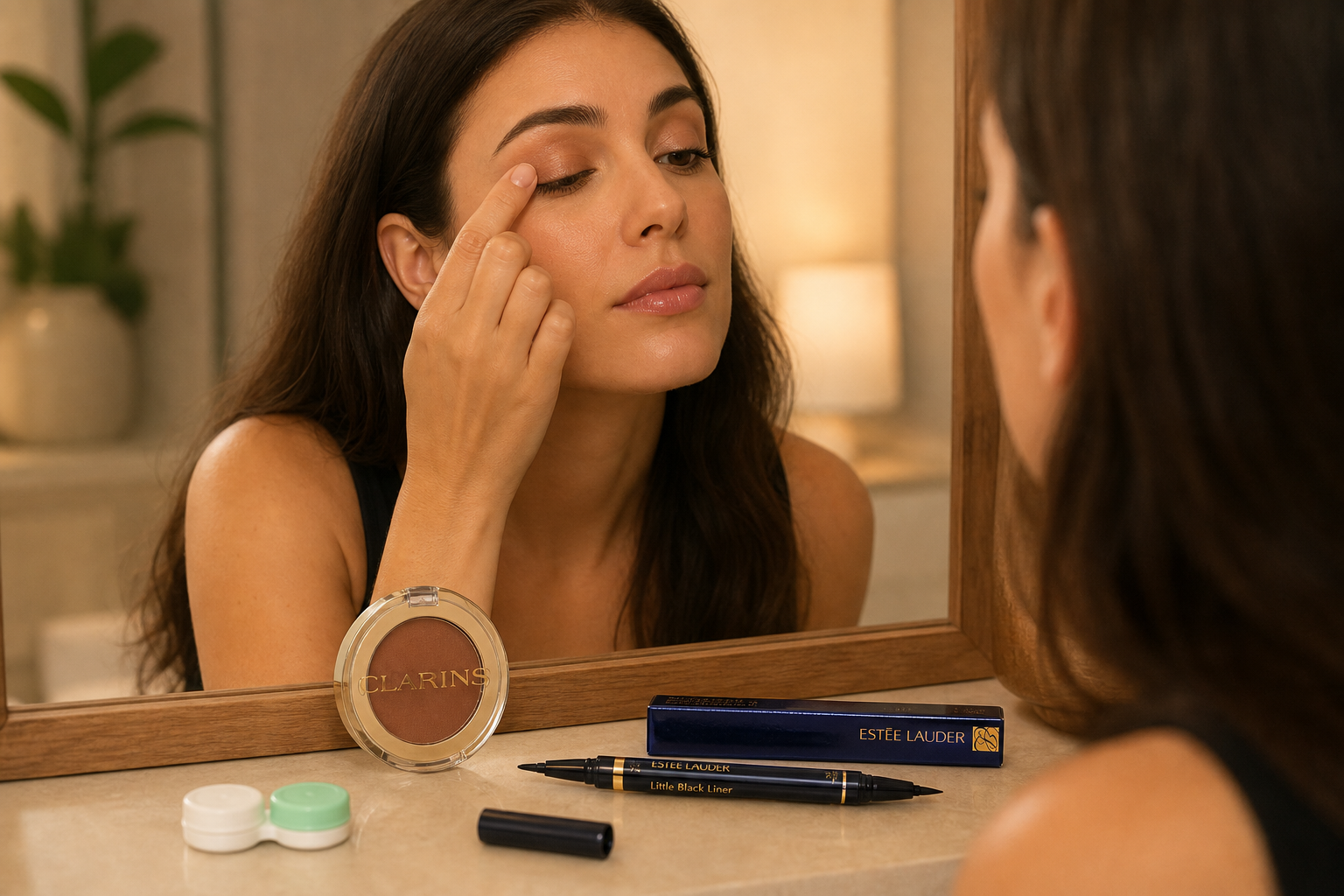
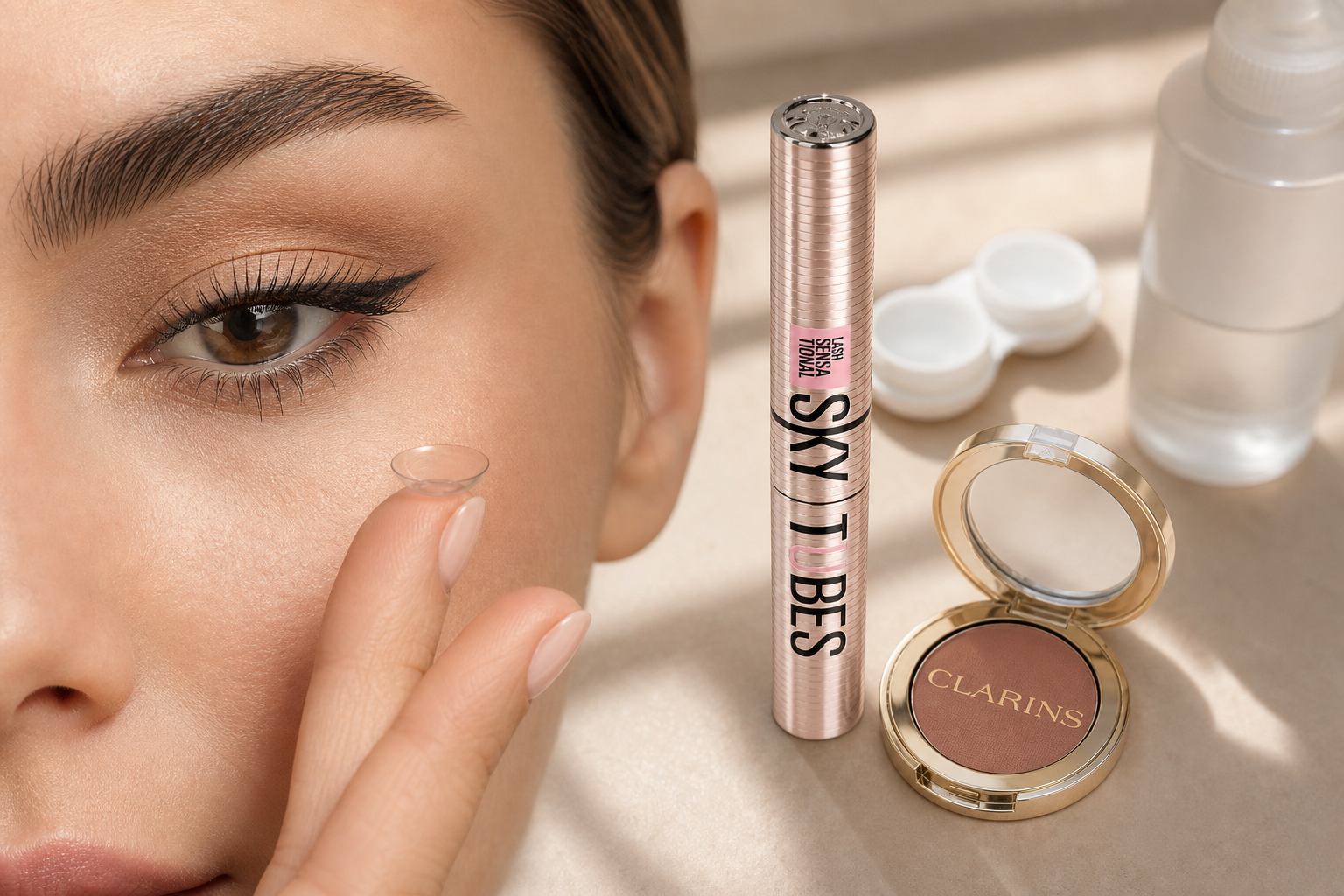
Put your lenses in before you reach for any facial product – that means before makeup, let alone mascara or eyeshadow. The eye and eyelid area should be clean and dry. Any leftover eye cream or serum will easily transfer to the lens surface, leaving a smudged mark that won't wipe off during the day. So, take care of your eye area well in advance, let it absorb, and only then reach for the lens case.
Putting in your lenses first has another advantage: you're applying makeup to an eye that sees clearly, so you don't have to get up close to the mirror and risk brushing too close to your lashes. Give your eyes a minute or two after inserting the lenses to adjust and for any tearing to subside – tears that run into freshly applied mascara can make you redo your work unnecessarily.
Evening: Lenses First, Then Makeup Remover
When removing makeup, the order is reversed, but the logic is the same: remove your lenses before the remover or cotton pad touches your eyelids. If oil or micellar components get on your eye and then you reach for the lens, you'll transfer them directly onto its surface. With monthly or long-term lenses, this creates deposits that the solution can only remove with difficulty. We cover the gentle makeup removal technique in more detail at the end of the article.
Hygiene That Really Matters
There are a few habits around eye makeup that complicate life for contact lens wearers more than anyone else. It's worth checking them:
- Washed and dried hands before any lens handling. Soap without moisturizing oils and a lint-free towel are better choices than a quick rinse with water.
- Regularly washed brushes and applicators. Eyeshadow brushes accumulate pigment and oil from the eyelid; lukewarm water with mild shampoo once a week is enough, and always let the brush dry thoroughly.
- No sharing mascara. The brush goes from tube to eye and back, transferring things that don't belong in someone else's eye. The same goes for trying mascara testers in stores.
- Never dilute dried mascara. Not with water, lens solution, or eye drops – you'll disrupt the preservation and turn the tube into an environment you don't want to transfer to your eye. Dried mascara is a sign it's time for a new one.
A practical tip that saves a lot of hassle: keep a solution and spare case in your handbag. If the lens fogs up, slips, or starts to irritate during makeup application, you have a place to store it and a way to rinse it, instead of blindly putting it back in your eye. With daily lenses, you can simply replace them with new ones in such situations.
If a Particle of Shadow or Lash Gets in Your Eye
It can happen even with the best technique. First of all, don't rub your eye – rubbing moves the particle under the lens and irritates the cornea. Blink several times and let tears do their work; if the foreign body sensation persists, remove the lens with clean hands and rinse it with solution, put back the monthly lens, discard the daily one. You can soothe the eye with moisturizing drops designed for lens wearers. If redness, stinging, or blurred vision continues even after removing the lens, finish your makeup later and consult your eye specialist.
Mascara for Contact Lens Wearers: What to Look for in the Ingredients
Mascara is the most sensitive item in the makeup bag for contact lens wearers. Anything that flakes off during the day ends up in the tear film and from there onto the lens surface. The good news is that you can usually tell the difference between a formula that will irritate you all afternoon and one you won't even notice by checking a few details on the packaging and the type of formula.
Avoid lengthening mascaras with fibers. These so-called fiber formulas contain tiny synthetic or cellulose fibers that attach to the tips of the lashes to visually lengthen them. However, these fibers are the first to flake off during the day – all it takes is rubbing your eye, a gust of wind, or tearing up. Under the lens, they act like foreign bodies: they scratch, make you rub your eyes, and the whole problem just gets worse. If you want a more dramatic look, opt for a volumizing mascara and achieve length by carefully brushing from the roots.
The second criterion is the stability of the formula. Mascara that starts to crumble after a few hours sheds microscopic black particles under the eyes, some of which end up in the tear film. A dry office environment, air conditioning, and heating exacerbate this. It's worth doing your own test: after about six hours of wear, check the lower lid and the skin beneath it in the mirror. If there are dark specks, the formula isn't suitable for you in combination with lenses, even if it applies beautifully.
In practice, you choose between three types of formulas, each behaving differently with lenses:
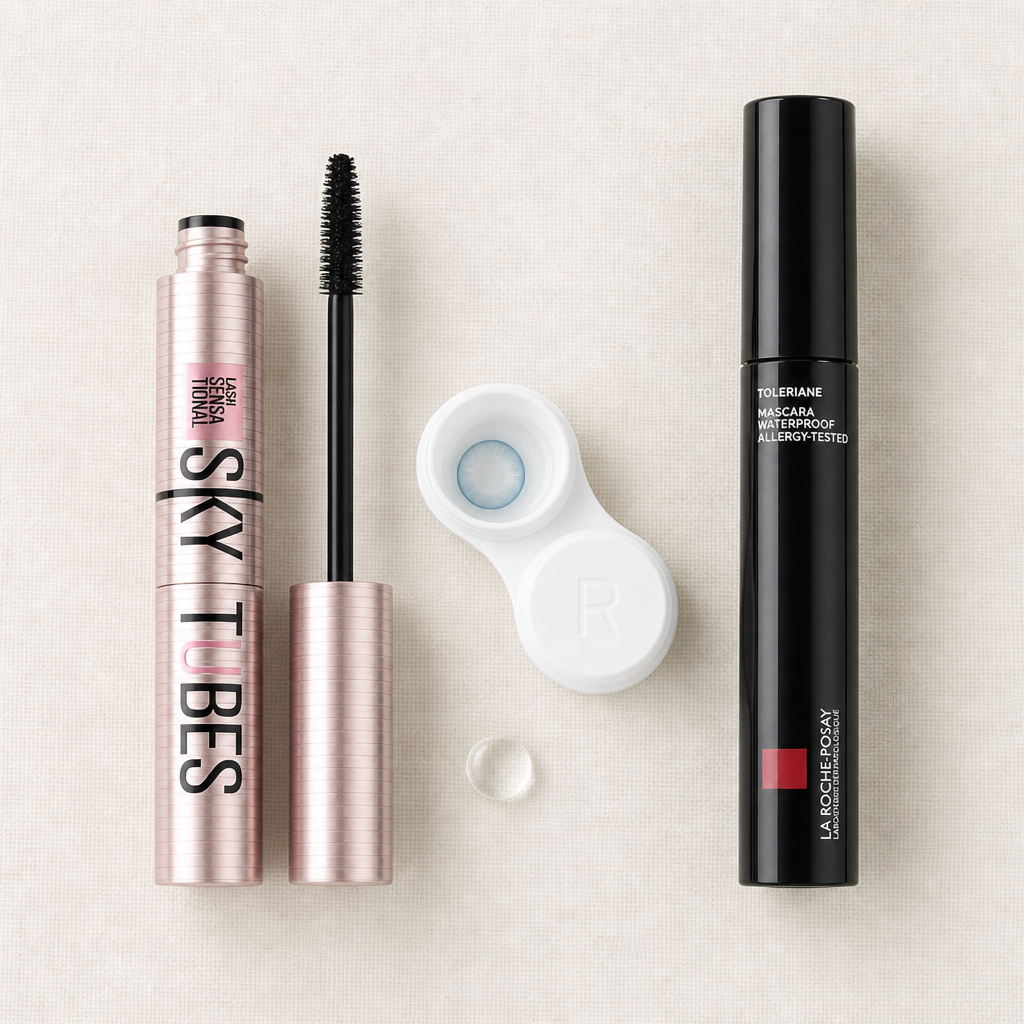
- Tubing mascaras coat each lash in a thin, flexible polymer tube. The formula doesn't use waxes that could crumble, so it stays intact all day. Removal is done with warm water and gentle finger pressure – the tubes slide off whole without rubbing, which is a big advantage for sensitive eyes. The trade-off is a slightly more understated volume, with results being more defined than dramatic.
- Classic washable formulas offer the widest range of effects from volume to curl. However, quality varies significantly from one to another, so watch for the aforementioned crumbling most carefully. A good washable mascara dissolves in lukewarm water with a gentle remover without having to press on the lid.
- Waterproof variants hold up in heat, water, and tears, but this resilience has a downside. They're based on waxes and film-forming agents that water doesn't dissolve, so they require a two-phase remover and more time with a cotton pad. More contact, more rubbing, more irritation – for everyday lens wear, it's the most demanding choice. Save them for weddings, beach holidays, or other special days.
Look for labels like "ophthalmologist tested" and "suitable for contact lens wearers" on the packaging, but read them with caution. They mean the product has passed tolerance tests under the supervision of an eye doctor or on volunteers wearing lenses. It's not a guarantee it will suit you – individual sensitivity can't be resolved this way. However, between two otherwise comparable mascaras, it makes sense to choose the tested one.
The last point doesn't concern the formula, but its lifespan. Replace your mascara about three months after opening, even if there's still some left in the tube. Every time you pull out the brush, air enters the moist environment of the tube, and the formula gradually thickens and changes structure. It's the drying mascara that crumbles the most and applies less smoothly, so you press harder on the lid than at the start. You'll find an indicative period after opening on the packaging near the open jar symbol; for mascaras, it's usually shorter than for other decorative cosmetics, and it's worth taking seriously for eye products.
Matte Eyeshadows, Liner Outside the Inner Lid Edge
Of all the products you apply in the morning, eyeshadows and liners come closest to your contact lenses. While mascara is all about the formula, here the key is texture and application. Every pigment particle that comes off the lid passes through the tear film and can end up on the lens surface – you'll feel it as scratching or blurred vision. But you don't have to give up eye makeup entirely. Just adjust your choice of textures and change two habits in your technique.
Pressed Shadows Stay on the Lid Better Than Loose Ones
Pressed shadows have pigment bound by a binder into a compact disc: they spread on the lid and stay where you place them. Loose shadows and pigments, on the other hand, scatter as soon as you open the jar and again during application; some settle under the eye, some in the tear film. For contact lens wearers, pressed textures are a more practical choice for everyday wear. If you don't want to give up loose shadows, pick them up with a damp brush that binds the pigment, and tap off excess away from the face.
Glitter and Shimmer Pose the Greatest Risk for Contact Lens Wearers
Fine pearlescent sheen and coarse glitter are not the same. Pearl consists of very fine pigments worked directly into the shadow texture, whereas glitter is separate shiny flakes with sharp edges. They don't dissolve in tears and behave like a foreign body between the lens and the eye. Glitter shadows are often the main reason a day with lenses turns into burning and red eyes. But there are alternatives that don't look dull:
- Satin Shadows – their shine comes from microscopic pearl within the pressed mass, so they brighten the lid without crumbling into the eye.
- Cream Shadows – the texture forms a fine film on the lid, doesn't scatter, and layers well; suitable for quick finger application.
- Matte Shadows – the calmest choice for a long day in front of a screen, when you blink less anyway.
Save coarser glitters for days when you wear glasses.
Primer Keeps Shadows Where They Belong
Eye primer is more than a cosmetic luxury for lens wearers. It creates an even base that captures pigment and reduces lid oiliness and color creasing. Less movement on the lid means fewer crumbs under the eye. Apply a thin layer, spread it with your finger up to the lash line, and let it set for a moment; a thick layer crumbles on its own.
Liner Above the Lash Line, Not on the Inner Lid Edge
The inner lid edge, the narrow wet strip between the lashes and the eye, is the one place to avoid completely when wearing lenses. Tiny glands open there, contributing to the tear film composition, and makeup applied directly to this edge washes into the eye in no time. The result is a cloudy view and pigment residue in the case and on the lens itself.
Draw the line along the outer lid edge just above the lash line, starting about a third of the way from the inner corner and extending to the outer corner. Leave the inner corner clean; this will open the eye more than a line drawn all the way to the nose. Highlight the lower lid with a softly blended shadow rather than a pencil. Pencil and liquid liner behave differently throughout the day:
- Eye Pencil – soft kajal pencils melt with the lid's warmth and leave crumbs after a few hours. Opt for harder, fast-drying formulas and go over the finished line with a dry brush.
- Liquid Liner – dries into a continuous film that doesn't crumble, but needs a few seconds to set: don't blink fully until it dries, or it will imprint on the upper lid.
Try out the new combination of shadows and liner on a regular shorter day first, not on a full-day trip.
Gentle Makeup Removal Without Rubbing – A Summary
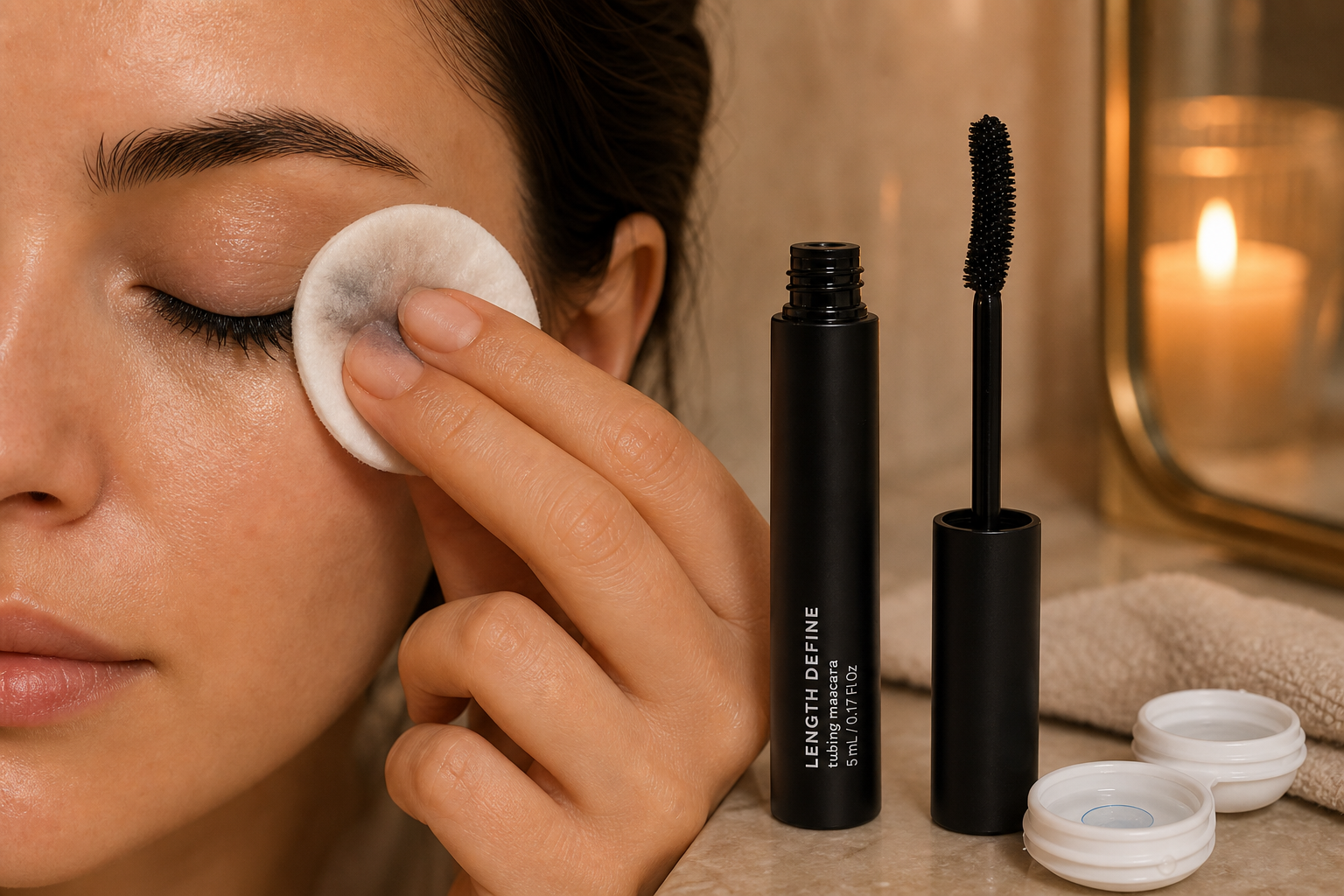
Removing makeup is as crucial for an eye with a contact lens as applying makeup in the morning. It's in the evening, when you're tired and want to finish quickly, that most irritations occur: mascara residues get under the eyelid through rubbing, and the delicate skin around the eyes takes a toll. The good news is that the entire routine takes barely two minutes if done in the correct order.
Steps Worth Following
- Wash your hands and dry them with a clean towel. Moist fingers and cream residues are the most common ways dirt gets onto the lens.
- Remove the lenses. Daily lenses go straight into the bin, monthly ones into a case with fresh solution – never into the solution from the previous day.
- Only then remove eye makeup. As long as the lens is in your eye, any makeup remover can reach it and settle on its surface.
- Choose a product based on your makeup type. Light washable mascara and matte shadows can be dissolved with micellar water, for waterproof mascara or liquid eyeliner, use a two-phase remover – the oil component softens the waxy film, the aqueous phase washes it away.
- Cleanse your face with a regular product and rinse your eyes once more with lukewarm water to ensure no oily film remains on the lashes.
Technique: Apply, Wait, Wipe in One Stroke
The most damage isn't caused by the remover itself, but by the hand movement. Place a moistened pad on the closed eyelid and let it sit for ten to fifteen seconds. The pigment and wax will loosen on their own during this time, so one slow stroke towards the temple is enough. Never rub side to side or in a circular motion – this spreads the pigment over the eyelid and irritates the eye, which is more sensitive than usual after a day of wearing lenses.
For the lash roots and inner corner, use a cotton swab dipped in remover; it's more precise than a full pad. If a gray shadow remains, repeat the process with a clean pad instead of applying more pressure.
If the Eye Feels Dry After Makeup Removal
A slight feeling of dryness after a full day of wearing lenses is not unusual. A final rinse with lukewarm water and possibly a drop of moisturizing eye drops, recommended by your eye specialist for your lens type, will help – apply them only after removing makeup, into a clean eye. If redness or burning persists into the next day, leave the lenses at home and schedule a check-up.
Brief Summary of Rules
- Put on lenses before applying makeup and remove them before taking makeup off – always with clean, dry hands.
- For mascaras, prefer formulas without fibers, non-flaking, and ophthalmologically tested; replace opened mascara roughly every three months.
- Avoid coarse glitters and loose shadows; satin and cream textures are a safer choice.
- Apply eyeliner above the lash line, not on the inner edge of the lid.
- A primer under shadows reduces flaking, so less pigment falls into the eye.
- Do not share brushes and applicators and wash them regularly; never dilute mascara with water or solution.
- Remove makeup by applying and wiping in one stroke, not by rubbing.
Where to Find Suitable Products in Brasty's Offer
When putting together an eye routine for wearing lenses, you only need four categories: mascaras, eye shadows, primers, and eye pencils or liners. In each, you'll find more affordable brands suitable for frequent changes, like Maybelline or Max Factor, as well as more premium lines like L'Oréal Paris or Clarins, where you'll appreciate more sophisticated brushes and finer pigments. However, the decisive factor isn't the price range, but the composition and how a particular product suits your eye. Try one package, observe how your eyes react during the day, and only then make it a staple in your makeup bag.
Category
Recommended articles

"Give a girl the right shoes and she can conquer the world!" Marilyn Monroe