
Why the Skin on Your Neck and Décolleté Needs Different Care Than Your Face
Whether you're dealing with the first fine lines or just wondering why the skin on your neck looks different from your face, one thing is clear: the neck and décolleté are distinct areas with their own set of rules. Changes often appear here before they do on the face – which is why it's worth paying attention to them a few years earlier than you might expect.
The reason is largely anatomical. The skin on the neck and décolleté is thinner than on the face and has fewer sebaceous glands. This means a weaker natural protective barrier, faster moisture loss, and less resistance to external factors. Add to this the mechanics of everyday life: you turn and move your head almost constantly, the skin here is continuously bending and stretching, and collars, scarves, and necklaces further irritate it.
In short, four factors affect this area that the face doesn't experience to the same extent:
- Thinner skin and fewer sebaceous glands – the area dries out more quickly and struggles to retain moisture.
- Constant movement – horizontal lines on the neck form from repeated bending, not facial expressions like wrinkles on the face.
- Friction from textiles and jewelry – wool sweaters, high collars, and necklaces irritate the skin daily.
- Sun exposure – the décolleté is often exposed, but it's easy to forget when applying sunscreen.
Applying the leftover of your daily cream to your neck is obviously better than nothing. However, as a long-term strategy, it's insufficient for two reasons. The first is quantity: you measure out a dose for your face, leaving a thin layer for the neck and décolleté that gets spread too thin. The second is the nature of the product. Facial creams for combination or oily skin tend to be light and mattifying, which is the opposite of what the drier skin on the neck usually appreciates.
It's worth reaching for a targeted product when you notice any of these signs: the skin feels uncomfortably tight after a shower, irritated after wearing a sweater all day, horizontal lines start to appear that don't disappear even when you tilt your head back, or uneven pigment spots appear on the décolleté. No cosmetic can turn back time and guarantee a specific result. What it can do, however, is regularly replenish moisture and lipids and keep the skin in better condition than it would be without care.
When it comes to choosing the right product, you might be surprised: suitable care isn't hidden in just one category in our catalog, but in three. In skincare, you'll find serums and creams that can also be applied to the neck. Body care offers nourishing balms and lotions in volumes that comfortably treat the décolleté and shoulders. And then there's a separate, significantly narrower category of neck and décolleté care with products developed specifically for this area.
The key decision usually isn't between brands, but between three formats – serum, cream, and balm. Each has a different texture, absorbs differently, and suits different skin types and seasons. So before you start comparing specific products, it's worth understanding this trio.
Serum, Cream, or Balm – How Each Format Differs
When choosing care for your neck and décolleté, the difference between serum, cream, and balm isn't just about price or packaging size. Three parameters are decisive: concentration of active ingredients, texture, and the area the product is meant to cover. Once you understand these, the choice narrows down to one question – what issue does your care need to address?
Serum: Targeted Treatment with High Concentration
Serum is the lightest and most concentrated of the three formats mentioned. It has a watery or gel-like texture, absorbs quickly, and doesn't leave a greasy film on the skin. That's why it comes right after cleansing – applied in a thin layer on slightly damp skin and allowed to absorb before applying cream.
An example of such a format is Vichy Minéral 89 Hyaluron Booster, a gel serum with hyaluronic acid designed to enhance skin hydration and elasticity. Serum makes sense when you want to address a specific issue on your neck and décolleté – loss of tone, fine lines, uneven surface – and want to work on it consistently for several weeks. However, on its own, it usually isn't enough: most serums don't have enough lipids to seal and protect the skin.
Cream: Daily Hydration and Protection
Cream is a balanced compromise between active ingredients and comfort. It's an emulsion of aqueous and oil phases, so it hydrates the skin while also providing a layer that slows water evaporation. The texture is thicker than serum, but still spreads well – it's easy to work with on the neck and décolleté even in the morning when you don't want to wait for the care to absorb under clothing.
A richer variant of this format is shown by Vichy Aqualia Thermal Rich Cream with a more nourishing consistency designed for dry skin. Cream can stand alone when your main concern is dryness, tightness, and regular daily maintenance, not targeted treatment. For most people, it's the cornerstone of a routine, with serum added as needed.
Balm: Nourishment for Larger Areas
Balm is the richest of these three formats. It has a dense, almost buttery texture, a higher lipid content, and its purpose is to replenish what the skin lacks when dry, thus supporting the renewal of the lipid barrier. Balms are commonly sold in larger packages because they are intended for application on larger areas – décolleté, shoulders, arms, and the rest of the body.
A typical example is Bioderma Atoderm PP Baume in a 500 ml package, a nourishing body balm that can also be used on the décolleté. You'll appreciate balm during the heating season, after prolonged sun exposure, or when the skin on the décolleté is irritated and flaky. For daily care of the face and neck, however, it tends to be unnecessarily heavy.
Formats Are Not Exclusive, They Can Be Layered
Serum, cream, and balm are not three variants of one choice, but three layers of the same routine. The rule is simple: proceed from the thinnest texture to the thickest, and give each layer a moment before applying the next.
- Morning: serum on slightly damp skin, cream after absorption; in summer months, add a product with SPF on top.
- Evening: serum followed by cream, or balm if the skin is significantly dry.
- Occasionally: balm alone on décolleté and shoulders on days when the skin reacts to cold, air conditioning, or sun.
If you're just starting, it's not necessary to purchase all three formats at once. Choose the one that matches your main concern – hydration, firming, or nourishment – and add the second one once you know what your neck and décolleté skin truly lacks.
Firming Serums and Creams for Mature Skin: Vichy and La Roche-Posay
The loss of firmness often appears on the neck and décolleté before you notice it on your face. The skin here tends to be thinner, with fine horizontal lines remaining visible even at rest, and they become more pronounced with every head turn. If this is your main reason for seeking skincare, it's worth choosing products that focus on firmness and fine lines. In our catalog, this role is primarily filled by two dermocosmetic brands that are among our bestsellers in facial and body care: Vichy and La Roche-Posay.
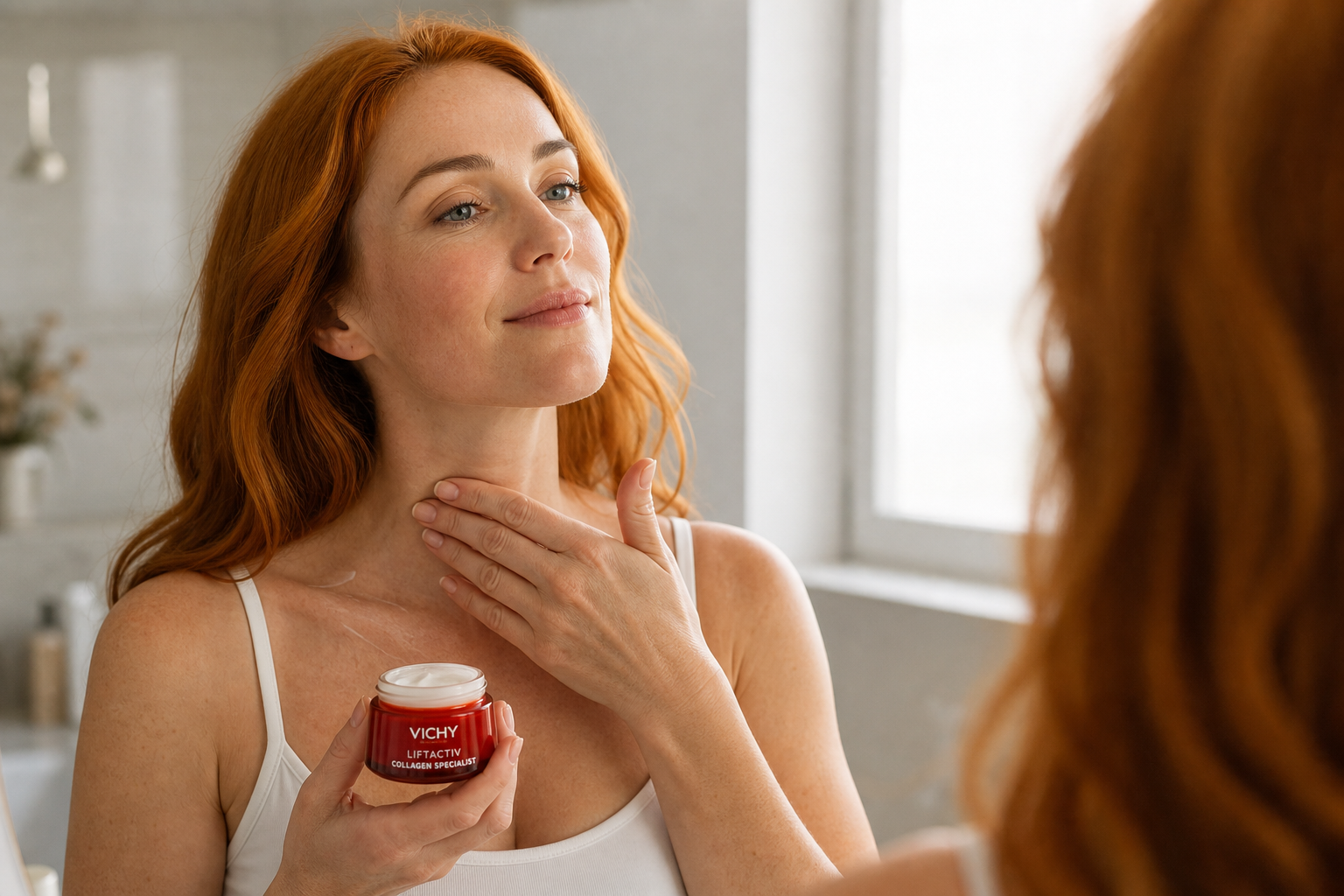
Vichy Liftactiv Collagen Specialist 50 ml is a day cream for skin that is starting to feel less dense. The texture is creamy but not suffocating, so you can spread it from the collarbone upwards to the neck and jawline without pulling the skin down. Expect to use more product on the neck and décolleté than on the face: the area is larger and the skin tends to be drier.
The night variant, Vichy Liftactiv Collagen Specialist Night 50 ml, is richer and takes into account that the skin is not disturbed by sun or clothing friction overnight. It makes sense especially if you find the day cream not nourishing enough for the décolleté, but you don't want to deal with a greasy film under your shirt during the day. Both variants can be combined: lighter in the morning, richer in the evening.
If you're dealing with changes associated with menopause, opt for the Vichy Neovadiol line. The night Neovadiol Post-Menopause Replenishing Firming Cream Night 50 ml targets skin that quickly loses comfort and firmness after menopause. Its daytime counterpart is the Neovadiol Post-Menopause Firming Anti-Dark Spots Cream SPF 50 50 ml, which, in addition to its firming focus, offers high sun protection and targets brightening of dark spots. This is practical for the décolleté: it's one of the areas we often leave exposed for years, and darker spots appear here more frequently than elsewhere.
If you want a more potent active ingredient and your skin can handle regular care without irritation, consider La Roche-Posay Retinol B3 Serum 30 ml. It's a light serum with retinol, applied before the cream, so it doesn't replace your firming cream but precedes it.
Retinol deserves careful introduction, especially in this area where the skin reacts more sensitively than on the face:
- Start twice a week, in the evening, on clean and dry skin.
- Gradually increase the frequency over several weeks, only if no tightness, redness, or peeling occurs.
- Do not combine retinol with other exfoliating products on the same evening.
- If irritation occurs, take a break and return to simple hydration.
- Always use sun protection in the morning: consider Vichy Liftactiv B3 SPF 50 50 ml, which combines daily care with a high protection factor.
Sticking to just the serum without morning protection doesn't make sense. Sun exposure is one of the factors that most significantly affects the appearance of the décolleté, and without protection, you're undoing part of the work of your evening care.
Whether you choose the collagen-focused line, the menopausal line, or the retinol serum, take it as a recommendation based on need, not a guarantee of results. Cosmetics can improve comfort, hydration, and the overall appearance of the skin, but they won't rewrite genetics or years spent in the sun. Consistency is usually more decisive than the price of the product: a cream that you actually apply every evening down to the décolleté will do more than the most expensive serum forgotten in the bathroom cabinet.
Nourishing Balms for Dry and Sensitive Skin: Bioderma and CeraVe
Not everyone is looking for a tight contour and smooth wrinkles on their neck and décolleté. Many people describe a completely different situation: skin that feels tight after a shower, peels in winter, reacts to wool and perfumed body lotions, and itches unpleasantly in the evening. In this case, starting with a firming serum doesn't make sense. First, you need to replenish missing lipids and support a weakened skin barrier – and that's exactly what balms are for.
Compared to a facial cream, a balm is thicker and greasier. It has a higher oil phase content, creating a more continuous layer on the skin that slows down water evaporation, allowing it to last significantly longer – even overnight for very dry skin. The second advantage is purely practical: balms are sold in half-liter and larger packages, so you can treat your neck, décolleté, shoulders, and arms without counting every drop. A fifty-milliliter facial cream would be used up in a few weeks on the same area.
Three Balms for Larger Areas
- Bioderma Atoderm PP Baume Ultra-Nourishing Balm 500 ml – a classic for very dry skin prone to itching. The texture is rich but absorbs faster than its appearance suggests, so you don't have to worry about a sticky shirt collar. It has long been one of the most sought-after items in our body care catalog, with demand rising significantly during the colder months.
- La Roche-Posay Lipikar Baume AP+ M 400 ml – a lipid balm developed for dry skin prone to atopy. It's suitable when dryness on the décolleté returns seasonally and is accompanied by irritation after showering. Its consistency is slightly lighter than Atoderm, making it ideal for transitional months when the richest texture isn't yet needed.
- CeraVe SA Smoothing Cream 340 g – the choice for skin that feels rough or grainy to the touch. It combines ceramides with salicylic acid, so in addition to nourishing, it also helps smooth the surface. Apply it to the décolleté only on truly rough areas and avoid the eye area; for irritated skin, opt for one of the previous two balms.
Whichever you choose, apply it to still damp skin after showering and spread it upwards from the décolleté to the neck with gentle strokes without pressure. Damp skin helps spread the balm in a thinner layer.
Care Begins in the Shower
The balm will only work as well as the washing routine that precedes it allows. Hot water and a highly foaming shower gel wash away the skin's sebum film, and dryness on the décolleté returns before the balm can take effect. The Bioderma Atoderm Huile de Douche 1000 ml shower oil is a grateful substitute in this regard: it transforms into a gentle emulsion upon contact with water, doesn't dry out the skin as much, and leaves a thin nourishing film after drying. Keep the water lukewarm and pat dry with a towel after showering, rather than rubbing – rough scrubbing can irritate sensitive décolleté on its own.
When a Balm is Enough and When to Supplement It
A balm alone is more than sufficient if the main issues are dryness, tightness, and sensitivity, and the skin still retains its elasticity. In such cases, there's no point in creating a multi-step routine – using one well-chosen balm twice a day will do more than three products used irregularly.
However, when visible loss of elasticity and fine horizontal lines accompany dryness, layering makes sense. In the morning, apply a lighter firming serum to clean skin and let it absorb, then use a rich balm as the final step in the evening. The rule of applying from the thinnest to the thickest texture also applies here: a serum won't penetrate through a thick occlusive layer.
How to Choose by Age and Skin Type: Specific Tips from Our Catalogue
Before you reach for a specific bottle, it helps to narrow down your decision to three simple branches. It's not so much about the price, but rather what the skin on your neck and décolleté needs at that stage: sometimes hydration and prevention are enough, other times targeted firming care is necessary, and for dry skin, rich nourishment is key. This will also determine the format you choose.
Under Thirty: Prevention and Light Hydration
If you're mainly dealing with dryness after removing makeup or a feeling of tight skin, a light serum that absorbs quickly and doesn't leave a film under clothing will suffice. From our range, Vichy Minéral 89 Hyaluron Booster 75 ml (£19.99) fits here – a hydrating serum with hyaluronic acid that you apply to your face and with the same upward stroke, extend over your neck to the décolleté.
At this age, consistency is more important than composition. Apply daily, and if you spend time outdoors, complement your care with a product containing SPF – the décolleté is one of the areas most frequently exposed to the sun.
After Forty: Targeted Firming Care
When horizontal lines on the neck become noticeable and the skin on the décolleté appears less supple, it makes sense to switch to a product formulated specifically for mature skin. Vichy Liftactiv Collagen Specialist 50 ml (£24.99) is a day cream from a range focused on smoothing wrinkles and firming contours; the night variant Vichy Liftactiv Collagen Specialist Night 50 ml (£27.99) is richer and suitable if you find a heavier texture bothersome under makeup during the day.
For skin post-menopause, which tends to be drier and thinner, we offer Vichy Neovadiol Post-Menopause Replenishing Firming Cream Night 50 ml (£31.99). Keep in mind that with firming products, changes appear gradually – you'll notice a difference after several weeks of regular use, not after just one week.
Dry, Sensitive, or Atopic Skin: Intensive Nourishment
If the skin on your décolleté peels or itches in winter, a serum or light cream won't solve the problem. Opt for a balm with a higher lipid content: Bioderma Atoderm PP Baume Ultra-Nourishing Balm 500 ml (£13.99) is a large-volume option for the whole body, including the neck and décolleté, similar to La Roche-Posay Lipikar Baume AP+ M Lipid Replenishing Body Balm 400 ml (£16.99). Both are suitable for sensitive skin and can be used long-term.
A special case is rough, uneven skin on the arms and décolleté. Here, a cream with an exfoliating component, such as CeraVe SA Smoothing Cream 340 g (£14.99), which combines smoothing with hydration, is effective. However, do not use it simultaneously with other irritating products.
How Much to Invest in Neck and Décolleté Care
The difference in price ranges is more noticeable here than with regular body cosmetics. Nourishing balms range roughly between £10 and £16 and last for months due to their large volumes. Firming serums and creams for mature skin start around £19 and for specialized lines, you can reach £27 to £31 for a 50 ml package. If you're unsure, start with a mid-range product and only switch to a more expensive one once you have established a routine – there's no point in paying for concentrated care that you then use only once a week.
A more focused selection of products specifically designed for this area can be found in the Neck and Décolleté Care category. It's a smaller category, so if nothing suits you there, browse the broader range of facial and body cosmetics – most serums, creams, and balms from facial and body care are equally suitable for the neck and décolleté.
Category
Recommended articles
"Give a girl the right shoes and she can conquer the world!" Marilyn Monroe