



Why Leg Hair Grows Inward After Shaving
You know the drill: you shave your legs in the evening, your skin feels smooth to the touch, and everything looks just as it should. But two or three days later, small bumps appear, some follicles turn red, and your legs start to itch. Sometimes you can even see a dark loop of hair under the surface that hasn't made it out. Whether you shave year-round or just during the season of short skirts and shorts, this scenario is familiar to most people – and it has nothing to do with skill.
Ingrown hair isn't the result of a clumsy razor stroke. It occurs where two circumstances meet: the way the hair grows back after being cut and the condition of the skin it has to penetrate. The freshly growing end is shorter and sharper than before, so it easily curls and heads under the skin instead of out. If the skin's surface is dry or thickened, the hair encounters an obstacle and gets trapped beneath it. This irritation is scientifically known as pseudofolliculitis and is a common skin reaction to shaving.
Some situations increase the risk more than others. Ingrown hairs are more common in people with thicker or significantly curly hair, dry and flaky skin, after dry shaving, and in areas where tight clothing presses against the skin – typically around the ankles, inner thighs, or behind the knees. The season also plays a role: in winter, leg skin tends to be drier, so bumps appear more easily than in summer. So if you feel like your legs "only cause problems sometimes," it's not a coincidence.
The good news is that prevention doesn't rely on one miraculous step but on three interrelated pillars:
- Exfoliation – regular and gentle removal of dead cells from the surface to give the growing hair a clear path out.
- Hydration – supple skin is more flexible and offers less resistance to growing hair.
- Skin Barrier Care – calm and non-irritated skin recovers faster after shaving and reacts less frequently with redness.
We will explore each of these pillars in more detail, including how to incorporate them into a routine that won't take more than a few minutes a week. Most people don't need to overhaul their entire bathroom – just align the timing of each step with when you actually shave.
There's one more thing that's good to clarify right from the start. Typical ingrown hairs appear as small bumps with a visible hair inside and resolve on their own within a few days. However, if painful red nodules, pus-filled areas, fever, or repeated irritation in the same spot occur and don't improve, it's no longer a cosmetic issue, and bathroom care won't suffice. In such cases, a dermatologist is needed – they will assess whether the problem is due to follicle inflammation or another skin condition and recommend an appropriate solution. Cosmetics can prevent and alleviate ingrown hairs, but they don't treat inflammation.
How Ingrown Hairs Form: Follicle, Keratin, Friction
Ingrown hairs don't happen by chance. They are caused by a combination of three factors: the shape of the follicle, the rate at which the skin's surface layer renews, and external mechanical irritation. Understanding what happens beneath the surface makes preventive steps much more sensible.
A hair grows from a follicle—a tiny canal in the skin that opens to the surface with a small opening. A razor doesn't remove the hair from the root; it merely shortens it, and very low: when the skin is stretched, the blade cuts below the surrounding surface level, leaving the shortened end hidden in the canal. As the hair continues to grow, it must find its way out again, and if it encounters resistance, it bends sideways or back into the skin. Additionally, the razor leaves a slanted cut with a sharp edge, which penetrates the surrounding tissue more easily than a naturally tapered tip. The result is often a small red bump.
Keratin: Why the Follicle Opening Gradually Closes
The skin's surface layer is constantly renewing: dead keratinized cells flake off to make way for new ones. However, this process doesn't always run at the same pace—it's slowed by dry air, cold, long hot showers, and shaving itself. When the flaked-off cells aren't washed away, they accumulate around the follicle opening, gradually narrowing or covering it. The growing hair then encounters a layer it can't penetrate and continues to grow beneath it—curled to the side or into a ball. On the surface, this appears as a harder bump, sometimes with a darker hair visible underneath. This is why bumps tend to persist more on dry skin.
Mechanical Friction, Stronger Hairs, Exposed Areas
The second trigger is mechanical irritation. Tight leggings, stockings, or high boots press the fabric against freshly shaved skin and gently rub with each step. The skin responds to repeated friction by thickening the horny layer, so the follicle openings close even more readily; with moisture and sweat, the irritated area becomes more sensitive.
Not every hair is equally prone to this. Stronger and curlier hairs grow curved even inside the follicle, so their ends more often aim at the canal's side wall instead of straight out. For fine straight hairs, the risk is lower, but never zero.
On legs, bumps most commonly appear on the shins and behind the knees. The skin on the shin is stretched over the bone, and the blade easily "skips" longer hairs, so the same spot is shaved repeatedly. The area behind the knee is soft, less accessible, and constantly bends while walking—a combination of repeated strokes, friction, and bending is most challenging for follicles.
Shaving Technique That Encourages Ingrown Hairs
The last piece of the puzzle is in your hands. Shaving technique determines how deeply the hair is cut and how much the skin suffers in the process.
- Dull Razor. A worn blade tends to tear the hair rather than cut it cleanly. The end remains frayed, and the skin becomes more irritated.
- Dry Shaving. Without gel, foam, or oil, the blade drags over dry skin, stripping away part of the protective film; a softened hair is much easier to cut.
- Repeated Strokes Against the Growth Direction. They may give a smoother result but cut the hair deepest—precisely where it's easiest to curl back into the skin.
- Strong Pressure and Repeated Strokes on One Spot. The more times the blade passes over the same section, the more surface skin cells it removes.
Ultimately, it's always the same equation: the deeper the hair is cut and the more closed the skin's surface is, the less chance the growing end has to emerge. Prevention therefore targets both sides of this equation.
Exfoliation as a Foundation for Ingrown Hair Prevention
When a growing hair cannot break through the skin's surface, it's often due to a thin layer of dead, keratinized cells clogging the follicle's opening. Exfoliation targets this issue directly: it regularly thins this layer, allowing the hair to emerge more easily. That's why it's worth considering it as a regular part of leg care, rather than a rescue solution when bumps are already visible.
You can approach exfoliation in two ways – mechanically or chemically. Both methods aim for the same goal but differ in how they achieve it and who they suit.
Mechanical Peels
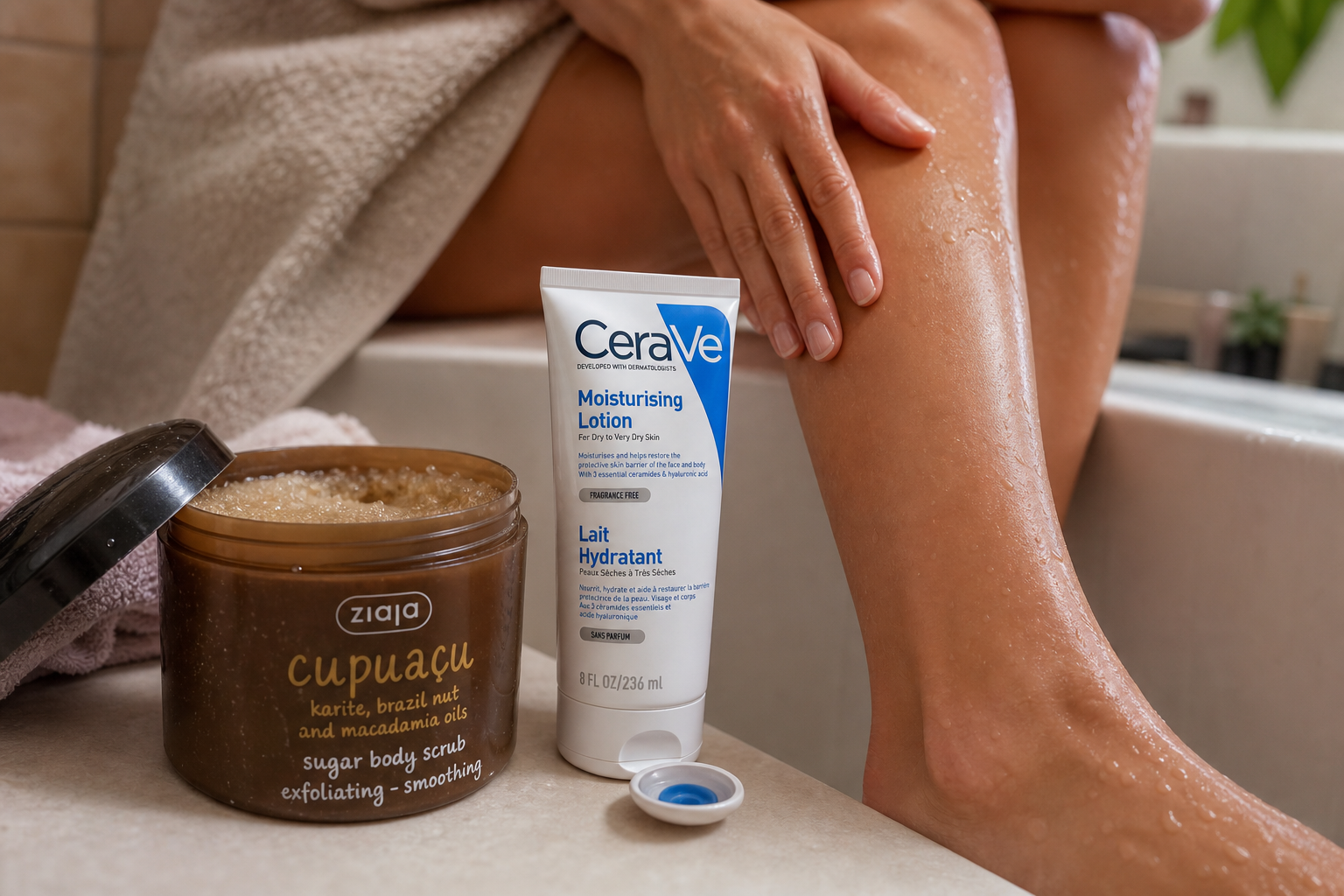
Mechanical exfoliation removes dead cells through friction. This includes body scrubs with sugar or salt particles, exfoliating gloves, brushes, and loofahs. The advantage is the immediate feeling of smooth skin and the ease of incorporating it into your shower routine. However, gentleness is key: use light pressure, short circular motions, and don't linger on one spot. Coarse particles and vigorous scrubbing can irritate the skin and damage its surface – and irritated skin is more prone to ingrown hairs, not less.
Mechanical peeling is particularly suitable when your skin can tolerate touch without redness and your legs have no active irritation or fresh wounds.
Chemical Exfoliation
Chemical exfoliation doesn't rely on friction but on substances that loosen the bonds between dead cells, allowing them to shed more easily. Salicylic acid dissolves in fats, reaching the follicle's opening and is often chosen where bumps recur. Fruit acids, such as glycolic or lactic acid, work more on the surface and, besides smoothing, help the skin retain moisture. Urea plays a dual role: in higher concentrations, it softens the keratinized layer, while in lower concentrations, it hydrates – making it suitable for drier legs prone to rough surfaces.
Chemical options are generally kinder to sensitive skin as they eliminate friction. They usually come in the form of body lotions, serums, or tonics that you simply apply and leave to work. Expect results after several weeks of regular use, not after the first night. If you're trying acids for the first time, start with a lower concentration, test the product on a small area, and monitor how your skin reacts.
How Often and When
Whichever method you choose, twice a week is usually sufficient. More frequent exfoliation won't yield better results – it may disrupt the skin's protective layer, which helps it withstand everyday stress, and open the door to irritation. For more sensitive skin, it's wise to start once a week and only increase when it's clear your legs can handle it without issues.
The timing around shaving plays a bigger role than it seems. Exfoliating right before shaving removes the layer that protects the skin during razor strokes, making shaving more irritating. Immediately after shaving, the skin is freshly stressed and doesn't handle additional stress well. A practical compromise looks like this: exfoliate the day before shaving or on a non-shaving day, and leave at least one day between the two activities.
And one more important note: exfoliation is not suitable for red, scratched, or inflamed skin. Until the skin calms down, stick to gentle cleansing and hydration; once it's calm, you can return to a regular routine.
Post-Shave Hydration: How to Support Your Skin Barrier
Exfoliating dead skin cells is only half the battle. If you don't replenish water and oils in your skin equally, it returns to a state where the surface dries out quickly, flakes slightly, and new hair growth encounters a tighter layer of keratinized cells. Additionally, dry skin struggles more with razor friction, perpetuating a cycle of irritation. That's why hydration is often the step that determines whether bumps return after a few days.
The skin barrier is a thin layer on the skin's surface where cells are connected by lipids—primarily ceramides, fatty acids, and cholesterol. Shaving mechanically thins this layer because the razor removes some surface cells along with the hair. This is why skin sometimes burns or feels tight after shaving, even if there's no visible injury. The purpose of post-shave care is to replenish this layer before it becomes excessively keratinized.
Body Lotion, Balm, or Shower Oil?
- Body Lotion – A light emulsion with a higher water content. It absorbs quickly and doesn't leave a greasy film, making it suitable for daily use in warmer months and for skin that's more dehydrated than truly dry.
- Body Balm – A thicker texture with a higher fat content. It stays on the skin longer, making it ideal for winter, very dry legs, or areas where bumps repeatedly appear.
- Shower Oil – Replaces traditional shower gel during washing. It doesn't strip as many natural lipids from the skin as foaming gels do, which is beneficial if your legs usually itch after a shower or if you have dry and sensitive skin.
Several groups of ingredients are worth noting. Ceramides are among the lipids that the barrier naturally contains, so they help replenish what is lost through shaving and washing. Glycerin acts as a humectant—it binds water and retains it in the upper layers of the skin. Urea has a dual role: at lower concentrations, it hydrates, and at higher concentrations, it softens the keratinized layer, which is a practical feature if you're prone to ingrown hairs. Panthenol is often found in products for irritated skin because it alleviates the feeling of tightness and redness after shaving.
Timing is as crucial as the composition. Apply the product to still damp skin, ideally within a few minutes after towel-drying—damp skin has water on its surface, which the moisturizing product helps retain inside. If you wait an hour, you'll be dealing with a dry surface, and the effect is noticeably reduced.
The second important factor is consistency. Hydration doesn't work as a rescue mission on the day of shaving; the skin barrier renews gradually over several days, so you'll see results more after two to three weeks of daily care rather than after one generous application. If you have sensitive skin, opt for fragrance-free and alcohol-free products, and avoid strongly scented body lotions immediately after shaving—freshly shaved skin reacts more sensitively to them than usual.
How to Create a Routine to Prevent Ingrown Hairs
When you read everything that's good for your skin after shaving, it might seem like a long to-do list. In reality, just a few habits in a consistent rhythm are enough – preparation, gentle technique, exfoliation between shaves, and hydration. Consistency matters more than individual products: supple skin free of dead cells offers less resistance to regrowing hair.
What a Typical Week Might Look Like
Consider the schedule below as a framework to adjust based on how quickly your hair grows back and how sensitive your skin is.
- Shaving day, before showering. Let your skin soften in warm water for a few minutes. Softened hair is easier to shave and the razor doesn't have to press hard.
- The actual shaving. Always use gel, foam, or oil, never dry. Replace the razor head before it starts pulling, and glide it in the direction of hair growth.
- Immediately after shaving. Rinse with lukewarm water, pat dry, and apply soothing hydration. Save products with alcohol for another time.
- Second to third day. First exfoliation, short and gentle. Not earlier – freshly shaved skin has tiny micro-cuts.
- The rest of the week. Hydration every day, ideally after a shower on damp skin. This step is most often skipped.
- The day before the next shave. Another exfoliation, so the hairs don't have to break through a thickened layer.
If you shave once every ten days, the cycle will stretch. If you shave twice a week, reduce exfoliation and choose a gentler option – otherwise, you'll overburden your skin and irritation will return from the other side.
What to Avoid
- Squeezing and picking at ingrown hairs. You'll only enlarge the follicle damage and risk inflammation or a dark spot that can take months to fade.
- Repeatedly going over the same spot. Each additional stroke removes a bit of the protective layer, so smoothness lasts briefly, but irritation lingers.
- Dull razor and dry shaving. The hair remains unevenly cut and is more likely to curl back into the skin.
- Strong exfoliation on freshly shaved skin. Grainy scrubs or high acid concentrations don't belong on that day.
- Tight clothing right after shaving. Leggings press regrowing hairs against the skin, and friction does the rest.
When to Leave Care to a Dermatologist
A home routine can handle common bumps and occasional redness. However, there are situations where it's wiser to see a specialist: when inflammation lasts for weeks and doesn't improve, when painful lumps or pus-filled areas develop, or when ingrown hairs keep recurring despite all care. A dermatologist will assess whether it's folliculitis or another skin issue and recommend a treatment that cosmetics can't replace.
What to Equip Your Routine With
All you need for the entire process are four things: a shaving product, a sharp razor, exfoliating care, and hydration. You can find the cosmetic part in the body care category:
- Smoothing body creams with salicylic acid – chemical exfoliation that you just apply and let work; practical for bumpy skin on thighs and calves.
- Nourishing body balms – thicker texture for dry skin, usually with ingredients like urea, ceramides, or panthenol.
- Shower oils and gentle cleansing gels – replace drying soap and prepare the skin for shaving.
Among the brands we have long carried in this category are Bioderma, CeraVe, or La Roche-Posay – all have lines for dry and sensitive skin, so you can put together a complete routine from shower to balm. Choose based on how your skin reacts.
The final advice is: give it time. Already ingrown hairs need weeks to come out, so you usually notice a difference after about a month of regular care. But then it becomes noticeable.
Category
Recommended articles
"Give a girl the right shoes and she can conquer the world!" Marilyn Monroe