



Have you grown your hair to shoulder length and are struggling with tangles, frizz, and split ends? We'll guide you through washing, conditioning, leave-in care, and detangling techniques to ensure a longer style looks neat even without daily styling.
Why Longer Men's Hair Behaves Differently
Hair that falls below the ears has a characteristic that short hair doesn't: it starts to have a life of its own. In the morning, it looks fine, but just an hour in a jacket with a collar can cause the ends to tangle into tiny knots. The top layer becomes static in dry air, creating a subtle halo around the head that can't be tamed with fingers. A well-cut style can then appear unkempt, even if you visited the hairdresser three weeks ago.
The reason usually isn't neglect, but the structure of longer hair itself. Hair grows about a centimeter a month on average, so the ends of a cut that reaches below your ears can be two or even three years old. During that time, they've endured hundreds of washes, friction from clothing, sun, frost, and towels. The outer layer of the hair, which normally seals it like roofing tiles, is worn down at the ends and doesn't fit snugly. As a result, the hair retains moisture poorly, dries out quickly, and tangles more easily with neighboring strands.
At the roots, the opposite is happening. Men's scalps tend to be more active in producing oil, so hair near the scalp gets greasy faster than hair of the same length on women. One head thus hosts two different situations at once: a scalp that needs regular cleaning and dry lengths that are burdened by each wash. Therefore, the universal method of lathering the entire head with shampoo and calling it a day is no longer sufficient for longer hair.
The good news is that the difference between a well-groomed and neglected longer style isn't about styling. It's not about how much paste you put in your hair in the morning or how long you spend shaping it. The difference lies in four habits that focus on care, not styling.
Four Habits That Support Longer Hair
- Washing focused on the scalp, not the lengths – clean what actually gets oily, and avoid unnecessarily drying out the rest of the hair.
- Conditioner after every wash, applied roughly from the ears down – restores smoothness to the lengths, preventing them from tangling so easily.
- Leave-in care and oil for the ends – provide protection where the hair can no longer do so itself, addressing what happens between washes.
- Detangling with the right technique and suitable tools – most mechanically broken hairs occur during brushing, not washing.
None of these steps are salon procedures. Together, they take just a few minutes a day, with most of the work happening in the shower or right after. What doesn't pay off is trying to make up for neglected care in one go – one mask a month won't fix what happens to your hair during the other thirty days. We will therefore discuss each of the four habits separately, including how often to wash, how much product to use, and what to avoid when detangling.
Washing That Won't Dry Out Your Hair
For hair that reaches below the ears, washing is handled differently than with a short cut. With short hair, shampoo runs through the entire length in a few seconds and doesn't have time to cause any damage. However, longer hair has to endure the cleansing agents for much longer, leading to a situation familiar to anyone who has transitioned to a longer style: the roots are clean after washing, but the ends suddenly feel rough to the touch, look dull, and are harder to comb. The good news is that this can be resolved with washing technique, not a major change in your bathroom routine.
Shampoo Belongs on the Scalp
Oil is produced on the scalp, not at the ends. So, apply shampoo to the dampened roots and massage it into the scalp with your fingertips: from the forehead to the back, behind the ears, and at the nape, where washing is often forgotten. Don't press your nails into the scalp; a calm, consistent pressure with your fingertips for about half a minute is sufficient. The massage does more for cleanliness than a larger amount of product.
Leave the lengths alone. When you start rinsing your hair, the foam will naturally flow down and clean the ends more gently than if you were to massage shampoo directly into them. If you're washing your hair after using styling paste or after a longer break, a double dose won't help, but rather a second quick wash: a small amount of shampoo, a quick massage of the scalp, and rinse.
How Often to Wash
The frequency doesn't depend on the length of your hair, but on the behavior of your scalp. A practical division that works:
- Oily scalp – you can wash every other day, or even daily if you're exercising. The condition is a gentle hydrating formula instead of a strongly degreasing shampoo; the latter may relieve for a day, but it dries out the scalp and the ends of longer hair suffer the most.
- Normal scalp – usually twice to three times a week is enough, and the lengths stay in good condition between washes without any problems.
- Dry or sensitive scalp – choose a lower frequency and look for a shampoo labeled as hydrating or for sensitive scalp.
Longer hair isn't damaged by the frequency of washing, but by aggressive formulations and hot water. If you opt for a gentler variant, you can wash more often than you expected.
What to Choose From
There are the most shampoos in hair care on Brasty, so choosing isn't a problem, rather the opposite. Orient yourself by two things: what the scalp needs and what the lengths need. For longer men's hair, a slightly oily scalp usually meets dry ends, so look for a hydrating or regenerating professional line that cleanses gently.
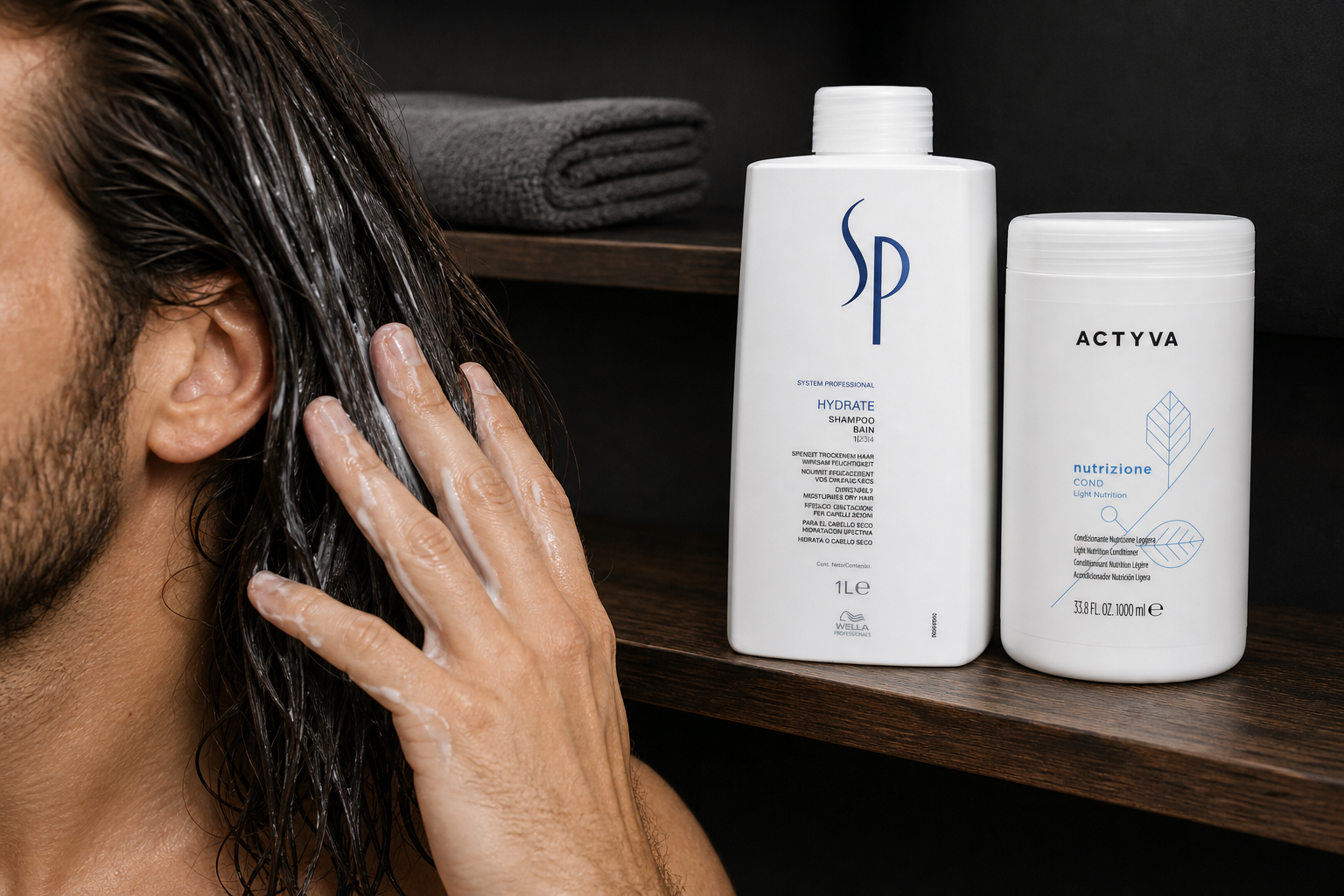
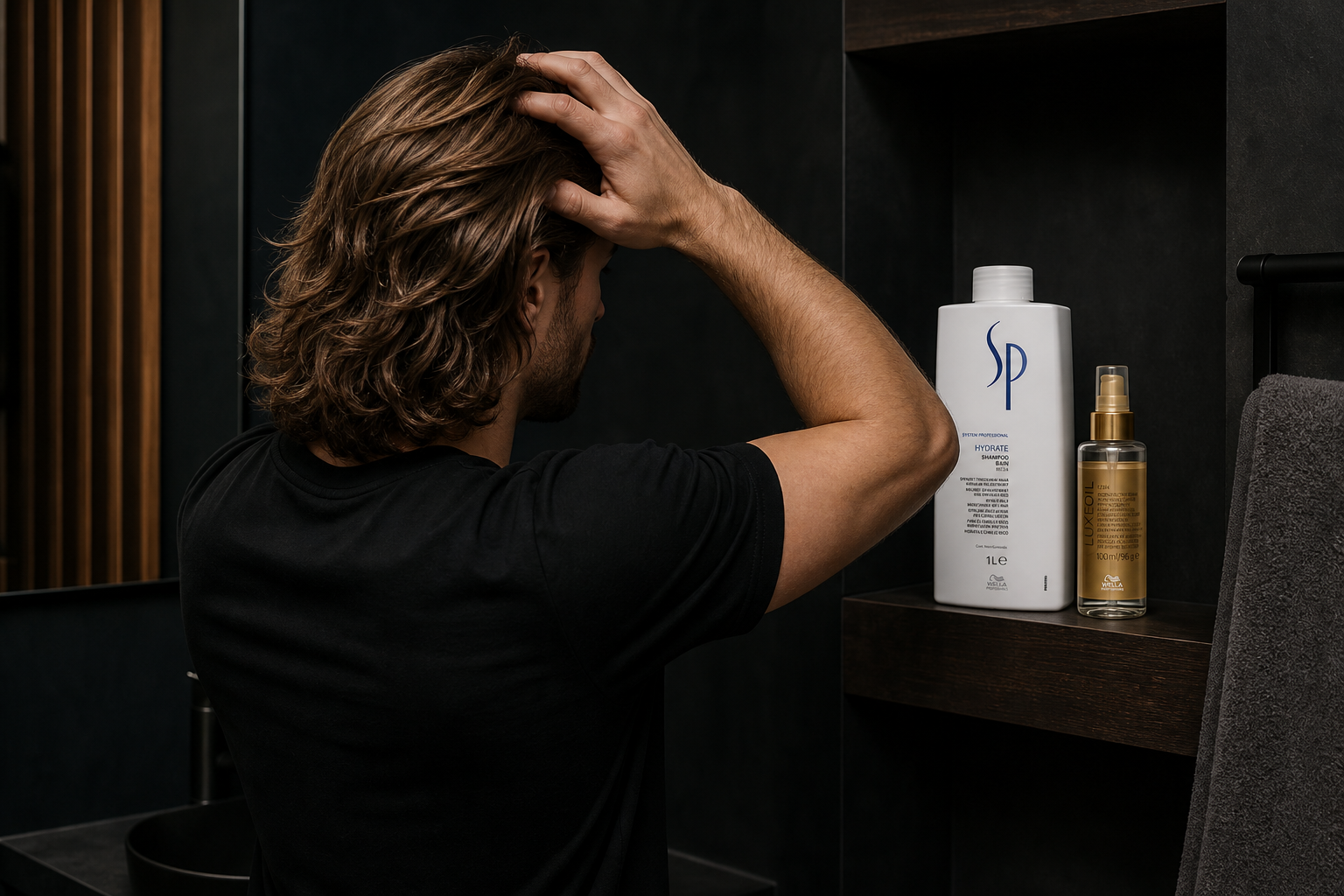
For example, the Wella Professionals SP Hydrate line, focused on hydrating dry hair, or L'Oréal Professionnel Série Expert Absolut Repair, which targets mechanically stressed and damaged lengths, are good examples. If you're mainly dealing with dandruff or itching, choose from the category of shampoos for sensitive scalp and catch up on the lengths with subsequent care.
Details That Make a Difference
The rest are small things to keep in mind for just a moment:
- Lukewarm water – a hot shower opens the hair cuticle and removes the protective oil from the lengths. Lukewarm water cleans just as well and leaves the hair smoother.
- Thorough rinsing – shampoo residues at the roots weigh the hair down and appear as grease the next day. Rinse a little longer than you think necessary, especially at the nape.
- Gentle squeezing – squeeze water from the lengths with your palms from top to bottom, then just wrap your hair in a towel and let it absorb for a while. Rubbing with a towel is the main cause of split ends and tangling in longer hair.
Wet hair is most vulnerable, so there's no rush after washing. Before you move on to the next step in care, let your hair drip dry for a few minutes.
Conditioner and Mask as the Foundation of Detangling
Longer hair doesn't tangle because it's weak, but because it rubs against itself. The surface of each hair is made up of a cuticle layer, and the older the hair ends are, the more this layer is open and rough. Conditioner smooths it down and reduces friction between individual hairs. A comb then glides through the lengths smoothly instead of getting stuck halfway and pulling out strands. For men growing their hair past their ears, conditioner isn't just an add-on to shampoo, but the second half of washing.
Shampoo does the exact opposite: it loosens the hair surface to remove grease and styling residue. If you stopped at shampoo, the lengths would remain rough, static, and much more prone to breakage during detangling once dry. Conditioner restores smoothness to the surface, makes combing easier while wet, and visibly reduces the number of hairs left in your comb.
Application matters almost as much as the product itself. Follow these steps:
- Gently squeeze excess water from washed hair first, so the conditioner doesn't dilute and slip straight down the drain.
- Apply it from ear level down, avoiding the roots and scalp – the hair at the root is the youngest, doesn't need smoothing, and extra care will only weigh it down.
- Spread it with your fingers along the entire length and give a few strokes to the ends, where wear is greatest.
- Let it work briefly, usually one to two minutes is enough, even while you finish showering.
- Rinse thoroughly with lukewarm water. Incompletely rinsed conditioner is the most common reason hair looks limp and gets greasy faster the next day.
The difference between conditioner and mask is in concentration and application time, not that one replaces the other. Conditioner is a quick surface treatment after every wash, which is pointless to skip. A mask is thicker, stays in the hair longer, and makes sense about once a week if your lengths are dry, dull, or the ends are breaking. In such a week, the mask simply replaces the conditioner; there's no need to combine them.
Among the types available, a pair of masks clearly shows the difference. Kemon Actyva Nutrizione Rich Mask is a nourishing mask for dry lengths that mainly need suppleness and manageability. Wella Professionals SP Luxe Oil Keratin Restore Mask is more aimed at mechanically worn hair – those ends that have been on your head the longest and suffer the most from detangling and rubbing against a coat collar. If you're unsure between types, go by the condition of the ends, not the hair length.
Hair treatments are a separate chapter. They make sense as a temporary boost in care – after summer, after a long period of sun and saltwater, or when you've let your hair grow out from a short cut and the lower part of the length is noticeably drier than the rest. Include a treatment for several weeks according to the instructions, then return to the usual conditioner plus mask duo. Running on the most intense care you have on hand permanently won't bring anything extra to your hair.
Finally, dosing, because this is where most men make the opposite mistake. Longer men's hair tends to be thicker, but there's less of it on the head than with long women's hair, so a walnut-sized amount for the lengths is usually plenty. Adding more conditioner won't repair the hair faster – it will just make it limp, lose volume at the roots, and look freshly washed for only half a day. If your hair hangs lifeless the day after washing, try reducing the amount first and rinsing better, only then change the product.
Leave-In Care and Oil for Hair Ends
Washing and conditioning take just a few minutes in the shower. The rest of the day and night, your hair is in motion: rubbing against the collar of your shirt, the hood of your hoodie, and at night against the pillowcase. During the day, it's blown by the wind and dried out by a heated office or air-conditioned car. This is where frizz, split ends, and static electricity are born, causing longer strands to stick to your face. For a man who has grown his hair to ear length, this is even more noticeable because the ends are easily two years old and their outer layer is no longer smooth. Leave-in care is the step that covers this gap between washes.
Leave-In Spray: Easy Detangling and Protection After Washing
You apply a leave-in product to damp, towel-dried hair and do not rinse it out. Its main task is to simplify detangling and set the hair into a state in which it will dry: strands separate more easily, remain more flexible, and are less likely to tangle during the day. Most leave-in care comes in the form of a light milk or a two-phase spray that is shaken and sprayed from a distance of about twenty centimeters.
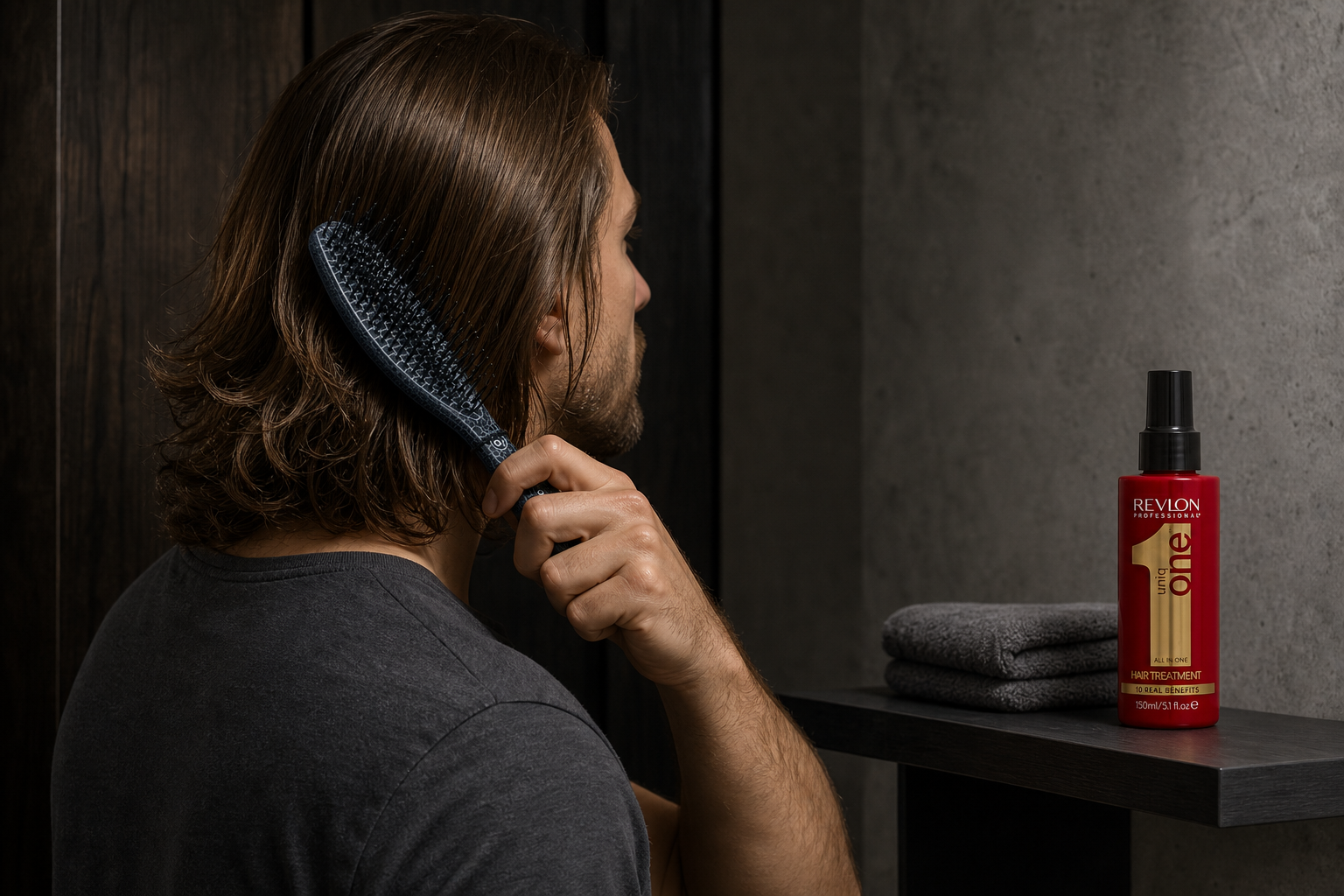
In the leave-in care category, you'll find both multi-purpose products like Revlon Professional Uniq One All In One Treatment and classic detangling spray conditioners, such as Lakmé Lak-2 Instant Hair Conditioner. The difference between them is mainly in thickness: the multi-purpose spray slightly smooths the surface and adds shine, while the detangling conditioner aims to let the comb glide through without pulling. If you have finer hair that gets greasy quickly, opt for the lighter version.
Oil for Hair Ends: Weight That Keeps Frizz in Check
Hair oil does something different than spray. It doesn't help with detangling but adds some weight to the ends and smooths out stray hairs, so the hair looks cohesive even in windy weather. That's why it's applied specifically to the bottom third of the length, never all over the head. A good example from the hair oil category is Wella Professionals SP Luxe Oil Reconstructive Elixir – a thicker elixir that you spread in your palms and then run through the ends.
Spray and oil do not compete; they work well in sequence: spray right after washing on damp hair, oil on almost dry ends before you head out. In winter or with very damaged ends, it makes sense to use oil even in the middle of the day, but really only in minimal amounts.
Three Mistakes That Turn Care Against You
- Too large a dose. The most common problem of all. Men's hair down to the ears needs two to three sprays and a single drop of oil. If you use more, the lengths will look limp and appear unwashed, even if they are clean.
- Application to the roots. The scalp produces its own oil, and for men, the roots are usually oilier than the ends. Leave-in care and oil should be applied from ear level down, ideally only to the lower half of the length.
- Applying to completely dry hair. Leave-in spray does not spread evenly on dry hair and leaves a sticky spot. Apply it to damp hair; oil is the only exception – it dilutes and runs off on completely wet ends.
If you're unsure about the dose, always start with the smallest amount you can imagine and let your hair dry. If the ends are still split, add one more spray or half a drop next time. The opposite direction is harder to fix: over-oiled lengths can only be saved by washing again, and every additional wash unnecessarily dries out the hair. A few days of trial and error are enough to remember the dose and stop thinking about it.
Detangling Step by Step and Weekly Routine
Whether your hair is just below the ears or reaching your shoulders, most breakage occurs exactly when you're detangling it. The technique takes just a few extra seconds and you can learn it in a single afternoon. The principle is simple: never untangle a knot by pulling from the roots down, but gradually from the ends up, in short sections.
- Divide your hair into two or three sections, so you're not working with the entire mane at once.
- Hold a strand in one hand and grip it just above the area you're combing. Your hand acts as a safeguard, preventing the pull from reaching the scalp.
- Start with the last few centimeters. Go over them twice, and only when they pass smoothly, move a bit higher.
- For a tight knot, put the brush down and loosen it with your fingers, or apply a bit of leave-in conditioner. Don't forcefully pull apart a dry tangled knot – you can lose more hair in that single motion than in an entire week.
- Finally, run through the entire length from the roots to align the hair and distribute the care evenly.
The brush and comb don't compete, they just have different roles. A brush with flexible bristles is designed for wet hair right after washing, when it's most vulnerable: the bristles bend under tension and tend to go around a knot rather than break it. A comb with wider teeth is suitable after applying leave-in care or oil, when you want to distribute the product along the lengths and create a parting. For dry hair during the day, a brush is sufficient again, but always starting from the bottom up.
Think about the night too. Eight hours of friction against a pillow does more to longer hair than you might think – in the morning, you're dealing with tangles that formed while lying down. Before bed, brush your hair once and tie it loosely, never tightly and never wet. A smoother pillow surface, like a satin cover, significantly reduces friction.
When we put together a weekly plan from the entire article, it looks surprisingly simple:
- Washing: according to the scalp, usually two to three times a week. Shampoo the roots, the lengths are cleaned by the running foam.
- Conditioner: after every wash, on lengths and ends, never on roots.
- Mask: once a week instead of conditioner, with a longer application time.
- Leave-in care and oil: as needed, usually after washing and between washes on the ends.
- Detangling: morning and evening, always from the ends up.
If you want to take away just one thing, let it be a brush that fits comfortably in your hand. In the accessories category, you'll find items from brands like Tangle Teezer and Olivia Garden – for example, Tangle Teezer Wet Detangler for post-shower detangling, Tangle Teezer The Ultimate Detangler for everyday use, or Olivia Garden iDetangle if you have finer hair that easily goes flat. You can complete the rest of your routine with hair cosmetics, from which we selected shampoos, conditioners, masks, and leave-in care in the article.
Longer hair in men doesn't require complicated care, but it does need regular care. Four habits – gentle washing, conditioner after every wash, leave-in care on the ends, and detangling from the ends up – keep hair in good condition without losing more than a few minutes daily. You'll first notice the difference at the ends, and after about a month, in the overall impression.


Category
Recommended articles

"Give a girl the right shoes and she can conquer the world!" Marilyn Monroe