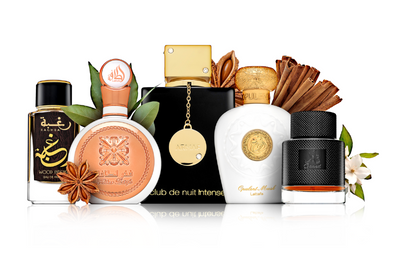
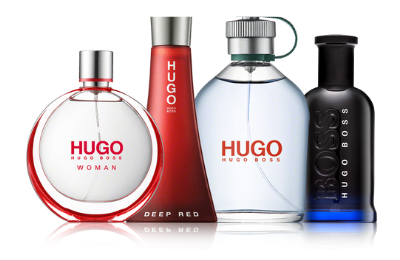
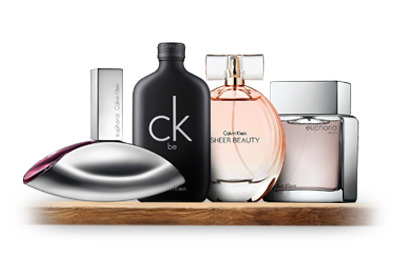

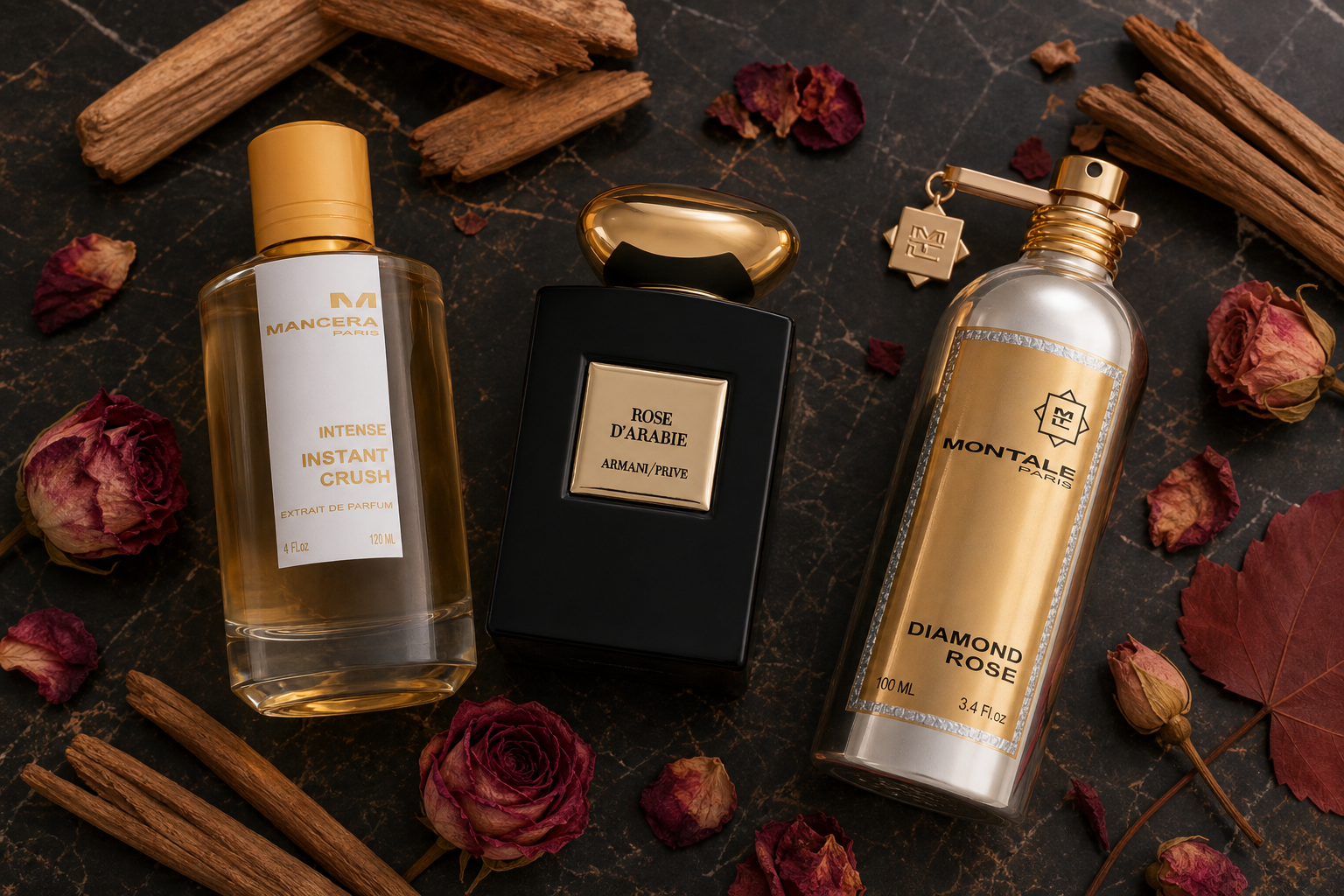
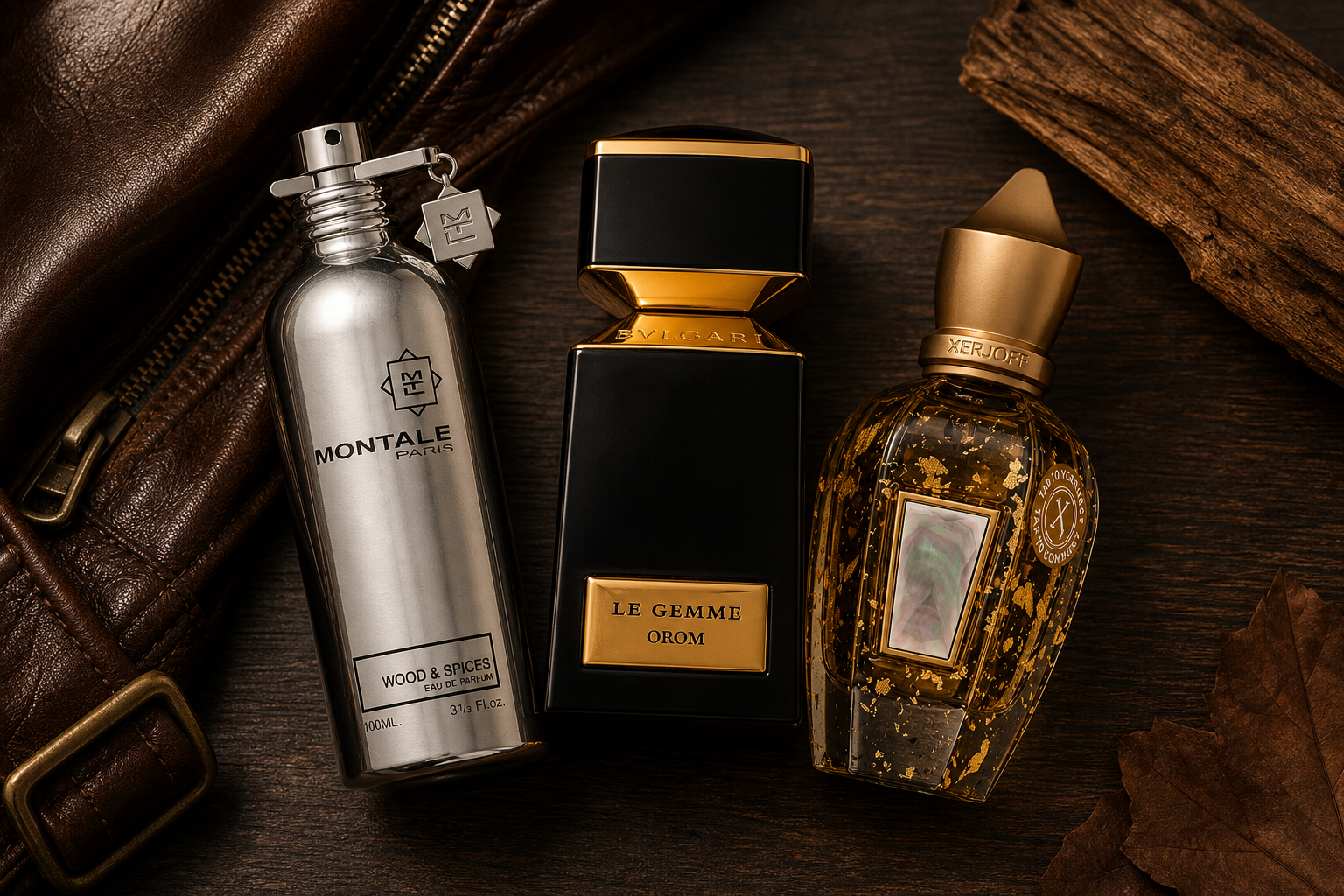

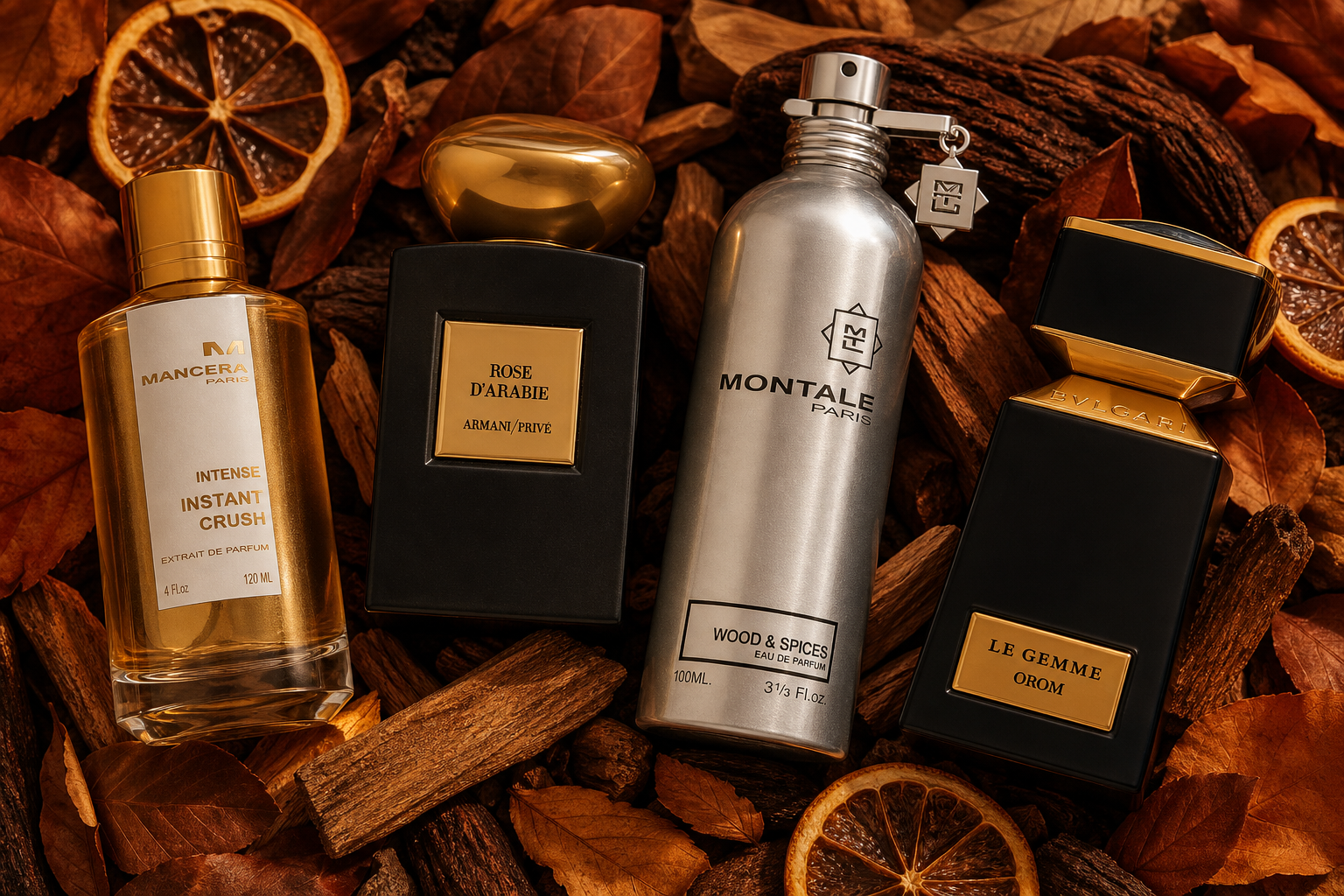
A seasonal selection for those who switch from light summer fragrances to richer compositions as the cooler months arrive. Introducing six top perfumes from Brasty's collection – three for women and three for men.
Autumn Changes Scents – Time for Richer Compositions
Whether you've been reaching for fresh citrus waters all summer or are just now searching for a fragrance to guide you through the cooler months, autumn is the perfect time to organize your shelf. As temperatures drop, it's not just your wardrobe that changes – the way scents work on your skin changes too.
The release of fragrance notes depends on warmth. In summer, when your skin is warm and the air is hot, top notes evaporate quickly and intensely. Light citrus or aquatic compositions therefore feel fresh and clear, but they also fade faster. In the autumn chill, the whole process slows down: those same fresh notes sound flatter and are harder to develop, while heavier ingredients – resins, balms, woods, and sweet oriental accords – have the space to unfold gradually and linger noticeably longer on the skin.
The practical consequence is simple: what felt pleasantly full in August may seem rather bland in October, and conversely, a rich woody or oriental composition that can become overwhelming in the heat finally comes into its own in autumn. Concentration also plays a role. Eau de Toilette contains a smaller proportion of fragrance composition than Eau de Parfum, and perfume extract goes even further in concentration – in cool weather, when the scent trail on the skin rises more slowly, this difference is significantly noticeable.
This article therefore goes beyond a general overview of autumn fragrances. We focus specifically on the most exclusive tier of Brasty's fragrance offerings, the segment that customers don't typically purchase every month:
- niche perfumery – lines that stand outside the mainstream offerings and work with ingredients and bolder structures in their own way,
- limited editions – versions of well-known compositions in a reworked, usually denser form,
- concentrated perfume extracts – the richest format, where significantly less fragrance is needed.
From this selection, we've compiled six recommendations: three women's and three men's perfumes, where warm woody or oriental compositions make the most sense in autumn. This isn't a ranking of the best-selling bottles or a list of new releases – we chose based on how the composition works in cooler air, how long it lasts, and what type of day it's suitable for. For each recommendation, you'll also find a note on who it suits and when to wear it.
If you're just starting with more intense fragrances, please keep one thing in mind: richer compositions are applied more sparingly than summer fresh waters. One to two sprays on the wrist or neck are usually enough, and before you dismiss the perfume as too heavy, let it settle on your skin for at least half an hour. The base notes, which are the reason these perfumes are worn, only emerge after the top layer has faded.
Musk, Vanilla, Tonka Bean, and Sandalwood
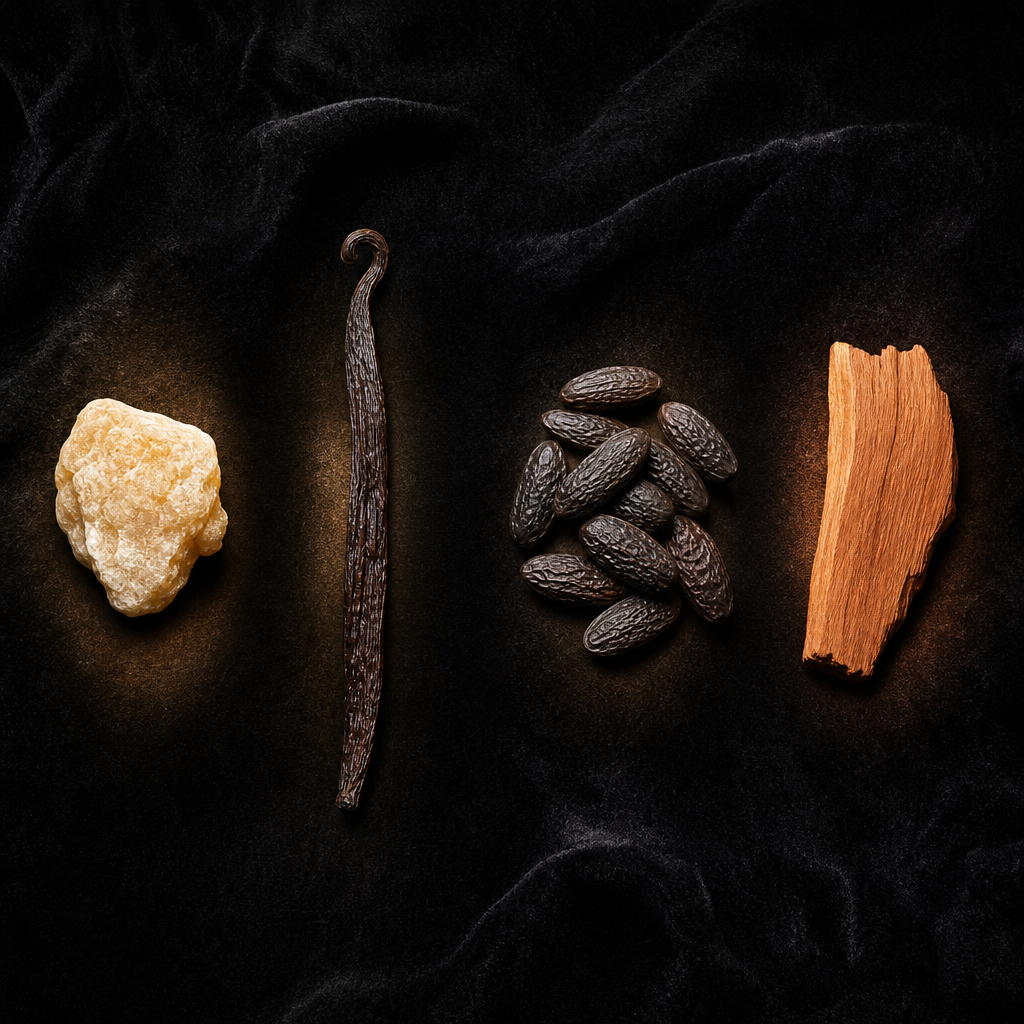
The autumn palette is no coincidence. Four ingredients repeatedly appear: musk, vanilla, tonka bean, and sandalwood. Each adds warmth and longevity to the composition, but they work at different levels of the fragrance pyramid and at different times.
Four Ingredients and Their Place in the Fragrance Pyramid
- Musk belongs to the base notes. On its own, it is rather quiet and powdery; its role is to hold other ingredients together and extend their life on the skin. It is also the reason why the same perfume can smell different on two people.
- Vanilla moves between the heart and the base. In lighter compositions, it remains creamy and almost gourmand, while in oriental ones, it blends with amber and resins, acquiring a darker, smokier character.
- Tonka Bean has a sweet almond profile with undertones of hay and tobacco. It appears in the middle notes and transitions into the base, where it turns sweetness into something more mature. With spices and leather, it becomes rougher.
- Sandalwood is a classic woody base—creamy, milky, and noticeably softer than cedar. It develops slowly and is often what you smell from the perfume after several hours.
The top notes in this type of perfume, on the other hand, tend to be short and complementary—bergamot, cardamom, or pink pepper. If the scent doesn't appeal to you on the blotter immediately, it's worth waiting: the true character reveals itself in the heart and base.
This is not just a seasonal trend. These four notes have long been among the most common in our perfume range, and their share among the best-selling compositions is only increasing. Alongside them, amber and patchouli remain consistently popular.
What Sets the Top of the Range Apart
The same ingredients can be found across the entire price spectrum. However, at the most exclusive level, several things change at once.
- Higher concentration of fragrance components. Perfume extract contains more than eau de parfum or eau de toilette. In woody and oriental notes, the base is denser, the trail longer, and fewer sprays are needed.
- Larger bottle sizes. Flagship compositions are often available in large or refillable bottles, which makes sense for a perfume to last the entire season.
- Exclusive and limited editions. Separate versions of well-known scents, usually with a denser base and limited availability. Once sold out, they typically do not return.
- Niche lines. They work with more expensive ingredients, such as oud or high-quality sandalwood, and do not aim to please everyone.
Houses that systematically work with warm woody and oriental bases are often recognizable by name. Among the major perfume brands, these include Yves Saint Laurent, Giorgio Armani, Bvlgari, and Christian Dior. Niche perfumery is a separate chapter, which we categorize independently, not just as a filter: Montale, Mancera, or Xerjoff build a large part of their portfolio on oud, sandalwood, tonka bean, and amber. It's worth exploring the perfume category and the niche segment side by side.
Three Luxurious Women's Perfumes from the Top of the Range
The exclusive tier of women's perfumery isn't about being louder. It's about the density of the composition: a higher concentration of perfume extract, ingredients that are replaced with simpler substitutes in cheaper lines, and a trail that lasts all evening without needing a touch-up. In autumn, this works to your advantage – cooler air slows evaporation, so even a rich fragrance feels sophisticated, not overwhelming.
We've selected three warm autumn compositions that you'll most frequently encounter at this level. It's not a ranking from weakest to strongest, but three different moods. Go through them and notice which one matches how you want to present yourself this autumn – choosing based on the nature of the fragrance makes more sense than choosing based on price.
Spicy Oriental Composition
The most distinctive of the trio. Cardamom, cinnamon, saffron, or pink pepper in the top notes, with amber and a resinous base underneath – a fragrance that enters the room before you do. In exclusive lines, the spiciness is smoother and less sharp than in more accessible versions of the same profile; the ingredients have room to develop slowly, and the transition between the heart and base is seamless.
- Trail: strong, noticeable even at arm's length.
- Longevity: typically lasts all day, even longer on a scarf or coat.
- Suitable for: evening events, theatre, festive dinners.
- Think twice if: you spend the day in an open-plan office – it's better suited as a weekend fragrance here.
Vanilla Patchouli Warmth
The most accessible of the trio and also the profile that most often becomes a signature scent. Vanilla adds softness and a gourmet sweetness, while patchouli grounds it, preventing the composition from becoming dessert-like. In more luxurious versions, vanilla tends to be darker and more resinous than sugary, which is precisely the difference that makes it worth moving up a tier.
- Trail: medium, stays close to the body and opens with the warmth of the skin.
- Longevity: long-lasting, with a sweeter finish at the end of the day.
- Suitable for: a regular workday, a café, traveling.
- Think twice if: gourmet notes generally don't suit you – here, sweetness is a key element, not an embellishment.
Darker Floral Woody Composition
A choice for anyone who finds spicy oriental too much and pure gourmand too little. Rose, jasmine, or tuberose set on a woody base of sandalwood and cedar – the floral element remains, but loses its spring lightness and gains depth. It's the most elegant way to wear a floral fragrance in autumn without feeling out of season.
- Trail: medium to strong, with a more pronounced first impression and a calmer fade-out.
- Longevity: reliable throughout the day, with the woody base disappearing last.
- Suitable for: business meetings, celebrations, and situations where you want to appear polished without being ostentatious.
- Think twice if: you're looking for a distinctly warm and sweet fragrance – this one is cooler and more serious.
Specific perfumes that match these three profiles in the current range can be found right below this paragraph. Consider them as a starting point, not the only solution: if a profile suits you, it's worth exploring sibling versions of the same line. The perfume extract of the same fragrance tends to be denser and quieter than the eau de parfum, and with larger volumes, one bottle will last you a significantly longer part of the season. And if you're unsure, start with a smaller bottle or a sample – an autumn fragrance reveals itself only after a few days of wearing, not after the first spray in the store.
Men's Perfumes from the Top Shelf: Woody Base, Oriental Heart
The selection for men follows the same logic as for women – just shifting the composition to a drier, woodier tone. The autumn chill diminishes the prominence of fresh citrus accords, allowing leather, oud, incense, and resins to shine. At the highest level of offerings, we find ourselves more among niche lines, concentrated perfumes, and larger bottles rather than regular shelf eau de toilettes. The three characters below cover most situations where men choose a fragrance in autumn – for each, we'll describe how it behaves on the skin, how strong its trail is, and where it fits best.
Aromatic Woody Classic: Vetiver, Cedar, Sage
Of the trio mentioned, this is the least conspicuous structure. Top notes usually open with bergamot or grapefruit, the heart holds lavender, sage, and cardamom, while the base notes rest on cedar, vetiver, and musk. The result feels clean, dry, and slightly formal – it's a composition that won't overpower a meeting room or a morning tram. In the form of concentrated eau de parfum, it typically lasts an entire workday, with the trail staying close to the body and opening mainly in warmth.
This direction makes sense if you wear perfume daily and want one scent that can transition from the office, through lunch, to an evening walk. It also works well as a first step into the more expensive segment: the woody base is recognizable, requires no getting used to, and pairs well with a wool blazer or a hoodie.
Spicy Leather: Saffron, Tobacco, Dark Amber
In perfumery, the leather note doesn't smell like a new jacket but rather a combination of saffron, smoky tones, spices, and tobacco. The autumn version usually complements it with cinnamon, nutmeg, or resin, and in the base notes, it's supported by amber and oud. This creates the richest of our three profiles: the scent develops slowly, lingers on the skin throughout the evening, and you can often still smell it on a scarf or coat collar the next day.
That's why it's worth applying it sparingly. Two sprays on the neck or chest are usually enough; more won't intensify the scent, just thicken it. The ideal occasion is an evening program – a restaurant, theater, formal event, or a chilly evening outdoors. For a shared office, it's quite a strong choice, so it's better to opt for the first profile there.
Gourmand Tonka Bean: A Sweeter Tone That Remains Masculine
Tonka bean brings an almond-vanilla sweetness with a hint of hay and tobacco to the composition. In men's perfumes, it's almost always paired with dry wood, amber, coffee, or cognac accord, so the result doesn't slip into dessert territory – it remains warm but structured. In cold air, it develops more slowly, while on warm skin, it intensifies, making it a reliable choice for transitioning between a frosty street and a heated interior.
The longevity is usually high because sweet and resinous base notes evaporate slowly. The trail is noticeable but less sharp than the leather tone. It's suitable for autumn evenings, informal gatherings, and weekends. Many compositions built this way are also labeled as unisex – take the "For Men" label as a guide, not a boundary, and if a scent from the women's shelf suits you, there's no reason not to wear it.
Across all three directions, a few practical things apply. Pay attention to concentration: eau de parfum and perfume last longer and have a denser trail than eau de toilette, which is useful in colder months. Always test on skin, not on a paper strip – woody and oriental bases develop over tens of minutes, and their most interesting part never shows on a test strip. And opt for a large bottle only when you already know the scent; with niche lines and concentrated perfumes, they last longer than you might expect.
How to Choose an Autumn Perfume for Every Occasion
Whether you're purchasing your first richer scent for the cooler months or adding to your collection with a fragrance that lasts from morning to night, you can narrow down your choices by asking three questions: how intense do you want the perfume to be, where will you wear it, and how high-end are you willing to go in the perfume shop.
Intensity: Based on Concentration, Not Price
The first guide is the type of product. Eau de Toilette has a lower concentration of fragrance composition, lasts for a shorter time, and is suitable for when you want to be noticed only up close. Eau de Parfum is a versatile choice for autumn – woody and oriental notes have room to shine without overwhelming the surroundings. Perfume extract is the most concentrated form; it's applied in drops and its trail lasts the longest. However, a higher concentration doesn't automatically mean a better choice – it mainly means you'll use the fragrance more sparingly.
Occasion as the Second Filter
- Office and Everyday Wear: more restrained woody compositions with a clean base, one or two sprays. Shared spaces tolerate a gentler trail, not a cloud.
- Evening Gatherings: an oriental heart with vanilla or tonka bean works where the fragrance is meant to be part of the impression. Apply to the neck and wrists, not on clothing.
- Formal Events: it's worth choosing a composition you won't encounter everywhere – this is where a more exclusive choice makes the most sense.
- Weekends and Outdoor Activities: leather and resinous notes withstand cold and wind well, as the cold air doesn't disperse them as quickly.
When It Makes Sense to Go for the Top Tier
Perfumes from the niche segment and limited editions cost more for specific reasons: they usually have a higher concentration, use higher quality ingredients, and are produced in smaller batches. In practice, this means three things for you – longer lasting on the skin, a more pronounced evolution of the scent throughout the day, and a lower chance of encountering the same fragrance in an elevator or on public transport.
Investing in a more expensive bottle makes sense if you already know which olfactory families suit you, or if you're looking for a signature scent. On the other hand, if you're just discovering whether a woody base suits you, it's wiser to start with more accessible classics. Tried-and-true mainstream compositions tend to be more straightforward, and you can move on to more demanding selections at any time later.
Layering, Dosage, and Storage
Layering in the cold season is mainly a way to extend the fragrance. The foundation is hydrated skin – on dry skin, perfume evaporates faster, so an unscented body lotion or a product from the same line helps. Don't pit two strong oriental compositions against each other; the result is usually an indistinct blend.
Be cautious with dosage in the cold. Cold air spreads the fragrance more slowly, so you may feel less scented on the street than you actually are – in a heated room, the trail will fully develop. Stick to the same number of sprays as in summer and apply to warm areas: neck, wrists, area behind the ears.
Storage during winter is simple, yet often done incorrectly. Perfume belongs in the dark, at a stable temperature, and in its original box – not on the windowsill and not in the bathroom, where temperature fluctuations and humidity gradually alter the composition.
Once you're clear on intensity and occasion, browse the perfume category on Brasty with the filter set to the highest price level – you'll find concentrated formats and limited editions grouped together there. If you're looking for compositions outside the mainstream, head straight to the separate section for niche perfumes.
Category
Recommended articles

"Give a girl the right shoes and she can conquer the world!" Marilyn Monroe