




Do you wake up with puffy eyelids and don't know where to start with your skincare? We'll show you a simple two-minute routine with caffeine serum and an eye area massage that you can easily do in front of the mirror.
Why You Wake Up with Puffy Eyelids
The pillow imprint on your face disappears within minutes, but swollen upper eyelids and a soft puffiness under the lower lashes last considerably longer. Whether it happens occasionally after a long night or almost every morning, it's worth knowing what's happening around your eyes overnight – this will help you determine if a morning routine will help or if something else is at play.
The skin around the eyes is among the thinnest on the entire body. It has minimal sebaceous glands, weaker subcutaneous tissue, and a dense network of small blood vessels and lymphatic pathways. Anything that retains water in the body will show up here sooner and more visibly than on the cheeks or forehead – fluid easily spreads in the loose tissue, and the thin skin can't hide it.
The second part of the explanation lies in body position. During the day, gravity helps you: fluid drains downward, and the eye area is continuously drained. Lying down, this advantage disappears, drainage slows, and you wake up just when fluid accumulation is at its peak. Once you stand up, move your facial muscles, and blink a few times, the lymph starts moving again – that's why morning puffiness usually subsides on its own within the first hour or two.
Besides sleeping position, everyday factors from the previous day contribute to morning puffiness:
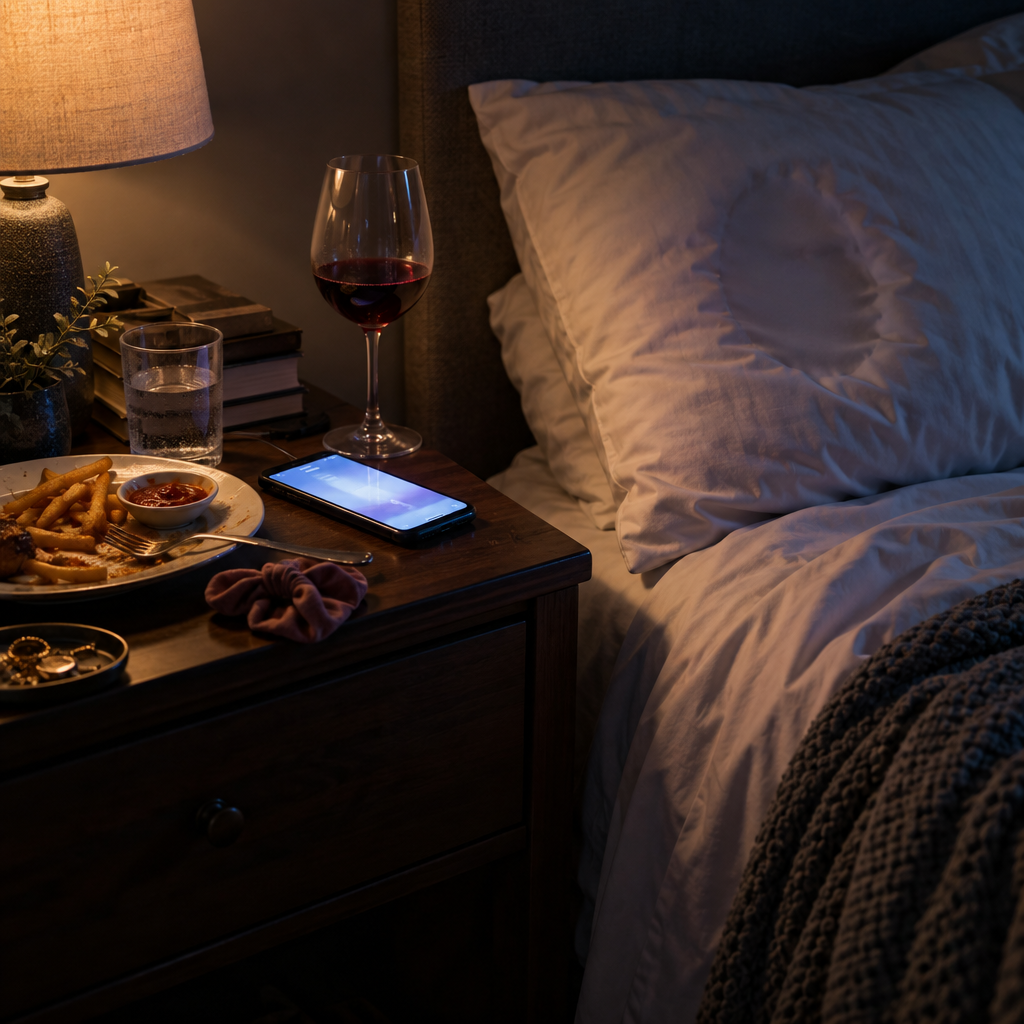
- salty or late dinner – higher salt intake retains water in the body,
- alcohol in the evening – alters fluid management and sleep quality,
- short or interrupted sleep – the body doesn't have enough time to regenerate,
- sleeping on your stomach or with your head low – fluid stays in the face longer,
- dry air in the bedroom – heating season, air conditioning, closed window,
- long evening in front of a screen, crying, or allergic reaction – eyes are irritated, and the surrounding area reacts,
- imperfectly removed eye makeup – makeup and mascara residues irritate the thin eyelid skin overnight.
Now for the important distinction. Morning puffiness is a condition that changes: it wasn't there the night before, it's most noticeable in the morning, and it subsides on its own during the morning. It responds to how you slept and what you ate, and it's worth targeting with cooling, gentle massage, and targeted eye care.
More permanent changes behave differently – they look similar in the morning and evening and don't change from day to day. These include the loosening of tissue and shifting of fat pads with age, a hereditary shape of the under-eye area, or deeper shadows caused by pigment and visible blood vessels. Cosmetics can smooth the surface and optically brighten, but they won't change the shape of the eye area – with such expectations, you would inevitably be disappointed.
And one more boundary. If swelling occurs suddenly, is significantly asymmetrical or painful, accompanied by redness, itching, or impaired vision, or lasts several days without improvement, it doesn't belong in a cosmetic routine but in the hands of a doctor. The same applies if swelling appears newly and regularly without an obvious connection to sleep or food.
But if you recognize yourself in the first description, with eyelids that deflate on their own by midday, a morning routine makes sense. In the following lines, we'll go through how to support this natural process in a few minutes and how to avoid unnecessarily irritating the sensitive eye area.
The First Five Minutes After Waking: Why Temperature Matters
Most morning routines start with a tube or bottle. Yet, between the moment you open your eyes and the time you reach for an eye product, there's a brief window that determines how your eye area will look for the rest of the morning. In this window, it's not about the formula or the brand, but something much simpler: temperature.
The skin on the eyelids is the thinnest on the entire face, and the subcutaneous vessels lie very close to the surface. That's why cold affects it more quickly and visibly than the cheeks or forehead. A brief contact with cold leads to the constriction of surface vessels, reducing puffiness visually and making the area appear firmer. A room-temperature product doesn't have this mechanical effect – it works only through its composition, while a cold texture or a cold applicator head adds a second, immediately visible sensation.
This leads to the first practical intervention that costs nothing: store your eye serum or gel in a cooler place overnight. It's not about the freezer, and it usually doesn't even have to be the fridge – just the bottom shelf of a cabinet by the window or a cooler part of the bathroom. If you opt for the fridge, choose the door, not the back wall by the evaporator. Keep in mind that some richer emulsions thicken significantly in the cold, making them harder to spread and requiring a little time to be easily dispensed after removal. A serum with a metal applicator head is the most grateful in this regard: metal retains a lower temperature on its own, so it cools even when you leave the product on the shelf.
If you want to enhance the effect, there are several options. Choose based on how much time you realistically have in the morning:
- Lukewarm and then cold water. First, rinse your face with lukewarm water, then switch to cold and let it act on the eye area for a few seconds. Alternating is gentler than a straight cold shower to the face.
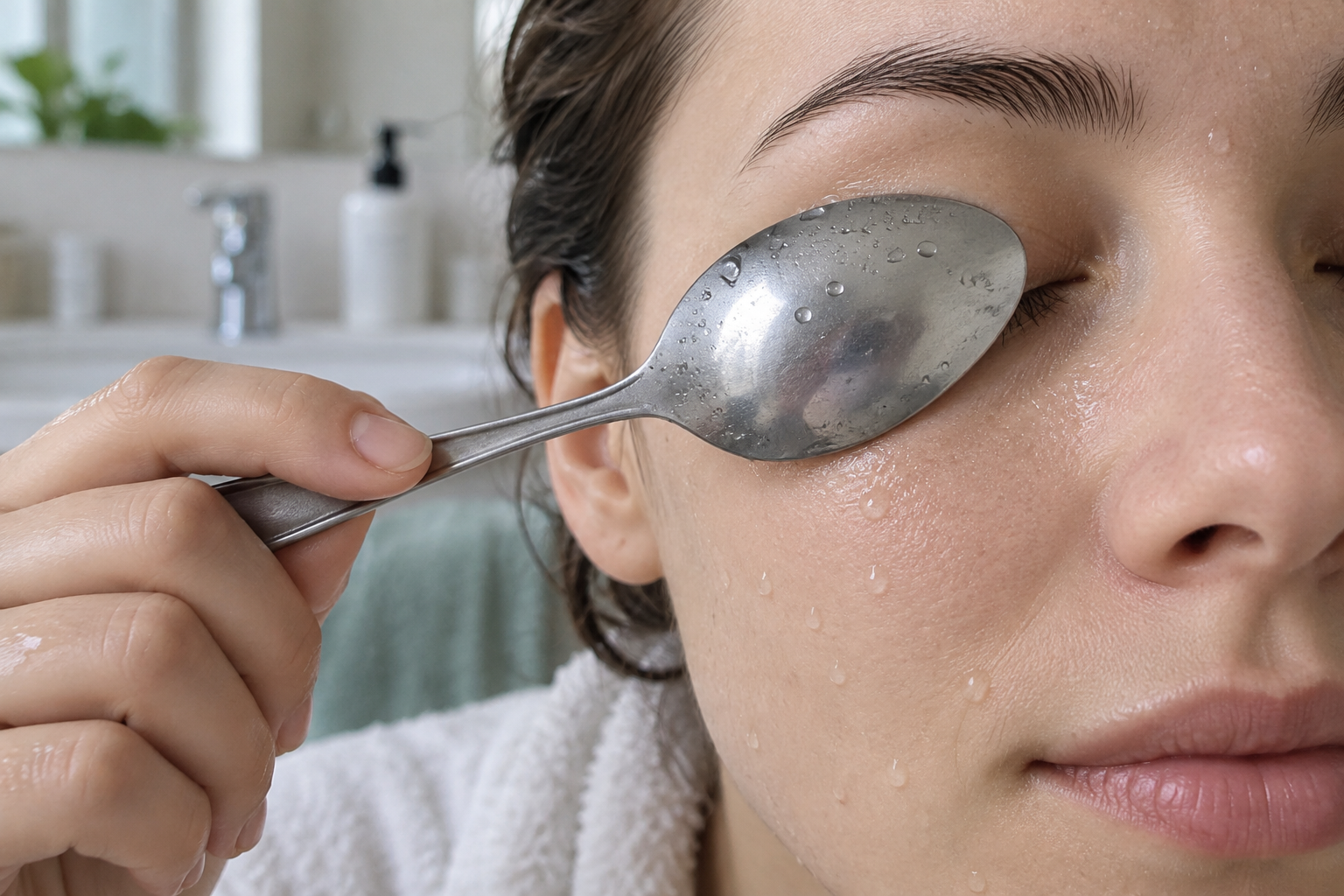
- Chilled spoon. Leave two teaspoons in a cup of cold water overnight, not in the freezer. In the morning, dry them and place the back on closed eyelids for about twenty to thirty seconds.
- Cold compress. A gauze square or cotton pad soaked in cold water, lightly wrung out, and placed on the eyelids. The advantage is that it distributes the cold evenly and doesn't press anywhere.
- Chilled eye product. The simplest option – cold and care in one step, without the need to prepare anything extra in the evening.
At the same time, it's important to know where cooling ends. Ice directly on the eyelids is not suitable. An ice cube has a significantly lower temperature than cold water and can cause irritation, redness, and minor vessel damage on such thin skin. If you want to use ice, always wrap it in a thin cloth and only for a short moment, never pressed directly against the skin.
Similarly, longer cooling does not mean a better result. A few dozen seconds is the upper limit, after which sensitive skin tends to protest – redness, tightness, or an unpleasant burning sensation may appear. That's a signal to stop, not to endure a little longer. Be more cautious if you have thin skin prone to broken capillaries, are dealing with eczema in the eye area, or have recently undergone a procedure with a dermatologist or aesthetician; in such cases, stick to lukewarm water and skip the cold entirely. And if you're troubled by significant swelling in the morning that doesn't disappear even after several hours, it's more a matter for a doctor than a cosmetic routine.
Cold itself doesn't treat anything – it doesn't hydrate or firm the skin. It's just a preparation that improves the initial state for a few minutes and simultaneously calms morning tension. What comes next is taken care of by the care itself and the way you apply it.
How to Apply Caffeine Concentrate Around the Eyes
When it comes to the eye area, technique is just as important as the product itself. The skin here is thin, mobile, and sensitive to pulling, so even a well-chosen concentrate can disappoint if you apply too much or in the wrong place. The method we describe takes less than a minute and after a few tries, you'll master it without thinking.
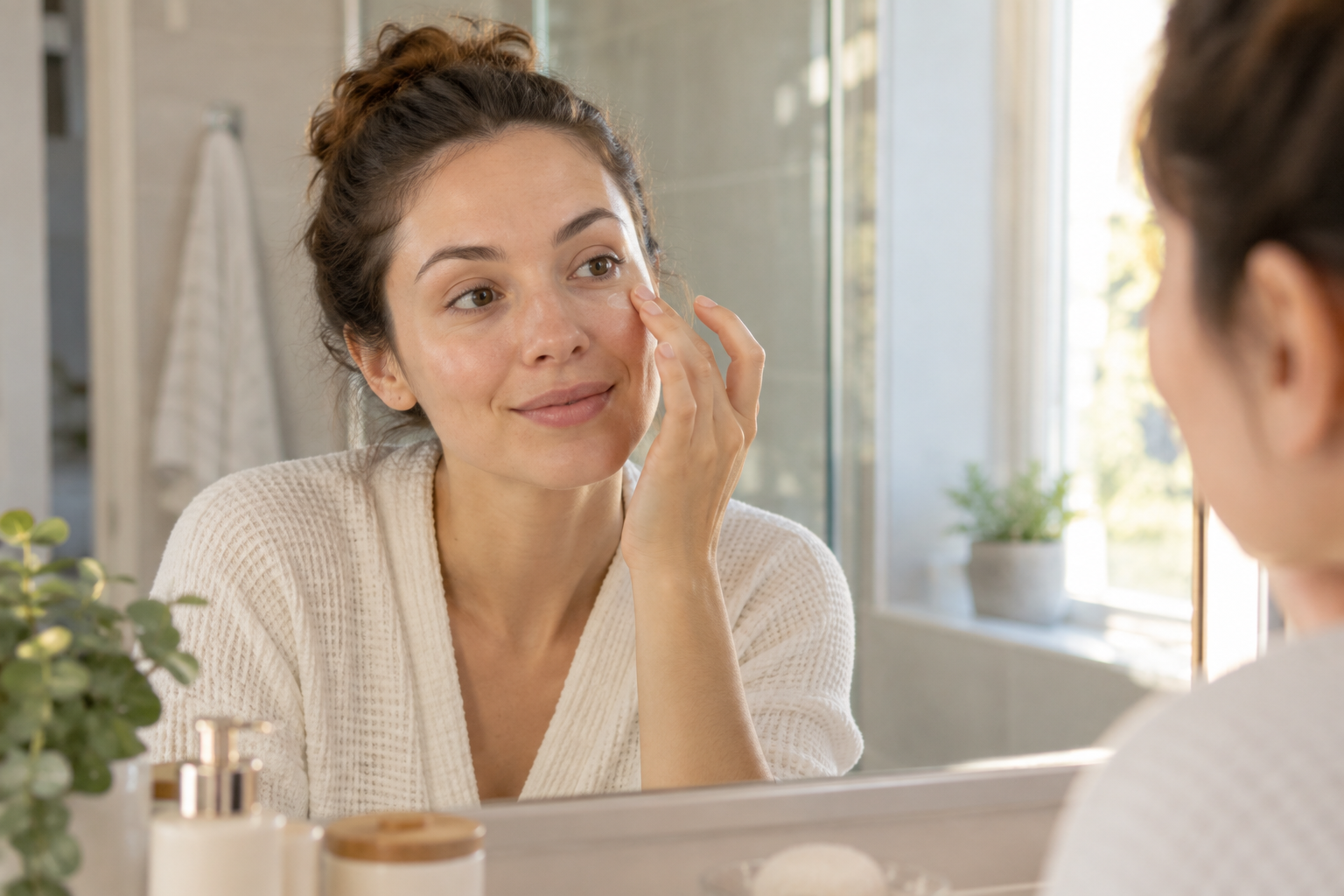
How much product is enough. A rice grain-sized amount is sufficient for both eyes, which is about one small drop divided in half. Eye concentrates are intentionally thick and rich, so they are used differently than regular facial serums. If you divide your dose into two parts before touching the skin, you won't feel the need to spread the excess elsewhere.
Why use the ring finger. The ring finger is the weakest of the fingers and applies the least pressure, which is an advantage in this case. Using your index or middle finger could unknowingly stretch the skin sideways, and it's precisely this pulling you want to avoid in the eye area.
- Divide the collected concentrate between two ring fingers and apply it as three to four small dots under each eye.
- Place the dots on the bony edge of the eye socket, about a centimeter below the lower lid, and continue towards the outer corner.
- Gently tap the product in with the fingertip until it absorbs. Do not spread it by pulling, just tap in place.
- Use any remaining product on your fingers to touch the area to the outer corner and above the eyebrow, if the product's formulation allows.
Where the product doesn't belong. Do not apply the concentrate close to the lash line or on the movable lid. The product naturally moves towards the eye during the day, so if you apply it too close, it may enter the eye and cause irritation. Leave a strip about half a centimeter from the lashes free. The bony edge of the eye socket is not a compromise – that's where morning puffiness most often settles.
What to expect from caffeine concentrates. Caffeine is popular in eye care mainly for the refreshing, tightening sensation you feel after application. Formulations with caffeine are usually light, quickly absorbed, and can handle makeup applied shortly after. The result is a temporary improvement in the appearance of morning puffiness, not a permanent change in the eye area: what you do in the morning lasts for hours, and the next day you repeat the process. If puffiness persists all day, appears only in one eye, or is related to medication, it's a matter for a doctor, not a cosmetic routine.
Common mistakes that weaken the results. Most disappointments with eye concentrates don't stem from the formulation but from application:
- Too large a dose. Excess product doesn't absorb, stays on the skin, and clumps under makeup.
- Applying on wet skin. After washing, let the eye area dry slightly. On water, the product slides, is harder to dose, and more easily runs to the lashes.
- Spreading by pulling. The classic movement from the inner corner outwards stretches the skin. Tapping does the same job without straining the area.
- Applying only under the eye. The outer corner and area above the eyebrow are often skipped, yet morning puffiness settles there too.
- Impatience. The difference with caffeine concentrates is assessed in minutes after application, not immediately.
Once you master this technique, it will become an automatic movement that won't require any extra thought in the morning.

Two-Minute Eye Area Massage Step by Step
Massaging the eye area is not about strength, but about direction and rhythm. The skin around the eyes is among the thinnest on the body, so every extra stroke shows up here sooner than elsewhere. The goal is not to rub the skin, but to gently move it so it doesn't look so stiff in the morning. Once you get used to a few movements, you'll be able to complete the entire sequence in two minutes and repeat it automatically after a few mornings.
Before you start, check three things: clean hands, a sufficiently slippery base, and a comfortable position. Never massage the eye area dry – fingers should glide over the skin, not move it. A thin layer of eye product that hasn't fully absorbed yet is enough. Sit up straight, lower your shoulders, and breathe calmly through your nose; raised shoulders and a stiff neck unnecessarily complicate the process.
Sequence of Strokes
- Warming Up (about 10 seconds). Place the pads of your ring fingers on the inner corners and just hold them there for a moment. The warmth of your fingers will soften the product, and you'll also become aware of how much pressure you're applying to the skin.
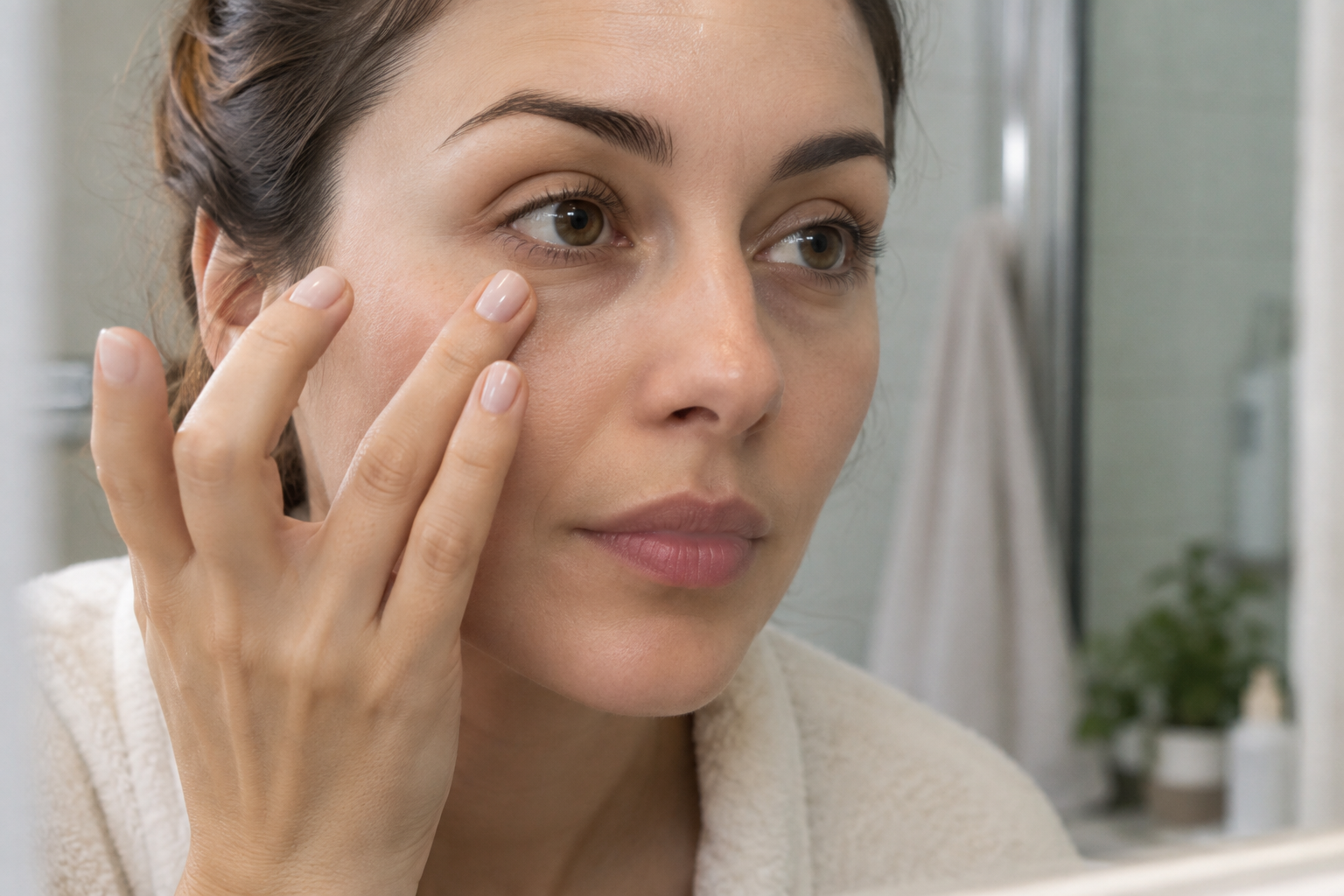
- Stroke Under the Lower Eyelid (about 30 seconds). Use the pad of your ring finger to make a continuous stroke from the inner corner along the bone under the eye towards the temple. Repeat eight to ten times, always in one direction – lift your finger back, don't return over the skin.
- Stroke Under the Eyebrow (about 30 seconds). Use the same motion along the upper edge of the eye socket: from the inner corner under the eyebrow out to the temple. Again, eight to ten repetitions. The finger rests on the bone, not on the movable eyelid.
- Tapping (about 30 seconds). Use the pads of your ring and middle fingers to tap around the eye, like playing the piano. Make three circles: under the eye outwards, around the temple, under the eyebrow back to the nose.
- Pressure Points (about 20 seconds). Stay for three seconds with light, steady pressure on the temples and in the hollow under the inner end of the eyebrow. Repeat three times on each point.
- Calming (about 10 seconds). Place your palms on your closed eyelids, let the warmth work for a moment, and then slowly remove your hands. This step is often skipped, yet it nicely concludes the massage.
How much pressure to apply? The right pressure is when the skin under your finger doesn't move or wrinkle – the finger glides over it, the skin stays in place. Try it first on the back of your hand: the pressure you barely feel there is just right for the eye area. If your skin is red or irritated after the massage, reduce the pressure and the number of repetitions next time.
You can count the rhythm with your breath, so you don't need a mirror or stopwatch. One calm inhale and exhale roughly corresponds to one stroke, one step of the sequence then lasts about eight breaths. For those who prefer counting, count eight to ten repetitions for strokes and three circles for tapping. Massage both eyes simultaneously and symmetrically – working on each separately often results in uneven outcomes.
When to Skip the Massage
The eye area massage is a cosmetic, not a therapeutic procedure. There are situations when you shouldn't start it in the morning:
- conjunctivitis, stye, or other painful lesion on the eyelid,
- recent procedure in the eye and face area – follow the advice of a specialist,
- irritated, cracked, or itchy skin, cold sore or developed eczema around the eye,
- acute allergic reaction with eyelid swelling,
- pain, impaired vision, or unilateral swelling that lasts several days.
Take the last point seriously: swelling that lasts for days, appears only on one side, or is painful, belongs to a doctor, not a morning routine. And even without issues, two minutes a day is a reasonable dose – a longer and more intense massage won't add anything to the thin skin.
How to Fit Your Routine into Two Minutes
You already know the individual steps. Now comes the most practical part – arranging them in a sequence that you can manage even on a weekday morning when you're brewing coffee and searching for keys. Morning eye care doesn't require ten products or a separate half-hour block. It needs a sensible order and a few extra seconds added to what you're already doing.
The Logic of Layering: From Lightest to Heaviest
The basic principle applies across all skincare: apply products from the lightest consistency to the heaviest. Watery and gel textures absorb quickly and need direct contact with the skin. Creams and balms contain more oil components and create a more continuous film on the surface – anything applied on top of them would penetrate much less effectively.
This also answers the common question of why eye serum or concentrate comes before a regular day cream. Eye products are often formulated with lighter textures and target the narrow area around the eyes. If you apply them over a layer of face cream, you're working through a barrier you've created yourself. Moreover, it complicates dosing: it's harder to gauge how much product actually goes on the lids and under the eyes on moisturized skin.
A Logical Order of Steps
- Cleansing – gentle gel, foam, or micellar water depending on your skin type. The goal is to remove overnight oil, not to dry out the skin.
- Eye Serum or Concentrate – the lightest texture of the day, applied in minimal amounts using the technique we described earlier.
- Short Massage – a few taps and strokes while the product is still moist and fingers glide easily.
- Eye Cream – only if you use both. It comes after the serum has absorbed and creates a sealing layer over it.
- Facial Care – serum and day cream for the rest of the face, with a curve around the eye area, which is already done.
- Protective Cream with SPF – the last step of morning care, unless it's already included in your day cream.
If you use just one eye product, which is a perfectly legitimate choice, the two middle steps merge into one, and the routine shortens even further.
Minute-by-Minute Plan
- 0:00–0:30 – cleansing and drying the skin by pressing a towel, without rubbing.
- 0:30–0:50 – applying eye serum or concentrate, one swipe per eye.
- 0:50–1:20 – massaging the eye area, approximately fifteen seconds per side.
- 1:20–1:40 – facial serum and day cream for the rest of the face.
- 1:40–2:00 – protective cream with SPF, including the forehead, nose, and upper cheekbones.
Consider these times as a guideline, not a stopwatch. The purpose of the schedule is to show that the entire process can indeed fit into two minutes if you don't jump between products and know what's next.
Consistency Over Quantity of Products
For the eye area, more than anywhere else, repetition makes the difference, not the number of bottles in the bathroom. Three products used every other day will do less work than one you reach for every morning. When you tailor the routine to a level you can realistically maintain, you're much more likely to stick with it a month later.
Don't expect results after the first week. Morning eye care mainly works with how the area looks after waking up and throughout the morning; deeper changes also relate to sleep and the overall condition of the skin.
If you're just choosing where to start, browse the Eye Care category in the Brasty catalog. You'll find eye serums, concentrates, and creams from brands like La Roche-Posay, Dermalogica, or Vichy, so you can choose based on texture, skin sensitivity, and price level. Feel free to start with one product and add more once you've got the morning routine down.
Category
Recommended articles

"Give a girl the right shoes and she can conquer the world!" Marilyn Monroe