

There are many conflicting tips about atopic and dry skin – from hot baths to completely skipping creams. In this article, we discuss what truly works and when it's time to consult a doctor.
Why There Are So Many Conflicting Tips About Atopic Skin
You probably know the scenario: as soon as the topic of dry, itchy, and irritated skin comes up among family or colleagues, everyone has their own tried-and-true advice. One person swears by a hot bath because it temporarily relieves the itching. Another claims that atopic skin should hardly be washed at all. A third relies on a homemade ointment from grandma, while a fourth warns against anything not from the pharmacy. These tips often contradict each other, leaving someone seeking relief more confused than informed.
The explanation is quite straightforward. Atopic skin behaves very individually: what soothes one person may irritate another. Everyone has a different level of skin barrier disruption, different triggers, and different environmental conditions they encounter daily. Personal experience is therefore strong but narrow. When a particular approach helps someone, they naturally pass it on as a general rule – and at that moment, a single case becomes a "fact" that travels further without the context in which it originated.
The second reason is the nature of the condition itself. Calmer periods alternate with flare-ups, and many changes occur spontaneously, regardless of what you have just started using. If you apply a new cream when the condition is naturally subsiding, it's easy to credit it with an improvement it didn't cause. Conversely, a product tried during a flare-up may unfairly gain a reputation as unsuitable, even though something entirely different caused the worsening.
There's also the confusion between short-term relief and actual improvement. Something that provides immediate relief may not benefit the skin in the long run – and conversely, care that seems unremarkable and ineffective at first may be exactly what gradually strengthens the barrier. This distinction is key to navigating the flood of advice.
In the following text, we proceed from basics to practice:
- we explain what happens to the skin during atopy and why it reacts differently than unaffected skin;
- we go through the most common myths surrounding washing and daily moisturizing, and discuss which ones hold up;
- we summarize the practical side of care, i.e., how to establish a routine that lasts on weekdays, not just weekends;
- we identify the point at which home care is no longer sufficient and a specialist is needed.
Before we dive in, an important note. This text is a guide, not a substitute for medical consultation. Atopic dermatitis is a condition whose diagnosis and treatment belong in the hands of a doctor; cosmetic care can complement and ease daily life with it, but it does not replace it. If your symptoms significantly limit you, worsen, or appear in a young child, consult a dermatologist before experimenting with online recommendations – including ours.
What is Atopic Skin and How Does a Compromised Skin Barrier Work
Atopic skin is an inherited condition, not something caused by improper washing or unsuitable creams. The essence is quite simple: the outermost layer of the skin does not perform its protective function as reliably as skin without atopy. This is the basis for most advice surrounding this topic—and also most misconceptions, as recommendations that do not consider the skin barrier usually miss the mark.
What the Skin Barrier Looks Like Up Close
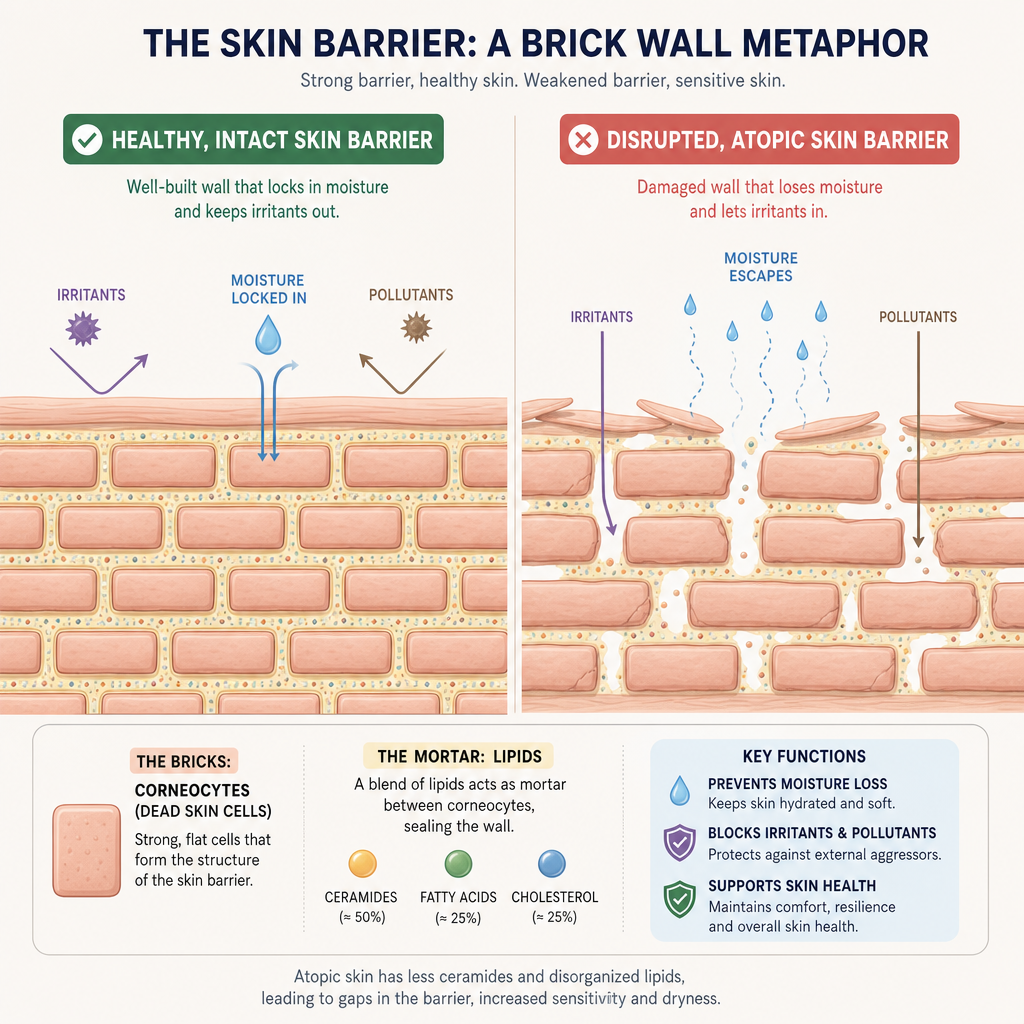
You can imagine the stratum corneum of the skin as a wall. Dead skin cells are the bricks, and intercellular lipids are the mortar that holds them together. This lipid filling mainly consists of ceramides, fatty acids, and cholesterol. When there is enough, the mortar holds, water stays inside, and external elements that shouldn't be there are kept out.
In atopic skin, there is less of this mortar, and it is often composed differently. The consequences are noticeable in everyday life:
- Water evaporates from the skin more quickly, causing it to dry out even without an obvious external cause,
- Irritants, allergens, and residues from cleansing products penetrate deeper,
- The skin reacts more sensitively to stimuli that do not bother other skin types—hard water, wool, dust, or sweat,
- Recovery from irritation takes longer because the barrier repairs more slowly.
Therefore, dryness in atopy is not a cosmetic detail but a main sign that the barrier cannot retain water. This is also why sensible care revolves around two things: not worsening the barrier and supplying what it lacks.
Typical Symptoms of Atopic Skin
Atopic skin announces itself with a fairly characteristic combination of symptoms. Most commonly, these include:
- A feeling of tightness and dryness, significantly stronger shortly after washing,
- A rough surface, fine flaking, and occasional redness,
- Itching, which is most pronounced in the evening and in the warmth of the bed,
- Worsening during the heating season, when dry indoor air takes away the remaining moisture from the skin,
- More sensitive areas in the bends of elbows and knees, on the neck, or on the backs of hands.
This list is for orientation, not for diagnosis. Only a doctor can assess whether it is atopic eczema or another cause of dry and irritated skin—and only they can decide on treatment.
Calm Periods Alternate with Flare-Ups
Atopy does not behave the same way all year round. Periods when the skin is essentially calm and only needs regular moisturizing alternate with flare-ups. These are phases when the skin is irritated, itchy, and reacts even to care it usually tolerates without issues. Triggers can include changes in weather, stress, a recent illness, a new cleansing product, or just a longer hot shower.
This alternation itself explains why the same advice works great one time and not at all the next. A method that proved effective during a calm period can have the opposite effect during a flare-up, and a strict regimen suitable for a flare-up is unnecessarily restrictive when the skin is fine.
With this framework, individual claims can be viewed much more soberly. For each piece of advice, just ask two questions: does it help the skin barrier, or does it burden it? And does it apply during a flare-up, or only when the skin is calm? Most myths about atopic skin fail at one of these two questions.
Hot Bath, Soap, and Other Myths About Washing Atopic Skin
Washing is a crucial moment for atopic skin. It determines whether the rest of the day will be calm or filled with tension and itching. It's also a step surrounded by the most contradictory advice—from recommendations for long hot baths to the belief that it's best to avoid water as much as possible. Let's go through the three most common claims and compare them with what is recommended in standard dermatological practice.
Myth: A hot bath relieves itching
At first glance, it seems so. Hot water can temporarily mask the sensation of itching, providing relief. The problem is what happens afterward. Hot water dissolves the lipids that hold the skin barrier together, removing what is already in short supply. Within twenty to thirty minutes after the bath, the itching often returns stronger than before.
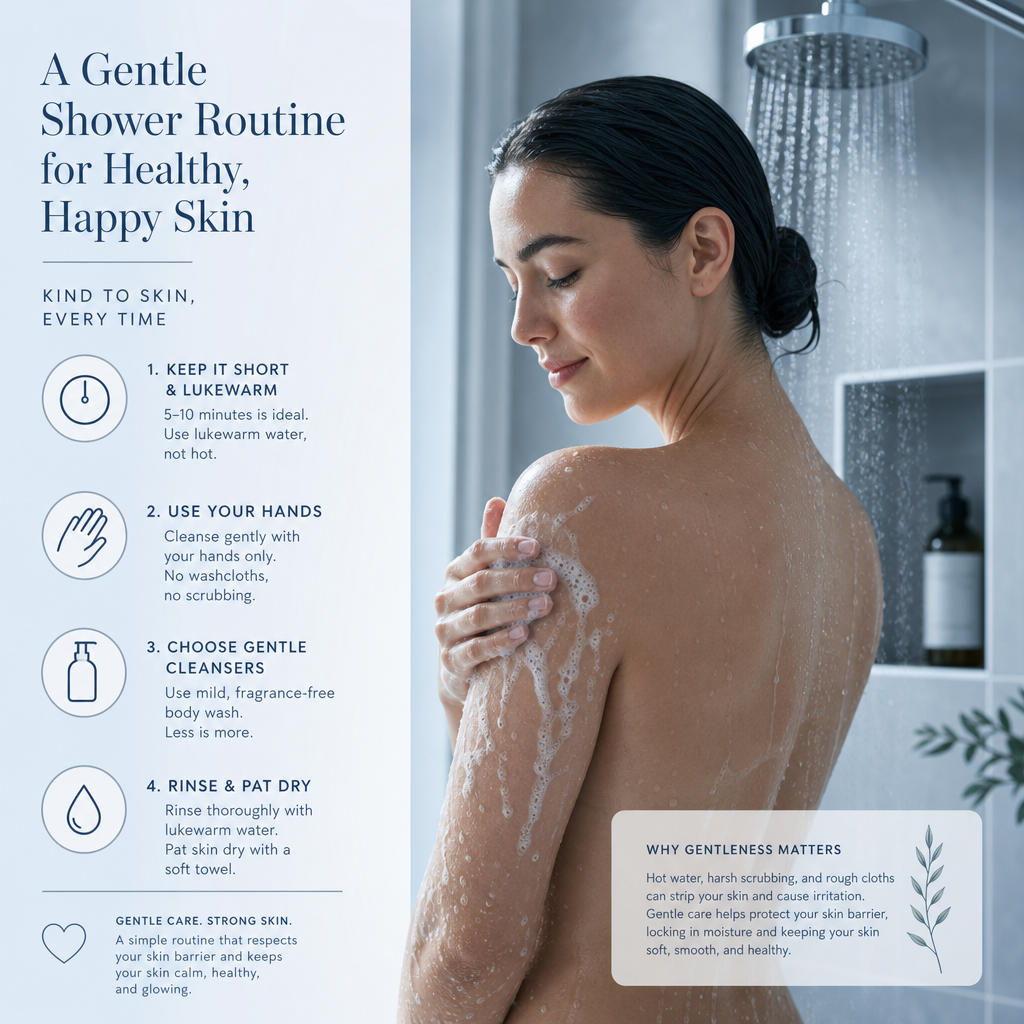
In practice, lukewarm water, approximately at body temperature, is recommended, and a shorter shower is preferred over a long soak in the tub. If you enjoy baths, a rough guideline is about ten minutes—not an hour with hot water top-ups. After washing, the skin should not be red or hot to the touch.
Myth: Atopic skin should hardly be washed at all
This opinion arose as a logical counterbalance to the previous myth, but it goes too far. Sweat, dust, pollen, detergent residues from clothing, and microorganisms accumulate on the skin throughout the day—all of which can worsen irritation. Washing also prepares the skin for the essential step of moisturizing.
A short daily shower usually doesn't bother atopic skin if done gently. What doesn't pay off is scrubbing with a washcloth, brush, or rough sponge, and using exfoliants on irritated areas. It's enough to gently wash with hands and focus on areas where it makes sense—armpits, groin, feet. The whole body doesn't need to be soaped from top to bottom every day.
Myth: Traditional soap is the gentlest choice
A bar of soap seems like the simplest and most natural option, but from the perspective of atopic skin, it is often one of the harshest. Traditional soap has an alkaline pH, while healthy skin is slightly acidic. After washing, the barrier is left unbalanced, and the typical feeling of "dry tension" is not a sign of cleanliness but rather a signal that the cleanser took more than it should have.
Gentler options are cleansing oils that emulsify upon contact with water, leaving a thin film on the skin, and mild soap-free cleansing gels with a pH close to that of the skin. It's beneficial to avoid strong fragrances and products with high alcohol content; for sensitive skin, fewer ingredients are usually a safer choice.
Steps Often Forgotten
The last two minutes of bathing are as crucial as everything that came before. If you vigorously rub yourself with a towel after a shower, you'll further irritate already sensitive skin. It's gentler to pat dry with a soft towel, avoiding rubbing.
- Leave the skin slightly damp; don't dry it completely.
- Apply care ideally within a few minutes after drying, while the skin is still moist—this helps the skin retain the water it has just absorbed.
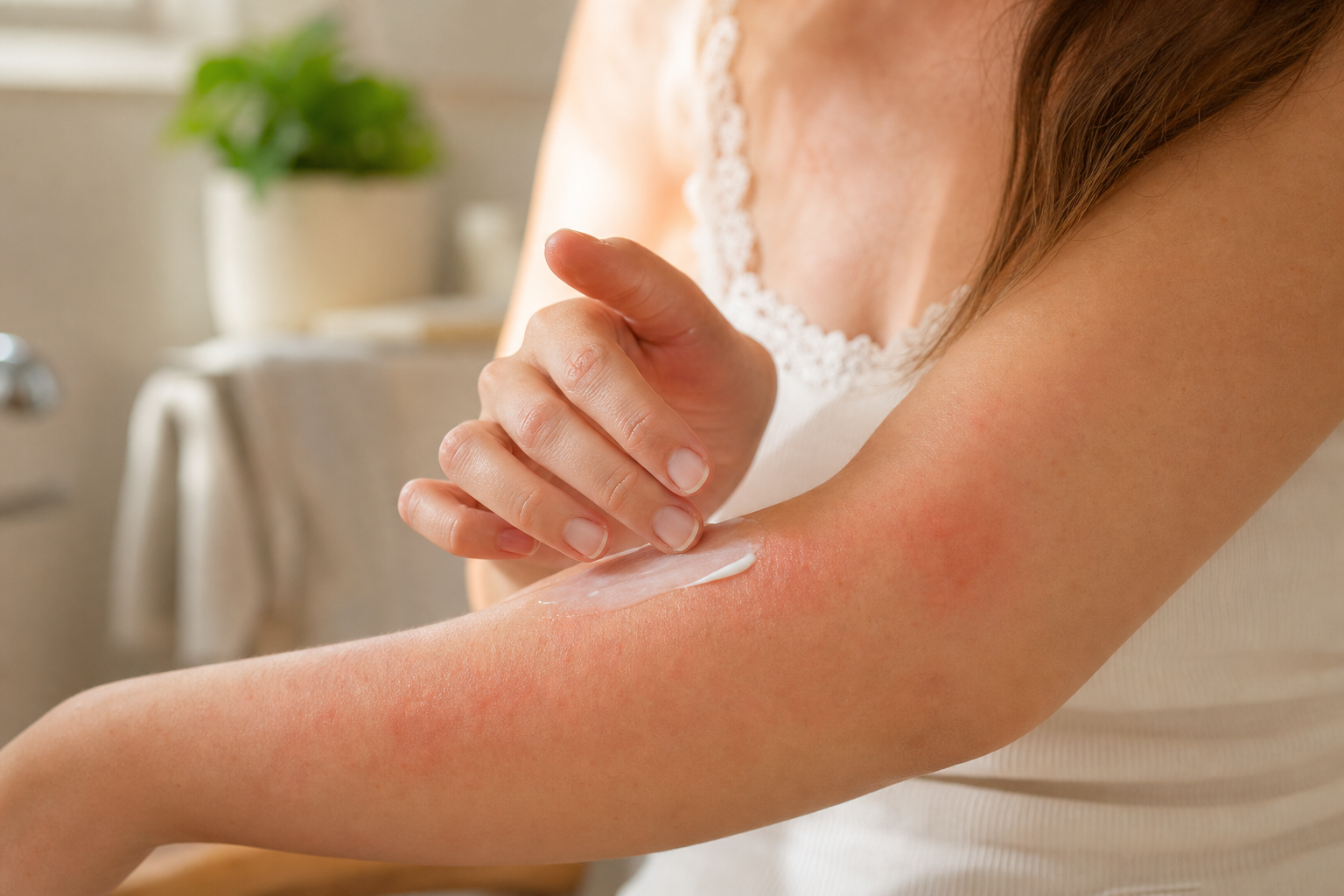
- Spread cream or balm in a thin layer in the direction of hair growth and let it absorb before dressing.
- Wash towels without fabric softener and preferably at a higher temperature; residues of softeners are common hidden irritants.
The specific form of post-wash care to choose depends on how dry the skin is and its current condition. This is the topic we continue to explore further.
Creams and Emollients: What Truly Helps Your Skin and What Irritates It
Moisturizing is a daily routine for atopic skin, which is why there are so many conflicting pieces of advice surrounding it. One says that using cream spoils the skin, another suggests using anything natural, and a third says to apply only when a problem is visible. Let's explore what is actually supported by how a compromised skin barrier functions.
Three Common Myths About Moisturizing
"The skin gets used to cream and stops taking care of itself." The skin barrier does not become dependent on emollients. Atopic skin lacks some lipids, which it would ideally replenish on its own, and care precisely fills this gap. The feeling that the skin is suddenly worse after stopping the cream usually just means that the original condition, which regular moisturizing compensated for, has returned.
"Natural ingredients are automatically gentler." Natural origin says nothing about compatibility. Many plant extracts and essential oils are actually common triggers of irritation for sensitive skin, whereas a lab-prepared formula is often deliberately free of fragrances and known allergens. What matters is the specific composition and how your skin reacts to it, not the word on the label.
"You should moisturize only when dry patches appear." Emollients make sense especially during calmer periods when nothing itches or burns. It is the care during these intervals that keeps the barrier in better condition. Sporadic moisturizing when the skin is already irritated addresses the symptom rather than the cause.
The Difference Between Light Hydration and Rich Balms
Emollients are products that replenish missing fats, soften the skin's surface, and slow down water evaporation. The practical difference between them is mainly in the ratio of fat and water components, which determines when each texture is suitable.
- Lighter lotions and emulsions absorb quickly and do not leave a greasy film. They are suitable for warmer months and for full-body application after a shower, when you dress immediately.
- Rich balms and ointments have a higher fat content, stay on the skin longer, and make sense during the heating season and on areas that repeatedly dry out – elbows, knees, backs of hands, shins.
It's not wrong to have both at home and switch between textures throughout the year. The condition of atopic skin changes with the season and with how much time you spend in dry, heated environments.
Ingredients That Often Irritate Sensitive Skin
- Strong fragrances – Fragrance blends are common causes of contact irritation, so fragrance-free products are usually chosen for atopic skin.
- Essential oils – Although they seem like a natural choice, citrus, mint, or clove oils can be problematic for sensitive skin.
- High alcohol content – Quickly evaporating alcohol in light gels and tonics can intensify feelings of tightness and burning.
- Colorants – They have no functional significance in the product and are an unnecessary risk for sensitive skin.
Try a new product first on a small area, such as the forearm, before applying it all over.
How Much and How Often
It's the amount and frequency where most home routines fail. Emollients should be applied in a thin but continuous layer over the entire body, not just on visibly dry areas – usually once or twice a day, more often during flare-ups. The best time is within a few minutes after showering, on still damp skin, when the care helps retain the water the skin just absorbed.
Gently rub the cream in the direction of hair growth, without vigorous massaging. And one final guideline: if a half-liter bottle of balm lasts you six months, you're probably moisturizing less than your skin needs.
Daily Routine Without Unnecessary Mistakes and When to Seek Medical Help
Atopic skin generally doesn't require a complicated ten-step care routine. It needs a few simple things done regularly and consistently. The most common mistake isn't choosing the wrong product, but inconsistency – a week of diligent care, then a break, then a new cream based on advice from a forum, and starting over again. The following routine is intentionally short, so it can be managed even on a weekday.
Simple Daily Routine
- Lukewarm and relatively short showers. While a long hot bath may provide temporary relief, it often leaves the skin drier and tighter than before.
- Moisturize shortly after washing. Ideally within a few minutes on still damp skin, before it has a chance to dry out.
- Reapply care throughout the day. Dry areas, hands, and parts that come into contact with water can tolerate repeated application. A richer balm is best saved for the evening.
- Protection in cold and windy weather. In frost, a thicker, greasier texture is more suitable than a light lotion, and don't forget about the face, lips, and backs of the hands.
- Clothing that doesn't irritate. Cotton and smooth materials work well directly on the skin; wool and rough seams can trigger itching on their own.
- Washing without unnecessary chemicals. Fabric softeners and heavily perfumed detergents leave residues on fibers. A longer rinse cycle is often a simpler solution than searching for a special product.
The environment where you spend your evenings surprisingly affects the outcome as well. During the heating season, the air in the apartment dries out all day, so a milder temperature in the bedroom, regular ventilation, and minimizing dust where you sleep can help. And a small detail that's often forgotten: short-trimmed nails. Scratching damages the skin mechanically and opens the way to inflammation, even though the itching itself is understandable and can't be willed away.
When Home Care Is No Longer Enough
Gentle washing and emollients can alleviate dryness and tension and maintain calmer periods for longer. However, cosmetics are not medicine and are not meant to replace a doctor. There is a threshold beyond which it makes sense to see a dermatologist or general practitioner instead of searching for another cream:
- the condition affects a large area of the body or spreads rapidly,
- lesions ooze, crack, form crusts, or pus – this may indicate an infection,
- itching disrupts sleep or normal functioning at school and work,
- the condition does not improve even after several weeks of consistent care,
- symptoms appear in an infant or young child,
- fever or significant pain accompanies the skin symptoms.
A doctor has access to treatments that cosmetics do not offer and can assess whether it is truly atopic eczema or another issue with similar symptoms. If a treatment has been prescribed, cosmetic care complements it, not replaces it – emollients are used alongside it, not instead of it.
How to Navigate the Offerings
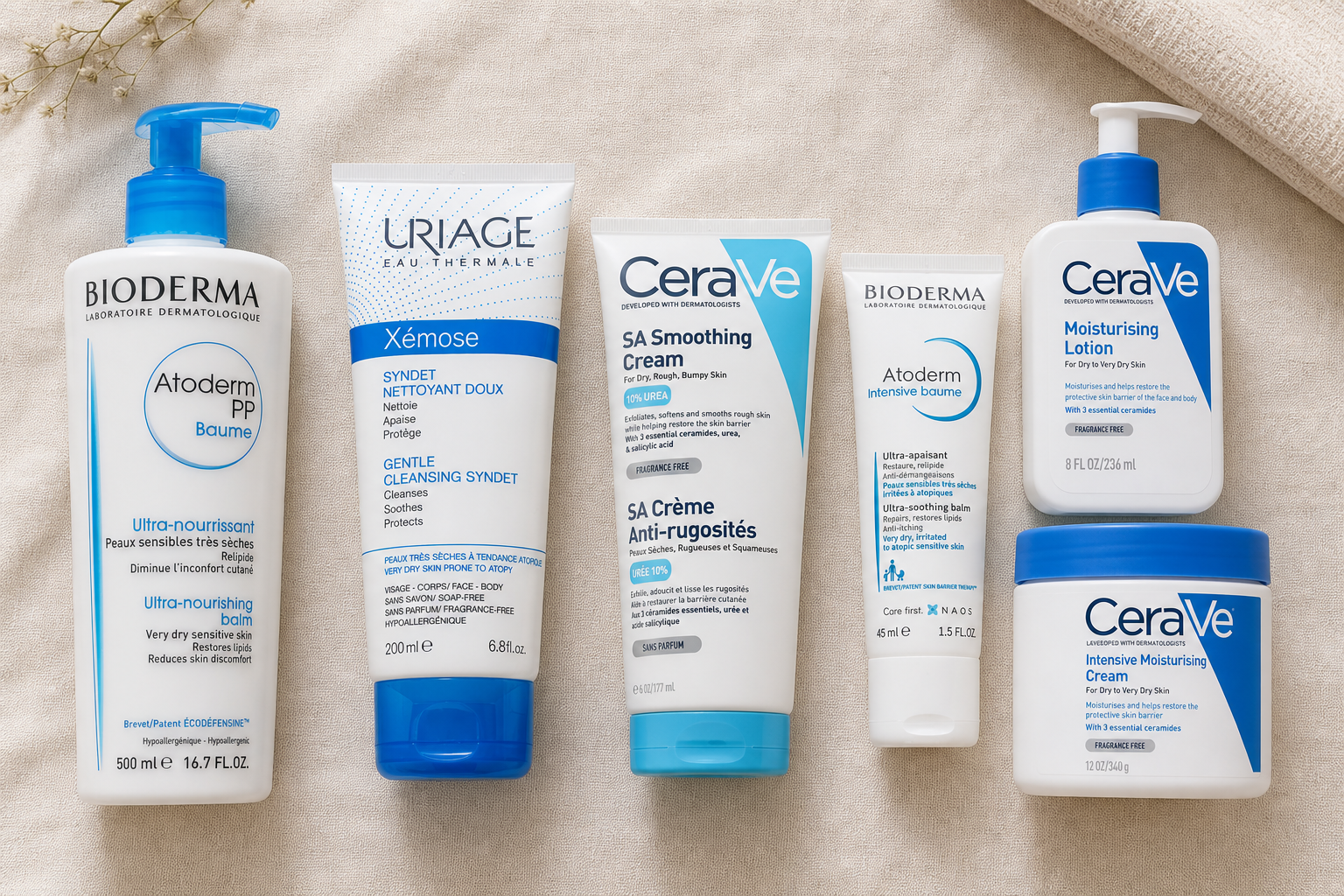
In our facial and body care range, you'll find several complete lines designed for dry and sensitive skin, which you can start with without having to mix and match products from different brands. These include Bioderma Atoderm, Uriage Xémose, La Roche-Posay Lipikar, and CeraVe. The logic is usually similar across all: a cleansing oil or gentle shower gel instead of soap, along with a richer body balm and possibly a lighter version for the face.
Please consider these as suggestions to try, not as a universal solution. Atopic skin reacts individually, and a product that suits one person may irritate another. It's worth introducing one new product at a time, giving it a few weeks, and starting with a smaller package before opting for a liter-sized one. If you're unsure about the ingredients due to allergies or concurrent treatment, it's better to consult your doctor or pharmacist.


Category
Recommended articles

"Give a girl the right shoes and she can conquer the world!" Marilyn Monroe