

There are myths about hair sprays – that they dry out hair, weigh down the scalp, or are difficult to wash out. Let's explore what reflects the composition of today's products and what is just a lingering notion from the past.
Why We're Still a Bit Wary of Hairsprays
Almost everyone has a can of hairspray at home. It often sits in the bathroom for months, gathering dust, and only gets used when a hairstyle really needs to last until the evening. The reason is usually the same: there's a lingering fear that hairspray might do more harm than good to your hair. If this sounds familiar, you're definitely not alone – and it's worth exploring where this distrust actually comes from.
A large part of today's concerns surprisingly have specific roots. They stem from memories of styling as it was twenty to thirty years ago. Back then, formulas were harsher, the mist was coarser, and the result on the hair was much more noticeable. Anyone who remembers a hairstyle that turned into a stiff shell after spraying has a reason to be cautious. That experience was real; nobody made it up.
The most commonly mentioned memories include:
- a white residue or tiny flakes that appeared after drying, especially on dark hair;
- clumped strands that couldn't be combed out without pulling and breaking;
- a sticky feeling that lingered in the hair until the next wash;
- a strong chemical scent that overpowered both perfume and shampoo;
- the impression that hair felt rough and dry to the touch after spraying.
These experiences are also passed down. Many of us have heard from our mothers or grandmothers that "hairspray ruins hair," and accepted it as fact long before we ever bought any ourselves. Distrust persists even among those who haven't had a bad experience themselves. They received it ready-made, along with the reasoning.
Meanwhile, styling products have evolved. The hairspray category has undergone a transformation similar to skincare over the past decades: the carrier, the fixing component, and even the fineness of the mist have all changed. Many concerns are therefore aimed at products that no longer behave this way. This doesn't mean that hairspray is risk-free in all circumstances and for everyone. It simply means that the statement "hairspray ruins hair" needs clarification: which hairspray, in what quantity, and how it's used.
The second source of distrust is the handling of the product itself. Hairspray is one of those cosmetics where the result heavily depends on how you use it. The same bottle can hold a hairstyle all day for one person without them even noticing, while for another, it ends up as a failed purchase in the cabinet. The difference often isn't in the formula, but in the habit.
The aim of this text isn't to defend hairsprays at all costs. Some criticisms are justified and worth voicing. Others are outdated notions that have outlived the products they originally concerned. In the following paragraphs, we'll gradually dissect each claim and try to separate verifiable facts from impressions. So next time you hold a can of hairspray, you'll at least know what to expect and what not to.
What Really Lies in the Ingredients of Hairspray Today
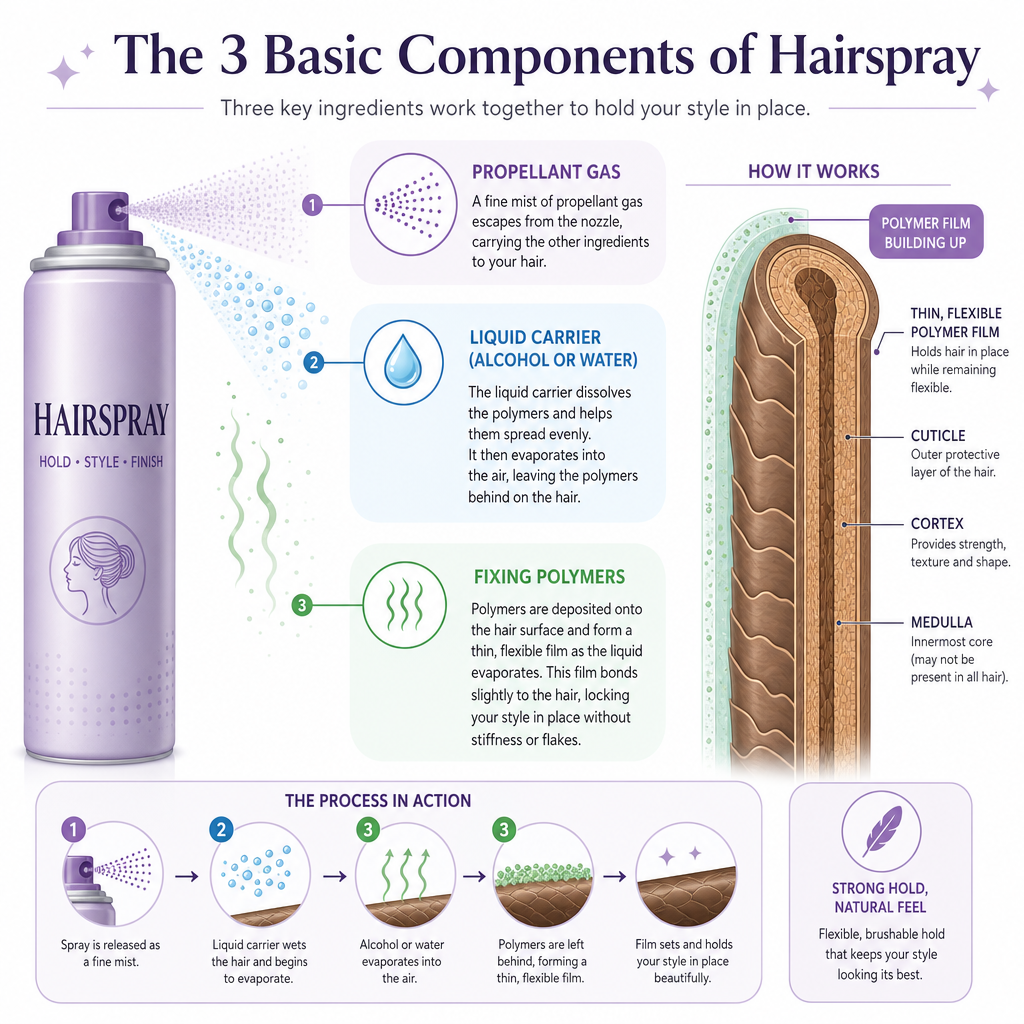
The list of ingredients on the back of the packaging may seem overwhelming at first glance, but it can be functionally divided into three basic groups and one supplementary group. Once you identify them, you'll find that hairspray is among the simplest formulations in all hair cosmetics – simpler than shampoo or hair dye. And that's why it can be discussed factually, without speculation.
The three pillars on which every hairspray stands:
- Fixative Polymers – ensure the actual effect, which is holding the hairstyle.
- Carrier – evenly distributes the polymers onto the hair and then evaporates.
- Propellant Gas – in aerosol packaging, it expels the mixture from the container as a fine mist.
Fixative Polymers are substances that dry into a thin, flexible film after the carrier evaporates. This film coats the hair surface and creates tiny bonds where individual hairs touch. These microscopic bridges hold the hairstyle in shape, and when you comb or shake your hair with your fingers, the bonds break again. In the ingredient list, you can recognize them by names containing the word "copolymer"; most commonly, they are polyvinylpyrrolidone-based copolymers. The difference between light and extra strong hold lies in nothing more dramatic than the type and amount of polymer in the formulation.
The Carrier makes up the majority of the content by volume. It is usually denatured alcohol (ethanol), more often water or a mixture of water and alcohol in non-aerosol sprays. Its role ends when it evaporates and leaves the polymer on the hair – the carrier is no longer present in the resulting film. Alcohol-based formulations dry faster, thus less disrupting the finished hairstyle, while water-based ones dry more slowly and feel softer.
Propellant Gas pertains only to aerosol packaging, i.e., classic pressurized containers. Today, liquefied hydrocarbons are used, typically propane, butane, and isobutane, or dimethyl ether. Older chlorofluorinated gases, which once gave hairsprays a bad reputation, have been out of European cosmetics for decades. The propellant gas does not remain on the hair; it evaporates immediately after application and has nothing to do with the resulting film.
The fourth group is optional but common in professional lines: caring and protective ingredients. You'll encounter panthenol, glycerin, hydrolyzed proteins, a small amount of plant oils, or UV filters. Their purpose is not to replace a mask or leave-in care – the contact of the spray with the hair is too brief, and its share in the hairstyle is too small. They are meant to reduce the feeling of dryness, add shine, and limit the impact of sunlight on the color of dyed hair.
And now the principle from which the rest of the article stems: hairspray works exclusively on the hair surface. It does not penetrate the cortex, the inner structure where the hair's strength and color reside. This is a fundamental difference compared to coloring or perming, which change the hair from within and irreversibly. In contrast, the film from hairspray can be removed with a regular wash, partially even with thorough combing. Most concerns surrounding hairsprays arise from attributing them with deep effects they are not capable of.
Does Hairspray Dry Out Hair? What Alcohol Really Does
The claim that hairspray dries out hair is one of the most common objections you'll hear when choosing styling products. It stems from a simple reasoning: there's alcohol in the formula, alcohol removes grease, so it must dry out hair too. This logic holds only until you look at the actual role alcohol plays in the spray and how long it stays on the hair.
Alcohol is a Carrier, Not an Active Ingredient
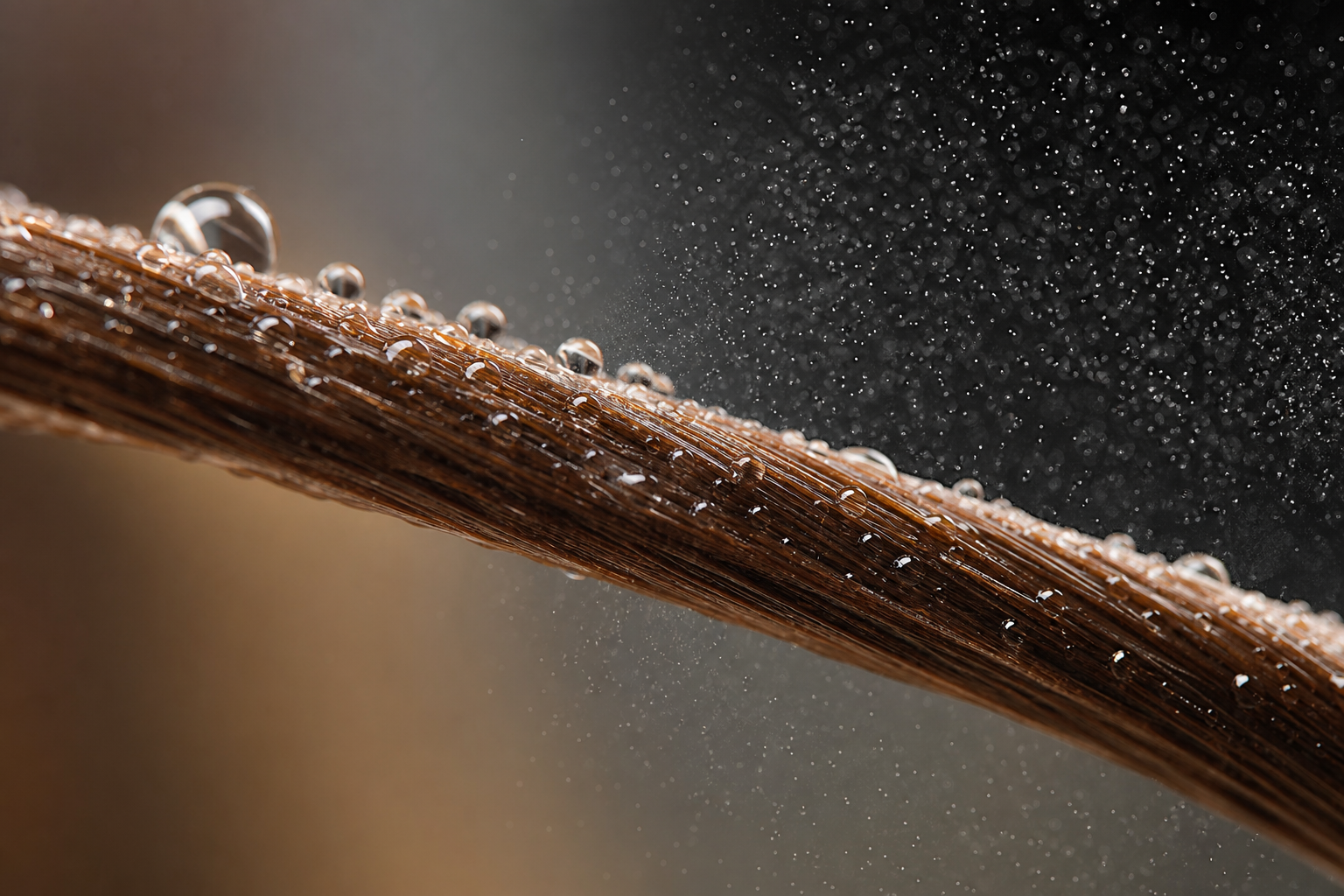
Alcohol – most commonly ethanol or denatured alcohol – serves as a solvent in hairspray. It keeps the fixing polymers in a liquid state so they can be dispersed into a fine mist, and once it lands on the hair, it starts to evaporate. The evaporation takes mere seconds, leaving behind only a thin film that holds the strands in shape. The speed of evaporation is precisely why the spray doesn't have time to penetrate the hair cuticle and draw out moisture: most molecules leave the hair before they have the chance. Comparisons to skin degreasing also fall short in terms of contact duration – hair is exposed to alcohol for a few seconds as a dispersed mist, not in a continuous layer for several minutes.
The Feeling of Drier Hair Versus Actual Damage
The feeling that hair has hardened and become drier after using hairspray is very real – it just doesn't originate where most people think. The fixed film changes the surface properties of the hair: strands become stiffer, don't glide as easily, lose elasticity, and feel rougher to the touch. However, the hair fiber retains the same moisture inside as it had before styling; only its surface has changed.
A good indicator is reversibility. If you wash out the hairspray with regular shampoo and your hair returns to its original smoothness and shine, it was a surface phenomenon, not structural damage. True damage doesn't behave this way – split ends or porosity from bleaching don't disappear after a single wash.
When Hair Really Suffers Under Hairspray
Idealizing hairsprays would be as misleading as demonizing them. There are situations where you can genuinely harm your hair – and it's not the formula's fault, but rather how you handle it:
- Brushing through fixed strands. The hardened film holds the hair together, and a comb can only pass through with force. This mechanical stress leads to breakage and splitting much more reliably than any spray ingredient. First, disrupt the fixation with your fingers or wash your hair before reaching for a brush.
- Repeated spraying without washing. Applying another layer on already fixed hair for several days in a row results in an increasingly harder film, less manageable lengths, and more strain with each brushing. Hairspray belongs on freshly washed hair, not on a multi-day buildup.
- Combining with intense heat styling. Straightening or curling strands that already have hairspray on them means exposing the hair to high temperatures over a layer not designed for it. The order should be reversed: first, apply heat protection and perform hot styling, then fixate at the very end.
How to Minimize the Risk
A few habits are all it takes. Hold the hairspray about twenty to thirty centimeters from your head – spraying too close creates a local wet spot and an unevenly stiff film, while from a distance, a fine mist is evenly distributed over the entire surface. Use just one light layer and repeat if necessary, rather than applying a large amount of product all at once. And most importantly: wash out what you've applied during the day in the evening or the next day. The alcohol in the formula is not the threat to hair that the myth makes it out to be – what matters is what you do with the fixed hair afterward.
Scalp Under Hairspray: Does It Weigh Down or Is It Just Hard to Wash Out?
Two common concerns about hairsprays are closely related. The first suggests that hairspray weighs down the scalp and settles at the roots. The second claims that it's difficult to wash out and leaves a residue that regular washing can't handle. Both stem from real experiences – but these experiences usually arise not because of the hairspray itself, but because of how it's used.
Where Hairspray Actually Lands When Applied Correctly
Hairspray is an aerosol and behaves accordingly: the further you hold the spray from your head, the finer and more even the mist settles on your hair. Most manufacturers recommend a distance of about twenty to thirty centimeters, roughly the length of a forearm, aiming at the lengths and ends, not the scalp. With such application, part of the carrier evaporates in the air, and only a fraction of the product reaches the scalp.
An unpleasant feeling usually arises when the spray is brought close to a few centimeters and sprayed directly at the roots. This is no longer a fine mist but a local deposit that clings to the scalp, tightens it, and crumbles during combing. A few habits can reliably prevent this:
- Hold the bottle about a forearm's length from your head and spray in short bursts, not one long press.
- Divide your hair into several sections – this way, the spray reaches evenly where it should, and you don't need to apply more than necessary.
- If you need volume at the roots, lift the strands and spray from underneath into the hair, not from above over the entire head to the crown.
- Let the hairspray dry for a few seconds before touching your hair; an undried film transfers more easily to your hands and back to the scalp.
Washing Out: Why Regular Shampoo Usually Suffices
Fixative polymers in hairsprays are designed to hold against humidity but also dissolve during regular washing. Surfactants in ordinary shampoo release them from the hair, and warm water rinses them away – a special product is usually not needed. The key is to thoroughly wet your hair before shampooing, emulsify the product in your palms, and rinse thoroughly; leftover shampoo residues act on the hair similarly to supposedly unwashable hairspray.
Where Does the Feeling of Unwashed Hair Come From?
In most cases, it's due to a combination of products, not the hairspray itself. Waxes, styling pastes, and clays contain an oily component that rinses out more slowly, dry shampoo adds a layer of absorbent particles, and leave-in care intentionally leaves its film on the hair. When hairspray is added on top of all this, it creates a mixture that one quick lathering can't handle. Under-dosed washing also contributes – a small amount of shampoo on thick or long hair barely covers the top layer.
When a Deep Cleansing Shampoo Makes Sense
The idea that a deep cleansing shampoo is necessary after every use of hairspray is unnecessarily strict – for regular styling, your usual care routine suffices. However, it finds its place if you layer styling products several times a week, regularly use dry shampoo, or feel that your hair is gradually losing volume and stops responding to care. In such cases, include it approximately once every one to two weeks and follow with a mask or conditioner, as more thorough cleaning dries hair more than everyday shampoo. If you are long-term troubled by itching or scalp irritation, it's appropriate to address the cause with a specialist and, in the meantime, choose a gentle formulation.
How to Choose Hair Spray by Hold Level and What to Pair It With
Once you understand how hair spray works, the final practical step is to choose one that suits your hairstyle and your daily expectations. Three factors are crucial: the hold level, the packaging format, and the care products you combine with the spray.
Hold Levels and Their Uses
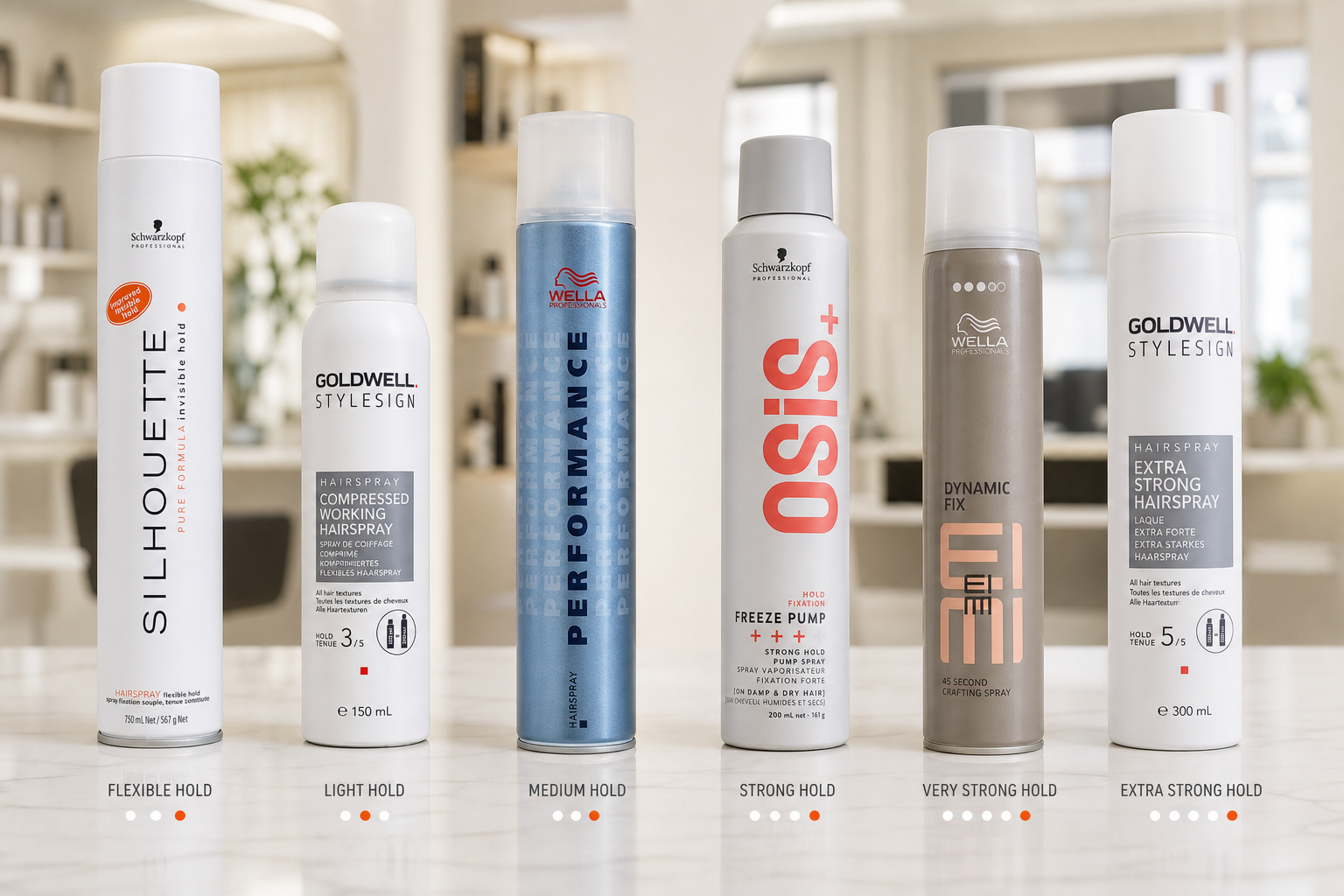
Manufacturers offer a range from light to extra strong hold; these are labeled on the packaging either in words (light, strong, extra strong, mega) or numbers. The difference lies in the amount and type of holding polymers, which determine how firm the film on the hair surface will be and how much it restricts movement.
- Light and Flexible Hold – ideal for everyday use when you just want to tame flyaways or set a parting. Hair remains flexible and the style can be adjusted with your fingers.
- Medium Hold – a compromise for blow-drying, waves, or slightly lifted roots. It holds the shape but doesn't make the hair a solid mass.
- Strong Hold – suitable for hairstyles that need to last all day, for fine hair that quickly falls flat, or when you want to maintain volume at the roots.
- Extra Strong to Mega Hold – for more demanding formal hairstyles: buns, half-up styles, sleek ponytails. Hair will move significantly less with this hold.
A useful rule of thumb: it's better to use a lighter spray in two thin layers than one heavy dose of strong spray. A thin layer dries faster, clumps strands less, and is easier to wash out in the evening.
Aerosol or Mechanical Pump?
The format determines how precisely you apply the spray. An aerosol spray creates a fine mist that you can distribute evenly over the entire head; it dries quickly and is suitable for finalizing a finished hairstyle from a distance of about twenty to thirty centimeters. A mechanical pump dispenses coarser droplets over a smaller area, making it practical for targeted work: securing individual strands, taming unruly hairs around the face, or fixing a braid.
Specific Guidance in Our Hair Care Range
Whether you're looking for a spray for everyday use or for a specific evening, you can choose based on the hold level:
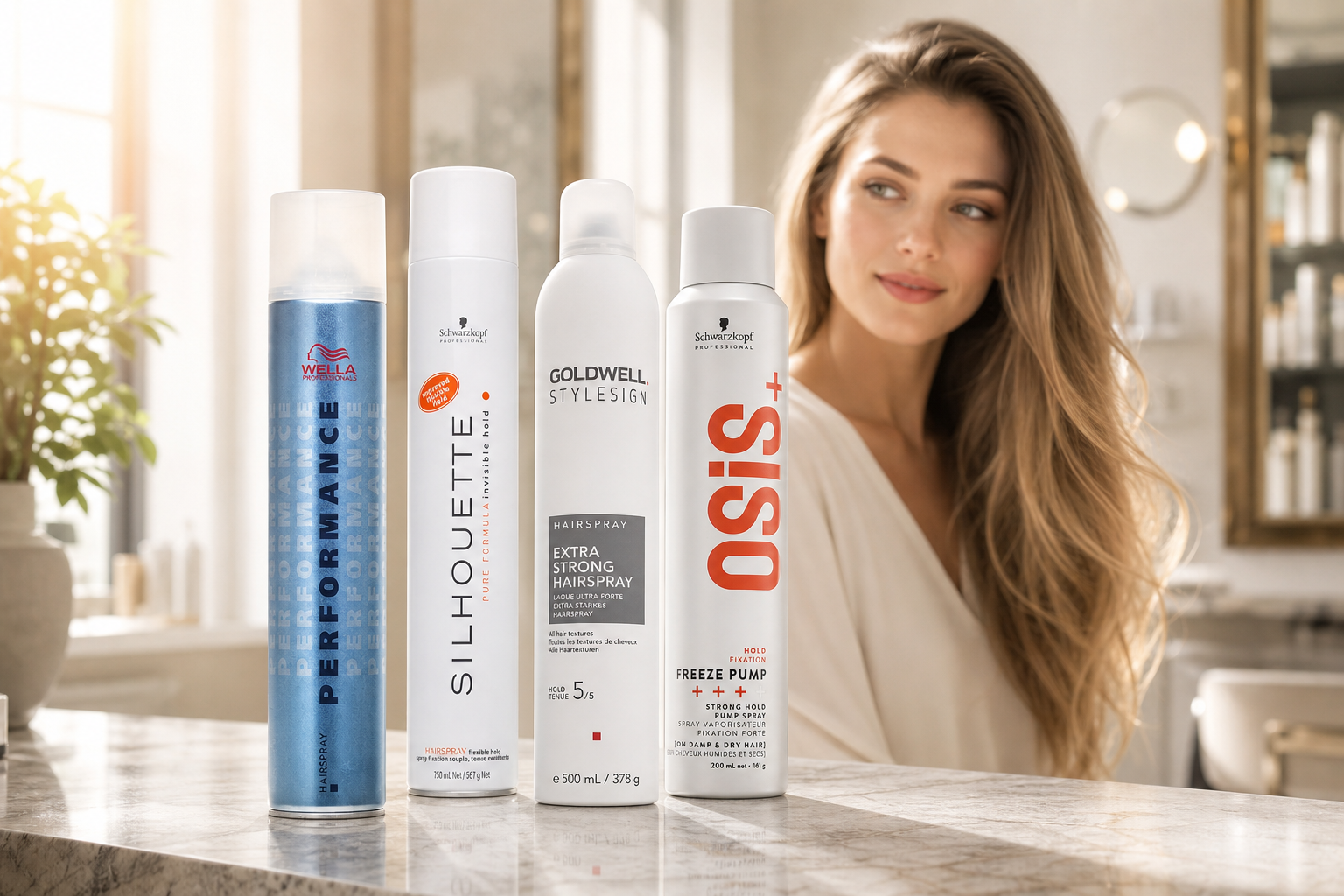
- Wella Professionals Performance Extra Strong Hold Hairspray 500 ml – firm hold for everyday use.
- Schwarzkopf Professional Silhouette Super Hold Hairspray 750 ml – strong hold in a large package, ideal for hairstyles that need to last for hours.
- Sebastian Professional Re-Shaper Strong Hold Hairspray 400 ml – a professional choice with strong hold that can be brushed out and reshaped during styling.
- Goldwell Salon Only Hair Lacquer Mega Hold 600 ml – the highest hold level in this selection, perfect for styled formal hairstyles.
What to Pair with Hair Spray
Hair spray alone doesn't treat the hair – it focuses on shape, not condition. Therefore, it makes sense to complement it with care products that work in the opposite direction. A hair mask once a week will restore suppleness to the strands and make detangling easier, while a leave-in treatment applied to damp lengths will reduce mechanical stress during styling. For fine hair, choose lighter textures to prevent the style from losing the volume you've set with the spray.
A small detail often overlooked: apply spray only to dry hair and let it dry for a few seconds. The result will hold more naturally than trying to perfect the style with a stronger dose.


Category
Recommended articles

"Give a girl the right shoes and she can conquer the world!" Marilyn Monroe