
Why Makeup Myths Spread Among Teenagers
Open any social network and within a minute you'll find someone explaining makeup. One video claims that foundation clogs pores and causes acne. Another, a few seconds later, recommends makeup as a shield against environmental impurities. Both sound convincing, both have thousands of reactions, and both can't be true at the same time. This contradiction is often one of the first experiences teenagers have with decorative cosmetics.
Short Videos Reward Certainty, Not Accuracy
The format in which makeup is most often discussed today lasts only a few dozen seconds. In such a short time, there's room for one sentence and one result, but not the conditions under which that sentence is true. Statements like never put this on your skin almost share themselves: they're short, unequivocal, and can be applied immediately. A more honest version of the same information would be it depends on your skin type, the specific product's composition, and how you remove it, and such a sentence spreads much less because it doesn't surprise anyone.
There's another factor at play. Makeup advice can be tried immediately, creating a sense of quick verification. If your skin looks better after a new technique, it's easy to credit that one trick, even though five other factors changed that day: sleep, weather, diet, or what you used to remove your makeup.
Decorative Cosmetics Are a Popular Topic for Shortcuts
The category itself plays a role. Decorative cosmetics include dozens of product types, from foundations, concealers, and powders to mascaras and serums for lashes and brows, to brushes and sponges. Each has a different composition, consistency, and purpose. Add in skin type, season, and how long the product stays on your face. The result is that almost every simplifying statement finds someone it truly applies to.
Most myths don't arise from malice. They're usually one person's personal experience that becomes a general rule along the way. The more confidently it's stated, the fewer people ask who it actually applies to and under what conditions.
It's Not Just About Girls
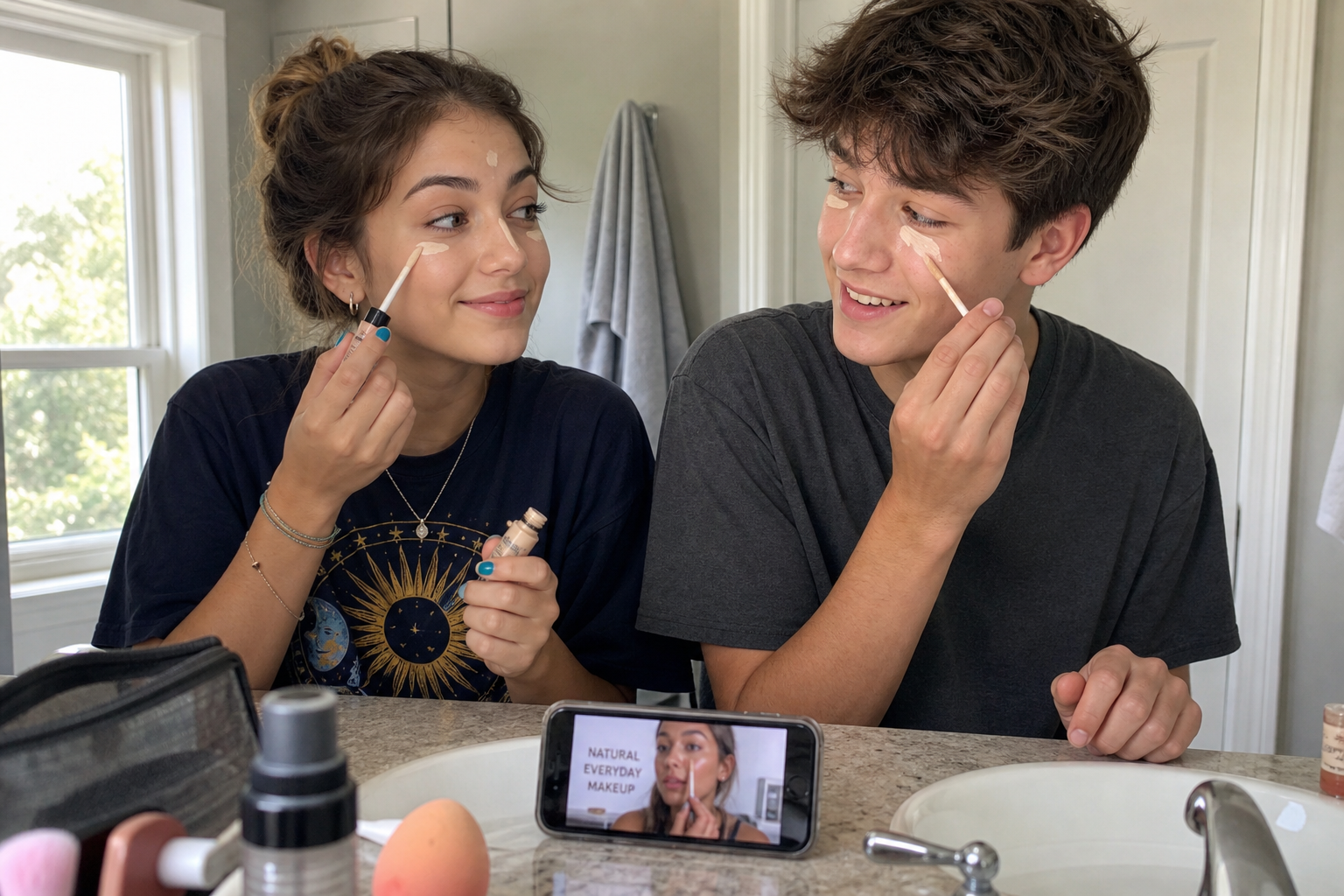
One more thing is often overlooked: makeup is no longer a topic reserved for girls. Concealer for a prominent blemish before a photo, brow serum, light foundation for a dance, or just powder to reduce shine in photos are now common parts of preparation for boys too. The difference is more that they don't talk about it as much among themselves, so they rely mainly on videos. The myth then persists longer because there's no one to supplement it with the experience of someone close.
Six Claims We'll Examine
In the following sections, we'll go through six claims that are most commonly circulated about makeup. Three of them concern skin health:
- makeup itself damages the skin,
- foundation causes acne,
- skin needs regular breaks from makeup to breathe.
The other three focus on the choice of products themselves:
- concealer can fully replace foundation,
- a more expensive product is automatically better,
- mascara damages lashes.
For each, we'll discuss what's real about it and where its validity ends. Most makeup myths aren't complete lies but truths taken out of context. And that's good news: once you know the context, you'll know when it makes sense to try advice from a video and when to ignore it.
How to Distinguish a Substantiated Claim from the Impression of a Single Video
Most makeup tips circulating online aren't lies. They often describe a specific experience: a product worked for someone, didn't for another, leading to statements that sound like universal rules. The difference between "this did this for me" and "this works for everyone" is a tool you can use whenever you encounter such claims. Once you see it, you'll recognize it in videos and comments almost immediately.
Personal experience isn't worthless—in fact, a well-described experience is often more specific than a general rule. The problem arises when a single trial becomes a rule for everyone. A video creator usually tests one shade, on their skin, in their environment, often for just a few days. That's a sample size of one person. A generally applicable insight, on the other hand, can be described without referencing a specific person: it talks about the type of product, its function, or its composition, not how it performed on one Friday night.
Before accepting any advice, consider a few questions:
- Is the author talking about themselves, or claiming something about everyone? The phrases "it lasts all day for me" and "it lasts all day" mean different things.
- Is it mentioned how long the product was used? The impression from the first application and the experience after a month often differ.
- Does the author mention their skin type? Without this, the evaluation of a foundation or powder is hard to transfer.
- Is the claim supported by anything else, or does it rely solely on that one video?
- Is any collaboration with the brand disclosed? This doesn't necessarily mean the review is false, but it contributes to the overall picture.
The second thing to look at is the ingredient list on the packaging. You don't need to understand every item, and there's no point in memorizing them. Just know that ingredients are listed in descending order by quantity, so those at the beginning form the base of the product, and those at the end are present in small amounts. So, if a video bases its entire recommendation on one "miracle" ingredient, check where it actually is on the list. And importantly: one ingredient alone doesn't determine if a product will suit you.
Skin type also plays a role. Dry, oily, combination, and sensitive skin behave differently, and the same makeup looks different on them—a mattifying formula might highlight flakes on dry skin, while it lasts longer on oily skin. That's why two people might describe the same product completely differently, and both are telling the truth. Before dismissing advice as nonsense, try to find out who it was intended for.
The final piece of the puzzle is age. Teenage skin undergoes hormonal changes and typically produces more sebum than adult skin, so makeup behaves differently—it may smudge or change color during the day. A large portion of online advice comes from adult creators dealing with a different situation. This alone explains why some makeup claims seem contradictory: they're not necessarily false, just describing different skin than yours.
With these three filters—who's speaking, about what composition, and what skin type—you can evaluate practically any claim you hear about decorative cosmetics. In the following sections, we'll apply them to six specific statements that are most frequently repeated.
Three Myths About Skin: Does Makeup Harm Your Skin?
The claims about what makeup does to your skin are among the most emotionally charged in the entire debate. They sound like warnings – and warnings are shared more readily than explanations. Let's go through the three most widespread ones and see where there's a real basis and where it's just a shortcut.
Myth One: Makeup Alone Damages Skin
The most common version of this claim is that every concealer damages the skin in the long run. There is a real core here, but it lies elsewhere than usually stated: the problem is not the makeup on the face, but the makeup that remains on the face. If the product is not properly removed at the end of the day, it mixes overnight with skin oils, dead cells, and environmental impurities. This mixture is often what irritates the skin.
This leads to a rather dull but reliable conclusion: spending two minutes on cleansing has a greater impact on skin condition than choosing between two similar makeup products. Tools play the same role. A brush or sponge that hasn't been washed for months transfers everything it has collected back onto your face – and that's a factor discussed significantly less in videos than the product itself.
Myth Two: Concealer Causes Acne
The situation here is more interesting because the claim didn't come from nowhere. Some cosmetic ingredients can contribute to clogging pores in some people; they are called comedogenic, and this is one reason why products labeled non-comedogenic are a popular choice for skin prone to imperfections. However, it is also true that during adolescence, acne is primarily influenced by hormonal settings and increased oil production – things unrelated to makeup. Makeup can be one piece of the puzzle, but hardly its origin.
Practically, this leads to three things:
- Assess skin reactions after several weeks, not after one evening – a one-time worsening usually has dozens of possible causes.
- Regularly clean application tools. Accumulated makeup in the bristles is a more common source of problems than the product itself.
- If imperfections persist or worsen, it's time to see a dermatologist. Decorative cosmetics are a means to enhance appearance, not a solution to skin problems, and it's fair to talk about them this way.
Myth Three: Skin Needs Breaks to Breathe
The idea of "skin that breathes" sounds logical, but it misses the physiology of the skin. The skin doesn't take oxygen from the air through the surface but from the bloodstream. A day without makeup doesn't give it anything that makeup would otherwise deprive it of, and conversely, one more day with makeup doesn't take anything away.
However, this doesn't mean that makeup-free days are pointless – they have value, just for a different reason. Fewer layers mean less cleansing, less friction during removal, and fewer opportunities to rush through something. Skipping full coverage over the weekend doesn't heal your skin, but it does give it a calmer routine. And if you wear makeup every day, there's no reason to talk yourself out of it: the consistency of your evening routine matters more than the number of makeup-free days.
The common denominator of all three claims is the same. The impact on skin condition is more about how you handle makeup than the mere fact that you wear it. Clean tools, consistent cleansing, and realistic expectations from cosmetics achieve more than searching for a single flawless product.
Three Myths About Products: Can Concealer Replace Foundation?
Myths about products often arise from shortcuts that sound good in a short video: one extra product, one item saved, one simple rule. The following three are among the most common, and for each, we'll show not only what doesn't hold true but also what this means when you're browsing an e-shop listing.
Myth One: Concealer Can Replace Foundation for the Entire Face
Concealer and foundation are not two versions of the same product. They differ in density and pigment content. Concealer is more concentrated and designed for small areas – under-eye shadows, individual blemishes, redness around the nose. Foundation, on the other hand, has a thinner consistency because its job is to even out the tone over a large area while remaining lightweight.
When you cover your entire face with concealer, it creates a layer that's too thick. It settles into fine lines, is harder to blend, and is more easily disrupted throughout the day. Add to that the small packaging, and you'll find that as a full-face solution, concealer is impractical and uneconomical.
However, the myth is based on real observation: if your skin tone is even and you only need to address two or three spots, concealer alone is indeed sufficient. For purchasing, this means you don't choose concealer as a replacement but based on the task it needs to perform. A liquid formula with an applicator is suitable for the under-eye area, while a thicker stick is for local coverage. And the shade of concealer is not chosen the same way as foundation: for under the eyes, a slightly lighter shade is usually chosen, while for covering blemishes, an exact match to the skin tone is preferred.
Myth Two: A More Expensive Product is Automatically Better
The price of decorative cosmetics consists of more factors than just the formula itself. It reflects the brand's position, packaging, applicator, size, distribution, and marketing. That's why it happens that two foundations with comparable results can have a significant price difference – and similarly, an expensive product may not suit a particular skin type, while a cheaper one might.
A higher price doesn't necessarily mean just marketing. Sometimes it reflects a wider range of shades, a more sophisticated applicator, or a texture that lasts longer. These are specific features you can verify in the product description – not the magic of the price itself. The difference is in asking, what extra am I getting for the money, rather than taking the price as a mark of quality.
For purchasing, this means a simple check. Compare the price per milliliter, not per package. And for products applied over a large area, prioritize shade and consistency over the name on the packaging.
Myth Three: Mascara Damages Lashes
Mascara is applied to the visible part of the lash, the structure that has already grown. Therefore, it doesn't affect the area where the lash grows. What truly affects lash condition is how you remove makeup: rubbing with a towel, pulling on lashes when removing residue, sleeping with makeup on, or trying to wipe off waterproof mascara with regular facial water.
The impression that mascara is to blame is also contributed to by the natural cycle – lashes grow and fall out continuously, but you notice them more on a makeup remover pad than on a pillow.
The practical consequence this time is more about accessories than mascara itself:
- for waterproof mascara, get a two-phase makeup remover so you don't have to apply pressure;
- don't dilute drying mascara with water – the extra liquid will only shorten its lifespan;
- if you alternate mascara with false lashes, keep in mind that the greater burden is usually not the mascara, but the glue and its removal.
How to Choose Products Based on Facts, Not Videos
When you go through all six discussed claims, one common thing emerges: most advice from social media doesn't address what you need, but what worked for someone else. The practical takeaway for shopping is simple: it's worth considering your skin type and how much time you realistically have in the morning, not what's currently trending in videos. We'll guide you on how to assemble your first kit so that you actually use it, and how to navigate prices.
Starter Kit for Beginners
To start, four items are more than enough. It's not a list you have to buy all at once – feel free to add to it gradually based on what you're missing.
- Make-up based on coverage needs. A light foundation or BB cream evens out skin tone and leaves it looking natural. A full-coverage foundation has a thicker consistency and is suitable when you want to significantly cover redness or pigmentation spots. Choose based on the coverage you really need, not the strongest available.
- Standalone concealer. It's used sparingly, on small areas, so it lasts a long time. One shade close to your skin tone is perfectly sufficient for starters.
- Mascara. A quick way to visually unify the result, even if you have nothing else on your face. The key is more about how you remove it in the evening than how much you spend on it.
- A decent brush or sponge. The tool often influences the result more than the make-up itself. Applying with fingers tends to be uneven and transfers dirt from your hands to your skin.
Why this particular quartet? It covers two things beginners most commonly address: evening out skin tone and enhancing the eyes. Eyeshadow palettes, contouring kits, or setting sprays are nice extras, but without mastering the basics, they usually just sit in the drawer. Once you know your foundation holds and your mascara doesn't smudge, it makes sense to expand your kit.
What the Price Tag Means
Prices in decorative cosmetics cover a wide range, but navigating them is easier than it seems. You can get mascara from affordable brands for around a hundred crowns, regular foundation or full-coverage foundation costs around two hundred crowns, and a quality set of brushes is roughly three to five hundred crowns. Premium and luxury brands start roughly where the affordable ones end; with lash and brow serums, you can go over eight hundred crowns.
The number mainly reflects the brand's position, packaging, and shade range – not automatically how the product will work on your skin. For a first purchase, it makes sense to start in the mid-range: you'll get decent quality and won't regret it if you find the shade is off or the consistency doesn't suit you. You can treat yourself to a pricier piece later, once you know what to expect from it.
Where to Find These Categories
In Brasty's decorative cosmetics range, you'll find all four items as separate categories: foundations, concealers, mascaras, and makeup brushes or sponges. For each, you can filter by brand and price range, so you can narrow down your selection even before you start comparing specific shades. Among the more affordable brands, you'll find Maybelline or Dermacol, and in the premium range, L'Oréal Paris or Real Techniques for brushes.
Whether you're choosing your first foundation or just replenishing what you've run out of, the principle remains the same: ask yourself what you need the product for, and only then look at the brand. A video can give you a tip, but the decision on whether the product suits you is ultimately yours – based on your skin type, the coverage you need, and the time you're willing to spend on makeup.
Category
Recommended articles
"Give a girl the right shoes and she can conquer the world!" Marilyn Monroe