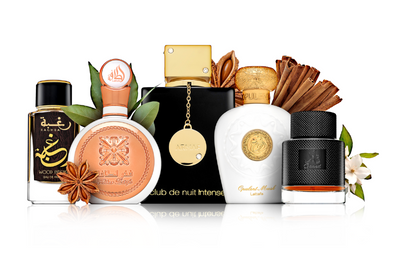


A seasonal selection for those seeking richer and warmer compositions with the arrival of cooler months. We'll guide you on how to choose a niche perfume with patchouli, amber, vanilla, or sandalwood – and recommend specific bottles from our niche category.
Autumn Changes Scents – Why Opt for Richer Compositions
You usually notice it around mid-September. You apply the same citrusy eau de toilette that worked reliably for you all summer, and by lunchtime, there's barely a trace left. It's not that the perfume has aged, nor that your sense of smell has changed. It's the environment in which you're wearing the scent that has changed. Fresh compositions that felt like a relief in the summer heat start to sound thin and somewhat empty in the cooler air – as if the text is missing its final third.
Autumn is therefore a time when many people naturally gravitate towards richer compositions. It's not about fashion, but context. A different fragrance suits a wool sweater, coat, and early dusk than a t-shirt and beach towel. Warm, fuller perfumes give an autumn day exactly what it lacks on an olfactory level: depth, softness, and a sense of coziness that one associates with a cloudy afternoon and a lit lamp.
This is where niche perfumery comes into play. Niche brands typically work with ingredients in higher concentrations and are less concerned about pleasing everyone. Where a mainstream perfume might smooth out patchouli to a subtle aftertaste, a niche composition lets it resonate fully. For autumn, this is more of an advantage than a drawback: the richness that would be overbearing in July reads as character in the cold. It is also true that oriental and woody fragrance families are among the best represented in the niche segment – so there's plenty to choose from.
At Brasty, niche perfumes are not a hidden filter within the perfume category but a separate navigation section of the assortment. Alongside established names like Montale, Mancera, or Xerjoff, you'll also find smaller brands that rarely make it into the usual selection. When you know you want niche, you don't have to hunt for it among thousands of other bottles – just open the part of the catalog where such compositions reside.
The entire selection we guide you through in this article is based on four ingredients. They appear so often in autumn compositions that it's worth knowing how they smell and what they do to a perfume:
- sandalwood – creamy, milky soft wood that grounds the scent without roughening it;
- patchouli – earthy, slightly bitter note with a strong trail that gives the composition a darker outline;
- amber – warm, balsamic component responsible for that "wrapped warmth" feeling on the skin;
- vanilla – a sweet counterbalance that softens the austerity of wood and spices and adds comfort.
Whether you're used to fresh waters and are just trying a richer perfume, or you choose an autumn scent anew each year, it makes sense to proceed from principle to specific bottle. First, it helps to understand how an autumn perfume differs from a summer one, then it makes sense to compare specific ingredients and decide between a woody and oriental direction.
What Makes a Perfume Autumnal: Warm Base and Slower Evaporation
An autumn perfume isn't identified by its label, but by how it behaves on the skin in cooler air. The scent is released from the skin through evaporation, and the speed of this process depends on the ambient temperature and your skin's warmth. Once the thermometer drops to ten degrees and you add a sweater and coat, the whole process slows down – the perfume develops more gradually, lasts longer, and its trail remains more concentrated around you than in the hot summer.
Practically, this means a shift in what you actually perceive from the composition. Top notes, typically citrus and fresh aromatic notes, are the most volatile and disappear in the cold before they can make an impression. In contrast, base notes – resins, woods, musk, or vanilla – need the warmth of the skin to unfold, and they carry the scent for the rest of the day. A summer composition based on citrus therefore often feels flat in autumn, and you may feel it doesn't last. In reality, it just lost the environment that suited it.
The second factor is the concentration of the fragrance component. The information on the bottle isn't just a marketing embellishment, but an indication of how dense the concentrate inside is – and thus how long and intensely the perfume will work:
- Eau de Toilette – the lightest of the common variants, with a significant share of top notes. In autumn, it's more suitable for heated interiors or for those who prefer a subtle trail and don't mind reapplying during the day.
- Eau de Parfum – a usual choice for cooler months. It has a denser base, develops more slowly, and lasts noticeably longer on a scarf or coat collar than on bare skin.
- Perfume – the highest concentration you'll find in a regular offering. It's applied drop by drop, is economical, and in the cold acts more like a quiet aura around you than a cloud.
With higher concentration, the application also changes. In the cold, it makes sense to apply perfume to areas where the skin is consistently warm and protected by clothing – on the neck under the collar, in the crook of the elbows, on the wrists. Cold skin doesn't activate the scent, so two sprays on a warm spot usually do more work than five sprays blindly into the air.
It's interesting to observe which ingredients thrive in autumn across the range. In our perfume category, there's a long-term increase in the presence of patchouli, vanilla, and cardamom – notes that have a rich, warm trail and function as a binder between the woody and oriental lines in a composition. These aren't just a seasonal fad, but ingredients that simply perform better in cold air and provide support to the perfume.
If you want to get a feel for this type of composition, you'll find most of them concentrated in the unisex section of the niche offerings. Unisex perfumes revolve around a woody, amber, and spicy axis, which doesn't have a distinctly feminine or masculine character – and this is where the slower evaporation benefits the most. It's a part of the range worth exploring in autumn, even if you've previously chosen strictly based on women's or men's labels.
Woody Line: Sandalwood, Cedar, and Vetiver
Woody compositions are a reliable choice for autumn. They lack the sweet playfulness of summer scents and the sharp freshness of spring citrus – they are dry, structured, and linger slowly. In cooler air, they develop gradually and stay close to the skin, offering more than a light summer fragrance that dissipates by midday.
Within the woody family, there are quite distinct personalities, and it's worth distinguishing them before choosing a bottle:
- Sandalwood – soft, creamy, slightly milky. It feels rounded and warming, staying close to the skin and is suitable for situations where you want to be noticed up close rather than across the room.
- Cedar – drier and sharper, with a characteristic pencil-like undertone. It gives the composition backbone and a clear line; it works well in a professional environment because it feels neat and unobtrusive.
- Vetiver – earthy, rooty, with a smoky to bitter hint. Of the three, it's the least sweet, making it suitable for those who deliberately avoid sweet scents.
If you're just finding your way into woody scents in niche perfumery, Mancera and Montale are good starting points. Both brands focus on rich, concentrated compositions with long-lasting effects and both have a broad woody range. The difference is more in the mood: Montale tends to be darker and denser, while Mancera is somewhat clearer and easier to wear on a regular day.
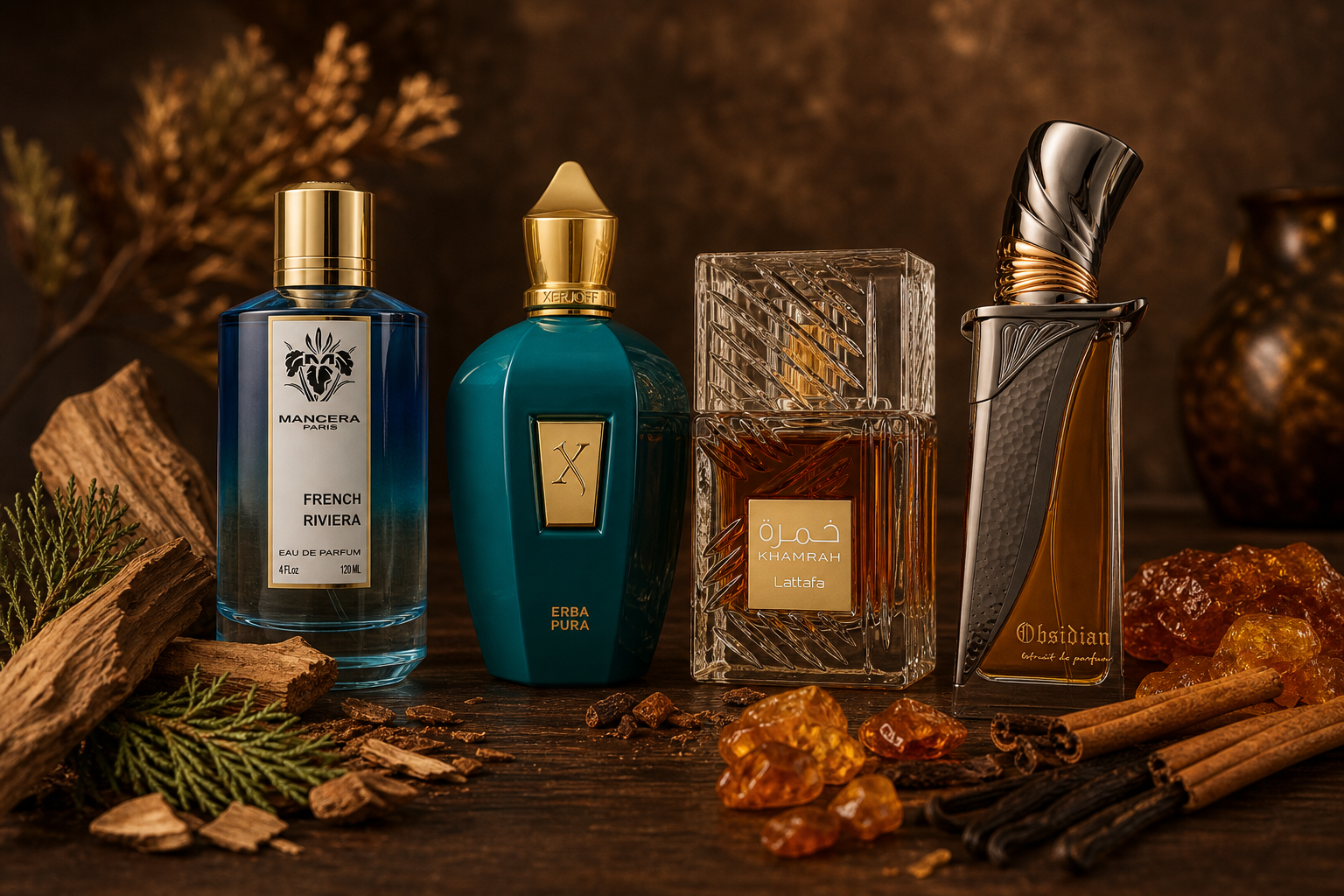
Mancera French Riviera is an Eau de Parfum in a 120 ml bottle and is among the more accessible entries into the woody line within the brand. It's a unisex composition that you can wear even in the office – it's not aggressive, but it's also not invisible. It suits people who want one bottle for most of the day: morning at work, afternoon coffee, evening casual meeting. The larger volume also means it will last you a significant part of the season without having to be sparing.
Mancera Intense Cedrat Boise is a perfume, which means a more concentrated form than Eau de Parfum – it usually lasts longer on the skin and requires fewer sprays. The name itself hints at the combination of citrusy citron with a woody base, making it a fresher entry into woodiness than classic sandalwood density. It's suitable for cool mornings when you want something sharp and awakening, but not sweet. Conveniently, you can try this perfume in a small 10 ml spray before deciding if the cedar dryness suits your skin.
Xerjoff Erba Pura belongs to a different price and performance category. It's a more luxurious Eau de Parfum for those who want to leave a noticeable trail. It's not a purely woody composition – it's closer to a fruity citrus sparkle set on a warm base. We mention it in the woody chapter because it addresses the same autumn need: fullness and long-lasting effect that light summer fragrances don't offer. It's a choice for evening, social events, and days when you want to be noticed even after several hours. In a shared office, however, apply it sparingly.
When choosing a woody scent for autumn, a simple filter helps: the cooler and more formal the environment, the better dry cedar or vetiver works; the more you seek comfort and warmth, the more likely you'll reach for sandalwood. And if you're torn between two bottles, it's usually decided by how the perfume smells on your skin after three hours, not how it feels in the first minutes after spraying.


Oriental Warmth: Amber, Vanilla, and Patchouli
The oriental family plays a different role in the autumn selection compared to dry wood. It's not about airy calmness, but warmth: resins, balms, spices, and sweet base notes warm up on the skin, creating a soft, dense trail around you. In cooler air, they develop more slowly, allowing details that would be lost in the summer heat to stand out over the first half hour.
Amber in modern perfumery is more of a chord than a single raw material – a combination of balsamic, slightly animalic, and sweet notes that add depth to the composition. You'll recognize it by how the scent seems to cling close to the skin, yet doesn't disappear: it fades softly, without sharp edges, and often becomes most prominent after several hours of wear.
Vanilla determines whether the composition remains an elegant oriental or shifts to a gourmand position. In one perfume, it functions merely as a sweetener for the woody base and is almost indistinguishable on its own. In another, it is the main star, announcing itself right from the start – with caramel, praline, or the impression of baked goods.
Patchouli is the counterbalance in this trio. An earthy, slightly camphorous, and bitter raw material that keeps the sweetness grounded and prevents it from slipping into a syrupy position. The more patchouli in the base, the darker and more mature the perfume will feel; the less, the closer it is to dessert. If you've rejected oriental perfumes in the past as too sweet, try compositions where patchouli is prominently heard.
Four Compositions from Sweetest to Most Restrained
The following quartet shows how differently the same raw material base can turn out. We rank them by sweetness, not price – so you can find the intensity you can endure all day.
- Lattafa Khamrah (Eau de Parfum, 100 ml) – the most gourmand choice of the selection. Date sweetness, cinnamon, and a spicy opening transition into a vanilla-tonka base. Suitable for cool evenings and wool sweaters, less so for a heated office. A good entry into the oriental family if you don't mind sweet scents.
- Montale Arabians Tonka (Eau de Parfum, 100 ml) – a reference vanilla-amber composition in this section. The sweetness here is dense but smoother and less dessert-like than the previous tip, with a prominent tonka base. According to sales, it is the most sought-after perfume by Montale in our range and also the most expensive item in this selection – reflected in its higher longevity and more noticeable trail.
- Nusuk Ateeq (Perfume, 100 ml) – the perfume concentration shifts the scent to an amber-spicy position. Sweet notes are present but serve more as a background than the main motif, giving the result a more formal feel. A suitable choice when you want oriental warmth even with a suit.
- French Avenue Obsidian (Perfume, 100 ml) – the darkest and most restrained of the quartet. Amber and a woody base keep the sweetness firmly in check, making it closest to the woody line. If you're drawn to oriental perfumes but fear over-sweetness, start here.
When wearing, a simple rule applies: the warmer and denser the composition, the fewer sprays needed. Two on the neck and one on the chest usually suffice – wool, coats, and scarves hold the scent much longer than a summer t-shirt, and the trail will develop throughout the day. If the result still feels heavy, apply the perfume to clothing instead of skin; it won't warm up as much, and the base will open more gradually.
Oriental and woody compositions are not mutually exclusive. Most autumn novelties stand somewhere between the two poles and differ only in whether the sweet component is at the forefront or just supporting the wood. By paying attention to this balance during testing, you'll choose much more accurately than by the name of the fragrance family on the label.
How to Choose a Niche Perfume for Autumn – From Sample to Full Bottle
Choosing a niche perfume based on a description can be tricky. A composition that reads as warm wood with a vanilla base might smell much sweeter or drier on your skin than you expected. This is especially true for richer autumn fragrances: they develop slowly, and the first impression from a test strip tells you very little. What matters is how the perfume behaves after three, six, and twelve hours of wear.
That's why it's worth taking a step-by-step approach and saving the full bottle for last.
- Start with a sample or a smaller volume. A sample of about ten milliliters will last you several days of wear – just enough time to see if the scent suits you in the morning on your way to work, not just in the first five minutes. In the niche category, you can find samples even from brands whose full bottles are in the luxury range, like Mancera.
- Test on your skin and during a real day. Apply one or two sprays on your wrist and leave the perfume alone. Don't rub it in or sniff it every five minutes – your nose quickly gets used to the scent. More interesting is the reaction of those around you and your own impression in the evening.
- Only then go for the hundred milliliters. A full bottle makes sense for a perfume you've worn for at least a week and still enjoy reaching for. With autumn compositions, also keep in mind that usage tends to be lower than in summer: richer scents require fewer sprays.
Price ranges in the niche category are broader than often expected. For orientation, it helps to divide them into three levels and assign each a specific direction:
- Around five hundred crowns. An affordable entry into the oriental line. This includes, for example, the Lattafa Khamrah Eau de Parfum in one hundred milliliters – spicy, with vanilla sweetness and a warm base, exactly the type of scent that works in autumn. If you want to stick to a woody note, French Avenue Obsidian offers a similar range.
- Approximately one to two thousand crowns. A middle level where the craftsmanship of niche brands is already noticeable. Montale Arabians Tonka builds on sweet tonka bean and a dense woody base; Mancera French Riviera, on the other hand, is a choice for those who want a warm scent with a lighter entry.
- Over two thousand crowns. The luxury segment, usually transitioned to after several tested bottles. Xerjoff Erba Pura is a typical representative – a fruity amber composition with a long trail, where a small volume is even more worthwhile than elsewhere.
Layering woody and oriental scents makes sense in autumn, but it requires moderation. A proven method is to lay a simpler woody perfume as a base – cedar, vetiver, sandalwood – and add an oriental composition with amber or vanilla with just one spray on top. The reverse order usually doesn't work: the sweet base overwhelms the woody line. If you're unsure, it's better to layer a perfume with a body accessory from the same line.
And a note on storage. What damages perfume the most in winter is temperature fluctuations and light, not the cold itself. The bathroom is therefore an unsuitable place – humidity and temperature jumps accelerate changes in the scent. Leave the bottle in its original box, in the dark, in a room with a stable temperature, and don't leave it on the windowsill. You'll notice the difference especially with oriental compositions, where the sweet base changes first.
A practical start looks simple: browse the niche category, choose two to three candidates across price ranges, get samples of them, and only buy the full bottle of the scent that still makes sense to you after a week. Autumn is ideal for such testing: you have a long season ahead where richer compositions can fully show themselves.
Category
Recommended articles
"Give a girl the right shoes and she can conquer the world!" Marilyn Monroe