



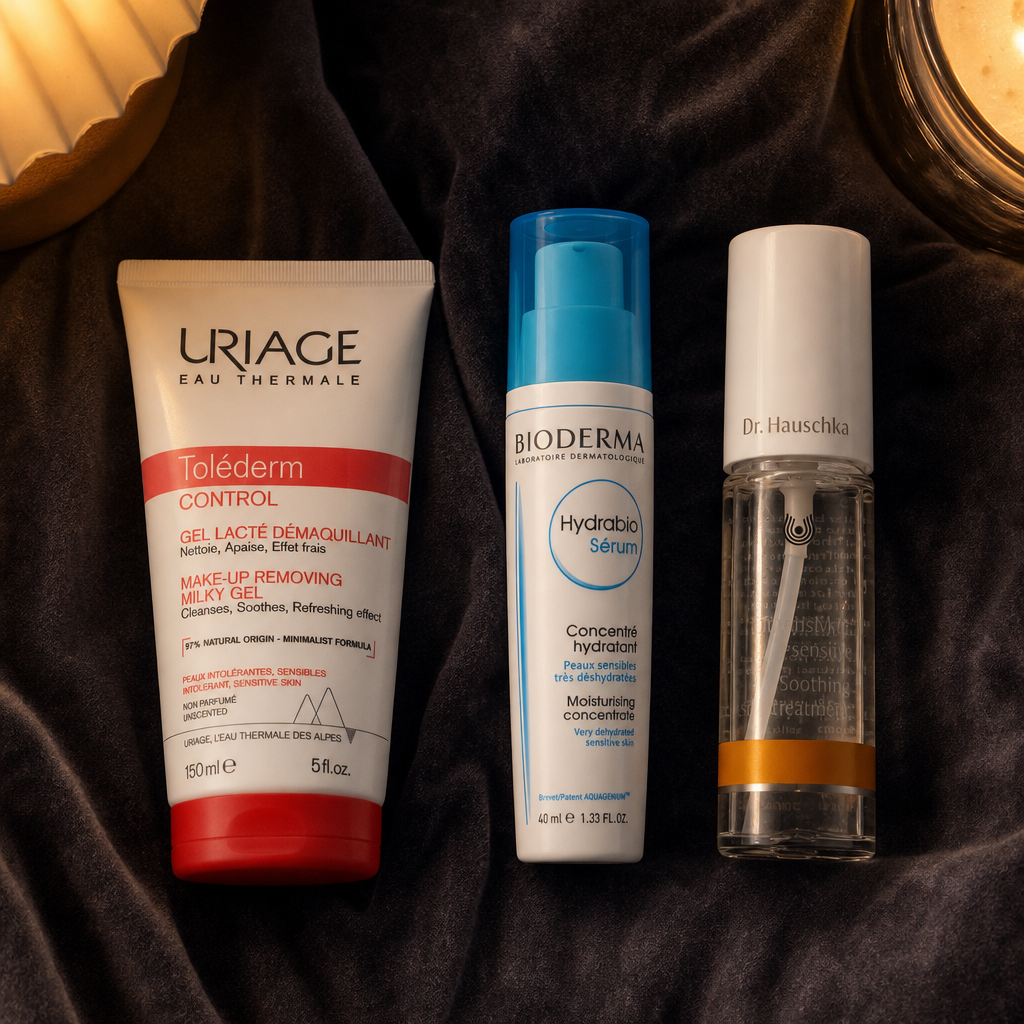

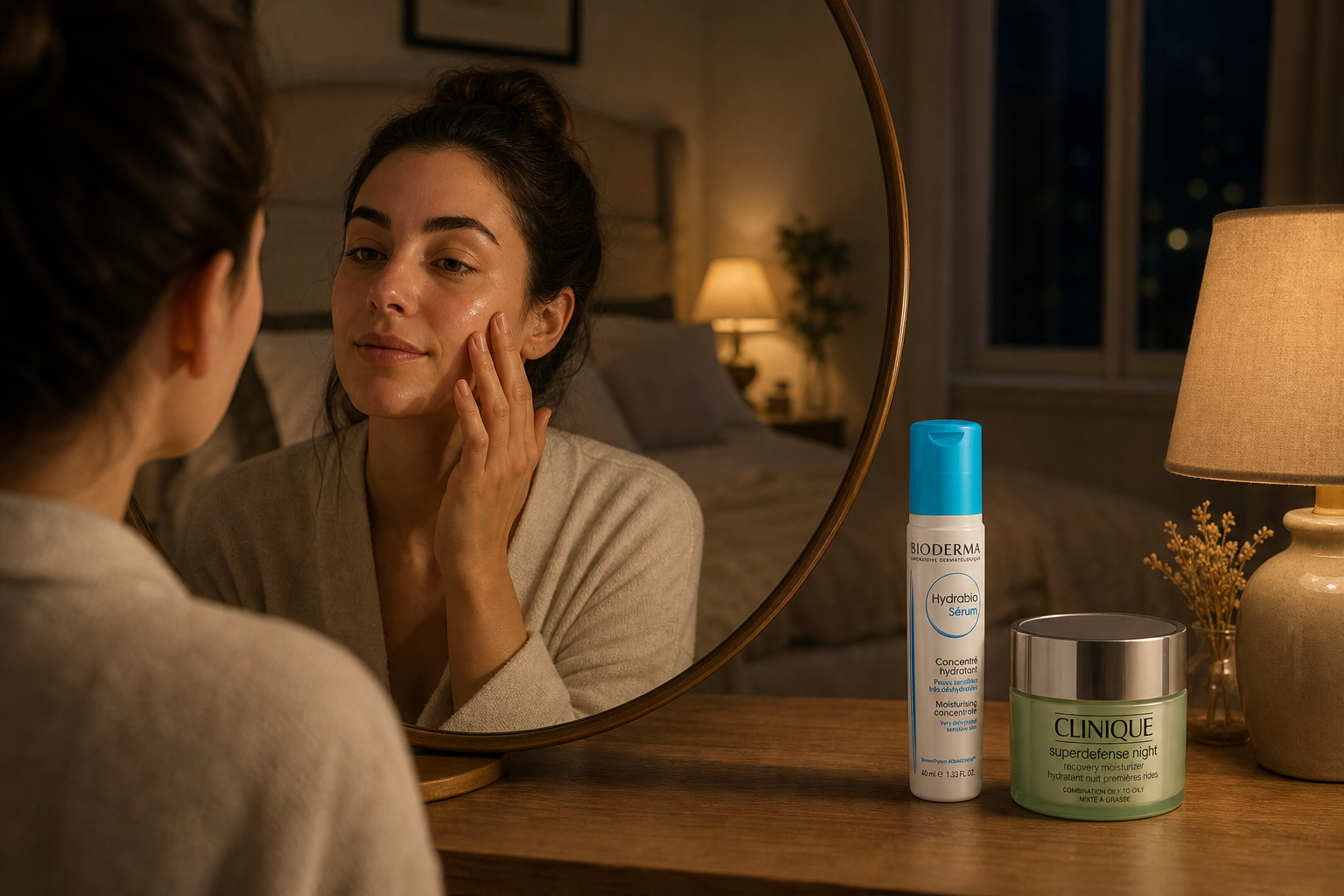
In the morning, we find time for our skin, but in the evening, we often just rinse it with water. Yet, it's at night that the skin rejuvenates – we'll explain what happens to it during sleep and show you a three to four-step evening routine that you can manage even when tired.
Morning Care Done Right, Evening Care in a Rush – Why It Often Happens This Way
Mornings usually go smoothly. You wash your face, apply serum or cream, wait a moment for it to absorb, and only then do you start your makeup or head out the door. The evening looks completely different: it's late, your eyes are closing, and skincare ends with a quick splash of water. If this sounds familiar, you're not alone – it's a common contradiction in skincare routines.
It's not about laziness or lack of willpower. Morning care has a natural flow: it leads to makeup, getting dressed, and leaving the house. It has a reason to be completed, so it gets done. In the evening, there's no next step. The only thing waiting is bed – and that's hard to compete with a cream whose results you'll see only weeks later.
Yet, there's more to it than meets the eye. Day and night place different demands on the skin. During the day, the skin is mainly defending itself – facing sun exposure, wind, dry air from air conditioning, dust, and makeup, and daily care is built for this defense. At night, none of this needs addressing, and it can focus on renewal. The evening step, therefore, doesn't play the same role as the morning one; it's not just "the same cream twelve hours later."
This leads to a slightly unpleasant irony: when evening care is the first to drop out due to fatigue, you miss the part of the day when cosmetics have the peace to work on your skin. In the morning, the skin immediately goes outside, under makeup, and into action. In the evening, it has several uninterrupted hours where no one disturbs it.
The good news is that the solution isn't a longer routine. Quite the opposite. An evening care routine that you actually stick to looks something like this:
- three to four steps that you can manage even when you're just ready to sleep,
- no extra products just because someone recommended them online,
- the ability to cut back on tougher days without canceling care altogether.
Ten steps in a row look great on video, but at eleven at night, it's a plan that lasts about a week. Three steps, where you know exactly why you're doing them, last much longer – and it's in regularity that most skincare results are found.
In the following sections, we'll first explain what happens in the skin overnight and why night products differ in composition and feel from daytime ones. Only then will we get to the practical part – what evening care consists of, the order in which to apply products, and where you can cut back when you really don't have the energy for more. The goal isn't to add another obligation to your evening, but to set it up so it lasts even on days when you're not in the mood for self-care.
What Happens to Your Skin While You Sleep
Nighttime is not downtime for your skin. While you sleep, your skin continues the work that takes a backseat during the day: during the day, it focuses mainly on defending against external influences, while at night it has the peace to focus on maintenance. Once you understand what happens in your skin during this time, it makes sense why evening skincare differs from morning routines.
Nighttime Cell Renewal of the Outer Layer
Your skin is constantly renewing itself. New cells are formed in the deeper layers, gradually moving to the surface, and eventually shedding from the outermost layer. However, this cycle doesn't run at the same pace all day. The body follows its internal biological clock, and some renewal processes shift to the sleep period when the skin isn't dealing with sun exposure, wind, air conditioning, or makeup. That's why nighttime is often referred to as the time when the skin has the most opportunity to recover.
Blood circulation also changes. During sleep, the skin is more vascularized and slightly warmer than during the day – and warmer skin releases a bit more moisture. This is the first part of the answer to why your skin can dry out overnight, even if you've spent the entire evening at home on the couch.
Transepidermal Water Loss Explained
Water continuously evaporates from the deeper layers of the skin into the surrounding air. This is scientifically known as transepidermal water loss and is a completely normal phenomenon – it happens to everyone all the time, you just aren't usually aware of it. The rate of evaporation is controlled by the outer layer of the skin, which you can imagine as a wall: cells are the bricks and the lipids between them are the mortar. As long as the wall holds together, evaporation is slow, and the skin retains its elasticity.
It's worse when the mortar between the bricks is weakened. This typically happens after overly aggressive cleansing, during the heating season, after a day in the sun, or simply with very dry and sensitive skin. Evaporation speeds up, the surface dries out, and in the morning, your skin feels tight, harder to the touch, and makeup is harder to apply. It's not necessarily a sign that you didn't apply enough cream in the evening. More often, it's a sign that water was escaping from your skin faster than it should.
The Environment Plays a Bigger Role Than You Might Think
The way your skin looks in the morning is influenced not only by what you apply in the evening but also by the conditions in which you sleep:
- Dry air in an overheated bedroom. Heating dries out the air, and dry air dries out the skin. A cooler, well-ventilated bedroom is gentler on the skin than a room that's as warm in winter as it is in summer.
- Pillow and sleeping position. A face buried in the pillowcase rubs against it all night, which mechanically irritates the skin and can cause redness in more sensitive skin. The fabric also absorbs some of what you've applied. More frequent changing of pillowcases and sleeping on your back rather than face down can do more than many products.
- Long hot shower before bed. Hot water dissolves the lipids in the outer layer faster than lukewarm water. If you leave the bathroom feeling like your skin is squeaky clean, it usually means the water and cleanser did more work than necessary.
- Short night. Lack of sleep shows on the skin as a tired appearance, less fresh color, and more pronounced shadows under the eyes. No cosmetics can make up for this, and honestly – sleep does more than any cream.
These three factors together form the logic on which evening skincare is based. At night, the skin has the best conditions for renewal, but it also loses water more easily and is exposed to a drying environment. Evening care, therefore, doesn't address sun protection or how the skin will look under makeup. It addresses two other things: providing the skin with what it needs for renewal and slowing down water evaporation as much as possible until morning. This then determines the composition of products suitable for nighttime use.
Why Night Creams Have a Richer Texture Than Day Creams
When you compare a day cream and a night cream from the same line, you often notice the difference at first touch. Day creams tend to be lighter, absorb quickly, and leave a matte or slightly satin finish. Night creams spread more slowly, linger on the skin, and feel more nourishing. This isn't a marketing gimmick or an attempt to sell two products instead of one—each formulation serves a different purpose and is limited by different conditions.
A day cream must last all day under makeup, withstand contact with dust, and frequent hand touches. Therefore, it's usually formulated as a lighter emulsion that dries quickly and doesn't create a slippery film on the skin. Additionally, manufacturers often incorporate a protective factor, and UV filters themselves affect the final consistency. Night creams don't have these limitations. They don't need to be invisible, hold under powder, or account for sunlight, so they can afford a higher proportion of lipids, butters, and oil components.
The word "richer" hides quite specific chemistry. Moisturizing and smoothing ingredients are simplified into three groups, which are represented differently in denser night textures than in light day ones:
- Humectants – glycerin, hyaluronic acid, or urea. They bind water and help retain it in the upper layers of the skin. You'll find them in both day and night care; they are the foundation of both.
- Emollients – plant oils, squalane, fatty acid esters. They fill the space between dead cells, making the skin appear smoother and more supple. There are usually more in night formulations because it doesn't matter if they leave a soft, slightly shiny surface.
- Occlusives – waxes, shea butter, lanolin, or silicone components. They create a thin barrier on the surface that slows water evaporation. These are what make night balms so dense and are the reason you wake up with skin that isn't tight.
Ceramides follow a similar logic. They are lipids that naturally form part of the skin barrier, and formulations with them tend to be inherently creamier. They make more sense in evening care than in morning care because the skin has all night to absorb them. The same reasoning applies to plant oils: in day products, you find them in smaller proportions, while in night balms, they form the backbone of the entire formula.
For the same reason, some active ingredients are more often included in evening care. Some are sensitive to sunlight or temporarily sensitize the skin, so it's more practical to use them at night—this includes AHA acids or retinoids. Nighttime also offers a longer and uninterrupted time for action. This doesn't mean that morning care is less important—it just has a different role and composition.
It's important not to read "richer" as "more suitable." A thick texture full of occlusive ingredients is a blessing for dry or mature skin, but on oily and combination skin, it can have a different effect: a greasy film in the morning, clogged pores, and the feeling that the cream just sat on the surface all night. In such cases, opt for a gel or lighter cream night care. The label "night" doesn't automatically mean "heavy"—many brands offer gel-cream night textures that supply the skin with water and lipids without leaving a greasy feeling.
You can use a simple guideline: if you wake up with tight, flaky, or unpleasantly dry skin, you can tolerate a richer texture. If, on the other hand, you reach for a blotting paper after waking up, a lighter option is more sensible. And since the condition of the skin changes throughout the year, it's okay to have two night textures at home and alternate them according to the season.
Evening Routine in Three to Four Steps
The good news is that your evening skincare routine doesn't have to be lengthy. When you know what each layer does, you can complete it in just a few minutes. Consider the following steps as a framework that you can adjust based on how your skin looks right now.
Step One: Makeup Removal and Cleansing
Cleansing is the one step that should never be skipped. Throughout the day, your skin accumulates sebum, dust, makeup residues, and sunscreen, and if left overnight, they can prevent your skincare from penetrating effectively.
Double cleansing is beneficial on days when you've worn heavy makeup, used waterproof products, or applied sunscreen. The first phase is oil-based or micellar: apply oil or balm to dry skin, massage it in to dissolve everything that water alone won't remove. The second phase involves a cleansing gel or foam. For micellar water, use two cotton pads, and for cleansing gel, a hazelnut-sized amount is sufficient.
Single cleansing is enough on makeup-free days, for sensitive skin, and for those whose skin feels tight after double cleansing. Cleansing twice when there's no need only disrupts the skin's protective barrier unnecessarily.
Whatever you choose, use lukewarm water, massage for about half a minute, and pat your skin dry instead of rubbing. Don't leave cleansing until the last minute before bed – if you rush through it half-asleep, you'll likely rush through the rest of your routine too.
Step Two: Serum, But Only If Your Skin Needs It
Serum is an optional middle layer. It has a lighter consistency than cream and provides one specific benefit, usually hydration or soothing. If your skin isn't lacking anything, feel free to skip it.
If you decide to use it, apply it to slightly damp skin right after cleansing. Use less than you might think: two to three drops or one pump for the entire face. Spread it with your palms and gently press it into the skin instead of rubbing vigorously, then give it half a minute. One serum per evening is plenty – layering multiple concentrated products on sensitive skin can lead to irritation.
Step Three: Night Cream or Balm
The final mandatory layer completes the routine. A night cream or richer balm locks in moisture and prevents it from evaporating during sleep. A hazelnut-sized amount is enough for the entire face, and even less for rich balms – if your skin is shiny and sticky after five minutes, use less next time.
Warm the cream between your fingers, apply it in dots on your forehead, cheeks, and chin, and spread it outwards from the center of your face. Eye care is optional and has its own measure: a rice grain-sized amount tapped under the eye with your ring finger.
Optional Fourth Step: Occasional Boost
The fourth step isn't part of the daily routine. It's a reserve for evenings when your skin needs more than usual – after a day in the cold or a week of poor sleep.
- Mask once or twice a week. Apply it after cleansing instead of serum, and then apply cream on top.
- Richer balm locally only on areas that are peeling or tight, typically around the nose and corners of the mouth. Leave the rest of the face with the usual cream.
- A few drops of oil over the cream when even a rich cream isn't enough overnight. Oil should always be the last layer, never under the cream.
Don't combine all three options at once, choose one based on what your skin needs that evening.
Before You Lie Down
Let your skincare absorb for ten to fifteen minutes before resting your face on the pillow – otherwise, a significant portion of the cream will end up in the bedding. And since evening care doesn't have to be the last task of the day, feel free to do it earlier, perhaps an hour after dinner.

How to Maintain Your Nighttime Skincare Routine Long-Term
Your evening routine rarely fails because it's poorly designed. More often, it falls apart because you set it up when you have extra energy – like on weekends or after a vacation. However, you need to maintain it even on days when you come home late and all you can think about is bed. This imbalance is where routines usually break, not because you chose the wrong cream.
The solution isn't about adding motivation, but about reducing the demands of the routine. Three things work reliably:
- Keep your evening routine short. Three steps that you can manage even when tired will last much longer than a seven-step process that you abandon after a week. Save the serum and any additional steps for days when you truly have the time – a voluntary bonus should not become an obligation.
- Keep products within reach. Items that are closed in a drawer or hidden in a cosmetic bag are used less often than you think. Keep your evening skincare together by the sink, in a single line, and in the order you apply them. It may sound trivial, but the difference between "I have to fetch it" and "it's right in front of me" is huge at eleven at night.
- Don't start your routine in bed. Remove your makeup and apply cream before you lie down – even right after dinner or a shower. A routine that stands between you and sleep almost always loses.
The second reason people give up on evening skincare is expectations. The feeling of comfort and hydration comes quickly, often within a few days – your skin doesn't feel as tight in the morning, makeup goes on more smoothly, and dry patches around the nose or cheeks calm down. However, subtler changes in skin texture, smoothing fine lines, or evening out tone are matters of weeks of regular use, not days. If you expect a visible difference from a night cream after three applications, you're almost certain to set it aside before it has a chance to show results.
This leads to the most common mistake: switching products too quickly. If you change your night cream after ten days for another, you'll never know what it actually did. Give a new product about a month before deciding on it. There's only one exception, and it applies without discussion: if your skin burns, itches, turns red, or shows irritation, stop using it immediately. This isn't a phase of adjustment that needs to be endured.
It's equally unwise to pile on active ingredients all at once. Exfoliating acids, vitamin C, strong peels, and intense serums in one evening won't bring faster results, just a greater risk that your skin becomes sensitive, red, and less tolerant of products it previously liked. It's wiser to choose one active ingredient that you currently need, incorporate it only on certain evenings, and keep the rest of the routine simple, hydrating, and soothing.
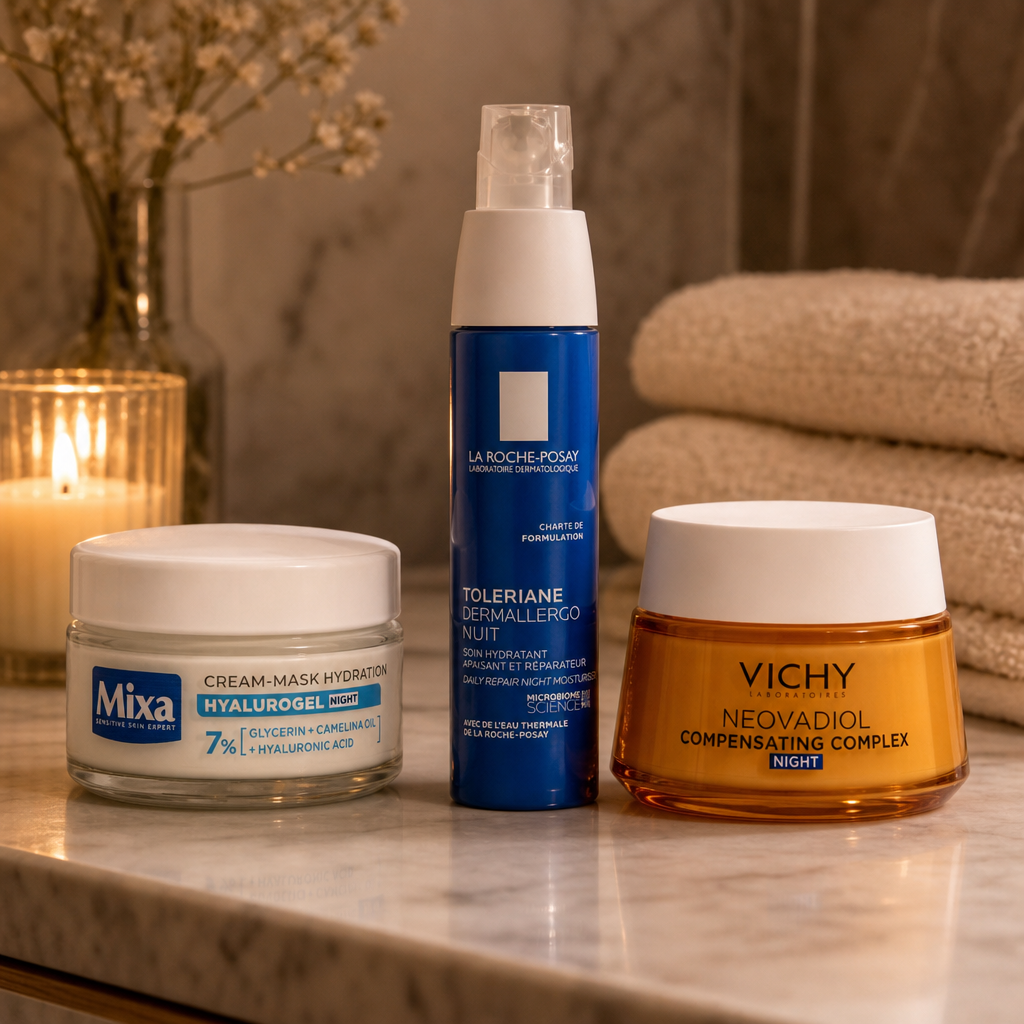
When supplementing or changing your evening skincare, choose based on your skin type, not how rich the texture looks in the jar. A thick balm doesn't make a product a better choice, just a different one – it suits dry and sensitive skin, but often not oily and combination skin. In the skincare category on Brasty, night creams and serums are most often chosen from brands like Vichy, Bioderma, La Roche-Posay, CeraVe, and Uriage; all offer several different lines depending on whether you're addressing dryness, sensitivity, oily skin, or signs of mature skin. And if you're unsure of your own skin type, start with the simplest possible trio – cleansing, cleaning, hydration – and expand it once you know what your skin truly lacks.
Category
Recommended articles

"Give a girl the right shoes and she can conquer the world!" Marilyn Monroe