



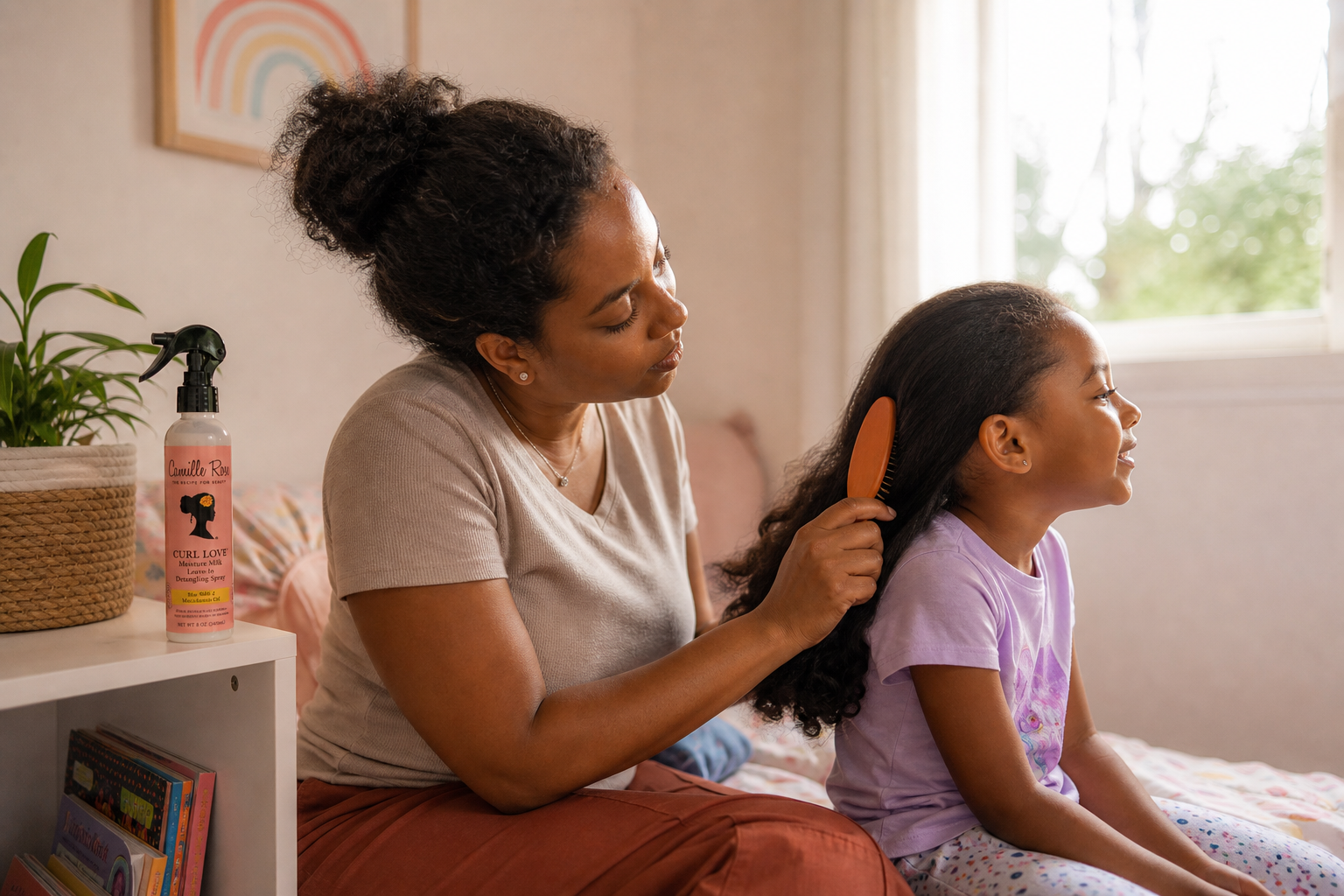
Morning detangling of long children's hair doesn't have to be a tearful battle. We introduce Tangle Teezer detangling brushes and leave-in care that release tangled ends without pulling, and advise how to combine them into a simple routine.
Why Brushing Children's Hair in the Morning is Such a Struggle
In many families, morning hair brushing is one of the most stressful moments of the day. Breakfast is done, shoes are almost on – and then comes the brush. The child dodges their head, a knot holds stubbornly at the ends, and leaving for kindergarten is delayed by ten minutes. Most of these morning battles have nothing to do with upbringing or patience. The cause is much more mundane and lies in the structure of children's hair and how you brush it.
Children's hair is usually thinner and smoother than adult hair, and its surface is more delicate. Thin hair easily rubs against itself and tangles, so during the night, a tight clump forms at the nape or behind the ears, which seems unsolvable in the morning. Static electricity from hats and scarves, playing on the carpet, and hair left to dry naturally after an evening bath all contribute to the problem.
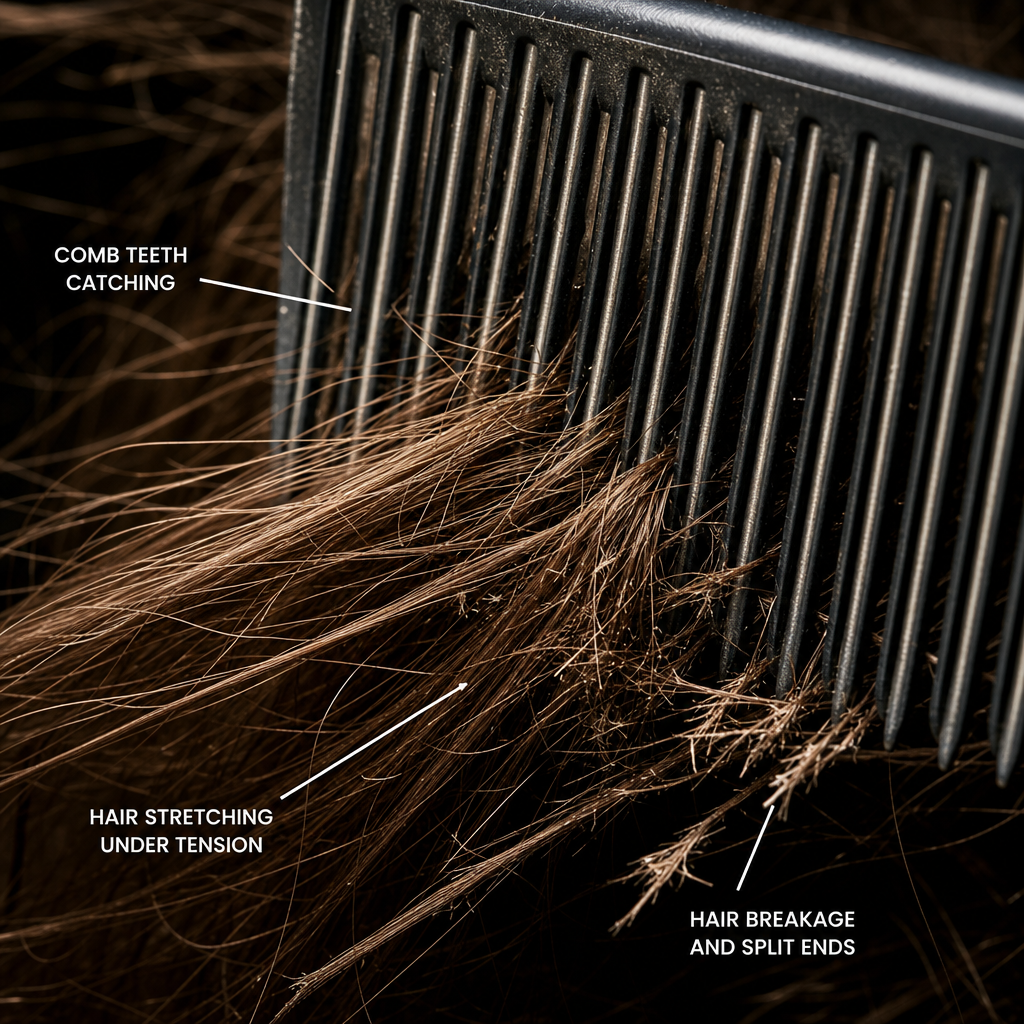
The other half of the problem is purely mechanical. When a brush enters a tangled strand from the top, it pushes the knot ahead and tightens it with each stroke. Dry, fine hair offers resistance – it has nothing to glide on, so instead of loosening, it breaks or pulls out. A stronger pull won't improve the situation, it just leads to tears faster.
And the child remembers the pain. Just two or three unpleasant mornings are enough, and the brush becomes something to resist in advance, even before it touches them. A routine task thus turns into a routine conflict, starting long before anything unpleasant happens. The good news is that this cycle can be broken without raising voices or drastically cutting hair.
The solution relies on two things that only work together: a brush designed for detangling and a leave-in treatment that softens the hair and loosens knots before you even touch them. A brush alone struggles with dry, tangled strands, while a leave-in product without a suitable brush won't separate the hair. In the rest of the article, we'll discuss both parts: we'll look at Tangle Teezer detangling brushes and leave-in sprays and lotions from our hair care range.
This text is mainly for parents whose children have:
- long hair that lies on the pillow overnight and stays in strands in the morning,
- fine and soft hair that easily becomes static and tangled,
- wavy or curly hair that forms knots even during the day,
- hair that dries freely and without brushing after washing.
If you recognize yourself in any of these points, morning brushing probably doesn't need more force or more time. It needs a different order of steps and two tools that will do most of the work for you.
Detangling Brush vs. Regular Comb
Children's hair is not just a smaller version of adult hair. It is finer, thinner, and each strand has a smaller diameter, making it more prone to tangling. Add to this the daily mechanics: a child tosses and turns on the pillow at night, wears hats, hoods, or backpack straps during the day, and the hair constantly rubs against fabric. This friction fluffs up the hair surface, turning loose strands into knots over time. That's why morning tangles always concentrate in the same spots – at the nape, behind the ears, and where the hair rests on the shoulders.
Now imagine what happens when a comb with rigid teeth or a brush with stiff bristles encounters such a knot. The tool meets resistance and stops, but the hand keeps moving. The force has nowhere to go, so it travels the length of the strand to the roots. The child feels the pull directly on the scalp and reacts in the only way possible – by flinching, protesting, and resisting brushing next time. The morning struggle usually doesn't arise from stubbornness but from simple physics.
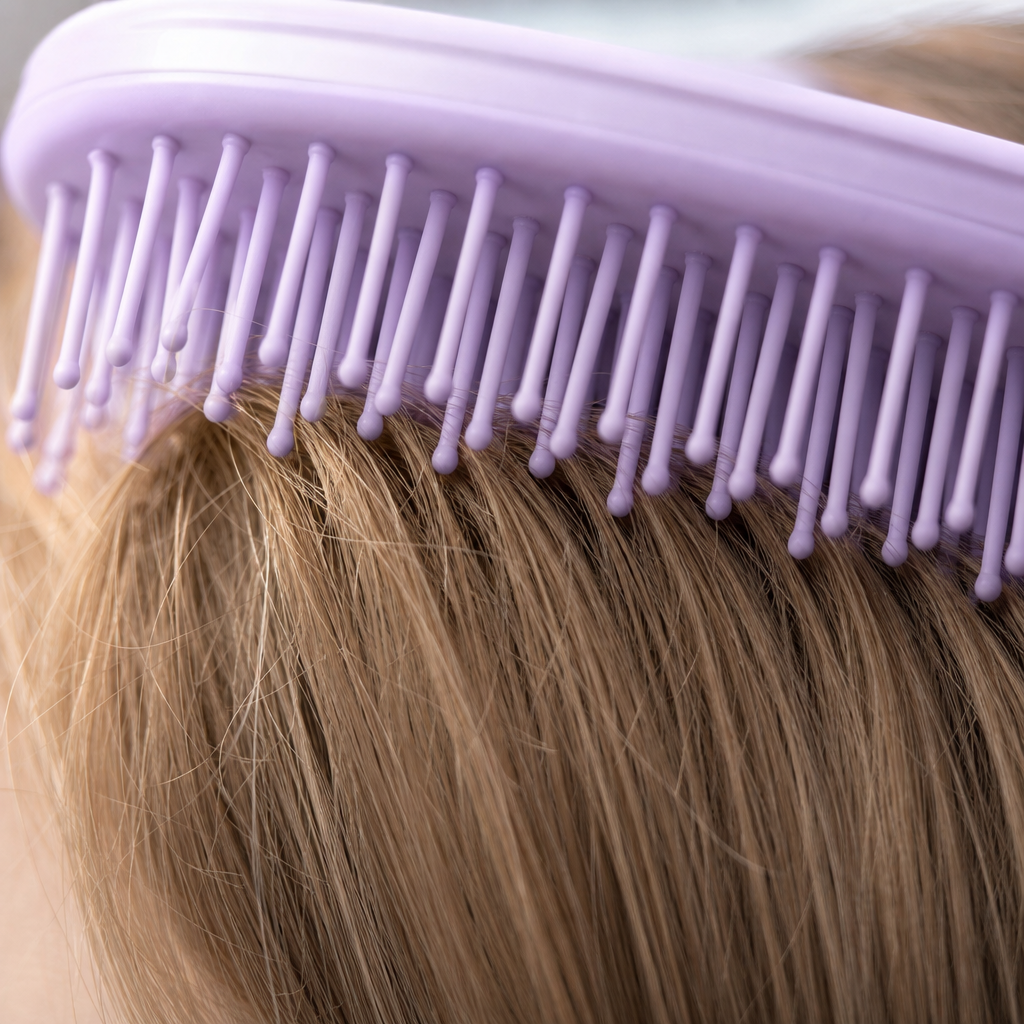
The detangling brush works on the opposite principle. The teeth are flexible, densely packed, and intentionally varied in length: shorter ones hold the strand in place, while longer ones penetrate deeper and gradually loosen the knot, layer by layer. When the brush meets resistance, the teeth bend and absorb some of the pull themselves, instead of sending it to the roots. The knot doesn't tear but untangles. You can even hear the difference – instead of snapping, you hear the brush smoothly gliding through the strand.
When choosing a brush for children's hair, it's worth considering a few things:
- Flexibility of the teeth – they should noticeably give under finger pressure, not remain rigid.
- Rounded ends – smooth tips glide over the scalp, while sharp points scratch it.
- Size of the brush body – a smaller format is easier for a child to hold when they want to brush themselves.
- Suitability for wet hair – wet hair is more susceptible to pulling, so manufacturers distinguish models designed for the bathroom.
- Easy cleaning – a brush that can be cleared of hair and rinsed once a week will last much longer in the family.
Does this mean the comb belongs in the trash? Definitely not, it just has a different role. A wide-toothed comb is great for parting hair, distributing conditioner or mask in the shower, and preparing strands for braiding. However, what it doesn't handle well is untangling a finished knot on dry hair – precisely the situation you reach for it in the morning. Combs with fine, dense teeth tend to tighten the knot rather than loosen it, so it's best to avoid them for children's hair.
You can find detangling brushes in the Hair Care Accessories category, right next to combs, clips, and hair ties. When buying a child's first brush, consider that it will become a staple of the morning routine, much like a toothbrush – and it's worth choosing one that the child will willingly reach for.
Tangle Teezer: models that handle children's hair
The Tangle Teezer brand is among the top twenty names in Brasty's hair care range, and interest in it has been growing in recent months. The reason is simple: it's not cosmetics, but an accessory that solves a specific problem – detangling knotted hair without unnecessary pulling. This is often the difference between a calm morning and a battle at the mirror for children.
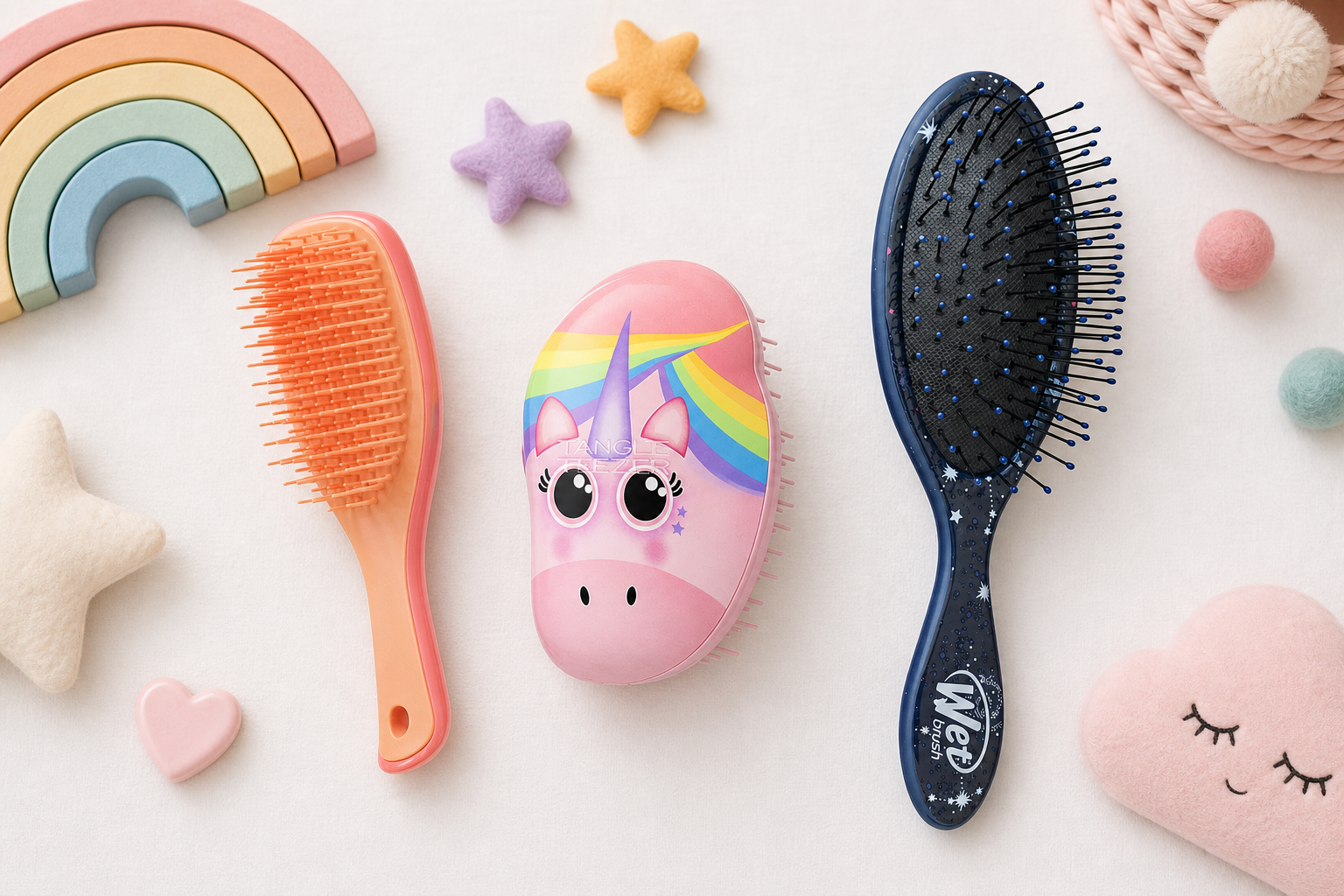
The common feature of the models is the dense teeth in two different lengths, which bend when they hit a knot instead of pulling the strand through with force. The shorter teeth smooth the hair surface, while the longer ones go through the strand. For children's hair, which is usually finer than adult hair, this means the brush works in small steps and doesn't try to untangle the whole knot at once. For parents, this means one practical thing – you brush more slowly, but without tears.
Wet Detangler Midnight Black – for post-wash and wet hair
The Wet Detangler is one of the brand's most sought-after items and has a major advantage for children's heads: the classic long handle. You can hold it in one hand while using the other to hold the strand above the ends, so the pull doesn't transfer to the scalp. It's perfect for right after washing, when hair is more sensitive to mechanical stress and knots form most easily.
- For whom: younger children brushed by an adult, and school-aged kids who can use the brush themselves.
- When: on wet or damp hair, even right after towel drying.
- Hair length: handles hair up to shoulder blades and longer – thanks to the handle, it works well strand by strand.
- Price: around two hundred crowns, making it a nice little birthday gift.
The Ultimate Detangler – for dry detangling during the day
The Ultimate Detangler, compared to the previous model, has a shaped handle that fits in the palm and keeps the wrist freer. This is especially appreciated by children who brush themselves: the brush holds firmly and doesn't slip from their hand. The tooth system remains the same, just in a more compact body, making this model ideal for dry hair during the day – after taking off a hat, after gym class, or before turning a messy head into a braid.
- For whom: children who want to brush their hair themselves and need a brush that's easy to grip.
- When: on dry hair in the morning and afternoon, for quick style adjustments.
- Hair length: short to medium-length hair, where brushing is more fluid from head to ends.
- Color variants: among the new arrivals, you'll find Vibrant Leopard or Runway Pink – for children, choosing a pattern is half the success.
Maintenance to keep the brush lasting
The brush deserves the same attention as the hair it detangles. Remove fallen hair after each brushing, otherwise, residues of leave-in care will settle between the teeth and the brush will stop gliding. About once every two weeks, rinse it in lukewarm water with a drop of shampoo, rinse, and let it dry teeth down on a towel. Do not dry it on a radiator or with a hairdryer – the plastic body and teeth deform with heat, and the brush loses the flexibility you bought it for.
If you want to start with one piece, the more practical choice is the Wet Detangler: it handles both wet and dry hair, and the handle gives adults better control over brushing. The Ultimate Detangler then makes sense as a second brush for the school bag or at grandma's, where it always turns out a comb is missing.
Leave-in Care That Untangles for You
A good brush can do a lot, but even it has its limits. When strands get so tangled that they cling like Velcro, the brush needs some external help. That's where leave-in care comes in – a product applied to damp hair after washing that doesn't need to be rinsed out. It stays on the hair as a thin film, allowing individual strands to glide more easily past each other. The brush then moves smoothly from the ends upwards, and you don't have to pull.
Imagine the surface of the hair as a roof of scales. On fine and freshly washed children's hair, the scales easily open up, catch on neighboring hair, and form a knot. Leave-in care smooths the surface and reduces friction, so instead of catching, the strands just slide past each other. You'll notice the difference with the first stroke – the brush doesn't meet resistance, and the child doesn't flinch in pain.
On the shelves, you'll find three formats that mainly differ in how dense they are and how much remains on the hair. For fine children's hair, a simple rule applies: the lighter the consistency, the less risk of weighing the hair down.
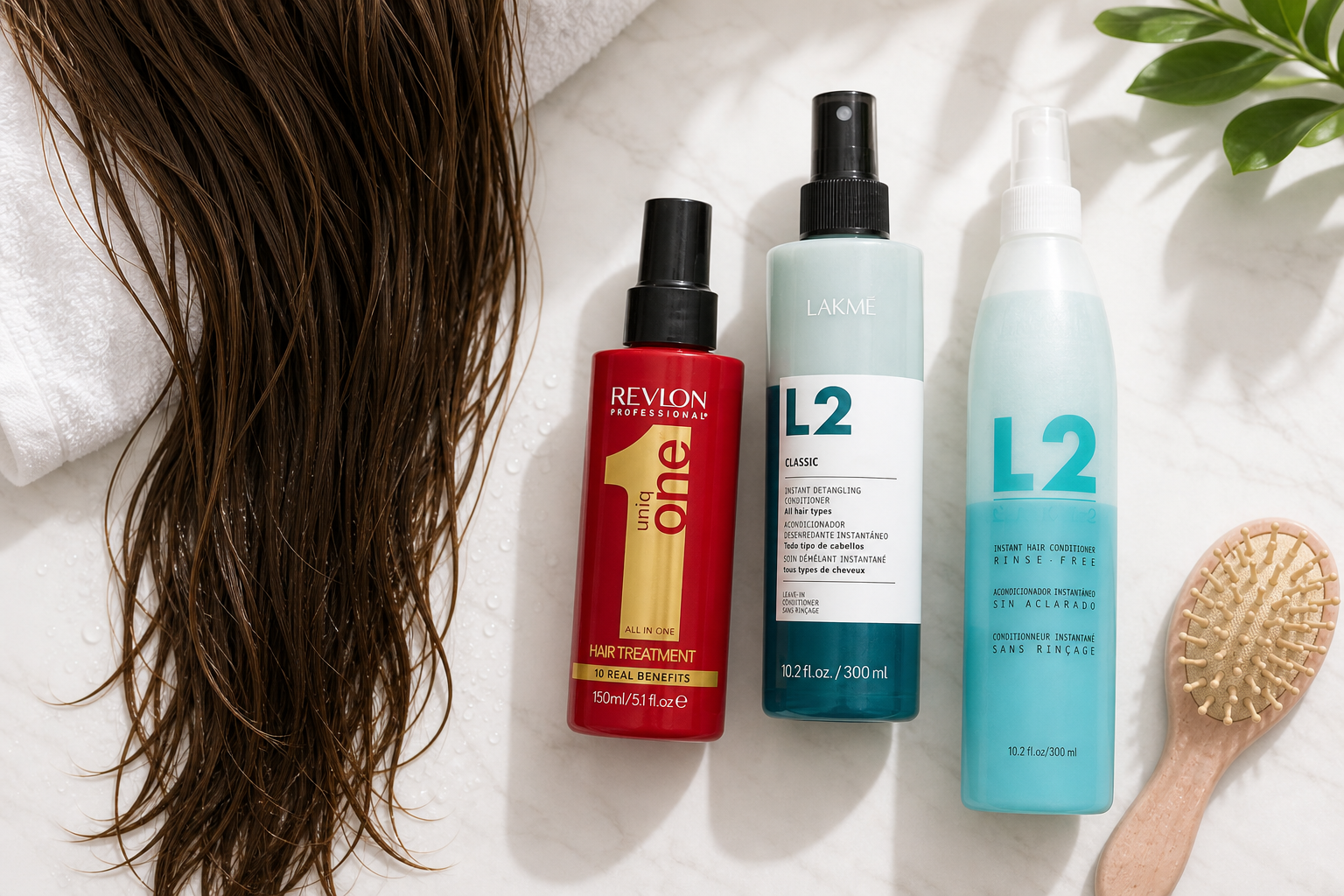
- Light Spray – the lightest of the three formats, disperses in a fine mist and doesn't weigh down even thin hair. You might opt for Revlon Professional Uniq One All In One Treatment 150 ml, which sprays in a very fine mist and is suitable for hair that tangles mainly at the crown and nape. The spray is also the quickest to apply among the described trio, which is crucial during the morning rush.
- Milk – the golden middle ground. It's more liquid than cream but stays exactly where you apply it, making it easy to target the ends. This group includes Selective Professional OnCare Smooth Hair Cuticle Smoothing Milk 275 ml, which focuses on smoothing the hair's surface. It's beneficial for children with longer hair, where knots mainly form in the lower third of the length.
- Thicker Leave-in Conditioner – the most nourishing of the described trio, designed for hair that tangles very stubbornly or has a coarser texture. Lakmé Lak-2 Instant Hair Conditioner 300 ml is one of the most sought-after in the leave-in care category. For very fine hair, use it more sparingly and only on the lengths to avoid weighing the hair down.
Dosage is where mistakes are most commonly made. For children, less is more: one to two pumps into the palm, spread between the fingers, and run through the lengths and ends. Never spray directly on the head or the roots – hair doesn't need care there and will only get greasy faster. If using a spray, aim from about twenty centimeters away and focus on the lower half of the hair.
How do you know you've overdone it with the amount? Hair feels limp, heavy, or sticks together at the roots after drying. Next time, try using half the amount and spread it more thoroughly in your palms. Conversely, if the brush still meets resistance, don't immediately double the amount – try applying the same amount to wetter hair first, as the product spreads more easily on a drier head. With such small doses, one bottle lasts a long time, so even a more nourishing conditioner is worth it.
Morning Routine Step by Step: Spray First, Then Brush
Morning hair brushing can be done in two to three minutes if you have a set routine. The difference between a struggle in front of the mirror and a calm start to the day is usually not the strength of your hand or the price of the product, but the order of the steps. If you soften the hair first and then brush it, the brush will glide through tangled areas without pulling – and your child won't associate brushing with an unpleasant feeling.
The routine actually starts the night before, not in the morning. Hair that moves freely on the pillow all night gets more tangled by morning than hair that's tied up. A few seconds before bed can save you several minutes in the morning.
- Braid a loose plait in the evening. It doesn't have to be tight or perfect – just one loose plait or two braids on the sides, secured with a soft hair tie without a metal clasp. This prevents strands from knotting into tangles that are hard to undo in the morning.
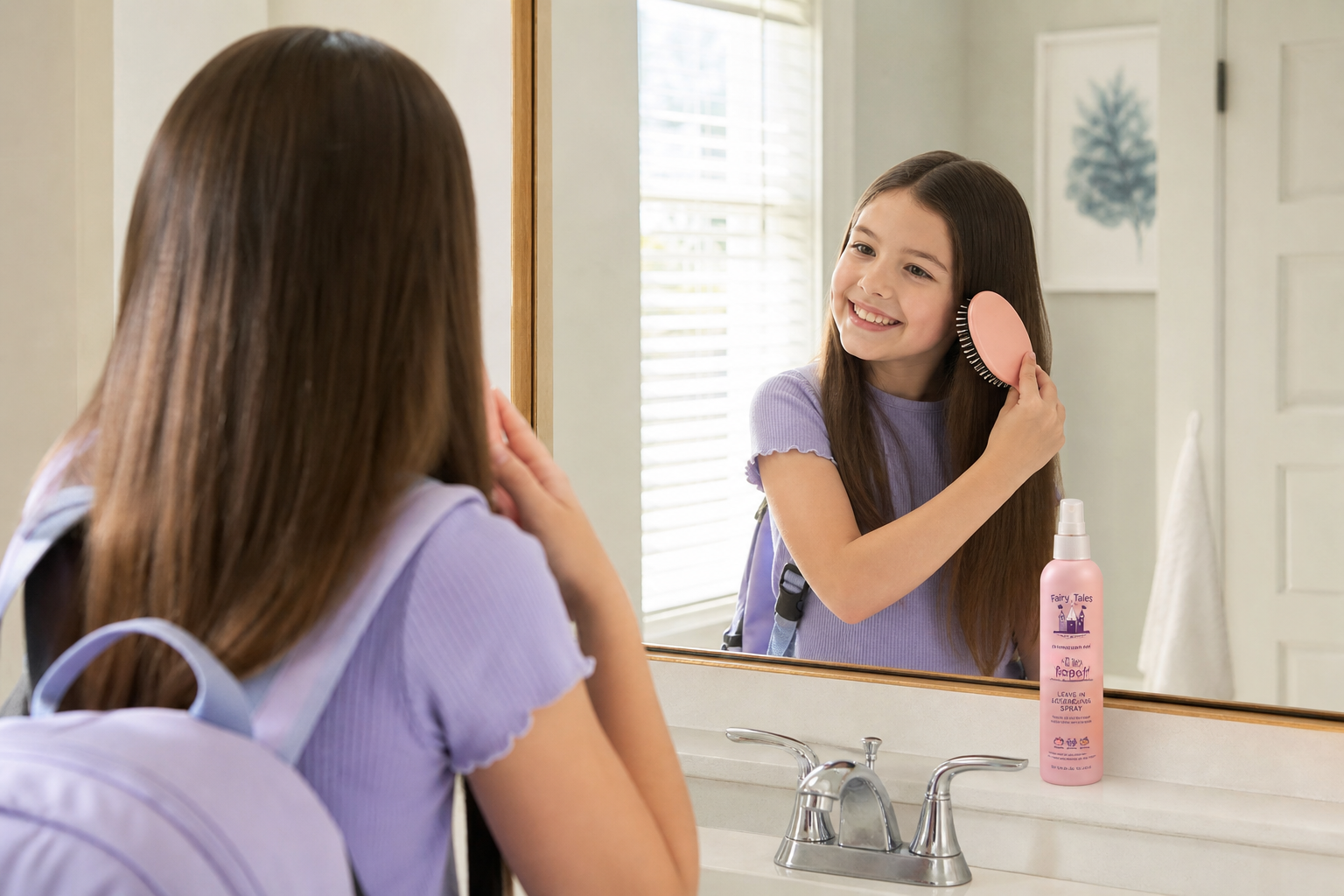
- In the morning, undo the plait and spray the hair with leave-in treatment. Apply the spray from about twenty centimeters away, focusing on the lengths and especially the ends. Avoid the scalp – it doesn't need the product and it could weigh the hair down at the roots.
- Let the treatment work briefly. Twenty to thirty seconds is enough for the fibers to soften on the surface. This is the perfect time for your child to put on their shoes or finish breakfast.
- Divide the hair into two or three sections. For longer and thicker hair, brushing in sections is faster than trying to tackle the whole head at once.
- Brush from the ends to the roots. Start with the last few centimeters, and once the brush glides smoothly, move up a bit. Hold the section above where you're brushing with your free hand – this way, the pull transfers to your palm, not your child's scalp.
- Finish by brushing the entire length. Two or three strokes from the head to the ends complete the routine and smooth the hair into a style.
Why this order? Leave-in treatment reduces friction between individual hairs, so knots are more likely to loosen under the brush rather than tighten. Brushing from the bottom up means you're only pushing a short section of hair ahead of you. If you start at the roots, you'll push all the knots into one clump at the ends – and that really can't be untangled without force. That's why the order matters more than the pressure you apply to the brush.
The entire morning routine takes about two minutes for medium-length hair, and three to four minutes for long, thick hair. The routine quickly becomes automatic, and older children will start spraying the treatment themselves over time.
If you want to build your routine with specific products, we offer two proven pairs from our selection:
- More affordable combination: Tangle Teezer Wet Detangler Midnight Black brush and Revlon Professional Uniq One All In One Treatment 150 ml leave-in treatment. The brush has a classic handle, making it easy to hold even during quick morning brushing, and the multi-purpose spray only needs to be applied to the lengths. Suitable for finer and medium-length hair and for families who want one product for everyone.
- More demanding combination: Tangle Teezer The Ultimate Detangler brush and Lakmé Lak-2 Instant Hair Conditioner 300 ml leave-in conditioner. This pair makes sense for long, thick, or curly hair where tangling is a daily issue. The larger packaging also lasts longer with daily use.
Both combinations can be found in the Accessories and Leave-In Care categories, where you can choose based on hair length and budget. If you're unsure, start with the more affordable option – practice will show whether your child needs more nourishing care or if a light spray and the right order of steps are enough.
Category
Recommended articles

"Give a girl the right shoes and she can conquer the world!" Marilyn Monroe