
Why the Perfume Label Doesn't Look Like the Fragrance Description
Whether you're choosing your first perfume or have a shelf full of bottles at home, you're likely familiar with this moment: you read about fresh bergamot, a heart of jasmine, and a warm base of sandalwood in the description. Then you turn the bottle around and find a series of Latin and English names on the box, with no trace of jasmine or sandalwood. It's not a mistake or an attempt to hide something. A perfume simply speaks two languages, each created for a different purpose.
The first language is olfactory. Top, heart, and base notes are a way to describe the impression: what you'll smell in the first few minutes, what unfolds after about half an hour, and what remains on your skin until evening. It's the language of perfumers and the way a fragrance is introduced to the customer, helping to create an image before you try the bottle. However, it's not a list of ingredients – it's an image, not a recipe.
The second language is legal. The list of ingredients on the box, label, or attached card follows European regulations for cosmetic products and uses the International Nomenclature of Cosmetic Ingredients, which you'll see on packaging under the abbreviation INCI. Its purpose is not to describe the fragrance but to clearly name the substances the product contains – so that a dermatologist, regulatory body, or someone specifically avoiding an ingredient can understand the list. That's why you'll find entries like alcohol denat., aqua, or limonene, rather than poetic expressions about white flowers.
Both descriptions are valid simultaneously. They differ only in the question they answer:
- Fragrance description answers the question of how the perfume smells, how it evolves over time, and for which occasion it is suitable.
- Ingredient list answers the question of what the product is made of and what must be listed.
- Neither of them can be translated into the other – you can't read the fragrance from the nomenclature on the packaging, and you can't determine what should appear on the label from the description of notes.
The key to the whole misunderstanding is simple: the entire fragrance composition is listed collectively in the ingredient list, most often as parfum or fragrance. A single such item can hide dozens to hundreds of individual ingredients, both natural and synthetic. Natural ingredients are not a single substance – jasmine absolute or sandalwood oil are themselves mixtures of many molecules, so fully listing them would make the list more confusing rather than clarifying. The specific formula is also the know-how of the perfume house and is not disclosed. Exceptions are selected fragrance ingredients that must be listed by name on the packaging – and these are often the source of most questions and misunderstandings.
This article will guide you through the label step by step without any scare tactics. We'll show you how the ingredients are ordered and what you can learn from their sequence, why some fragrance ingredients are listed separately, and what their presence does and doesn't say about the perfume, where the ideas of pure and impure composition come from, and how to read the label directly in the store without needing a chemical dictionary. The goal is not to decide for you what to buy but to give you the key to the text that no one can skip on the packaging.
How to Read the Ingredient List on a Perfume Box
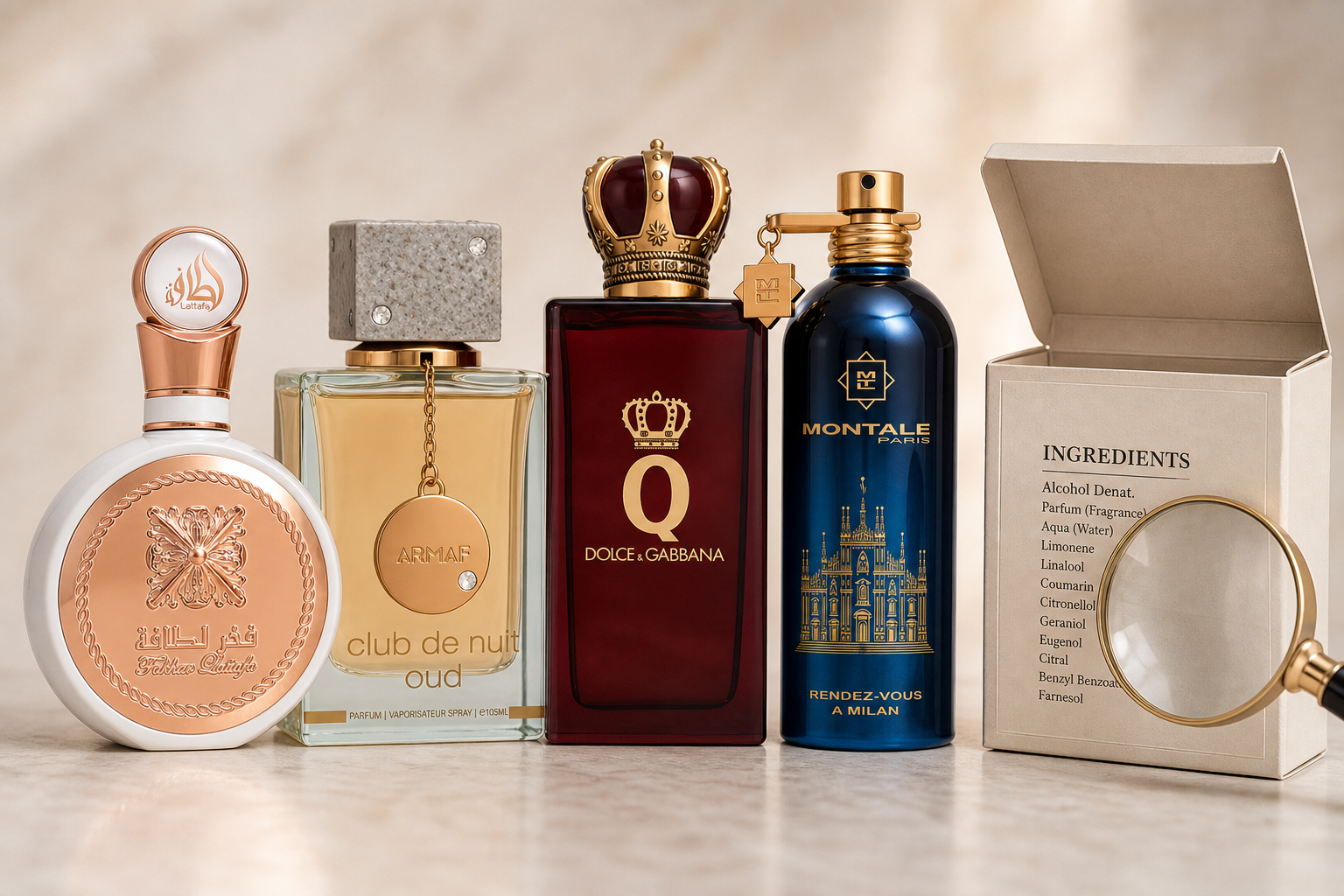
The ingredient list on a perfume box looks like a chemical protocol, and in a way, it really is. It’s not a description of the scent but a mandatory list of ingredients with a fixed structure. You’ll usually find it under the English word "Ingredients," and it’s written in the International Nomenclature of Cosmetic Ingredients, known as INCI. That’s why you see Latin and English names even on a perfume whose packaging otherwise speaks Czech.
The entire list follows one basic rule: ingredients are listed in descending order of their presence. What’s listed first is what’s most abundant in the bottle. However, this rule only applies up to the one percent threshold – ingredients below one percent can be listed in any order by the manufacturer. This is significant for perfumes because most of the specifically named fragrance substances appear at the bottom of the list.
The first positions are therefore the same for the vast majority of perfumes:
- Alcohol Denat. – denatured alcohol, the carrier that dissolves the fragrance composition and evaporates after spraying. It usually makes up the largest part of the volume.
- Aqua – water, which is used to adjust the final consistency and concentration of the product.
- Parfum or Fragrance – the actual fragrance composition, hidden under a single word.
Why the Entire Composition is Just One Word
The fragrance composition consists of dozens to hundreds of ingredients, both natural and synthetic. European regulations allow them to be collectively listed as "parfum" or "fragrance." The formula is a trade secret in perfumery, and listing it completely would essentially provide a recipe for copying. The exception is fragrance substances that must be listed by their own name – these therefore stand separately in the list after the collective composition label.
For the same reason, you won’t learn the proportion of ingredients from the label. It won’t tell you how much of the composition is rose and how much is musk, nor the concentration of fragrance substances in the product. Whether you’re holding an eau de toilette or an eau de parfum is indicated by the product name, not the composition – specific percentages are not disclosed by manufacturers and vary between brands.
Colorants, UV Filters, and Stabilizers
Following the trio of alcohol, water, and composition is a short group of auxiliary substances. There are usually only a few, and each has a practical reason:
- Colorants are identified by the designation CI and a number, such as CI 19140 or CI 17200. This refers to the international index of cosmetic colorants. They are responsible for the color of the liquid in the bottle and have no effect on the scent.
- UV Filters, such as Ethylhexyl Methoxycinnamate or Butyl Methoxydibenzoylmethane, protect the contents of the bottle from light. They are not for skin protection but for the stability of the color and fragrance composition.
- Antioxidants and Stabilizers, typically Tocopherol or vitamin E, slow down the oxidation of the composition so that the perfume lasts longer without changing its character.
The Ingredient List is Not an Olfactory Pyramid
The most common confusion concerns the pyramid you know from product descriptions. Top, middle (heart), and base notes are not the composition. They are a sensory description of how the scent evolves over time – what you smell in the first few minutes, what after half an hour, and what remains on the skin in the evening. Bergamot listed in the pyramid may not correspond to any specific item in the ingredient list; it could be a synthetic material creating a bergamot impression.
The practical consequence is simple. The pyramid tells you how the perfume smells, while the ingredient list describes what is physically in the bottle. Neither replaces the other, and looking for "vanilla" or "jasmine" in the composition usually doesn’t make sense – both are hidden under the collective term "parfum."
Mandatory Allergenic Substances: What They Reveal About Perfume
When you encounter a list of names like linalool, limonene, citral, or geraniol in the ingredients, it might initially seem like a warning. In reality, it's a specific and practically useful piece of information that the label provides – not a signal that the perfume is of poor quality or risky. It's worth understanding why these substances are listed separately and what their presence truly implies.
Why Certain Fragrance Ingredients Are Named
European cosmetic regulations include a list of fragrance ingredients known to cause contact sensitivity in some individuals. While the rest of the fragrance composition is hidden under the general term parfum, these specific ingredients must be listed by name once their concentration exceeds a certain threshold. For products that remain on the skin – including perfume and eau de toilette – this threshold is significantly lower than for rinse-off cosmetics. Therefore, the list for a perfume is often longer than for a shower gel with the same scent.
The purpose of this rule is not to deter purchases. It's a tool for those who already know from past experience that a certain ingredient doesn't suit them, allowing them to identify it on the label. The list of monitored substances has expanded in recent years, so you might find names on newer labels that you didn't see on older bottles. This doesn't mean the composition has changed – just that the requirements for listing have become more precise.
An Allergen Is Not a Dangerous Substance
The term allergen in this context describes potential, not a property that manifests in everyone. The vast majority of people use perfumes with linalool or limonene for years without any reaction, and these substances are allowed in cosmetics precisely because they are considered safe at given concentrations. The risk concerns a minority of sensitive individuals who may experience irritation or skin reactions with repeated contact.
If you've never had any issues, the list at the end of the ingredients has no practical impact on you. Conversely, if you know that certain scents cause reactions, you finally have the opportunity to compare specific names between two products. However, this text is for informational purposes and does not replace an examination or consultation with a doctor; only a specialist can confirm true sensitivity to a specific substance.
A Long List Often Means Lots of Natural Ingredients
Here's a detail that might surprise many readers: most of these substances are not lab additives that someone intentionally adds to the fragrance. They occur naturally in essential oils and plant extracts:
- linalool is a common component of lavender, bergamot, or coriander,
- limonene makes up a large part of citrus peel oil,
- geraniol and citronellol are typical components of rose and citronella oil,
- citral is found in lemongrass and lemon oil,
- coumarin naturally occurs in tonka beans,
- eugenol is characteristic of cloves and cinnamon.
This leads to a rather unexpected conclusion: a perfume based on a high proportion of natural ingredients will generally have a longer list of allergens than a composition based on synthetic molecules. A long list does not indicate lower quality or greater chemical load – rather, it suggests how the fragrance was composed and which ingredients play a key role. Once you understand this connection, the fine print becomes less daunting and serves as another guide to help you interpret the perfume.
Myths About Clean Ingredients: Natural vs. Synthetic
One persistent belief about perfume ingredients is that natural materials are automatically gentler and synthetic molecules are inherently a worse choice. This notion is fueled by marketing labels like "clean ingredients," which have no official definition. However, when you look at how perfumes are created, the line between natural and synthetic isn't where you might expect.
Natural Doesn't Mean Simple
A natural extract isn't a single substance. An essential oil derived from flowers, bark, or resin is a mixture of dozens to hundreds of molecules, and its exact composition varies depending on the variety, soil, weather, and harvest year. That's why compounds that naturally occur in raw materials, like limonene in citrus peel or linalool in lavender, are commonly listed among the fragrance ingredients on packaging. The focus here isn't on the molecule's origin but its potential to cause a reaction in sensitive skin.
The variability of natural raw materials also has practical implications for perfumers. Two batches of the same essential oil can smell different, and the proportion of individual components can fluctuate. For a composition that needs to be sold consistently over the years, this is a complication that must be balanced with something stable.
The Power of Synthesis
A synthetically prepared molecule has defined purity and a known profile. This allows the perfumer to know exactly how much to add to the composition, and the manufacturer can reliably adhere to the concentration limits for individual fragrance ingredients. Another advantage is reproducibility: the perfume you buy in two years should smell the same as today's bottle – and such consistency would be hard to achieve without synthetic materials.
Synthesis also eases the demand on resources that couldn't sustain intense perfumery demand. This applies to:
- sandalwood, whose natural forests are limited and protected,
- natural musk, which was once obtained from animals and is now used in a lab-prepared form in perfumery,
- ambergris and other animal-derived materials, which are commonly replaced by synthetic equivalents.
There is also a whole category of scents that cannot be captured without synthesis. Usable extracts cannot be distilled from lily of the valley, lilac, or peony – these tones are created solely by combining individual molecules. Many popular floral and gourmand compositions wouldn't exist without the laboratory.
Takeaway
Neither category alone guarantees quality or compatibility. What matters is the specific substance, its concentration, and how your skin reacts to it – not its origin. A natural extract can be a source of allergenic components, while a synthetic molecule can be well-tested and tolerated; the reverse can also be true. That's why each material is evaluated individually.
There's another practical reason to be skeptical of the "purely natural" label: you usually can't determine the origin of the ingredients from the list on the packaging. The fragrance blend is listed collectively, and the names of fragrance ingredients don't change based on whether the molecule was created in a distillation pot or through synthesis. So if someone bases a promise of natural purity on a label, they're relying on something that's not actually stated there.
Category
Recommended articles
"Give a girl the right shoes and she can conquer the world!" Marilyn Monroe