
Labeling on the Bottle: Why the Same Fragrance Lasts Differently Each Time
You know the scenario: you've finally found a fragrance that suits you, but there are two bottles with the same name available. One is significantly more expensive than the other, and the difference lies in the subtle label on the bottle – one is an Eau de Toilette, the other an Eau de Parfum. When you apply the fragrance, one lasts all day, while the other fades away on your way to work.
This difference isn't due to chance or inferior quality. The main factor is the concentration of the fragrance composition, meaning the proportion of aromatic ingredients dissolved in the alcohol base. The higher this proportion, the richer the scent trail and the longer it typically lasts on the skin. The bottle size, cap shape, or brand prestige don't affect longevity – a 100ml bottle won't last longer on your skin than a 50ml one, you just have more of it at home.
Concentration also affects the price. Aromatic ingredients are the most expensive part of any perfume, so a higher composition proportion reflects in the price per milliliter. However, this doesn't mean the more concentrated option is automatically the right choice. Lighter concentrations are suitable for hot summer days or the office, where a strong scent might be distracting, while richer versions are more appreciated in the evening and during cooler months.
The label reveals quite a bit, you just need to know where to look. Alongside the name and volume, you'll find the designation that determines the fragrance's strength:
- Perfume Name – reveals the fragrance composition but says nothing about its intensity.
- Concentration Designation – ranges from light colognes to perfume extracts. This is where intensity and longevity are determined.
- Volume in Milliliters – indicates how long the bottle will last, not how long the scent will stay on your skin.
The second part of the answer is that the fragrance doesn't live in the bottle but on your skin. Dry skin holds fragrance shorter than well-hydrated skin, and factors like ambient temperature, season, and where you apply the perfume all play a role. The same product can therefore behave differently on two people, and it may last differently for you in spring than in winter.
In the following sections, we'll go through the entire chain from the label on the packaging to the last lingering note. First, you'll get familiar with the different concentrations and what they mean for everyday wear. Then we'll show you how the fragrance is structured and why its character changes throughout the day. Finally, we'll provide specific tips to get the most out of your perfume – from application methods to where to store the bottle at home.
Next time you're choosing, the label on the bottle won't be a mystery but a reliable guide. And that's the difference between buying blindly and making a decision that makes sense to you.
Four Perfume Concentrations: From Eau de Cologne to Perfume Extract
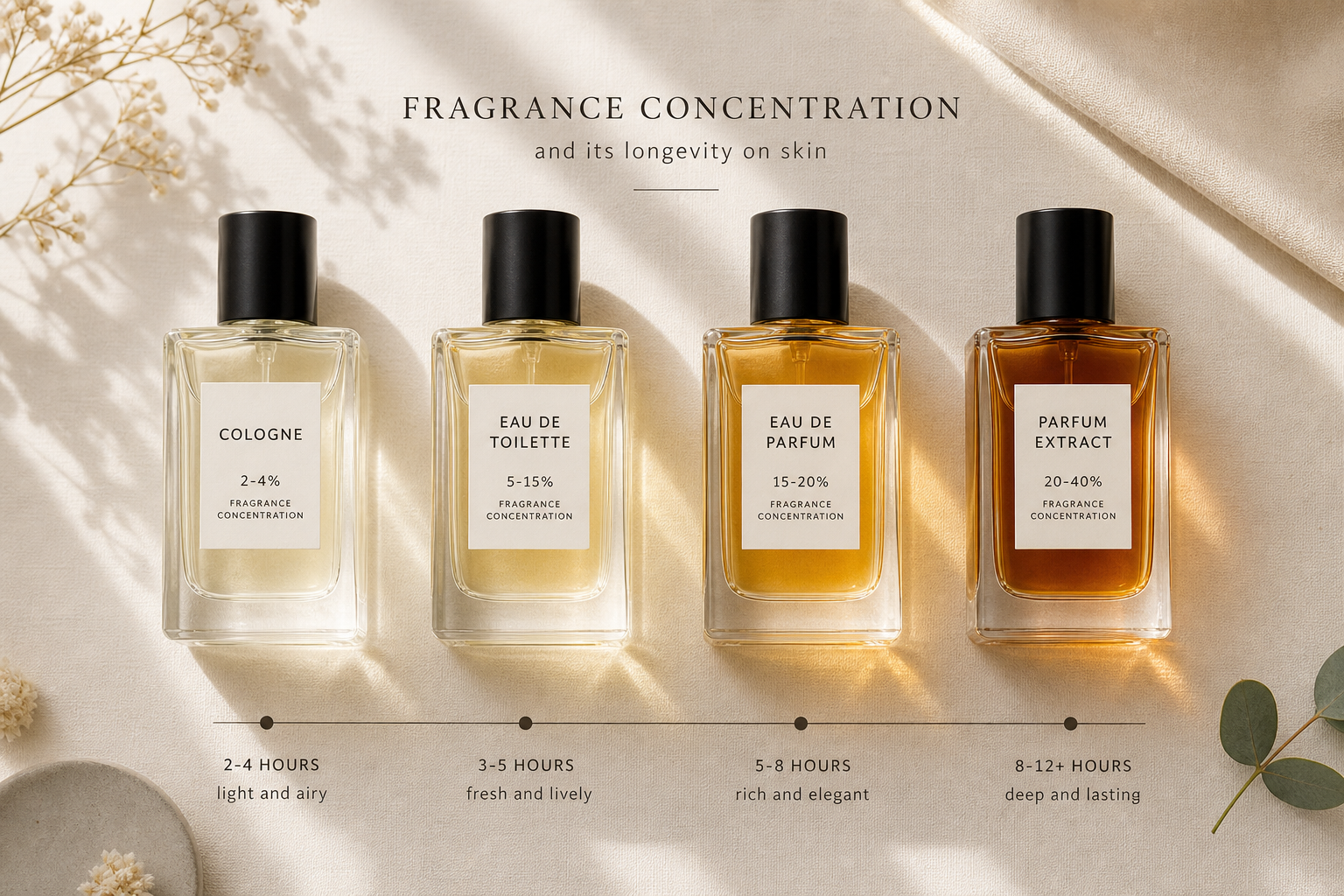
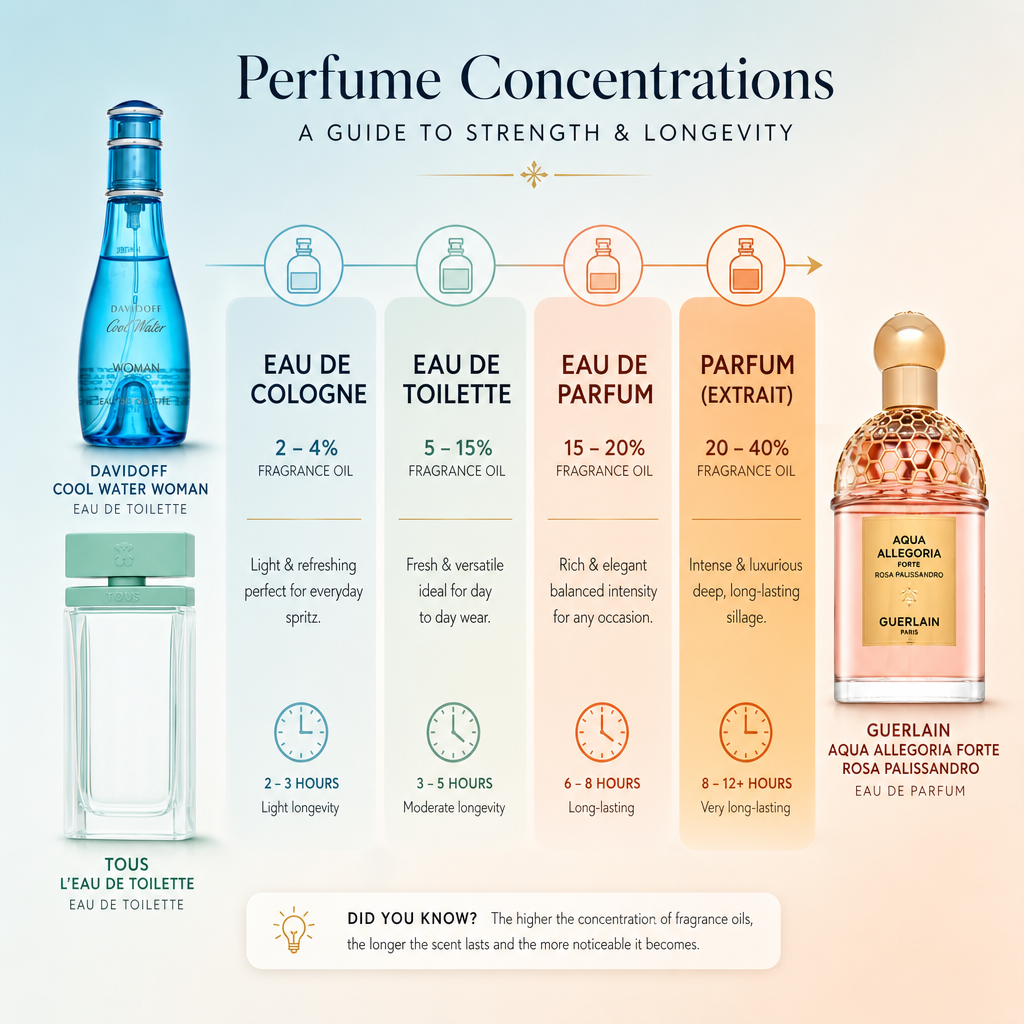
The label on the bottle might look like a marketing sticker, but it actually describes something quite specific: the percentage of fragrance oil dissolved in alcohol and water. The higher this percentage, the richer and denser the scent tends to be—and the slower it fades from the skin. In the usual offerings, you'll encounter four main levels, and once you understand them, you'll be able to navigate the labels forever.
- Eau de Cologne – roughly two to five percent fragrance oil, making it the lightest of the four. It feels fresh, more like a refreshment than a strong perfume, and typically lasts about one to two hours. That's why it's bottled in larger containers, with the expectation that you'll reapply it throughout the day.
- Eau de Toilette – approximately five to fifteen percent fragrance oil. It's noticeably stronger than cologne, yet remains airy and unobtrusive. Expect it to last about three to five hours. It's a versatile daily choice and a great starting point.
- Eau de Parfum – around fifteen to twenty percent fragrance oil. The scent is fuller, clings closer to the skin for longer, and typically lasts five to eight hours. This category includes a large portion of what's sold on the market today, including many well-known compositions.
- Perfume Extract – the most concentrated option, usually twenty percent fragrance oil or more. It tends to be oilier, applied in small doses, and typically lasts eight hours or more. Bottles are therefore smaller, and one application lasts significantly longer.
The numbers provided are for guidance, not guarantees. Manufacturers aren't bound by a uniform standard, so one brand's eau de toilette might be denser than another's eau de parfum. The ingredients in the composition also play a role: light citruses evaporate faster than musk or woody bases, regardless of what's on the label. The concentration label gives you a good estimate, but the final say comes down to the specific formula and your skin.
It's more practical to think in terms of occasions rather than comparing percentages. For a hot summer day, the office, or sports, lighter eau de toilette or cologne is suitable—fragrance evaporates faster and more intensely in the heat, so a light concentration feels pleasant and doesn't bother anyone on the tram. For the evening, dining out, or formal occasions, eau de parfum is a better fit, lasting throughout the event without needing reapplication. Perfume extract is then the choice for cooler months and times when you want the scent to remain prominent and concentrated around you.
When you look at the composition of a typical perfume offering, you'll see that the vast majority consists of eau de toilette and eau de parfum. Colognes today represent a smaller yet still vibrant segment—found mainly among fresh men's classics. Perfume extracts, on the other hand, are a minority and more expensive category: they have smaller volumes, higher prices per milliliter, and are often introduced as a complement to an existing scent, not as the first bottle in a collection. If you're just starting out, eau de toilette or eau de parfum is a sensible starting point—they can be worn every day, and you won't pay for longevity you won't use in everyday life.
The Structure of a Fragrance: Why Citrus Notes Fade Faster Than Musk
When you read the list of notes in a perfume, you're actually looking at a timeline. Perfumers build the composition in three layers – top, middle (heart), and base notes – and each of them reveals itself on the skin at different times. This structure is called the fragrance pyramid, and it's a practical way to understand why the same perfume smells different in the first fifteen minutes than it does in the evening.
The difference isn't due to the quality of the ingredients, but physics. Lighter and more volatile molecules evaporate quickly from the skin, while heavier and less volatile ones linger much longer. Therefore, the pyramid is not a hierarchy of importance, but the order in which individual ingredients come to the forefront.
Top notes create the first impression and typically dissipate within the first five to fifteen minutes. They often include citrus fruits like bergamot, mandarin, grapefruit, or lemon, as well as aromatic herbs and juicy fruity accords. That's why the scent you spray on a test strip in a store and evaluate after a minute tells you very little about the final result. The citrus start is designed to captivate and then fade. So if you feel like the perfume has disappeared after half an hour, often it's just the end of its first chapter.
Middle or heart notes emerge once the top notes fade and usually last several hours on the skin. Here, the character of the entire composition is decided: floral notes like jasmine or rose, spices such as cardamom, aromatic lavender, or fruity and tea accords. When someone describes a perfume as floral or spicy, they are usually referring to the heart.
Base notes, also known as the foundation, evaporate the slowest. They remain on the skin and clothing and create the lingering scent that others associate with you. You most commonly encounter them in this form:
- Musk – a soft, clean, and slightly powdery note that connects and carries other ingredients the longest.
- Amber – a warm, slightly balsamic note that gives the composition a velvety feel and envelops the skin.
- Vanilla – a sweet and creamy component, the base of gourmand fragrances; loses its excessive sweetness when combined with spices.
- Tonka Bean – related to vanilla, but drier, with almond and tobacco undertones.
- Sandalwood – smooth creamy woodiness that softens the sharp edges of the rest of the composition.
- Cedar – a drier, pencil-like woody tone that adds structure and clearer outlines to the fragrance.
- Patchouli – an earthy, darker ingredient; in small amounts, it deepens, in larger amounts, it dominates the entire finish.
Once you connect this timeline with the composition listed for a product, reading perfume descriptions starts to make sense. A composition based mainly on citrus and light florals will feel fresh and airy, but its trail will be rather discreet. Conversely, a perfume whose base is built on musk, amber, or woods will usually last significantly longer on the skin, even if it doesn't seem dramatic in the first few minutes.
This also leads to a practical conclusion for testing. Apply a sample to your wrist and evaluate it only after several hours – only then does the perfume smell as you will actually wear it. And if a scent seems weaker after an hour, it may not be a flaw: you might have just reached its quiet but persistent conclusion.
Why Your Perfume Doesn't Last: Common Causes of Weak Longevity
We've all been there: you apply your perfume in the morning, but by noon, the scent seems to have vanished, and by evening, it feels like you never opened the bottle. Weak longevity doesn't necessarily mean you've bought a bad perfume. More often, it's a combination of small factors – from the condition of your skin to the application area and even your own nose, which gets used to the scent faster than those around you.
Dry skin doesn't hold scent well. Fragrance molecules need something to cling to. They last significantly longer on hydrated, slightly oily skin because natural oils act as a carrier, releasing the scent gradually. In contrast, dry skin quickly "drinks up" the perfume and lets it evaporate. This difference is most noticeable in winter, when the combination of cold and overheated rooms dries out the skin, and for people with naturally dry skin all year round.
Clothing and hair aren't skin. Fragrance can last a long time on fabric, but it remains static – it lacks the body heat that gradually opens up the middle and base notes. The result is a flat impression, which also mixes with the scent of laundry detergent. Hair holds scent well, but the trail disperses quickly in the wind. When you apply perfume exclusively outside the skin, it has nowhere to develop, and you rightfully feel that "nothing is noticeable."
The usual course of the day also shortens longevity without you noticing:
- Heat and movement. Higher temperatures accelerate evaporation. In summer, in a heated office, or after exercise, the scent shines more intensely but also depletes faster.
- Wind and air conditioning. Flowing air continuously carries the scent away – both outdoors and in the car.
- Friction from clothing. Collars, sleeves, or bag straps mechanically wipe the scent off the skin.
- Individual skin chemistry. Skin acidity, sweat levels, and hormonal changes affect how fragrance molecules manifest. That's why the same perfume smells slightly different on each person and lasts all day for some, but only a few hours for others.
Olfactory Adaptation: You Stop Noticing the Scent Before Others Do
The most common cause of perceived weak longevity isn't the perfume, but your nose. Olfactory receptors quickly adapt to a constant stimulus, and the brain starts to deem it unimportant – just like you stop noticing the scent of your own home when you return from vacation. With a perfume you've been wearing since morning, this usually happens within the first hour or two.
Practically, this means your scent likely lasts longer than you think. Others still perceive it because they encounter it intermittently. So before you reach for another spritz, ask someone close to you – you'll save yourself from unnecessary overload, which can be unpleasant in enclosed spaces.
Fresh Compositions Tend to Be More Fleeting Than Gourmand Ones
Part of the answer lies in the choice of fragrance itself. Citrus and aromatic compositions rely on light, volatile ingredients like bergamot, mandarin, grapefruit, or lavender – these evaporate the fastest and are meant to create a fresh first impression, not to last twelve hours. In contrast, gourmand, oriental, and woody fragrances are based on heavier materials like vanilla, amber, musk, patchouli, cedar, or sandalwood. These release slowly from the skin, creating a trail that you can smell even after a very long time.
So if you're expecting a summer citrus eau de toilette to last as long as a winter woody perfume, it's not a product flaw, but a characteristic of the fragrance family. Once you know which cause applies to you, weak longevity ceases to be a mystery.
How to Extend the Longevity of Your Fragrance: From Application to Proper Storage
Whether you have a single favorite bottle at home or switch perfumes according to your mood, there are quite a few ways to enhance longevity before opting for a different concentration. The difference between a scent that fades by midday and one that lasts into the afternoon isn't always due to the composition itself—much of it comes down to how you apply it and where you store the bottle.
Application: Hydrated Skin Holds Fragrance Longer
Fragrance molecules cling to supple and moisturized skin longer than to dry skin, from which they evaporate more quickly. If you tend to have dry skin, apply an unscented body lotion or body oil a few minutes before your perfume, focusing on the areas where you'll be spraying. It's important to use a base that doesn't compete with the fragrance: scented body care with a different composition can muddle the overall impression.
Apply to pulse points, where the skin is warmer and the scent releases more effectively:
- inner wrists,
- neck under the jawline and behind the ears,
- inner elbows,
- behind the knees, especially in warmer months when the fragrance rises upwards.
Spray from a distance of about fifteen to twenty centimeters to disperse the scent into a fine mist rather than a concentrated drop. Do not rub your wrists together after spraying—friction heats the skin and breaks down the delicate top notes before they have a chance to develop. Let the perfume dry naturally.
Layering works best when there's a shower gel or body lotion from the same line as the perfume. Otherwise, regular unscented body care will do. Spraying on clothing usually lasts longer than on skin, but keep in mind that the scent develops differently on fabric and may leave marks on delicate materials like silk.
Storage: Cool, Dark, and Stable Temperature
Heat, direct light, and temperature fluctuations are the biggest enemies of fragrance. That's why the typical bathroom is one of the least suitable places, even though bottles often end up there automatically. Stick to simple rules:
- a cabinet, drawer, or the original box at room temperature,
- no windowsills or shelves where the sun shines,
- no bathroom where temperature and humidity change with showers,
- keep the bottle closed and don't decant into other containers except for a travel atomizer designed for that purpose.
An opened bottle has its lifespan and changes character over time. Citrus and fresh top notes are the first to fade, while compositions with strong woody or oriental bases age more slowly. If a perfume darkens over time or starts to smell sour at the beginning, it's not a defect; the composition has simply changed. For fragrances you wear occasionally, smaller bottles make sense—you'll use them up while they're still in good form.
What to Consider for Your Next Choice
If longevity is your main criterion, consider opting for an Eau de Parfum or a perfume extract rather than an Eau de Toilette or cologne. The composition itself can also help: fragrances with base notes of musk, amber, vanilla, or woods last longer on the skin than purely citrus or aquatic ones. Conversely, a light Eau de Toilette makes sense for the office, in summer heat, or anywhere a subtle hint of fragrance is preferred.
In the categories For Women, For Men, and Unisex, you can browse the selection directly by the concentration indicated on the bottle and compare how the Eau de Toilette and Eau de Parfum differ in price and description within the same line. Before making a final decision, let the fragrance sit on your skin all day instead of judging it from a quick sniff on a paper strip—only then will you truly know how long it lasts on you.
Category
Recommended articles
"Give a girl the right shoes and she can conquer the world!" Marilyn Monroe