
 Riiffs Freeze in Flames: Ice and Flames Illuminate Warsaw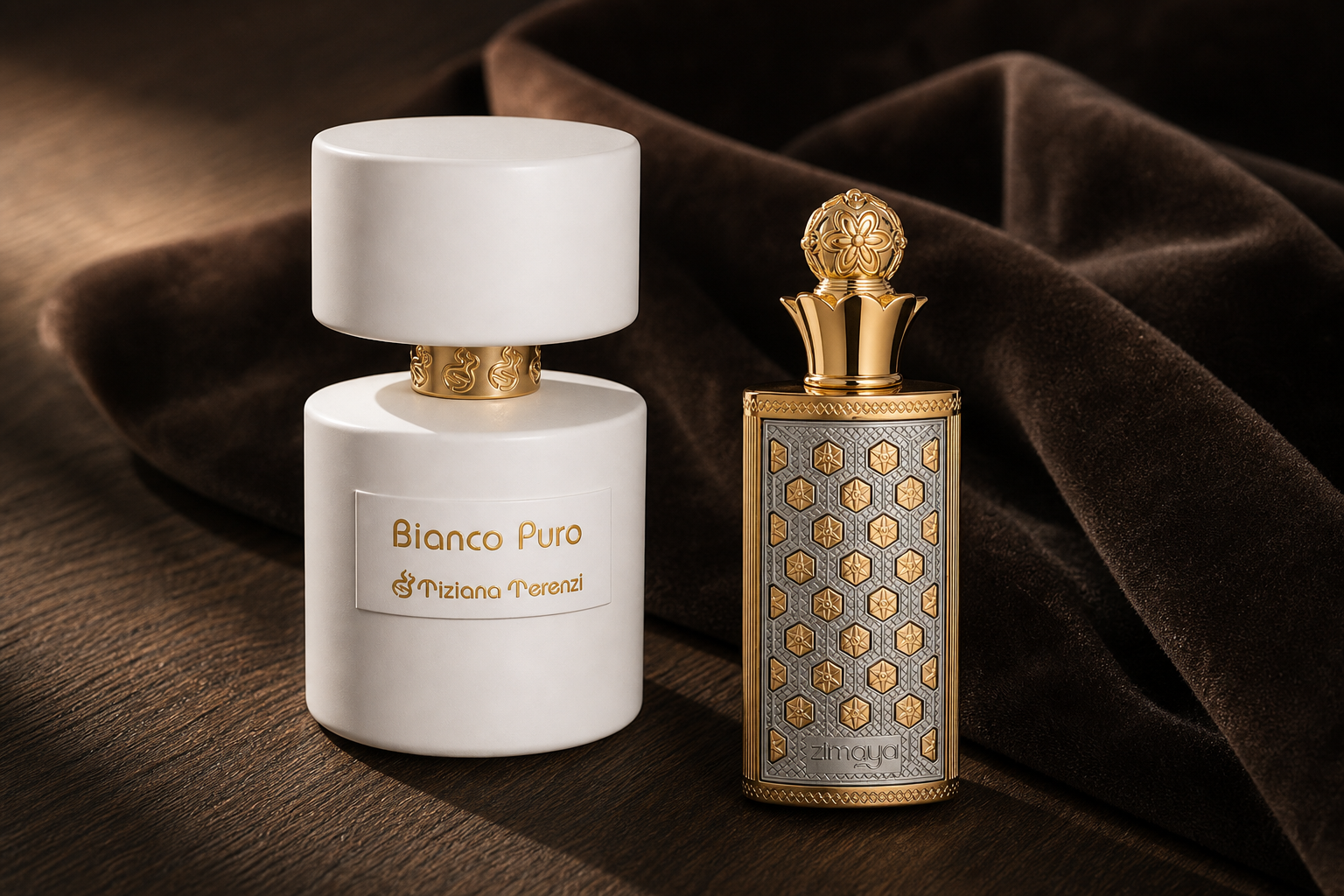
Perfume extract, attar, or perfumed oil? Our guide to niche perfumery formats explains the differences in intensity, longevity, and application methods, and when each is best suited.
Why Concentration is More Than Just a Number on the Label
When choosing a perfume, you often encounter the duo of Eau de Toilette and Eau de Parfum. The difference between them is quite well-known today, and we cover it in detail elsewhere. However, niche perfumery works with a much broader range of formats: alongside Eau de Parfum, you'll find perfume extracts, oil-based attars, roll-on bottles, and solid wax perfumes. Before diving into these, it's worth getting familiar with the terminology. The word concentration appears in descriptions much more often than it is explained, and the idea that it is a single number determining the strength of a perfume leads to most disappointments when buying blind.
Every perfume consists of two parts. The first is the fragrance composition, which is the blend of ingredients mixed by the perfumer. The second is the carrier, in which the composition is dissolved or dispersed. Concentration expresses what proportion of the bottle's content is the composition itself: the higher the proportion, the less carrier and the denser the resulting liquid. Exact numbers vary from house to house. Labels like Eau de Parfum or perfume extract are not strictly defined by any standard, so two extracts from different brands can differ in concentration and character more than the label might suggest. The number on the package is a guide, not a guarantee.
The Carrier Determines How the Fragrance Behaves
The carrier is not just a filler for the bottle. Most commonly, it is cosmetic alcohol, which evaporates quickly after application and carries the fragrance molecules with it into the surroundings. That's why alcohol-based perfumes feel open from the first moments, and their development is easy to read: first, the fresh top notes, then the heart, and finally the base notes. An oil carrier practically does not evaporate. It stays on the skin and releases fragrance gradually, so the scent starts more quietly, stays closer to the body, and develops more slowly. The wax base of solid perfumes goes even further – the scent binds to the application spot and creates only a minimal aura around you.
The same composition can therefore behave like three different perfumes in three different carriers. In alcohol, light citrus and aromatic notes stand out, while in oil, the base comes to the forefront: woody, resinous, or balsamic ingredients that evaporate the slowest. It's neither a flaw nor an advantage of one format over another, just a different way the fragrance reaches your surroundings.
This leads to the most common misconception: that a higher concentration automatically means a louder perfume that can be smelled across the room. In practice, it's often the opposite. Denser material evaporates more slowly, stays closer to the skin, and lasts longer, but doesn't necessarily create a more pronounced trail. How far a perfume is smelled is mainly determined by the composition of ingredients and their volatility – not the percentage on the label. Higher concentration thus changes the character of the trail: more concentrated, slower, closer.
Throughout the article, we'll work with several terms that are worth mastering:
- Concentration – the proportion of fragrance composition in the bottle's content.
- Carrier – alcohol, oil, or wax in which the composition is dissolved or dispersed.
- Trail – how far the perfume is smelled from you and how long it lingers in the air.
- Longevity – how long the fragrance lasts on the skin or clothing.
- Development – the transformation from top notes through the heart to the base notes.
With this vocabulary, you can discuss niche perfumery formats factually. Instead of asking which is stronger, ask how you want the perfume to behave: should it be prominent in the first hour and then fade, or work quietly in the background all day? The answer usually leads you to the format sooner than to the percentage.
Perfume Extract: Understanding the Highest Concentration
Perfume extract, known as extrait de parfum, is at the top of the concentration scale. In the catalog, you can identify it by the PAR label in the product name, where other bottles might indicate Eau de Parfum or Eau de Toilette. The fragrance component makes up a significantly larger portion of the composition, leaving proportionally less room for the base, usually alcohol. In niche perfumery, what was once an exceptional supplementary variant has become a standard format – many brands now introduce the extract as the primary form of a new release, not just as an additional, more intense version.
The first difference compared to Eau de Parfum is noticeable even before you smell the fragrance. The extract is thicker and spreads more slowly on the skin because it contains less quickly evaporating alcohol. It doesn't leave that typical cooling sensation upon application and disperses less into the air around you. This is why it is often packaged in smaller bottles – it's expected that one bottle will last significantly longer than the same volume of Eau de Parfum.
The development of the composition itself is also slower. The top notes, such as citrus, spices, or aromatic herbs, don't evaporate as quickly in an extract; instead, they subtly blend into the heart of the fragrance. The woody, resinous, or balsamic base, on the other hand, asserts itself earlier and lasts longer. If you know the Eau de Parfum of the same name, the extract might seem darker, sweeter, or denser – it's not a different scent, just a different unfolding of the same story over time.
This also affects the scent trail. The extract stays closer to the skin, creating more of a personal aura than a pronounced trail across the room, but it lasts noticeably longer – with a well-constructed composition, it can last an entire workday. If you expect mainly volume from a more concentrated format, you might be surprised: the extract offers depth and longevity, not reach.
This leads to the most common dosing recommendation: apply less than you're used to. It's wise to follow a few simple guidelines.
- Start with one or two applications and only after an hour assess if more is needed.
- Target warm areas with thinner skin – wrists, the area under the collarbone, the nape of the neck.
- Do not rub the applied fragrance; friction accelerates the evaporation of top notes and unnecessarily shortens the development.
- For bottles with a dropper or applicator stick, use one drop per spot, not several.
- Delay layering with another perfume until you know the extract on its own; the dense base clashes with other compositions more than you might expect.
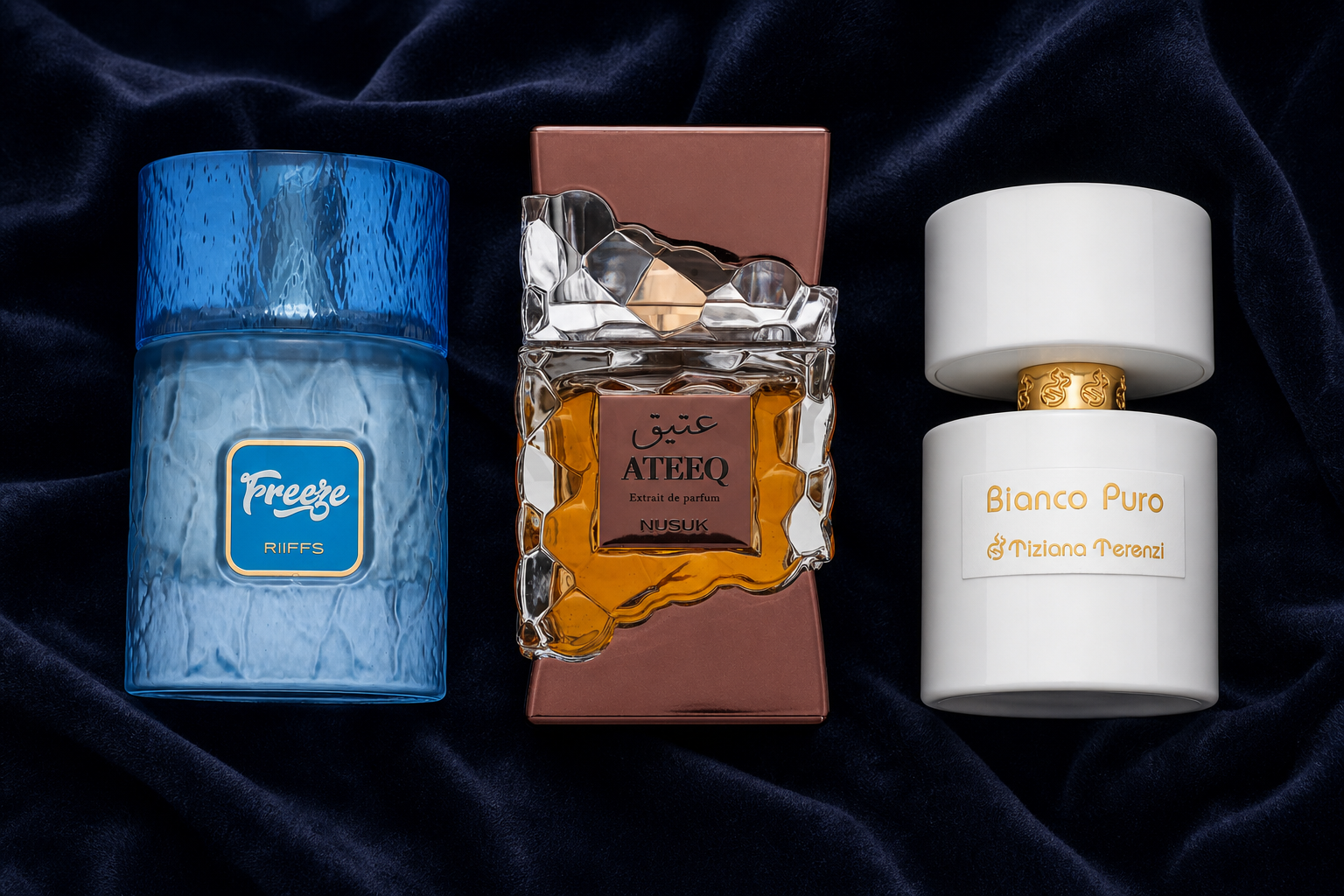
The price level of extracts is usually higher than that of Eau de Parfum from the same brand, which can be off-putting at first glance. However, when calculated per application, the difference is far less dramatic: you use less fragrance per application, and the scent lasts longer on the skin, so you typically don't need to reapply during the day. With more affordable niche brands that offer extracts as standard, the difference diminishes even faster – for example, Riiffs or Nusuk offer extracts even in the mid-price range. It's therefore worth comparing the overall duration a bottle will last you rather than just the price tag.
Thus, an extract is not automatically a better choice, but a different one: a denser material that rewards moderation and patience. If you enjoy fragrances that accompany you quietly and for a long time, you'll feel comfortable with this concentration. Conversely, if you prefer a pronounced trail that others will notice, the extract might surprise you with its subtlety.
Attars: Alcohol-Free Oil Perfumery
Attar is an oil-based perfume without alcohol. The fragrant ingredients are not dissolved in alcohol but in a neutral carrier oil that is almost scentless on its own. This method has roots in Arabic and Indian perfumery, where fragrant substances were traditionally macerated or distilled directly into an oil base, most commonly sandalwood. Today's commercially produced attars use a combination of natural and synthetic ingredients in a lighter plant-based carrier, but the principle remains the same: no alcohol, a high concentration of fragrance, and a small bottle that dispenses drop by drop.
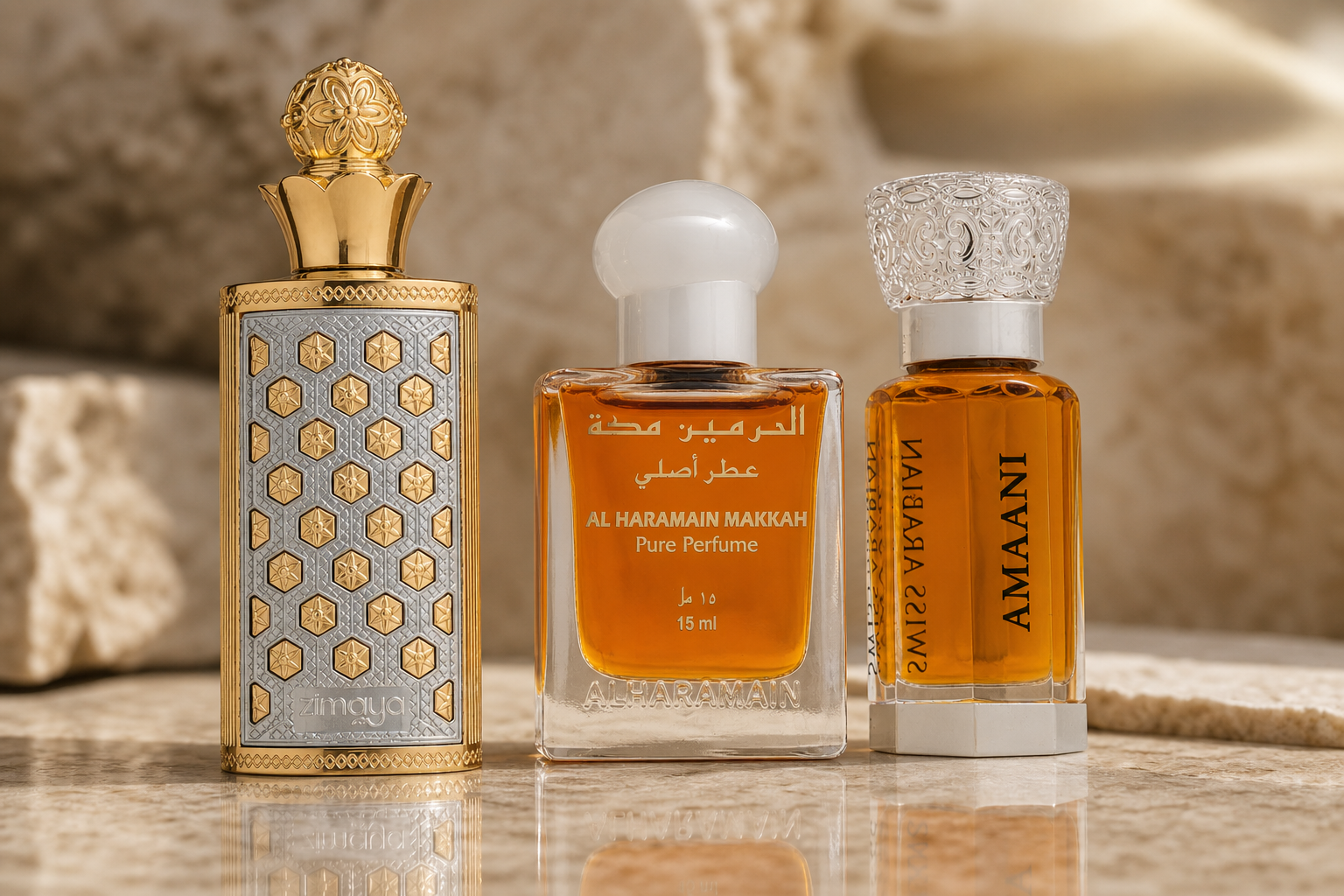
In Czech e-shops, the terms attar and concentrated perfume oil are often used interchangeably. In catalogs, you may also encounter the abbreviation CPO, which stands for concentrated perfume oil – modern oil concentrates that follow the same logic as traditional attar, just in a more European-style packaging. They are offered by brands like Zimaya or Lattafa. So if you're looking for attar and see concentrated perfume oil in the product description, it's not a different category, just a different name for the same format. Look for differences in the specific composition, not the name.
The oil carrier changes the behavior of the perfume more than you might think from just one different ingredient. Alcohol evaporates quickly after application, carrying the top notes with it, which is why the alcohol version is significantly louder in the first few minutes and can be detected from several steps away. Oil does not evaporate, so the fragrant molecules are released gradually. The development is therefore slower and calmer: the top accord unfolds more gently, the heart comes later, and the base notes often last longer on the skin than the corresponding alcohol variant. The scent stays close to the body – attar is more likely to be noticed by someone standing next to you than by an entire room.
Application looks different than with a spray. The oil is applied in small amounts to areas where the skin naturally warms, as heat gradually opens up the fragrance:
- Wrists – a classic spot with an artery close to the surface. Spread the drop gently by pressing, not rubbing your wrists together.
- Behind the ears and on the neck – the scent remains at face level and works in close proximity, which is desirable for oils.
- Behind the knees – a warm and clothing-protected spot from which the fragrance rises throughout the day.
The oil absorbs into the skin, so do not apply it to textiles. An oily residue is difficult to remove from fabric, and the scent develops differently on clothing than on skin. Use a smaller amount than you would with a spray – the concentration is higher and the oil spreads naturally over the skin.
Who is this format suitable for? Primarily where an alcohol-based fragrance would be too loud. In an office or shared workspace, you'll appreciate that the scent stays with you and doesn't spread throughout the entire floor. In warmer months, it also matters that high temperatures accentuate differences: an alcohol perfume opens more sharply in the heat, while an oil-based one remains more balanced. And because it is dispensed drop by drop, you can easily adjust the intensity – from a single drop for subtle wear to several spots if you want the fragrance to be noticeable to those around you.
Roll-on, Sample, Solid Perfume: Formats for Everyday Wear
Not every difference between bottles is about concentration. Various formats you encounter in niche perfumery address different concerns – how the perfume is applied, how much you can carry in your handbag, and how easily you can try the composition before opting for a full-sized bottle. The same composition can feel airy from a spray and dense from a roller.
Roller vs. Spray
A roll-on is a bottle with a ball applicator that spreads the perfume directly onto the skin. The dosage is precise, nothing is lost to the air, and the scent remains in a narrow trail around the wrist or neck. It's suitable for the office and public transport, where you don't want to affect those around you. However, the ball touches the skin, so over time, traces of oil can get into the bottle; wiping the applicator after use is a small step that benefits the contents.
A spray disperses the scent into a fine mist. The composition opens up more quickly, the top notes are more noticeable, and the trail around you is wider. This also affects the dosage: one press is not the same as one swipe with a roller.
Samples: An Easy Way to Try
A sample is a small amount of perfume decanted from the original bottle. For niche perfumery, it makes practical sense – with more expensive compositions, you can buy a few milliliters and wear them for a week before deciding on a full bottle. Niche scents also develop slowly, so one scented paper in a store tells you little; only several days on your skin will show how the composition works with your chemistry and the season.
At Brasty, you'll find samples of luxury perfumes as standalone items, so testing doesn't have to mean buying a whole bottle. The small packaging also fits in your carry-on luggage.
Solid Perfume: Wax Instead of Alcohol
Solid perfume is a fragrant blend captured in a wax base, usually in a small container. It's applied with a finger, nothing spills, and nothing breaks, making it a reliable companion for your handbag. The trail is very close and intended more for you than for the whole room. The wax carrier releases fragrant substances slowly, so the composition may seem more subdued than its alcohol version.
How to Store Perfumes
Fragrant substances are most damaged by light, temperature fluctuations, and air. A few rules apply to every format:
- Store bottles in the dark – in a drawer or the original box, not on a windowsill.
- Maintain a stable room temperature without fluctuations.
- Always close the cap tightly or put the spray cover back on.
- Do not pour the contents into unknown containers and avoid shaking the bottle unnecessarily.
The bathroom is one of the least suitable places, even though perfumes are often left there. During a shower, the temperature and humidity rise sharply, and after airing, they drop again; this cycle repeats several times a day. A bedroom or a drawer in the hallway is a better choice for your collection.
Longevity: Alcohol vs. Oil
Alcohol-based perfumes have their own preservative in the bottle – alcohol prevents the growth of microorganisms, and the composition in a well-sealed bottle lasts for years. However, they do change: citrus top notes oxidize first, while the woody or amber base remains almost unchanged. The darkening of the contents itself does not mean the perfume is spoiled; it is common in oriental compositions.
Oil formats, such as attars and oil-based roll-ons, behave differently. They do not contain alcohol but do contain a carrier oil, which can go rancid over time. On the other hand, nothing evaporates from them, so you don't lose volume with proper storage. For solid perfumes, watch the base itself: if it starts to smell like old fat, it's time to replace the container.
How to Choose the Right Format for Every Occasion
The theory of concentrations makes sense when you're standing in front of a shelf of perfumes, pondering what to wear today. The format not only determines longevity but also how far the scent will reach and how precisely you can apply it. Consider the following guidelines as a guide, not rules – the final decision rests with your skin, your surroundings, and how long your day will be.
We've identified four situations where the differences between formats are most pronounced.
- Office and Enclosed Spaces: Here, you'll appreciate an oil-based format or attar. An oil carrier keeps the scent close to the skin, so it's primarily perceived by you and those who are really close. One drop on the wrist usually lasts the entire workday without distracting anyone.
- Evening and Social Occasions: Perfume extract is in its element. Its slower development and richer texture allow the composition to unfold gradually, so the scent you notice upon arrival isn't the same as the one you leave with. Two drops on the neck and behind the ears are usually enough.
- Travel and Longer Journeys: Small packages win – roll-ons, decants, or solid perfumes. They fit in a pocket or handbag, can be applied anywhere without misting an entire carriage, and there's no risk of the bottle opening in your bag.
- Summer Heat: Warm skin heats the scent faster, so even a usual dose can seem louder than you're used to. Use less, stick to cooler areas like the inner wrist or behind the knees, and consider an oil format – it won't evaporate as quickly in the heat.
If the situation doesn't clearly guide you, consider the three axes where formats differ the most:
- Longevity – The higher the concentration of fragrance oils and the denser the carrier, the slower the scent fades. Oil formats and perfume extracts last longer than lighter alcohol-based variants.
- Sillage Intensity – Alcohol carries the scent into the air, while oil keeps it close to the skin. If you want to be noticed across the room, go for a spray; if you want the scent to be discovered only by those who come close, choose oil.
- Application Method – A spray covers a larger area but is harder to control. A roller, dropper, or solid form gives you control over each drop, which is more useful for concentrated scents than you might think.
Before You Opt for a Large Bottle
With concentrated formats, it's doubly true that the scent from a test strip and the scent on your skin are two different experiences. The strip shows only part of the composition, while your skin completes it – temperature, hydration, and your natural scent can sometimes shift the result significantly. Therefore, try a new perfume first in a small volume: a decant, travel size, or smaller bottle lets you experience the scent throughout the day, from the first minutes to the lingering base.
Give the testing at least one regular day, ideally one that matches the situation you're buying the perfume for. A scent that excites you in the store might feel completely different after three hours in an overheated office. And if the format doesn't suit you, you'll lose much less investment than if you had bought a large bottle right away.
Whether you're drawn to the richness of a perfume extract, the subtle trail of attar, or the practicality of a concentrated oil for travel, you'll find these formats together in Brasty's niche section – from Arabian houses like Lattafa to European niche classics like Montale. Start with what suits your day, and let the smaller size decide if the scent deserves a permanent spot on your shelf.
Category
Recommended articles
Riiffs Freeze in Flames: Ice and Flames Illuminate Warsaw "Give a girl the right shoes and she can conquer the world!" Marilyn Monroe