


How Plant-Based Refills Differ from Traditional Diffusers
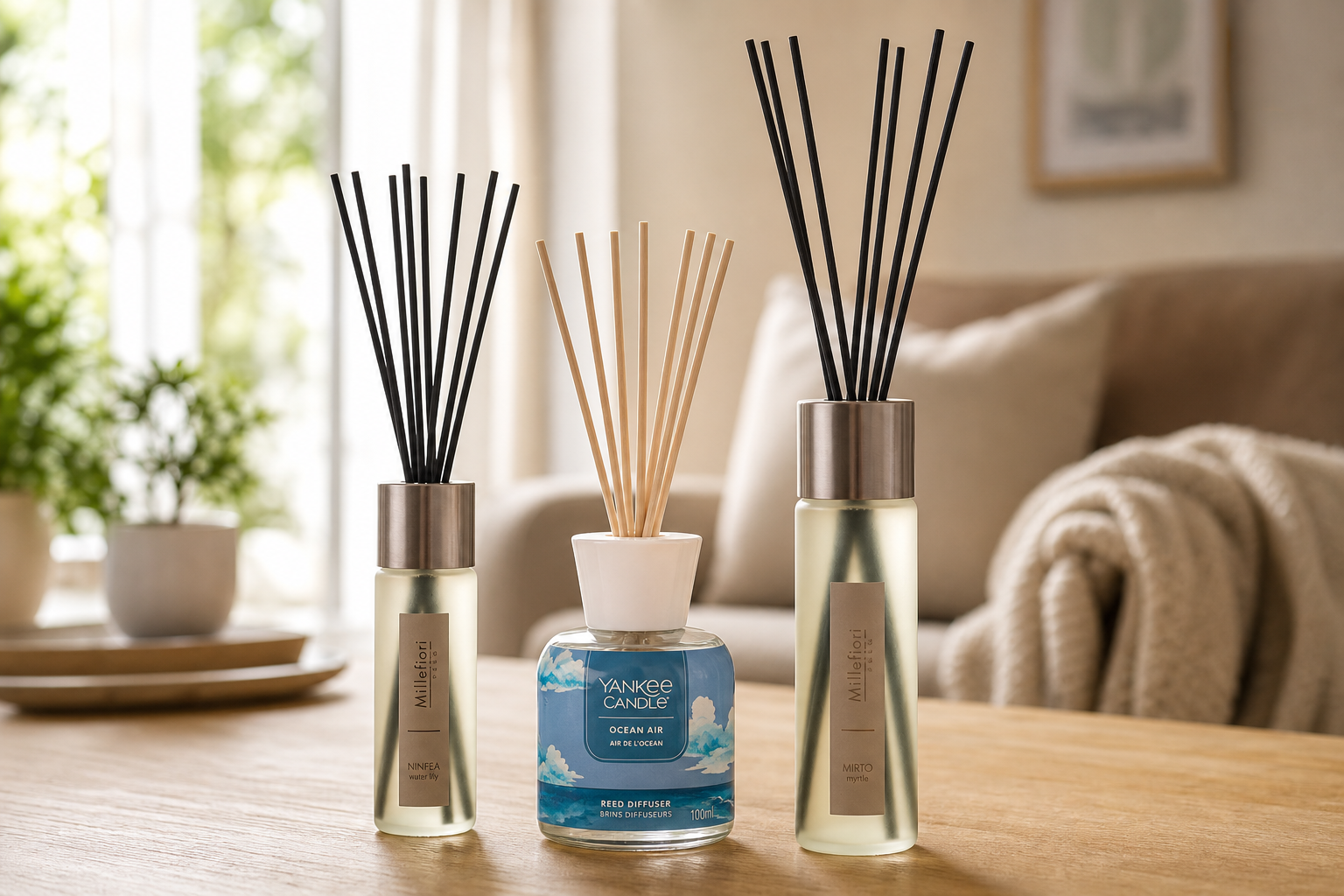
At first glance, a reed diffuser looks the same: a bottle, fragrant liquid, and a bundle of sticks that disperse the scent into the room. The key difference between various refills lies in what makes up the liquid itself. Fragrant ingredients are never standalone – they are always dissolved in a carrier. It is the choice of carrier that determines how the refill behaves in the bottle and in your home.
Plant-based refills use a carrier derived from plant materials – typically plant oils or their lighter derivatives. In contrast, traditional refills are most often based on mineral oil, a petroleum-derived substance, or a combination of solvents and alcohol. The fragrance composition can be practically the same in both cases: it's the environment in which it's dissolved that changes, not the scent itself.
There are several reasons why more and more people are interested in plant-based options. Some customers read the ingredients of home fragrances as carefully as they do cosmetics and want to know what is evaporating into their air for weeks. Others are attracted by the idea of a renewable resource instead of a petroleum-based one. And some are simply curious if a different type of refill will be more pleasant in their interior – perhaps because they found the diffuser too intense in a small room.
However, it's worth setting expectations right from the start. A plant-based refill is not automatically stronger or weaker than a traditional one – it simply behaves differently. The difference in the carrier is more about how quickly the scent fills the space and how it affects the room both up close and from a distance. In practice, you might notice these things in particular:
- Scent onset. Thicker plant oils travel through the stick more slowly, so the scent develops in the room more gradually than with lighter, fast-evaporating bases.
- Presence in the space. A plant-based base has its own subtle tone that mingles with the fragrance composition. For some scents, this results in a softer and more rounded effect, while for others, it allows you to better control the overall impression.
- Behavior in everyday use. Open windows, heating, drafts, or the size of the room affect plant-based refills just like any other. The difference in the base does not override these influences.
One more thing to be clear about. The term "plant-based refill" refers to the carrier, not the entire bottle. The fragrance component is still a perfume composition, which can combine natural and synthetic ingredients – and that's okay, because many popular tones cannot be produced any other way than synthetically. Therefore, the plant origin of the base does not automatically mean the refill is gentler on sensitive noses: even natural fragrant ingredients are common allergens, and with a diffuser, it's always wise to ventilate and avoid placing it too close to areas where you spend the entire day.
You have two options before you, differing not in quality but in principle. Whether you're considering a plant-based refill for its composition or are simply curious if it will work better in your home, it makes sense to know what lies behind the carrier oil, how the scent travels from the bottle into the space, and how to identify a refill that suits your apartment. These are the questions we will focus on in the text.
Carrier Oils: Plant-Based vs. Mineral Oil
When you look at the composition of a diffuser refill, the fragrance blend itself makes up only a small part of the whole. The rest is the carrier oil – the liquid in which the fragrance ingredients are dissolved and which gradually transports them to the reeds. The carrier determines the viscosity of the refill, how readily it wicks, and how quickly it evaporates from the surface of the reeds. On the label, you can usually identify it as it appears at the top of the ingredient list.
Petrochemical-Based Carriers
Traditional diffusers most commonly use carriers made from petroleum-based materials. The most widespread is dipropylene glycol, alongside isopropyl myristate or light mineral oils. They have several practical advantages: they are very thin, reliably dissolve even higher concentrations of fragrance materials, and behave predictably, so individual batches differ only minimally. Low viscosity means the liquid travels quickly up the reed, and the fragrance usually fills the room within the first few hours.
Plant-Based Carrier Oil Alternatives
Plant-based carriers are derived from renewable resources – most commonly coconut, rapeseed, or sunflower. These are not virgin oils like those you know from the kitchen: they would yellow quickly in a diffuser and clog the reeds' pores. Fractionated and esterified derivatives are used, which are light, clear liquids without a strong inherent odor, with behavior in the diffuser precisely defined. Compared to petrochemical carriers, they tend to be slightly thicker, and their dissolving ability is more selective – the fragrance blend is mixed specifically for them and cannot simply be transferred from one formula to another.
In practice, the two types of carriers differ in several properties that you can recognize without a lab:
- Density. Petrochemical carriers tend to be more watery, while plant-based ones feel noticeably oilier to the touch.
- Wicking Speed. Thinner liquid rises up the reed faster, while thicker liquid takes more time to reach the top ends.
- Evaporation. Lighter carriers evaporate more readily from the reed's surface, while thicker ones release the fragrance more slowly and evenly.
- Residue on Furniture. Plant oils leave a greasier stain, while thinner petrochemical carriers absorb more quickly – for both types, a coaster under the diffuser is advisable.
What Density Means for the Final Fragrance
The difference in density mainly affects the pace. A thinner refill quickly releases even the most volatile top notes into the air, so shortly after placing the reeds, you'll notice a fresh citrus or aromatic start, which fades relatively soon. A thicker plant-based carrier holds the blend together more: the fragrance develops more slowly, but then it acts more consistently and retains the character described on the packaging for longer. So if a plant-based diffuser seems quieter the first day after changing the refill, it may not be a defect – give the reeds a day or two to saturate with the carrier.
One more thing is worth mentioning: a plant-based foundation does not mean the refill is free of synthetic components. The carrier and the fragrance blend are two different layers of the product; even with a plant-based carrier, the fragrance is often a combination of natural extracts and synthetic fragrance materials. If you care about the origin of both, look for information on the label about the percentage of natural ingredients in the fragrance itself, not just the plant-based foundation.
How Reed Sticks Distribute Fragrance in a Room
A reed diffuser seems like a very simple piece of equipment: a bottle, a refill, and a bundle of thin reeds. In reality, quite elegant physics are at play. The sticks do not work like a wick in a candle that burns fuel, but as an absorbent path through which the refill rises and evaporates into the air at the top. Therefore, the diffuser works continuously, quietly, without electricity and without an open flame.
A reed stick is interwoven with a system of longitudinal channels running its entire length. Once you immerse it in the refill, the liquid is absorbed into the channels and moves upwards against gravity. This phenomenon is called capillarity, or capillary action, and you know it from everyday situations: a wet corner of a paper napkin colors itself much higher than where the water reaches.
At the top, on the part of the stick protruding from the bottle's neck, the refill meets the room air and begins to evaporate. This leads to the first practical consequence for setting intensity: the strength of the fragrance is related to the area exposed to the air. The more sticks you have above the neck, the more evaporates. In a small bathroom or on a desk, three to four pieces are often enough, while in a living room you can easily use the whole bundle. Moreover, the fragrance does not spread immediately – a new refill usually needs a few hours for the sticks to soak through their entire length and for the scent to distribute evenly in the room.
Reed, Synthetic Fiber, and Wood
The material of the sticks determines how quickly the refill rises, and thus the character of the entire diffuser. You will most often encounter three variants:
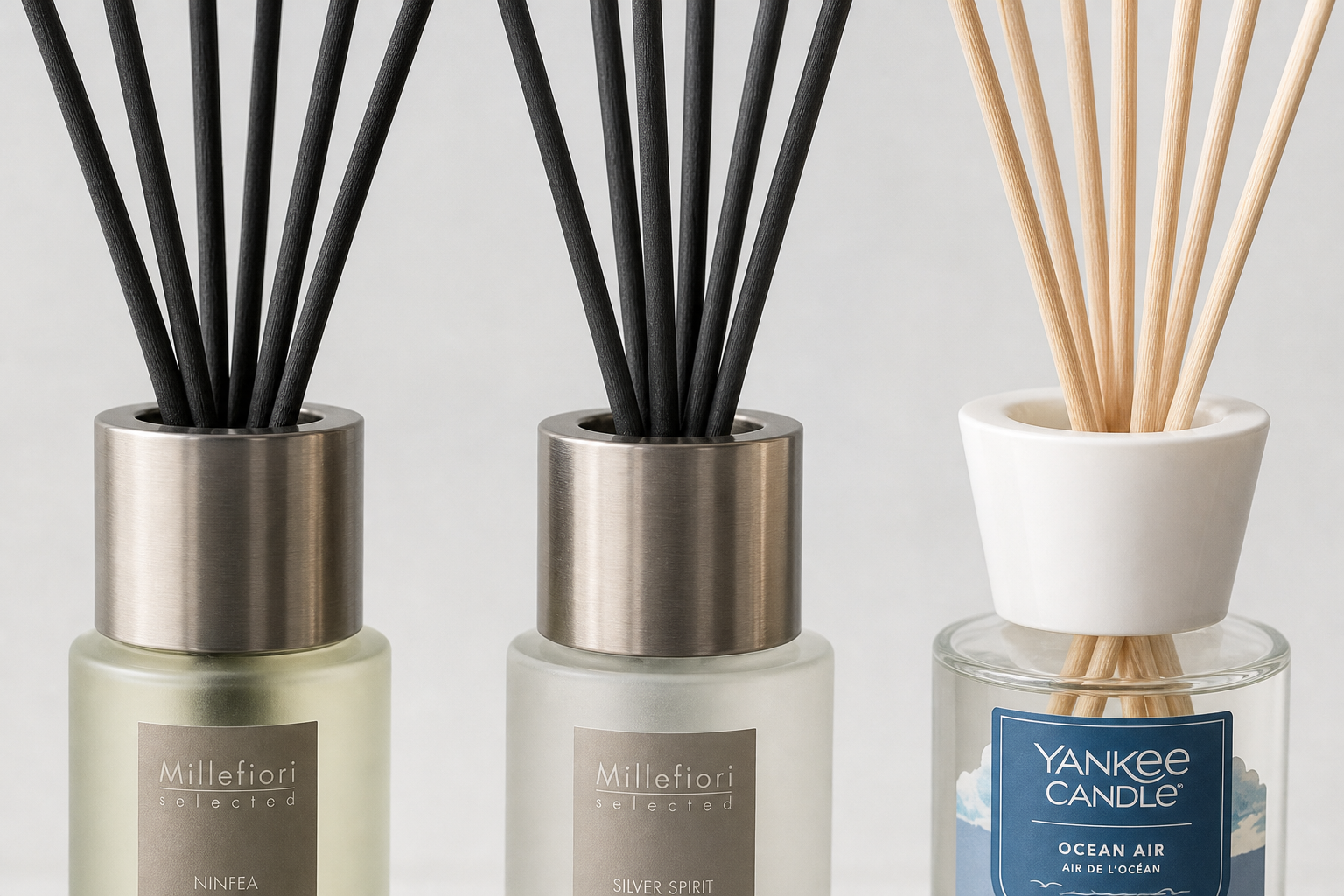
- Classic Reed (commonly referred to as rattan) has natural, relatively wide channels. It absorbs readily and is supplied with most diffusers. However, with denser plant-based refills, its pores can gradually clog and the flow slows down.
- Fibrous Synthetic Sticks are made from a bundle of artificial fibers, so they have a denser and more regular structure than a natural stem. They absorb more evenly and handle more viscous plant carriers better.
- Wooden Sticks work the slowest. Wood is denser, has lower absorbency, and releases fragrance more subtly. They are suitable for the bedroom, workspace, or anywhere you want just a gentle background scent.
If you find the fragrance weak, before reaching for another refill, try replacing the sticks with a more absorbent type. Conversely, this also applies: tame a strongly scented composition with wooden sticks or simply by removing a few.
Why and How Often to Rotate Sticks
By rotating, the soaked end of the stick comes up into contact with the air. Evaporation increases sharply, and the fragrance in the room intensifies – it's a quick way to refresh the diffuser. A reasonable rhythm is about once a week, or after airing.
Rotating every day, however, does not make sense. The refill is consumed significantly faster, the fragrance can start to feel heavy or suffocating, and in a closed room, your sense of smell adapts more quickly, so you stop noticing it even though it is intense for visitors. Moreover, with each manipulation, the greasy ends of the sticks touch the surroundings, so handle them by the dry part and place a mat or tray under the diffuser – the oil refill can leave a stain on varnished wood and stone.
The practical minimum to get by: set the basic volume of the fragrance with the number of sticks, its nature with the material, and occasionally fine-tune it by rotating. By combining all three levers, you can scent both a small hallway and a spacious living room with the same refill.
How Long Does the Refill Last and What Affects the Scent's Strength
The most common question regarding plant-based refills is simple: how long will one bottle last me? The honest answer is a bit less straightforward. A diffuser is not an appliance with a fixed output, but an open system that reacts to its surroundings. The same refill might last two months in one home and barely five weeks in another, without anything being wrong with it.
As a rough guide, for standard volumes, you can expect the following range – consider it an estimate, not a guaranteed duration:
- 100 ml – approximately six to ten weeks in a smaller room,
- 200 ml – approximately two to four months,
- 500 ml and more – several months, typically in larger or open spaces.
The range is intentionally broad. If someone promised you an exact number of days, they would be promising something that cannot be guaranteed with evaporation affected by temperature and air flow.
What Most Influences Longevity and Intensity
- Volume of the refill. The most obvious factor. However, double the volume doesn't automatically mean double the duration – a larger bottle is usually meant for a larger space where evaporation speeds up.
- Number of sticks used. The more you place in the bottle, the more intense the scent and the shorter the lifespan. It's a direct trade-off, not a free enhancement.
- Size and layout of the room. A closed room retains the scent significantly better than an open space connected to a hallway or staircase.
- Heating and temperature. Warm air significantly accelerates evaporation. A diffuser above a radiator or near a fireplace will last noticeably shorter than the same piece in a cooler bedroom.
- Draughts and ventilation. Moving air spreads the scent faster, but also carries it away. A spot between a door and a window is among the least suitable.
- Direct sunlight. Sunlight heats the bottle and can change the color of plant oils over time. A place out of direct light is gentler on the refill.
This is why the same refill behaves differently in a small bathroom compared to an open living space. In a bathroom of a few square meters, the scent stays concentrated, saturates the space quickly, and the bottle lasts longer – often, half the sticks will suffice. In a living room connected to a kitchen and hallway, the same amount of fragrance disperses into a much larger volume of air. You'll need more sticks, the lifespan shortens, and the resulting impression might be subtler than expected.
Also, keep in mind that the scent doesn't disappear overnight. It's strongest in the first weeks after filling the sticks, then the intensity gradually settles into a calmer and more stable level. Towards the end of its lifespan, the level in the bottle noticeably drops and the sticks at the top become gray and dusty. That's the moment to consider replacing it, even if there's still some left at the bottom.
And one last thing that affects longevity more than it might seem: your own sense of smell gets used to a constantly present scent. If you stop noticing the diffuser after a few weeks, it doesn't necessarily mean it has stopped working. Ask a visitor or return home after being away for a while – you'll usually notice the difference immediately.
What to Consider When Choosing a Plant-Based Refill
Whether you're purchasing a plant-based refill for the first time or just looking for a replacement for a bottle that's run out, there are usually four main factors to consider: the volume of the refill, the fragrance family, the sticks, and the character of the room where the diffuser will be placed. By considering these in order, your choice will narrow down naturally, and you won't have to rely solely on how the scent smells directly in the store.
It's worth considering these key points:
- Bottle volume. Smaller bottles are suitable for the bathroom, toilet, or hallway, areas where a subtle hint is sufficient. For the living room or an open space connected to the kitchen, opt for a larger volume – a larger surface area and longer sticks can fill more cubic meters.
- Fragrance family. Citrus and aromatic compositions feel fresh and are suitable for the kitchen or study. Woody and oriental bases are richer and work better in the bedroom or living room, especially during the cooler months. Floral compositions are a universal choice if you're unsure.
- Sticks. Check whether the refill is sold with sticks or separately. Reed sticks can get clogged over time, so it's practical to have a spare set on hand; their number is also the easiest way to adjust the intensity.
- Character of the room. Drafts, underfloor heating, a radiator under a shelf, or direct sunlight on a windowsill – all these affect how quickly the scent diminishes from the bottle. Therefore, place the diffuser in a quieter corner of the room rather than in a passageway.
Transitioning from a Classic Diffuser
If your diffuser with a mineral carrier has run out at home, there's no need to throw away the entire container. Rinse the glass bottle with warm water and a little detergent, let it dry completely, and only then pour in the new refill – remnants of the old mixture would otherwise distort the new composition. Always replace the sticks with new ones, as the soaked wood retains the original scent and mixes with the new refill.
For your first plant-based refill, it's better to choose a scent you're already familiar with from another format. If a particular scented candle worked well for you at home, look for a similar olfactory profile in the diffuser – this way, the transition won't involve two unknown variables at once. Keep in mind that the same composition in a plant-based carrier may develop slightly more subtly than in the synthetic mixture you're used to.
Fortunately, you don't have to choose blindly. In the home fragrance category on Brasty, you can calmly compare volumes, refill compositions, and individual fragrance families side by side before deciding whether you want a complete diffuser or just a standalone replacement refill for a bottle you already have at home.

Category
Recommended articles
"Give a girl the right shoes and she can conquer the world!" Marilyn Monroe