
 Riiffs Freeze in Flames: Ice and Flames Illuminate Warsaw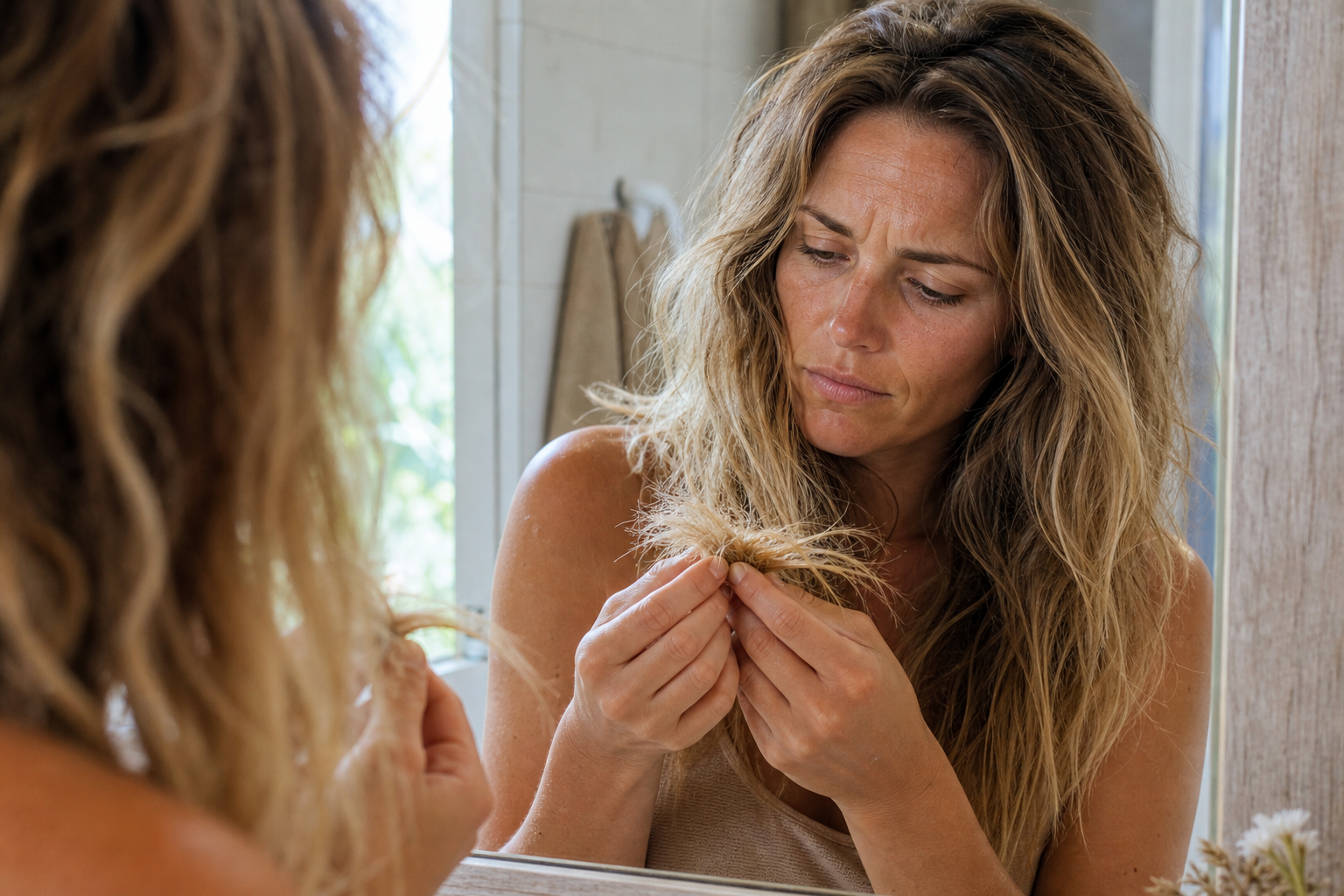
Summer takes a toll on your hair with sun, sea salt, and chlorine — we'll guide you on how to identify damage and which masks, oils, and leave-in treatments can help reverse it.
Why Hair is Harder to Comb After a Holiday
Whether you've spent the summer by the sea or most of your free days by the pool, the end of the season looks similar for your hair. It feels drier to the touch than you're used to, the comb gets stuck, and the ends split even a few centimeters above the cut line. Wet hair tangles into small loops, and after drying, instead of a smooth surface, fine flyaways appear, and the hairstyle you managed in two minutes back in June suddenly requires time and patience. Most of us interpret this as a permanent loss of hair quality. But in reality, it's something else.
Summer doesn't impact hair with one big blow but with a series of small stresses that accumulate over several weeks. Sun, saltwater, chlorinated pool water, wind, and dry air add to what hair endures from regular activities — more frequent washing after every swim, drying, combing wet hair, and for some of you, summer lightening. None of these factors alone may be significant. Together, however, they lead to the hair's surface no longer being smooth, making it harder for hair to retain moisture.
This is where the difficulty in combing comes from. Healthy hair has a gently closed structure on the surface that allows the comb to glide. When this surface becomes rough, individual hairs rub against each other, tangle, and the comb encounters resistance. Each forceful combing then deepens the stress because dry and mechanically strained hair breaks more easily than hair that is sufficiently hydrated and protected. This creates a cycle that can be broken — and it doesn't start with more vigorous combing, but with how you treat your hair after washing.
The good news is that the end of the summer season is not a point of no return. Hair damage cannot literally be "healed" — hair is a non-living structure, and what happens in its outer layer won't heal like skin. However, targeted care can do a lot: replenish moisture, smooth the surface, improve combability, and unify the appearance of the ends, making hair look better and feel more pleasant to the touch. The rest can be resolved with scissors at the hairdresser and a few weeks of a more consistent routine. Depending on how your hair looks today, you can identify what to focus on in your care:
- hair is dry along the entire length and dull regardless of styling,
- the comb or brush gets stuck mainly in the last third of the length,
- ends are lightened and appear thinner than the rest of the hair,
- colored or highlighted hair feels porous and quickly "drinks up" any care,
- blonde shades have shifted to yellow or greenish tones,
- hair is difficult to style and holds a hairstyle for a shorter time than at the beginning of summer.
The more points that apply to you, the more it makes sense to adopt a more intensive care routine for a few weeks than just shampoo and conditioner. In practice, this means a regular hair mask that works in depth and is left to act, along with oil or leave-in treatment for the ends and lengths. Each of these three things addresses a different part of the problem, so they don't exclude each other — on the contrary, they work best together.
In the following sections, we will first go through what specifically harmed your hair during the summer and why colored and bleached hair recovers differently than uncolored hair. Then we'll move on to selection: we'll recommend specific restorative masks, oils, and leave-in treatments from our hair care range, mention who they are suitable for, and finally, we'll put together a simple weekly routine for the end of the season. We'll guide you so that after reading, you can tailor your care to your hair, not buy everything.
Sun, Salt, and Chlorine: What Really Happens to Your Hair
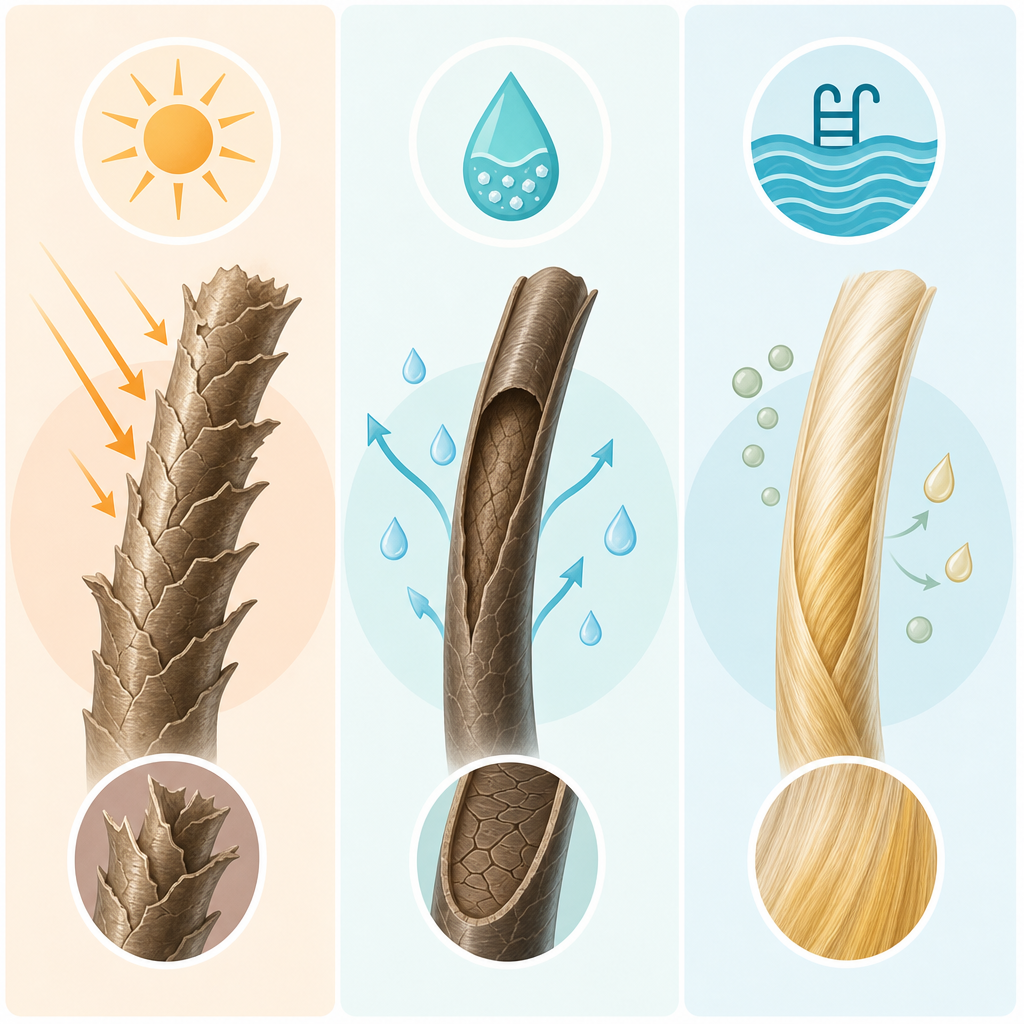
Summer hair damage is often summed up in one sentence: "the sun dried it out." However, the August condition of your hair is actually due to three distinct factors, each with a slightly different impact. By distinguishing between them, you'll better understand why what worked in May isn't enough by the end of the season.
Ultraviolet radiation affects the outer layer of the hair, known as the cuticle. This layer is made up of flat scales that, in healthy hair, lay smoothly against each other and reflect light, making the hair appear shiny and easy to comb. Long hours in direct sunlight gradually disrupt this layer: the scales lift, the hair surface becomes rough, and light scatters instead of reflecting in one direction. This results in the typically dull, "dusty" look of post-holiday hair. The rougher surface is also mechanically challenging: combs face more resistance, and split ends occur more readily. For colored hair, the sun also affects the pigment, causing the shade to appear faded and lose depth.
Sea salt works differently. Salt attracts water, and when salty water in the hair dries, tiny crystals remain, continuing to draw out moisture. Thus, hair dries out even after you leave the water, and with each subsequent dip, the effect compounds. The popular "beachy" volume is actually the flip side of this — hair clings together because it has lost its smoothness. It's worth rinsing your hair with fresh water right after swimming.
Chlorinated water in pools strips hair of its natural protective film, making the result similar to the effect of salt: hair becomes dry, rough to the touch, and harder to comb. Additionally, pools introduce a unique phenomenon not found elsewhere — for blonde, highlighted, and bleached hair, the shade can shift to yellow or greenish tones. This isn't due to the chlorine itself but to metals dissolved in the water, particularly copper, which more easily deposits in light and more porous hair.
And here's the crux of the matter: not all hair enters the summer season in the same starting position. Colored and bleached hair has already undergone a chemical process that opened the cuticle to allow color inside. They are therefore more porous, absorbing and losing water more quickly — and the same goes for pigment. Practically, this means:
- uncolored hair usually ends summer with drier lengths and split ends,
- colored hair also deals with a faded, uneven shade,
- bleached and highlighted hair is the most vulnerable and often develops unwanted yellow or green tones in the pool.
So why isn't the conditioner you've been using all year enough? Conditioner is designed for everyday use — it smooths the cuticle, eases combing, and rinses out in a minute. But post-summer, it's not just about a smooth surface: hair lacks moisture and nourishing ingredients throughout its length, which is a job for products with a thicker texture and longer application time. Hair masks, oils, and more intensive treatments are therefore more effective at the end of the season: they stay on the hair for several minutes, are more concentrated, and penetrate further than a quick rinse.
This also explains the logic of how to layer your hair care. First, it's sensible to replenish what hair lost during the season — namely moisture and nourishing ingredients within the length. Only then comes the step that seals the result on the surface and protects the hair from further mechanical and thermal stress. Reversing the order usually doesn't help — without replenishing, you're sealing an empty hair.
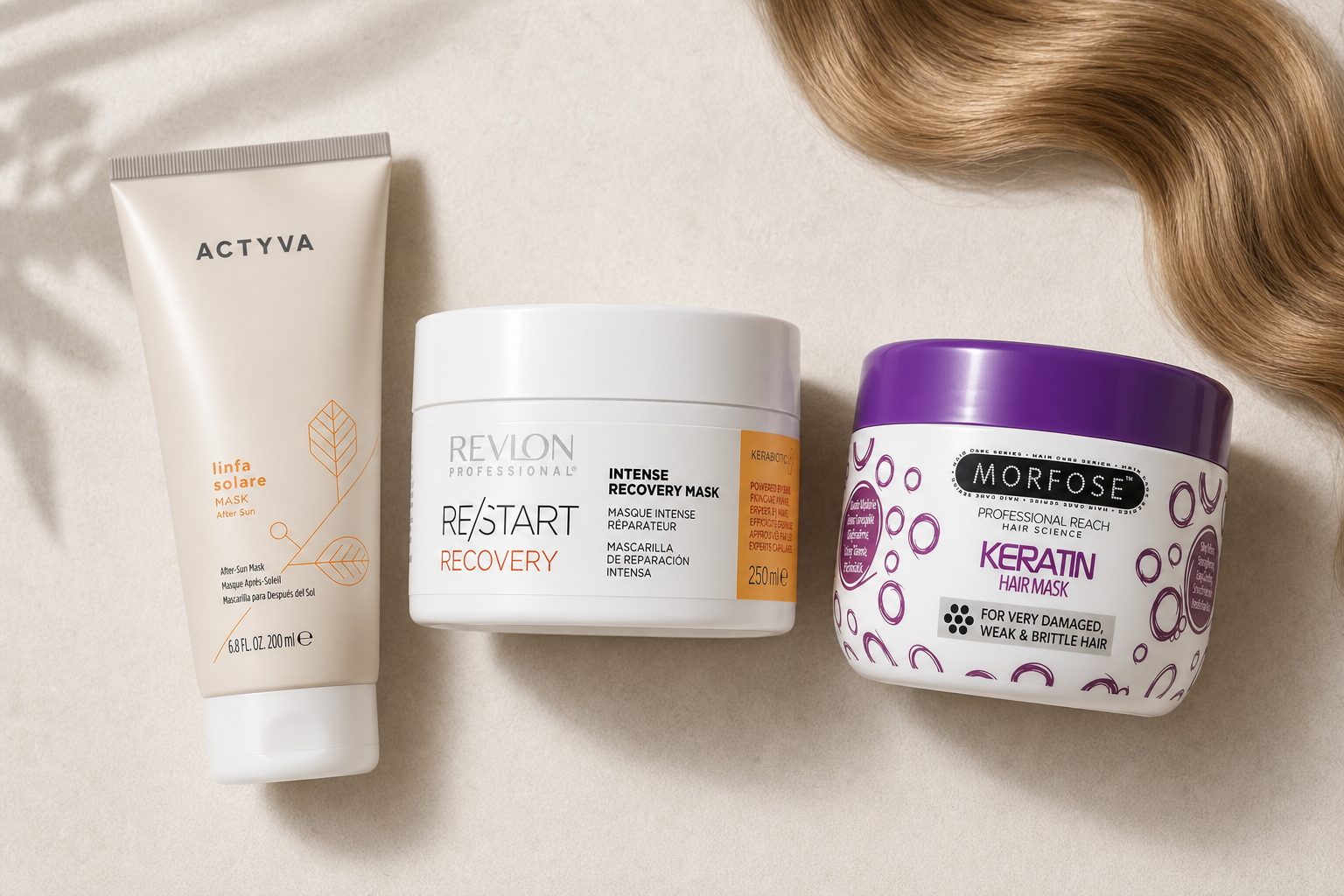
Regenerating Hair Masks: What to Choose After the Summer Season
Using a mask after the summer season is a step that can make the biggest difference to your hair. Unlike conditioner, it stays in the hair for several minutes and has a more concentrated texture, allowing it to penetrate deeper into the hair fiber. However, it's important to choose based on what your hair lacks — different masks are suitable for hair that has been mechanically stressed after a month by the water, and others for colored lengths that the sun has lightened and weakened.
Whether your hair needs nourishment or strengthening of its damaged structure, our hair care range offers professional solutions for both situations. We've selected six masks and for each, we explain who it is suitable for and how often to include it in your care routine.
Intensive Regeneration for Mechanically Stressed Hair
- Wella Professionals Fusion Intense Repair Mask (500 ml) — choose this if your hair is brittle and sensitive to detangling after summer. From our selection, this is the strongest option for hair that has suffered from the combination of salty water, drying, and styling. Use it once a week, and after the worst condition subsides, switch to every ten to fourteen days.
- Wella Professionals SP Luxe Oil Keratin Restore Mask (400 ml) — another way to strengthen the structure, with keratin care and an oil component from the Luxe Oil range. The texture is lighter, making it more pleasant for hair that easily becomes weighed down, and it restores softness and shine to the lengths. It works well as a regular weekly mask.
For Significantly Weakened and Colored Lengths
- L'Oréal Professionnel Série Expert Absolut Repair Gold Quinoa + Protein Masque (500 ml) — a protein mask for lengths that are noticeably weakened after summer and prone to breakage in colored hair. Let it work for the entire recommended time, not just a minute in a rush. For very damaged hair, start twice a week and after three to four weeks, switch to one application.
- L'Oréal Professionnel Série Expert Pro Longer Lengths Renewing Mask (500 ml) — the choice for those of you who want to let your lengths grow after a summer trim. It focuses on the ends, which tend to be drier than the hair at the scalp, and helps keep lengths in good condition. Once a week, with emphasis on the lower half of the hair.
Nourishment for Dry Hair and More Accessible Salon Care
- Kemon Actyva Nutrizione Rich Mask (200 ml) — if your hair is primarily dry, not mechanically split, start here. A rich nourishing mask in a smaller package, making it suitable as a first trial. Once or twice a week, depending on how dry the lengths are.
- Londa Professional Visible Repair In-Salon Treatment (750 ml) — salon treatment in the largest package from our selection and at the same time a more accessible option for intensive regeneration. Suitable when you're addressing care for the whole household or when hair needs a longer-term treatment. Once a week after washing your hair.
Practical application note: apply the mask to towel-dried hair, not hair dripping with water — excess water will dilute it and cause it to slide off the surface. Avoid the scalp and roots, and focus on the mid-lengths and ends, where the hair is oldest. Keep in mind that one application won't change the condition of your hair — post-summer regeneration results are noticeable after three to four weeks of regular care.
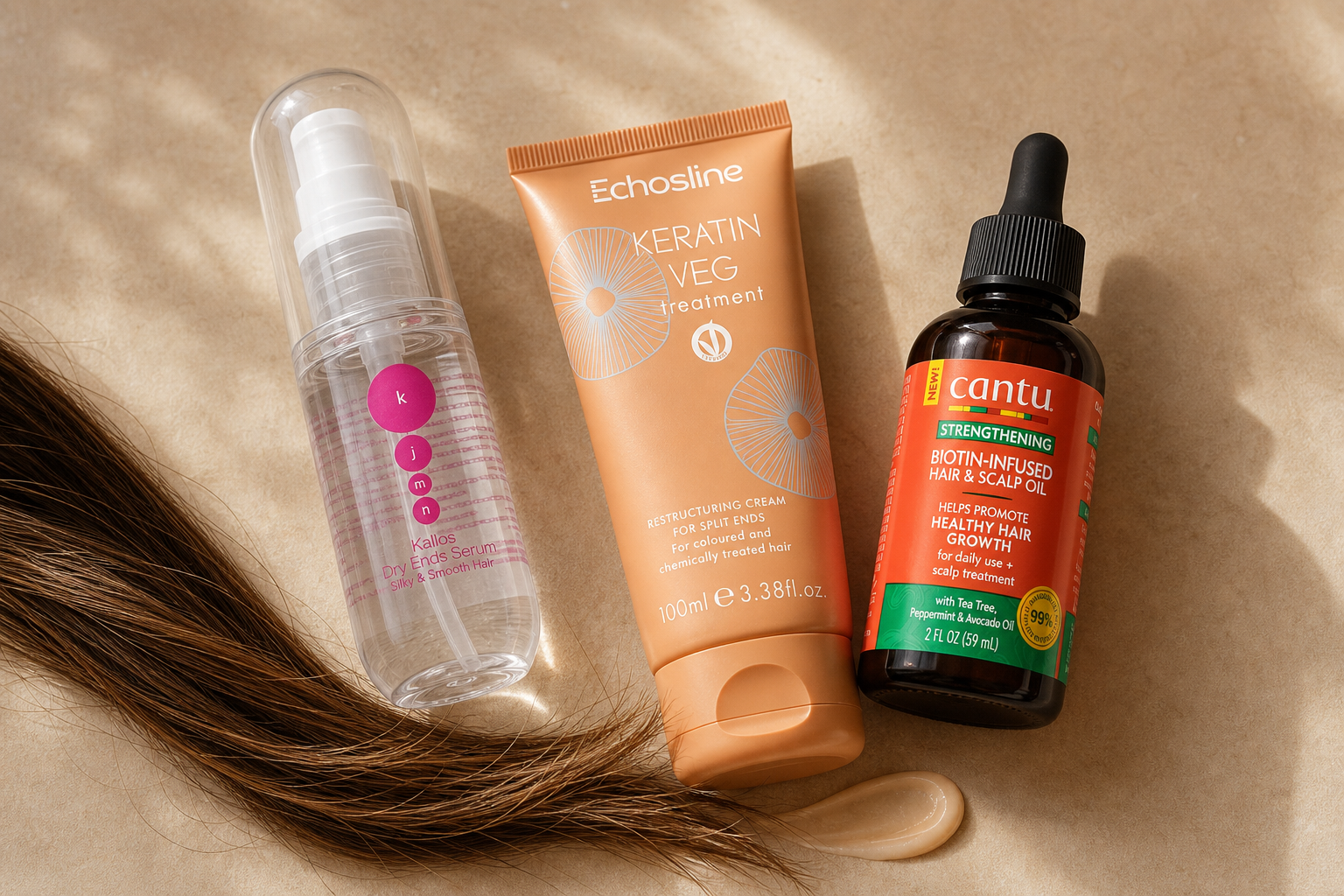
Hair Oils and Leave-In Treatments for Split Ends
A mask does a lot of work in the shower, but the fate of your ends is decided afterwards — when you take your hair out of the towel and pick up the brush. Wet hair is more vulnerable because the swollen hair cuticle is more easily abraded and, after the summer season, it doesn't have the strength to resist pulling. Oil and leave-in treatments are therefore two steps that complement and seal the mask, not replace it: the mask works within the structure, while these products work on the surface and during detangling.
Let's start with a factual note. A split end won't fuse back together — the only definitive solution is trimming. However, what oil and leave-in treatments can do is soften the ends, visually smooth them, and slow further splitting by reducing mechanical stress. This is a realistic goal after a holiday.
Hair Oils: The Difference Between Damp Lengths and Dry Ends
Hair oil has two completely different uses, and most disappointments come from confusing them. On damp lengths, oil is applied as a preparation before blow-drying — it spreads over the entire surface, eases detangling, and partially dampens heat. On dry ends, it is applied at the very end, in a really small amount, as a final touch for shine and to smooth frayed ends. If you apply oil to dry hair in the same amount as to damp hair, the result will be heavy and greasy.
- Wella Professionals SP Luxe Oil Reconstructive Elixir — a light elixir suitable for both uses. On damp lengths, it acts as a pre-blow-dry preparation, and on dry ends, just a drop is enough. Ideal if you're not used to oils and don't want to risk weighing your hair down.
- Orofluido Elixir — a more nourishing and pronounced choice with a denser film. It works well on coarser, thicker, or severely dried hair that absorbs light oil without effect.
When it comes to dosage, the rule is without exception: less is more. Start with one to two drops in your palm, spread between your fingers, and apply from the bottom third of the lengths down — never to the roots. For thin and fine hair, half a drop is often enough, and it's better to add more after drying than to over-oil and have to wash your hair again.
Leave-In Treatments: The Step That Saves Detangling
Leave-in treatments are applied to towel-dried hair, and their role is simple — to separate the hair so the brush glides through without pulling. Unlike oil, they have a lighter, more watery or milky texture and are suitable even where oil would be too much.
- Milk_Shake Incredible Milk — a multifunctional spray milk that addresses detangling and heat protection in one step. A practical choice if you don't want to build a multi-step routine.
- Milk_Shake Leave In Conditioner — focused directly on detangling. Opt for this when the main issue is tangled structure and hair snags with the first brush stroke after a holiday.
- Davines OI All In One Milk — an easy everyday option for those who want a light result without residue on the hair.
- K18 Professional Molecular Repair Hair Mist — the highest price range in this group. It's worth considering for a combination of colored or bleached hair further stressed by sun and chlorine when simpler leave-in treatments visibly fall short.
Whether you choose oil, milk, or both, follow one rule: apply leave-in treatment to damp hair first, then blow-dry, and use oil as the final touch on dry ends. In this order, the products don't overpower each other, and your hair remains light even after several days.
End-of-Season Routine Step by Step and Our Recommendations
Whether you're coming back from vacation with dry hair lengths or blonde hair that has lost its cool tone due to chlorinated water, the result depends on your routine—not the number of products in your bathroom. Post-summer regeneration is more about a few weeks of consistency than one intensive treatment, and we've put together the following routine so you don't have to change your regular washing schedule.
Weekly Routine
- Gentle shampoo with every wash. Wash your hair as often as needed, but choose a shampoo that doesn't strip the remaining lipids from your lengths. Focus the lather mainly on the scalp, the ends will rinse themselves.
- Mask once or twice a week. Replace your conditioner with a mask during one wash a week, or two if your hair is significantly damaged or colored. Apply it from mid-lengths down and leave it on as directed—longer time won't double the effect.
- Conditioner on the remaining days. The mask doesn't replace it. Conditioner seals the hair cuticle after every wash and is the one that helps most with detangling.
- Oil or leave-in treatment after every wash. Rub a small amount into damp hair, again just into the lengths and ends. This step makes the biggest difference in how your hair looks and behaves when detangling.
- Evaluation after three to four weeks. Only after a month does it make sense to assess whether your hair needs more nourishment or, conversely, lighter care.
Shampoo Base: Three Variants According to Hair Type
Shampoo is the only step you repeat with every wash, so it's worth starting there. Depending on what your hair needs most after summer, we recommend three different bases:
- Wella Professionals SP Luxe Oil Keratin Protect Shampoo — the choice for stressed hair that is dry along the entire length after the season. Suitable if you already use a mask or elixir from the same line and want to harmonize your care into one whole.
- Milk_Shake Moisture & More Shampoo — for dry lengths that are difficult to detangle after washing and lack moisture rather than strength. Also suitable for longer hair where the difference between roots and ends is significant.
- Fanola No Yellow Shampoo — for blonde and highlighted hair that has turned warm, yellowish after sun and chlorine exposure. Purple pigments help return the shade to a cooler tone. Use it once, at most twice a week, and on other days return to your regular shampoo—otherwise, the hair may turn purple.
Practical Tips for the End of the Season
- Get your ends trimmed. Split ends can't be repaired by any treatment. A centimeter or two at the hairdresser will do more for the appearance of your lengths than a month of masks, and the rest of the care won't be wasted on a part of the hair that's destined to be cut off.
- Wash with lukewarm water. Hot water opens the cuticle, and dry hair tends to become even more frizzy after it. Finish the last rinse with cold water if you can.
- Limit heat styling for a few weeks. Use a hairdryer on a lower temperature, and give your straightener and curling iron a break. If you can't avoid them, apply heat protection first.
- Handle your hair gently. Detangle from the ends upwards and don't drag a brush through wet hair knots. Replace a towel turban with gentle squeezing into a cotton cloth.
And lastly, perhaps the most important recommendation: don't start with the entire range at once. Choose one mask from the hair mask category and one oil or leave-in treatment from the hair oil category, add a shampoo that matches your hair type, and give it a month. You'll see how your hair reacts, and you'll choose additional products with much better insight—instead of a bathroom full of half-used bottles.
Category
Recommended articles
Riiffs Freeze in Flames: Ice and Flames Illuminate Warsaw "Give a girl the right shoes and she can conquer the world!" Marilyn Monroe