

We'll show you where the pulse points are on your body and how to properly apply perfume to make the scent last as long as possible. We'll also discuss the most common myths about perfume application and reveal which ones are actually true.
Why the Same Perfume Lasts Differently on Everyone
You know the scenario. Your colleague applies perfume in the morning, and by the afternoon, there's still a delicate trace lingering. You reach for the same bottle, spritz it on before leaving home – and by lunchtime, you feel like the scent has vanished. It's not a faulty batch or a composition that "doesn't work." The same perfume behaves differently on each person's skin, and a significant part of the difference is something you have full control over: where and how you apply it.
Perfume isn't a separate layer that just sits on the skin. It gradually evaporates and mixes with what your skin offers – its temperature, level of hydration, and amount of natural oils. Dry skin holds fragrance notes less effectively because there's nothing for them to cling to. Well-hydrated and slightly oilier skin, on the other hand, retains them longer. That's why the same eau de parfum can feel fresh and light on one person, while on another, it might seem notably richer.
Several factors influence the outcome, which have nothing to do with the bottle itself:
- Temperature and Season – in the heat, the scent develops faster and dissipates just as quickly, while in the cold, it unfolds more slowly.
- Condition of the Skin – hydration, natural oils, and whether you've recently shaved or scrubbed the area with a towel.
- Clothing and Movement – fabrics capture the scent differently than skin, and when walking, the fragrance spreads more noticeably than when sitting.
- Your Own Sense of Smell – after a while, you get used to your perfume and stop noticing it, even though others can still smell it. This acclimatization is called olfactory adaptation and is behind most complaints that "the scent disappeared."
- Amount and Place of Application – one spray in the middle of the forearm and two on strategically chosen spots can yield completely different results.
The last point is the one you can most easily address. You can't change your skin type or the weather, but the application technique is purely a matter of habit – and habits can be adjusted in a single morning. Most people apply perfume the same way for years because that's how they learned, not because they've verified it truly works for them.
In the following sections, we'll explore where on the body perfume has the most favorable conditions and why, how to handle the spray to distribute the scent evenly, and what to do with areas that are better avoided. We'll also go through tips passed down among customers for years – from rubbing wrists to storing the bottle in the bathroom – and discuss which hold up and which might harm your perfume. Consider the following pages a practical guide, not a lecture on perfumery. Most of the tips you can try out tomorrow morning, even before you leave the house.
What Are Pulse Points and Why Do Scents Come Alive on Them
The term pulse point sounds technical, but it actually refers to a simple anatomical fact. These are areas where blood vessels run close to the skin's surface—places where you can easily feel your own pulse. The blood flowing through these vessels carries heat from the deeper layers of the body, making the skin in these areas slightly warmer than areas where there is more tissue between the vessels and the surface. The difference isn't dramatic and is usually imperceptible to the touch. However, it's enough for perfume.
Heat is the main driver of evaporation. A perfume composition doesn't release from the skin all at once, but gradually, depending on how volatile the individual ingredients are. A warmer base speeds up and smooths out this process, allowing the scent to fully open up rather than remain flat and monotonous.
- Top notes are noticeable immediately after application. They are often based on citrus, fresh accords, or aromatic herbs. Their molecules are light and dissipate on warm skin within a few minutes.
- Middle notes, also known as the heart of the fragrance, emerge after about half an hour. They carry the main character of the composition—most commonly floral, spicy, or fruity motifs—and last for several hours.
- Base notes or the base form the trail you leave at the end of the day. Vanilla, amber, musk, patchouli, or sandalwood evaporate the slowest, and therefore last the longest on the skin.
Warm skin also affects how far the scent is perceived. Warm air above the pulse point rises, carrying perfume molecules with it, so the scent doesn't just linger on the skin but spreads into the immediate surroundings. Movement also plays a role—with every hand gesture or turn of the head, the fragrance is stirred again. This is why perfume applied to a pulse point seems more vibrant than the same perfume on a cool, still area.
However, pulse points have a downside that's less often discussed. The higher temperature not only initiates evaporation but also accelerates it. Perfume applied to a warm area is detected sooner and more intensely, but it also gets used up faster. A pulse point alone doesn't guarantee longevity—it depends on a combination of location, fragrance concentration, and skin condition.
The type of skin also matters. Fragrance molecules need a certain layer of oil and moisture on the skin's surface to cling to. Dry skin doesn't provide this base sufficiently, so the perfume evaporates faster and the scent trail is weaker. Well-hydrated skin, on the other hand, acts as a natural carrier—molecules stay on it longer, and the development of individual notes is smoother. If perfumes generally disappear on you sooner than expected, try applying them to skin treated with an unscented body lotion or cream. Applying shortly after a shower, when the skin is still supple and warm, also helps.
Consider pulse points as a starting point, not a guarantee. They provide the warmth a scent needs to develop and help it reach the surroundings. However, how long it ultimately lasts on you also depends on how you prepare your skin and the composition you offer it.
Pulse Point Map: Where to Actually Apply Perfume
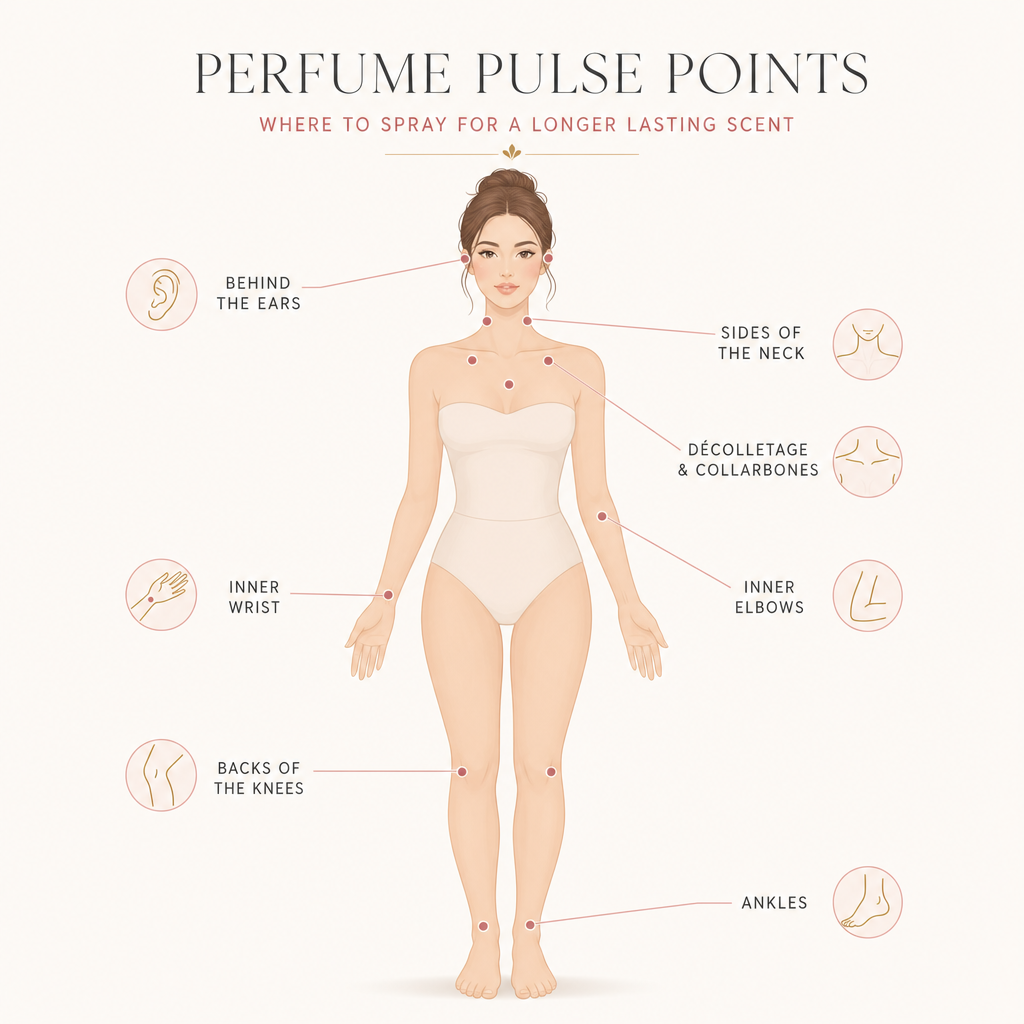
Once you understand why fragrances develop more readily on warmer areas, the final step is knowing exactly where to aim the spray. The body has more pulse points than commonly mentioned, and each interacts with the fragrance slightly differently. Let's go through them from top to bottom.
The logic is simple. Points on the upper half of the body carry the scent closer to the face, making it noticeable to those who are really close. Lower body points take advantage of warm air rising: the fragrance releases gradually with movement, creating a softer, yet continuous trail.
- Inner Wrists – an easily accessible spot. The skin here is thin, arteries are close to the surface, and the composition develops quickly. Plus, you naturally gesture with your wrists while talking, spreading the scent around. A good choice if you want to smell the perfume yourself throughout the day.
- Sides of the Neck – where the carotid artery pulses, keeping the scent close to the face. It's a more intimate position: primarily noticeable to people you greet or sit next to.
- Behind the Ears – a small area with a surprisingly noticeable effect. The fragrance stays discreet here and doesn't overpower the surroundings. A small amount, one short spray from a distance, is more than enough.
- Décolletage and Collarbone – a warm, well-circulated area from which the scent rises and creates a seamless trail around you. In cooler months, clothing partially protects it, slowing evaporation.
- Elbow Creases – often overlooked, yet very practical. The skin bends with each arm movement, releasing the scent in doses. Suitable for summer tops or sleeveless dresses.
- Backs of the Knees – another warm spot, making sense mainly when wearing skirts, dresses, or shorts. The trail rises gradually from here and remains subtle.
- Ankles – the lowest point on the map, more of a complement to one of the upper points. You might not notice the perfume from here yourself, but those around you will as you walk.
How many sprays are just right? For a regular day, two to three on the upper half of the body usually suffice – for instance, one wrist and one side of the neck. If you want a more pronounced trail for the evening, add a point lower on the body rather than another spray on the same spot. Hold the spray about 15 to 20 centimeters from the skin. From a shorter distance, a concentrated wet spot forms, causing the top notes to evaporate unevenly, while from a greater distance, most of the perfume disperses into the air and misses the target. The ideal is a fine mist, not droplets.
Timing also plays a role. Perfume adheres best to clean skin shortly after a shower, when the skin is still warm and carries only residual moisture.
Not every spot is suitable for perfume. Avoid skin irritated after shaving or epilation – the alcohol in perfume stings freshly shaved skin unpleasantly and can unnecessarily prolong irritation. The same caution applies to sunburned or abraded areas and around the eyes. In direct summer sunlight, perfume on exposed skin is more prone to irritation, so for all-day outdoor activities, it makes sense to choose points covered by clothing, like elbow creases under a sleeve.
Consider this map as a suggestion, not a mandatory list. Try out two or three combinations gradually and notice how long the scent lasts and how strongly those around you perceive it – this will help you identify which points suit your skin best.
Perfume Application Myths: Rubbing Wrists and Spraying Hair
There are surprisingly many tips about applying perfume that have been passed down from generation to generation without being properly verified. Some have a rational basis, while others actually shorten the fragrance's longevity. Let's go through the most common ones one by one and see which hold up and which are better left behind.
Rubbing your wrists together helps the fragrance develop. This movement is almost ingrained in everyone, yet it doesn't help the composition at all. Rubbing creates heat and mechanical friction, which disrupts the delicate layer of perfume on the skin – the top notes, which are the most volatile, evaporate faster than they naturally should. As a result, the fragrance skips part of its development and moves to the heart of the composition sooner. Just spray the perfume and let it dry naturally. If you need to reduce the amount, gently press your wrists together without moving, or simply skip the second spray.
Perfume in hair ensures the scent lasts all day. Hair does indeed hold scent for a long time because its molecules cling to the surface. The problem is what carries the perfume: alcohol dries out hair strands, and you'll notice it quickly on colored or naturally dry hair. Therefore, we don't recommend direct spraying into hair as a daily routine. There are several gentler ways:
- spray perfume on a brush, let it air for a few seconds, and comb through your hair,
- apply the scent to a scarf or ribbon you wear in your hair,
- spray perfume on the inside of a collar or scarf, from where it will release similarly to hair,
- opt for a hair mist, a product specifically designed for hair that contains significantly less alcohol.
Spraying perfume into the air and walking through the mist distributes the scent evenly over the body. It looks elegant, but from a practical standpoint, it's mainly wasteful. Most droplets end up on the floor and in the surrounding air, with only a fraction reaching the skin – and even then, in a very thin layer that evaporates quickly. If you prefer a subtle trail, it makes more sense to apply a smaller amount directly to one or two targeted spots than to disperse a whole cloud in the room.
Perfume belongs on clothing just as much as on skin. Textiles do hold scent longer than skin, that's true. However, they lack contact with your body heat, so the composition doesn't develop as the perfumer intended – it remains flatter and more static. Another issue is stains: oils and dyes can leave marks on silk, satin, or light cotton, even after washing. If you want to have the scent on your clothes, spray from a greater distance, on the reverse side, and preferably on more durable materials.
Perfume belongs in the bathroom where it's always at hand. The bathroom is actually one of the least suitable places for perfume in the home. Fluctuating temperature and humidity during showers accelerate chemical changes in the composition, and the fragrance can lose its freshness while the liquid's color changes over time. Direct sunlight on the windowsill is just as harmful. Therefore, store the bottle in a cool, dark place, ideally in its original box, in a closed cabinet, or in a drawer. Always tighten the cap – unnecessary evaporation is a subtle way to lose perfume.
The common denominator of all these myths is the attempt to force the fragrance to do something. Perfume only needs two things: clean, hydrated skin and the peace to develop on its own. When you eliminate rubbing, clouds in the air, and a bottle on the window, you usually notice the difference sooner than with any additional trick.
How to Choose a Perfume That Lasts Longer
The application technique can do a lot, but part of the longevity is decided when choosing the bottle itself. Two things are crucial: the concentration of the fragrance component and the ingredients on which the composition is built. If you pay attention to both, you'll save yourself the disappointment of a perfume that smells great for the first twenty minutes and then practically disappears.
Concentration: Eau de Toilette, Eau de Parfum, and Perfume
The label on the bottle is not just a marketing embellishment, but an indication of the proportion of fragrance component in the alcohol base. The higher the proportion, the slower the composition evaporates, and the longer it usually leaves a trail.
- Eau de Cologne – the lowest proportion of fragrance component among the four types mentioned. It's light and fresh, suitable for refreshing after a shower or on a hot day, but expect to reapply it during the day.
- Eau de Toilette – the most common variant and a good compromise between price and longevity. Many people spritz it once for a day at the office, and it's usually just right for the evening.
- Eau de Parfum – a higher concentration, which is found in most new releases today. It usually lasts for a regular workday without needing a top-up.
- Perfume – the highest concentration of fragrance component. It's denser, stays closer to the skin, and you need significantly less, so a smaller bottle might not be a disadvantage.
The differences mentioned are to be taken as a guideline, not as a guaranteed number of hours. The same label can behave differently for two different perfumes depending on the specific formula and the skin it's applied to.
Ingredients Matter as Much as Percentages
The second factor is the structure of the composition. Top notes are the most volatile and leave first – typically bergamot, grapefruit, mandarin, and other citrus fruits that give the perfume its fresh first impression. After them comes the heart, and finally, the base notes, which stay on the skin the longest.
If you're looking for a perfume with a long-lasting trail, focus on the base. Compositions built on heavier ingredients usually last longer:
- vanilla and tonka bean – a sweeter, gourmand direction, prominent especially in cooler months,
- amber and musk – warm, soft notes that keep the scent close to the body and extend its fading,
- patchouli – an earthy ingredient that adds depth and drive to the composition,
- woody base, such as sandalwood, cedar, or vetiver – a dry and elegant finish that is easy to wear year-round.
This doesn't mean you should avoid citrus and floral perfumes. Just expect a shorter trail and possibly opt for a variant where the fresh start is based on a woody or musky base – a combination that is found in many summer novelties today.
Where to Start in the Offer
Orientation is made easier by categorization: categories For Women, For Men, and Unisex. Unisex perfumes are particularly worth noting if you're drawn to oriental or woody directions – that's where you'll find the most compositions with a strong base today.
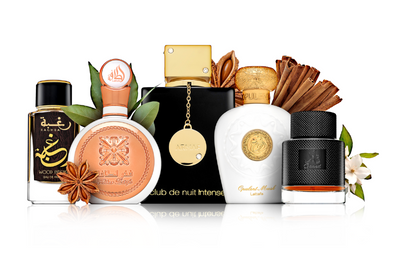
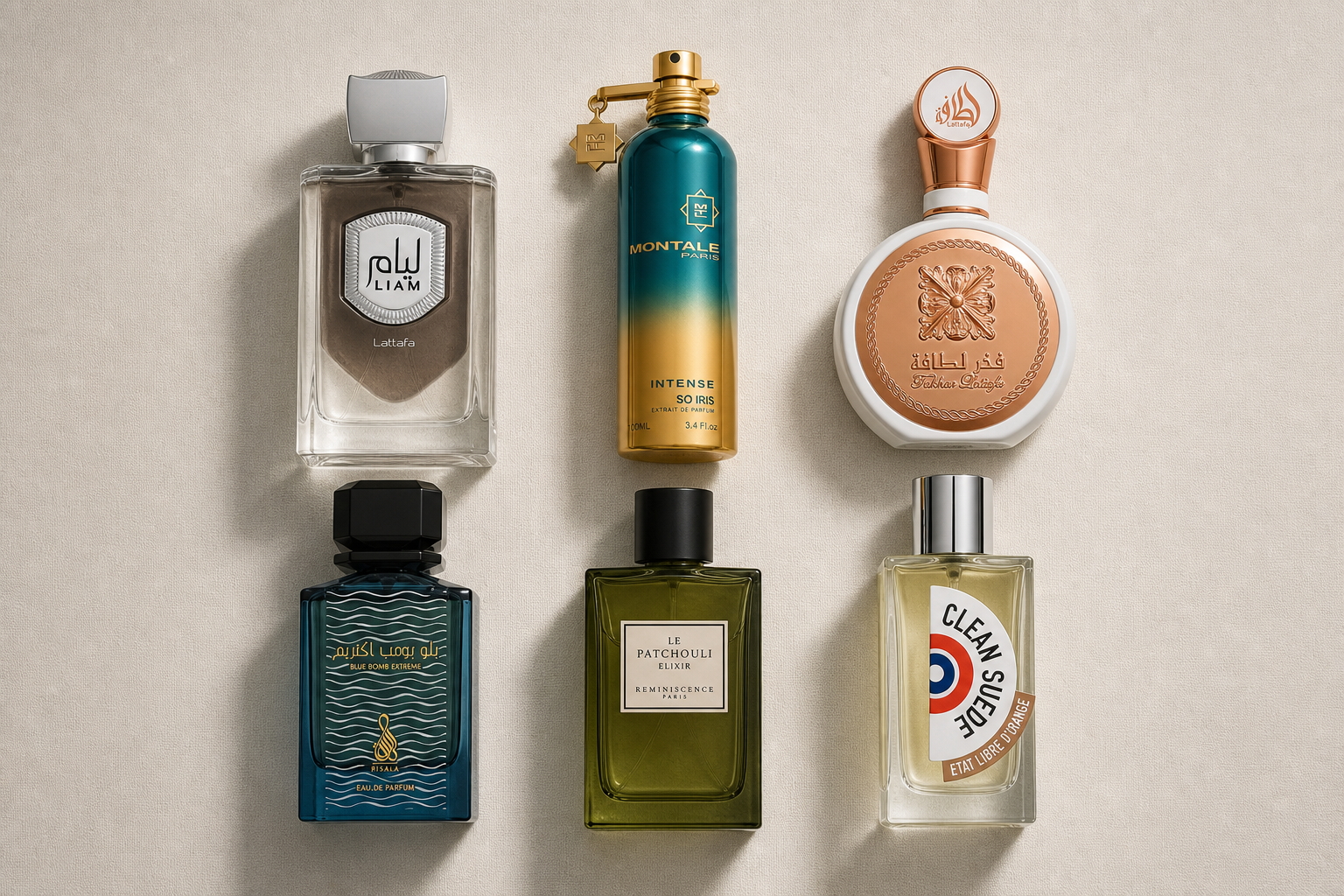
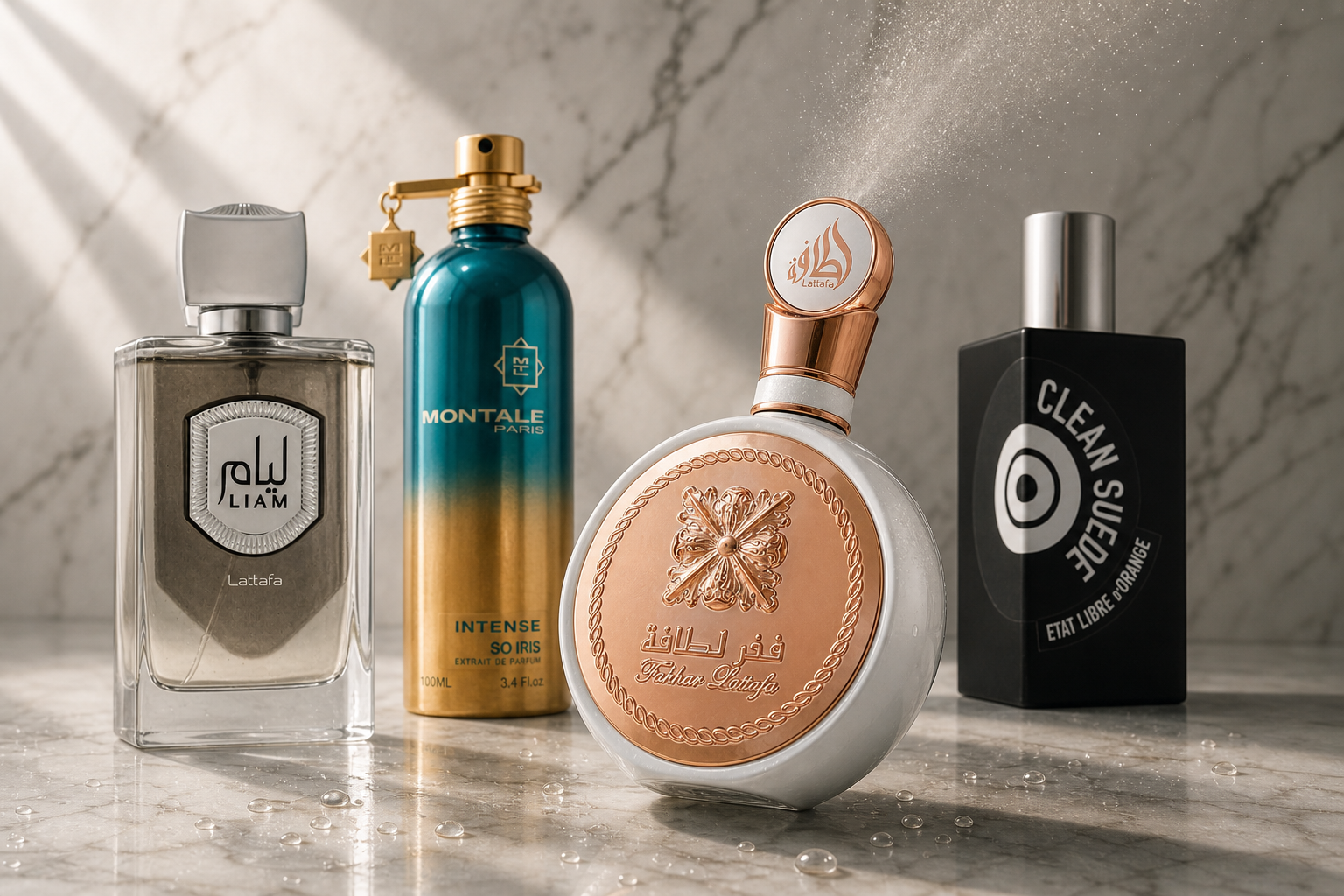
Among the available brands, Lattafa focuses on heavier, long-lasting compositions, offering oriental and gourmand scents at a friendly price. If you want to go higher, Montale works with intense woody and fruity compositions in a unisex spirit. And for a more demanding selection, there's standalone niche perfumery, where you'll encounter smaller series and less common ingredients.
One last piece of advice: your skin always has the final say. Before deciding, try the perfume directly on your wrist and give it at least half an hour to develop. A paper test strip will reveal the composition, but not how long the scent will last on you.

Category
Recommended articles

"Give a girl the right shoes and she can conquer the world!" Marilyn Monroe