
Why Blonde Hair Turns Yellow and How Purple Shampoo Can Help
Whether you sport subtle highlights, soft balayage transitions, or cool platinum blonde, the situation is often the same: a few weeks after leaving the hairdresser, the cool shade starts to fade. The ends shift to a warmer tone, a yellowish hue appears around the face, and more noticeably bleached hair may develop brassy to coppery reflections. The hair isn't damaged, and the color hasn't washed out – it's simply showing the effects of the bleaching process.
When lightening hair, its natural pigment is removed. However, this doesn't happen evenly: the cool tones disappear first, while the warm yellow and orange undertones, which are common in Central European hair, are the most resistant. The hairdresser covers these with a toning shade, but this toning layer is inherently temporary. Once it washes out, the warm undertone of bleached keratin remains – and it naturally doesn't just vanish.
What Speeds Up the Process
The speed at which the yellow tint returns isn't the same for everyone. Several factors you encounter daily play a role:
- Water – Hard water with higher mineral and iron content settles in lightened hair, giving it a grayish or rusty tone. Chlorinated pool water has a similar effect.
- Sun – Ultraviolet radiation breaks down residual pigment and the toning component. After summer, blonde hair is often significantly warmer than in spring.
- Heat from Styling – Straighteners, curling irons, and hot blow dryers accelerate oxidation and open the hair cuticle, causing the color to fade faster.
- Hair Porosity – Bleached hair is more porous, so it holds pigment less effectively. The more times it has been lightened, the shorter the toning lasts.
- Inappropriate Care – Harsh cleansing bases and some styling products with warm pigments can shift the shade to yellow faster than expected.
Where Purple Shampoo Comes In
Purple shampoo is a regular cleansing product with added purple toning pigment. During washing, it adheres to the hair surface and visually neutralizes yellow tones, as purple is opposite yellow on the color wheel. The result isn't a new color but a return to the cooler impression you had after leaving the salon. The effect is temporary and gradually fades with subsequent washes, so the shampoo is used regularly – not as a one-time fix.
For you, this means one main thing: purple shampoo is one of the simplest ways to maintain your shade at home between salon visits. It won't replace professional toning or fix a botched lightening job, but it can significantly extend the time your blonde looks as it should. It achieves this within regular washing, without mixing or measuring.
In the Shampoos category at Brasty, you'll find toning options across virtually all price levels – from affordable volumes for frequent washing to premium salon lines that combine pigment with moisturizing and regenerative care. The differences between them aren't just in price: they vary in pigment intensity, how they dry the hair, and for which light base they are suitable.
In this comparison, we'll focus on five brands most commonly sold in toning hair cosmetics: Fanola and Schwarzkopf Professional as representatives of the affordable and mid-range, and Wella Professionals, Milk_Shake, and L'Oréal Professionnel from the premium segment. For each, we'll discuss who it's suitable for, how intensely it tones, and what to expect with regular use.
How Purple Pigment Works and How to Choose the Right Shampoo
The principle behind purple shampoos can be imagined as a color wheel. Colors opposite each other on the wheel neutralize each other — and purple is directly opposite yellow. When you apply a cleansing product with purple pigment to your hair, the pigment temporarily binds to the hair's surface and visually tones down unwanted yellow hues. The hair isn't dyed in the true sense; its toning is adjusted, and after a few washes without the pigment, the shade returns to its original state. That's why purple shampoo is called a toning shampoo and is used repeatedly, not just once.
The same logic applies to blue pigment, just positioned differently on the color wheel. Orange is opposite blue, so blue toning shampoos work on brassy and orange tones, which appear more in darker blond hair, highlighted brown hair, or lengths that haven't reached a light phase during bleaching. If you see a warm coppery tint in your hair rather than a light yellow, purple pigment might not be enough, and the blue variant will work better. For very light blond hair, it's the opposite: the blue pigment can be unnecessarily strong and may leave a cool gray cast.
Three Criteria for Comparing Shampoos
To make the comparison in the following parts of the article clear, we evaluate each product based on three consistent criteria:
- Intensity of the pigment. Determines how strongly the shampoo tones. Strongly pigmented formulas can handle significantly yellowed bleached hair but require careful dosing. Gentler variants are suitable for ongoing maintenance of a cool shade, focusing more on maintaining the result rather than correcting it.
- Duration of application. The range is usually from one to about ten minutes. Shorter durations are more convenient for daily routines, while longer exposure provides a more noticeable tone shift — and also more room for error if you leave the shampoo on longer than recommended by the manufacturer.
- Gentleness to dry and bleached lengths. Bleached hair has a disrupted cuticle and retains moisture poorly, so the formula's composition is crucial. Check if it contains moisturizing or protein components and how aggressive the cleansing base is.
Packaging Volume and Usage Frequency Determine the Price
The price on the label doesn't tell you much by itself. Purple shampoos are typically sold in sizes ranging from around 300 ml to liter-sized professional variants, which are significantly more economical per milliliter — they make sense if you use the shampoo regularly or share it at home. The second variable is frequency. Toning shampoo is usually used once or twice a week, so even smaller bottles last for months. Calculate the cost per use rather than the price per bottle.
Where Each Product Fits Price-Wise
In hair cosmetics on Brasty, prices fall into four distinct bands, and we use the same division in the following comparison:
- Affordable class — roughly up to 160 CZK. Straightforward formulas focusing on the toning effect, without extensive care components.
- Mid-range class — approximately 160 to 220 CZK. Professional salon lines in smaller packages, usually with a more balanced cleansing base.
- Premium class — roughly 220 to 500 CZK. This is where most demand lies; formulas combine pigment with hydration and complement a comprehensive care line.
- Luxury class — over 500 CZK. Mostly liter-sized salon packages or lines with sophisticated compositions and distinctive fragrances.
With this map, you can easily categorize specific brands. Choose based on the tone you actually see in your hair and how often you're willing to use the shampoo, not just based on the pigment's strength.
Affordable and Mid-Range: Fanola and Schwarzkopf Professional
Whether you're trying a purple shampoo for the first time or looking for a replacement for your almost empty bottle, it makes sense to start at a price point where you can afford to experiment. The difference compared to premium lines is often more about the ease of use and how the shampoo fits into a broader care system, rather than the pigment's actual effect. The following two brands have long been among the most sought-after in the Shampoo category.
Fanola: Intense Pigment at a Reasonable Price
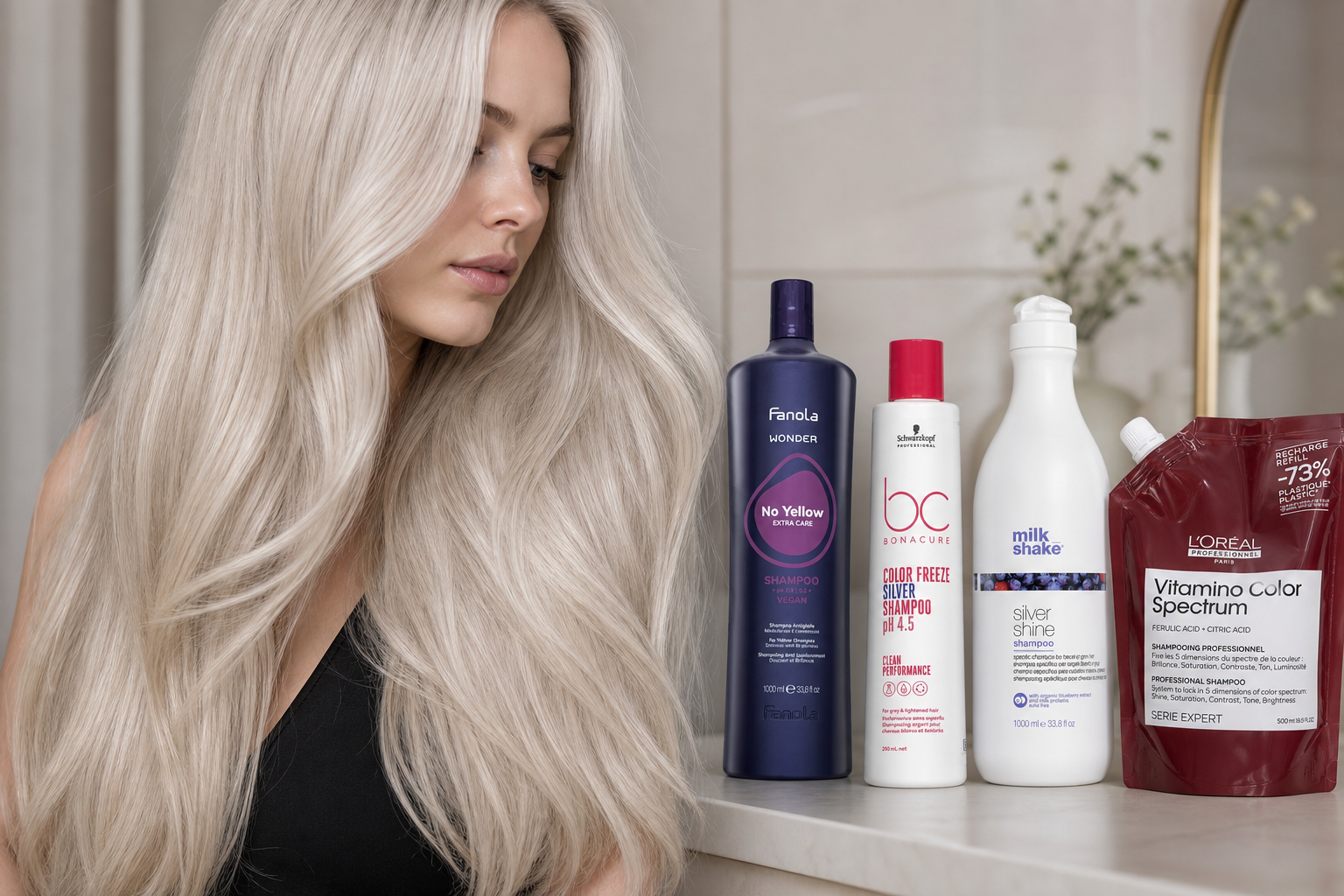
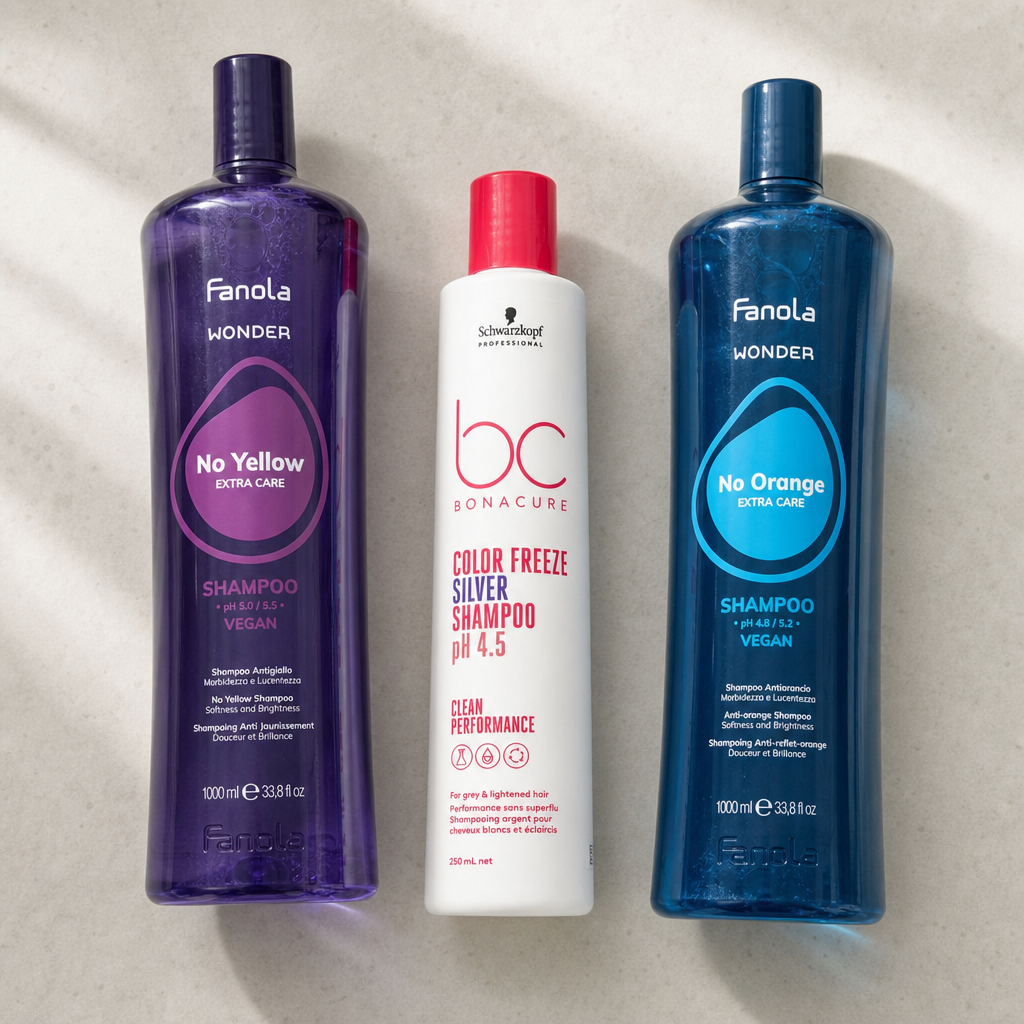
Italian brand Fanola is often the first encounter with toning care, and it's no coincidence. Its No Yellow Shampoo in a 350 ml bottle is the brand's best-selling product and a staple in our hair care range. The pigment is truly concentrated — the shampoo has a deep purple, almost ink-like color and leaves a mark on your hands and in the sink. We recommend working with gloves and keeping an eye on the time: the application time for such a strong product is measured in minutes, and you should follow the instructions on the packaging, not your instincts. For regular use and longer hair, the liter variant is worth it, which you'll also find in salons.
The sister line No Orange addresses a different issue. While the purple pigment neutralizes yellow tones on light blonde and platinum hair, No Orange works with blue pigment targeting orange and brassy undertones — those that appear in darker blondes, caramel highlights, and dark hair lightened by several shades. You can find it as Wonder No Orange Extra Care Shampoo in a liter bottle.
Schwarzkopf Professional: Salon System with Extensive Support
Schwarzkopf Professional is a classic professional salon brand, ranking among the top three in hair care in our market and offering hundreds of items across washing, care, styling, and coloring. For blonde hair, this has a specific benefit: you can integrate a toning shampoo into the entire process — from lightening, through bond treatments in the hair, to subsequent care. In the catalog, you'll find both the lightening Igora Vario Blond Plus and the strengthening Fibreplex, which hairdressers use when transitioning to lighter shades.
We recommend choosing the specific toning shampoo and volume based on the current offerings in the Shampoo category — salon lines change more frequently than entry-level brands, so confirm the packaging directly on the product page. Generally, professional toning shampoos are more subtly pigmented than Fanola; they are designed for regular washing rather than a bi-weekly treatment.
Comparison in Three Points
- Intensity of Pigment: Fanola No Yellow is among the most intensely pigmented options in this price range and offers little forgiveness — prolonged application can leave a noticeable purple tint on porous areas. Professional lines tend to be gentler and more predictable.
- Application Time: For highly pigmented shampoos, it's a matter of minutes, while gentler salon variants can be left on the hair longer. In both cases, follow the manufacturer's instructions and initially shorten the time to a minimum.
- Hair Type: The purple variant targets cool blondes, platinum, gray, and white-highlighted hair. No Orange with blue pigment is intended for darker blondes, caramel highlights, and brassy undertones after lightening a dark base.
Premium Lines: Wella Professionals, Milk_Shake, and L'Oréal Professionnel
In the premium and luxury segment, a purple shampoo is expected to do more than just tone. While pigment remains the core of the product, it is enhanced with a more pronounced care component to restore what bleaching has taken away from the hair — moisture, elasticity, and surface smoothness. You'll notice the difference especially in the lengths and ends: after washing, hair doesn't feel as dry and the light shade looks cleaner.
Wella Professionals
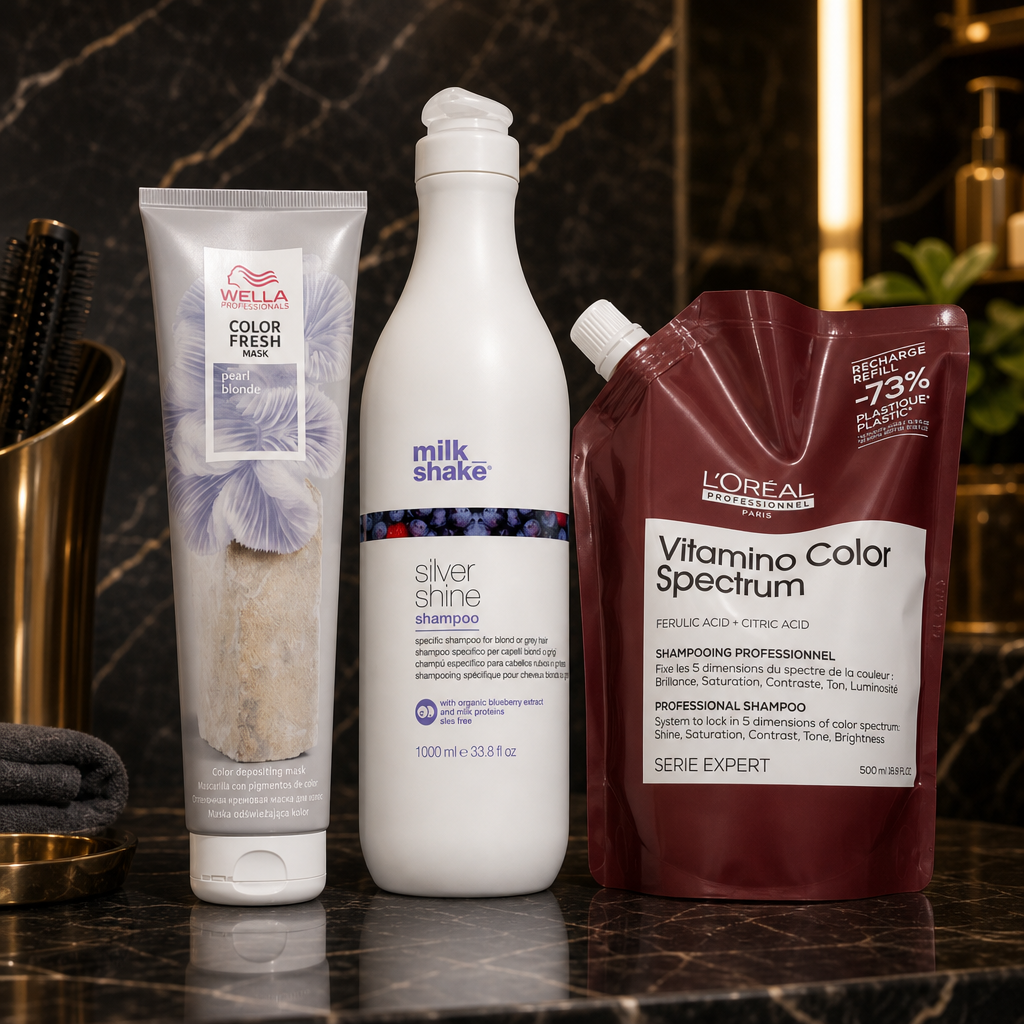
Wella Professionals is one of the best-selling brands of professional hair cosmetics on Brasty, with a catalog that includes hundreds of items across washing, care, and coloring. For blonde hair, it is crucial that the brand treats colored and bleached hair as a separate discipline — alongside toning shampoos, it also offers lines focused on maintaining shade and restoring damaged structure. From the brand's catalog, you can complement the purple shampoo with:
- Wella Professionals SP Color Save Shampoo 1000 ml — a wash for colored hair on days when you don't need to tone.
- Wella Professionals SP Luxe Oil Keratin Restore Mask 400 ml — a mask for lengths stressed by regular bleaching.
- Wella Professionals Fusion Intense Repair Mask 500 ml — a more intense option for hair that breaks and splits.
Wella is especially suitable if you wear blonde long-term and want a predictable system: the lines can be combined with each other, and large packages make sense for frequent washing.
Milk_Shake
The Italian brand Milk_Shake is one of the fastest-growing names in the premium range on Brasty, and its position is based precisely on what blonde hair most often needs — hydration. The textures are creamy, leaving the lengths soft and making the hairstyle easier to comb.
- Milk_Shake Moisture & More Shampoo 1000 ml — a hydrating wash that can be alternated with purple shampoo.
- Milk_Shake Incredible Milk 150 ml — a leave-in treatment, consistently one of the best-selling hair care products on Brasty.
- Milk_Shake Leave In Conditioner 350 ml — a light conditioner for daily detangling.
We recommend the brand if you find dryness and frizz more bothersome than the warm undertone in blonde hair.
L'Oréal Professionnel
L'Oréal Professionnel represents a salon approach to color care. For blonde hair, protecting the shade between salon visits is key: the slower the color fades, the fewer corrections your hair will need throughout the year.
- L'Oréal Professionnel Série Expert Vitamino Color Spectrum Professional Shampoo 1500 ml — a wash for colored hair in salon-sized packaging.
- L'Oréal Professionnel Série Expert Absolut Repair Gold Quinoa + Protein Masque 500 ml — a protein mask for significantly damaged hair.
- L'Oréal Professionnel Série Expert Pro Longer Lengths Renewing Mask 500 ml — for long blonde hair with thinning ends.
Which Brand Suits You
- Soft highlights or balayage — can only handle a mild dose of pigment. Opt for the hydrating care from Milk_Shake and use purple shampoo only occasionally.
- Full blonde in medium shades — a system from one brand with both toning and regular shampoo is suitable, typically from Wella Professionals.
- Platinum and icy blonde — requires regular shade correction and the strongest care support; here, the salon approach of L'Oréal Professionnel makes sense.
Premium lines are not a prerequisite for beautiful blonde hair. However, they make sense when you bleach your hair repeatedly and want toning to go hand in hand with care.
How to Incorporate Purple Shampoo into Your Routine and What to Pair It With
Purple shampoo is designed for one specific task — toning. It doesn't replace your regular cleansing routine, nor should it, as it's formulated for color correction, not daily hydration. It works best when alternated: use your usual shampoo for most washes and switch to purple shampoo when you notice your blonde losing its brightness.
In practice, this usually means using it once or twice a week for most blonde hair. You'll fine-tune the frequency based on how quickly warm undertones return. Cool platinum after bleaching needs more frequent toning than natural light blonde or low-contrast highlights. Let the shade guide you, not the calendar — once your hair is cool enough, return to your regular shampoo for the next wash.
Watch the Application Time
A common mistake with purple shampoos isn't choosing the wrong product, but leaving it on for too long. Pigment quickly absorbs into the porous structure of bleached hair, and too much can leave a cool or slightly purple tint that you'll need to wash out. Proceed with caution:
- Follow the application time recommended by the manufacturer on the packaging — it's often shorter for more concentrated formulas.
- Start with the lower end of the recommended range and only extend the time based on the results.
- Apply to damp hair and distribute the product evenly to avoid uneven pigment absorption.
- The most porous areas, typically bleached ends, require less time than the roots.
- Always rinse thoroughly, ideally with lukewarm water.
If you're unsure how your hair will react, test the product on a discreet strand first.
Toning Alone Isn't Enough
Bleached lengths lose suppleness and struggle to retain moisture, so alongside color correction, they primarily need nourishment. This is where categories like Hair Masks, Conditioners, and Leave-In Treatments come in handy — use them on days when you're not using purple shampoo.
From our catalog, the Wella Professionals SP Luxe Oil Keratin Restore Mask has proven effective as a regular restorative treatment for stressed lengths, or the mask from the L'Oréal Professionnel Série Expert Absolut Repair range if your hair is significantly weakened from repeated lightening. For leave-in care, Milk_Shake Incredible Milk simplifies detangling and adds smoothness to lengths without weighing them down. A conditioner after every wash is the foundation you can build on.
Three Scenarios Based on Budget
Whether you're just starting with toning or looking for care for long-maintained platinum, you can simplify your selection into three paths:
- Affordable Start — Fanola. A sensible choice if you want to try purple shampoo first and see how often your hair needs it. Keep in mind that it's a more heavily pigmented formula, so pay extra attention to the application time.
- Mid-Range Option — Schwarzkopf Professional. Suitable when you've established a toning routine and want a professional line where you can also add complementary care from the same brand.
- Premium Care for Stressed Platinum — Wella Professionals, Milk_Shake, or L'Oréal Professionnel. Makes sense for hair undergoing repeated lightening where toning must go hand in hand with intensive regeneration.
None of these paths are closed — a more affordable purple shampoo can be well combined with a premium mask, as nourishment is the part that pays off for bleached hair. You can find our selection of toning shampoos for blonde hair and complementary care in the Brasty catalog.
Category
Recommended articles
"Give a girl the right shoes and she can conquer the world!" Marilyn Monroe