
Why Niche Perfumery Relies on Unusual Ingredients
Whether you're just discovering niche perfumes or already have a shelf full of them, sooner or later you'll wonder how they differ from the fragrances you know from mainstream perfumeries. The answer doesn't start with the bottle or the advertising campaign, but several steps earlier – with the list of ingredients that the perfumer can work with.
A mainstream perfume is produced in large volumes and must remain available for years at the same quality and price. This imposes strict conditions on the composition: every ingredient must be available in large quantities, have a predictable price, and withstand harvest fluctuations. Materials processed in only a few hundred kilograms annually simply don't fit into such a brief.
Niche perfumery operates with a different set of calculations. Smaller batches, a narrower customer base, and a higher price per milliliter allow for ingredients that are seasonal, less accessible, or so distinctive that they would be difficult to manage in large-scale production. Here, the perfumer doesn't have to find a compromise for the widest possible audience – they can let one material take center stage, even at the risk that the result won't appeal to everyone.
Time also plays a role. Smaller batches allow for longer maceration and more careful work with individual batches of ingredients, as production is not continuous. Additionally, natural materials vary from year to year depending on weather, soil, and harvest time – and niche brands can afford to acknowledge this variability instead of smoothing it out into a single unchanging line.
This is why three groups of ingredients appear noticeably more often in niche compositions, which we will explore in more detail in this article:
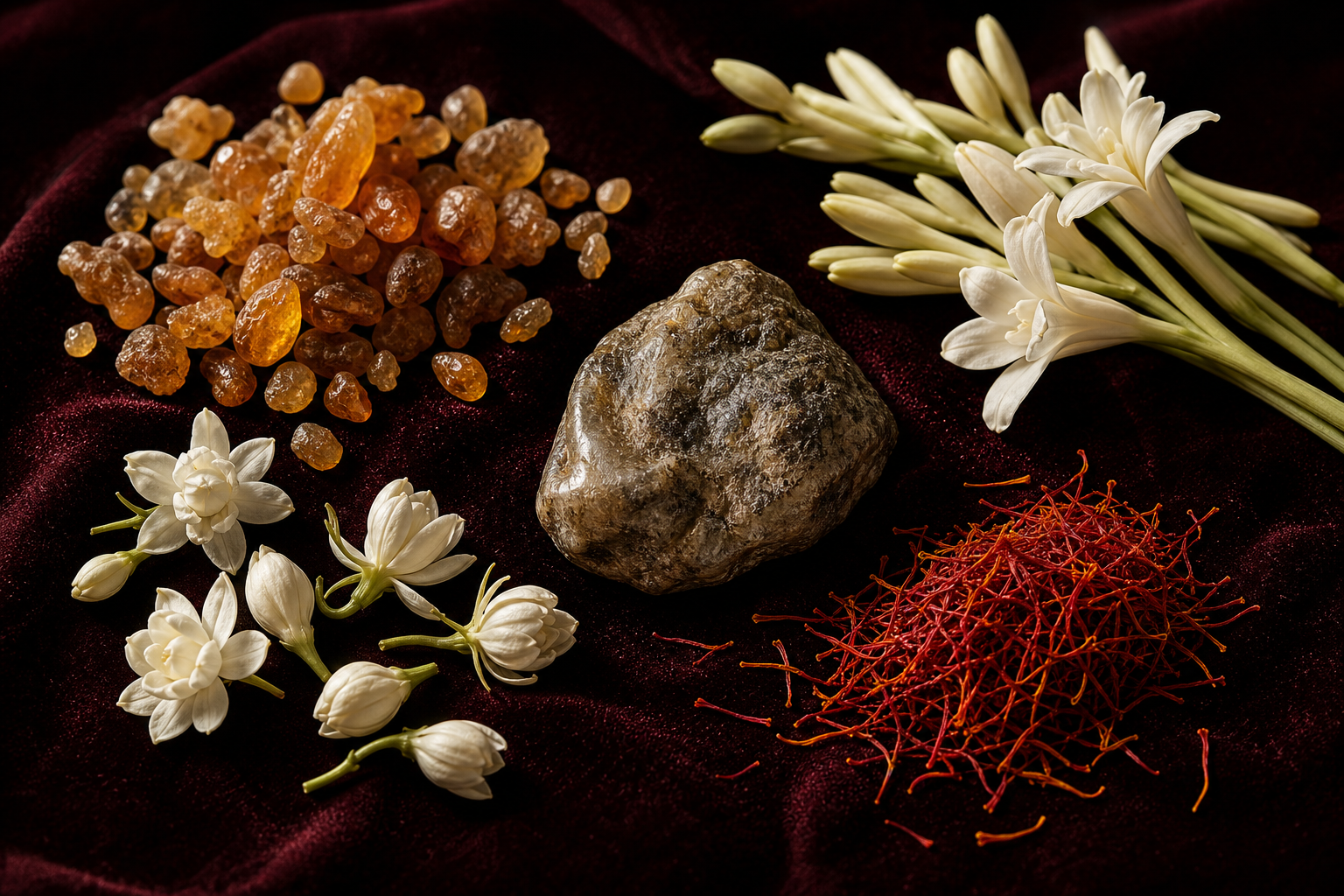
- Resins and Balsams – frankincense, myrrh, or benzoin. Materials collected drop by drop from wounded bark and linger longest in the perfume.
- Animalic Notes – ambergris, musk, or castoreum. Today, they mostly appear in perfumes in synthetic and biotechnological forms, as the original sources are largely a thing of the past.
- Rare Floral Extracts – orris root, tuberose, or jasmine sambac. Their price is determined by the number of flowers needed for a single kilogram of absolute.
For each of these groups, we'll look at how the ingredient is obtained, why it's among the more expensive, and what it specifically does to the resulting fragrance. This isn't about perfumery exotica for collectors – all three groups can be found in compositions you wear regularly, just in different concentrations and forms.
This doesn't mean that a niche perfume is automatically a better choice than a well-crafted mainstream one. It means it's created according to a different brief – and that it's worth understanding it through the ingredients rather than the packaging. If you know you like resinous warmth or, conversely, a pure floral line, you'll navigate the composition description much faster. At Brasty, niche perfumery is not just a filter within perfumes but a separate category – customers usually discover it through a different path than typical perfume novelties.
Resins and Balms: Frankincense, Myrrh, and Benzoin
Resins are among the oldest fragrant materials used by humans. Fragrant balms were burned in temples long before the first alcohol-based perfume was created, and their role has changed little since then – they still form the base of compositions and hold them together. Niche perfumery often returns to them because they can withstand high concentrations and give the fragrance a character that is difficult to replicate synthetically.
How Resin is Formed
Frankincense, myrrh, benzoin, labdanum, and opoponax share a common origin: they are plant secretions that occur in response to injury. A gatherer cuts the bark of a tree or shrub, the plant heals the wound with a thick sap that hardens in the air into droplets called tears. After several weeks, the tears are collected by hand, sorted by size, color, and purity, and only then are they distilled or extracted to obtain an essential oil or resinoid – a thick dark concentrate that the perfumer further works with.
Labdanum is a small exception in this group. It is not obtained from the trunk but from the sticky coating on the leaves and twigs of the cistus, a shrub growing in the Mediterranean. Historically, it was even collected from goat hair, where the resin stuck during grazing; today, the branches are boiled and the extract is subsequently purified.
Why Their Price is So High
The price is not driven by marketing but by the simple arithmetic of collection. A tree yields only a limited amount of resin per season and needs time to regenerate between cuts – excessive collection can harm the tree and reduce production. The collection is done by hand, often in remote and arid areas of the Middle East and northeastern Africa, where the raw material is also stored and sorted. From several kilograms of raw tears, only a fraction of usable resinoid is produced, as the rest consists of solid parts, bark, and impurities. Additionally, quality fluctuates between harvests: the same tree can produce light, pure drops one year and significantly darker, harder-to-process material the next.
Olfactory Profile of Individual Resins
Although all are called resins, their scents differ significantly. Once you name them, you'll easily recognize them in compositions:
- Frankincense (olibanum) – dry, smoky, initially citrusy-peppery, with a cooler, almost sacred impression.
- Myrrh – bittersweet and balsamic, with a leathery and slightly medicinal undertone that adds gravity to the fragrance.
- Benzoin – the sweetest of the group, vanilla-like, powdery, and warm; often acts as a bridge between resins and gourmand notes.
- Labdanum – leathery sweetness of dried fruit and tobacco, the backbone of classic amber accords.
- Opoponax – a milder relative of myrrh, more honeyed and softer, with a hint of spice.
What Resins Do to Perfume
All these materials belong to the base notes, the part of the composition that develops the slowest and lasts the longest. Their molecules evaporate slowly from the skin, so a perfume with a strong resinous base can last on the skin for several hours and be noticeable on clothing or a scarf the next day. They also act as fixatives – slowing the evaporation of lighter citrus and floral notes above them, making the entire fragrance appear fuller and more stable.
If you are just discovering resinous scents, it's worth testing them on the skin and with some distance. In the first few minutes, they often appear sharper than they will eventually be; the warmth and smoke unfold after about half an hour. They fully develop in cooler months and during evening wear, where the lower temperature allows them to unfold slowly. And remember, less is more – one to two sprays are usually enough.
Animalic Notes: Ambergris, Musk, Castoreum
Long before perfumery began working with lab-created molecules, animalic raw materials were the pillars of the perfumer's palette. They weren't used for their own beauty—most of them smell rather unpleasant in concentrated form—but for what they could do to surrounding ingredients. In minute dilution, they softened sharp edges, extended longevity on the skin, and added warmth to the fragrance, which is still described today as sensual.
Ambergris is formed in the digestive tract of the sperm whale as a reaction to indigestible food remnants. The lumps that reach the sea mature for years in the sun and salt before losing their original sharp odor and gaining the character that has earned them the nickname "floating gold." It smells mineral-like, slightly salty, with tobacco and sweet undertones. Above all, it acts as a fixative, a component that holds other ingredients together.
Musk was originally obtained from the gland of the musk deer, a small Asian ruminant. Its scent, in strong dilution, is soft, warm, and surprisingly clean—resembling skin and freshly laundered fabric more than anything animalic. This is why musky notes have become a cornerstone of much of modern perfumery: they are not dominant but give the fragrance a corporeal presence.
Castoreum comes from the scent glands of the beaver and brings a leathery, smoky, slightly tarry note akin to birch tar. Civet from the civet cat's glands adds an animalic, sharply honeyed accent that, in small doses, transforms into a warm sweetness. Both materials were primarily used in classic perfumery in oriental and leather compositions, where they were meant to create an impression of depth and richness.
Perfumery has moved away from natural animal sources for several reasons. The musk deer and sperm whale are protected species, and international conventions on the trade of endangered species have significantly limited their use. Additionally, there are ethical concerns about sourcing these materials, the inconsistent quality of individual batches, and the cost, which few perfumes today could bear. Natural ambergris washed ashore is used by only a fraction of brands and is practically absent in regular distribution.
Substitutes are not an emergency solution but a separate chapter of perfumery chemistry. Ambergris's woody character is now provided by ambroxan, a molecule prepared from sclareol from clary sage. Musky notes are represented by macrocyclic and polycyclic musk molecules, whose range extends from powdery softness to cool purity. Leather and tarry notes are composed of birch tar, isobutylquinoline, and other building blocks. Biotechnology also allows some materials to be created through fermentation, the work of microorganisms.
What do these notes actually do to a fragrance? In a composition, they fulfill three roles:
- Deepen the composition. They create a base layer that other ingredients rely on, so the fragrance doesn't seem flat.
- Extend longevity. These are heavy, low-volatility molecules that evaporate slowly from the skin and hold lighter notes together.
- Add a corporeal character. They blend with the skin's own scent, creating an effect known as a second skin.
If you want to experience this layer of fragrance, give the perfume time. Animalic and musky notes lie in the base notes and fully reveal themselves only after several hours, when the top citrus and spices have long faded. Test them on the skin, not on a paper strip, and keep in mind that everyone perceives them differently: sensitivity to individual musk molecules varies so much among people that the same fragrance can have a different effect on two individuals.
Rare Floral Extracts: Why Are They So Expensive
Whether you're curious about why one niche perfume costs several times more than another, or you're just fascinated by the word "absolute" on the label, floral ingredients provide the clearest answer. The price of a fragrant ingredient doesn't depend on how rarely the plant grows, but on the ratio between the weight of the harvest and the amount of fragrant material that can be obtained from it. And for some flowers, this ratio is exceptionally unfavorable.
Flowers are processed in two ways. Only those that can withstand heat, like roses, are distilled with steam. For more delicate flowers, steam would damage the fragrant substances, so solvent extraction is used: a waxy concrete is formed, from which the absolute, the most concentrated form of floral fragrance, is extracted with alcohol. Each additional step means loss of material and extra hours of work. Added to this is the manual harvesting, which cannot yet be replaced by machines for fragile flowers.
This is best seen in five ingredients that perfumers reach for when they want to showcase what they're working with:
- Iris Root – it's not a flower, but a rhizome. After harvesting, it is dried and aged for several years, because it is during aging that substances called irones form, giving iris its powdery, subtly violet scent. Years of storage without yield and very low extraction make it one of the most expensive items in a perfumer's inventory.
- Tuberose – the flowers are most fragrant at night and early morning, so harvesting takes place outside regular working hours. The yield of absolute is low, but the fragrance is dense, creamy, milky sweet, and unmistakable in a composition.
- Jasmine Sambac – the tiny flowers are picked one by one and only in the short window when they are open; hundreds of kilograms are needed for a kilogram of absolute. Sambac is often described as greener and sharper compared to grandiflorum jasmine.
- Taif Rose – a Damask rose grown at higher altitudes in Saudi Arabia, harvested in a short spring season and only in the morning hours. It is said that tons of petals are needed for a kilogram of essential oil. The resulting fragrance is spicier and more honeyed than roses from cooler regions.
- Saffron – botanically, it's not a flower, but three stigmas from each crocus, hand-picked. About a hundred thousand flowers are needed for a kilogram of dried spice. In perfumes, it is therefore used in small amounts and brings a leathery, spicy tone with hints of hay and honey.
This raises the question of why not replace it all synthetically. To some extent, it can be done and is commonly done. A reconstruction, a blend of molecules assembled to mimic the profile of a natural extract, is more accessible, stable, and repeatable. Moreover, some flowers do not provide any usable extract, so without reconstruction, they wouldn't be present in perfumery at all.
However, natural absolute contains hundreds of compounds, many of which are present in such small amounts that they don't transfer into the reconstruction. This is noticeable: natural material changes over time on the skin, has depth and a certain plasticity, while reconstruction remains flatter and more predictable. The variability of individual harvests is also a factor – similar to wine, the yield varies depending on the weather and location. For mass production, such inconsistency is a complication, but for niche perfumery, it's more of an argument.
For you, this means one practical thing: the price of a niche perfume reflects not just the brand and the bottle, but also what's inside. Pay attention to specific labels in the description, such as iris absolute, jasmine sambac, or Taif rose – and expect that such compositions develop slowly on the skin.
Three Luxurious Perfumes Highlighting Rare Ingredients
The theory of resins, animalic notes, and rare floral extracts only makes sense once you experience them. That's why we've selected three perfumes from the luxury price range that clearly demonstrate what each group of ingredients does to the composition. Each relies on a different ingredient logic, and thus behaves differently on the skin.
Montale Arabians Tonka: Resinous and Balsamic Base
Montale Arabians Tonka is an Eau de Parfum with a volume of 100 ml, perfectly fitting into the world of balsamic and resinous materials. The base is formed by Tonka bean complemented by an amber undertone and oakmoss – ingredients with heavy, slow-evaporating molecules. Practically, you’ll notice this in the fragrance's progression: the first half-hour is the sweetest and loudest, then the composition settles into a warm, slightly smoky finish that lingers on the skin and clothing for hours. It will suit those who love rich oriental perfumes for cooler days and don't mind a scent that is noticeable even from a distance.
Yves Saint Laurent MYSLF: Ambroxan Instead of Natural Ambergris
The MYSLF Eau de Parfum by Yves Saint Laurent clearly shows how today's perfumery works with the legacy of animalic ingredients. Natural ambergris is replaced by ambroxan – a synthetic molecule with a similar effect, giving the composition volume, velvety depth, and the ability to cling to the skin. The result feels cleaner and more predictable than historical animalic materials: instead of a heavy, animalic impression, you get a warm, slightly mineral trace that lasts all day. Opt for it if you're looking for a modern perfume for work and evening, remaining more elegant than ostentatious.
Jean P. Gaultier Divine Elixir: Floral Richness in the Highest Concentration
Divine Elixir by Jean P. Gaultier is a pure perfume with a volume of 100 ml, the most concentrated form of the composition. This plays a significant role with floral ingredients: floral absolutes are plastic and changeable, and higher concentration gives them room to unfold. Therefore, on the skin, the scent doesn't appear all at once – first, you'll notice a fresher opening, and only after a while does the rich floral heart assert itself, fading into a creamy, slightly powdery base. It's a choice for those who love bold, festive floral perfumes and expect the scent to accompany them throughout the evening.
Things to Consider When Choosing
Whether you're drawn to resinous depth, amber softness, or floral richness, with perfumes featuring rare ingredients, it's worth adhering to a few principles:
- Test on skin, not on paper. Resins, balsams, and amber molecules react to the temperature and oils of the skin; a test strip will only give you the initial impression.
- Expect a slower development. Rare ingredients usually sit in the base notes, so you might not fully recognize the true character of the perfume until two or three hours later.
- Apply sparingly. With high concentration, usually one or two sprays are enough; more won't improve the scent, just make it louder.
- Try in different weather. Heat amplifies resinous and balsamic notes, while cold calms them – the same perfume can therefore feel different in summer and winter.
If you're choosing for the first time, start with the group of ingredients that intrigued you the most while reading. Rare materials can't be judged from a description, but after a few days of wearing, you'll usually know if their depth suits you.
Category
Recommended articles
"Give a girl the right shoes and she can conquer the world!" Marilyn Monroe