
The Hotel Lobby as Inspiration: Why Large Spaces Smell Different
Do you know that moment when you walk into a hotel lobby and there's just a certain scent in the air? It's not overpowering, it doesn't hit you as soon as you walk in, but it lingers evenly – at the reception, by the seating area, and even further away by the elevators. And when you return from a walk two hours later, it smells exactly the same. Achieving that effect at home is considerably more challenging.
The typical scenario looks like this: you buy a diffuser that worked beautifully in the bedroom, and you move it to an open-plan space with a kitchen island and dining area. Or to the landing of the stairs, or perhaps to a long hallway you walk through twenty times a day. And the scent disappears without a trace. You only smell it when you lean in close to the sticks – two steps away, there's nothing left to notice.
It's not a fault of the diffuser or a weak fragrance. It's a matter of scale. A bedroom of twelve square meters with closed doors is, from a scent perspective, a small, enclosed box where the aroma has nowhere to escape. An open space is the exact opposite and works against you in several ways:
- Volume of air. It's not the floor area that matters, but the volume. A living room with a ceiling height of three meters has about a fifth more air to scent compared to a room of the same size with a two and a half meter ceiling.
- Airflow. Stairs and hallways act like a chimney. Warm air rises and carries the scent away faster than the diffuser can replenish it.
- Missing boundaries. In an open-plan space, there are no doors or walls for the scent to cling to. Instead of concentrating, it gradually disperses into the rest of the floor.
- Everyday household activities. Cooking, airing out, opening the front door. Each of these episodes partially flushes the space, and the diffuser has to start over.
The solution isn't a stronger perfume. A more intense composition in the same small bottle will only give you a few days of a stronger burst and then just as quick a decline – with the added risk that the scent will be unpleasantly overwhelming near the diffuser, while still undetectable at the other end of the room. The consistency you admire in a hotel lobby relies on something else: a sufficient volume of fragrance, a large evaporation surface, and most importantly, continuous operation. The scent doesn't work in bursts but flows smoothly twenty-four hours a day, allowing it to settle in the space before it can be ventilated away.
This is exactly what you want at home. A large-format diffuser isn't just a bigger version of the small one – it's a different category of home fragrance that accounts for the space absorbing air more quickly, and therefore delivers it in greater quantity and for a longer duration.
In the following chapters, we'll give you a clear guide to choosing a large-format diffuser – from the parameters that determine its reach to everyday operation. We'll primarily focus on large-format diffusers from Millefiori Milano, which represent the main choice in our home fragrance offerings for open-plan spaces and large areas. Whether you're dealing with a through-floor of a family house or just a hallway meant to welcome guests before you do, the principle remains the same – and it starts with selecting the right volume.
Volume, Sticks, Reach: How to Identify a Diffuser for Large Spaces
A diffuser might seem like a simple object – a bottle, a refill, and a bundle of sticks. But once you move it from the bathroom to the hallway or an open-plan kitchen and living room, you'll see how crucial the difference in formats is. The scent doesn't spread through pressure or a fan, but through evaporation, and how much ends up in the air per hour is determined by the evaporation area and the supply the sticks draw from. A diffuser for large spaces is identified by three factors: the volume of the refill, the number of sticks, and the room conditions.
Volume of Refill as the First Indicator
Volume is a practical converter between the bottle and square meters. Consider the following division as a guideline to start from:
- 100 ml – closed rooms of about 10 m²: bathroom, toilet, closet, small study. The scent has a short journey here, and a larger volume would feel overwhelming.
- 250 ml – a standard room of approximately 15 to 25 m²: bedroom, children's room, separate dining room. A universal format if you have a traditionally divided apartment.
- 500 ml – hall, staircase, open-plan spaces, and rooms over 30 m². A large volume here doesn't function as a luxury version of the same, but as a way to maintain the scent several meters away from the bottle.
The difference between formats isn't just in how long the refill lasts. A larger bottle is usually taller and wider, can accommodate longer and thicker sticks, and maintains stable evaporation even after several weeks. A small diffuser placed in the middle of a hall won't spread the scent – it will just deplete faster.
Sticks: The Regulator You Control
The sticks are the only part of the diffuser that you actually control after setting it up. There is a direct correlation: the more sticks you place in the bottle, the faster the scent rises into the space, and the shorter the refill's lifespan. The same bottle can last two months or significantly longer – it mainly depends on how many sticks you've used.
Start with about half of the supplied sticks and evaluate after two to three days if you can smell the scent at the door; only then add more sticks one by one. Length also plays a role – the stick should extend above the neck at least as much as it remains submerged in the refill. Turning the sticks about once a week temporarily intensifies the scent, for example, before a visit.
What Influences Reach Independently of the Diffuser
The same bottle behaves differently in various households. Before opting for a larger volume, consider four factors that change reach regardless of the product:
- Ceiling Height. The scent rises upwards. In an older apartment with a ceiling over three meters, it disperses into a volume that isn't reflected in the floor area – consider a higher format than the area suggests.
- Draught and Ventilation. A bottle placed in the path between the front door and the staircase depletes noticeably faster, and part of the scent is carried away by the flowing air.
- Heating. Heat accelerates evaporation. A diffuser on a windowsill above a radiator or in a room with underfloor heating will use up the refill faster than the same bottle in a cooler hallway.
- Space Layout. Closed doors, heavy textiles, and tall furniture slow down the scent. An open-plan layout spreads it further, but also dilutes it.
The difference between formats stands out where the same composition exists in two sizes. Millefiori Milano Fragrance Diffuser Ambra & Rosa 100 ml is a diffuser for a single closed room – on a desk, in the bathroom, or on a shelf in the closet. The same scent in a 500 ml version has a different role: it serves the hall and adjoining corridor and maintains the impression even where the space opens into another floor. It's not about a cheaper and more expensive version of one product, but two different tools for two different tasks.
Large Format Millefiori Milano Diffusers for Open Spaces
An open layout, where the kitchen seamlessly transitions into the dining and living areas, requires a diffuser that doesn't dispense fragrance drop by drop. The Italian brand Millefiori Milano offers large space solutions with 500 ml bottles and long rattan sticks. These pieces form the backbone of scenting the entire home: they differ not in strength but in olfactory character. The decision is not about which diffuser is stronger, but about the mood you want the space to maintain.
When choosing, consider situations rather than names. Ask yourself if the room should be more calming or representative, if cooking takes place there, and how often people come and go. The following 500 ml diffusers cover most of these needs.
- Fragrance Diffuser Ambra & Rosa 500 ml – a warm amber base underpinned by a rosy heart. A fragrance that makes a space feel more lived-in rather than refreshed. It suits the living area and evening settings when you want the home to feel settled and calm. In an open layout, it pairs well with food aromas, as it doesn't compete with sharp citrus scents.
- Fragrance Diffuser Lychee Rose 500 ml – a fruity floral opening where juicy lychee softens the rose. A lighter, daytime scent, suitable for the dining area or spaces used mainly in the morning and afternoon. A good choice if classic amber scents feel too dense for a large space.
- Fragrance Diffuser White Musk 500 ml – a pure musk trail without pronounced sweetness. This is the most subtle option among the 500 ml: it won't overpower your morning perfume or the scent of freshly laundered clothes. Suitable for the bedroom, study, or any space where you want a sense of cleanliness without a specific fragrance theme.
- Fragrance Diffuser Legni e Fiori d´Arancio 500 ml – a woody-citrus contrast where orange blossom sits on a woody base. A versatile composition that works year-round and handles daylight and drafts well. If you're choosing your first large diffuser for the home and don't want to commit to a single season, start here.
- Fragrance Diffuser Mela & Cannella 500 ml – apple with cinnamon, a cozier gourmand position. Not a year-round scent; it comes into its own from autumn to winter when the space should feel warm and inhabited. It performs better in a large open space than in a small room, where it could quickly become overwhelming.
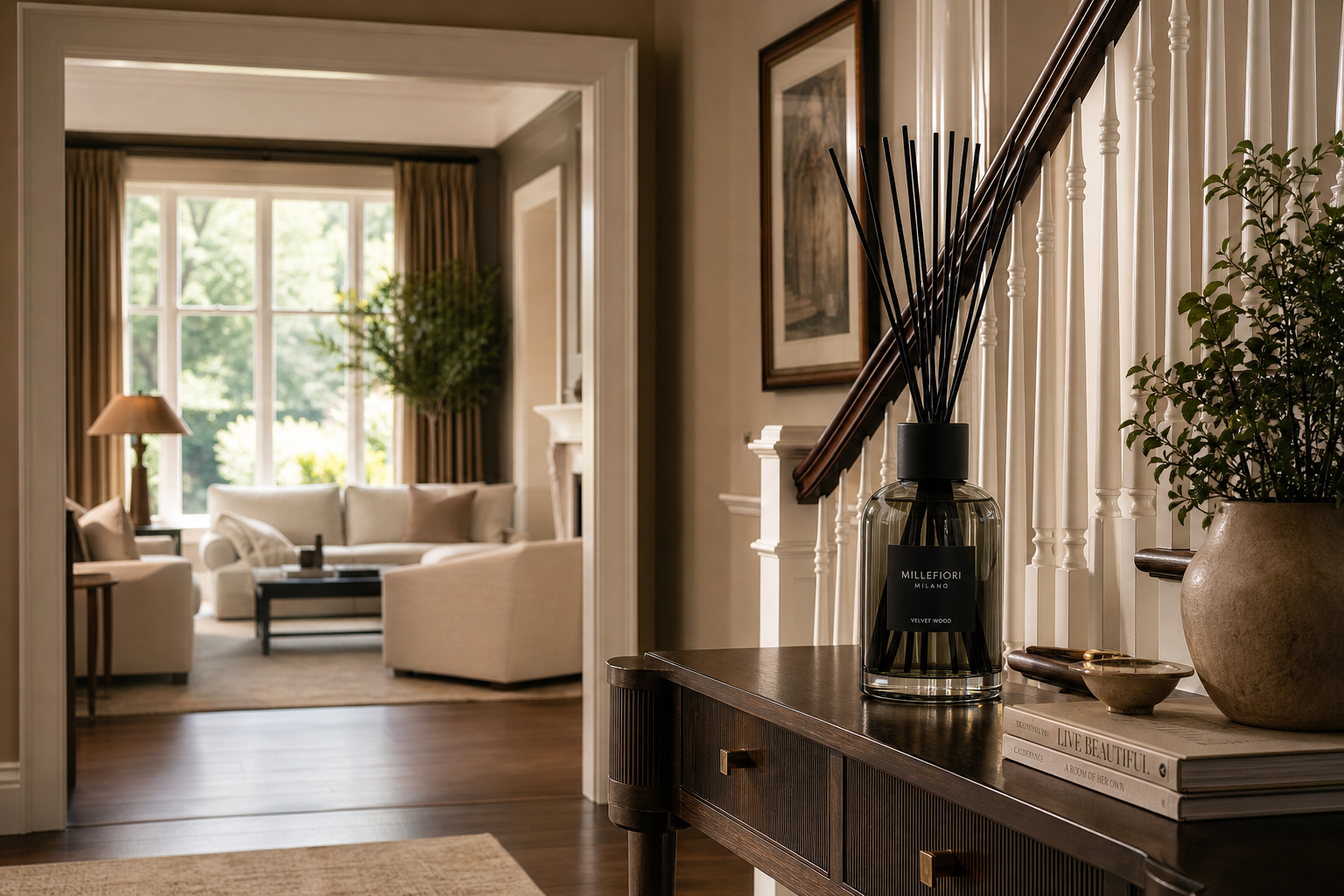
If you need the diffuser to also serve as part of the interior decor, opt for the design line Zona. Zona Moonflower 500 ml features a delicate floral composition and feels more airy, while Zona Fior di Muschio 500 ml leans towards a greener, mossy fresh scent with a hint of forest floor. Both variants have a more restrained bottle and are suitable for places where the diffuser is prominently visible – such as the entrance hall, on a sideboard by the staircase, or in the representative part of the living room.
A practical tip to conclude: in a large space, don't mix two strong 500 ml diffusers side by side. Either choose one scent as the leading theme for the entire floor, or combine a more pronounced composition in the living area with a subtler musk where sleeping and working occur. This way, the transition between zones feels natural, and your nose won't become accustomed to the scent as quickly as when a single intense trail surrounds it throughout the house.
Hallway, Staircase, Living Room: Which Diffuser Volume Goes Where
Scenting an entire home isn't the job of just one diffuser, no matter how large it is. Air in a house doesn't behave like it does in a single closed room – it flows through the hallway, rises up the staircase, and changes direction every time someone opens the terrace door. Therefore, a well-thought-out arrangement of three to four diffusers of different volumes works more reliably, with each covering its section and together creating a continuous trail from the entrance to the bedroom. A simple principle will help you: the larger the volume and the more sticks, the busier and more open the space the diffuser can handle.
The most work is done by the largest diffuser in the hall or on the staircase landing. It serves as the olfactory entrance to the house, through which every guest and every draft passes, and at the same time, it's the place from which the scent naturally spreads to the floors. A 500 ml format fits here – for example, Millefiori Milano Fragrance Diffuser Ambra & Rosa 500 ml with a warm amber-floral composition or the more subtle Millefiori Milano Fragrance Diffuser White Musk 500 ml, if you want the entrance to feel clean and understated. Place the diffuser on a solid surface away from doors and heating; in a direct air stream, evaporation speeds up and the scent lasts a shorter time.
The living room can handle a noticeably smaller volume, as the scent here doesn't need to overcome drafts but rather complement the stay. A 250 ml diffuser, like Millefiori Milano Zona Legni & Spezie 250 ml, provides a woody-spicy base that lasts all day and doesn't overpower the smell of food or coffee. Place it more towards the edge of the living space – on a sideboard, shelf, or side table – rather than in the middle of the seating area. A scent half a meter from your head becomes intrusive after an hour; the same composition from four meters away feels like the natural atmosphere of the room.
Small rooms can make do with a hundred. In the bathroom, toilet, closet, or small office, a 100 ml format makes sense, such as Millefiori Milano Zona Aria Mediterranea 100 ml with a fresh marine-citrus profile. In enclosed spaces without windows, the scent accumulates much faster, so a larger volume would feel suffocating – and you'd waste it unnecessarily.
The arrangement can thus be summarized into a simple key:
- 500 ml – hall, staircase landing, open-plan kitchen with living room;
- 250 ml – living room, bedroom, larger office;
- 100 ml – bathroom, toilet, closet, corridor between rooms.
The remaining decision is whether the whole house should smell the same. In most cases, it's worth sticking to a related fragrance family across floors: woody tones in the living room and amber in the entrance meet softly in transitions, and no unpleasant break occurs. A safe combination is scents that share at least one ingredient – musk, wood, or vanilla. On the other hand, olfactory separation of spaces makes sense where a room serves a different function: a bathroom with citrus freshness and a bedroom with a calm powdery composition don't compete, as there's usually a door and hallway as a buffer between them.
For guests, it's handy to have a quick booster on hand. A home spray, such as Millefiori Milano Scented Home Spray Lychee Rose 150 ml, boosts intensity within seconds and aligns with the diffuser base after half an hour – especially if you choose a spray from the same fragrance family as you have in the hall. Scented candles like Woodwick or Yankee Candle are great as an evening addition for one specific room: they add warmth, the crackle of the wick, and light, but only burn when you're there. The continuous base that holds even in an empty house is provided by the diffuser.
Refills for Long-Term Use: How to Keep Your Fragrance Flowing
For large diffusers, the ongoing cost is more significant than the initial purchase. A 500ml bottle will last several months in a typically ventilated living room, but if you replace it each time with a completely new package, you're paying again for the glass, cap, and set of rattan sticks. Refills skip this part: you get the same fragrance composition in a separate bottle, and you simply pour it into the diffuser you already have at home.
How Much You Can Save with Refills
The clearest comparison is a pair from our catalog. The Millefiori Milano Fragrance Diffuser Lychee Rose 500 ml is priced around 944 CZK, while the Millefiori Milano Fragrance Diffuser Lychee Rose Refill 500 ml is about 513 CZK. For the same volume of scented mixture, you pay just under sixty percent of the price of a complete package, and this difference accumulates with each subsequent replacement. It's similar with the Zona range: the Millefiori Milano Zona Legni & Spezie 250 ml costs approximately 603 CZK, while the Millefiori Milano Zona Legni & Spezie Refill 250 ml is around 452 CZK. These prices are indicative; you can find the current status directly with the specific product.
The larger the format you use, the sooner switching to refills pays off. For a 100ml bottle, it's a matter of a few tens of crowns annually, but for a 500ml diffuser that scents an open space year-round, the savings over two years can cover the purchase of another unit for an adjacent room.
What Lasts and What Changes
The glass bottle in large formats is intended as a permanent part of the setup and can withstand dozens of refills. Before refilling, simply rinse it with lukewarm water and let it dry completely, then pour in the new refill—remnants of the old composition would cloud the new scent. Rattan sticks have a shorter lifespan: they gradually become saturated, their pores clog, and the fragrance weakens even in a full bottle.
- Turning the Sticks – every one to two weeks, turn them upside down. The saturated part will be exposed to the air, and the intensity will noticeably increase for a few days.
- Replacing the Sticks – plan to replace them roughly after every second refill, or sooner if you don't perceive the fragrance even shortly after turning.
- Changing the Composition – when switching to a different scent, always use fresh sticks, otherwise the old and new scents mix into an indistinct result.
- Handling – turn the sticks over a cloth or paper. The oil mixture leaves stains on wood and lacquered surfaces.
How to Ensure Your Fragrance Doesn't Run Out
A fragrance outage is most frustrating when you can't react immediately—before a visit, during holidays, or in the middle of a season when you've tuned your home. The simplest safeguard is the level in the bottle: once it drops to about a third, order a refill in advance. For large formats, this means one short check per month, which you can easily combine with regular cleaning.
The second safeguard is stock. For a fragrance you use long-term and know suits you, it makes sense to keep one extra refill at home. For seasonal compositions, buy one at a time—the scent that works in November may be unnecessarily heavy in May.
Recommended Purchase for the First Year
If you're just putting together your first purchase, a proven combination looks like this: one 500ml diffuser for the main living space and two refills of the same or a related scent in reserve. Depending on usage intensity, this can cover you for a whole year without interruption while leaving room to change the composition as you go. You can find diffusers and separate refills in the home fragrance category, where the Millefiori Milano brand has its own range of large formats and matching refills.
Category
Recommended articles
"Give a girl the right shoes and she can conquer the world!" Marilyn Monroe