
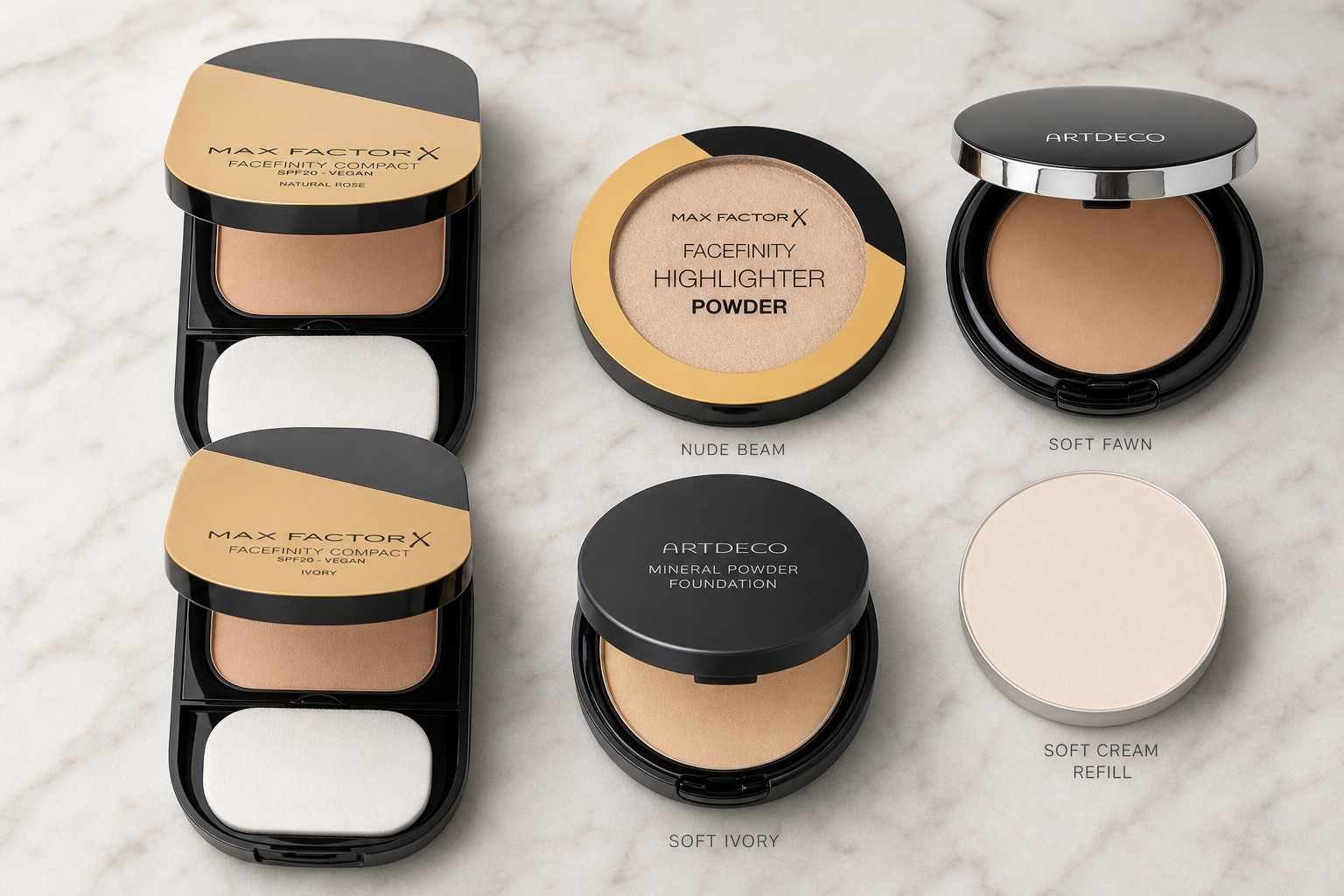

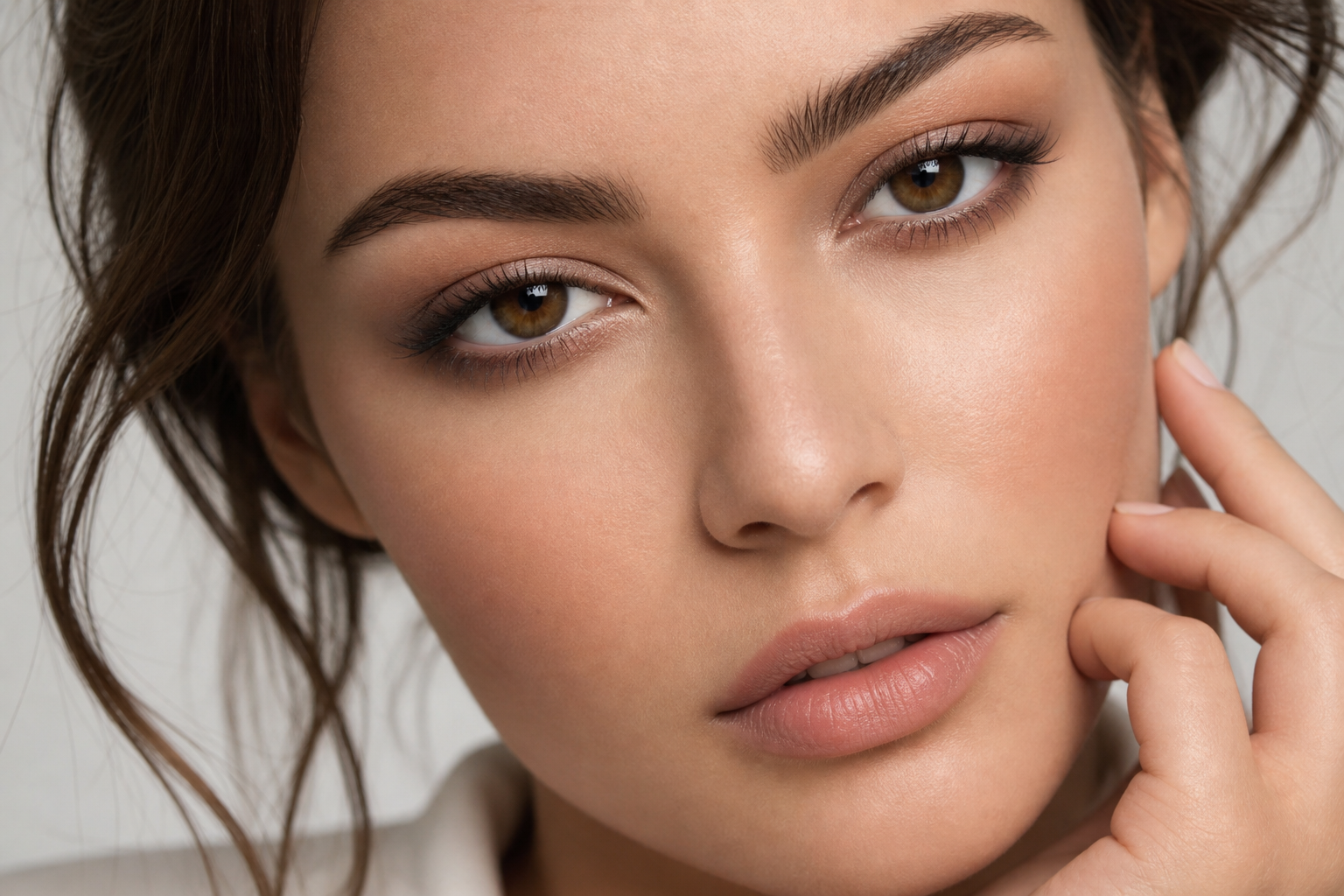
Struggling with a shiny T-zone and smudging makeup? Check out the new transparent and illuminating setting powders from Max Factor, Artdeco, and Vichy, and discover how they differ from previous generations.
Why Makeup Becomes Shiny and Smudges During the Day
In the morning, your skin looks even, the shade matches, and the makeup stays exactly where it should. But by noon, the first shine appears on the forehead and nose, in the afternoon the coverage starts to settle into fine lines around the eyes, and by evening it's clear that little remains of the original finish. This is usually not due to application errors – it's a normal skin reaction to what happens throughout the day.
The main culprit for shine is sebum. Sebaceous glands work continuously, with their highest concentration in the so-called T-zone, which includes the forehead, nose, and chin. Sebum gradually penetrates the makeup layer to the surface, disrupting its integrity and creating a light reflection that we perceive as shine. This isn't exclusive to oily skin: even skin that's otherwise dry can have a more pronounced T-zone, which is why shine appears there first.
The second factor is the environment. In an air-conditioned office, dry indoor air alternates with outdoor heat, and in winter, heating alternates with frost. Skin reacts individually to these fluctuations – some may dry out, causing makeup to adhere unevenly, while others may experience increased sebum production. Add humidity from exercise, travel, or a day spent walking around the city, and you have an explanation for why the same makeup lasts differently on a Thursday meeting compared to a Saturday wedding.
The third factor is movement. Your face never stops: you talk, blink, smile, rest your chin on your hand, hold your phone to your face. This causes makeup to shift to areas where the skin naturally creases – into lines around the eyes, the nasolabial fold, under the eyebrows. This can give the impression that the makeup has "smudged," even though it has simply moved to where your expressions have taken it.
Before reaching for a setting powder, it's worth identifying what happens to your makeup first:
- shine on the forehead and nose by mid-morning, while the rest of the face remains fine – classic sebum T-zone;
- makeup settles into fine lines around the eyes and smile lines – a combination of facial expressions and too thick a layer;
- shade darkens or shifts to a warmer tone after a few hours – makeup's reaction to sebum;
- coverage disappears in patches, especially where you touch your face or rest it – mechanical wiping.
Setting powder is often considered an afterthought, added at the end if there's time. In reality, it's a separate category with its own logic. Older generation compact powders were primarily for coverage and tone evenness, containing pigment and applied with a sponge or foam applicator. Setting powder has a different purpose: to set the layer you've already applied, reduce shine, and keep makeup in place. It's usually transparent or very lightly tinted, with a finer particle structure and is applied lightly, not densely.
This also leads to a different selection logic. With compact powder, you primarily consider the shade, which must match your skin tone. With setting powder, the particle structure, degree of matte finish, and how it behaves on dry or oily skin are more important – qualities you can't determine by the color in the packaging. We'll explore these differences in more detail in the article, including how the 2026 innovations from brands like Max Factor, Artdeco, and Vichy approach setting.
The New Generation of Setting Powders: What's Changed
A few years ago, buying a setting powder mainly meant finding the right shade. The powder was supposed to mattify but acted like the other half of your makeup – adding coverage, settling into fine lines, and leaving a grayish cast on darker skin tones. Today's innovations address a different challenge: they aim to keep makeup in place and control shine without altering the color.
Smoother Textures Instead of Extra Coverage
The key advancement has been in the fineness of the particles. Modern setting powders have a micronized texture that spreads over the skin in a thin film and doesn't cling to pores as much. This leads to another change – many new products are marketed as blurring. They diffuse light so that transitions and skin texture appear softer without adding another layer of color. You'll notice this because, after applying the powder, the skin looks matte and even, not chalky.
The way powder works throughout the day has also changed. Formulations are lighter, allowing for repeated touch-ups without causing makeup to crumble or highlight dry patches. If you've had unpleasant experiences with powders in the past, it's worth giving the category another chance – the texture is often a completely different type of product.
Transparent and No Color: What These Labels Mean
In the Powder category, variants described as transparent, translucent, or no color are increasingly common. All three labels point to the same idea: the powder contains minimal pigment, so it doesn't show color when blended into the skin. The practical benefit is twofold. You don't have to match the shade with your makeup, and such a powder can serve multiple skin tones in one household – without altering the lighter-toned concealer you've applied under your eyes.
One limitation is worth knowing in advance: colorless powders should be applied sparingly. A thicker layer can appear as a lighter veil in flash photography and highlight flaking areas on dry skin. A thin layer applied with a fluffy brush will prevent this in most cases.
Loose or Pressed Format
Both formats essentially do the same thing, but they differ in their application:
- Loose powder has a finer texture and spreads more easily over a larger area. It's suitable for morning setting at home, on zones that shine first – forehead, nose, and chin – and for pressing powder over concealer with a sponge.
- Pressed powder is compact, usually with a mirror and applicator, making it easy to use in a handbag or on the go. It's more practical for touch-ups during the day when you want to quickly control shine without building a new layer.
When to Use Colorless and When to Use Tinted Powder
Colorless powder makes sense wherever the color is already addressed by the layer beneath it. If you've applied makeup or concealer and just want to set and mattify it, a tinted powder would unnecessarily darken or change the shade you've matched in the morning. The colorless option is also a safer choice in summer when your skin tans and the makeup shade changes faster than your powder supply.
On the other hand, you'll appreciate tinted powder when it needs to do part of the makeup's job. It lightly evens out skin tone, covers minor redness, and can replace the entire coverage layer on a rushed morning. Products like L'Oréal Paris True Match Super-Blendable Powder, which is shade-matched and works more like a light compact makeup than pure setting, come close to this task.
Simplified guideline: the more products you have under the powder, the more likely you should choose colorless. The more the powder needs to replace, the more a tinted variant makes sense.
Transparent Innovations from Max Factor and Artdeco
Transparent setting powders have one major advantage: you don't have to worry about the shade. They don't add color or coverage, they simply set what you've applied underneath. In this category, two new products have been introduced that are worth your attention – Max Factor Facefinity Pro Blur Longwear Setting Powder Translucent and Artdeco No Color Setting Powder 12 g. Each targets a slightly different need, so it's worth comparing them side by side.
Max Factor Facefinity Pro Blur Longwear Setting Powder Translucent
Facefinity Pro Blur is a continuation of the well-known Facefinity line, and its name suggests its goal: a blurred, velvety finish that softens harsh makeup transitions and minor skin imperfections. The powder is translucent, so you don't have to match it with your foundation shade – a benefit especially for darker skin tones where white powders often leave a grayish cast. The "longwear" label indicates its long-lasting nature, making it more suitable for a day with multiple activities rather than just an hour before heading to the theater.
When to reach for it:
- for a long workday when you want to set your makeup in the morning and only check the T-zone later,
- when sharp lines around the nose or at the jawline bother you on a finished makeup look,
- for photos and video calls, where a blurred finish looks more natural than intense mattifying.
Artdeco No Color Setting Powder 12 g
The name "No Color" is literal: the powder is colorless and its sole purpose is to lock in the result without adding any tint. The 12 g packaging is generous for a setting powder – it is applied in a thin layer, so one package usually lasts for several months. Artdeco targets precise work with this product: setting concealer under the eyes, around the nose, or on lipstick whose longevity you want to extend.
When to reach for it:
- for setting concealer under the eyes, where you want to minimize the risk of settling into fine lines,
- when you don't need any color correction, just to keep the makeup in place,
- for quick mattifying of the T-zone during the day if you carry a small brush with you.
How They Differ
Both powders fall into the same category but are suited for slightly different situations. When placed side by side, the differences can be summarized in three points:
- Coverage: neither adds coverage, expect both to set rather than conceal imperfections. Facefinity Pro Blur also works with optical blurring, making the skin appear smoother even though nothing is physically added underneath.
- Finely Milled: the finer the powder, the less it emphasizes fine lines and dry spots. For the under-eye area and around the lips, the colorless variant from Artdeco usually makes more sense, while for full-face setting, a powder with a blurring effect will suffice.
- Skin Type: with oily and combination skin, you'll appreciate the long-lasting effect and ability to control shine. For dry skin, it's safer to apply a thin layer of colorless powder only on selected areas rather than powdering the entire face.
Price-wise, both new products are in the affordable range. Max Factor is in the mid-range of decorative brands, making it a good choice as a first setting powder if you're just testing whether a matte finish suits you. Artdeco is a step higher, in the premium range – you'll pay more, but you'll get colorless setting and packaging that won't need replacing soon. Neither belongs to the luxury powder category, where prices are significantly higher.


Vichy Dermablend Covermatte: Concealing Powder for Demanding Skin
Translucent powders tackle shine but don't add pigment – and this is where paths diverge. If you have skin prone to redness, pigmentation spots, or more pronounced imperfections, a translucent setting powder may mattify the surface, but it will leave visible everything you've tried to cover with makeup. The answer is a powder that sets and conceals at the same time.
This category includes the new Vichy Dermablend Covermatte 45 Gold 9.5 g and Vichy Dermablend Covermatte 35 Sand 9.5 g. These are compact powders from the dermatological Dermablend line, which Vichy has long focused on for its coverage capabilities. Shade 35 Sand is aimed at lighter to medium-light skin with a neutral, sandy undertone, while 45 Gold is for medium-dark skin with a warmer, golden undertone. The 9.5 g packaging is compact enough to fit into a smaller handbag.
How it differs from translucent setting powder
- Contains pigment. Translucent powder absorbs oil and evens out the surface, while Covermatte also adds coverage – it can thus tone down redness even after makeup has dried.
- Chosen by undertone. With the translucent variant, you don't worry about shade, but with a concealing powder, you do, just like with foundation. That's why there are two shades available, not one universal one.
- Applied selectively. Translucent powder is usually worked into the entire face, but concealing powder makes sense to target areas that become exposed during the day – around the nose, chin, forehead.
- Can be worn alone. On days when you don't want full coverage, it can be used without makeup underneath, as a lighter correction.
A duo with concealing foundation
It pairs well with the Vichy Dermablend Fluid Corrective Foundation 16HR 45 Gold 30 ml, a liquid foundation from the same line and in the same shade. The logic of this duo is simple: the liquid foundation evens out the tone across the face, and the powder then locks in the result and adds coverage where you need it most. Since both products come from the same line, you don't have to worry about whether the textures and undertones will match.
In practice, keep in mind that the concealing powder is applied in a thin layer over the liquid foundation. Let the base dry for a moment before powdering – otherwise, the layers will compete, and the finish will feel heavy instead of matte.
The second option is to use Covermatte as a standalone daily correction. In the morning, you can go out with just hydration or a light base, and during the day, touch up areas where shine returns. This scenario is especially appreciated by those who don't want to wear full coverage all day but still want a unified tone.
Who this approach makes sense for
- Skin prone to redness, where translucent powder mattifies but doesn't change the color.
- Pigmentation and sun spots that show through makeup during the day.
- Combination to oily skin, where coverage around the nose and chin fades fastest.
- Long days with photoshoots, presentations, or social events, when you want a retouch on hand that can handle both at once.
Conversely, if your only concern is shine in the T-zone and your skin tone is even, you don't need a concealing powder – a lighter translucent variant will do the same job and leave the makeup's original look intact. The difference is in the goal: translucent powder maintains what you applied in the morning, while concealing powder adds something more. If you're unsure, start with translucent setting and only reach for the concealing one when you find yourself missing coverage, not matte finish, at the end of the day.
Step-by-Step Setting Routine: Powder, Brush, Spray
Whether you have ten minutes or just three for your morning makeup, the order of steps is as crucial as the products themselves for lasting results. Setting powder isn't a magical finishing touch – it acts as one layer in a chain, where the next layer only works as well as the previous one was prepared. Let's go through the process as it makes sense in a typical bathroom, not in a makeup studio.
- Prepared skin. Allow your day cream to absorb for a few minutes. Makeup applied on a still-slippery layer will slide off, and powder will adhere unevenly.
- Primer. A mattifying or smoothing primer works mainly in the T-zone and around the nose. If you have dry skin, feel free to skip it – adding an extra layer won't help with longevity.
- Foundation and concealer. Apply a thinner layer than you might want to. Setting powder will tighten even lighter coverage, while a thick layer will be more emphasized.
- Setting powder. Apply translucent powder over your entire face, or target areas that shine first: forehead, nose, chin, and under-eye area.
- Setting spray. The final mist connects the layers and removes the powdery look. From the category of setting sprays, a lighter formula like L'Oréal Paris Infaillible 3-Second Setting Mist 75 ml will suffice – apply from about twenty centimeters away to create a fine mist, not droplets.
Brush or Damp Sponge
The tool changes the result more than often expected. A fluffy powder brush – such as from the Real Techniques range – picks up only a small amount of product and disperses it into a thin, translucent layer. It's suitable for overall mattifying when you want to maintain the natural texture of the skin and just reduce shine.
A damp sponge works the opposite way: it presses the powder into the makeup, so the layer holds more firmly and the coverage appears more compact. This technique is for areas that break down the fastest, such as around the nose, inner corners of the eyes, and the crease under the lower eyelid. However, just dampen the sponge and squeeze it well – a wet sponge dissolves the powder instead of setting it.
How Much Powder is Just Right
A cakey appearance doesn't come from a bad powder, but from excess product and a technique that spreads it across the face. Three habits will help. Always tap off the excess from the tool, ideally against the edge of your hand. Apply the powder with pressure, not dragging – dragging smudges the makeup underneath and creates patches. And add a second layer only after a while, when you see how the first has settled; powders continue to set on the skin for several minutes, and what looks weak right after application may be just right in ten minutes.
During the day, don't add more makeup, just re-powder the T-zone. If you're taking powder with you, a compact version has a practical advantage over loose powder: it doesn't spill in your bag and you can manage it without a mirror in the bathroom.
In conclusion, a specific recommendation that can be read as two different routines. For regular days, when it's mainly about a matte finish and subtle shine correction, opt for a translucent powder – it doesn't change the makeup shade, so you don't have to match your skin tone. On days when you need coverage and longer wear, a colored covering option like Vichy Dermablend Covermatte is worth it, as it sets and unifies at the same time. You can find the complete range of both groups on Brasty in the Powders category, where you can compare loose and compact formats side by side.
Category
Recommended articles

"Give a girl the right shoes and she can conquer the world!" Marilyn Monroe