

After summer, skin often remains dry, sensitive, or unevenly pigmented. We'll show you how the skin barrier works, the order to incorporate cleansing, hydration, and regenerative ingredients, and why it's important to continue sun protection even in autumn.
How to Recognize Weakened Skin After Summer
The end of summer shows on your skin before it appears on the calendar. Your tan slowly fades, but instead of a fresh look, you experience tightness, small flakes, and sensitivity to products you've used all year without issue. It's not a whim or a mistake in your routine – your skin is simply signaling that its barrier took a hit over the holidays.
Signs You'll Notice First
A weakened barrier presents itself more as a collection of minor issues rather than one prominent symptom. Go through the following list and see how many points apply to your skin:
- Tightness after washing – your skin feels uncomfortably tight after drying and only feels relieved after applying cream. Balanced skin doesn't need this extra step.
- Small flakes and uneven texture – most commonly around the nose, chin, and forehead. Makeup clings unevenly to these areas, highlighting them rather than covering them.
- Redness and burning – even from products that used to suit you. Typically after using serums with acids or heavily fragranced creams.
- Oiliness along with dryness – shine in the T-zone and dryness on the cheeks. This combination tempts you to reach for mattifying products, even though your skin needs nourishment.
- Uneven pigmentation – darker spots on the cheekbones, forehead, or backs of hands that don't fade with your tan.
- Dull, tired tone – your skin looks grayish and reflects light poorly, even when you're well-rested.
One or two points from the list might not mean much; skin often reacts to weather and hormonal changes. But if you notice three or more and they persist for more than a few days, it's likely a weakened barrier, not just a temporary skin mood.
What Drained Your Skin Over the Summer
A weakened barrier rarely has a single cause. Summer usually adds up several stressors that don't seem dramatic on their own:
- Ultraviolet radiation – even with sunscreen, we spend much more time in the sun than during the rest of the year.
- Salt and chlorinated water – after swimming, a film of salt or chlorine remains on the skin, drying it out further until rinsed off.
- Air conditioning – in the car, office, and hotel room, it reduces air humidity, causing the skin to lose more moisture.
- Frequent showers – two or three times a day, often with hot water and a strong foaming gel.
- Wind, sand, and dust – mechanical irritation that acts like an unwanted exfoliation on the skin.
- Simplified summer routine – on vacation, you might skip serum and night cream, sticking only to what fits in your carry-on.
Each of these factors alone might be manageable for your skin. But together, and over several weeks, they strip the protective layer faster than your body can replenish it.
Why This Condition Can Be Reversed
The good news is that this condition is usually temporary. The skin continuously renews itself, and the barrier can recover once you stop adding stress and provide what it lacks. Don't expect an overnight transformation: relief from tightness and flakes usually comes within one to two weeks of gentle care, while a more even tone and lighter pigment spots may take months.
The most common mistake is to react in the opposite direction – increasing exfoliation, introducing several new serums at once, and hoping the skin will balance out faster. A weakened barrier usually responds with even more irritation; a calm and simple approach will benefit you more than an intensive treatment.
If redness, itching, or peeling persists even after several weeks of gentle care, or worsens, consult a dermatologist – cosmetics can support barrier recovery, but they can't replace professional assessment of skin issues.
Skin Barrier: What Holds It Together
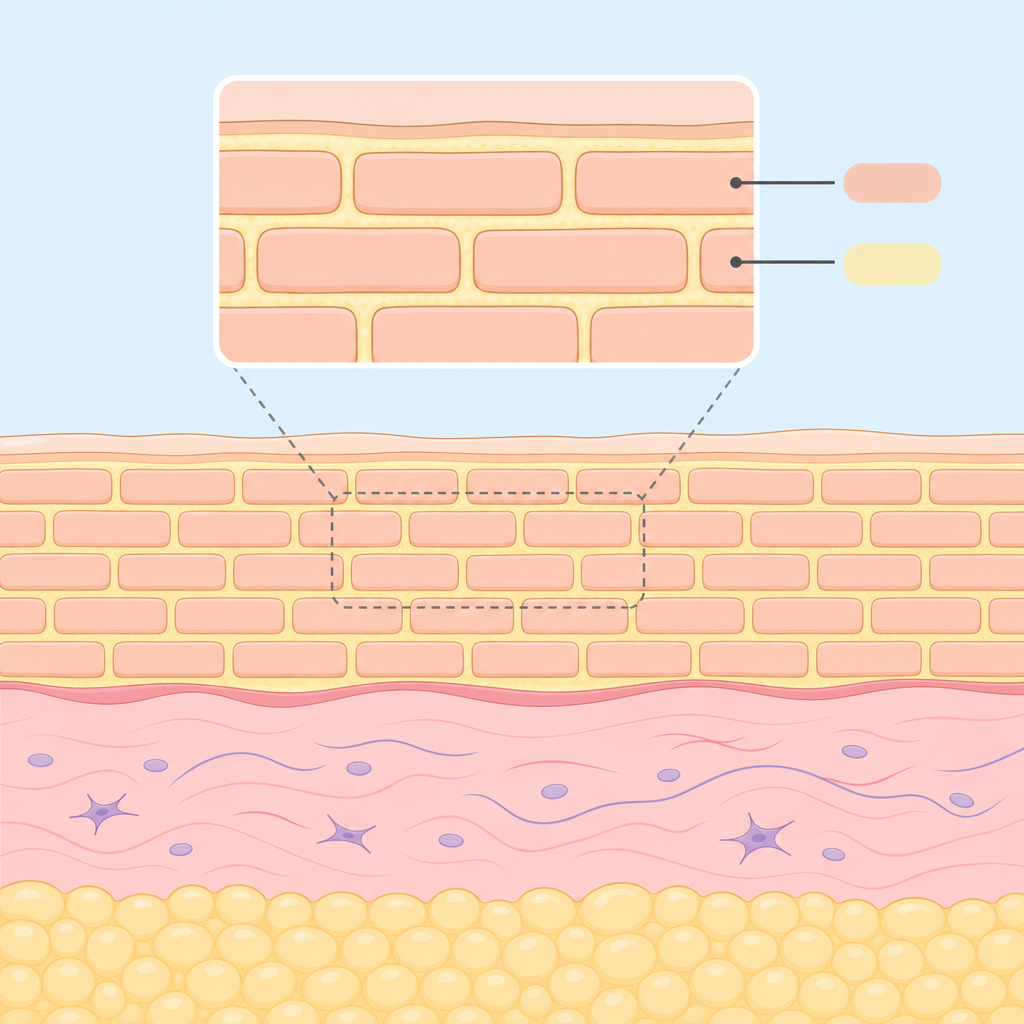
The term "skin barrier" might sound technical, but it refers to something very tangible. It's the outermost layer of the skin, known as the stratum corneum, and it determines two things at once: how much water your skin retains and what gets in from the outside. As long as it functions, you hardly notice it. But once it weakens, even skin that has been trouble-free for years will show signs.
The simplest way to imagine it is as a wall. Corneocytes, which are dead but still functional cells, are the bricks. The space between them is filled with mortar made of intercellular lipids—a blend of fats that hold the bricks together and seal the joints. As long as there's enough mortar, the wall is intact. When it diminishes, the joints open up, and water escapes from the skin faster than you can replenish it.
The mortar has three main components, each playing a different role. Ceramides make up the largest portion, creating a layered structure that ensures tightness. Cholesterol adds flexibility to this structure so it doesn't become brittle. Free fatty acids help maintain a slightly acidic environment on the skin's surface, which suits the natural skin microbiome. It's essential that they work as a team: if one component is missing, the excess of the other two can't compensate.
When lipids decrease, two things happen simultaneously. The skin starts losing water through evaporation—this is called transepidermal water loss and is the main reason for the feeling of tightness. At the same time, its permeability increases: fragrances, preservatives, or surfactants from cleansing products penetrate deeper than they should, causing the skin to react with burning or redness. That's why a cream you've used all spring without issues suddenly doesn't suit you—its composition hasn't changed, but the terrain it lands on has.
The barrier isn't disrupted by one dramatic event, but rather by an accumulation of small things. After summer, several usually come together:
- Ultraviolet radiation. Long hours in the sun stress the skin even if you don't get sunburned. Increased pigment production is just the visible part, but the quality of the stratum corneum also changes.
- Aggressive surfactants. Cleansing gels and soaps with high pH remove not only impurities but also part of the intercellular lipids. The skin can handle it once, but repeated daily exposure takes its toll.
- Excessive use of acids. Fruit acids and retinoids have their place in skincare, but when the barrier is weakened, frequent application worsens the condition.
- Hot water and long showers. Warm water dissolves lipids more readily than lukewarm water. After a vacation, when you shower twice a day, the small losses add up.
- Mechanical irritation. Sand, coarse exfoliating particles, or vigorous towel drying disrupt an already weakened surface. Friction doesn't clean the skin better, it just unnecessarily burdens it.
The good news is that the stratum corneum renews itself continuously. The less glamorous but more realistic news is that it takes time. Renewal in healthy skin is measured in weeks rather than days, and no single product can significantly speed up this rhythm. However, you can influence the burden: the fewer things dismantle the barrier in the meantime, the more smoothly it can cope. If tightness, redness, or flaking persist for more than a few weeks or worsen, such a condition should be assessed by a dermatologist—cosmetic care is support, not a substitute for professional examination.
Gentle Cleansing as the First Step to Regeneration
When your skin feels tight and peels after summer, most of us reach for a nourishing cream. However, regeneration starts a step earlier – with what you use to wash your face. A cleanser is the only cosmetic product designed to remove something, and therefore, it can harm a weakened barrier the quickest.
Why High pH Cleansing Gels Aren't Beneficial for Your Skin
Healthy skin has a slightly acidic surface. Traditional soaps and some highly foaming cleansing gels are significantly above this level and shift the skin into an alkaline range after washing. While healthy skin usually restores its natural environment on its own, it takes longer for a weakened barrier, allowing water to escape more easily in the meantime. Aggressive surfactants also contribute by washing away not only impurities but also some lipids that seal intercellular spaces.
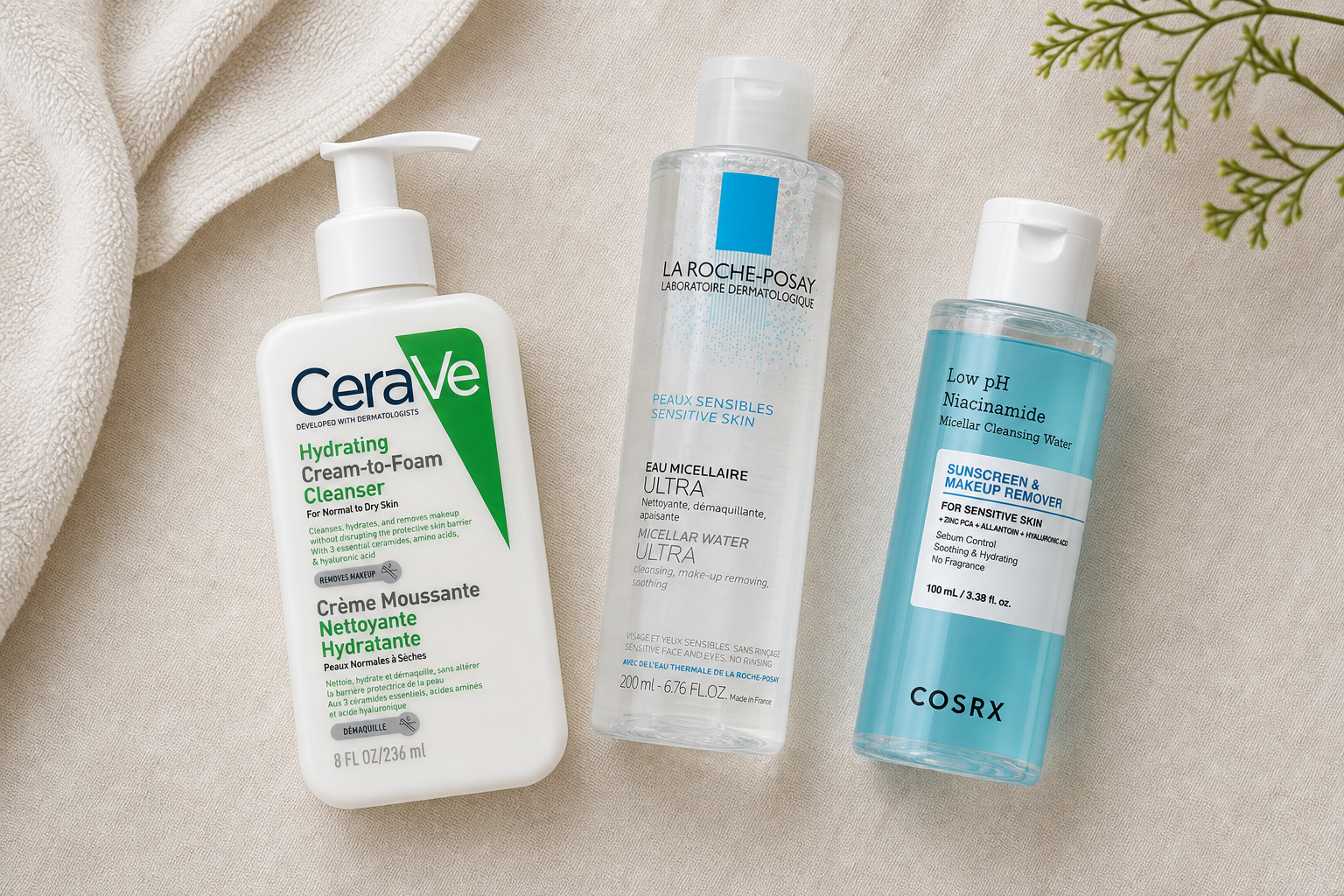
Gentle cleansing emulsions, cleansing milks, and creamy textures work differently: they contain fewer surfactants and are supplemented with softening ingredients, so your skin doesn't feel "squeaky" clean after rinsing. Micellar water works thanks to micelles, small clusters that bind makeup residues and oils. It's mainly suitable as the first phase of cleansing or for days when your skin reacts with irritation to almost anything.
You can tell your cleansing routine is further drying out your barrier by several signals:
- Within five minutes after washing, your skin feels uncomfortably tight, and you're waiting for cream as a rescue;
- Small flakes appear, most often around the nose, on the chin, and at the edges of the eyebrows;
- Your skin turns red after washing, and the redness takes more than fifteen minutes to subside;
- Seemingly oily skin becomes shiny faster than before during the day – this is often a reaction to dryness;
- The cream you've been using for years without problems suddenly stings.
Just one or two such signals are enough to consider switching your cleanser to a gentler one for a few weeks. The difference is usually noticeable fairly quickly, typically within ten days.
When Two-Phase Cleansing Makes Sense
Products with protective factors and waterproof textures are designed to stay firmly on the skin, so a quick wash with water won't reliably remove them. After a day in the sun, it makes sense to cleanse in two steps: first with an oil-based or micellar product to dissolve filters and makeup, and then with a gentle emulsion or gel to rinse off the rest. It sounds like extra work, but it actually saves your barrier – you don't have to use one product repeatedly or with pressure. In the morning, often lukewarm water or a very gentle emulsion is enough.
For the same reason, put aside rough scrubs with crushed particles and stronger acid exfoliations, ideally for at least the first two weeks. A weakened barrier loses flaked cells even without help, and further mechanical irritation prolongs the condition. You can return to them once your skin stops feeling tight and the redness disappears – and then gradually, starting once a week if needed.
Practical Details That Make the Biggest Difference
- Lukewarm water instead of hot. Hot water dissolves skin lipids faster, and the feeling of tightness is more pronounced after a shower.
- Short contact of the product with the skin. Let a foaming cleanser work for a few dozen seconds, not minutes – extra time doesn't improve the cleansing effect, it just dries out the skin.
- Gentle drying without rubbing. Pat with a towel, don't rub; ideally, use a clean towel or disposable tissue.
- Hands instead of tools. Leave cleansing brushes, rough washcloths, and gloves for when your skin is calm.
Cleansing is paradoxically the smallest change with the most quickly visible impact. Once your skin stops feeling tight after washing, subsequent care works more predictably.
Hydration Step by Step: Serums, Creams, Oils
Skin weakened after summer usually doesn't need more products, just a better order. The rule is: proceed from the lightest consistency to the thickest. A watery serum penetrates the upper layers of the skin quickly, a moisturizing cream locks it in, and the most nourishing layer comes last. If you reverse the order, the oilier texture creates a film on the surface, and the serum underneath has nowhere to go.
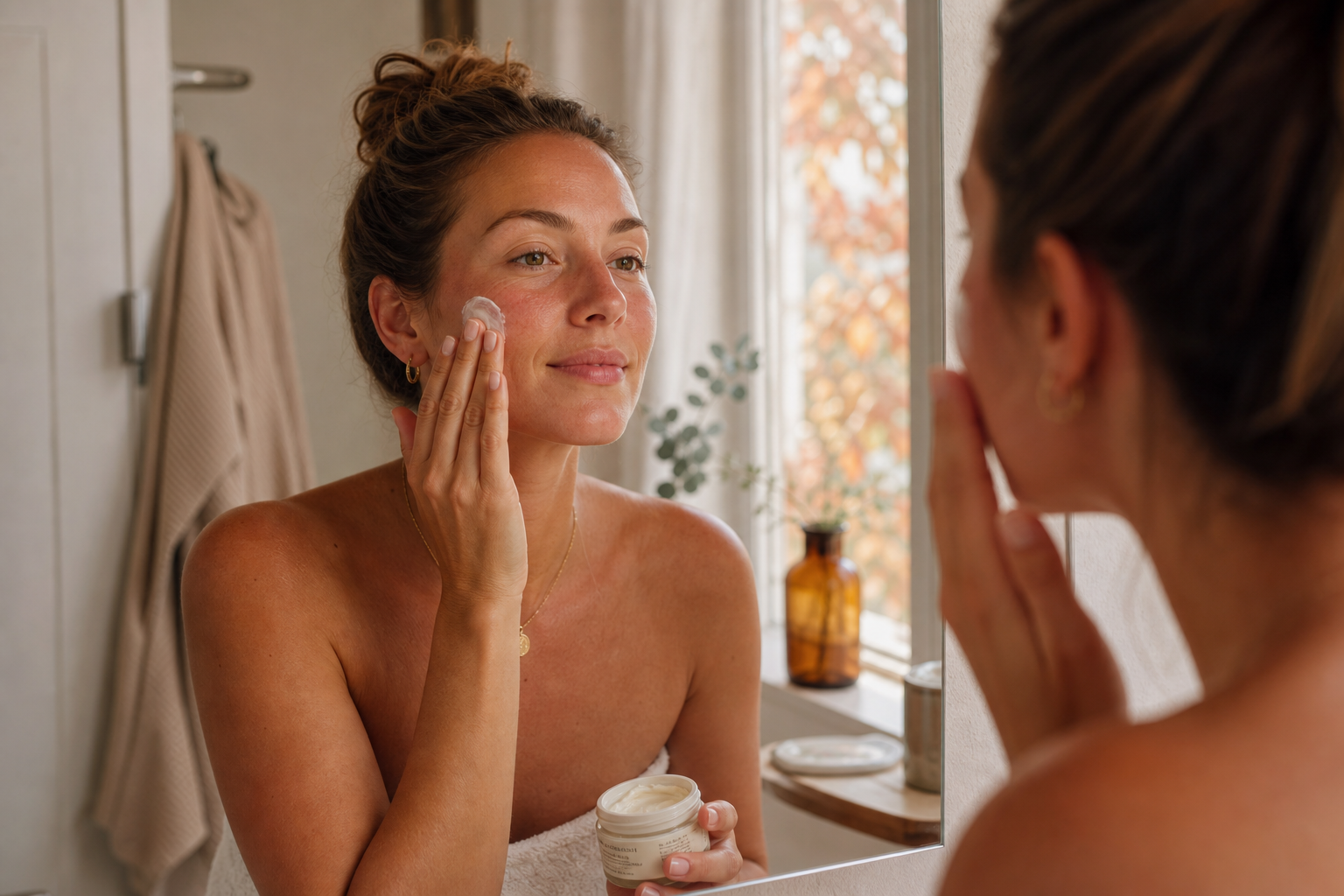
Apply serum to skin that is still slightly damp after cleansing – it spreads better. Just a few drops and a gentle pressing with the palms, no rubbing. This is where humectants come into play, ingredients that bind water. However, they are not enough on their own: in dry environments, like those created by air conditioning or heating, water evaporates from the surface almost as quickly as you applied it.
That's why the second step, a moisturizing cream, is more important than usual after summer. Its role is not just to add water, but mainly to reduce its loss and replenish lipids that the skin lost during summer. Here's the core of the matter: hydration without lipids often misses the mark after summer. If the skin lacks intercellular fats, even the largest dose of water in a serum won't solve the problem – it improves for a few hours, and by evening the skin is tight again. So, opt for a cream that combines both water and fat components, and don't be afraid of a thicker texture than your summer gel choice.
At night, you can afford an even richer layer: a more nourishing balm, or a few drops of oil applied at the very end. Oil itself doesn't hydrate the skin, but it helps slow down water evaporation. Use it sparingly and target areas that truly feel tight; for skin prone to clogged pores, avoid using it on the chin and forehead.
What Each Ingredient Does
- Hyaluronic Acid – a humectant that binds water and improves the feeling of suppleness. Works best under a cream.
- Panthenol – a soothing ingredient that weakened and reddened skin usually tolerates well.
- Niacinamide – a versatile ingredient that supports barrier function and helps even out skin tone with long-term use.
- Ceramides – lipids that are a natural part of the skin barrier. In creams, they replenish what was lost over the summer.
- Squalane – an emollient that softens and smooths without leaving a heavy film.
Be especially careful with uneven pigmentation, which summer tends to highlight. Niacinamide and vitamin C are among the ingredients that can gradually soften skin tone, but results come over weeks, not days – expect eight to twelve weeks of regular use. Vitamin C is often in more acidic formulations, and freshly irritated skin may react with stinging. If it stings after application, put it aside for a few weeks and start with gentler ingredients.
Introduce New Ingredients One at a Time
The most common mistake after summer is an enthusiastic overhaul of the entire routine over a single weekend. If you suddenly add a serum, a new cream, and vitamin C, and the skin reacts with redness, you have no way of knowing what's causing it. So proceed in small steps:
- Introduce one new product and give it seven to ten days before adding another.
- Test new serum first on a small area, like near the jawline.
- Keep acids and retinoids aside until the skin stops burning and peeling.
- If irritation occurs, return to the basics: gentle cleansing plus a simple cream.
A routine that helps weakened skin ends up looking surprisingly simple – serum, cream, and something more nourishing at night.
Autumn Routine: Sun Protection Continues
As soon as the holidays are over, sunscreen usually gets tucked away until next summer. However, by doing this, you remove a crucial step that helps your skin recover. Autumn sun may be less intense, and sunburn is less likely, but UVA rays remain consistent throughout the year and can penetrate clouds and window glass. These rays contribute to pigmentation spots from summer lasting well into winter.
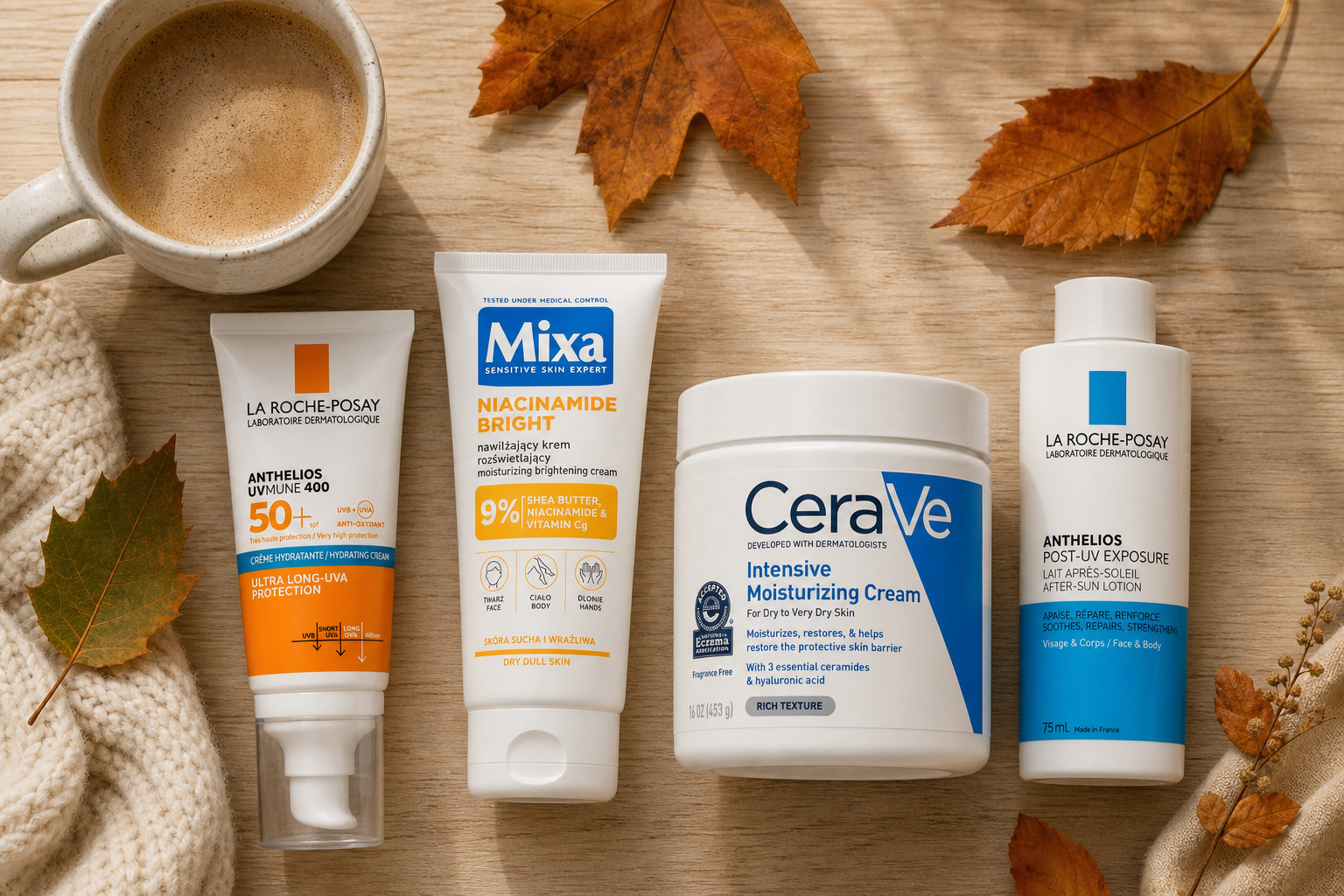
Practically, this means one thing: if you're focusing on uneven skin tone in your routine, applying sunscreen in the morning is essential. Without it, your skin is constantly stimulated to produce pigment, delaying results. Keep sun protection in your daily routine throughout autumn, ideally all year round – just adjust it according to how much time you actually spend outdoors.
Lighter Texture than in Summer
Summer sunscreens are designed for swimming, sweating, and long hours in direct sunlight. They tend to be waterproof, thicker, and less suitable for everyday autumn wear under makeup. If you know you'll spend most of your day indoors or commuting, opt for a light fluid, liquid cream, or daily moisturizer with SPF – the texture is thinner, absorbs quickly, and doesn't leave a film on the skin.
SPF 50 is sensible if you're dealing with pigmentation or have irritated skin post-summer. For a typical autumn day in the city, SPF 30 is a reasonable compromise. Apply it as the last step in your morning routine, after serum and hydration, and don't forget your neck, ears, and the backs of your hands – these areas often show uneven tone the most.
A Simple Plan for Four to Six Weeks
Barrier regeneration isn't a weekend task. It helps to spread out the steps over time and not introduce everything at once:
- Weeks 1–2 – Calm and Basics. Gentle cleansing, hydration, a more nourishing night layer, and sunscreen in the morning. Avoid acids, retinoids, and harsh peels for now.
- Weeks 3–4 – Lipid Replenishment. If your skin no longer feels tight after washing, add one new active ingredient and monitor the reaction for about two weeks.
- Weeks 5–6 – Targeted Care. Once your skin is calm, it's worth reintroducing a gentle peel about once a week or adding another active product. Sun protection remains unchanged in the routine.
If you experience burning, itching, or redness at any point, step back and stick to cleansing, hydration, and protection for a few days. If problems persist or worsen, consult a dermatologist – cosmetics cannot replace professional assessment.
How to Assemble Your Routine
In our skincare and body care range, you'll find several dermocosmetic brands that have long focused on sensitive and weakened skin. Choose according to your skin type and the step you're addressing:
- Bioderma – micellar waters, gentle cleansing gels, and shower oils, lines for sensitive, dry, and atopic skin.
- CeraVe – moisturizing creams, lotions, and cleansing emulsions with ceramides, simple fragrance-free formulas.
- La Roche-Posay – body balms for very dry skin, serums for uneven tone, and high SPF products for the face.
- Vichy – daily creams with SPF, hydrating boosters, and a range of sun protection products.
Whether you just want to add missing protection or build a routine from scratch, start with what your skin needs first: calm, hydration, and SPF every morning. The rest can be added gradually, as your skin indicates it's ready.
Category
Recommended articles

"Give a girl the right shoes and she can conquer the world!" Marilyn Monroe