

Sunscreen may go back in the cabinet after the holidays, but UV rays still affect your skin in autumn. We've selected five lightweight face creams and fluids with SPF that can be worn under makeup, and we'll advise you on which one suits you best.
September Sun Warms Less, But Still Affects Your Skin
The end of summer holidays usually follows a predictable pattern in most bathrooms. The sunscreen that sat at the edge of the shelf all summer is moved to the back of the cabinet – somewhere near the swimsuits, scarf, and plans for the next vacation. In the morning, you return to your regular moisturizer because the sun no longer burns, your skin doesn’t feel sticky after work, and there’s no urge to reach for the tube with SPF. It seems perfectly logical. However, ultraviolet radiation follows a different calendar than our feelings.
What you perceive as burning in the summer, which ends with redness after a few hours by the water, is mainly due to ultraviolet radiation type B. Its intensity in our latitudes indeed decreases during September and October, which is why you rarely get sunburned during this period. However, alongside it, type A radiation also affects the skin, which doesn’t heat or burn. It doesn’t cause any immediate reaction to indicate you’ve been outside too long, yet it penetrates deeper skin layers, and its amount changes much less throughout the year.
This is precisely the difference that makes autumn deceptive. Ultraviolet radiation type A passes through cloud layers and ordinary window glass, so you encounter it even on days when you don’t wear sunglasses at all. The commute to work, an hour by the office window, a lunch break outside, a walk with the dog on a cloudy afternoon – none of these seem like sun exposure, yet they add up. Moreover, the midday sun in September still stands relatively high; September is not November.
Dermatological cosmetics have long addressed this fact: ultraviolet radiation type A contributes to the formation and deepening of pigment spots and to signs known as photoaging – loss of elasticity, uneven tone, and fine wrinkles. It’s not something you’ll see in the mirror the next morning, and that’s precisely why year-round protection is so easily forgotten. This is doubly true for pigment spots. If you have darker patches left on your cheekbones or above your upper lip after summer, stopping SPF in autumn is a reliable way to complicate your efforts to lighten them.
There’s no need to make it a scare tactic. SPF in your autumn routine isn’t an obligation or a catch-all insurance; it’s a specific step that makes the most sense in several situations:
- you’re dealing with pigment spots or dark marks from imperfections,
- you’re using retinol, acids, or other active ingredients for which daily protection is commonly recommended,
- you spend most of the day by a window or repeatedly move outdoors during the day,
- for mature skin, you want to maintain the results you’ve already invested time and patience in.
The good news is that today’s daily creams and fluids with SPF have little in common with thick beach cosmetics. They spread easily, absorb quickly, and makeup stays on them. In this article, we’ll introduce you to five specific facial creams and fluids with SPF from dermatological brands available with us, and for each, we’ll discuss who it suits and how it behaves on the skin. We’ll also advise you on how to choose among them so that your morning care takes the same minute as before.
A Day Cream with SPF is Not the Same as a Summer Sunscreen
When we hear "sun protection factor," most of us think of a large beach bottle that we pull out twice a year at the seaside. However, a product for all-day exposure to direct sunlight and a day cream with SPF are two different types of cosmetics, even if they have similar numbers on the packaging. They differ in texture, how they behave on the skin, and most importantly, the situations they are designed for.
A classic sunscreen is designed for extreme conditions – hours in direct sunlight, sweat, sand, and repeated swimming. Therefore, it tends to be more water-resistant, thicker, and often leaves a noticeable film. On the beach, this makes sense. On a September morning before heading to work, not so much: under makeup, such a cream behaves differently than you might expect, and after a few hours in the office, no one wants it on their face anymore.
A day cream or fluid with SPF addresses the opposite situation. It targets a typical day in the city – driving, lunch outside, walking the dog, long sessions by a glass wall. Sun exposure is lower but spread throughout the year and repeated daily. This is reflected in the formulation: lighter, faster-absorbing, and ready for something else to be applied on top.
When choosing such a cream, it's worth paying attention to a few specific things:
- Protection against UVA radiation. The SPF number primarily describes protection against UVB radiation, which causes sunburn. UVA radiation, often associated with premature skin aging, doesn't lose its intensity as much in autumn as UVB does. Look for products that specifically state broad-spectrum protection or have the UVA symbol in a circle.
- Texture without a sticky film. A cream that remains greasy or shiny on the skin will stop being applied after three days. Fluids and gel emulsions are generally more appreciated in this regard than rich creams, although for dry skin, the opposite is true.
- Compatibility with makeup. Morning layering is a weak point for most high-SPF products. A good day cream can be covered with a primer and liquid foundation after a while without rolling into small clumps under the brush.
- Suitability for your skin type. Oily and combination skin will appreciate a mattifying fluid, sensitive skin a simple composition with gentle filters, and mature skin a more nourishing consistency. The range of dermocosmetics today is broad enough that you don't have to compromise on comfort or protection.
This is precisely why SPF has moved from the beach shelf to the daily routine in recent years. Dermocosmetic brands from our selection, such as Vichy, Bioderma, La Roche-Posay, CeraVe, or Uriage, now offer day creams and fluids with high SPF as a regular part of skincare, not as a seasonal accessory. It's not a separate category alongside hydration – hydration and protection simply meet in one step.
A quick note for clarity. Tinted variants, i.e., creams with SPF and a light covering pigment, are a separate chapter – they address tone unification, shade selection, and behave more like a light foundation. In this selection, we focus on clear creams and fluids that work as a neutral base for anything you apply on top in the morning.
Three Lightweight Creams and Fluids That Work Under Makeup
Autumn protection hinges on whether you actually apply cream every morning. We've chosen the first trio based on one criterion: it must be light enough to wear under makeup while providing full protection against ultraviolet rays. All three products have a neutral or very mild scent, and none leave a noticeable white film.
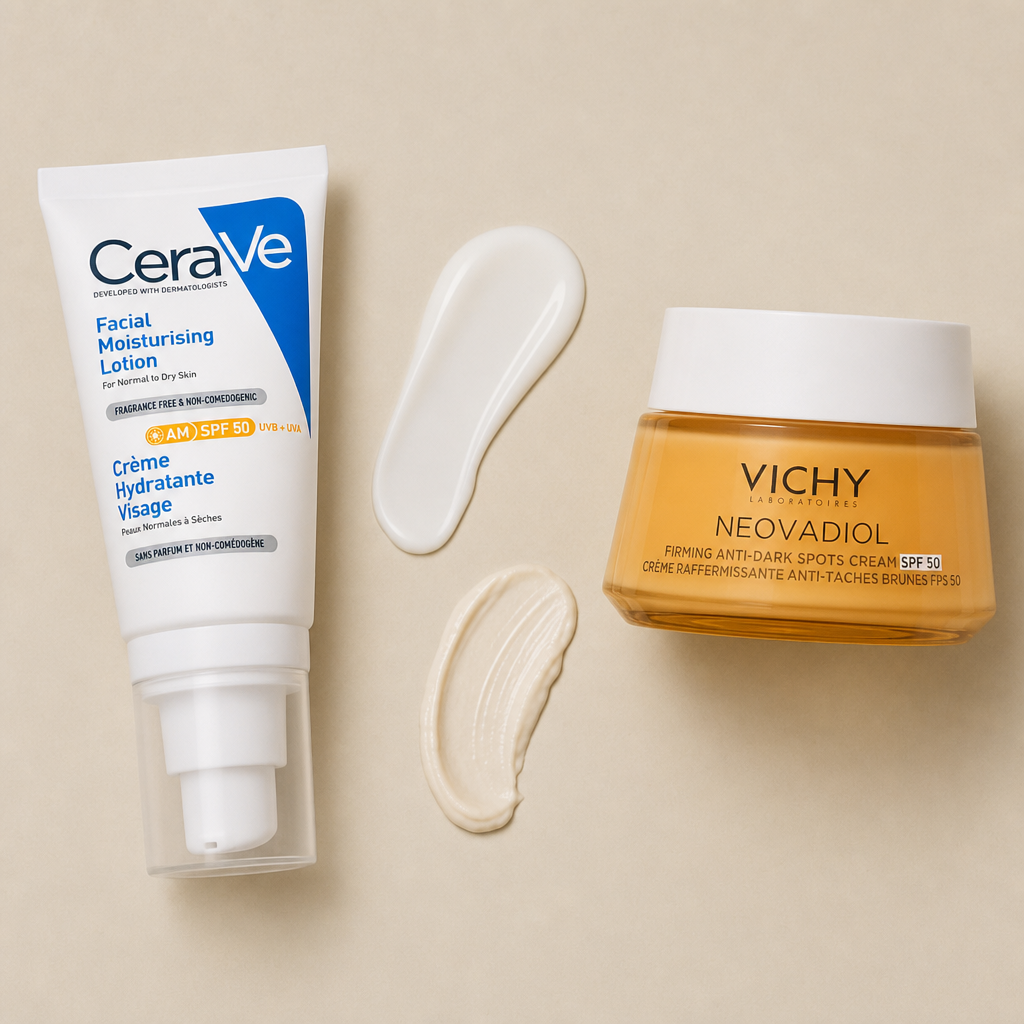
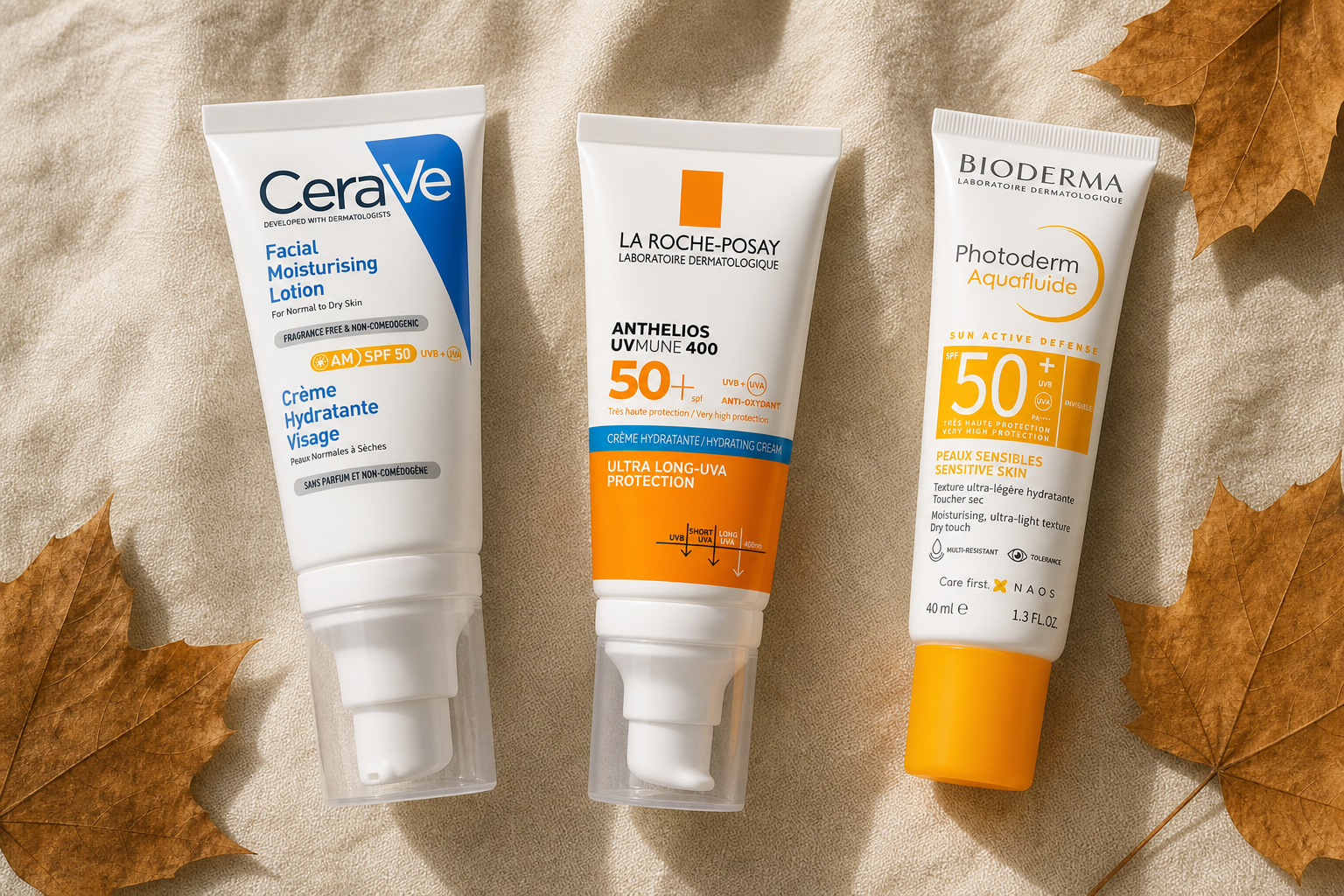
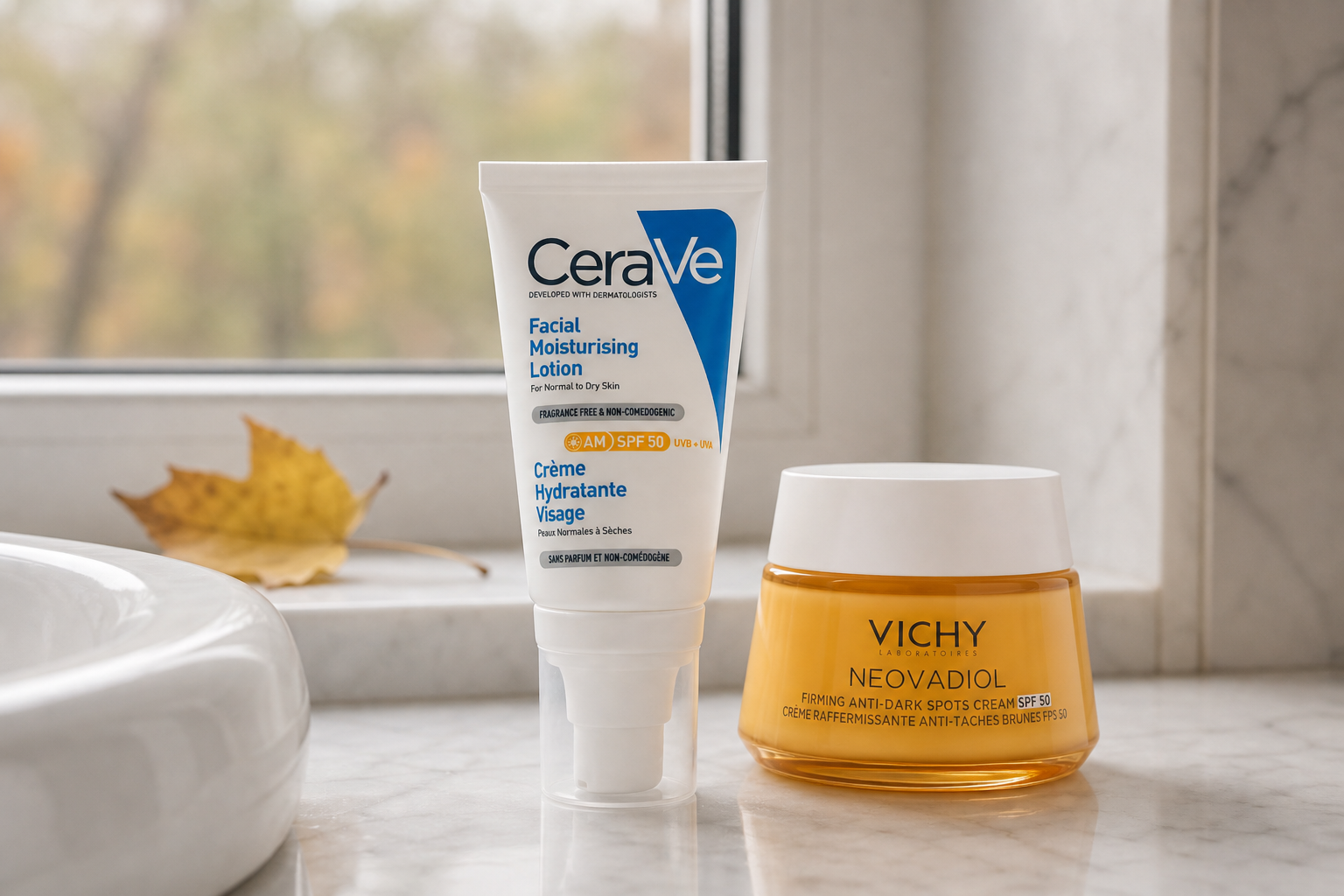
CeraVe Facial Moisturising Lotion SPF50
A moisturizing fluid that makes sense if you're looking for one product instead of two. It combines daily hydration with an SPF 50, cutting one step from your morning routine. The brand relies on ceramides and hyaluronic acid, ingredients that help the skin retain moisture—something you'll appreciate when the heating starts drying out the air in your home.
- Texture: a lightweight milky fluid that spreads into a thin layer and absorbs quickly.
- Under makeup: leaves a satin finish, with foundation adhering without flaking.
- Suitable for: normal to dry skin and anyone dealing with tightness after washing.
- Price range: more affordable end of dermocosmetics; compared to the other two options, it's an entry-level choice.
La Roche-Posay Anthelios UVMune 400
The choice for those who want coverage of the long-wave UVA rays—part of the spectrum that penetrates deeper skin layers and contributes to photoaging and pigmentation spots. The UVMune 400 line is built on a filter the brand developed with this spectrum area in mind. The moisturizing cream with SPF 50+ is a variant intended for regular daily facial care, not for beach outings.
- Texture: creamy, slightly richer than a fluid, but not sticky after application.
- Under makeup: requires about a minute to dry, then holds even liquid makeup without sliding.
- Suitable for: normal to dry skin, sensitive skin, and anyone seeking high protection due to pigmentation.
- Price range: more premium dermocosmetics, chosen for the filter, not the packaging size.
Bioderma Photoderm
If your skin burns, reddens, or develops minor imperfections after using regular sunscreens, the Photoderm line is worth a try. Bioderma bases it on the same approach to sensitive skin that most customers know from the Sensibio micellar water. The line offers several textures: Photoderm Aquafluide is a lightweight fluid for daily wear, Photoderm AKN Mat with SPF 30 or 50+ targets combination and oily skin prone to imperfections and leaves a matte finish.
- Texture: from very fluid to mattifying emulsion—depending on the specific variant.
- Under makeup: mattifying variants work as a base layer on their own, the liquid fluid disappears on the skin almost without a trace.
- Suitable for: sensitive skin that reacts to traditional sunscreens, and combination skin that shines in the heat.
- Price range: mid-range between the previous two tips.
Whichever of these three options you choose, the difference lies not in the level of protection factor, but in the texture and how your skin behaves throughout the day. If you're unsure, try to imagine your typical morning: the fewer steps and the shorter the drying time, the more likely you'll stick with the cream even in November.
When Protection Also Needs to Address Pigmentation and Mature Skin
For some of you, a protective factor is purely preventive. For others, it's a tool to address what you already see on your skin – uneven tone after summer, darker spots on the cheekbones and forehead, or skin that has lost firmness over the years. In such cases, it makes sense to opt for a day cream that not only offers protection but also includes other active ingredients, even if it means choosing a more premium product.
Why a year-round protective factor makes the most sense for pigmentation. Dark spots react to ultraviolet radiation even when you perceive it as weak. The September and October sun may not burn, but UVA rays penetrate clouds and window glass, causing pigmentation to return. If you're using care aimed at evening out your tone and don't cover it with a protective factor during the day, you're working against yourself: you try to even out the tone at night and expose your skin to stimuli that maintain the spots in the morning. For pigmentation, a protective factor is not a seasonal accessory but a year-round routine staple.
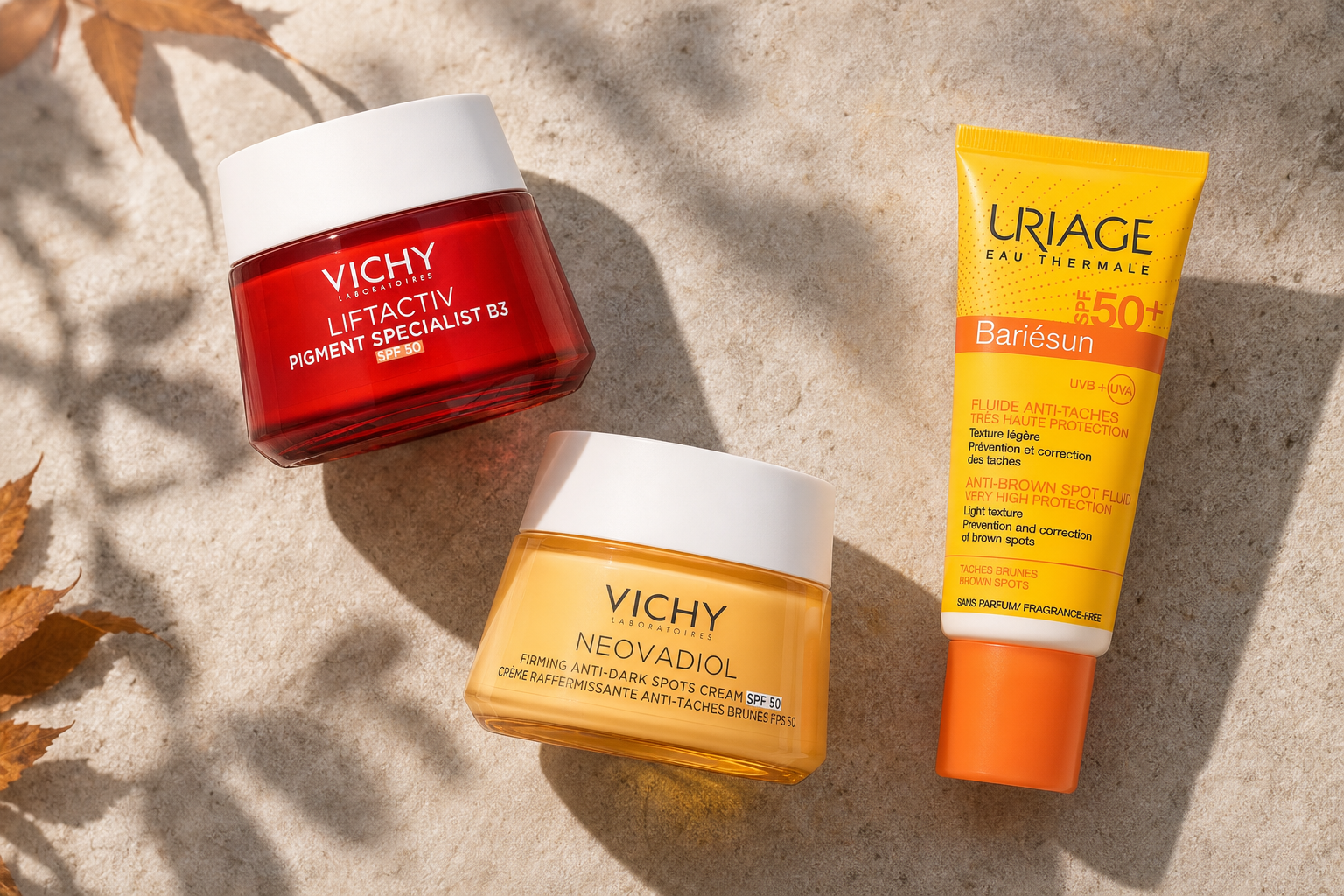
Vichy Liftactiv B3 SPF 50 is a day cream that the brand bases on niacinamide, or vitamin B3, combined with a protective factor of 50. It focuses on evening out tone and dark spots, making it a choice for skin that doesn't look uniform after summer. The texture is creamy and suits normal to dry skin; if you have significantly oily skin, a lighter fluid will be more comfortable during the day. Remember that tone care doesn't change overnight – it takes weeks and months of regular use, and results vary for each skin type.
Vichy Neovadiol Post-Menopause Firming Anti-Dark Spots Cream SPF 50 targets mature skin during menopause, which tends to be drier, thinner, and less firm than before. The cream combines firming care, dark spot treatment, and a protective factor of 50 into one morning step. The texture is richer and nourishing, which is exactly what dry mature skin appreciates in autumn, but it means it's less suitable under mattifying makeup than light fluids. Don't expect miracles overnight; the goal is to keep the skin protected and hydrated, not to promise specific results.
It's worth opting for a more comprehensive day cream with a protective factor, especially if any of the following apply:
- After summer, darker spots have appeared on your cheeks or forehead, and you want to prevent their return.
- You use evening care with retinol, fruit acids, or vitamin C and need to protect your skin during the day.
- Your skin is undergoing hormonal changes, and a regular moisturizing cream is no longer enough.
- You want to complete your morning routine in one step without layering serum, cream, and protection separately.
Daytime protection complements evening care. A morning cream with a protective factor protects the skin but does not regenerate it on its own. That work is done by night care when the skin is unburdened, and active ingredients that don't get along with the sun can work. For mature skin, it makes sense to complement the daily Neovadiol with a night cream from the same range, while for skin that addresses wrinkles and firmness, a night cream like Vichy Liftactiv Collagen Specialist is effective. The morning and evening duo makes economic sense too: you're buying two steps, not five.
And who might not find this investment worthwhile? If your main concern is that your protection doesn't slide under makeup, and you're not dealing with pigmentation or loss of firmness yet, a simpler and lighter fluid will suffice. A premium day cream makes sense when you want more than just protection from your morning step – and when you're ready to use it year-round, not just until the first rainy week.
Which Cream Suits Whom and How to Incorporate It into Your Autumn Routine
Whether you're dealing with sensitive skin that reacts to almost everything or the first pigment spots after summer, you can narrow down your choices with a few simple guidelines. For clarity, we've summarized all five tips into one list.
- Sensitive and Reactive Skin: Bioderma Photoderm – this range is built around tolerance and offers lightweight textures that don't unnecessarily burden the skin.
- Oily and Combination Skin: CeraVe Facial Moisturising Lotion SPF50 – a liquid emulsion that absorbs quickly, doesn't leave a noticeable shine, and works well with makeup applied on top.
- Dry Skin and All-Day Wear Under Makeup: La Roche-Posay Anthelios UVMune 400 – a creamier option with high UVA protection for those who want one product for hydration and protection.
- Skin Prone to Pigmentation: Vichy Liftactiv B3 SPF 50 – daily care that combines a high protection factor with care for an even skin tone.
- Mature Skin in Menopause and Beyond: Vichy Neovadiol Post-Menopause SPF 50 – a richer texture that considers the changed needs of the skin while maintaining high protection.
If none of the mentioned textures suit you and you're primarily looking for tolerance, a good alternative is the Uriage Bariésun range. It's also designed for sensitive skin and, in addition to classic creams, offers lighter formats, so you can choose based on whether you want to wear the product every day under makeup or rather supplement it during a longer stay outdoors.
How Much to Apply and Where the Cream Fits in Your Routine
A common reason why the declared protection doesn't work in practice is applying too thin a layer. For the face and neck, use about half a teaspoon of product, which is significantly more than most of us apply inadvertently. It helps to divide it into several smaller portions – forehead, cheeks, nose, chin, and neck – and only then spread it all out. Don't forget the ears, under-eye area, and hairline; these are the areas where protection is most often lacking.
In your morning routine, SPF cream goes at the end of your skincare: after cleansing, after serum, and before makeup. Give the serum a few dozen seconds to ensure the layers don't mix and the protective film remains intact. Before reaching for a primer or foundation, let the cream settle for two to three minutes – makeup then applies noticeably better and creases less. If you spend a significant part of the day outdoors, it makes sense to reapply protection during the day.
And one more thing that's easiest to forget in autumn: an overcast sky is no reason to skip the cream. Clouds let through some ultraviolet radiation, and your skin will get it even on the way to work or by the window in the office. It's more practical to make the protective factor an automatic step, as natural as cleansing or moisturizing. In spring, you won't be returning to pigment spots that subtly darkened during autumn and winter.
If you want to compare the mentioned creams side by side, you can find them in the skincare section of our e-shop. It's also worth comparing the size of the packaging: a product you use daily and in sufficient quantity will be used up faster than you might expect.
Category
Recommended articles

"Give a girl the right shoes and she can conquer the world!" Marilyn Monroe