
 Riiffs Freeze in Flames: Ice and Flames Illuminate Warsaw
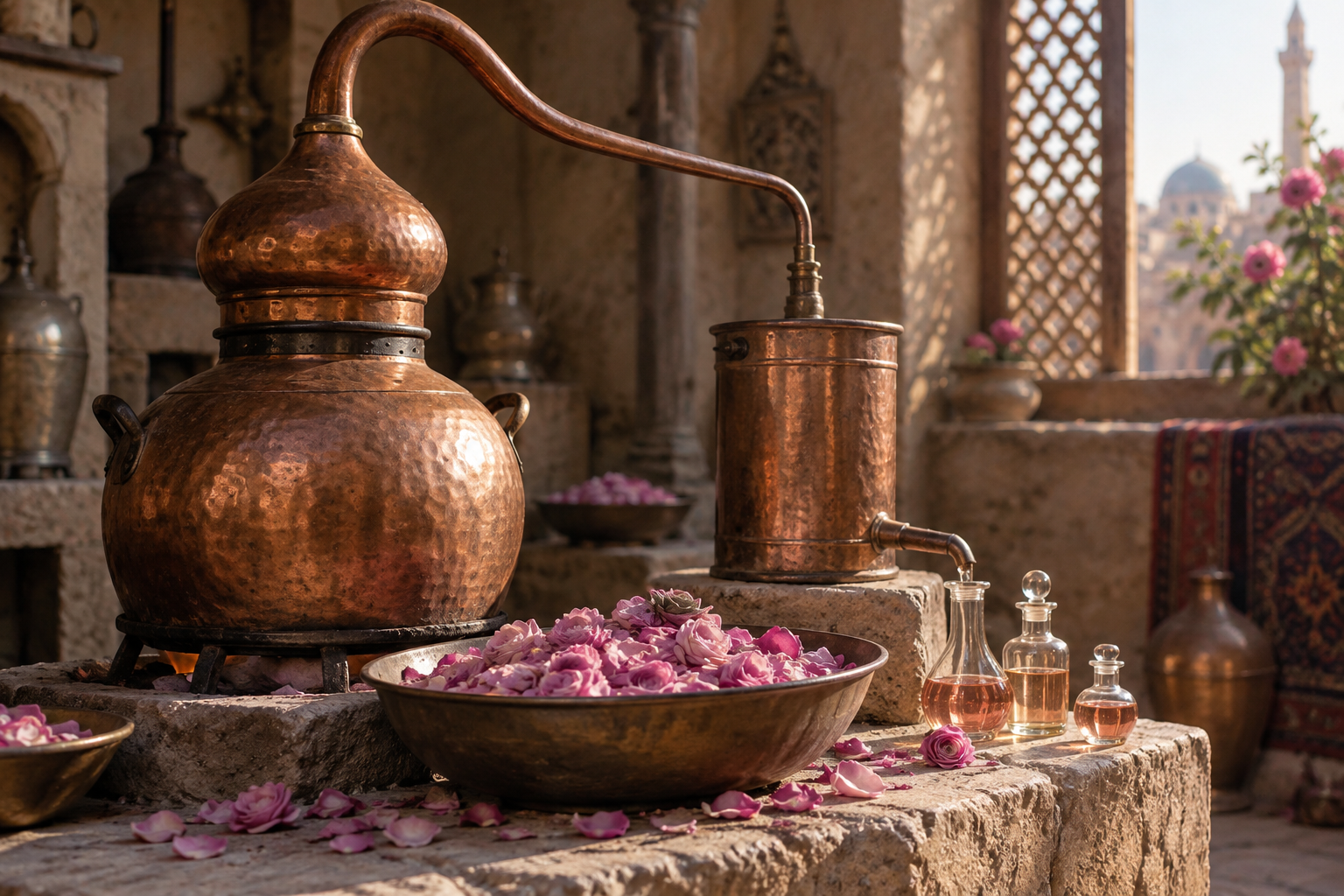
In the third part of the series The History of Fragrances, we journey into the Arab and Persian world of the early Middle Ages, where the art of scent became a science. Discover the alembic, Avicenna, rose water, and attars, and learn how this knowledge made its way back to Europe.
From Roman Roses to Arab Scholars
Welcome to the third installment of the History of Fragrances series. In the first part, we journeyed to ancient Egypt and Mesopotamia, where fragrant resins rose in temples to the gods, and oils and ointments were used to care for the bodies of both the living and the dead. The second part, titled Rome Smells of Roses, took you through the baths, feasts, and markets of an empire that imported fragrant substances from much of the then-known world. Today, we move forward several centuries – to a time when the center of fragrance work shifted to the Middle East.
When the Western Roman Empire fell in the 5th century, many trade routes were disrupted, and some of Rome's sophistication in the West was forgotten. However, life continued in the East: Byzantium and Sassanian Persia continued to cultivate the tradition of fragrant oils, incense, and gardens. Into this environment, a new force entered in the 7th century. Arab conquests connected vast territories within a few decades, and by the 8th century, the Islamic world stretched from Andalusia on the Iberian Peninsula to Persia and Central Asia.
This vast empire had one great advantage for the history of fragrances: it united people, languages, and knowledge that had previously lived separately. Merchants traveled with caravans overland and with ships by sea, allowing raw materials from the Arabian Peninsula, India, and Southeast Asia to meet in a single marketplace. Fragrant substances thus came into the hands of people who not only wanted to use them but also to understand them.
The heart of this transformation became Baghdad, founded by the Abbasid caliphs in 762 as their new capital. According to tradition, the House of Wisdom, or Bayt al-Hikma in Arabic, was established here – a library and meeting place for scholars, which flourished approximately in the 9th century under Caliph al-Ma'mun. Historians still debate whether it was a true academy or rather a palace library with a translation workshop. What is certain is that translation was concentrated in Baghdad at that time. Works by Hippocrates, Galen, Aristotle, and Dioscorides, whose work describes medicinal and aromatic plants in detail, were translated from Greek, Syriac, and Persian into Arabic. Among the most famous translators was Hunayn ibn Ishaq, and alongside medical texts, attention also turned to alchemy.
Why is this so important for the story of fragrances? Greek authors left descriptions of plants, resins, and methods for preparing ointments, oils, and medicinal preparations. However, Arab and Persian scholars did not take their writings as closed and unchangeable wisdom. They read, compared, supplemented, and most importantly, tested them in practice. Fragrance gradually ceased to be just a custom, ritual, or expression of luxury – it became a field in which observation, recording, and verification were key. Anyone who wanted to discover how to capture the scent of a rose so that it would last for months had to understand plants, fire, and water.
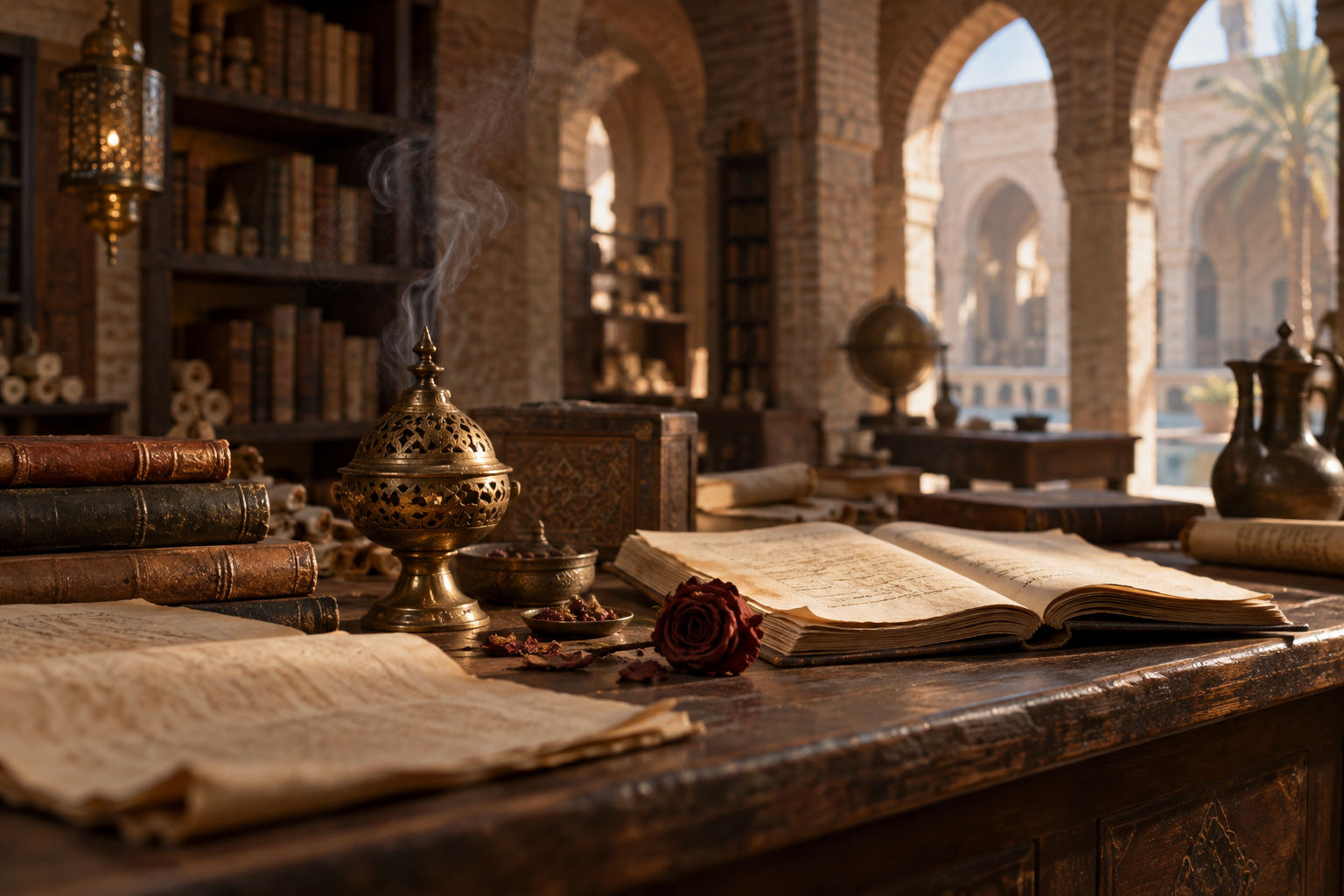
Imagine for a moment the Baghdad library full of manuscripts, where doctors, philosophers, and translators bent over parchment and paper. It was from this environment that the tools and methods emerged that, many centuries later, helped create perfumes as we know them today.
Alembic: How Avicenna Perfected Distillation
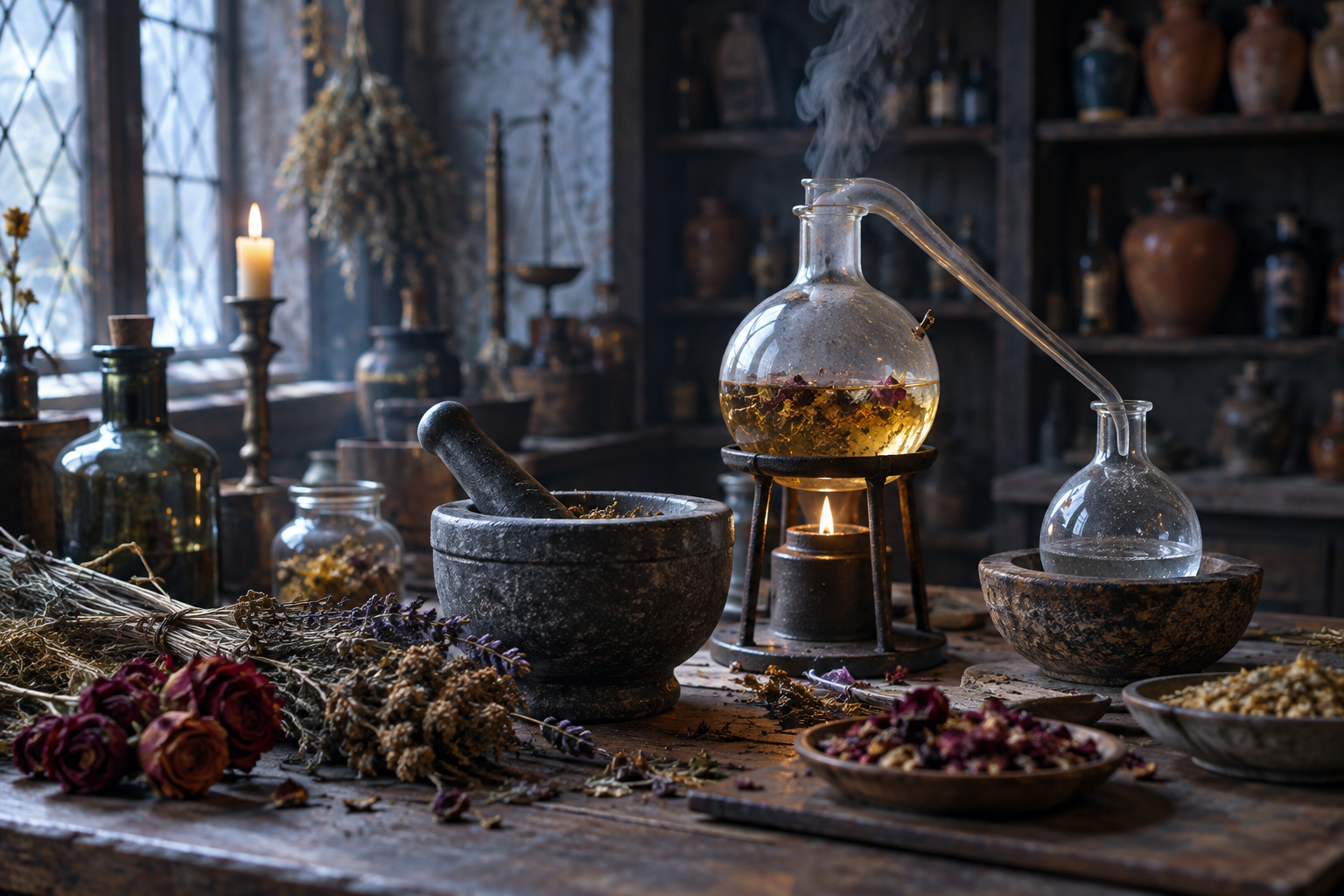
The word alembic sounds mysterious, but it refers to a fairly simple thing – a distillation apparatus. It entered European languages from the Arabic al-anbík, which itself comes from the Greek ambix, meaning a vessel or lid. The etymology suggests that it is not an Arab invention in the true sense: similar devices were used by alchemists in Egyptian Alexandria in the first centuries AD. However, Arab and Persian scholars adopted the alembic, described it, improved it, and most importantly, made it a common tool in laboratories, pharmacies, and fragrance workshops.
You can imagine the principle with a pot and lid, where droplets condense during cooking. The alembic consists of three parts:
- Lower vessel – ingredients, such as flower petals, are placed inside and covered with water. The vessel is then heated over a fire or in a water bath.
- Head – placed on the lower vessel, it captures the rising steam, which carries with it tiny fragrant substances from the plants.
- Conduit pipe – leads the steam out of the head. As the steam cools, it turns back into liquid, which drips into a collecting container.
The result is a fragrant watery liquid, and if there are enough raw materials, a thin layer of oil may appear on its surface. This concentrated portion is the precursor to what we now call essential or ethereal oil.
The founder of Arab alchemy is often considered to be Jabir ibn Hayyan, who is said to have lived in the 8th century. A large collection of writings has survived under his name, although historians believe that much of it was written by later authors who claimed his authority. These texts, in any case, rank distillation among the basic laboratory procedures.
More specifically, al-Kindi, a scholar active in Baghdad in the 9th century, delved into fragrances. He is credited with a treatise on perfumes and distillation, containing numerous recipes for fragrant waters, oils, and substitutes for expensive materials. For the history of perfumery, it is valuable evidence that fragrance distillation was already an established craft at that time, not just a curiosity for scholars.
The main figure in this story, however, is Avicenna, whose real name was Ibn Sina (circa 980–1037), a Persian physician and philosopher. Tradition attributes two things to him: perfecting cooling during distillation by coiling the conduit pipe into a spiral and cooling it with water, and obtaining rose essence directly from petals. Better cooling means that the steam condenses more efficiently, and fewer fragrant substances escape uselessly.
With both claims, caution is warranted. It is a tradition, not a documented invention – rose water was distilled before Avicenna, and the cooling spiral appears in sources rather later. His true contribution may lie mainly in carefully describing the processes and placing them within a scientific framework. Whether you see him as an inventor or a skilled mediator, the principle his era popularized has remained unchanged: steam distillation remains one of the main methods of extracting fragrant oils from plants for today's perfumes.
Rose Water and Attars: The Riches of Persian Gardens
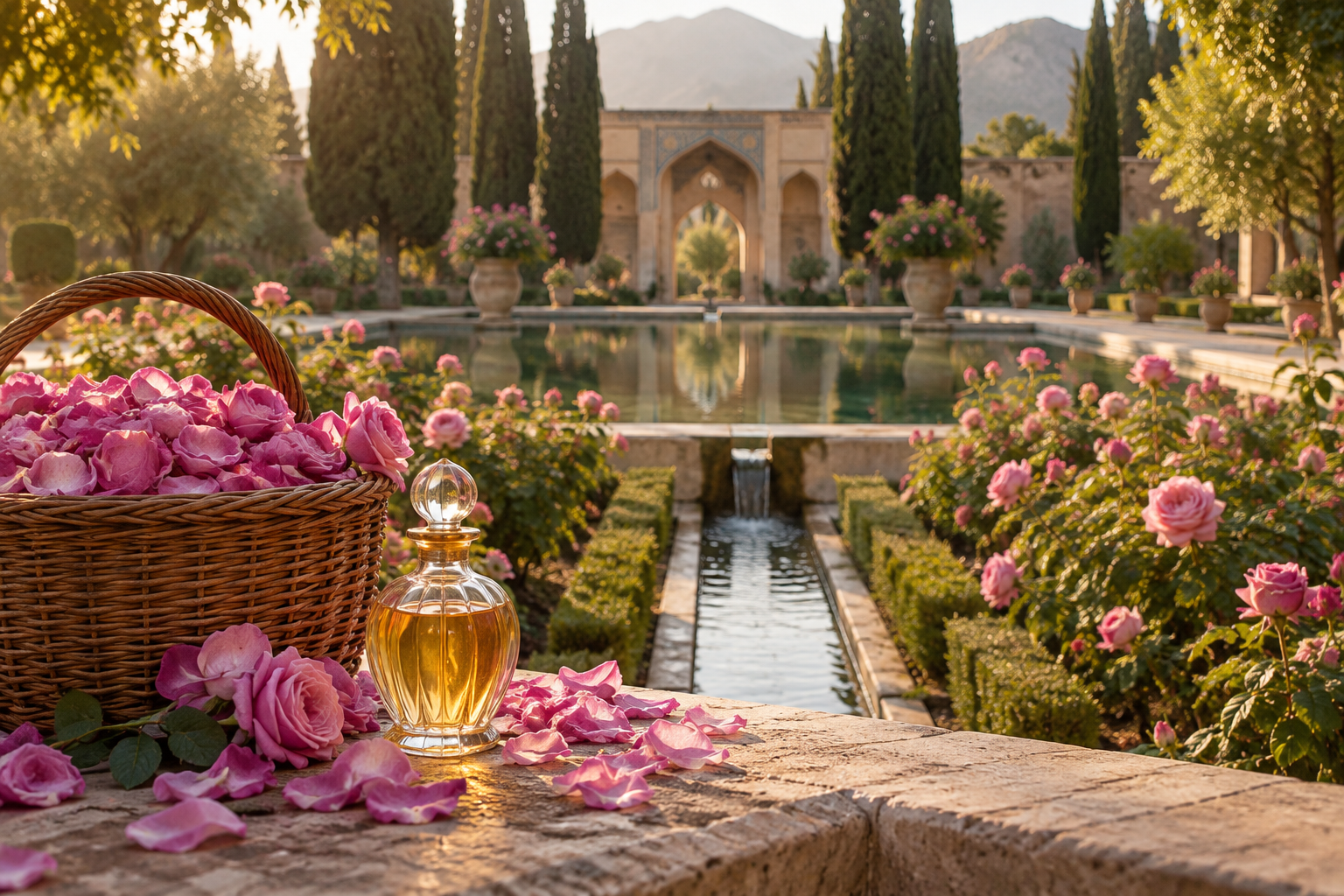
Imagine a walled garden, with a pool and channels of flowing water at its center, surrounded by beds of roses whose fragrance lingers in the warm air until late evening. The Persian garden was not just a place of rest—it was a vision of paradise and a source of a commodity that became one of the most valuable exports of the ancient world. Rose water was produced from the petals of roses here.
The region of Fars in southern Iran is traditionally considered the center of production. According to historical accounts from Arab geographers and travelers, rose water was distributed from here to Mesopotamia, Egypt, India, and according to some sources, even to China. Harvesting took place early in the morning when the flowers were most fragrant, and the petals were processed without unnecessary delay. This tradition continues in Iran to this day—in the vicinity of the city of Kashan, Damask roses are harvested every spring, and rose water is still prepared in small family workshops.
Attar: Fragrance Without Alcohol
Alongside rose water, another form of fragrance developed in the Arab, Persian, and later predominantly Indian world—attar (often spelled attar or ittar). It is a concentrated oil essence that contains no alcohol. Fragrant substances from flowers were traditionally captured in a carrier oil, most often sandalwood, resulting in a thick, intense fragrance applied in only tiny amounts directly to the skin.
Attars hold a special place in the Islamic world for practical reasons: without alcohol, they can be used without concern during prayer and religious festivals. Their tradition is still alive today—the Indian city of Kannauj is renowned for producing attars using ancient methods, and oil-based fragrances are an integral part of Arabian perfumery. If you've ever encountered a perfumed oil, you've encountered a direct descendant of this centuries-old tradition.
Ingredients That Shaped the World of Fragrance
Roses held a prominent place in this world, but they were far from alone. Trade routes brought ingredients from various corners of the known world to the markets of Baghdad, Basra, or Damascus:
- Frankincense and Myrrh – aromatic resins from the southern Arabian Peninsula and Africa, associated for centuries with religious ceremonies.
- Ambergris – a rare substance from sperm whales, washed ashore by the sea. Valued for its warm, deep scent and ability to lend longevity to compositions.
- Musk – originally an animal-derived ingredient from the Himalayas and Tibet, one of the most expensive. Today, only its synthetic form is used in perfumery.
- Camphor – a fresh, cooling substance from Southeast Asia, mentioned in historical sources among luxury goods.
These ingredients composed fragrances that we now classify as oriental—warm, resinous, and sensual. Their echoes can be found in many contemporary compositions, where ambergris, musk, or frankincense appear in the base notes.
Rose Water in Cuisine and Faith
Rose water was not just for the dressing table. It flavored sweets, sherbets, rice dishes, and pastries and still holds a place in the kitchens of the Middle East and India today. Guests' hands were sprinkled with it as a sign of hospitality, and it was used in religious ceremonies as a symbol of purity.
This is also tied to a well-known story. According to tradition, Sultan Saladin ordered the sacred sites to be washed with rose water after the conquest of Jerusalem in 1187 to purify them. Historical accounts report that a large quantity was brought into the city. Whether history unfolded exactly this way or later tales embellished it, it clearly shows the value rose water held in the ancient world—it was not just a fragrance but a symbol of respect and renewal.
Fragrance as Medicine: Healing, Spas, Everyday Purity
For scholars of the Arab and Persian world, fragrance was not just a pleasant accessory. Imagine a time when the boundaries between the pharmacy, kitchen, and dressing table practically did not exist – the same substances that scented a festive feast also appeared in medical texts. Fragrant materials were perceived as something that affected the whole body and mind, and they were treated accordingly.
The most famous testimony is the Canon of Medicine, an extensive work by the Persian physician and philosopher Ibn Sina, known in Europe as Avicenna, completed around the beginning of the 11th century. His section on medicinal substances describes hundreds of materials of plant, animal, and mineral origin, including rose, saffron, amber, musk, and camphor. The medicine of the time was based on the ancient teaching of bodily humors: each substance was attributed a certain "nature" – warm, cold, moist, or dry – and the physician chose it to balance the patient's body according to contemporary beliefs. Fragrances were thus part of a comprehensive system, not a separate amusement.
It is worth noting that this is a historical perspective on the understanding of health at the time. Today's medicine is based on completely different foundations, so these old practices should be taken as evidence of past centuries' thinking, not as a guide.
Hammam and Ritual Washing
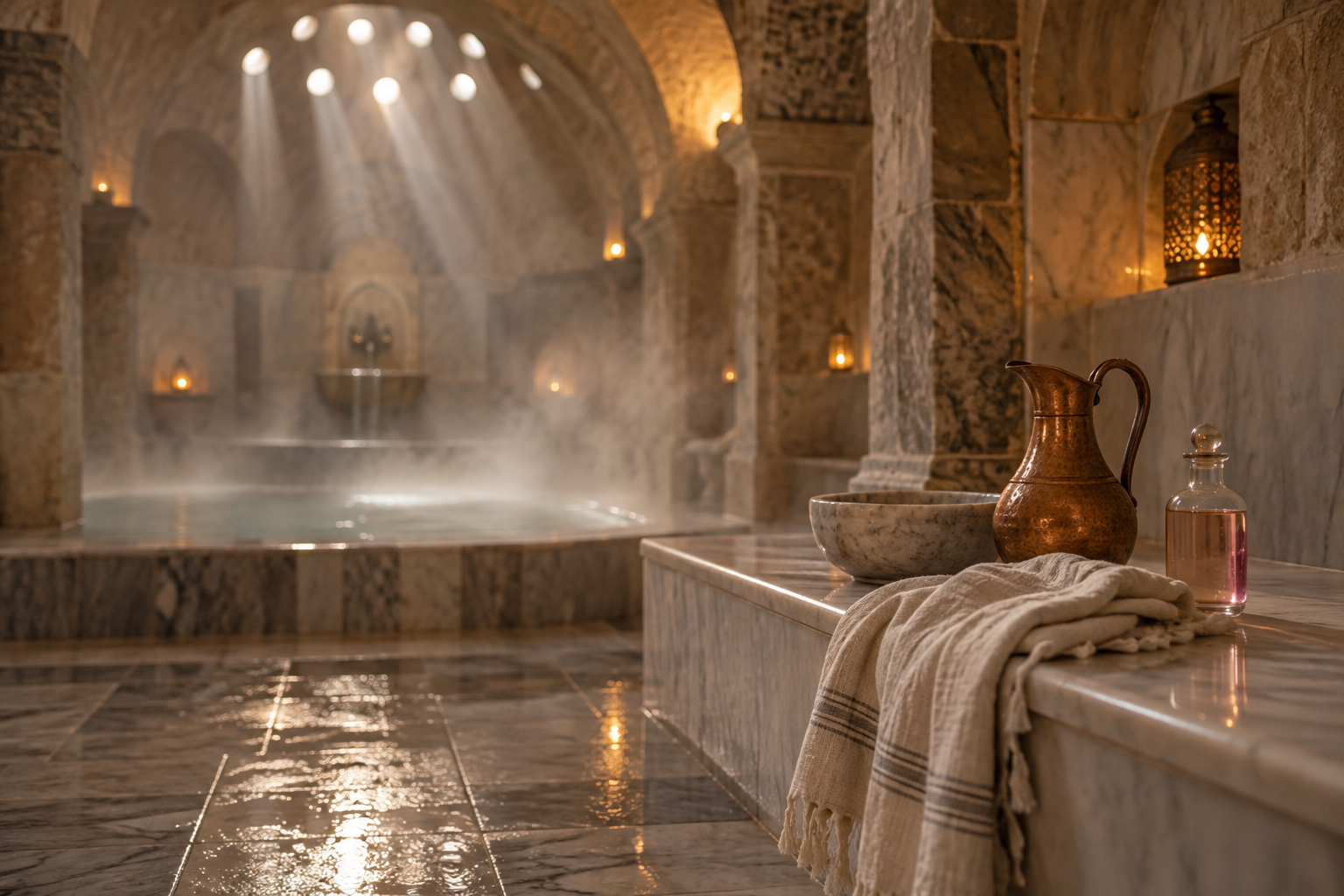
The second pillar was cleanliness. Islamic tradition places great emphasis on ritual washing before prayer, so water and washing were part of everyday life. In cities from Damascus to Isfahan, public baths called hammams operated, continuing the tradition of Roman and Byzantine baths. A visit had its order:
- gradual transition from a lukewarm room to a hot, steamy one,
- thorough scrubbing of the skin and washing of the hair,
- rest in a cooler room, often accompanied by conversation and refreshments,
- final refreshment with fragrant water or oil.
Thus, baths were not just hygienic facilities but also meeting places where news was discussed and deals were made.
Rose Water in Everyday Life
Rose water and fragrant oils accompanied households at every step. According to custom, guests were offered it to wash their hands after a meal, rooms were sprinkled with it during celebrations, and fragrant oils were rubbed into hair and beards. Chroniclers mention that after 1187, Sultan Saladin traditionally had the sanctuaries of Jerusalem washed with rose water – a gesture that shows how strongly it was associated with the idea of purity and respect.
In much of contemporary Europe, the situation was different. Baths existed there too, but the knowledge of distilled fragrant waters and sophisticated pharmacy was preserved mainly in monastic gardens and libraries. This difference later explains why Europeans received Arab knowledge with such interest.
Return to Europe: Andalusia, Sicily, Crusades
While distillation workshops and medical writings were emerging in Baghdad and Persian cities, Latin Europe had limited access to ancient knowledge. The path back wasn't through a single gateway, but several – through the Iberian Peninsula, Sicily, and the Levant, where the Crusades headed from the end of the 11th century.
Córdoba and Toledo: Libraries that Changed Language
In Muslim Andalusia, Córdoba in the 10th century was one of the largest and most educated cities of the time. According to tradition, as early as the 9th century, the musician Zirjáb brought court fashion, grooming, and a love for fragrant preparations from Baghdad. Gardens with roses, orange trees, and jasmine were as much a part of the Andalusian cityscape as the baths.
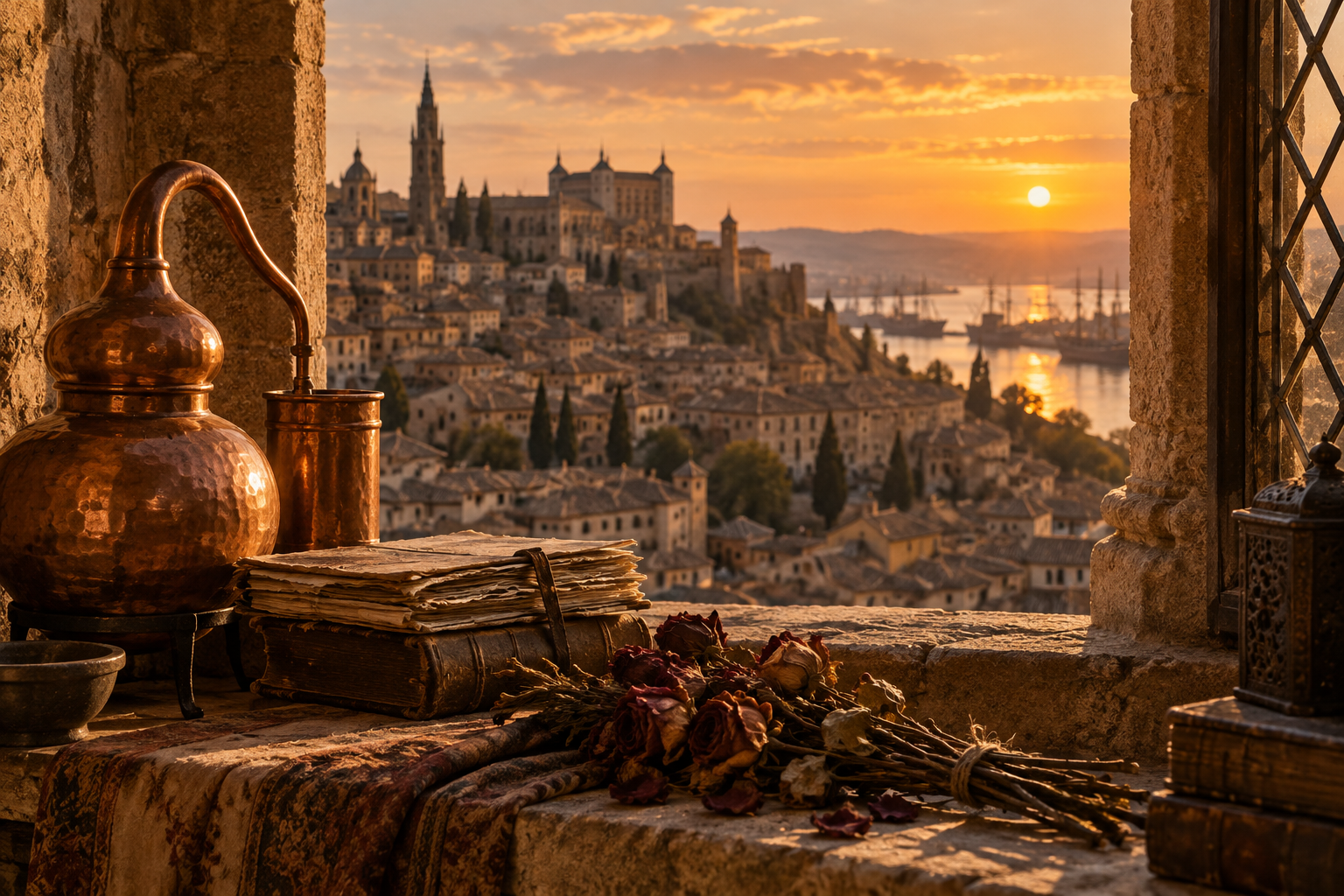
When Toledo fell to the Castilian kingdom in 1085, it retained its Arabic libraries and scholars who knew Arabic, Latin, and Hebrew. In the 12th century, an environment emerged here that is collectively known today as the Toledo School of Translators. Arabic writings on astronomy, mathematics, philosophy, and medicine were translated into Latin here – including Avicenna's Canon of Medicine, which served European universities for centuries. Along with the texts, words also made their way to Europe: alembic, alcohol, and elixir all have Arabic origins.
Norman Sicily and Trade through Venice
The second gateway was Sicily. The island was under Arab rule for approximately two centuries, and the Norman rulers who took over in the 11th century did not sweep away the Arab culture. At the court in Palermo, Latin, Greek, and Arabic scholars met, and gardens, citrus groves, and irrigation systems remained part of the island's landscape.
The Crusades then opened direct contact for Europeans with the cities of the Levant. Knights, pilgrims, and merchants returned with pepper, cinnamon, cloves, incense, but also with rose water and the custom of perfuming oneself. According to tradition, it was through this route that the Damask rose, whose name refers to Damascus, spread to Europe. The real driving force, however, was trade: Venice, Genoa, and Pisa established permanent connections with the ports of the eastern Mediterranean, and fragrant goods flowed through their warehouses long after the Crusader states had vanished.
What Lives On from the Arab-Persian Heritage
When you hold a bottle of perfume today, you hold a piece of this story. We have chosen three traces that are evident in contemporary perfumery:
- Distillation – the principle of evaporation and condensation is still used today to obtain a large portion of essential oils from flowers, leaves, and wood.
- Rose Essence – the rose remains one of the most valuable raw materials, and rose water is used in skincare and cooking from Morocco to India.
- Tradition of Attars – concentrated oil-based perfumes without alcohol, applied in small amounts directly to the skin, are a living part of Arab perfumery and have been discovered by European fragrance enthusiasts in recent years.
Along with manuscripts and spices, the idea that fragrance is part of a cultivated life also made its way to Europe. How European craftsmen further developed it will be revealed in the 4th part of the series, which will take you to the glove makers of Grasse in the Middle Ages and Renaissance.
Category
Recommended articles
Riiffs Freeze in Flames: Ice and Flames Illuminate Warsaw "Give a girl the right shoes and she can conquer the world!" Marilyn Monroe
